I. INTRODUCTION
According to the Unani system of medicine, the health is a state of body in which there is equilibrium in humors and functions of the body. To maintain the correct humoral balance there is a power of self preservation called "Quwwate Mudabbirahe Badan" (Immunity of body) in the body.
Therefore the aim of the Unani physician is to find out the cause of the underlying disruption of humors, so that it can be corrected and disease can be cured. The temperament of the person is identified and diet/medicine/other recommendations are made that are most suitable for achieving and maintaining health of the particular person.
Sexual function is an important component of quality of life and subjective well being of humans. Human sexuality is a multidimensional phenomenon having biological, psychological, behavioral, clinical, moral and cultural aspects. It has been integral part of all cultures since time immemorial. But no single dimension of sexuality is universally dominant. Every person has sexual feelings, attitude and believes, but everyone's experience is unique because it proceeds through an intentionally personal prospective. The cardinal phases in sexual act in male are desire, erection, penetration and orgasm. The phases of sexual act in females are quite different from male. Usually in medicine and also in cultural aspects, sexuality has been mainly concerned with male sexual desire which increase in proportion to the level of secretion of the sex hormones. Sexual response is triggered by both psychological and physical stimuli. Sexual problems are widespread and adversely effects mood, well being, and inter-personal functioning.
Unani medicine treats sexual debility in its own way and proposes different methods of treatment Ilaj bil Ghiza (Ditotherapy), Ilaj bil Dawa (Pharmacotherapy) and Ilaj bit Tadbeer (Regimental therapy). Therapeutic use of the drugs is based on certain principles. The sexual problems are taken up in individualized way taking into account the entire personality of the patient . Unani medicine has holistic approach towards diagnosis and treatment of sexual dysfunction that is not just confined to inability to perform the sex rather includes loss of libido, erectile dysfunction, ejaculatory insufficiency, an orgasmic state, excessive nocturnal emissions and even infertility in males, which may be due to Zoofe Bah (sexual dysfunction) or Nuqse Mani (seminal defects). It also distinguishes between sexual inadequacy and seminal inadequacy .
In present study an important Unani compound formulation Majoon Aarad Khurma has been modified into granular form using natural sweetening agent Stevia rebaudiana which has sweetening property as well as hypoglycemic activity, the granules of Majoon Aarad Khurma become palatable and will not cause any harm to diabetic patients who are suffering from sexual dysfunction. This study also includes evaluation of physicochemical standards of Majoon Aarad Khurma and granules of Majoon Aarad Khurma and their safety and toxicity study.
II. MATERIAL AND METHODS
According to the protocol of the study "Studies on Majoon Aarad Khurma and its Granules prepared with Stevia, with reference to the Standardization and Toxicity Evaluation" Majoon Aarad Khurma and Granules of Majoon Aarad Khurma was prepared in the laboratory of Dept. of Ilmul Saidla, NIUM.
III. PREPARATION OF MAJOON AARAD KHURMA
All the required ingredients of Majoon Aarad Khurma and Granules of Majoone Aarad Khurma were procured from the raw drug dealers under the supervision of the Guide, and all the raw drugs were identified and authenticated by the expert Dept. of Ilmul Advia, NIUM Bangalore, (Karnataka).
The Majoon Aarad Khurma was prepared as per the formulation mentioned in the National Formulary of Unani Medicine, Part-1, Govt. of India. The composition of Majoone Aarad Khurma is as given below:
| Sl. No. | UNANI NAME | BOTANICAL NAME | PART USED | QUANTITY |
| 1 | Khurma | Phoenix dactylifera | Fruit | 200gm |
| 2 | Samagh arbi | Acacia arabica | Gum | 200gm |
| 3 | Singhara khushk | Trapa bispinosa | Fruit | 200gm |
| 4 | Satawar | Asparagus rasemosus | Root | 50gm |
| 5 | Jaiphal | Myristica fragrans | Nutmeg | 1.25gm |
| 6 | Javitri | Myristica fragrans | Mace | 1.25gm |
| 7 | Qaranfal | Myrtus caryophyllus | Flower Buds | 2.5gm |
| 8 | Maghaze Badam | Prunus amygdalus | Fruit | 25gm |
| 9 | Maghaze Chilghoza | Pinus gerardiana | Fruit | 25gm |
| 10 | Maghaze Fundaq | Corylus avellana | Fruit | 25gm |
| 11 | Maghaze Pambadana | Gossypium herbaceum | Fruit | 5gm |
| 12 | Qand safaid | Sugar | Sugarcane | 1kg |
The dried raw drugs from 2-7 mentioned in table were powdered in mixer and sieved in (sieve number 80), raw drugs from 8-11 were powdered separately and sieved in (sieve number 40), and dates were separately dried in a hot air oven at C for 4 hours then powdered and passed through (sieve number 60). Qiwam was prepared according to method mentioned in Formulary with 1 kilo sugar and 600 ml water; the dried drugs were mixed one by one in the Qiwam and stirred slowly. Finally all the Maghaziyat (Kernels) 8-11 were mixed gradually in the Qiwam. And stored in a container at room temperature for further study .
IV. PREPARATION OF GRANULES OF MAJOON AARAD KHURMA
The granule of Majoon Aarad Khurma was prepared as per the formulation mentioned in the National Formulary of Unani Medicine, Part-1, Govt. of India, the composition of granules of Majoon Aarad Khurma is as given below:
| Sl. No. | UNANI NAME | BOTANICAL NAME | PART USED | QUANTITY |
| 1 | Khurma | Phoenix dactylifera | Fruit | 200gm |
| 2 | Kamagh arbi | Acacia arabica | Gum | 200gm |
| 3 | Singhara khushk | Trapa bispinosa | Fruit | 200gm |
| 4 | Satawar | Asparagus rasemosus | Root | 50gm |
| 5 | Jaiphal | Myristica fragrans | Nutmeg | 1.25gm |
| 6 | Javitri | Myristica fragrans | Mace | 1.25gm |
| 7 | Qaranfal | Myrtus caryophyllus | Fruit | 2.5gm |
| 8 | Maghaze Badam | Prunus amygdalus | Fruit | 25gm |
| 9 | Maghaze Chilghoza | Pinus gerardiana | Fruit | 25gm |
| 10 | Maghaze Fundaq | Corylus avellana | Fruit | 25gm |
| 11 | Maghaze Pambadana | Gossypium herbaceum | Fruit | 5gm |
| 12 | Stevia plant powder | Stevia rebaudeana | leaves | 3.50gm |
All the dried ingredients were powdered and sieved in (sieve number 80). All the Maghaziyat (kernels) were powdered separately and sieved in (sieve number 40), and dates were separately dried in a hot air oven at 100 °C for 4 hours and then powdered and passed through sieve number 60. Stevia plant extract was prepared with 120 ml water at low temperature for 15 minutes, and sieved through muslin cloth, the total quantity of this extract obtained was 80 ml. All the dried drugs were mixed one by one in Stevia extract, and subjected into the granulator (sieve number 20) for formation of granules and then stored in container at room temperature for further study .
V. ACUTE TOXICITY STUDY
a) Experimental Animal
Swiss mice of both sexes, weighing 25-35 gm were used. The animals were procured from the, Sri Raghvendra Enterprises, Vijayanagar, Bangalore, Karnataka (India).
Prior to the experiment the animals were allowed to acclimatized for at least one week. They were maintained under standard laboratory conditions throughout the experimental period and were provided with standard diet and water ad libitum unless stated otherwise. They were housed in clean polypropylene cages at room temperature , humidity at 45-55% with 12 hours light: 12 hours dark cycle. The animal care procedures and experimental protocol were in according with the guidelines of CPCSEA.
b) Extractive Values
For the determination of extractive values in non-successive of GMAK was carried out in Soxhlet apparatus, with hydro-alcoholic solvents i.e. 50% distilled water and 50% ethanol (1:1) ratio.
c) Methodology for Acute Toxicity Study
Acute toxicity test was performed according to the World Health Organization (WHO) guideline (WHO 2000) and the Organization of Economic Co-operation and Development (OECD) guideline for testing of chemicals 420 (OECD 2001). Swiss mice of either sex weighing 25-35 gram were randomly assigned to four groups (I, II, III, & IV,) of 7 mice each. Mice were fasted overnight (12 hrs) with free access to water prior to administration of single doses (0.398, 5.73, 9.73, & 16.69 g/kg b.wt.). The extract dissolved in distilled water and administered orally once a day. After the administration of the test drug all the animals were kept in polypropylene cages singly and were observed for Gross behaviour and mortality at 0 min, 30 min, 60 min, 120 min, 240 min and 24 hrs. The Gross behavioural changes such as piloerection, grooming, trembling, wriggling, diarrhoea, breathing difficulty, constant changing position, immobility, asthenia, anorexia, ataxia, urination and syncope were monitored continuously for any above abnormal changes.
VI. PHYSICO-CHEMICAL EVALUATION
The Physico-Chemical studies were carried out on Majoon Aarad Khurma and Granules of Majoon Aarad Khurma in the laboratory of Dept of Ilmul Saidla, NIUM, Bangalore. Majoon Aarad Khurma and Granules of Majoon Aarad Khurma were prepared and subjected to Physico-Chemical evaluation under the following parameters:
(1) Organoleptic properties such as the appearance, colour, smell, and taste (2) Alcohol soluble matter and Water soluble matter (3) Successive extractive values (4) PH value (5) Bulk density and Tapped density (6) Ash value (7) Volatile oil (8) Saponification value (9) lodine value (10) Acid value (11) Estimation of total Alkaloids (12) Resin (13) Reducing and non-Reducing sugars (14) Crude fibers (15) Thin layer chromatography (TLC) was also conducted for identification of compounds.
VII. RESULTS AND OBSERVATION
Both the test drugs sample Majoon Aarad Khurma and granules of Majoon Aarad Khurma were evaluated for physico-chemical parameters as recommended and almost all the values of both the test drugs were found within the standard limits.
| Sl. No | Physico Chemical Properties | MAK | GMAK |
| 1. | Organoleptic Properties | ||
| Apearance | Semi Solid | Granules | |
| Odour | Brownish | Brownish | |
| Smell | Pleasant | Pleasant | |
| Taste | Sweet | Sweet | |
| 2. | Alcohol Soluble Matter | 65.5% | 24.6% |
| 3. | Water Soluble Matter | 46.5% | 36.6% |
| 4. | Successive Extractives | ||
| Petroleum Ether | 2.4% | 4.2% | |
| Chloroform | 0.4% | 0.6% | |
| Ethyl Alcohol | 41.7% | 19.13% | |
| Aqueous | 35% | 37.2 | |
| 5. | PH Value | ||
| 1% | 4.90 | 5.82 | |
| 10% | 4.32 | 5.27 | |
| 6. | Ash Value | ||
| Total Ash | 0.66% | 2.5% | |
| Acid Insoluble Ash | 0.66% | 0.66% | |
| Water Soluble Ash | 1.33% | 1.16% | |
| 7. | Bulk Density | 0.6gm/ml | |
| Tapped Density | 0.68gm/ml | ||
| Carr's Index | 12% | ||
| Hausner Ratio | 1.13 | ||
| 8. | Volatile oils Traces | 0.1% | 0.1% |
| 9. | Saponification Value | 680.13 | 77.07 |
| 10. | Iodine Value | 4.29 | 1.14 |
| 11. | Acid Value | 4.21 | 2.80 |
| 12. | Alkaloids Total | 0.13% | 3.52% |
| 13. | Resin Estimation | 15.1% | 37.2% |
| 14. | Determination of Resin | 15.2% | 37.2% |
| 15. | Reducing sugar | 9.2% | 15.6% |
| 16. | Non-Reducing sugar | 32.11% | 24.2% |
| 17. | Crude Fibers | 1.13% | 2.62% |
| 18. | TLC | 0.27 | 0.31 |
| Rf Values | 0.31 | 0.36 | |
| 0.50 | 0.50 | ||
| 0.68 | |||
| 0.75 |
VIII. CHEMICAL EVALUATION
a) Thin Layer Chromatography:
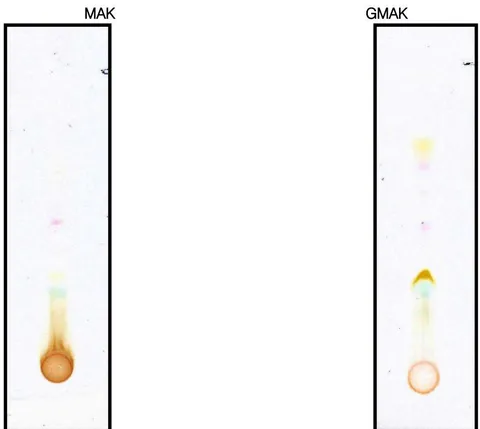
Thin layer chromatography was carried out on T.L.C. pre coated aluminium plates, silica gel 60 F 254 (layer thickness 0.25 mm) for ethanolic extract of both the test drug samples MAK and GMAK in various mobile phases, later sprayed by different spraying reagents to visualise the spots. The values of the spots were calculated for both the drugs by the following formula.
| Extract | Solvent System | No. of Spots | Value | Colours |
| MAKEthanol | Toluene: Ethyl acetate (7:3, with 2 drop Sulphuric acid) | 3 | 0.27 | Green |
| 0.31 | Yellow | |||
| 0.50 | Pink | |||
| GMAKEthanol | Toluene: Ethyl acetate(7:3, with 2 drop Sulphuric acid) | 5 | 0.31 | Green |
| 0.36 | Brown | |||
| 0.50 | Light Pink | |||
| 0.68 | Pink | |||
| 0.75 | Yellow |
b) Acute Toxicity Study
The acute toxicity study was done on Swiss mice of either sex using Hydro-Alcoholic extract of granules of Majoon Aarad Khurma orally, no behavioural changes and mortality was found during 24 hours observation period.
IX. DISCUSSION
Majoon Aarad Khurma is one such popular drug which is widely used as an effective aphrodisiac, which is prepared with sugar as base but as we know that the intake of sugar is not advisable in diabetic patients because the presence of sugar in large amount in blood may develop the complications of diabetes more rapidly so any preparation having sugar as a base or content may create such risk. So even after gaining such popularity as an aphrodisiac, Majoon Aarad Khurma cannot be given to diabetic patients who are suffering from erectile dysfunction. Hence sugar free an alternate formulation should be innovated or designed to meet the demand of the diabetic patients.
X. CONCLUSION
The Physicochemical standards for scientific evaluation of Majoon Aarad Khurma and granules of Majoon Aarad Khurma were estimated and the standards were evaluated as recommended by CCRUM.
Based on the finding it is concluded that
➢ Granules possessed the same principles and maintained same characteristics as traditional dosage form Majoon Aarad Khurma.
The granules of Majoon Aarad Khurma were found to be more stable, convenient and comfortable in usage and dispensing, and also safe, light, efficacious, cost effective and quality controlled.
Stevia a natural sweetening agent which was used as base for granules was evaluated for its toxicity in animal models and no toxicity was found, hence Stevia can be used as safe and efficacious sweetening agent in preparation of granules as well as in other Unani formulations.