I. INTRODUCTION
The Order Zingiberales consists of 8 family members which include Costaceae which has distinct aerial shoot that have characteristic monostichous phyllotaxy (1). The non-aromatic vegetative body, spirally arranged leaves and anther appendages to separate the Costaceae from Zingiberaceae. Costus lucanusianus is commonly called Bush cane, in Ijaw and Nembe it is referred to as Ogbodoin and Ogbodain, in Ikwerre it is called Opete and in Efik it is known as Mbritem (2). Costus is the largest genus in the family Costaceae with about 150 species which are mainly tropical in terms of distribution (3 and 4). There are about 4 genera in Costaceae (5).Costus lucanusianus has the calyx-tube longer than the bracts and often densely puberulous, leaf sheaths have long bristly rim below the apex and inflorescence globose as markedly differentiated from other species of Costus (6). The sap is used to relieve malaria attack by the Ijaw people and occasionally chewed to quench thirst (2). In Ikwerre ethnicity, it is administered to reduce the severity of snake bites. It is used in Southern Ivory Coast for anti-abortive activities(7). A decoction of the stem sap is used as eye wash and for treatment of early eye diseases.
Considering The justification focuses on the fact that Costus lucanusianus is used variously in treating different diseases, It is observed that the herb contains sodium chloride (NaCl), Sodium hydroxide (NaOH) and lots more which are very important industrial and domestic compounds, it is therefore necessary to consider Taxonomic lines of evidence as concerns this plant, hence the objectives focus on morphological, anatomical and phytochemical characteristics on Costus lucanusianus J. Braun & K. Schum. belonging to the family Costaceae.
II. MATERIALS AND METHODS
a) Geographic Location
b) Morphological Studies
The meter rule was used to measure the plant height, starting from the root-collar to the terminal bud while leaf length from the leaf tip to the petiole base. The leaf width is measured across the leaf lamina, from one margin to another at the widest point on it.
c) Micro-morphological Studies
Harvested leaves and young stem for this study were peeled and subjected to alcohol solutions in the ratio of 50%, 75% and absolute alcohol respectively following the method of (8). The cleared epidermal layers were stained with safranin for 5 minutes, washed and counter stained with Alcian blue for the same time interval, rinsed and temporarily mounted in aqueous glycerol solution. Photomicrographs were taken from good preparations.
d) Anatomical Study
The plant grew in the wild. The harvested stems, leaves, petioles, flowers, fruits and roots were dehydrated in alcohol solutions of 50%, 75%, absolute alcohol and thereafter subjected to alcohol chloroform series in the ratio of 3:1 of alcohol chloroform series, 1:1, 1:3 and pure chloroform following the method of (9) modified. Free hand section was done using a systematic arrangement of 5 razor blades as described by (10) was adopted. Microphotographs were taken from good preparations using Sony camera of 7.2 Mega pixels having 2.411 LCD monitor and High sensitivity ISO 1250.
e) Phytochemical Study
The leaves of Costus lucanusianus studied were sun dried for 72 hours (3 days) and weighed. Fifty grammes (50g) of the dried leaves were macerated in 96% ethanol with the aid of a pestle and mortar. The extract was thereafter filtered and evaporated to dryness (constant weight) using a rotary evaporator set at C. Residue yields were noted and used for the phytochemical screening.
f) Test for alkaloids
This was done using 0.5g of the plant extract stirred with 5ml of 1% aqueous hydrochloric acid on a steam bath; 1ml of the filtrate was treated with a few drops of Mayer's reagent and a second 1ml portion was treated similarly with Dragendorff's reagent. The third 1ml was treated with Wagner's reagent. Turbidity or precipitation with any of these reagents was taken as preliminary evidence for the presence of alkaloids in the extract being evaluated (11 and 12). A modified form of the thin-layer chromatography (TLC) method as described by (13) was used. One gramme (1g) of the extract was treated with 40% calcium hydroxide solution until the extract was distinctly alkaline to litmus paper, and then extracted twice with 10ml portions of chloroform. The extracts were combined and concentrated to 5ml. The chloroform extract was then spotted on thin-layer plates. Four different solvent systems were used to develop each plant extract. The presence of alkaloids in the developed chromatograms was detected by spraying the chromatograms with freshly prepared Dragendorff's spray reagent. A positive reaction on the chromatograms (indicated by an orange or darker colored spot against a pale yellow background) was confirmatory evidence that the plant extract contained alkaloid.
g) Test for tannins
i. Ferric chloride test (FeCl )
5g of the pulverized sample was boiled in 5ml of distilled water for 5minutes on water bath. This was filtered while hot. 1ml of 5% FeCl was added to the filtrate and observed. Blue-black, green or blue-green precipitate was taken as the presence of tannins (14)
h) Test for anthraquinones
Born trager's test was used. Five grammes (5g) of each plant extract were shaken with 10ml benzene, filtered and 5ml of ammonia solution added to the filtrate. The mixture was shaken and the presence of a pink, red, or violet color in the ammonia (lower) phase indicated the presence of free hydroxyanthraquinones.
i) Test for combined anthraquinones
Five grammes (5g) of each plant extract was boiled with 10ml aqueous sulphuric acid and filtered while hot. The filtrate was shaken with 5ml of benzene, the benzene layer separated and half its own volume of 10% ammonia solution added. A pink, red or violet coloration in the ammonia phase (lower layer) indicated presence of anthraquinone derivatives in the extract (12).
j) Test for phlobatannins
The deposition of a red precipitate when an aqueous extract of the plant part was boiled with 1% aqueous hydrochloric acid was taken as evidence for the presence of phlobatannins(12).
k) Test for cardiac glycosides
Lieberman's test was used in which 0.5g of the extract was dissolved in 2ml of acetic anhydride and cooled in ice. One milliliter (1ml) of Sulphuric acid was carefully added in drops until a color change from violet to blue to green indicated the presence of a steroidal aglycone portion of the cardiac glycoside (14).
i) Test for Saponins
Frothing tests was done following the method described by (15). The ability of saponins to produce frothing in aqueous solution and to haemolyse red blood cells was used as screening test for these compounds. 0.5g of the plant extract was shaken with water in a test tube. Frothing which persisted on warming was taken as preliminary evidence for the presence of saponins. The disc was then washed in ether, dried and placed on a 7% blood nutrient agar. Complete haemolysis of red blood cells around the disc after 6 hours was taken as further evidence of presence of saponins. (15)
III. RESULTS
a) The Geographic location
The geographic location of the parent plant is University of Port Harcourt, Port Harcourt, Rivers State, Nigeria.
b) Morphological Study
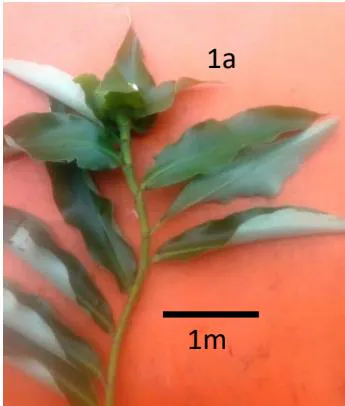
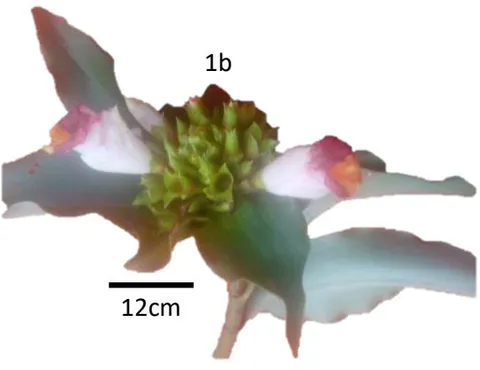
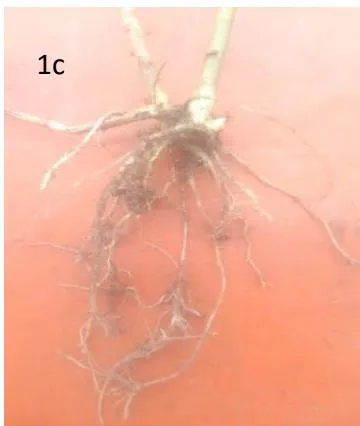
Costus lucanusianus J. Braun & Schum. is a perennial herb which grows up to 3 m in height with no branches hence growth is monopodia in nature. Figure 1a, b, c and d. The glabrous stem is cylindrical, greenish, masked with brown leaf sheaths and hairs observed around the petiole base. The petiolate leaves are lanceolate and large in spiral phyllotaxy measuring up to cm long and cm wide. Region of leaf blade is hairy and leaf apex is acute. Flowers are in terminal clusters with cymose inflorescence. The corolla is whitish with pinkish lips and deep yellowish tube or throat. Creeping rhizomes are present with fibrous root system.
| Characters | |
| Habit | Evergreen herb. |
| Duration | perennial |
| Root | Fibrous Root system from rhizomes |
| Stem Description | Greenish to brownish, fleshy edible herbs |
| Leaf type | Simple lanceolate with acute apex |
| Leaf organization | Simple and petiolate |
| Phyllotaxy | Spiral arrangement |
| Leaf outline or shape | About three times as long as wide, lanceolate with acute apex and cuneate base. |
| Leaf margin | Even or smooth |
| Length of leaf (cm) | about 25 cm long |
| Range | 15 to 35 cm long |
| Mean | 25 ± 10 cm long |
| Breadth of leaf (cm) | 8 cm wide |
| Range | 3 cm to 12 cm wide |
| Mean | 7 ± 4cm wide |
| Flower description | Flowers are terminal clusters with cymose in florescenceon capitulum |
c) Epidermal Study
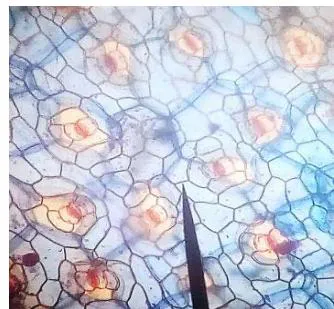
Epidermal studies revealed tetracyticstomata which are amphistomatics and epidermal cells are in polygonal in shape. Lower epidermis has more stomata than the upper one. See plates 2a and2b.
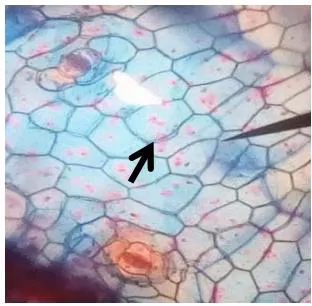
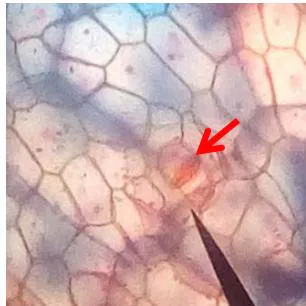
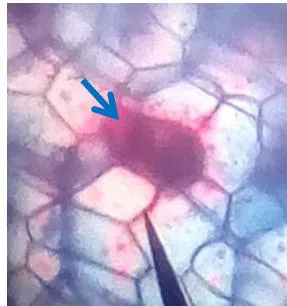
d) Anatomical Study
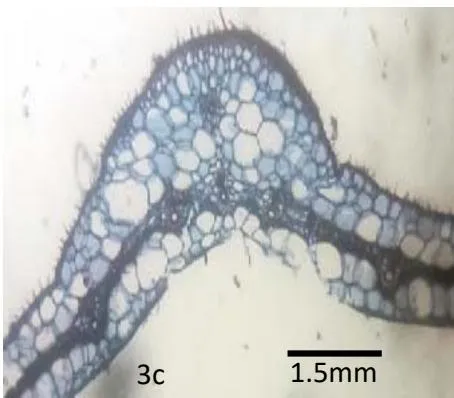
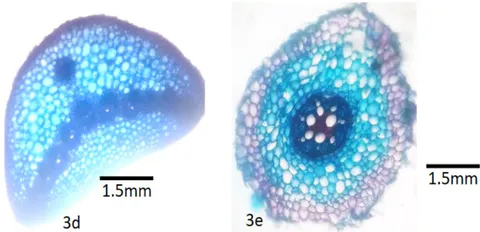
Anatomical study showed circular sections of spiral leaves with numerous scattered vascular bundles in the main stem, mid-ribs and root, but absence of pith in the stem while the root anatomy has large central pith.
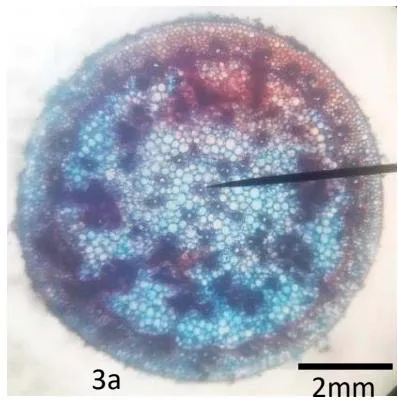
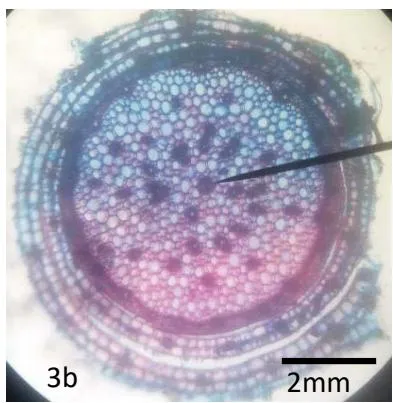
Plates 3a, 3b, 3c, 3d, 3e and 3f. The hypodermis is preoccupied with sclerenchyma and vasculation is closed type. Parenchyma occupied the ground meristem. Pith observed in the root section surrounded with large vessels in ring form at pith region.
IV. PHYTOCHEMICAL STUDY
Phytochemical investigation revealed presence of flavonoids, terpenoids, steroids, fixed oil, cardenolide and saponins. See table 1.
| Phytochemicals | Test methods | Costus lucansianus |
| Flavonoids | ACIB | + |
| Triterpenoids/Steroids | Lisbermann-Buchard's Test | - |
| Salwoski | + | |
| Cardenolide | Keller Killani | ++ |
| Kedde | ++ | |
| Saponins | Frothing Test | + |
| Emulsion Test | ++ | |
| Alkaloids | Drangerdoffs | - |
| Mayer's | - | |
| Hager's | - | |
| Tannins | - | |
| Cyanogenic glycosides | - |
V. Discussion
The micro-morphological study revealed tetracytic stomata on both sides of the leaf surfaces. Unlike most members of the Order Zingiberales, Costus lucanusianus has non-aromatic characteristics. The description accorded to Costus lucanusianus in this investigation tallied with those of (6) who stated that Costus lucanusianus has the calyx-tube longer than the bracts and often densely puberulous, leaf sheaths have long bristly rim below the apex and inflorescence globose and as differentiated from other species of Costus, The sap is used as remedies to eye infections, anti-snake poisons and used to quench thirst where drinkable water is far-fetched. The absence of tannins and presence of saponins in the stem sap is an indicator of no dyes or staining properties but could be used for soap making, unlike most other members of Zingiberales such as Musa species which have lots of dyes.
VI. CONCLUSION
More research using the rhizomes, roots and fiber content should be encouraged for proper exploitation of the species and extended to other members of the genus Costaceae. The fiber could be good source for paper and thread making.