
I. BACKGROUND
schemic heart diseases and cardiac arrest are a leading cause of death around the world 1. In India, these conditions are the leading cause of death in the country 2. It is estimated, that by 2020, 60% of heart diseases in the world will occur in India 3. Out of hospital cardiac arrests (OHCA) is a global public health issue 4. It is also the leading cause of deaths in India 5. A study conducted in Andhra Pradesh reports that sudden cardiac arrest is the cause of one in 10 recallable deaths 6. It is reported that "chain of survival", which includes an early call for help, early basic life support (BLS), early defibrillator and early advanced cardiac life support greatly increases the chances of survival among patients suffering from OHCA 7,8.
It is estimated that 50,000 deaths can be averted if basic life support (BLS) is performed in case of out of hospital cardiac arrest, especially by bystanders 9. When bystanders initiate early BLS, the survival rate in such cases can double 8. However, studies report that the performance of BLS by laypeople around the world is low. In India, a study by Krishna et al. show that among patients who suffered from OHCA, only 1.3% received BLS by a bystander 5. The survival and neurological outcomes of OHCA depend on the time taken for BLS to be provided to the patient 10. The chance of survival decreases by 10% per minute delay in administering BLS 7. Hence, it is important that OHCA patients receive BLS at the earliest from laypeople who witness it.
Awareness of BLS and training of BLS are two important factors that influence the provision of BLS by laypeople. Awareness of life-saving skills, such as the provision of basic life support (BLS) among the general population is important 5,9,11,12. The levels of awareness of BLS among the general population differed around the world. Studies from the United States of America 13, Portugal 14, China 15 report a high level of awareness among the general population about basic life-saving skills. However, studies from countries such as Saudi Arabia 16, Jordan 9 and Turkey 17 report low awareness of basic life-saving skills. The sources of knowledge about BLS included schools, universities, workplaces, television and internet 9. In India, the level of awareness of BLS among medical students has been reported to be low by various studies 12,18–20.
Along with awareness, to increase the confidence of people to apply BLS techniques in the emergency following an OHCA, training is essential. Training in BLS has also shown to increase willingness to provide life support to strangers during emergency 4. BLS training rates vary across communities according to the policies in place. The various training rates reported are 79% in Washington, 26% in China, 40% in Turkey, and 35% in Japan 10,13,15,21. In India, most studies among medical interns and nursing students have reported a low level of BLS skills among these groups
12,18–20. To our knowledge, very few studies report on the level of perceived skills and training among the general population. Hence, we conducted a study to assess the awareness and knowledge of basic life support (BLS) and the receipt of BLS training among the general population in Mumbai, India.
II. METHODS
a) Study design
A cross-sectional survey using a structured questionnaire.
b) Setting
The study was conducted in Mumbai, a metropolis with a population of 12.5 million people 22. The emergency medical systems in the city consist of the public 108 system and scattered private providers 11,23. The study was conducted by Nanavati Super Speciality Hospital, which is a tertiary care hospital, with a well-equipped emergency department 24.
c) Study population
The study recruited participants above 18 years of age. Any person who was willing to participate and could understand English were eligible to participate in the survey. People who were attending or had graduated from medical or paramedical courses, since they have BLS training as part of their curriculum, were excluded from this survey. Any person who met the inclusion criteria and was able to provide informed consent were included in the study.
d) Data collection and tools
Data was collected using a structured questionnaire. The questionnaire had two parts. The first part was designed to collect socio-demographic information. The second part had 10 questions eliciting awareness of participants about basic life support. The questionnaire had one open-ended question asking suggestions to improve the awareness of BLS in society. The questionnaire was prepared and administered in the English language. The questionnaire was shared using Google forms using. The consent form was built into the form which was shared online. Participants could click on the link in the description to access the form. Data was collected in September 2019.
e) Analysis
All responses were downloaded from the Google forms in Microsoft Excel. Data were imported from the excel database into STATA version 15 (Stata Corp, College Station, TX, USA) for analysis. Frequencies and percentages were used for the description of categorical variables and medians with interquartile ranges for continuous variables. A chi-squared test was used to analyze the association between awareness and training with age groups, sex and education.
f) Ethics
Internal Ethics Committee of the Dr. Balabhai Nanavati Hospital, Mumbai approved the study. The informed consent form was the first page of the online survey questionnaire. Participants could only proceed with the survey questionnaire after they accepted the informed consent form.
III. RESULTS
The study included a total of 233 participants. Among the participants, 198 (85.0%) were between the age group of 18-30 years. All participants were educated, with 119 (51.1%) having completed postgraduate/Ph.D. degrees. The socio-demographic characteristics of the participants have been shown in Table 1.
| Characteristic | n (%) |
| Total participants | 233 |
| Age | |
| 18-30 | 198 (85.0) |
| 31-40 | 28 (12.0) |
| >41 years | 7 (3.0) |
| Sex | |
| Male | 61 (26.2) |
| Female | 92 (39.5) |
| Prefer not to reveal | 80 (34.3) |
| Education | |
| Junior college or less | 8 (3.4) |
| Undergraduate | 106 (45.5) |
| Postgraduate /Ph.D. | 119 (51.1) |
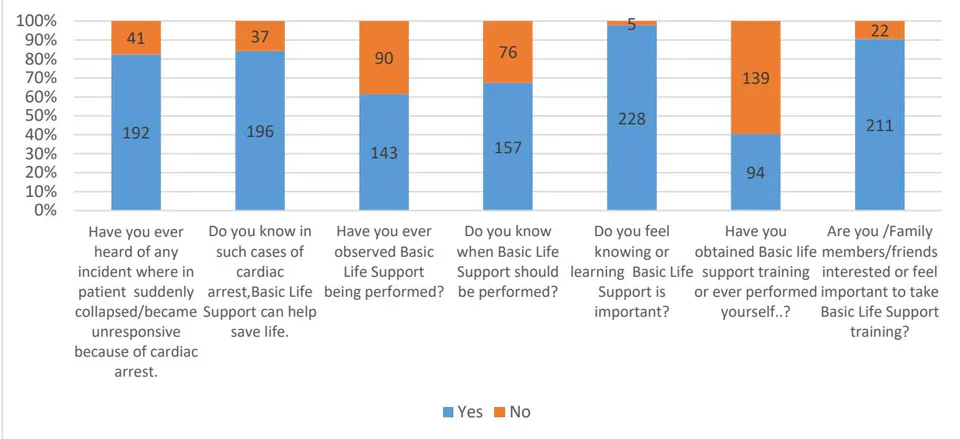
The responses to questions about BLS awareness are summarized in figure 1. Among the survey participants, 192 (82.4%) responded that they had seen a person collapse. In case of coming across with a person who has collapsed, 124 (53.2%) participants said that they would initiate basic life support, 40 (17.2%) would rush the person to a hospital, 34 (14.6%) would call for an ambulance, while 35 (15.0%) said that they would wait for a doctor.
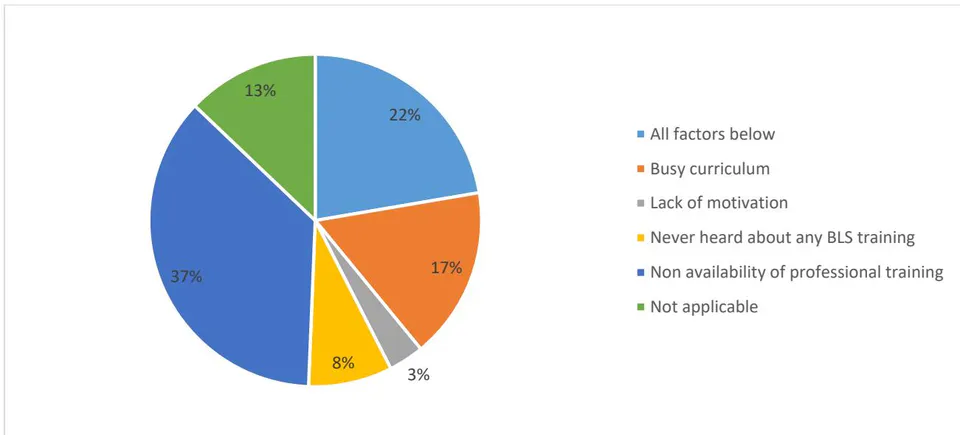
A total of 196 (84.1%) said that they knew that basic life support would be helpful in such a situation, and 157 (67.4%) said that they knew when basic life support should be performed. A total of 143 (61.4%) had seen basic life support being performed. While 228 (97.9%) participants said that they felt that learning how to perform basic life support is necessary and 211 (90.6%) expressed interest in taking the training, only 94 (40.3%) reported ever receiving any training. When asked for reasons for not taking basic life support training, 85 (36.5%) reported unavailability of training. The other responses are detailed in figure 2.
There was no statistically significant difference in awareness and training of BLS with age, sex, or education.
a) Recommendations to improve awareness of BLS
Participants recommended the use of advertisements delivered through social media, internet, and traditional media to improve awareness about basic life support among the general population. Participants also suggested that along with conducting awareness, it is important that people should have easy access to basic life support training. The sites suggested for such training include workplaces, schools and colleges, and residential societies. Hospitals may also conduct BLS training. This training should be conducted ideally free of cost or at reasonable fees so that the masses can access this training. BLS training can be conducted as part of corporate social responsibility initiatives. The training should also be advertised widely so that people can learn about opportunities to access such training.
IV. DISCUSSION
This study shows that a large proportion of the study population (84.1%) was aware of BLS and its applicability in helping patients with sudden cardiac arrests. A large proportion of respondents (82.4%) had seen someone collapse due to sudden cardiac arrest which might be the reason for this high level of awareness. Also, a majority of the participants in this study had a university degree, were young (85% participants in 18-30 years age group), and from an urban area, which might be the factors influencing this high level of awareness.
A large proportion of participants (90.6%) expressed interest in taking up training in basic life support. However, only 40.3% reported taking up any BLS training. This level is similar to those being reported from other developing countries and lower than the high-income countries 7,8,26,9,10,13–16,21,25. Being trained for basic life support skills was not significantly associated with the level of education in our study, which is in contrast to other studies 10. This might be due because most of the participants in this study had completed at least undergraduate level university degrees. Among the reasons for not taking up BLS training, participants reported a lack of awareness about how and where to access such training.
BLS training in many countries is part of the high school curriculum or a requirement for obtaining a drivers' license 10,13. Participants in this study, when asked for suggestions to improve awareness and, training on BLS also said that it is essential to easy access BLS training in the country. Such training can be conducted in high schools as part of the curriculum 5. A study from Punjab, India, demonstrated positive outcomes of conducting BLS training in schools 27. BLS training can also be offered at workplaces by employers to improve the availability, and acceptability of such training. The use of social media platforms and television to spread information about such initiatives is an important suggestion since other studies have reported that these are the main sources of information for people to access information about BLS 9. Costs of training were reported as a major deterrent for undertaking BLS training and the suggestions to include these training under corporate social responsibility initiatives can provide sustainability and stability to such initiatives.
This study was conducted using an online platform, which might have biased the selection of respondents, which is a limitation of this study. Also, the survey was administered only in English, which might have led to only people with a university degree or higher being represented in this study, which might also explain the high levels of awareness that we observe. Due to this, the survey results might not apply to the wider population. Despite of these limitations, the study has certain strengths. The study includes a large sample of urban educated youth, with 85% participants in the age group of 18-30 years, which suggest that this age group can be targeted to provide BLS training with good acceptability of such training initiatives, which is an opportunity worth exploring.
V. CONCLUSION
The level of awareness about basic life support was high among urban, educated residents of Mumbai. However, the level of BLS training among this population was low. As OHCA and ischemic heart diseases become more and more common among the population, it is important to increase the awareness and training of BLS among the population to increase bystander provision of BLS in cases of OHCA, which will help improve outcomes among such patients.