Palavras-chave: formação de professores, infraestrutas didáticas, necessidade praxeológicas do professor. Abstract- The aim of this study is to reflect on teacher training, based essentially on the Didactic Anthropological Theory and on research aimed at studying the praxeological needs of teachers. It is a qualitative study of a theoretical-bibliographical nature, as it produces reflections based on our theoretical framework and research that deals with teacher training in the light of the Didactic Anthropological Theory. Our reflections led us to consider teacher training, didactic infrastructures for teacher training and the praxeological needs of the teacher. In addition, we took as an example one of the episodes from the experimental phase of Lobo's research (2019), which aimed to study the knowledge of plane analytic geometry that can be acquired by students (teacher trainees) from a Mathematics degree course in Bahia (Brazil), participating in supervised curricular internship classes, who were involved in a training process based on a Study and Research Pathway. The aim is to reflect on the complexity of building teaching praxeologies.
## I. INTRODUCTION
Teacher training is one of the crucial problems faced by training institutions and researchers in mathematics didactics. Generally, it is concerned with specific aspects, and some official documents confirm the need for research in this area, due to the gap between what we want teaching to be and how it is carried out (Andre, 2001). In this direction, the Referentials for teacher training state that:
[...] despite the commitment of many and the progress of the experiments already carried out, there is a huge gap - and not just in Brazil - between the knowledge and actions of the majority of teachers in practice and the new conceptions of teacher work that these movements have been producing. It is therefore a question not just of doing training better, but of doing it differently. These changes require, among other things, that teachers reconstruct their practices and, to do this, it is necessary to "build bridges" between the reality of their work and what is targeted. (Brasil, 1999, p. 16).
As this statement alludes to practicing teachers, it refers to a special type of training, continuing education, which is now considered essential for classroom teachers, both to update their knowledge and techniques in the specific area they teach, and to develop skills and attitudes. It also suggests that the concept of teacher training should be questioned, because it can be conceived in different ways, considering the objectives, content and methods.
In order to analyze and interpret the findings from the teacher's practices and their student's learning activities, an appropriate theoretical framework and methodology must be used. Figure 1 presents a structure that maps out the paths to be taken in order to read the reality of the mathematics classroom.
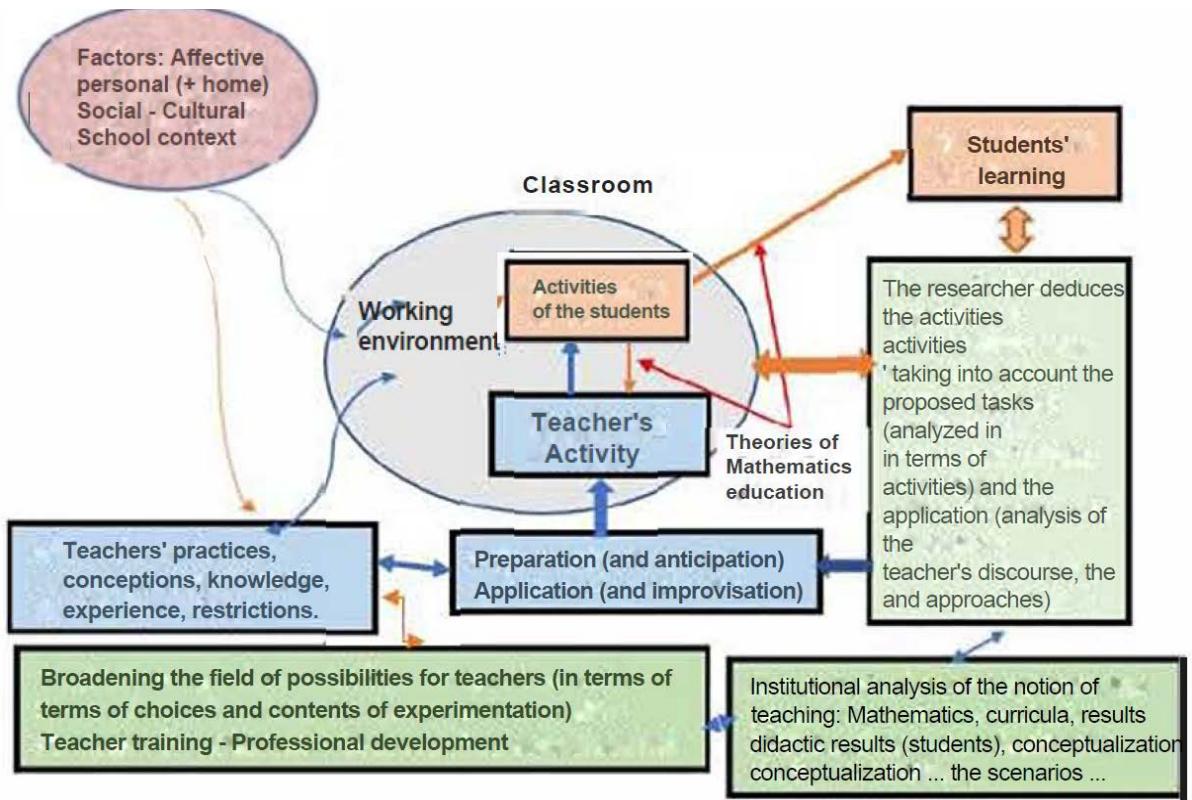
Source: Adapted from Abboud-Blanchard, Robert, Rogalski & Vandebrouck (2017, p.11). Figure 1: Classroom reading grid
The scheme (Figure 1) allows us to study and understand students' mathematical learning in the context of the teaching they receive at school, but also elements of the teacher's practice. It is therefore necessary to study students' (mathematical) activities in the classroom, what they do (or don't do), what they say (or don't say), what they write (or don't write), even if we can only collect traces of them, because what they think remains unobservable (Abboud-Blanchard et al., 2017). This requires choosing an appropriate theoretical framework for studying students in situations, distinguishing between tasks and activities, and focusing the study on learning.
We understand that knowing, as a personal construction, does not only occur cognitively; it is necessary for the subject to identify with what they learn so that they can give their own meaning to the relationship they build with knowing. Learning takes on an active meaning for the individual and is linked to the moment and situation in which the learning takes place. In this way, the object of analysis - when studying learning processes - should be the relationships in which subjects engage with knowing. In other words, to question this set of relationships with knowing, is to be interested in the process in which the subject is integrated into their environment.
As for theories of Mathematics Education, it is important to use them to ensure a certain coherence in the decomposition of the reality involved. Situation theory, for example, can help design situations that are potentially favorable to learning and whose implementation needs to be tested. The didactic variables available to the teacher allow him/her to influence the possible activities of the students. The didactic contract serves to specify the expectations, explicit or not, of the teacher and students towards each other, and highlighting it can help us understand what can distort or reinforce the games in which students are involved (Abboud-Blanchar et al., 2017).
The Anthropological Theory of the Didactic (the theoretical-methodological framework of our study) allows, for example, reference mathematical analyses based on the identification of the praxeologies at play, ranging from the types of tasks and techniques to the technologies in use and the theories in which they are embedded. In addition, the phenomena identified are part of various levels of determination, from the classroom to society (aspects that we will delve into in this text).
In this article, we reflect on the praxeological needs of math teachers from the perspective of the Anthropological Theory of the Didactic (ATD) developed by Chevallard (1999) and collaborators.
Olarría and Sierra (2011, pp. 466-467) state that, in the context of ATD, the profession of math teacher, must be equipped with its own didactic-mathematical resources, which constitute the necessary infrastructure[^1] to deal with the difficulties, problems and challenges that continually arise in teaching and which, due to their complexity, cannot - and should not - be dealt with by the teacher alone. For this reason, the problem of teacher training should be seen as an aspect of one of the "great problems" of didactics: the links between the development of didactic science, the development of the educational system and the training of its agents. This is why the shortcomings of the education system should not be attributed solely to the responsibility of the individual teacher, nor to their level of training.
Therefore, in this text we present some of the constitutive elements of the teacher's praxeological equipment (Chevallard & Cirade, 2010), with a focus on a qualitative study of a theoretical-bibliographical nature, since it produces reflections based on our theoretical framework and research that deals with teacher training.
In terms of the literature review, we relied mainly on Chevallard (1999). Cirade (2019), Wozniak (2020), among other authors. We focused our reflections on the following aspects: mathematical praxeologies, infrastructures for teacher training, and the praxeological needs of the teacher.
In the next section, we present some constructs from ATD that are fundamental to the construction of this text.
## II. ANTHROPOLOGICAL THEORY OF THE DIDACTIC
In the context of this theory, didactics is defined as the science of the conditions and restrictions of the social dissemination of praxeologies: the didactics of mathematics is therefore the science of the conditions and restrictions of the social dissemination of mathematical praxeologies (Chevallard & Cirade, 2010). These authors differentiate between conditions and restrictions: a restriction is a condition considered, from a given institutional position, at a given time, to be non-modifiable. A condition is a constraint considered to be modifiable.
What didactics studied, first and foremost, were the conditions and restrictions created by what Chevallard and Cirade (2010) call the *didactic*, i.e. all the personal or institutional "facts and gestures" inspired by a didactic intention. This intention is intended to ensure that a person or institution complies with a given praxeological content. Didactics has focused mainly on the study of the *didactic* created in the classroom by the teacher. Against this limitation of the field of study, the authors assert that the theory of didactic transposition[^2] highlights the conditions not created by the teacher, which are often constraints for him or her, and, more broadly, the conditions created at other levels of what is known as the scale of levels of didactic codetermination, shown in Figure 2.
The Anthropological Theory of the Didactic (ATD) studies the conditions of possibility and functioning of Didactic Systems, understood as subject-institution-knowing relations (in reference to the didactic system treated by Brousseau (1986), student-teacher-knowing).
Chevallard (1999) asserts that ATD studies man in relation to mathematical knowing, and more specifically, in relation to mathematical situations, and places mathematical activity and, consequently, the study of mathematics within the set of human activities and social institutions.
In ATD, the notions of (types of) task, (type of) technique, technology and theory make it possible to model social practices in general, and particularly mathematical activity, on the basis of three postulates:
1. Every institutional practice can be analyzed, from different points of view and in different ways, in a system of relatively well-defined tasks.
2. The fulfillment of every task derives from the development of a technique
The word technique is used here as a "way of doing" a task, but not necessarily as a structured and methodical or algorithmic procedure.
The institutional relationship that is established between an institution I (student, teacher,...) and an object O depends on the positions they occupy in that institution, and the set of tasks that these people must fulfill using certain techniques. According to Chevallard (1992, p. 86),
An object exists from the moment that a person X or an institution I recognizes it as existing (for them). More precisely, we can say that the object O exists for X (respectively for I) if there is an object, which I will denote by R(X, O) (respectively $\mathbb{R}_\mathrm{I}(\mathbb{O})$ ), which I will call X's personal relationship with O (respectively I's institutional relationship with O).
Tasks are identified by an action verb, which alone would characterize a task genre, for example: calculate, decompose, solve, add, which do not define the content under study. On the other hand, "solving a fractional equation" or "decomposing a rational fraction into simple elements" characterize types of tasks in which certain tasks are found, such as "solving the equation $x + 2 = 0$ " or "decomposing the fraction $7/9$ into simpler fractions" (Silva, 2005).
For a given task, there is usually one technique or a limited number of techniques recognized in the institution that problematized that task, although there may be alternative techniques in other institutions. Most institutional tasks become routine when they no longer present any problems. This means that in order to produce techniques, you need to have an effectively problematic task that stimulates the development of at least one technique to answer the questions posed by the task. The techniques produced in this way are then organized so that they function regularly in the institution.
These two postulates result in a "practical-technical" block made up of a type of task and a technique that can be identified in everyday language as "know-how to do". (Chevallard, 2002a, p. 3)
The third postulate to be stated refers to the ecology of tasks:
3. The ecology of tasks, in other words, the conditions and constraints that allow them to be produced and used in institutions. Thus,
[...] the ecology of tasks and techniques are the conditions and restrictions that allow them to be produced and used in institutions and it is assumed that, in order to exist in an institution, a technique must be understandable, legible and justified [...] this ecological need implies the existence of a descriptive and justificatory discourse of tasks and techniques that we call the technology of technique. This postulate also implies that every technology needs a justification which we call the theory of technique and which constitutes its ultimate foundation (Bosch; Chevallard, 1999, pp. 85-86).
It is assumed that in order to exist in an institution, a technique must at least be comprehensible, legible and justified, which would be a minimum condition to allow its control and guarantee the effectiveness of the chosen tasks. These ecological conditions and restrictions imply the existence of a discourse that describes and justifies the tasks and techniques that Bosch & Chevallard (1999) call the technology of technique. Every technology also needs a justification, which they call the theory of technology.
A complex of techniques, technologies and theories organized around a type of task forms a praxeological organization (or praxeology) (Bosch & Chevallard, 1999). A set of techniques, technologies and theories The word praxeology is formed by two Greek terms, praxis and logos, which mean practice and reason respectively. It refers to the fact that in an institution, a human practice is always accompanied by a more or less developed discourse of a logos that justifies it, accompanies it and gives it reason.
The praxeology associated with a knowing is the combination of two blocks: knowing-how to do (technical/practical) and knowing (technological/theoretical), whose ecology refers to the conditions of its construction and life in the educational institutions that produce, use or transpose it. The conditions for the "survival" of knowing and doing are considered here in analogy to an ecological study: what is the habitat? What is the niche? What role does this knowing or know-how play in the "food chain"? These answers help us understand the mathematical organization determined by a praxeology.
Chevallard (1999) observes that the praxeologies (or organizations) associated with mathematical knowing are of two kinds: mathematical and didactic. Mathematical organizations refer to the mathematical reality that can be constructed to be developed in a classroom and didactic organizations refer to the way in which this construction is carried out; thus, there is a relationship between the two types of organization that Chevallard (2002a) defines as the phenomenon of codetermination between mathematical and didactic organizations.
In a process of knowing/knowledge formation, praxeologies age because their theoretical and technological components lose their credibility. Constantly, new praxeologies emerge in a given institution I that can be produced or reproduced if they exist in any institution I'. The passage from the praxeology of institution I to that of institution I' is called Transposition by Chevallard (2002b), more specifically, Didactic Transposition, when the target institution is an educational institution (school, class, etc.).
In the next section, we present some reflections from research in mathematics. Didactics on teaching practices, the conditions and constraints related to these practices, and teacher training.
## III. TEACHING INFRASTRUCTURES FOR TEACHER TRAINING
Cirade (2019, p. 341) identifies some difficulties encountered by trainers in the exercise of their profession. The author observes that "a difficulty having been recognized by a person or an institution $\xi$, can be transmuted, for a person or an institution $\xi^{*}$, into the form of a question to be answered and that "the recognition that a difficulty affects the exercise of the profession, its transmutation into a question Q, the construction of an answer R and the control of the validity and value of this answer are by definition the responsibility of the noosphere of the profession" (Chevallard, 2013, p. 88). From this perspective, Chevallard (2011, p. 12) states that.
Given an activity project $\Pi 0$ in which such an institution or person $U_{o}$ plans to get involved, what is, for this institution or person, the praxeological equipment $\{\wp\}$ that can be considered indispensable or simply useful in the conception and realization of this project?
In the case of $U_{0}$ being a teacher training institution and $\Pi_0$ being the teacher training project, the question for Cirade (2019) is to study the praxeologies that are useful or indispensable for the realization of this project, since both the $U_{0}$ institution and the $\Pi 0$ project are decisive in this study. In this didactic institution $U_{0}$, it is a question of establishing teaching praxeologies around a question Q, with students X and study directors Y, in order to constitute a study milieu M and face it in order to produce an answer R' (optimal answer). This system is modeled by the Herbartian scheme, presented here in its semi-developed form:
$$
[S(X;Y;Q)\rightarrow M]\hookrightarrow R^\vee
$$
In the process of studying $Q$, various resources can be mobilized: the resources that make up the "didactic milieu" or milieu for the study (of $Q$ ), M is the set of resources useful for studying the question $Q$, producing the answer $\mathbf{R}^{\vee}$ and validating it. The upward curving arrow $(\rightarrow)$ indicates that it is the didactic system $S(X;Y;Q)$ that constitutes, that "manufactures" this milieu. Therefore,
M is not created in advance; it is created in parallel with the search for answers. The construction of millieu M involves activating gestures in five moments: observing, analyzing, evaluating, developing, disseminating and defending objects, works, resources, information, etc. that can be incorporated, in whole or in part, into the millieu and be an indispensable part of the construction of answer R'. (Chevallard, 2009a, p. 20)
The milieu M can be represented as:
$$
\mathrm {M} = \left\{\mathrm {P} _ {1} ^ {\diamond}, \mathrm {P} _ {2} ^ {\diamond}, \mathrm {P} _ {3} ^ {\diamond}, \dots , \mathrm {P} _ {v} ^ {\diamond}, \Theta_ {v + 1}, \dots \Theta_ {\mu}, O _ {\mu + 1}, \dots O _ {\pi} \right\}.
$$
Thus, the Herbartian scheme developed would be represented as follows:
$$
[S (X; Y; Q) \rightarrow -R_I^c, R_2^\circ, R_3^\circ, \dots, R_n^\circ, Q_{n+1}, \dots Q_m, O_{m+1}, \dots O_p^\prime] \rightarrow R^\vee
$$
Chevallard states that
The elements of $\mathbf{R}_{\mathrm{i}}^{\circ}$ for $\mathrm{i} = 1,\dots,\mathrm{n}$ are the "stamped" answers, "validated" by institutions, for example, the class book, a website, the teacher's course, a lecture note, etc. The elements of $\mathbf{Q}_{\mathrm{j}}$ for $\mathrm{j} = \mathrm{n} + 1,\dots,\mathrm{m}$ are questions derived from Q, i.e. questions formulated by trying to answer Q. The elements of $\mathbf{O}_{\mathrm{i}}$ for $l = m + 1,\dots,p$ are works, theories, experimental set-ups, praxeologies that are believed to be useful for deconstructing the answer R'. (Chevallard, 2009b, pp. 21-22, our translation) From this perspective, adapting it to our study context, we reformulated Cirade's[^3](2019) question as follows: "How can we establish a certain organization of mathematical knowledge in a class at a given level of schooling?" The process of studying this question and its derivative questions allows us to build a milieu of teaching praxeologies, which must be analyzed and evaluated in order to develop teaching products (Cirade, 2019).
The author notes that, for the didactic systems studied in teacher training, a $R_{i}^{\diamond}$ answer could be a lesson report, an extract from a textbook, a teacher's website, etc. It will therefore be necessary to observe, analyze and evaluate the corpus, which can be of a diverse nature; and we can see that, in addition to teaching praxeologies stricto sensu, we are required to integrate corpus study praxeologies into the milieu M: this is an important issue at the training level.
It is always complex to justify to students preparing for the teaching profession the need to carry out mathematical praxeological analysis, as well as didactic praxeological analysis and the relationship between the two (Cirade, 2019). This question concerns the raison d'etre of didactic analysis and how to highlight it. From this perspective, the author notes that it is necessary to carry out a praxeological analysis of the work in terms of the direction of study, which will include identifying the didactic moments of study[^4] and identifying the types of tasks to be studied.
The reasons for a didactic analysis, which should be highlighted in (initial) teacher training, lead to the question of didactic infrastructures in training, in the dual sense of the study (the teaching praxeologies) and the direction of the study (the training praxeologies). For a $\Pi_0$ project, with the aim of encouraging students to engage in work to design mathematical and didactic praxeologies in a scientifically based way, Cirade (2019) identified some conditions under which this project should develop:
- The introduction of the professional gesture in training, with regard to the analysis of corpus data from teaching practice, leads to the introduction of corpus study praxeologies in the M milieu that enable this analysis.
- The question "What mathematical concept should be taught?" can be studied scientifically using the notion of praxeology, which allows us to understand what is proposed in the prescribed/suggested curriculum, what is found in textbooks, etc. The question concerns, in a non-independent way, the four components of praxeology (type of tasks, technique, technology and theory) considered.
Praxeological analysis makes it possible to change the students' relationship with the objects under consideration (the mathematics/statistics to be taught).
Cirade (2019) states that there are many conditions that need to be taken into account when studying a project like II0, such as the primacy given to technology, seen as a producer of techniques, rather than justifying an emerging technique, or the unavailability in the profession of teaching materials for designing collections of study and research activities. The conditions raised above do not exhaust the work to be done to identify the conditions linked to the praxeologies of the study of the corpus, and it would be important to continue exploring other levels of didactic codetermination.
This scale of levels of didactic codetermination (Figure 2) distinguishes, from bottom to top (see Figure 2), the level of the discipline to which the intended praxeological content belongs (mathematics, French grammar, biology, etc.), then the level of pedagogy, then that of the school, as well as that of society and, finally, that of civilization. Contrary to a tradition that saw the pedagogical level (home to the conditions and constraints considered non-specific to a given praxeological content) as the alpha and omega of the ecology of school didactics, didacticians have studied the conditions and constraints at the level of the discipline, sometimes forgetting then the constraints at a higher level, without which many phenomena affecting the dissemination of the discipline cannot be explained (Chevallard & Cirade, 2010).
Each level in Figure 2 imposes, at some point in the life of the educational system, a set of constraints and support points. At the higher levels (Civilization, Society, School and Pedagogy), there are more generic types of constraints, in which society, through educational institutions, organizes the study of different subjects. The lower levels correspond to the conditions and restrictions directly linked to the different components of a discipline, according to the way it is structured in the educational institution in question.
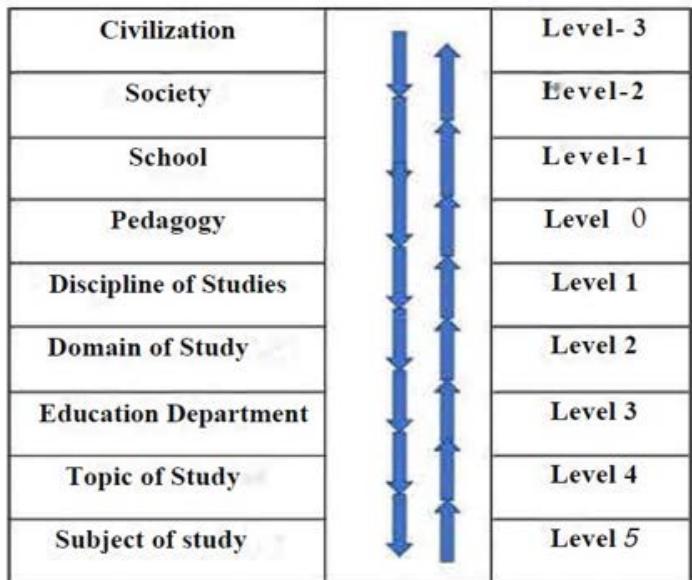 Figure 2: Levels of didactic codetermination
Source: Chevallard (2002b, p.50) To give just one example, at the deepest level of the scale, one can go beyond the theme or subject to explore conditions related to sectors, domains and the discipline itself (mathematics, for example)
Other conditions are very important: the denial of the need for scientifically-based praxeological equipment is, in our opinion, one of the most important restrictions within the scope of such a project, because in the teaching profession, the situation described by Chevallard (1997, p. 23) still seems relevant to us:
the absence of a language that is sufficiently rich and widely shared to allow an objective (and not simply personal) analysis of even the most common professional situations should be noted, resulting in a weak collective and individual capacity to communicate, to debate, to even think about the objects of an activity that easily gets stuck in the repetition of gesture and technical solipsism.
This weighs heavily on teacher training and gives rise to a number of difficulties that trainers encounter, such as justifying to students the need to rely on scientifically based tools. But this is not the only source of these difficulties, which are obviously due to the complexity of the issue at stake in the study of training, i.e. the teaching of praxeologies, but also to the poor development of training praxeologies and therefore the virtual absence of didactic infrastructures for teacher training.
Cirade (2006) distinguishes at least three types of teaching praxeologies directly related to mathematics teacher training: mathematical praxeologies for teaching (mathematical knowledge to be taught), mathematical praxeologies for teaching (mathematical knowledge necessary for teaching, which cannot be reduced to praxeologies for teaching) and didactic praxeologies (necessary for designing, managing, analyzing and evaluating the way teaching is carried out). From this perspective, Olarría and Sierra (2011. p. 467) reinforce this idea when they state that:
Among the praxeologies necessary for teaching mathematics are multiple mathematical organizations (i.e. types of mathematical tasks, techniques and technological-theoretical discourses) that are institutionally new, i.e. absent from both high school and university, where future teachers received their previous mathematical training. These praxeologies contain, but far exceed, the set of mathematical knowledge that must be taught, but they are not reducible to the "wise" mathematical organizations that future teachers learn in college.
Cirade's work (2006) shows the enormous problematicity of the mathematics taught in elementary school and how the mathematical resources that could allow this problematicity to be addressed are still very far removed from the mathematical culture of both teachers and many members of the mathematically literate community (Olarría& Sierra, 2011).
Chevallard and Cirade (2010) emphasize that, in order to teach mathematics, there is, among the relevant knowledge, the tool for teaching mathematics, which is mathematics itself. It is therefore important to take into account the praxeologies for the profession, i.e. all the praxeologies with which the profession can benefit from equipping itself. The authors further reinforce this perspective when they state that Of course, this category contains the subcategory of praxeologies to be taught, but it is far from being reduced to it: mathematically speaking, it includes the indispensable knowledge to identify the praxeologies to be taught. The (vague and evolving) set of mathematical praxeologies to be taught can then be included in another subcategory, that of praxeologies for teaching, which includes, along with the didactic praxeologies related to this or that mathematical praxeology to be taught, the mathematical praxeologies directly useful for designing and constructing these didactic praxeologies (the elaboration of which also presupposes praxeologies for the profession that are not, strictly speaking, praxeologies for teaching). (Chevallard &Cirade, 2010, p. 3)
We emphasize with these authors that the profession must equip itself with useful praxeologies in order to contribute to the construction of a validated response to identify the mathematical praxeologies that should be taught. Also, to avoid the phenomenon of "monumentalism[^5]", which often permeates the didactic-mathematical training of future teachers, it is necessary to make this knowledge appear with meaning, that is, as answers to crucial questions for the teacher in training. (Higueras& García, 2011, p. 460)
It is important, therefore, to build training devices that have the potential to enable trainee teachers to construct personal answers as a result of a set of answers to questions generated by a generating question stemming from a teacher's didactic problem. It's not just a matter of setting trainee teachers the task of generating new school situations, but of generating mathematical and didactic organizations using "mathematical-didactic knowledge and previously constructed answers in a meaningful, controlled and intentional way". (Higueras & García, 2011, p. 460) In the next section, we discuss some of the praxeologies necessary for the teacher's teaching practice.
## IV. THE TEACHER'S PRAXEOLOGICAL NEEDS
We reflect on and question the praxeological needs of the teacher, based on Wozniak (2020). As the director of study, the teacher allows students to build a relationship with knowing in accordance with what the school institution wishes to establish. To do this, once the praxeologies to be taught have been clearly identified, the teacher designs the mathematical organizations to be used in lessons and chooses the didactic organizations adapted to their project.
Wozniak (2020) reflects on a methodological issue to discover the teacher's praxeological needs for teaching mathematics, which Chevallard and Cirade (2010, p. 44) call normal "praxeological equipment". For the author, identifying these needs makes it possible to anticipate what the teachers' difficulties might be in exercising their profession. This identification is made according to a praxeological model of reference. The question addressed by the author starts from what Chevallard (2011, p. 98) calls the "primordial problem":
Given an activity project in which such an institution or person plans to get involved, what, for this institution or person, is the praxeological equipment that can be considered indispensable or simply useful in the conception and realization of this project?
The author notes that teachers' primary needs concern knowing of the mathematical skills to be taught. Cirade (2006) shows how a didactic device involving a question forum, created by Yves Chevallard in the training of future teachers, is particularly effective for:
- (a) revealing that teachers' questions are actually questions from a profession;
- (b) working collectively on these questions;
- (c) bringing to light certain praxeological needs, whether explicitly expressed or emerging from the study of the questions themselves. (Wozniak, 2020, pp. 788-789)
As we saw in the previous section, Cirade (2006) identifies what this specific knowings is made of in relation to the knowings taught to secondary school mathematics teachers. She distinguishes between the mathematics to be taught, the mathematics for the teacher which is "the mathematics that the teacher may see fit to mobilize to equip his or her thinking and action" (p. 185) and the mathematics for teaching which begins when teachers "begin to question the reasons for the existence of such and such a notion, such and such a theory, such and such a theorem" (p. 133). Chevallard and Cirade (2010, apud Worzniak, 2020, p.790) structure praxeologies for the profession as follows:
Of course, this category contains the subcategory of praxeologies to be taught; but it is far from being reduced to it: at the mathematical level, it thus includes the knowledge indispensable for identifying the praxeologies to be taught. The (vague and evolving) set of mathematical praxeologies to be taught can then be included in another subcategory, that of praxeologies for teaching, which includes, along with the didactic praxeologies related to such and such a mathematical praxeology to be taught, the mathematical praxeologies that are directly useful for the design and construction of these didactic praxeologies (the elaboration of which also implies praxeologies for the profession that are not, strictly speaking, praxeologies for teaching). We can therefore write the following: praxeologies for the profession $\supset$ praxeologies for teaching $\supset$ praxeologies to be taught For Wozniak (2020), studying issues related to teachers' praxeological needs means approaching the question of conditions and constraints not from a top-down perspective - how didactic determinants at higher levels of didactic codetermination
(Figure 2) impact on the didactic system - but from a bottom-up perspective that comes from the didactic system: what do teachers need to teach? The question is therefore how to identify these needs, which can be related to both mathematical and didactic organization.
To answer this question, we rely on three determinants identified by Wozniak (2020), namely: the importance of ecological analyses, naturalistic observations and the fate of didactic engineering, important aspects that we discuss in the next three sections.
## V. ECOLOGICAL ANALYSIS
Ecological analyses (Artaud, 1997) and the study of didactic transposition phenomena make it possible to discover certain praxeological needs of teachers. Thus, for example, Chevallard and Wozniak (2011) studied why textbooks for the third grade of secondary school did not introduce probabilities according to a frequentist approach, even though this aspect was present in the school programs of the time.
The epistemological study carried out by these authors based on the book *Introduction à la théorie des Probabilité*, by B.V. Gnedenko and A. Khintchine, showed how the problem of the frequentist approach makes it possible to establish the rules for calculating probability. Chevallard and Wozniak (2011) show how the frequentist model makes it possible to establish the rules for calculating probability, which they consider to be an essential methodological aspect, since it is a way of understanding why didactic phenomena are what they are, in this case, the lack of teaching of a particular object of knowing. They also consider that a historical review of the construction of the notion of probability has made it possible to illustrate how the classic definition of "number of favorable cases/number of possible cases" can lead to the dissociation of the calculation of probabilities from its statistical basis in school culture
Wozniak (2020) states that the teaching of probability thus becomes the teaching of syntax without semantics: for a student, the probability of an event is nothing more than what is obtained by applying the rules of probability calculation.
By analyzing the respective roles of estimation and prediction in the probabilistic modeling of statistical variability, he diagnosed a need for mathematical and didactic knowledge for teaching probability from a frequentist approach in the ninth grade of the French system.
## VI. NATURALISTIC OBSERVATIONS
Wozniak (2020) states that observations in which the teacher is free to act offer the opportunity to compare what is done with what could be done, in order to determine what should be done to enable students to build appropriate relationships between knowings and the institution of reference.
We agree with the author when she observes that at the methodological level, praxeological needs are revealed by the distance between the practices observed and the praxeological model of reference in terms of mathematical organization and didactic organization. This model depends on the focus of knowing and the institutional relationship with this object that prevails in the reference institution. This distance is measured especially through the technological discourse that reveals to the class the knowledge used, describes it, explains it, justifies it, questions it and, finally, validates what has been built together. To do this, words, notations and ostensibles are needed so that the class can tell itself what knowledge it has built collectively and refer to it.
In Wozniak (2012), the author proposed a classification of praxeologies according to the role of technological discourse. He states that in silent praxeology, the role of discourse is only visible from its praxis component through the technique used, while the logos component is inaudible or silent. A weak praxeology allows the logos component to be glimpsed through the ostensibles associated with the technique used, while the technological discourse is implicit or limited to the description of the technique. Finally, a strong praxeology dialectically implements the two components praxis and logos to act, think and validate the action.
It also ensures that if the use of silent or weak praxeologies is an indication of praxeological needs, it is still necessary to validate what has been identified as a need of the profession and not just of the teachers observed. This is done by considering what individual practices reveal about the constraints of the didactic system.
## VII. THE FATE OF DIDACTIC ENGINEERING
From the perspective of the Didactics of Mathematics, it is known that a Didactical Engineering is designed to seek answers to a research question which, most of the time, is not necessarily a concern of teachers, or at least not in the same terms. Wozniak (2020) states that this partly explains why it is not enough to propose problem situations from Didactical Engineering for teachers to adopt and implement them as designed.
For teachers to "benefit" from the products of didactic engineering, they need to understand their raison d'etre and be able to "read" the experience as an answer to a question. From the point of view of the dialectic of media and milieux[^6], Didactic Engineering is a media for the teacher-experimenter, and a tool that allows them to interrogate experimentation in order to constitute it as a milieu for the development of their praxeological equipment (Wozniak, 2020).
Research Engineering is a potential resource. This situation is similar to that of a naturalistic observation, in which engineering plays the role of one resource among others, whether naturalistic or organized around Didactic Research Engineering, and in which deviation from the praxeological model of reference is always an indicator.
Perrin-Glorian (2011) has shown the complexity of the reception of Didactical Engineering by a school institution in relation to the types of questions it answers, whether for research, training or the design of teaching situations in the classroom. It seems that teachers' ability to use the proposed didactic tools depends on constraints that go beyond those that prevail only in the classroom when they teach.
Teachers' praxeological needs are symptoms of the conditions and constraints of their situation, and the (re)knowledge of useful mathematical and didactic praxeologies is not only the problem of the teacher, but also of the profession as a whole.
Wozniak (2020) has identified several complementary ways of identifying teachers' praxeological needs. The author notes that these praxeological needs help to establish a set of facts that validate the elements brought to light. Each of the paths considered is based on the ecological analysis triptych of what is - what could be - what should be, which is a set of conditions and constraints, and is based on comparison with a praxeological reference model. In order to carry out such and such a project, it is necessary to implement such and such a praxeology or praxeologies, and it is the distance from this initially established praxeological complex that allows gaps and needs to be identified.
In the next section, based on an example, we reflect on the complexity of the process of constructing teacher praxeologies.
## VIII. COMPLEXITY OF THE PROCESS OF BUILDING TEACHING PRAXEOLOGIES: AN EXAMPLE
We take as an example one of the episodes from the experimental phase of the research by Freitas (2019), whose aim was to study the knowledge of plane analytic geometry that can be acquired by students (teacher trainees) from a Mathematics degree course in Bahia (Brazil), participating in supervised curricular internship classes, who were involved in a training process based on a Study and Research Pathway. The aim was also to analyze the benefits obtained in this training process for projecting this knowledge into secondary education. The theoretical-methodological device was based mainly on DBT and the constructs of a Study and Research Pathway for Teacher Training (SRP-TT).
Based on the paradigm of questioning the world, Chevallard (2001, 2009a, 2009b, 2011, 2013) presents a didactic device called the Study and Research Pathway (SRP), which extends the didactic system to integrate the Herbartian scheme[^7]: S (X; Y; Q) $\rightarrow$ R<sup>+</sup>. The scheme indicates that students X investigate a question Q under the direction of Y, with the aim of giving an answer R to Q. In other words, a question Q is explored and an answer R must be produced. This process is indicated by the arrow $\rightarrow$. The symbol $\downarrow$ as the exponent of R represents the institutional relativity of knowing, i.e. that the answer R is produced under certain conditions and restrictions specific to that institution. (Chevallard, 2009b, apud Almouloud et al. 2021).
Almouloud & al. (2021) state that the SRP is characterized by a generative question Q, the answer to which is not immediate; hence the need to formulate other questions derived from Q. Remember that the construction of the didactic milieu M is simultaneous with the construction of answers to the questions derived from Q. It is hypothesized that students expand their possibilities for action by formulating questions, looking for resources and sources of information, constructing answers, evaluating them and defending them critically to other students (Chevallard, 2012 apud Almouloud et al. 2021).
With regard to the Study and Research Pathway for Teacher Training (SRPTT), its aim is to familiarize teachers in initial or continuing training with the SRP as a useful didactic device for their professional development.
In order to prepare for an effective transition from the monumentalist paradigm to the paradigm of questioning the world, teacher training itself needs didactic devices that are not based solely on the monumentalist paradigm and, for this reason, it is necessary to resort in some way to devices with a SRP-type structure (Study of questions, media, milieux) (Ruiz-Olarria, 2015, p. 136).
The SRP-TT is also developed from a generating question Q0-TT which must be formulated to search for contexts linked to teacher training, which must focus on a teaching object to be worked on considering the school level in which these teachers are inserted.
Returning to Fritos' work, we focused our analysis on the episode concerning the students' work on constructing Study and Research Paths to answer the following question: What should be taught about Plane Analytic Geometry to high school students, and how should it be taught?
It was hoped that these students had expanded their praxeological equipment with regard to GAP, more specifically, with regard to the point and line in the plane studied in previous episodes, so that they could propose didactic organizations, or a teaching plan, that would answer the following questions (Figure 3):
Part 1: Construct a schema or conceptual map, globally representing the evolution of the study carried out, in terms of the mathematical objects studied.
Part 2: Based on the reflections made in the didactic modeling workshop, develop a didactic organization of study for your 3rd year high school students, based on the following question: how to teach the analytic geometry of the point and the line?
Source: Freitas (2019, p. 295)
Figure 3: Didactic integration activity
The author hoped that the students would analyze all the material they had built and propose a study for their potential high school students. The activity was carried out in groups, with construction, study and research taking place, followed by sharing.
Freitas (2019) found that the students were more committed to developing the mathematical content than in the first moment of planning, at the beginning of the study on the alignment of three points, as can be seen in the following extract:
H1 - We prepared the three-point alignment activity, five questions for them to identify if they understood how this... if it is aligned and this question here which is more... which also involves the first degree exponential function. Now we have to finish? The activity from the other days. Because here, look, on the first day we only chose one question, which is this one, in addition to the examples we're going to give, which is going to be more about construction. The second is also about construction. And then, on the third day, there's this one, and then, to understand when we take... as we did here, the general equation of the line. With... with the general equation of the line there are those cases when "B" is zero and when it's parallel to "X". Now what did we think? To put this into Geogebra, so we could draw a line. And then, from the... quotient, they see the... happen in Geogebra. Not on the board, as we're seeing.
H2 - Oh, yes, yes.
H1 - Because there are times when even the drawing on the board is a bit complicated for them to visualize. It may not be the best... ((overlapping voices))
H2 - Visualize it, right?
H1 - Now... now here I'm in doubt. If it's to continue... because, if it's to continue the content, you see the reduced equation, you see the angle, in this case the slope of the line, and the angle. Then there's the reduced line and the parametric line, but since we didn't... in the conceptual map we only went as far as the general equation, we're also only going as far as the general equation in the plan.
H2-(Who writes) [00:01:44] Geogebra?
H1 - Geogebra, every time we write it, it looks like this.
(Audio transcription, Group A production),
This transcript shows the students planning tasks to propose in the context of the didactic organization and the lesson plan, which they classify as exercises, construction tasks and visualization tasks using Geogebra. They wondered how far they would go with the content. They decided that they would comply with the proposal of the map built in the previous session. This moment
The students' planning was very significant, although it was not possible to identify possible praxeologies for teaching GAP in the audios. The trainees' work, despite the difficulties in expressing themselves in formal Portuguese, reveals the activity of the practice of being a teacher, planner, organizer from a didactic and mathematical point of view, considering, among other things, the pedagogical aspects. (Freitas, 2019, p. 347) In the last phase of the experiment, the aim was to finalize the study by socializing and debating the collective construction, with a view to finding the answer to the study's guiding question, $Q_{0}$. In addition, Freitas (2019) proposed collectively evaluating the device as a proposal for training (future) teachers.
In order to answer question $Q_{0}$, one of the groups of students realized that they had organized a teaching plan that contained the following items: the educational institution; the workload: 10 hours of study; the class: third year high school; the contents: coordinate system, point and line, the objectives, the methodology, the resources and the assessment. Regarding the objectives, the group presented the following:
- Understand the procedures used to identify the coordinates of the point;
- Geometrically represent given points on the Cartesian plane;
- Understand collinearity;
- Recall basic concepts about points and lines;
- Explore some of the tools in the Geogebra software;
Recognize a line, a semi-straight line, a line segment and the different positions relative to the line;
- Define the distance between two points on the Cartesian plane (production excites Group A). (Freitas, 2019, pp.347-348)
Regarding the didactic organization of the work, the excerpt below reveals how this organization was thought up by the students.
Introduce the content by presenting the orthogonal Cartesian system and its axes, then specify the generalization of the ordered pair.
Then ask the class to represent some points geometrically. After understanding what each of the coordinates of the ordered pair represents, ask the class to graph two points using Geogebra software, and to find strategies for calculating the distance between two given points.
Next, still using Geogebra, we will construct a right-angled triangle with vertices $A$, $B$ and $C$, recalling the Pythagorean Theorem and specifying that the calculation can be done using it.
We will use example 1, attached, and ask the class to solve the following exercise, using the knowledge acquired so far.
(UFU-MG) The points $A(2, y)$, $B(1, -4)$ and $C(3, -1)$ are given. What must the value of $y$ be for triangle $ABC$ to be right-angled at $B$?
Starting the study of the line with the alignment of three points: ask the class to think of two points in pairs and record them individually. Then represent them graphically. Ask the students what they understand about collinearity, in order to construct the formal definition together with the class, and present ways of verifying whether it exists or not. By calculating the determinant of the matrix. Propose solving the attached activity, using the knowledge acquired during the discussions and explanation of the content.
From the knowledge of the alignment of three points, with the help of the triangle constructed in one of the previous lessons, we will deduce the general equation of the line.
The particular cases of the line will be studied, using Geogebra software to show geometrically what happens in each case, addressing aspects relating to the slope of the line.
Note: The procedures may be altered or added to.
Resources: blackboard, computer, eraser, paintbrush, textbook, exercise list; assessment will be continuous throughout the students' teaching and learning process.
Analyzing participation and solving the proposed exercises.
The author summarized the most significant points of the group's oral presentation:
- Develop exploratory activities using the Geogebra interface to represent points on the Cartesian plane;
- Identify the mathematical objects of study in the curriculum, which a priori the students should have studied in previous years and the need to articulate them in order to teach GA, for example matrices and determinants;
- Use the Geogebra interface to enable visualization and exploration of the content and propose "exercises" (tasks) with demonstration;
- Incorporating a questioning and participatory approach to the students in the process of constructing knowledge, getting the student to think and discuss the content until they reach a generalization;
- They discussed didactic time and cognitive time, i.e. each class has a different amount of time to progress with the content. The students also stated that they should know the "level of the class", in order to approach previous content, which is important for the continuity of the work;
- In the activities using the software interface, the students listed orthogonal coordinates, the representation of points and the study of the distance between two points,
- They emphasized the importance of monitoring the construction of the activities using the software, with a view to the teaching objectives for each proposed activity;
- In the case of the study of distance, they brought up the possibility of replicating the demonstration with the right triangle, carried out during the study;
- They proposed working in pairs to study the alignment of three points;
- They proposed working on the deduction of the general equation of the line and then, from the particular cases, the slope and the angular coefficient;
- They identified that the proposal was still incomplete, as it could be expanded and improved.
- Progressively proposing the study of segmented and reduced equations, while at the same time continuously assessing, always with the student's participation in the construction of knowledge. (Freitas, 2019, pp. 348-349)
From the students' performance in this task, there are indications that those who participated in all the episodes would have understood the need for detailed planning, well thought out and supported by didactic reflections and the mathematical praxeologies being studied. (Freitas, 2019)
The author also points out, with regard to the mathematical organization, that the students proposed a set of tasks, such as, for example, tasks on the alignment of three points and the distance between two points, the completion of which was planned based on the use of the software and the others as fixation exercises.
The tasks were organized as a set of task types, using $T_{Ai}$ for group A tasks and $T_{Bi}$, for group B tasks.
$T_{A1}$: determine the distance between two points $(-1,1)$ and $(3,2)$;
$T_{A_2}$: check that points $A$ $(0,4)$, $B$ $(-6,2)$ and $C$ $(8,10)$ are aligned, algebraically.
$T_{A3}$: Determine the value of $y$ so that points $P(1,3)$, $Q(3,4)$ and $R(y, 2)$ are the vertices of any triangle.
$T_{A4}$: Points $A$ (-1, 2), $B$ (3, 1) and $C$ (a, b) are collinear. For $C$ to lie on the abscissa axis, what must be the values of $a$ and $b$?
$T_{A5}$ (UFSM) The figure shows the graph of a function of the 1st degree that passes through points $A$ and $B$, where $a \neq 2$. The point where the line $AB$ intersects the $x$ -axis has an abscissa equal to: (a) 1-a; (b) 4-a; (c) $\frac{3a - 12}{a - 2}$; (d) 4-a; (e) 12 - 3a. (Figure 3)
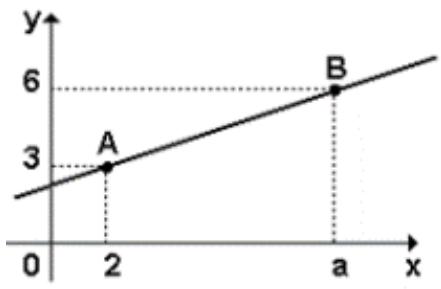
Source: Freitas (2019, p.350) Figure 4: Figure of task $T_{A5}$
$T_{A6}$: determine the value of $k$ so that the equation $kx - y - 3k + 6 = 0$ represents the line passing through the point $(5,0)$.
$T_{A8}$: EBSERH - AOCP 2016). If there is a line whose equation is $y - 2x - 10 = 0$, is it correct to say that this line passes through which of the following two points? (a) $A$ (5, 0) and $B$ (-20, 35); (b) $C$ (12, 21) and $D$ (0, 20); (c) $E$ (14, -15) and $F$ (-7, 7): (d) $G$ (5, 30) and $H$ (0.5, 4); (e) $A$ (0, 10) and $B$ (-13, 16). (Written production of group A) (Freitas, 2019, p. 350))
It can be seen that all the types of tasks proposed by the students are described in the dominant model of the textbooks analyzed, but the techniques envisioned by the students are part of the alternative model proposed by Freitas (2019) in the training. Regarding the technological-theoretical discourse, they relied on what had been developed during the training, such as the right triangle and Pythagoras' Theorem. $\mathrm{T}_{\mathrm{A5}}$ (UFSM) formulation shows a conceptual problem related to confusion between the graph of a function and its figural representation.
Regarding the alignment of three points, the students suggest as a technological-theoretical discourse, the condition of collinearity of points to deduce the alignment condition and the general equation of the line. According to Freitas (2019, p. 351)
The trainee teachers' productions revealed that technological knowledge appeared as something "natural", or naturalized in the teaching process, even if they didn't have a deeper understanding of it. Apart from visualization, other potentialities of the dynamic environment were not explored.
Group B's presentation identifies the following contents:
- Introduce analytical geometry so that students understand the content and can apply and identify it in everyday life;
- Identify the relationships between plane geometric figures and the Cartesian plane;
- Understand how studies of the optical system can help in the study of points and lines (Written production. Group B) (Freitas, 2019, p. 351)
And it describes the likely stages of its didactic sequence, with the didactic and pedagogical procedures for each lesson:
Lesson 1: We will start the lesson interactively to find out the students' previous knowledge of the content on the study of points. We will ask questions such as: what is a point? Can planet earth be considered a point in relation to the universe?
Then we can define what a point is in mathematics. Next, we'll work with a cardboard image of a neighborhood common to the students (e.g. the school district) and ask them to identify buildings that are between the intersection of two streets. The main objective is to remember the Cartesian plane.
Lesson 2: We'll start with a ruler and a Xerox or graph paper. We will ask the students to measure the distance between certain points on the Cartesian plane, starting with the distance between points that are on horizontal and vertical lines, which will allow us to associate it with the modulus of a number. After that, we will ask the students to measure the distance between points or measures of segments that are on non-horizontal and vertical lines, so we will show the use of the Pythagorean Theorem to solve this problem, in addition, we will ask the students questions about the midpoint and equidistance between points.
Lesson 3: We will share exercises from the previous lesson and discuss the interdisciplinary nature of mathematics in different areas in relation to the Cartesian system. We will use examples from geography involving the content of longitude and latitude, how a ship is located in the middle of the ocean and an airplane in the sky.
Next, we will propose a research activity on what the teacher has discussed. The class will be divided into groups of 5 students and the teacher will assign topics to them. It is expected that the school will have a computer room. If not, it will be agreed in the previous lesson that research will be carried out for the students to bring in. The lesson will be to maintain these presentations.
Lesson 4: The group presentations will take place.
- Lesson 5: The lesson will be expository and we will talk about the alignment of 3 points. There will be an activity before the lecture and another afterwards to establish the method of determining whether the three points are aligned.
- Lesson 6: We will continue with the exercises from the previous lesson, applying the following methods: matrices by Sarrus, cofactors, Chio Rule.
- Lesson 7: Assessment (Written production, Group B) (Freitas, 2019, pp. 351-352)
With regard to mathematical organization, group B presented a set of task types, based on Figure 4.
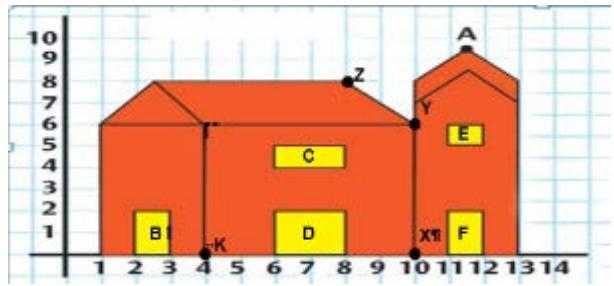
Source: Freitas (2019, p. 352) Figure 5: Illustration of group B tasks
The types of tasks that group B developed from Figure 4 are explained below:
$T_{Bi}$: knowing that the width of door $A$ can be represented by the distance between the points $(2,0)$ and $(3,0)$. What is the width of the door?
$T_{B2}$: as we can see on the Cartesian plane, the height of door $D$ is defined by the following points, (6, 2) and (8, 2). What is the height of the door?
$T_{B3}$: find the midpoint of the width of door $D$, knowing that the start point is $(6,0)$ and the end point is $(8,0)$.
$T_{B4}$: Determine points $X$ and $Y$, then calculate the distance between points $X$ and $Y$ and find the midpoint of points $X$ and $Y$.
$T_{B5}$ Find the point $Z$, and using the point $Y$ found in the previous question calculate the distance between the point $Y$ and $Z$ and find its midpoint.
$T_{B6}$: Find point $K$ and calculate the distance between $K$ and $Y$ and then calculate the midpoint of points $K$ and $Y$. (Written production, Group B) (Freitas, 2019, p. 353)
Tasks $T_{B4}$, $T_{B5}$, $T_{B6}$ are tasks of the same type: identifying the coordinates of points and calculating distance.
Freitas points out that the two groups realized that their proposals were not yet ready, given the various aspects that had been pointed out and which had not been taken into account by the two groups. These joint reflections helped the students to realize that they had to redesign their proposal.
The "finalization" of the intervention proposal for high school students and the emerging need to (re)plan it, stand out in the context of the research as a didactic moment of evaluation of the experimental device, with the presentation of the answer to the initial question $Q_0$ (how to teach the analytic geometry of the point and the line?) of the device.
At the end of this training, Freitas (2019, p. 354) observes that the
[...] the study leaves open the desire to improve the knowings acquired by the subjects and to see it put into practice, or even to improve and experiment with the teaching plan organized by the trainees. However, the limitations of the research make this second phase of experiments immediately unfeasible, which we leave for future studies.
An important aspect highlighted by the author is the "volume of each piece of knowing" necessary for teaching practice. At each work session, certain specific mathematical and didactic praxeologies, referring to the teaching situations themselves, were mobilized or (re)signified by the subjects. The author observes that this movement, typical of working with the SRP, guided by the generative questions of each phase of the experiment, generated a framework of teaching, mathematical and didactic praxeologies with the support of ATD, some of which were structured (developed) by the subjects during the different sessions.
Freitas (2019) points out that from a macro perspective, the device would have enabled subjects to (re)signify certain teaching praxeologies. In addition, the mathematical and didactic organizations proposed by the trainee teachers referred to potential students and were not actually applied to (real) high school students. It would be relevant to observe how the trainees, who were the subjects of Freitas' research (2019), would develop the teaching sequences that they had developed in the schools that were part of the supervised internship.
The conclusions drawn from Freitas' research (2019) are in line with the results of Artaud, Cirade and Michel Jullien (2011), who observed the positive and negative points of the implementation of aSRP by student-teachers and their attempts to design a SRP, loaded with a complex of conditions and restrictions that favor, allow or, on the contrary, hinder the dissemination of the notion of SRP. Among the favorable conditions, the authors mention the technological elements that will justify the need for SRP, in particular the improvement of motivation and the amalgamation of the mathematical organizations produced. The amalgamation of mathematical organizations will, however, be limited, from the point of view of the praxeologies implemented, by the thematic vision of mathematical organizations that we have seen some people propose and whose prevalence in the profession we know: in fact, certain existing structures in the secondary mathematics teaching system in France, such as the division into chapters or a chronogenesis reading of the content of the syllabus, drive this thematic vision. (Artaud et al., 2011, pp. 792-793)
The authors also point out that this amalgam is faced with the problem of understanding the moment of institutionalization and its articulation with other moments in the study of regional or even local mathematical organization.
In the episode by Freitas (2019) that we analyzed, we noticed, as in the research by Artaud et al. (2011. pp. 792-793) that synthesis occurs very early on, from two points of view. On the one hand, it interrupts the dynamics of the study and therefore gives shape to diffracted mathematical organizations. On the other hand, as the technological-theoretical moment has not really taken place, due to the lack of - adequate - articulation with the exploratory moment, the statements recorded in the synthesis are not
related to the practices that require them and therefore have only a very partial status of a technological element.
As we saw in the previous section, the issues related to teachers' praxeological needs are related to conditions and restrictions that have high impacts on the didactic system and on the search for an answer to the question: what do teachers need to teach?
## IX. CONCLUSIONS
In this text, we reflect on teacher training based on the Anthropological Theory of the Didactic and on research aimed at studying teachers' praxeological needs. Our literature review led us to reflect on the didactic infrastructures for teacher training and the praxeological needs of teachers. In addition, we took as an example one of the episodes from the experimental phase of Freitas' research (2019), which aimed to study the knowledge of plane analytic geometry that can be acquired by students (teacher trainees) from a Mathematics degree course in Bahia (Brazil), participating in supervised curricular internship classes, who were involved in a training process based on a Study and Research Pathway.
With regard to didactic infrastructures for teacher training (Cirade, 2020), we infer that the praxeological equipment of the profession should include a set of mathematical knowledge that allows teachers to question their projects for teaching mathematical concepts, reformulate it or even, in certain cases, discard it; in short, make a didactic decision that has the potential to advance their students in the appropriation of these concepts.
Finally, Wozniak (2020) identifies several ways of finding the teacher's praxeological needs. These paths are complementary and help to establish a set of facts which, when constituted as a whole, validate the elements brought to light. Each of the paths considered is based on the ecological analysis triptych of the following questions: What is it? What could it be? What should it be? These questions involve a set of conditions and restrictions, and are based on comparison with a praxeological reference model. In order to carry out such a project, it is necessary to implement the praxeologies deemed relevant to the realization of this project, and it is the distance from this initially established praxeological complex that allows us to identify gaps and needs (Wozniak, 2020).
With regard to the complexity of the processes of constructing teaching praxeologies, the analysis of the findings related to our example shows that the device enabled the subjects to (re)signify certain teaching knowledge and that there would have been a change in the knowledge that was part of the research subjects' praxeological equipment. However, the design of the students' SRPs reveals the need to expand the praxeological equipment of these students with regard to vectors in the plane and in space, based on the consolidation of knowledge of synthetic geometry and GAP, in order to constitute a fundamental technological-theoretical block in the construction of Linear Algebra knowledge (Freitas, 2019).
[^2]: Didactic transposition is "the set of transformations that a 'wise' knowing undergoes in order to be taught". In this definition, we can distinguish "knowing" from "taught knowledge". Knowing does not exist "in a vacuum" within a social void: all knowing appears, at a given moment, in a given society, as anchored in one or more institutions. (Chevallard, 1989, apud Almouloud, 2022, p. 140) _(p.4)_
[^3]: How can we establish a certain organization of mathematical knowledge in a middle or high school class? (Cirade, 2019, p. 342, our translation) _(p.7)_
[^4]: These are the moments discernible in study processes. In the study of a how question relating to a type of tasks T, ATD recognizes six such "study moments": the moment of the first encounter with T; the moment of exploration of T and emergence of a technique; the moment to build the techOnological and theoretical block $[\theta / \Theta]$; the moment to work on the praxeology pro $\Omega$ duced, $[\mathrm{T} / \tau / \theta / \Theta]$ and particularly on the technique; the moment to institutionalise it; the moment to evaluate the praxeology produced and one's relation to it. (See also (Yves Chevallard, with Marianna Bosch, 2020, p. 26) _(p.8)_
[^5]: Chevallard (2006) defines the phenomenon of monumentalism as the result of the loss of the raison d'etre of the mathematical praxeologies studied at school. Similarly, we believe that the training of mathematics-didactic teachers often suffers from the same phenomenon: the loss of the raison d'etre that gives meaning to the mathematical-didactic knowledge that trainee teachers study in faculties of Education Sciences (Higueras & Garcia, 2011, pp. 433-434). _(p.10)_
[^6]: The dialectic of media and milieux considers that any statement made (by a media) is, a priori, a conjecture that has not yet been proven, and that the search for proof is cohesive with the determination of milieux for the question under investigation. Note that experiments in the sense of the experimental sciences, reasoning and calculations are essential types of media that the investigator tries to "make speak" (Sineae Kim (2015, apud Artaud, 2019, p.249) This dialectic thus implies, in particular, carrying out tasks of the type "verifying a statement" and "controlling a result". These types of tasks are part of the study of a praxeology and are not specific to mathematics, but we will consider them in the context of the study of mathematics below. For example, we can see types of tasks such as verifying a geometric statement, verifying the result of a numerical calculation, verifying the behavior of a sequence or a function, etc (Arthaud, 2019, pp. 249-250). _(p.13)_
[^7]: Called the Herbartian scheme by the German pedagogue, Johann Friedrich Herbart (1776-1841), who is considered the father of scientific pedagogy. _(p.14)_
Generating HTML Viewer...
References
31 Cites in Article
Referencias Study of Convergent Praxeological Needs for Teachers' Didactic Infrastructures.
Almouloud,Saddo,José Nunes,Viana,José Pereira,Carlos De Souza,Teodora Figueroa,Pinheiro (2021). Percurso de Estudo ePesquisa como metodologia de pesquisa e de formação.
Michèle Artaud Introduction à l' approche écologique du didactique-L' écologie des organisations mathématiques et didactiques.
Michèle Arthaud (2020). Des liens entre l'organisation de savoir et l'organisation de l'étude dans l'analyse praxéologique.
Marianna Bosch,Yves Chevallard (1999). La sensibilité de l'activité mathématique aux ostensifs.
Brasil (1999). Ministério da Educação -Secretaria de Ensino Fundamental.
Guy Brousseau (1986). Fondements et méthodes de la Didactique des Mathématiques.
Luisa Higueras,Ruiz,Francisco García,Javier (2011). Análisis de las praxeologías didácticas: implicaciones en la formación de maestros.
Y Chevallard (1992). Concepts fondamentaux de la didactique : perspectives apportées par une approche anthropologique.
Yves Chevallard (1997). Familière et problématique, la figure du professeur.
Yves Chevallard (1999). L´ analyse des pratiques enseignantes en théorie anthropologique du didactique.
Yves Chevallard (2001). Les TPE comme problème didactique.
Yves Chevallard (2002). Les classiques de la didactique (suite 4/4).
Yves Chevallard (2002). Les classiques de la didactique (suite 4/4).
Yves Chevallard (2009). Contribution de Yves Chevallard.
Yves Chevallard (2009). La notion d'ingénierie didactique, un concept à refonder. Questionnement et éléments de réponse à partir de la TAD. 15.
Yves Chevallard (211). Les problématiques de la recherche en didactique à la lumière de la TAD.
Yves Chevallard (2013). Enseñar matempatica em la Sociedad del Mañana: Alegato a favor de un contraparadigma emergente.
Yves Chevallard,Marianna Bosch (2022). Anthropological Theory of the Didactic (ATD).
Yves Chevallard,F Wozniak (2011). Un cas d'infrastructure manquante: statistique et probabilités en classe de troisième.
Yves Chevallard,Gisèle Cirade (2010). Les ressources manquantes comme problème professionnel.
Gisèle Cirade (2019). Infrastructures didactiques pour la formation des professeurs : le cas de l’étude de praxéologies d’enseignement.
G Cirade (2006). Devenir professeur de mathématiques : entre problèmes de la professions et formation en IUFM.
Ana Reis Pieretti,Maria Mazzilli Pereira (2019). Efeito do Feedback e da Reapresentação dos Quadros Completados Incorretamente Sobre o Desempenho em uma Instrução Programada.
Alicia Olarría,Ruiz,Tomás Sierra,Ángel (2011). La formación matemático-didáctica del profesorado de secundaria.
M Perrin-Glorian (1994). Théorie des situations didactiques : naissance, développement.
M.-J Perrin-Glorian (2011). L'ingénierie didactique à l'interface de la recherche avec l'enseignement. Développement des ressources et formation des enseignants.
Maggy Schneider (2011). Les « mathématiques comme problème professionnel » Apprendre à distinguer plusieurs niveaux praxéologiques.
Florence Wozniak (2020). Les besoins praxéologiques du professeur.
Florence Wozniak (2012). Des professeurs des écoles face à un problème de modélisation: un equestion d' équipement praxéologique.
Explore published articles in an immersive Augmented Reality environment. Our platform converts research papers into interactive 3D books, allowing readers to view and interact with content using AR and VR compatible devices.
Your published article is automatically converted into a realistic 3D book. Flip through pages and read research papers in a more engaging and interactive format.
Our website is actively being updated, and changes may occur frequently. Please clear your browser cache if needed. For feedback or error reporting, please email [email protected]
Thank you for connecting with us. We will respond to you shortly.