I. INTRODUCTION
The current Pandemic N-COVID-19 taking toll on health care providers worldwide as it is observed that mortality is more among health care providers. The health of health care providers is a major concern. As they have to take care of their health first to serve the humanity. It is observed that mortality among health care providers is more compared to common man.
Therefore, it is necessary to study the knowledge, attitude and hygienic practices regarding N-COVID-19 among health care providers.
It is a small attempt to study the knowledge, attitude and practice to prevent N COVID-19 among health care providers themselves working in tertiary care hospitals of a Medical College. Let us hope, it is the beginning of research study of N-COVID-19 Pandemic in tertiary care hospital. Such study is first of its kind in the said tertiary care hospital.
In 2019, an outbreak of the coronavirus began in Wuhan, China, affecting over 1,300 people, the largest recorded to date. The outbreak is ongoing as of February 2020. The 2019-nCoV infection caused clusters of severe respiratory illness similar to severe acute respiratory syndrome coronavirus and was associated with ICU admission and high mortality.
The name "coronavirus" is derived from the Latin corona, meaning crown or halo, which refers to the characteristic appearance of the virus particles (virions): they have a fringe reminiscent of a crown or of a solar corona. Coronaviruses comprise the subfamily Ortho coronavirinae in the family Coronaviridae, in the order Nidovirales. They are enveloped viruses with a positive-sense single-stranded RNA genome and a nucleocapsid of helical symmetry.
a) Aim and Objectives
AIM - To find out the awareness regarding coronavirus among health workers working in tertiary care hospital Objective- To find out hygienic practices practiced by the participants.
b) Methodology
| Sr/No | Topic | Content |
| 01 | Setting | 2 Tertiary Care Hospitals attached with the Medical College |
| 02 | Design | Cross sectional observational epidemiological study |
| 03 | Ethical consideration | Consent taken from the participants after explaining the purpose of study in their language |
| 04 | Sample size | 100participants from one Tertiary Care Hospital and 103 from another Tertiary Care Hospital, total 203 participants |
| 05 | Study Period | February 2020 |
| 06 | Analysis | The statistical analysis of data done with the help of Microsoft excel data sheet 2016 version and SPSS package 25version |
| 07 | Inclusive criteria | 1}Health care professionals working in Tertiary Care Hospitals2}Health care professionals willing to give consent |
| 07 | Exclusive criteria | Health care professionals not willing to give consent |
c) Results and discussions
A pre-structured proforma was prepared and got validated. Institutional Ethics Committee clearance was taken. Written consent of each participant was taken after explaining the purpose of the study in their
The Epidemiological findings of the study are as follows:
language. Proforma was administered by the interns in person. Questions were asked to the participants from both the tertiary care hospitals. The data entered in Excel data sheet and analyzed using spss package.
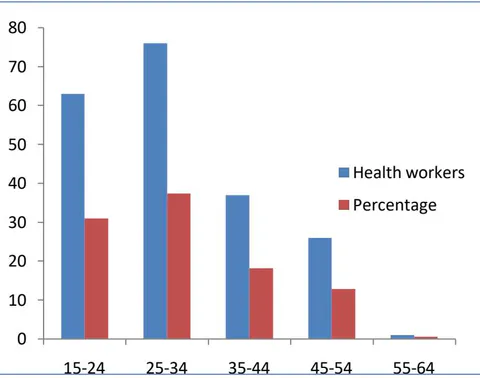
Graph 1 shows the age wise distribution of the participants participated in the study. We found out that amongst the participants, maximum 37.4% (76) were from 25-34 years of age group and 31%(63) participants were from 15-24 years of age group.
In our study, 51.24% (104) were females and 48.76% (99) were males. 50.74% (103) participants were from one tertiary care hospital whereas 49.26% (100) were from other tertiary care hospital.
Cover nose and mouth when coughing and sneezing Chi Square Table P-Value Significant at 5% Level Clean and Disinfect Touched Objects When Having Respiratory Infection No Yes Total No 11 65 76 1.148 0.284 No Yes 26 101 127 Total 37 166 203
Regarding hygienic practices practiced among health care providers, we found out that 101 participants were cleaning and disinfecting touched objects when having a respiratory infection and covering nose and mouth while coughing and sneezing, though, this is not statistically insignificant, it is a good hygienic practice seen amongst health care providers.
In a study conducted by Maria Cohut et al shows same results highlighting the practices of hygiene behavior in order to prevent spread of COVID-19. The Questionnaire was as follows:
II. KNOWLEDGE ATTITUDE PRACTICE
Regarding N-COVID-19in tertiary care hospital among health workers
Do you clean your hands before and after attending patients with soap and water/alcohol-based hand rub? YES/NO
Do you wear a mask when in contact with patients? YES/NO 3. Do you seek early medical attention whenever you have fever, cough, or breathlessness for more than two weeks? YES/NO
Do you seek early medical attention whenever you have fever, cough, breathlessness for more than two w YES/NO
Do you have any travel history from coronavirus infected areas? YES/NO 5. If you have respiratory infection, do you clean and disinfect touched objects and surfaces? YES/NO
If you have respiratory infection then do you clean and disinfect touched objects and surfaces? YE
Do you have contact with person who has history of travel from coronavirus infected areas? YES/NO
Do you have history of close contact with a laboratory confirmed patient of corona virus? YES/NO
Do you cover your nose and mouth when coughing and sneezing? YES/NO ke symptoms?
Do you take precautionary measures when any of your close contacts have cold or flu-like symptoms? YES/NO 10. Do you eat thoroughly cooked meat and eggs? YES/NO
10. Do you eat thoroughly cooked meat and eggs? YES/NO 11. Do you avoid unprotected contact with pets and farm animals? YES/NO
11. Do you avoid unprotected contact with pets and farm animals? YES/NO
- Do you touch your eyes, nose, and mouth with unwashed hands? YES/NO 13. Have you undergone any awareness program regarding coronavirus? YES/NO
13. Have you undergone any awareness program regarding coronavirus? YES/NO
14. Do you have an isolation ward for coronavirus patients in your hospital? YES/NO
15. Whether HCP attending the suspected coronavirus patient is routinely investigated? YES/NO
- Have you posted signs/posters for spreading awareness of coronavirus at the entrance/OPD waiting areas/strategic places? YES/NO
17. Do you spread awareness about coronavirus in your respective residential society? YES/NO
Is it ensured that rapid triage and isolation of patients with symptoms of suspected coronavirus and other respiratory infection taken into consideration? YES/NO
Does the ambulance service notify your health care Center before transferring a suspected coronavirus patient? YES/NO
Does your hospital contain necessary investigation and treatment modalities for treatment of corona virus infection? YES/NO
Based on the Questionnaire, table is formed Table 4: Knowledge attitude and practice regarding coronavirus among health care providers in tertiary care center
| Question | Awareness | Total | |||
| Yes | % | No | % | ||
| Q1 | 203 | 100.0 | 0 | 0.0 | 203 |
| Q2 | 175 | 86.2 | 28 | 13.8 | 203 |
| Q3 | 173 | 85.2 | 30 | 14.8 | 203 |
| Q4 | 0 | 0.0 | 203 | 100.0 | 203 |
| Q5 | 127 | 62.6 | 76 | 37.4 | 203 |
| Q6 | 0 | 0.0 | 203 | 100.0 | 203 |
| Q7 | 0 | 0.0 | 203 | 100.0 | 203 |
| Q8 | 166 | 81.8 | 37 | 18.2 | 203 |
| Q9 | 171 | 84.2 | 32 | 15.8 | 203 |
| Q10 | 153 | 75.4 | 50 | 24.6 | 203 |
| Q11 | 134 | 66.0 | 69 | 34.0 | 203 |
| Q12 | 81 | 39.9 | 122 | 60.1 | 203 |
| Q13 | 79 | 38.9 | 124 | 61.1 | 203 |
| Q14 | 61 | 30.0 | 142 | 70.0 | 203 |
| Q15 | 82 | 40.4 | 121 | 59.6 | 203 |
| Q16 | 89 | 43.8 | 114 | 56.2 | 203 |
| Q17 | 149 | 73.4 | 54 | 26.6 | 203 |
| Q18 | 129 | 63.5 | 74 | 36.5 | 203 |
| Q19 | 107 | 52.7 | 96 | 47.3 | 203 |
| Q20 | 80 | 39.4 | 123 | 60.6 | 203 |
a) In our study we found that,
86.2% (175) were wearing masks rather than 13.8% (28) were not wearing masks while in contact with patients.
85.2% (173) were seeking early medical attention while having respiratory infection for more than two weeks while 14.8% (30) were not seeking early medical attention while having respiratory infection for more than two weeks.
62.6% (127) were cleaning and disinfecting touched objects and surfaces while having respiratory infection while 37.4% (76) were not cleaning and disinfecting touched objects and surfaces while having respiratory infection.
81.8% (166) were covering their nose and mouth while coughing and sneezing while 18.2% (37) were not covering their nose and mouth while coughing and sneezing.
84.2% (171) were taking precautionary measures when their close contacts were having cold or flu like symptoms while 15.8% (32) were not taking precautionary measures when their close contacts were having cold or flu like symptoms.
75.4% (153) are eating thoroughly cooked meat and eggs while 24.6% (50) are not eating thoroughly cooked meat and eggs.
66% (134) avoided unprotected contact with pet and farm animals while 34% (69) were having unprotected contact with pet and farm animals.
39.9% (81) were touching their body parts with unwashed hands while 60.1% (122) were not touching their body parts with unwashed hands.
38.9% (79) have undergone awareness program regarding coronavirus while 61.1%(124) have not undergone awareness program regarding coronavirus.
43.8% (89) have posted signs and posters regarding coronavirus and 56.2% (114) have not posted any signs and posters regarding coronavirus.
73.4% (149) were spreading awareness regarding corona virus in their respective residential areas while 26.6% (54) were not spreading awareness regarding corona virus in their respective residential areas.
III. CONCLUSION
From our study, we conclude that majority of health care provider staff were using precautionary measures while dealing with COVID-19 patients. With only 38.9% (79) underwent the awareness program. If 100% of staff would undergo the training and awareness program, we are sure they will take better care of themselves and patients while on duty. The awareness program and training should be repeated periodically.
Conflict of Interest: Nil
ACKNOWLEDGEMENT
We thank our interns for their valuable assistance in data collection. We sincerely thank Mr. Abhiram Behera, Statistician cum Asst. Professor, Community Medicine, Terna Medical College & Hospital, Nerul for valuable statistical inputs.