
I. INTRODUCTION
The increasing demand of oil and the adverse effects such as the resulting climate change (Bunthita et al, 2016) have led to the search for alternative energy sources with very little impact on the environment (Siti et al., 2017, Novidzro et al., 2013). Thus, the depletion of crude oil reserves and soaring crude costs offer excellent prospects for bioethanol (Boulal et al, 2010), considered as an appropriate alternative to gasoline (Chamoumi, 2015). Bioethanol used as biofuel is mainly produced from plant reserve organs (Riess, 2012). However, the use of these reserves for the production of bioethanol competes directly with products intended for human consumption (Maria, 2012). To overcome these problems, research has focused on the valorization of inedible organic matter for the production of bioethanol. Indeed, the use of neem fruit is very interesting because its seed can produce oil and its pulp contains sugars. These sugars can be valorized by a biotechnological process for the production of a product with high added value, like bioethanol.
In Cameroon, the fight against desertification and climate change is a government concern. Faced with these challenges, neem is one of the most used trees for reforestation in the Sahelian regions (Foundoun, 1998). In March 2011, according to the Regional Delegation for the Environment and Nature Protection of the Far North, nearly 560 000 neem and Acacia plants have reforested about 1500 hectares in. Léré (Mayo Department). Kani). In addition, according to Tizé et al. (2016), about 45 500 neem trees are distributed in the city of Maroua (Cameroon). At maturity, neem produces an average of 50 kg of sweet fruit each year (Formad, 2013), whose pulp (48% of the total mass of neem fruit) remains unvalued. As a result, the neem pulp represents a significant amount of biomass, which requires energy recovery.
In order to give an added value to the fruit pulp of neem, the objective of this study is the physicochemical characterization of the neem pulp for the production of bioethanol. Specifically, it is a question of making a determination of the total sugar content of neem fruit pulp, the specific production and the alcoholic content of bioethanol obtained from the fruit pulp of neem.
II. MATERIAL AND METHODS
a) Study area and plant material
The study was realized during the period February-March 2017 in the Far North region (Cameroon). Four sites of neen productions were selected for the collection of neem fruits: 02 sites in Mayo-Sava (Mora and Mora I) and 02 sites in the Diamaré (Makabaye and Baoliwol). Neem fruits were sorted on the basis of skin color (preferably yellow) and appearance (cool) to the touch, fallen from the tree between 24 and 48 hours. However, for the Mora I site the neem fruits were collected (yellow and firm to the touch) and were not subject to any selection criteria beforehand.
The plant material consists of neem fruits, collected in 04 sites in the Far North region
b) Biological material
The biological material is the dry yeast strain Saccharomyces cerevisiae (Lesaffre, Turkey), used for the alcoholic fermentation of the pulp juice of neem fruits.
c) Methodology
i. Physical characteristics of neem fruits
Parameters such as average weight, proportions of pulp and almonds were considered. The average weight was determined by weighing batches of 100 dried neem fruits using a scale (Compact Scale Electronic, USA). The masses of the fruit components were determined by weighing after coring (removal of the kernel) batches of 200g of dried neem fruit.
ii. Process for obtaining the neem pulp powder
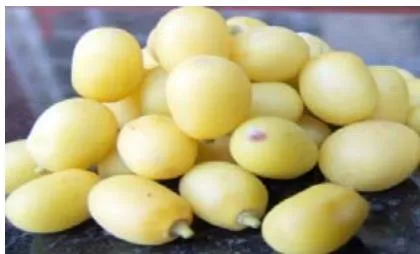
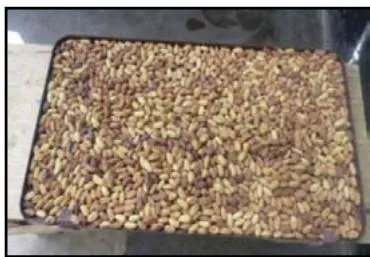
Neem fruits were sorted at site collection and cleaned with water (Figure 1a). The fruits were distributed on a rectangular tray, placed on the roof to capture the maximum solar radiation for an average of 3 to 4 days. The fruits are returned from time to time to accelerate and harmonize the drying time (Figure 1b). Once this drying is complete, each fruit placed in the horizontal position is cut in half with a knife (Stainless Steel, China) and the kernel is removed. The pulp obtained was exposed to the sun for 6-8 days on average and the end of drying is observed when the pulps are firm at the finger pressure.
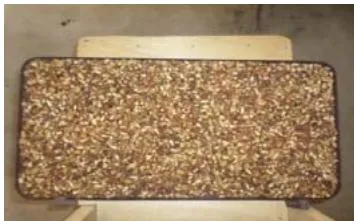
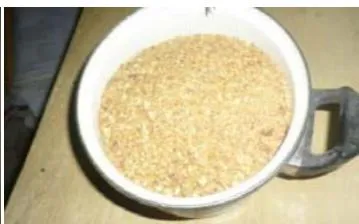
The obtained pulps were ground with a wooden mortar until the powder was obtained and the resulted powder was sieved using a sieve of mesh equal to , the fine powder obtained was sent to the laboratory.
iii. Physico-chemical characterization of neem pulp
The dry matter was determined on a mass of 5 g of neem pulp, placed in an isothermal oven at to a practically constant mass (AFNOR, 1982). The total ash content was determined by calcining the test portion used for the dry matter, in a high temperature oven at (AFNOR, 1982). The total lipid content was determined according to the Russian method (Bourely, 1982). The proteins were assayed according to the method of Devani et al. (1989) after mineralization according to the Kjeldahl method (AFNOR, 1984). Total sugars were assayed by the phenol-sulfuric method (Dubois et al., 1956).
iv. Alcoholic fermentation of the juice of neem pulp
a. Preparation of the inoculum
The inoculum was obtained according to the protocol described by Massengo et al. (2016). The yeast is pre-cultured by the introduction of 06 g the dry yeast strain Saccharomyces cerevisiae (Lesaffre, Turkey) in 100 ml of distilled water, containing 44 ml of a solution of 12% saccharose (v/v), with continuous stirring for 90 minutes and at a temperature of C (Gauthier et al., 2005).
b. Extraction of the neem pulp juice and preparation of the fermentation concoction
Extraction of pulp juice from neem fruit was carried out according to the adapted method of Chniti (2015). A mass of 200 g of powder was diluted with distilled water at a 1/5 (w/v) dilution ratio is heated at 70 °C. for 60 minutes (Chniti et al., 2013), with continuous stirring. The juice is filtered using muslin after cooling. The resulting juice was heated at 85 °C for 20 minutes to remove bacterial flora and cooled to room temperature (Diakabana et al., 2013, Massengo et al.,
2016). The medium is enriched with urea (NH CONH , 4g/L) to ensure optimal growth of yeasts and accelerate the kinetics of fermentation (Novidzro et al., 2013, Gbohaida et al., 2016) Inoculum in the ratio Innoculum/Concoction = 1/500 (V/V) was added to the fermentation concoction, with continuous stirring.
c. Adjustment to different pH of the concoction of fermentation pulp
From the obtained neem pulp concoctions, 04 alcoholic fermentation tests were carried out: a test where the pH of the concoction was not adjusted (pH =
5.4) and 03 tests with the pH of the concoctions were adjusted. at 4.3, 4.5 and 4.7 with dilute sulfuric acid solution (1.5N H2SO4). Once the desired pH is reached for the various adjusted concoctions (4.2, 4.5, and 4.7) and unadjusted concoction, they are transferred to 1L fermentors and anaerobically conducted for 120 hours (Ameyapoh et al., 2006), at a temperature of 30 ± 2 °C (Boulal et al., 2013, 2010, Kaidi and Touzi, 2001). The device of the alcoholic fermentation is presented by figure 3.
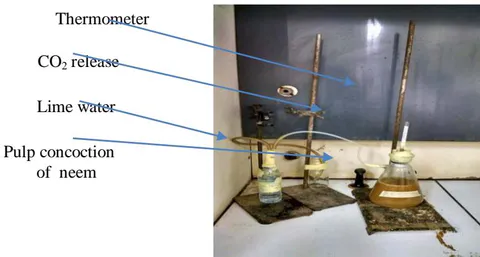
The fermentation was monitored by taking 10 mL with a syringe every 24 hours and for 120 hours. The controlled parameters are: the pH, the temperature and the density of the fermentation must.
At the end of the alcoholic fermentation, the ethanol contained in the must is distilled off at a temperature of C (Diakabana et al., 2016).
d. Alcohol content of the bioethanol obtained
The ethanol productivity was determined by directly measuring the volume of distillate obtained (after distillation) for each fermentation test. The alcoholic degree was determined after the distillation of the bioethanol mixture during the distillation of the different fermentation tests. The alcoholic degree was determined by the OIML method (1973).
d) Statistical analyzes
Each experiment was repeated 03 times for physicochemical analyzes of the pulp and the physical characterization of the fruit. Fermentation tests at different pHs were performed in duplicate. The results obtained were expressed in the form: M ± σ, with σ the standard deviation and M the average. A probability p < 5% was considered as a non-significant difference in the data analysis.
III. RESULTS AND DISCUSSION
a) Physical characterization of neem fruits
The physical characteristics of neem fruits are presented in Table 1.
| Sites Parameters | Makabaye | Mora | Mora I | Baoliwol |
| Average weight (g)1 | 260.25±2..34a | 238.45±2.62a | 240. 19± 0.90a | 264.25±0.50e |
| Almond content (%)2 | 52.45±0.34b | 51.35 0.34b | 52.15±0.34b | 52.21±0.54b |
| Pulp content (%)2 | 47.55±2.50c | 48.65±1.40c | 47.85±1.70c | 47.79±2.20c |
b) Physico-chemical characterization of neem pulp
| Sites Parameters | Makabaye | Mora | Mora I | Baoliwol |
| Dry matter content (g/100g) | ||||
| Total ash (g/100g db) | ||||
| Lipid content (g/100g db) | ||||
| Protein content (g/100g db) | ||||
| Total sugars (g/100g db) |
c) Fermentation kinetics
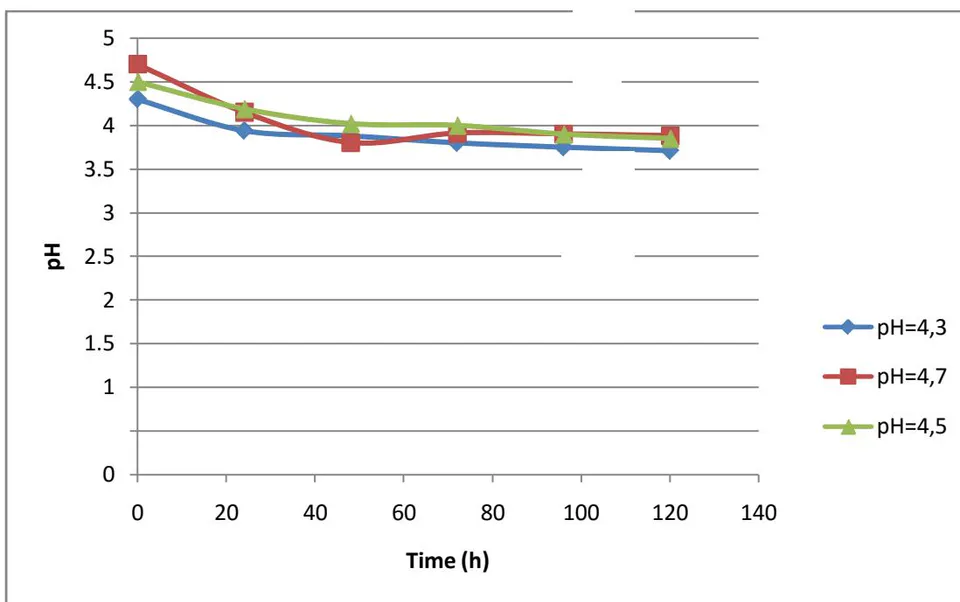
metabolites and ethanol. This justifies the lowering of the pH of the various musts during alcoholic fermentation, represented by Figure 4.
The consumption of carbon and nitrogen substrates is accompanied by the production of acid
d) Density of the fermented must
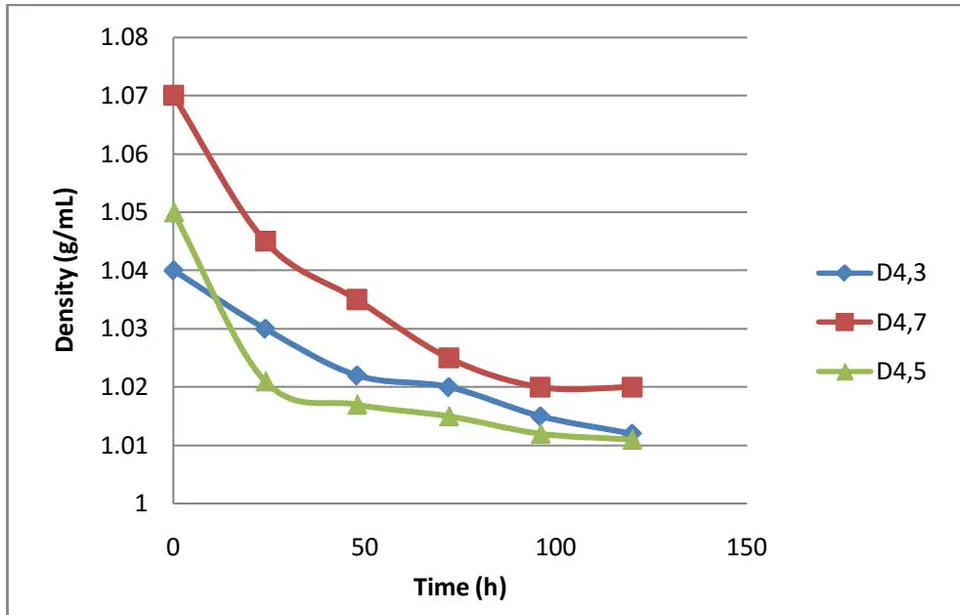
The decrease in density (Figure 5) is observed for the different pH values (4.3, 4.7 and 4.5), which can be explained by the transformation of fermentable sugars into alcohol and the loss of mass under form of (Gaillard et al., 1995).
e) Bioethanol productivity and alcohol content The production of bioethanol for the various alcoholic fermentation tests is shown in Table 3. The lowest value was observed in pH 4.5 and while the highest was observed at pH 5.4 in the unajusted must..
| pH | Alcohol content (mL/100 g de d.b) | |
| Ajusted must | 4.3i | 3.1a |
| 4.5i | 3.0a | |
| 4.7i | 4.2b | |
| Unajusted must | 5.4j | 5.1c |
IV. DISCUSSION
The fruit pulp of neem with his high total sugar content (72-73%) is therefore an important source of bioethanol production. These levels are higher compared to the total sugar content of date must (50-60%) (Boulal et al., 2013). The low production of bioethanol from neem pulp is partly due to the loss of protein and nutrients during juice filtration. Indeed, these nutrients are necessary for the growth and development of microorganisms.
Low availability of sugars can also reduce the yield of bioethanol production. However, the use of enzymes such as pectinase (Ezoua et al., 1999) or pretreatment of the pulp beforehand (Alain, 2008) would make it possible to obtain significant yields of available sugars and possibly to improve ethanol productivity.
The high production of bioethanol at pH = 5.4 and pH = 4.7 compared to other tests (pH = 4.5 and pH = 4.3) is strongly related to the activities of the yeast
Saccharomyces cerevisiae. The decrease in pH observed during the monitoring of fermentation tests, shows a microbial activity, source of production of acidic compounds (Ezoua et al., 2008). The latter appear to have an inhibitory effect on cell growth by causing a decrease in biomass production (Giannattasio et al., 2005). This may justify the low production of bioethanol at pH = 4.3 and pH = 4.5.
At the beginning of fermentation, there is a rapid decrease of the pH and a sub-sequential increase of the acidity of the various fermentation tests. This phase could correspond to the growth phase of yeasts, resulting in the production of secondary metabolites. The increase in acidity could also be due to the production of CO2 or acidic compounds by the yeast during fermentation.
After 03 days of fermentation, pH stabilization was observed at the level of the different tests. This could correspond to the depletion of the medium in fermen-tescible sugars or the saturation of the media by secondary metabolites likely to inhibit yeast growth or to slow down their fermentative activity (Novidzro et al., 2013). Also, Ouédraogo et al. (1999) showed that growth of Saccharomyces cerevisiae is optimal at pH = 5.
The fermentation of the different tests ends from the 3rd day while the stop is noticed on the 5th day. This observation is in agreement with that of Gbohaida et al. (2016).
In addition, the drop in density observed for the various tests is due to a loss of material (in the form of carbon dioxide) during the alcoholic fermentation (Kouakou et al., 1987) and the transformation of sugars into bioethanol (Ouédraogo et al., 1999).
V. CONCLUSION
Neem pulp is a very rich substrate of fermentable sugars, whose fermentative transformation is promising. This pulp represents about 48% of the total neem fruit mass, and is therefore an important source of biomass. The physico-chemical composition of neem pulp shows that total sugars are the major components (74% for Makabaye and 73% for Baoliwol). These sugars can therefore be converted by biotechnological processes into bioethanol. In the alcoholic fermentation tests of neem pulp at different pH values (4.2, 4.5, 4.7, and 5.4), the best bioethanol production rate was observed at pH = 5, 4 (5.1 mL/100g pulp MS) and pH = 4.7 (4.2 mL/100g pulp MS). This study is the first to characterize neem fruit pulp and to determine its total sugar content for bioethanol recovery. Numerous perspectives stem from this present work, namely: the characterization of the sugars contained in the fruit pulp of neem and the optimization of the extraction of pulp sugars from neem fruits.