
I. INTRODUCTION
An increase in the fertility of soil is one of the most important tasks of any state, since the high fertility of soil is the basis of national security. This state of affairs connected with the fact that high fertility provides with foodstuffs the population of the country [1].
There are different methods of an increase in the fertility, beginning from the use of the mineral fertilizers and concluding by the correct crop rotation . In tsarist Russia in view of the absence at that time of the production of the mineral fertilizers was used in essence three-field system. This system assumed sowing the useful cultures only of times in three years. Two remained years soil rested and returned the hearth of the pairs, when nothing they sowed on the ploughed earth, when in the appropriate sections of graze cattle .
The use of the mineral fertilizers, widely utilized in the practice of agriculture at present, not the best method of an increase in the fertility, first of all because such methods are not ecologically clean . The use as the fertilizers of nitrates, which ensure an exuberance in the plant and its foliage, presents special danger, but at the same time its fruits and leaves are saturated by the substances, which are harmful with the use.
For the named reasons the use of ecologically clean methods of an increase in the fertility of soil presents large prospects. Let us examine one of such methods, which are used for these purposes high-frequency currents.
II. THE LAWS OF PENETRATION FIELDS ON AND CURRENTS INTO THE SOIL
Deficiencies in the use of direct currents or currents of low frequency for treating the soil it consists in the fact that such currents apply to large depths, while the layer, in which is located the root system of plants it composes several ten centimeters. Use of the high-frequency currents it makes it possible to solve this problem, since in connection with the presence of skin effect such currents apply to the small depth from the surface, which depends on frequency and ground conductivity.
The electrodynamics of material media, which include the soil Maxwell's equations are described . For the vacuum they take the form:
where E and H - tension of electrical and magnetic field, and - electrical and magnetic induction, and - magnetic and dielectric constant of vacuum. From (2.1-2.4) follow the wave equations
\begin{array}{r} \\nabla^ {2} \mathbf{E} = \mu_ {0} \varepsilon_ {0} \partial^ {2} \mathbf{E} / \partial t ^ {2}, \\nabla^ {2} \mathbf{H} = \mu_ {0} \varepsilon_ {0} \partial^ {2} \mathbf{H} / \partial t ^ {2}, \\end{array}these equations show that in the vacuum can be extended the plane electromagnetic waves, the velocity of propagation of which is equal to the speed of light of
For the material media of Maxwell's equation they take the following form:
where and - the relative magnetic and dielectric constants of the medium and n, e, V - density, value and charge rate.
Since the soil is conductor, let us examine the equation of current distribution in the conductor, which follows from Maxwell's equations:
In these equations - the charge density, i-the current density of conductivity, which is determined by differential Ohm's law
where - the specific conductivity of medium.
Current density in Maxwell's equations in this case can be expressed through the tension of electric field.
Let us rewrite equation (2.5) with the aid of Ohm's law (2.6):
The represented equations are recorded in general form. Let us limit to the case, when fields change according to the harmonic law . then
This equation can be still simplified, since the conduction currents in the conductors are considerably more than bias currents, consequently:
Let us take rotor from both parts of this equation and will develop equation for the left side
Substituting values and from Maxwell's equations, we obtain:
This is an equation of skin effect, or the equation of distribution. Similar equations can be obtained and for the electrical fields on and the current densities of conductivity.
If fields change according to the harmonic law, equations (2.7 - 2.9) take the form:
Let us accept for the conducting half-space direction of flow for the axis z, and normal to the surface for the axis x and we will consider that current distribution along the axes in z it remains constant. The equation of distribution in this case will take the form:
where or
The complete solution of this equation takes the form
Constant must be equal to zero, otherwise with current it will be infinitely great, which is impossible. Constant can be determined from the boundary conditions, by considering that on the surface of conductor with x=0 is satisfied the condition . Based on this condition, we obtain:
Where .
It follows from the equation that the value of current density decreases exponentially an increase in the distance from the surface and decreases in e of times at a distance from the surface. In connection with this this value is conventionally designated as depth of penetration. Specifically, this distance should be considered the distance, up to which high-frequency currents penetrate the soil.
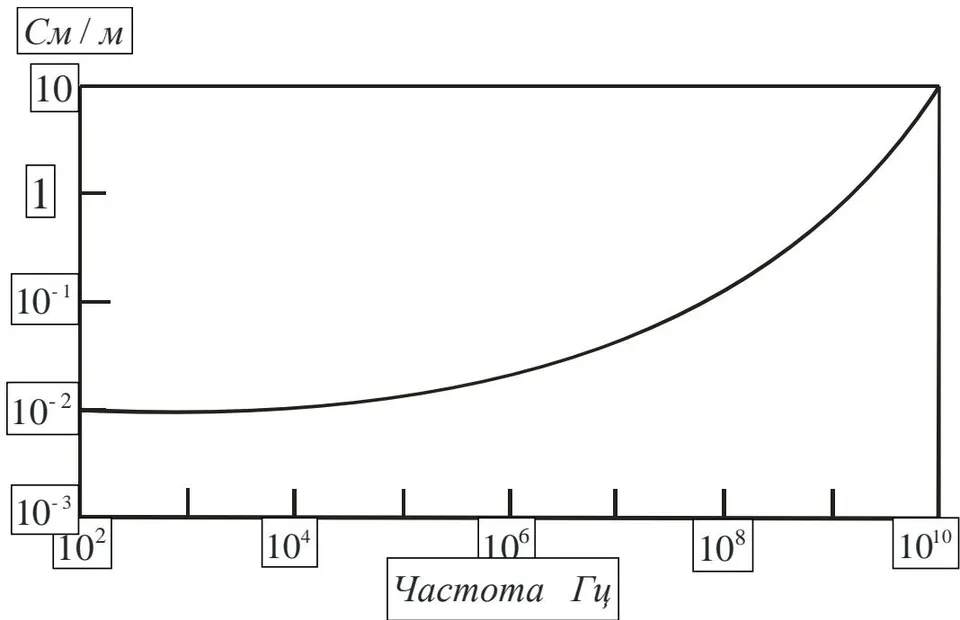
In moist soil the conductivity on the direct current is from to S/m [9]. However, it depends on frequency, as shown in Fig. 1. As can be seen from graph with an increase in the frequency ground conductivity increases.
The equivalent dielectric constant of moist soil also depends on frequency and with an increase in the frequency it decreases (Fig. 2).
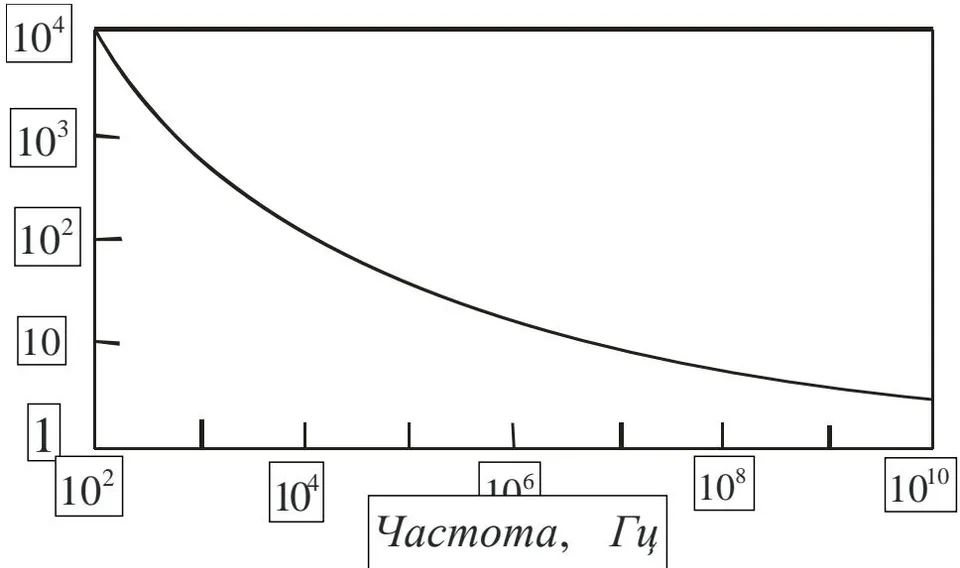
Using the graphs, depicted in Fig. 1 and Fig. 2, let us calculate depth of penetration fields on into the soil for the frequencies: , , , and . These values will be respectively equal: 3.7m, 0.75m, 0.17m, 0.06m and 0.017m. Using these data, it is possible to select the value of frequency taking into account the depth of the germination of the root system of plants.
III. THE ELECTRICAL PROPERTIES OF THE BIOLOGICAL TISSUES
Biological tissues are - heterogeneous materials, with the complex microscopic structure. Separate cells constituting cloth, frequently carry out special functions and different types of cells they have different structure. The parts of the cells – intracellular organelles - have the special specialized value. On the molecular level the cloth consists of the myriads of the most complex molecules, the simplest of which molecule of water. All these elements of cell, intracellular organelles, biomolecules, consist of the charged parts, on which the forces act, if they are placed into the electromagnetic field. The behavior of the separate elements of cell in the field depends on the field frequency, and their change as a result in the action of field it is manifested in the form the macroscopic dielectric constant of cloth. Dispersion proves to be complex even in simple biological materials. The qualitative description of the physical mechanism of that producing frequency changes in the properties is given below.
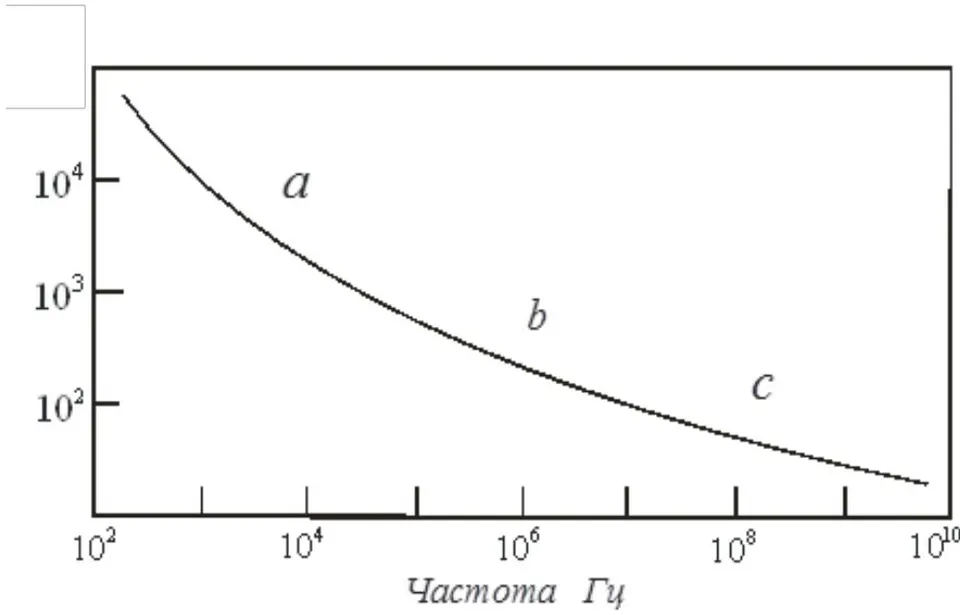
The dispersion of dielectric constant in different frequency bands can be connected with the specific features in the structure of biological tissue. In view of the limitedness of experimental information and complexity of problem some mechanisms proposed are more or less speculative. In Fig. 3 Is represented the dispersion of the dielectric constant of cloth with the high liquid-water content in the range of frequencies from 10 to 30 GHz. On the graph there are three regions of dispersion, which are designated by the letters a, b, c.
Dispersion of the type a is observed on the bottom edge of frequency band usually near the frequency 100 Hz and appears most incomprehensible of three forms dispersion. In this range the measured values of the permeability of the order . For the explanation to this dispersion several mechanisms were proposed, including the effect of the transfer through the cellular membrane and the relaxation of the ionic atmosphere around each cell. The ionic atmosphere is connected with the colloidal particles, which are located in the form of suspension in the solution of electrolyte. These particles are electrically charged because of constantly locating in them to ions or to the ions, adsorbed from the electrolyte. Each colloidal particle electrostatically attracts the ions of opposite sign, which surround particle, forming the dual layer of charges, or the ionic atmosphere, as shown in Fig. 4.
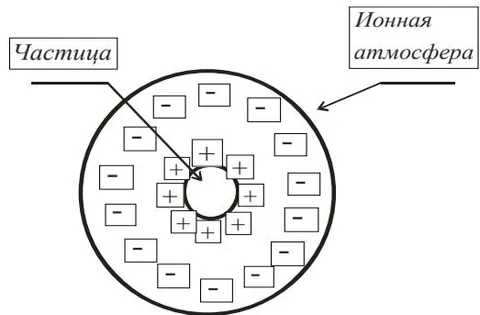
Electrostatic attraction makes possible to a certain degree for ions to move inside the layer along the area of the particle and it prevents them to leave surface. If we apply electric field, then the ions of opposite signs will be displaced and will create the induced resulting dipole moment for the entire particle together with its atmosphere. This moment can substantially increase the equivalent permeability of solution. According to the theory, proposed Shvarts , the relaxation time of dipole moment, connected with the motion of ions, is determined by the diffusion of ions in the layer. Dispersion (or the phenomenon of relaxation) it was observed at the low frequencies in the suspensions of nonbiological substances. An example is represented in Fig. 5, (diameter of spheres , volume concentration 30%) in electrolyte solution [11].
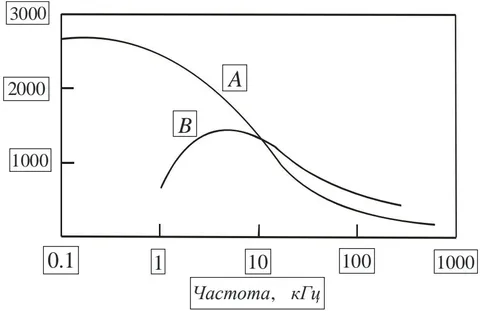
Dispersion of the type b (Fig. 5) it is explained by the basic structure of cell. In cloth with the high liquid-water content the internal part of the cell and the electrolyte, which surrounds it outside, is the conducting liquid, divided by cellular membrane. In this case conductivity the dielectric constant of the membrane is lower than in the divided by it media. The suspension of cells is the heterogeneous material, in which is observed the dispersion of equivalent conductivity and permeability, called Maxwell-Wagner effect.
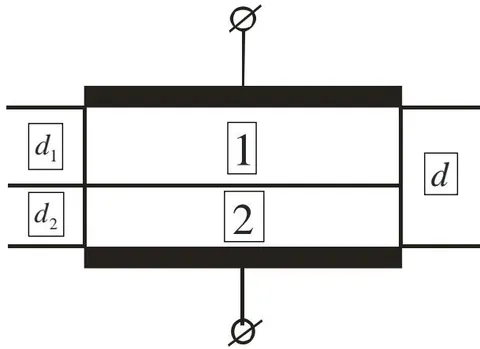
Maxwell-Wagner effect it is easy to explain on the model of parallel-plate capacitor, shown in Fig. 6. In this model between the plates of parallel-plate capacitor are located two layers of uniform material, parallel to plates. Layers by thickness d 1 d 2 have the electrical parameters , and , , which for simplicity are considered material and as the not depending on the frequency. For determining the equivalent parameters of two-layered material let us calculate the admittance of capacitor.
where A - the area of plates, .
From the simple correlations for the capacitor we determine conductivity on the direct current and relative the dielectric constant of the dual layer
where
As can be seen from formula the equivalent permeability of filling of capacitor depends on frequency, although the basic parameters of its parts (two layers) of the frequency do not depend. Formula shows that the expression for the permeability of heterogeneous material takes the same form as for the uniform material with the dipole relaxation and the unique value of relaxation time .
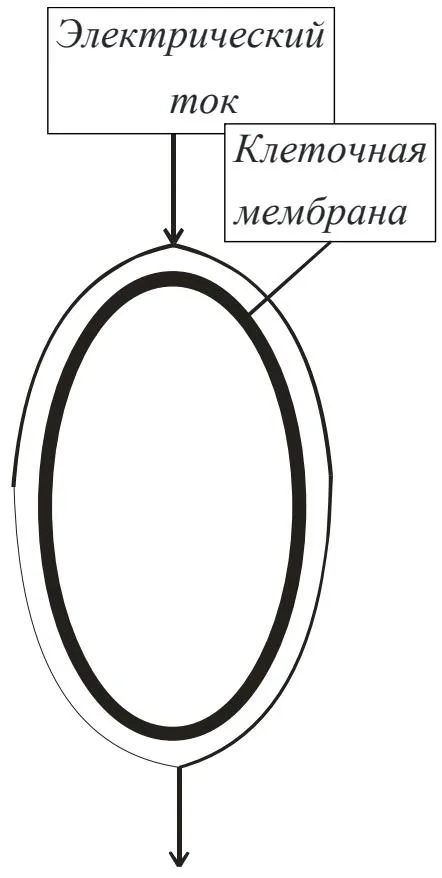
If we into the capacitor place the multilayer material, which consists of n the parallel layers of material 1 with the overall thickness and n the layers of material 2 with the overall thickness , that the main equivalent parameters of heterogeneous filling will be determined by formulas (3.1) and (3.5). As a result Maxwell-Wagner effect the value of the low-frequency permeability of heterogeneous filling proves to be greater than permeability value of each individual part and . For example if much more and , the attitude much more than one with much more than one. Maxwell-Wagner effect in the suspension of biological cells is considerably more complex than in two-layered capacitor. However, the results of the analysis of this effect in both layers are similar. For the qualitative analysis of relaxation explanations introduced equivalent diagram (Fig. 7), approximately describing average biological cell in the suspension [13]. Electric current in the cell and its nearest environment is shown in Fig. 7. It consists of two parts. Current passing through the cellular membrane and the internal part of the cell, is elements and equivalent diagram, while the current, which flows along the environment near the cell, is the elements , . Admittance on the contacts of diagram in Fig. 8 it is equal
where , , .
If we consider that the biological material consists of such average cells, then the layer of material, placed into the capacitor, can be considered as the system, which consists of many equivalent diagrams, which present separate cell and connected together in different sequential or parallel combinations. For example, if N - the number of cells per unit of volume of material, A - the area of the plates of capacitor, d - the distance between the plates, then the volume of material Ad can be considered parallel combination from the diagrams, each of which presents sequential combination from the simple equivalent diagrams. Then the admittance, measured on the contacts of capacitor will be
Where the brackets [] indicate the greatest integer value of value.
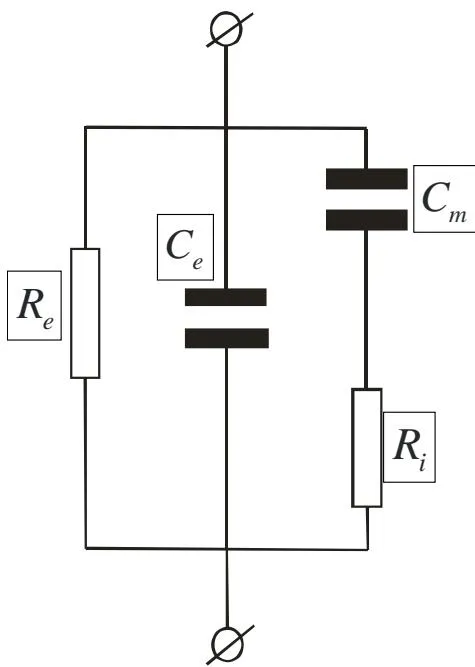
Proximate analysis shows that the basic parameters of medium are simply connected with the equivalent admittance of cell, which has the same dispersion. As a result the assumptions, accepted with the analysis, expression for the equivalent admittance (3.6) takes the same form as expression for the permeability of material with the dipole relaxation, characterized by the unique value of relaxation time .
In the general case of dispresiya type b it is characterized by the time allocation of relaxation. The carried out consideration shows that dispersion of the type b with the electrically heterogeneous structure of cell. An order of magnitude of relaxation time can be estimated, examining typical cell. Capacity and complete conductance enter into expression for the relaxation time. In the first approximation, capacity is connected with the membrane of cell and possible are to assume that proportional , where r - a radius of cell, t - the thickness of the membrane, - the dielectric constant of the membrane. Analogously conductivity is connected with the current in the cell and must depend on the conductivity of media inside and outside the cell. Since these media have approximately identical conductivity , possible is to assume that proportional , then relaxation time is obtained order for the typical parameters of the cell , , , , , which corresponds to central frequency about 6 MHz. In the cloths, which consist of the cells of large radii, the dispersion of such type is observed with the lower frequencies.
Dispersion of the type c occurs at the higher frequencies and is caused by the dipole relaxation of the free water, which is contained in the cloth.
It should be noted that the frequency of dispersion is the higher, the less the physical dimensions of structure. The dispersion, connected with the cell, occurs at the low frequencies. Finally dispersion at the high frequencies is connected with the presence of water.
IV. TECHNICAL REALIZATION OF EXPERIMENTS ON A STUDY OF THE INFLUENCE OF CURRENTS IN THE SOIL ON ITS FERTILITY
In the previous division it is shown that the currents of different frequency, which flow through the soil and the root system of plants, differently penetrate the root system, therefore, and the influence of these currents on the cells of root system is different. This circumstance can influence an increase in the plants, and, therefore, also to their increase and productivity. It is shown also, that depending on current frequency they penetrate into the soil to different depth, which gives the possibility to localize time currents in its surface layer. This gives the possibility to economize energy, which must be expended on the excitation of such currents. The second important circumstance is the fact that with the aid of such currents it is possible to warm thoroughly soil both before the sowing and during an increase in the plants.
The procedure examined is separately productive in the hot-houses or over the small areas, which are characteristic for the homestead sections.
The realization of this procedure is characterized by laying into the soil of the bare wires, to which is connected the electric generator of the corresponding frequency and power. The distance between similar is selected by wires depending on the method of fitting the plants in the hot-house. For example, cucumbers are planted in the hot-houses by numbers; therefore its pair of wires is necessary for each such number. With the debarkation of plants it follows to embed by jack method into the soil several lines of the wires at the specific distance, after connecting between themselves even and odd lines. The procedure examined makes it possible in one and the same hot-house to carry out the comparisons of an increase in the plants, when currents act on the root system and when they do not act. For this generator they connect to the specific pair of wires, after leaving rest without the nourishment. It is possible to also carry out the comparison of an increase in the plants in one and the same hot-house, introducing into different pairs of wires the currents of different frequency and power.
The obtained results can be used for developing the technical task for the industrial production of generators for the purposes indicated.
V. CONCLUSION
In the article questions of the penetration of the electric currents of different frequency into the soil are examined. Is built the electric analogue of the organic cellular structures, which the root system of plants is. The dispersion properties of such structures are explained. The technical realization of experiments on a study of the influence of high-frequency currents in the soil on its fertility is proposed.