
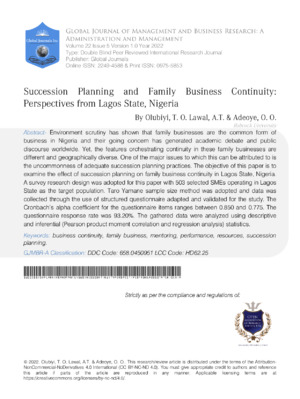

Succession Planning and Family Business Continuity: Perspectives from Lagos State, Nigeria

1
Olubiyi, Timilehin Olasoji
2
Olubiyi
Olubiyi
3
Timilehin Olasoji
Timilehin Olasoji
1 Babcock University

Send Message

To: Author

GJMBR Volume 22 Issue A5

Article Fingerprint

ReserarchID

GZR1L

Succession Planning and Family Business Continuity: Perspectives from Lagos State, Nigeria Banner
  • English
  • Afrikaans
  • Albanian
  • Amharic
  • Arabic
  • Armenian
  • Azerbaijani
  • Basque
  • Belarusian
  • Bengali
  • Bosnian
  • Bulgarian
  • Catalan
  • Cebuano
  • Chichewa
  • Chinese (Simplified)
  • Chinese (Traditional)
  • Corsican
  • Croatian
  • Czech
  • Danish
  • Dutch
  • Esperanto
  • Estonian
  • Filipino
  • Finnish
  • French
  • Frisian
  • Galician
  • Georgian
  • German
  • Greek
  • Gujarati
  • Haitian Creole
  • Hausa
  • Hawaiian
  • Hebrew
  • Hindi
  • Hmong
  • Hungarian
  • Icelandic
  • Igbo
  • Indonesian
  • Irish
  • Italian
  • Japanese
  • Javanese
  • Kannada
  • Kazakh
  • Khmer
  • Korean
  • Kurdish (Kurmanji)
  • Kyrgyz
  • Lao
  • Latin
  • Latvian
  • Lithuanian
  • Luxembourgish
  • Macedonian
  • Malagasy
  • Malay
  • Malayalam
  • Maltese
  • Maori
  • Marathi
  • Mongolian
  • Myanmar (Burmese)
  • Nepali
  • Norwegian
  • Pashto
  • Persian
  • Polish
  • Portuguese
  • Punjabi
  • Romanian
  • Russian
  • Samoan
  • Scots Gaelic
  • Serbian
  • Sesotho
  • Shona
  • Sindhi
  • Sinhala
  • Slovak
  • Slovenian
  • Somali
  • Spanish
  • Sundanese
  • Swahili
  • Swedish
  • Tajik
  • Tamil
  • Telugu
  • Thai
  • Turkish
  • Ukrainian
  • Urdu
  • Uzbek
  • Vietnamese
  • Welsh
  • Xhosa
  • Yiddish
  • Yoruba
  • Zulu

Environment scrutiny has shown that family businesses are the common form of business in Nigeria and their going concern has generated academic debate and public discourse worldwide. Yet, the features orchestrating continuity in these family businesses are different and geographically diverse. One of the major issues to which this can be attributed to is the uncommonness of adequate succession planning practices. The objective of this paper is to examine the effect of succession planning on family business continuity in Lagos State, Nigeria. A survey research design was adopted for this paper with 503 selected SMEs operating in Lagos State as the target population. Taro Yamane sample size method was adopted and data was collected through the use of structured questionnaire adapted and validated for the study. The Cronbach’s alpha coefficient for the questionnaire items ranges between 0.850 and 0.775. The questionnaire response rate was 93.20%. The gathered data were analyzed using descriptive and inferential (Pearson product moment correlation and regression analysis) statistics.

Funding

No external funding was declared for this work.

Conflict of Interest

The authors declare no conflict of interest.

Ethical Approval

No ethics committee approval was required for this article type.

Data Availability

Not applicable for this article.

Olubiyi, Timilehin Olasoji. 2026. \u201cSuccession Planning and Family Business Continuity: Perspectives from Lagos State, Nigeria\u201d. Global Journal of Management and Business Research - A: Administration & Management GJMBR-A Volume 22 (GJMBR Volume 22 Issue A5): .

Download Citation

Alt text: Sustainable development and business continuity in Nigeria's Lagos State.
Issue Cover
GJMBR Volume 22 Issue A5
Pg. 27- 34
Journal Specifications

Crossref Journal DOI 10.17406/GJMBR

Print ISSN 0975-5853

e-ISSN 2249-4588

Keywords
Classification
DDC Code: 658.0450951 LCC Code: HD62.25
Version of record

v1.2

Issue date

July 2, 2022

Language

English

Experiance in AR

The methods for personal identification and authentication are no exception.

Read in 3D

The methods for personal identification and authentication are no exception.

Article Matrices
Total Views: 1627
Total Downloads: 31
2026 Trends
Research Identity (RIN)
Related Research

Published Article

Environment scrutiny has shown that family businesses are the common form of business in Nigeria and their going concern has generated academic debate and public discourse worldwide. Yet, the features orchestrating continuity in these family businesses are different and geographically diverse. One of the major issues to which this can be attributed to is the uncommonness of adequate succession planning practices. The objective of this paper is to examine the effect of succession planning on family business continuity in Lagos State, Nigeria. A survey research design was adopted for this paper with 503 selected SMEs operating in Lagos State as the target population. Taro Yamane sample size method was adopted and data was collected through the use of structured questionnaire adapted and validated for the study. The Cronbach’s alpha coefficient for the questionnaire items ranges between 0.850 and 0.775. The questionnaire response rate was 93.20%. The gathered data were analyzed using descriptive and inferential (Pearson product moment correlation and regression analysis) statistics.

Our website is actively being updated, and changes may occur frequently. Please clear your browser cache if needed. For feedback or error reporting, please email [email protected]
×

This Page is Under Development

We are currently updating this article page for a better experience.

Request Access

Please fill out the form below to request access to this research paper. Your request will be reviewed by the editorial or author team.
X

Quote and Order Details

Contact Person

Invoice Address

Notes or Comments

This is the heading

Lorem ipsum dolor sit amet, consectetur adipiscing elit. Ut elit tellus, luctus nec ullamcorper mattis, pulvinar dapibus leo.


High-quality academic research articles on global topics and journals.

Succession Planning and Family Business Continuity: Perspectives from Lagos State, Nigeria

Olubiyi
Olubiyi
Timilehin Olasoji
Timilehin Olasoji

Research Journals





























































