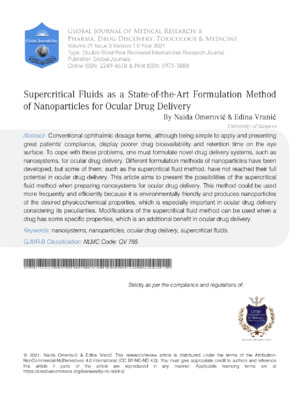
Supercritical Fluids as a State-of-the-Art Formulation Method of Nanoparticles for Ocular Drug Delivery

α
Naida Omerovic
Naida Omerovic
σ
Naida Omerović
Naida Omerović
ρ
Edina Vranić
Edina Vranić
α to σ University of Sarajevo University of Sarajevo

Send Message

To: Author

Supercritical Fluids as a State-of-the-Art Formulation Method of Nanoparticles for Ocular Drug Delivery

Article Fingerprint

ReserarchID

PDDTM9JW72

Supercritical Fluids as a State-of-the-Art Formulation Method of Nanoparticles for Ocular Drug Delivery Banner

AI TAKEAWAY

Connecting with the Eternal Ground
  • English
  • Afrikaans
  • Albanian
  • Amharic
  • Arabic
  • Armenian
  • Azerbaijani
  • Basque
  • Belarusian
  • Bengali
  • Bosnian
  • Bulgarian
  • Catalan
  • Cebuano
  • Chichewa
  • Chinese (Simplified)
  • Chinese (Traditional)
  • Corsican
  • Croatian
  • Czech
  • Danish
  • Dutch
  • Esperanto
  • Estonian
  • Filipino
  • Finnish
  • French
  • Frisian
  • Galician
  • Georgian
  • German
  • Greek
  • Gujarati
  • Haitian Creole
  • Hausa
  • Hawaiian
  • Hebrew
  • Hindi
  • Hmong
  • Hungarian
  • Icelandic
  • Igbo
  • Indonesian
  • Irish
  • Italian
  • Japanese
  • Javanese
  • Kannada
  • Kazakh
  • Khmer
  • Korean
  • Kurdish (Kurmanji)
  • Kyrgyz
  • Lao
  • Latin
  • Latvian
  • Lithuanian
  • Luxembourgish
  • Macedonian
  • Malagasy
  • Malay
  • Malayalam
  • Maltese
  • Maori
  • Marathi
  • Mongolian
  • Myanmar (Burmese)
  • Nepali
  • Norwegian
  • Pashto
  • Persian
  • Polish
  • Portuguese
  • Punjabi
  • Romanian
  • Russian
  • Samoan
  • Scots Gaelic
  • Serbian
  • Sesotho
  • Shona
  • Sindhi
  • Sinhala
  • Slovak
  • Slovenian
  • Somali
  • Spanish
  • Sundanese
  • Swahili
  • Swedish
  • Tajik
  • Tamil
  • Telugu
  • Thai
  • Turkish
  • Ukrainian
  • Urdu
  • Uzbek
  • Vietnamese
  • Welsh
  • Xhosa
  • Yiddish
  • Yoruba
  • Zulu

Abstract

Conventional ophthalmic dosage forms, although being simple to apply and presenting great patients’ compliance, display poorer drug bioavailability and retention time on the eye surface. To cope with these problems, one must formulate novel drug delivery systems, such as nanosystems, for ocular drug delivery. Different formulation methods of nanoparticles have been developed, but some of them, such as the supercritical fluid method, have not reached their full potential in ocular drug delivery. This article aims to present the possibilities of the supercritical fluid method when preparing nanosystems for ocular drug delivery. This method could be used more frequently and efficiently because it is environmentally friendly and produces nanoparticles of the desired physicochemical properties, which is especially important in ocular drug delivery considering its peculiarities. Modifications of the supercritical fluid method can be used when a drug has some specific properties, which is an additional benefit in ocular drug delivery.

References

61 Cites in Article
  1. Vincent Lee,Joseph Robinson (1986). Topical Ocular Drug Delivery: Recent Developments and Future Challenges.
  2. E Runkle,David Antonetti (2011). The Blood-Retinal Barrier: Structure and Functional Significance.
  3. Naida Omerović,Edina Vranić (2020). Application of nanoparticles in ocular drug delivery systems.
  4. Arto Urtti (2006). Challenges and obstacles of ocular pharmacokinetics and drug delivery.
  5. Ashaben Patel,K Cholkar,V Agrahari,A Mitra (2013). Ocular drug delivery systems: An overview.
  6. Przemysław Baranowski,Bożena Karolewicz,Maciej Gajda,Janusz Pluta (2014). Ophthalmic Drug Dosage Forms: Characterisation and Research Methods.
  7. S Reimondez-Troitiño,N Csaba,M Alonso,M De La Fuente (2015). Nanotherapies for the treatment of ocular diseases.
  8. Kishore Cholkar,Ashaben Patel,Aswani Dutt Vadlapudi,Ashim K. Mitra (2012). Novel Nanomicellar Formulation Approaches for Anterior and Posterior Segment Ocular Drug Delivery.
  9. Patrizia Paolicelli,Cecilia Prego,Alejandro Sanchez,Maria Alonso (2010). Surface-Modified PLGA-Based Nanoparticles That Can Efficiently Associate and Deliver Virus-Like Particles.
  10. Pierre Kondiah,Yahya Choonara,Pariksha Kondiah,Thashree Marimuthu,Pradeep Kumar,Lisa Du Toit,Girish Modi,Viness Pillay (2018). Nanocomposites for therapeutic application in multiple sclerosis.
  11. I Muhamad,S Selvakumaran,N Lazim (2014). Designing polymeric nanoparticles for targeted drug delivery system.
  12. R Müller,M Radtke,S Wissing (2002). Solid lipid nanoparticles (SLN) and nanostructured lipid carriers (NLC) in cosmetic and dermatological preparations.
  13. M Üner,G Yener (2007). Importance of solid lipid nanoparticles (SLN) in various administration routes and future perspectives.
  14. Rajashree Hirlekar,Harshal Garse,Vilasrao Kadam (2011). Solid Lipid Nanoparticles and Nanostructured Lipid Carriers: A Review.
  15. Ripal Gaudana,Hari Ananthula,Ashwin Parenky,Ashim Mitra (2010). Ocular Drug Delivery.
  16. Aniruddha Amrite,Uday Kompella (2005). Size-dependent disposition of nanoparticles and microparticles following subconjunctival administration.
  17. Aniruddha Amrite,Henry Edelhauser,Uday Kompella (2008). Modeling of Corneal and Retinal Pharmacokinetics after Periocular Drug Administration.
  18. Narayan Cheruvu,Aniruddha Amrite,Uday Kompella (2008). Effect of Eye Pigmentation on Transscleral Drug Delivery.
  19. Narayan Cheruvu,Aniruddha Amrite,Uday Kompella (2009). Effect of Diabetes on Transscleral Delivery of Celecoxib.
  20. U Kompella,S Sundaram,S Raghava,E Escobar (2006). Luteinizing hormone-releasing hormone agonist and transferrin functionalizations enhance nanoparticle delivery in a novel bovine ex vivo eye model.
  21. Esther Eljarrat-Binstock,Faik Orucov,Yanir Aldouby,Joseph Frucht-Pery,Abraham Domb (2008). Charged nanoparticles delivery to the eye using hydrogel iontophoresis.
  22. Hyuncheol Kim,Shaun Robinson,Karl Csaky (2009). Investigating the Movement of Intravitreal Human Serum Albumin Nanoparticles in the Vitreous and Retina.
  23. Vibhuti Agrahari,Abhirup Mandal,Vivek Agrahari,Hoang Trinh,Mary Joseph,Animikh Ray,Hicheme Hadji,Ranjana Mitra,Dhananjay Pal,Ashim Mitra (2016). A comprehensive insight on ocular pharmacokinetics.
  24. M Mudgil,N Gupta,M Nagpal,P Pawar (2012). Nanotechnology: a new approach for ocular drug delivery system.
  25. Pinto Reis,C Neufeld,R Ribeiro,A Veiga,F (2006). Nanoencapsulation I. Methods for preparation of drug-loaded polymeric nanoparticles.
  26. Q Fan,G Mani (2007). Dyeable polypropylene via nanotechnology.
  27. Amol Thote,Ram Gupta (2005). Formation of nanoparticles of a hydrophilic drug using supercritical carbon dioxide and microencapsulation for sustained release.
  28. Pratibhash Chattopadhyay,Ram Gupta (2001). Production of griseofulvin nanoparticles using supercritical CO2 antisolvent with enhanced mass transfer.
  29. E Reverchon,R Adami (2006). Nanomaterials and supercritical fluids.
  30. Albertina Cabañas,Martyn Poliakoff (2001). The continuous hydrothermal synthesis of nano-particulate ferrites in near critical and supercritical water.
  31. François Cansell,Cyril Aymonier (2009). Design of functional nanostructured materials using supercritical fluids.
  32. Ke Wu,Jing Li,Wayne Wang,Denita Winstead (2009). Formation and characterization of solid dispersions of piroxicam and polyvinylpyrrolidone using spray drying and precipitation with compressed antisolvent.
  33. E Reverchon,G Della Porta,A Di Trolio,S Pace (1998). Supercritical Antisolvent Precipitation of Nanoparticles of Superconductor Precursors.
  34. Bala Subramaniam,Roger Rajewski,Kirk Snavely (1997). Pharmaceutical Processing with Supercritical Carbon Dioxide.
  35. Markku Rantakylä,Matti Jäntti,Olli Aaltonen,Markku Hurme (2002). The effect of initial drop size on particle size in the supercritical antisolvent precipitation (SAS) technique.
  36. Scott Sellers,Graham Clark,Robert Sievers,John Carpenter (2001). Dry powders of stable protein formulations from aqueous solutions prepared using supercritical CO2‐assisted aerosolization.
  37. R Sievers,Ets Huang,J Villa,G Engling,P Brauer (2003). Micronization of water-soluble or alcohol-soluble pharmaceuticals and model compounds with a low-temperature Bubble Dryer®.
  38. E Reverchon,G Della Porta (2003). Particle Design Using Supercritical Fluids.
  39. E Reverchon,G Della Porta (2003). Micronization of antibiotics by supercritical assisted atomization.
  40. Chandra Vemavarapu,Matthew Mollan,Mayur Lodaya,Thomas Needham (2005). Design and process aspects of laboratory scale SCF particle formation systems.
  41. Amyn Teja,Charles Eckert (2000). Commentary on Supercritical Fluids: Research and Applications.
  42. Andre Blasig,Chunmei Shi,Robert Enick,Mark Thies (2002). Effect of Concentration and Degree of Saturation on RESS of a CO<sub>2</sub>-Soluble Fluoropolymer.
  43. Sang-Do Yeo,Erdogan Kiran (2005). Formation of polymer particles with supercritical fluids: A review.
  44. Mohammed Meziani,Pankaj Pathak,Ya-Ping Sun (2009). Supercritical Fluid Technology for Nanotechnology in Drug Delivery.
  45. Jennifer Jung,Michel Perrut (2001). Particle design using supercritical fluids: Literature and patent survey.
  46. Pratik Sheth,Harpreet Sandhu,Dharmendra Singhal,Waseem Malick,Navnit Shah,M Serpil Kislalioglu (2012). Nanoparticles in the Pharmaceutical Industry and the Use of Supercritical Fluid Technologies for Nanoparticle Production.
  47. B Helfgen,M Türk,K Schaber (2000). Theoretical and experimental investigations of the micronization of organic solids by rapid expansion of supercritical solutions.
  48. Markus Weber,Mark Thies (2002). Understanding the RESS Process.
  49. Ranjit Thakur,Ram Gupta (2005). Rapid Expansion of Supercritical Solution with Solid Cosolvent (RESS−SC) Process: Formation of Griseofulvin Nanoparticles.
  50. Ranjit Thakur,Ram Gupta (2006). Rapid expansion of supercritical solution with solid cosolvent (RESS-SC) process: Formation of 2-aminobenzoic acid nanoparticle.
  51. Ranjit Thakur,Ram Gupta (2006). Formation of phenytoin nanoparticles using rapid expansion of supercritical solution with solid cosolvent (RESS-SC) process.
  52. T Young,S Mawson,K Johnston,I Henriksen,G Pace,A Mishra (2000). Rapid Expansion from Supercritical to Aqueous Solution to Produce Submicron Suspensions of Water-Insoluble Drugs.
  53. Jiahui Hu,Keith Johnston,Robert Williams (2004). Nanoparticle Engineering Processes for Enhancing the Dissolution Rates of Poorly Water Soluble Drugs.
  54. Xiaoxia Chen,Timothy Young,Marazban Sarkari,Robert Williams,Keith Johnston (2002). Preparation of cyclosporine A nanoparticles by evaporative precipitation into aqueous solution.
  55. Xianmin Kwauk,Pablo Debenedetti (1993). Mathematical modeling of aerosol formation by rapid expansion of supercritical solutions in a converging nozzle.
  56. Ernesto Reverchon,Paolo Pallado (1996). Hydrodynamic modeling of the RESS process.
  57. P Hirunsit,Z Huang,T Srinophakun,M Charoenchaitrakool,S Kawi (2005). Particle formation of ibuprofen–supercritical CO2 system from rapid expansion of supercritical solutions (RESS): A mathematical model.
  58. Michael Türk (2000). Influence of thermodynamic behaviour and solute properties on homogeneous nucleation in supercritical solutions.
  59. B Helfgen,P Hils,C Holzknecht,M Türk,K Schaber (2001). Simulation of particle formation during the rapid expansion of supercritical solutions.
  60. Markus Weber,Lynn Russell,Pablo Debenedetti (2002). Mathematical modeling of nucleation and growth of particles formed by the rapid expansion of a supercritical solution under subsonic conditions.
  61. C Lengsfeld,J Delplanque,V Barocas,T Randolph (2000). Mechanism Governing Microparticle Morphology during Precipitation by a Compressed Antisolvent: Atomization vs Nucleation and Growth.

Funding

No external funding was declared for this work.

Conflict of Interest

The authors declare no conflict of interest.

Ethical Approval

No ethics committee approval was required for this article type.

Data Availability

Not applicable for this article.

How to Cite This Article

Naida Omerovic. 2021. \u201cSupercritical Fluids as a State-of-the-Art Formulation Method of Nanoparticles for Ocular Drug Delivery\u201d. Global Journal of Medical Research - B: Pharma, Drug Discovery, Toxicology & Medicine GJMR-B Volume 21 (GJMR Volume 21 Issue B3): .

Download Citation

High-quality alt text emphasizing the research focus on nanocarriers for ocular drug delivery and supercritical fluids.
Journal Specifications

Crossref Journal DOI 10.17406/gjmra

Print ISSN 0975-5888

e-ISSN 2249-4618

Keywords
Classification
GJMR-B Classification: NLMC Code: QV 785
Version of record

v1.2

Issue date

October 27, 2021

Language
en
Experiance in AR

Explore published articles in an immersive Augmented Reality environment. Our platform converts research papers into interactive 3D books, allowing readers to view and interact with content using AR and VR compatible devices.

Read in 3D

Your published article is automatically converted into a realistic 3D book. Flip through pages and read research papers in a more engaging and interactive format.

Article Matrices
Total Views: 1979
Total Downloads: 913
2026 Trends
Related Research

Published Article

Conventional ophthalmic dosage forms, although being simple to apply and presenting great patients’ compliance, display poorer drug bioavailability and retention time on the eye surface. To cope with these problems, one must formulate novel drug delivery systems, such as nanosystems, for ocular drug delivery. Different formulation methods of nanoparticles have been developed, but some of them, such as the supercritical fluid method, have not reached their full potential in ocular drug delivery. This article aims to present the possibilities of the supercritical fluid method when preparing nanosystems for ocular drug delivery. This method could be used more frequently and efficiently because it is environmentally friendly and produces nanoparticles of the desired physicochemical properties, which is especially important in ocular drug delivery considering its peculiarities. Modifications of the supercritical fluid method can be used when a drug has some specific properties, which is an additional benefit in ocular drug delivery.

Our website is actively being updated, and changes may occur frequently. Please clear your browser cache if needed. For feedback or error reporting, please email [email protected]

Request Access

Please fill out the form below to request access to this research paper. Your request will be reviewed by the editorial or author team.
X

Quote and Order Details

Contact Person

Invoice Address

Notes or Comments

This is the heading

Lorem ipsum dolor sit amet, consectetur adipiscing elit. Ut elit tellus, luctus nec ullamcorper mattis, pulvinar dapibus leo.

High-quality academic research articles on global topics and journals.

Supercritical Fluids as a State-of-the-Art Formulation Method of Nanoparticles for Ocular Drug Delivery

Naida Omerović
Naida Omerović University of Sarajevo
Edina Vranić
Edina Vranić

Research Journals