I. INTRODUCTION
Rising global competition and the increasing costs of natural resources today as well as customers demands for higher product quality, greater product selection, and better customer service have created new challenges for manufacturing industries. Companies today are increasingly dealing with supplier and customer local and from all corners of the globe. In the recent competitive market, producing value-added, high quality and innovative products have come out as the fundamental tactic for manufacturing companies to stay alive. Manufacturing industries in different nations have taken on numerous performance improvement programs and developed new operating viewpoint to enhance the way they operate to stay competitive Agus (2015). However, among those improvement programs, supply chain integration has become an integral part of corporate strategy and its adoption in manufacturing companies has steadily accelerated since the 1980s. Although, effective supply chain management and supply chain (SC) integration are becoming increasingly critical factors for business success Wang & Cassivi (2006), Georgise et al (2014). Moreover, Supply chain integration can be defined as the degree to which a firm can strategically work together with its supply chain partners and cooperatively manage intra- and inter-organizational processes to achieve effective and efficient flows of products, services, information, money, and decisions to provide the maximum value to the final customer with low costs and high speed Huo(2012). Science, supply chain integration provided evidence of their potential joint positive impact on competitiveness and firm performance DeWitt (2006). Supply chain Scholars shows the importance of Supply Chain practice to firms' their competitive strategies and advantage as well as can improve organization performance Lambert and Cooper (2000), Birhanu (2014), Pathak (2015) Rao (2015). According to Bekele (2008), Gebreeyesus & Sonob (2011), Sarmiento & Nagi (2012), Georgise et al (2014) states that, the performance of an organization is influenced to a greater or lesser degree by the actions of the organizations that integrate the inputs and the supply chain at large extents. Even though, the impact of supply chain integration practices vary, depending on the type of firm trick and there are no commonly accepted concepts the impact of supply chain integration on performance. In addition, there is very little empirical evidence as how different supply chain integration influence various types of company performance. For example, Koufteros et al (2007), studies elaborate the sole roles of supplier integration or customer integration in improving performance. Some recent studies also consider both internal and external integration impact to performance, Swink et al (2007), Flynn et al (2010). Moreover, Huo (2012) supply chain research supply chain integration can be viewed as internal and external integrative capabilities that lead directly or indirectly to company performance. Even though, most of the previous studies that address the relationship between supply chain integration and performance but no researches are conducted which components of supply chain integration highly impact on performance. There is a pay little attention to scholarly work focusing on explicitly the impact of various dimensions of supply chain relationships (such as knowledge, production & design, technology and resource) on performance, rather the general supply chain integrations (internal and external integrations) impacts. A key question is whether the implementation of supply chain integration (such as knowledge, production & design, technology and resource) can make an impact on company quality performance? This paper intends to filling this gap by using data collects from literature review on significant value in supply chain integration and practices is apply.
In addition, the previous research work on supply chain shows that, the significance role of manufacturing industries to improve their efficiency and Competitive advantage Fabbe-Costes et al (2008), Wang (2010), Alfalla-Luque et al (2013), Otchere et al (2013). The strategic supply chain integrating with suppliers to customer implies to improved operations and overall performances of the firms Kim (2009), Flynn et al (2009). Despite these efforts, in the East Africa basic metal industries has not yet made their share of markets and their contribution still low. Meanwhile, the basic metal industries of developing countries doesn't get enough attention and are not studied well and seems to be isolated from global literature Georgise et al (2014), Msimangira & Tesha (2014). Few studies describe and show that the Ethiopian manufacturing industries including basic metal industries have various challenges and obstacles hamper their productivity, performance and competitiveness Dagne Birhanu (2009), Tolossa et al (2013), Georgise et al (2014). But up to now there is no effort to investigate the effect of supply chain integration on basic metal industry to impact quality performance of basic metal industries in the country. Consequently, this study addresses impact of quality performance improvements through supply chain integration in manufacturing industries. This factors that influence quality performance include knowledge, technology, resource utilization, production and design integration are considered. However, the study analyzes those significant achievement factors of quality performance related to supply chain integration (SCI). In the next section, we will review related literature and develop hypotheses by proposing a conceptual model, ahead of describing the methodology and presenting the results of analysis. We provide a discussion of the findings and managerial implications. Finally, we present the conclusions, limitations, and suggestions for future research.
II. RESEARCH MATERIAL AND METHODS
To test these hypotheses empirically we apply AHN (Open Decision maker). The Open Decision Makes enables you to find the best alternative for a defined goal with the AHP (Analytic Hierarchy Process) method. following the methodology successfully used in previous papers Alfalla-Luque et al(2012), Maleki et al (2013), we adopt a literature survey as the strategy for collecting data, and to identify valid measures, and then adapted existing scales to measure supply chain integration and company performance is analyze. In order to achieve the objective, we use online databases and library services such as Taylor & Francis (www.tandfonline.com), Emerald (www.emeraldinsight.com), ELSEVIER (www.elsevier.co), www.sciencedirect.com and other related sources, journal articles, reports, policies, standards and manuals were obtained from these selected databases. A search of articles published between 2000 and 2016 identify with the key words including Supply chain, integration, Quality, Performance, Global Supply chain, Basic metal, performance measurement and logistics are used for searching and screening. Depending on the significance of the material, through abstract and keyword screening operation are make and the collected data are further reduce. The screening and reducing materials also again brought down to the most important data considering recent publications, reading methodology and result of the papers. From total of 125 articles 13 articles are selected and use for the analysis. Finally, it has been filter out to for this literature purpose write up. It is difficult to include all documents that made contribution to the field. At last, 13 articles were collected as the samples area. The objective is to focus on how supply chain integration impact on performance of manufacturing industries, to see current state of the art of the researches peak and to identify the gaps from previously conducted researches. The gaps that exist can be filled by the overall research works considering further research areas.
III. LITERATURE REVIEW
a) Supply chain integration
A enormous deal of research has been done on the importance of integrating suppliers, manufacturers, distributors, retailers, and customers Huo (2012), Rehme, (2012), Hatani et al(2013), Rakhman et al (2016). Even though, the supply chain integration is relatively new as an area of research, although there is an extensive body of research on uni-dimensional supply chain relationships, examining collaborative relationships between a manufacturer and either its customers or suppliers Flynn et al(2009). supply chain integration continues to be a key theme amongst those seeking to understand how to harness the potential of the supply chain to create sustainable value. Kannan & Tan(2010) supply chain integration is the strategic integration of both intra- and inter-organizational processes and gauges the extent to which supply chain partners work collaboratively together to gain reciprocally beneficial outcomes. Supply chain integration means the co-operation between various functions in the supply chain. The degree to which an organization strategically collaborates with its partners and manages intra and inter-organizational processes in order to achieve efficient and effective flows of products, services, information, money and decisions Halme (2010). An effective and efficient supply chain integration achieves the well defined flows of products and services, information, money and decisions, to provide maximum value to the customer at low cost and high speed Flynn et al (2009). Integration can be characterized by cooperation, collaboration, information sharing, trust, partnerships, shared technology, and a fundamental shift away from managing individual functional processes, to managing integrated chains of processes Power (2005, Krishnapriya (2014)). Supply chain member organizations integrate in to three dimensions customer, supplier and internal integration. This dimensions are considered as independent variables of supply chain integrations on manufacturing industries Flynn.et.al (2009), Otchere.et.al (2013). Furthermore, Study describes as, Successful coordination and integration of supply chains for all the activities associated with moving goods from the raw materials stage through to the end user for sustainable competitive advantage Lambert and Cooper (2000). World-class organizations now realize that non-integrated manufacturing processes, non-integrated distribution processes and poor relationships with suppliers and customers are inadequate for their success. the success coordination, integration management of key business across the member of supply chain will determine the ultimate success of the single industry Vorst (2000). Different supply chain integration level and various dimension of supply chain integrations are essential to ensure enhanced significance in supply chains. In most modern systems, the wisdom is it's better to do what you do best and own a very limited asset. Nearly everything is outsourced but the brand and distribution process integration with supply chain partners Ray (2013). However, in the developing Country manufacturing industry, supply integration still infant. According to Getahun (2012) investigates that, lack of supply integration and customer integration within the garment industry, have the potential to affect the quality and competitive advantage of the sector. Negussie (2014) supply chain evaluation study shows that developing nation leather industries are suffering from the shortage of raw material (hides and skins) as well as its quality problem. Companies in developing countries need to integrate their operations, especially the sourcing processes into the global supply chain Georgise (2014), Msimangira (2014) and some sectors are fragmental and infant integration including basic metal industries Xiong & Helo (2008). Hence it is an important issue, to study and implement supply chain strategy for developing nation manufacturing industries. However, we intended to study and implement integrated supply chains systems for basic metal industries, order to bring the improvement of basic metal industry performance. The study investigate the relation between supply chain integration and quality performance with associated resource, knowledge, technology, production & design is address.
b) Quality
Although there are several definitions of quality, simply put, quality can be defined as meeting or exceeding customer expectations Evans & Lindsay (2002). When we buy something we know almost without thinking about it whether it has a high quality or not. Producing items of the highest possible quality has become more and more important over recent years due to ever increasing competition between the companies who manufacture the items and the ever increasing demands of the consumer for better quality items that perform better and last longer. Therefore the pursuit of quality has developed into a science among manufacturing companies and much time and effort is spent in this area. Quality can be a confusing concept as it has different meanings to different people depending on whether they are the producers of a product or the users of it. Various definitions are available by quality gurus such as Deming, Crosby, Juran, Feigenbaum and Ishikawa. dictionary definitions of quality have their core terms like "degree of excellence", "relative nature", or "kind or character", and usually go on to equate quality with high rank or greater standing Patel (1994). Currently, an increasing number of product recalls are occurring. Such product recall incidents have resulted in serious customer dissatisfaction and significant company losses in both image and business. Because of this, quality is a critical requirement for customers, especially in the case of expensive and complex products. According to Lee (2013) states that, to ensure product quality collaboratively becomes a vital task for the companies along the supply chain. However, in its most general connotation, therefore, quality is seen as being value oriented. Quality is not absolute, it is always expressed as a relative term, take as example A is of better quality than B. Quality means different things to different people but a broad definition in relation to local government social services reads: Quality is the totality of features or characteristics of a service that bear on its ability to satisfy a given need.
This clearly indicates that quality is also judged on the customer's perception of how a service met their needs. However, there are a number of definitions that are generally accepted and used. Hence quality can be variously thought of as:
Product Conformance specification - Conformance quality is the degree to which a product's design and operating characteristics meet established standards. It reflects whether the various produced units are identically made and meet the specifications. Philip Crosby consider that, Conformance to requirements or specification and reliability as a test of quality, once a specification is established, quality can be said to be a matter of ensuring conformance to specification. It sets a level which is considered to be good enough and it results in an emphasis on inspection Birhanu Beshah&Dr.-Ing. Daniel Kitaw (2011), Board and Meyer-Ter-Vehn (2013).it is the capacity and process ability of the objects produces within the given specifications to full fill given the expectations.
Product Performance- Performance quality is the primary product characteristics. Performance quality refers to the levels at which the products primary characteristics operate. Buyers will pay more for better performance as long as the higher price does not exceed the higher perceived value. David A. Garvain categorized as Product Performance involves the various operating characteristics of the product. For a television set, for example, these characteristics will be the quality of the picture, sound and longevity of the picture tube and for an automobile, performance would include traits like acceleration handling, cruising speed, and comfort. In service businesses say, fast food and airlines performance often means prompt service Harvard Business Review (1987), No. 87603, Levine & Toffel (2010). Hence we argue that, quality performance is, the measurement of product on its capability operate within the intended requirements to meet the primary expectations and purposes.
c) The effect of Supply chain integration on Quality Performance
Alfalla-Luqu et al (2013), Annan et al (2013) literature review analyses shows that, how supply chain integration affects the overall supply chain performance in terms of efficiency and responsiveness. Even though Boyer (1999), Huo et al (2012) investigates, financial performance used as a key output measure of firm performance. In addition, other scholars use different performance measurements such as, Aishah et al(2013) used Long run competitiveness and Huo et al (2013) financial performance and operational performances us as output measures. on the other hand for example Huo et al (2013) to study the effect by using internal integration, process integration as indirect variables and in their study they use. when we say internal integration there are numerous components of internal integration, which one is likely related to financial performance? we should exactly tackle and show the exact effect integration components but their study is general. it needs for further investigations by using different indirect variables of Supply chain integration like knowledge, production and design, technology, so as to decide where finance or operational performances us as key performance measures?.on the other hand the previous studies have locate the limitations in relying using on financial performance measures in supply chain studies Johnson and Kaplan (1987). For example, numerical performance measures used as simple qualitative evaluations may not sufficiently illustrate firm performance. As a result, in this study, we take on quality performance to measure the benefits of supply chain integration. Supply chain integration can help companies to understand the requirements of customers, to work with customers in joint product design, manufacturing process, information exchange, and strategic accomplishment. For example, Tan (2001), Flynn et al (2010) found that internal integration could create a close link between manufacturing and distribution processes to deliver products and services in a timely and effective manner.
Competent external integration allows manufacturers to speed up product delivery processes, improve production planning and reduce inventory obsolescence using accurate information shearing about customer demands and preferences Swink et al, (2007), Flynn et al (2010). additionally, process integration facilitate manufacturers reduce error and enhance product quality through information sharing and joint planning, which are directly related to the manufacturers' operational performance, Petersen et al (2005), Huo et al (2013), Chi et al (2013). Research and development integration has a positive impact both on business performance and social performance, and that business performance serves as a mediator in the relationship between the integration of R&D-marketing and social performance Xu et al (2014). Hence without the cooperation of various functions, it is difficult for companies to collaborate with and meet the requirements of customers in a dynamic business environment. Thus, we propose our first set of hypotheses:
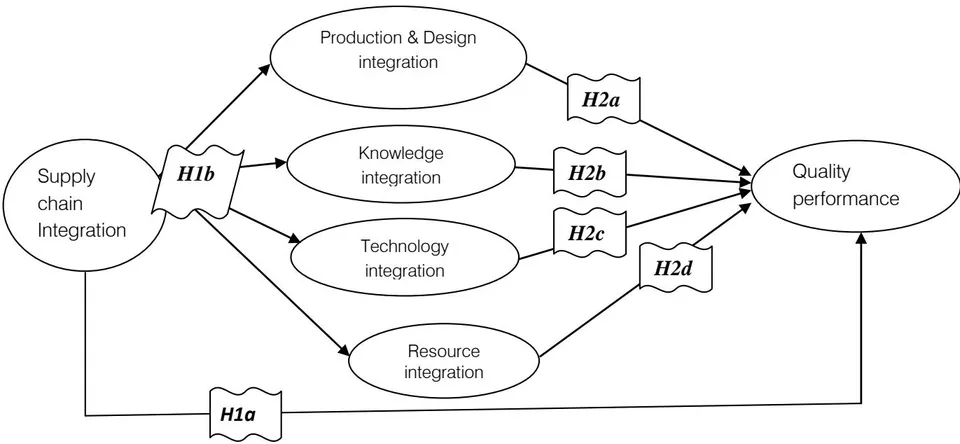
H1a: The level of Supply chain integration is positively impact with quality performance.
Few previous studies have investigated the impact of supply chain integration on the dimension of supply chains. We argue that the integration and cooperation between production process, knowledge, technology between internal& external firm, can facilitate the overall performance of the organizations. as a result, we propose:
H1b: Supply chain integration has an positively related on Production, knowledge, Technology and Resource integration in the supply chain on quality performance.
Supply chain integration plays an important role in the enhancement of quality performance. However, Supply chain integration enhances suppliers' understanding of the needs of the company, especially regarding the quality standards of raw materials, production and components. In addition, supply chain integration can improve information shearing, partnerships, joint planning, and product design with suppliers. Even though, According to Aishah et al (2013) supply chain integration directly impacted by different factors towards the performance of supply chain integration on the long term competitiveness and sustainable economic growth. However, very limited studies had been conducted on the effects of supply chain integration components in order to achieve long-term and sustainable economic growth. we propose the following hypothesis
H1c: Supply chain integration, through knowledge, Production, Technology and Resource integration, has an impact on quality performance of manufacturing industry.
Production integration with other functional areas and suppliers is a key aspect for achieving sustainable competitive advantage. Paiva et al (2011) analyze and found that the impact of manufacturing integration on performance. They found that production integration aspects are positively related to sales growth, but only manufacturing-R & D integration is positively related to profitability. Lin et al (2012) characterize the effect of vertical integration on profitability, product price, and quality in a competitive setting. Thus is no clear findings that shows the significant association between manufacturing integration and quality performance improvement. The diverse findings in the above studies the need for further investigation of the relationship between production integration with impact of on quality performance. as a result we propose
H2a. Production & Design integration is positively related quality performance on a supply chain.
In knowledge-based environments, necessity to develop a systematic approach to integrating knowledge resources throughout the industry in order to improve quality. The firm which is enhance the quality performance is comprises of accomplishing quality objectives in a convenient way and fortifying connections both inside and outside the boundaries of the firm Gardner et al(2011). integrating the firm into the knowledge features will abbreviate the correspondence chains between different departments.
The implementation of knowledge integration is an important factor for the firms in order to compete in the quality performance. Overall improvement in knowledge integration across the supply chain directly impact performance of supply chain. for establishing system-wide Knowles integration among supply chains will improve resource utilization, productivity growth, quality, delivery and flexibility of the supply chain. However, the tasks of knowledge integration is might differ from firm to firm and industry to industry. Our hypotheses capture these relationships by proposing that knowledge integration in a supply chain is a function of the extent of knowledge integration with impacts on quality performance within a firm. thus we propose
H2b: The knowledge integration positively impact and will improve quality performance.
We believe that a higher level of technological exchange and sharing is increase communication between manufacturer, suppliers and Customers, improve production capability and improves performance of supply chain. A higher level of untreated linkage between internal and external supply chain firms through an recognized technology improves the company, trust and relationship, thus improving the overall performance of supply chain. though we propose, this hypothesis
H2c: Technology integration positively impact quality performance.
Resources is viewed as the major organization driver in the global competitiveness. the quality and availability of resource an organization determines the success potential. integration and linkages facilitates product development, manufacturing, utilization and delivery efforts, which in turn has implications for quality, increased responsiveness to market changes, and the reduction of defects from the supply chain. This in turn will have implications for broader measures of quality and overall performance. we explore to hypotheses:
Authors& years (Ref.no) Integration types Performance measures Methodology Major findings Beheshti et al (2014) Internal integration and external (Supplier, Customer) integration Financial performance survey instrument and Data analysis by SPSS software. The findings show that supply chain integration at any level is beneficial to the financial performance, Companies with total supply chain integration reported the highest level of financial performance. Huo (2012) Internal integration, supplier integration Customer integration operational and financial performance Using data collected from 617 companies in China and the structural equation modeling method internal integration improves external integration and that internal and external integration directly and indirectly enhance company performance. Huo et al (2014) Internal integration,process integration, product integration, Financial performance Survey methodology was used to collect data and Hierarchical linear regression used to analyze the moderating effects. internal integration significantly affected the financial perform- ance of cost leaders, while process integration contributed more to the financial performance of differentiators. Seo et al (2014) innovativeness Integration supply chain integration (SCI) and supply chain performance A questionnaire survey and structural equation modeling were used Innovativeness in the supply chain had a positive impact on both supply chain integration and supply chain performance. internal and supplier integration fully mediated innovativeness-supply chain performance relationships, whereas customer integration had no mediating role on those relationships. Flynn et al (2009) customer, supplier and internal integration operational and business performance. the contingency approach, hierarchical regression was used to determine the impact and In the configuration approach, cluster analysis was used to develop patterns. the results indicated that internal and customer integration were more strongly related to improving performance than supplier integration. Yu et al (2014) Green supply chain management with Customers, Internal GSCMI, GSCM with Suppliers integration Operational performance in terms of flexibility, delivery, quality and cost use survey data collection and analyzed using structural equation modeling. This study generates important findings of the significant and positive relationships between IGSCM (internal, with customers and with suppliers) and operational performance in terms of flexibility, delivery, quality and cost. Gimenez et al(2012) Supply chain integration Cost performance survey-based research design is developed shows that supply chain integration increases performance if supply complexity is high, while a very limited or no influence of supply chain integration can be detected in case of low supply complexity. Also show that in high supply complexity environment integration has a negative effect on cost performance. Yim& Leem (2013) social capital i.e (structural, relational, and cognitive) integration Firm performance survey instrument is developed, authors validated their model and tested the hypotheses using the partial least squares (PLS) structural equation model (SEM). Empirical results reveal that the three dimensions of supply chain social capital - structural, relational, and cognitive - had significant effects, directly or indirectly, on supply chain integration and performance, and supply chain integration played a mediating role in the relationships between structural capital and firm performance, between relational capital and firm performance, and between cognitive capital and firm performance. Danese & Romano (2011) customer and supplier integration Efficiency performance Survey method and hierarchical regression analysis apply. Supplier integration positively moderates the relationship between customer integration and efficiency, whereas the analyses do not support the hypothesis that in general customer integration positively impacts on efficiency. Also supplier integration is at a low level, customer integration can even produce a reduction in efficiency. Lee et al (2007) Internal, supplier and customer integration cost-control and reliability performance Multivariate regression models and survey instrument are used Internal integration is the most important contributor to cost-containment while integration with the supplier is the best strategy to achieve supply chain reliable performance. Eckstein et al (2015) supply chain agility and supply chain adaptability cost performance and operational performance Survey empirically invest and apply hierarchical regression analysis find that supply chain agility and supply chain adaptability positively affect both cost performance and operational performance. Also shows Product complexity positively moderates the links between supply chain adaptability and cost performance, and supply chain adaptability and operational performance. Yu (2015) internal, customer and supplier integration operational and financial performance Survey method and structural equation modeling (SEM) was used. Results indicate positive direct relationships between IT implementation and internal, customer and supplier integration. The results also suggest that IT-enabled internal integration is significantly and positively related to both operational and financial performance. Jayaram et al (2010) supplier and customer integration quality performance flexibility performance Using empirical data collected, drawing on contingency theory and regression analysis approach is employed The interaction between supplier coordination and size was directly and positively related to quality performance (large size effect). However, the interaction between customer coordination and size was directly and negatively related to flexibility performance (small size effect).Also shows interaction between supplier coordination and clock speed was directly and positively related to only flexibility performance
IV. RESULT AND DISCUSSION
This study investigates the impact of supply chain integration on quality performance, by openly focusing on the effect of knowledge, technology, production & design and resource integration in the supply chain context. We found that most of our hypotheses are supported or partially supported, broadly indicating that supply chain integration is related to quality performance. The independent variables are selected and then tested to know their effect on quality performances. From figure1 observe that supply chain integration, knowledge, production & design, technology and resource are entered as independent variables. Whereas quality performance is selected as the dependent variable. The analysis and testing is particularly we apply Hierarchical open decision analysis is used to test our hypotheses(H1a–H2c) to (H2a-H2d). We investigated that production& design, knowledge, technology and resource integration is directly related to quality performance. Although supply chain integration affect quality performance through the interaction and integration of knowledge, production & design, technology and resource utilization.
Tables 2a-2c Result Summary of AHP - Analysis results. Table 2 a: Alternatives Ranking
| Name | Value | |
| 1 | knowledge integration | 38.85% |
| 2 | Supply chain Integration | 17.75% |
| 3 | Technology | 15.27% |
| 4 | production & Design integration | 14.83% |
| 5 | Resource integration | 13.30% |
| Resource integration | Supply chain Integration | Technology | knowledge integration | Production & Design integration | |
| Resource integration | 17.65% | 9.54% | 9.26% | 13.43% | 13.47% |
| Supply chain Integration | 21.06% | 24.22% | 12.22% | 19.43% | 9.49% |
| Technology | 16.03% | 18.31% | 21.73% | 11.58% | 16.71% |
| knowledge integration | 34.77% | 34.09% | 39.27% | 46.03% | 28.44% |
| Production & Design integration | 10.50% | 13.84% | 17.52% | 9.53% | 31.90% |
| 1 | knowledge integration | 41.12% |
| 2 | Resource integration | 19.14% |
| 3 | production & Design integration | 16.32% |
| 4 | Technology | 12.43% |
| 5 | Supply chain Integration | 10.99% |
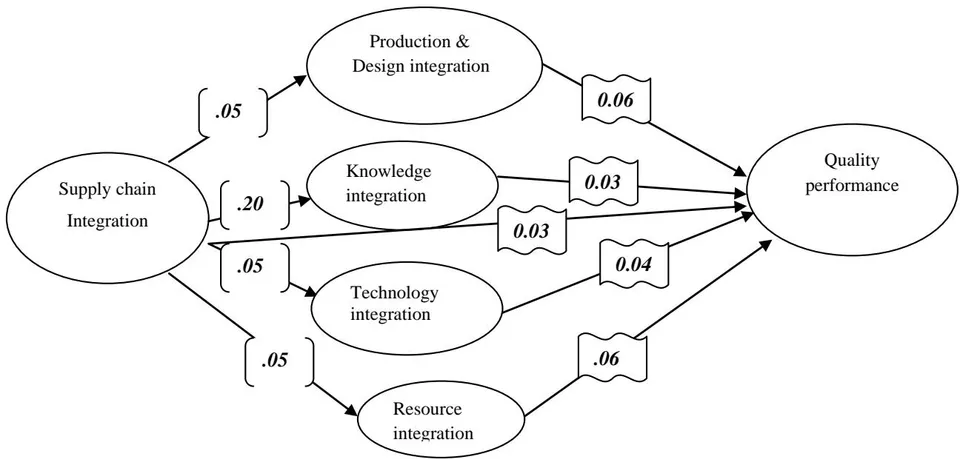
Tables 2a-2c Result Summary of AHP-Analysis results and figure 2 performance improvement supply chain integration paths indicates that supply chain integration is positively and significantly associated with the four independent variables, that impact on the quality performance on firms. We found that most of our hypotheses are supported that supply chain integration is related to quality performance. This implies that, the results indicated that internal integration is highly impact positively associated with quality performance, supporting H2b. The relationship between supply chain integration and knowledge, Production& design, Technology and Resource integration, has an impact on quality performance of manufacturing industries, supporting H1c. Production & design, technology and resource integration are positively related to quality performance supporting H2a, H2c and H2d. However, the level and interaction of supply chain variables have different effects on quality performance and supply chain practices. though, within constant Critical consistency ratio: (0.1), the Consistency ratio of each independent variables is different.
The this difference are highly related to interaction terms between supply chain practices and competitive strategies have different effects on quality performance. Knowledge and supply chain integration higher and positive effect on the improvement and success of quality performance in supply chain. we compare our results with those from previous research on supply chain integration, our finding that supply chain integration is extensively associated to supply chain performance. From table1.several studies (Gimenez et al (2012), Danese & Romano (2011), Yim & Leem (2013), Seo et al (2014), Yu (2015) investigated the effect of supply chain integration on performance.
Accordingly, our research emphasize the importance of knowledge, technology, production & design and resource integration improve quality performance on supply chains. Even though some studies Flynn et al (2009), Huo et al (2014), Yu et al (2014) have examined the important role of internal integration in improving operational, business performance and financial performance and recognized a positive link, there are still studies Jayaram et al (2010) that found the significant association between supplier and customer integration impact effects on quality performance. Huo et al (2014) also shows that, the relation of Internal integration, process integration, product integration, with financial performance. This is an vital finding, since to a large extent of the existing literature on supply chain integration does not include multi-dimensional variables integration as a dimension of supply chain integrations. This is not exactly show the effect of this variables on supply chain performances. consequently multi dimension supply chain integrations should considered and the relationship between supply chain integration and multiple quality performance dimensions needs further investigation. Thus our study clearly shows that supply chain internal (such as knowledge, technology, production & design and resource) highly related and impact for supply chain integration improvement, and positively associated with quality performance on a supply chain. The pervious findings, as illustrated in Table 1, offer to support for our hypotheses and results. The results also indicate that the strongest relationship subsist between supply chain integration, knowledge, technology, production & design and resource integration with quality performance. However, the findings provide guidelines for managers adopting supply chain integration perform under different competitive strategies. primary, knowledge, technology, production& design and resource integration directly improve firms' quality performance. Subsequently Supply chain integration through knowledge, technology, production& design and resource are extensively enhance for quality performance. While former research typically investigated a positive relationship between supply chain integration and supply chain performance, our findings as well confirms a significance function of supply chain integration in enhancing supply chain performance. This result implies that executive should look for to tactically facilitate multidimensional integration by collaboratively working together with a strong emphasis on supply chain practices to improve supply chain quality performance.
V. CONCLUSION AND LIMITATIONS
To meet the increasing demand of high-quality and technological goods from sophisticated local and overseas markets, manufacturing companies must continuously improve their efforts in technology and quality operations of SCM. Supply chain integration provides to focuses competitive advantage and improve quality performance. The effect of supply chain variables and quality performance is asses and investigated using literature review and AHP analysis. The results of this study shows in the understandings of how supply chain variables (knowledge, technology, production & design and resource) influence supply chain integration and quality performance. The result indicates that knowledge, technology, production & design and resource integration directly related and impact on quality performance for manufacturing companies. Supply chain integration has also positively linkage on Production, knowledge, Technology and Resource integration so as to improve quality performance in a supply chain. Although previous research usually investigated a positive relationship between supply chain integration and supply chain performance, our findings also confirmed a vital role of supply chain integration in enhancing supply chain performance on firms. Even though our findings have important implications for researchers and managers, we recognize that the present study has certain limitations. We study the effects of knowledge, technology, production & design and resource integration as the independent variables to impact quality performance, but other variables such as integrated topology, information system might help to explain causal variation in supply chain quality performance. Future research should investigate in addition to the effects of above the variables on, supply chain integration and firm performance, but also include the relation between information system, topology with on quality and financial performance.