## I. INTRODUCTION
Climate change poses an immediate and escalating threat to human health, intensifying extreme weather events like deadly heatwaves, fiercer hurricanes, and devastating wildfires. Vulnerable populations—children, the elderly, those with pre-existing health conditions, and marginalised communities—face heightened risks (www.noaa.gov, 2021). The repercussions extend beyond health, imperilling food and water sources: warming and acidifying oceans jeopardise seafood supplies and marine ecosystems, while prolonged droughts endanger crop yields and water availability. The ecological toll is staggering, with an estimated one million species at risk of extinction due to habitat loss, notably in the Arctic. Financially, climate-related disasters cost billions, with projections indicating a potential $1.5^{\circ}\mathrm{C}$ rise in global temperatures within a decade, leading to catastrophic sea-level increases, mass displacements, and an influx of climate refugees (IPCC, 2021). Inaction could escalate health crises, with $2^{\circ}\mathrm{C}$ warming foreseeably resulting in thousands of premature deaths and increased childhood asthma cases, exacerbating societal inequalities (EPA, 2021).
Crypto mining is the computerised process that yields cryptocurrencies. As the industry has grown, so has the power it consumes. In 2021, crypto miners consumed 102 terawatt-hours of electricity, according to an estimate compiled by Cambridge University (Messina, 2023). That is roughly equivalent to the annual electricity demand of Pakistan, a country of 228 million people (FCA, 2021). In August 2018, a Princeton University associate professor expert in cryptocurrency testified at a hearing of the US Senate Committee on Energy and Natural Resources, saying that bitcoin mining accounts for nearly $1\%$ of the world's energy use. While mining may potentially be done using renewable energy, in practice, it is not. This is highly concerning, considering the huge magnitude of cryptocurrencies and the expanding demand for Bitcoin mining. Thus, the highly energy-intensive process threatens the ability of governments around the world to reduce their dependence on climate-warming fossil fuels.
Since its inception, Bitcoin's trust-minimising consensus has been enabled by its proof-of-work algorithm. Machines that do "work" consume enormous amounts of energy. Moreover, the energy used is mainly derived from fossil fuels (Reiff, 2021). The design of proof-of-work cryptocurrency mining incentivises miners to ramp up operations as quickly as possible, often irrespective of the source of energy (DeRoche et al., 2022).
## II. SWITCHING TO PROOF OF STAKE AS A PROMISING TECHNICAL FIX
Any inspection of policy intervention to mitigate cryptocurrency's carbon emissions will consider how to motivate a switch away from the proof-of-work blockchain used by Bitcoin. Although Bitcoin is the largest cryptocurrency by market share, most of the top 25 cryptocurrencies use more energy-efficient protocols than PoW – and new tokens generally avoid PoW. That said, the market capitalisation of PoW-based crypto-assets remains high, at around $80\%$ of the total crypto-asset market.
Chart 3
## Market capitalisation of PoW-based crypto-assets vs. other consensus mechanism-based crypto-assets
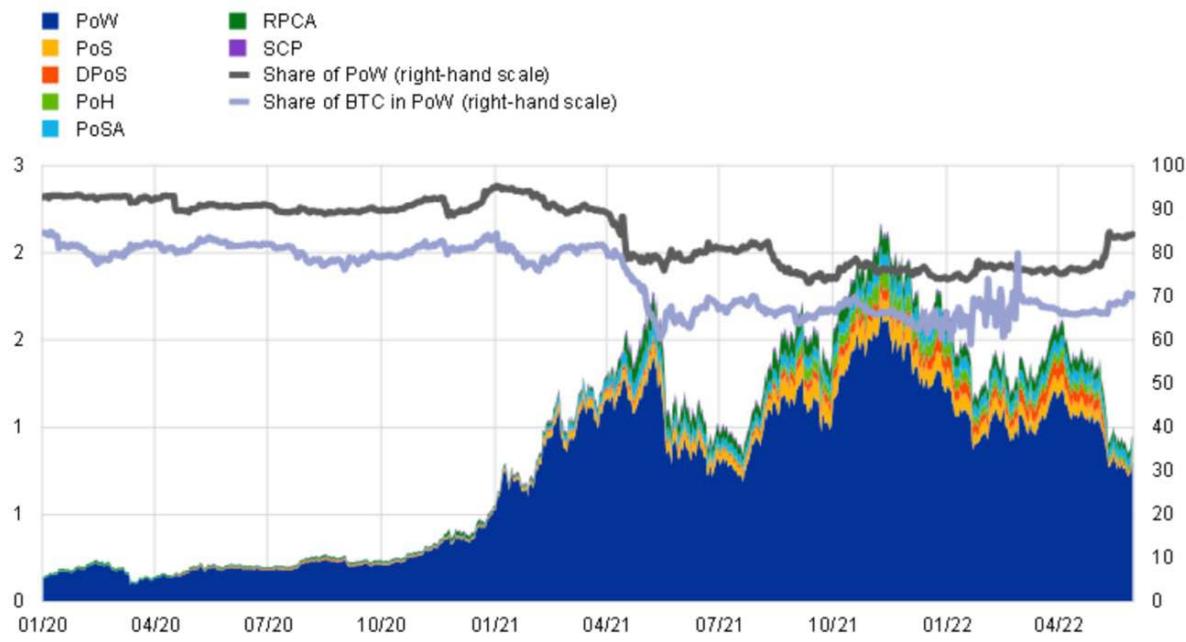
(1 Jan. 2020-31 May 2022; left-hand scale: EUR trillions; right-hand scale: percentages) Fig. 4: (Gschossmann et al., 2022)
However, less energy-intensive models are available whose adoption should be encouraged. The US Congressional Research Service proposes proof-of-stake and proof-of-authority as more sustainable consensus mechanism alternatives to proof-of-work (Gulli, 2020). With Ethereum, the platform of choice for the NFT market, developers have been pressured to reduce Ethereum's carbon impact. Pressure from scholars and regulators, as well as a social outcry against the carbon impact, has motivated developers to adapt to less polluting alternatives to proof-of-work, such as proof-of-stake (Truby et al., 2022).
## III. A PAST SUCCESS STORY: ETHEREUM'S
### TRANSITION TO PROOF OF STAKE
Proof-of-stake (PoS) is one of the well-known consensus mechanisms offering high energy efficiency. In the case of PoS, participants referred to as "validators" lock up set amounts of cryptocurrency or crypto tokens – their "stake" – and in exchange, they get a chance to validate new transactions and earn a reward (Singh, Oguntoye and Packard, 2022). Crypto-assets built on PoS blockchains thus rely on miners pledging crypto-asset collateral instead of computing power, which involves much fewer mathematical calculations and has lesser computational requirements, leading to substantially lower energy consumption.
Ethereum 2.0 attempts the energy problem by shifting from the PoW consensus mechanism to the PoS, estimating that energy consumption would be reduced by 99.95 percent, comparable to that of a small town of around 2,100 homes in the United States (Gschossmann et al., 2022). Its energy consumption relative to other technologies is shown in Fig. 5, which shows both estimated energy consumption after the transition to PoS (Ethereum 2.0) and consumption before the transition.
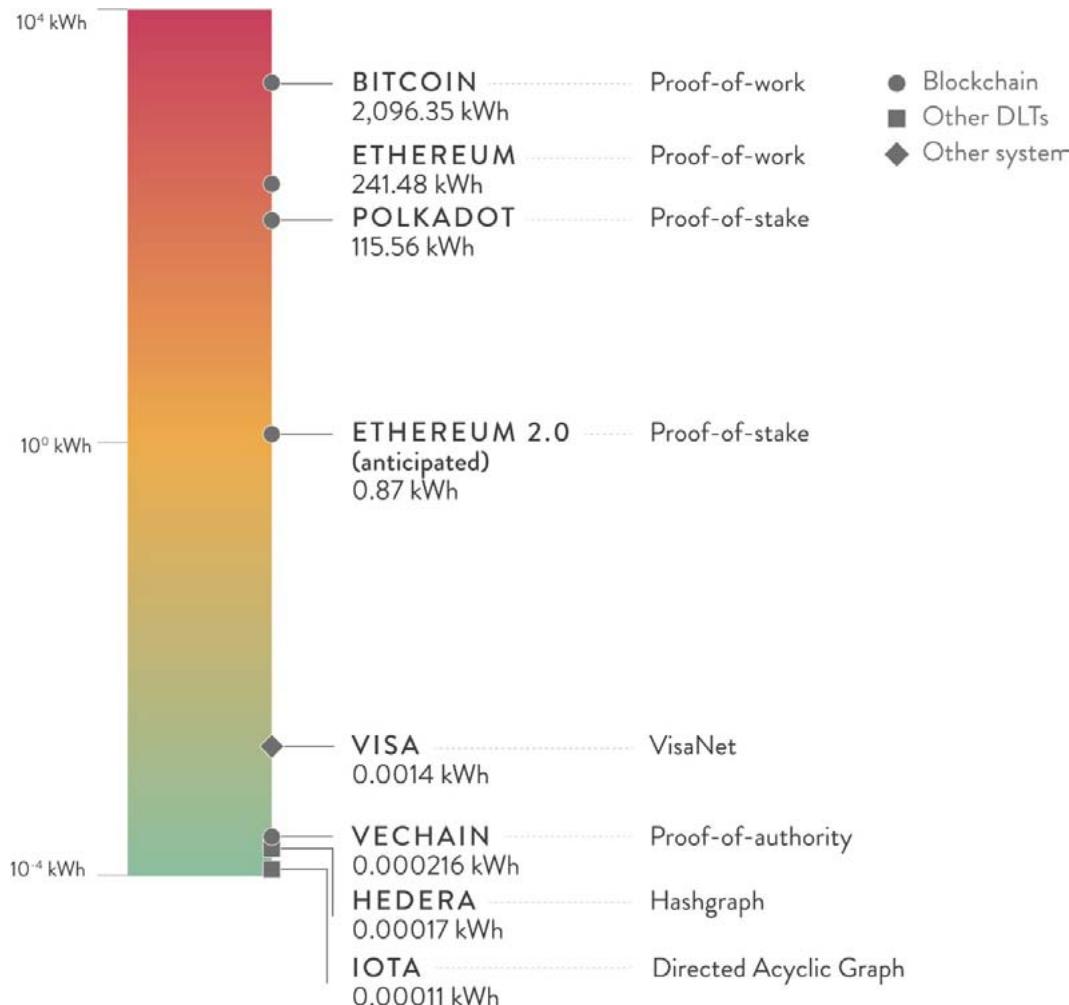 Fig. 5: (Singh, Oguntoye and Packard, 2022)
Ethereum completed its transition to PoS in September 2022. CCRI (Crypto Carbon Ratings Institute) estimated the network's annual electricity consumption to be 2.601 MWh (0.0026 TWh), down from 23 million MWh (September 2022), which corresponded to yearly carbon emissions of 870 tons CO2e applying regional-specific carbon intensity factors, down from 11 million tons. This corresponds to 44,000 times less carbon emitted than Bitcoin in a year. The report commissioned from (CCRI) also claims that Ethereum now uses approximately $99.99\%$ less energy than before the merge was completed. It also suggests the blockchain's carbon footprint has dropped by just over $99.99\%$ as well (Hayward, 2022), meaning that Ethereum's energy needs, and carbon footprint have both fallen even more than anticipated.
Previously, Ethereum was not very scalable due to increased network congestion and data redundancy with the addition of nodes and transactions. This increased the energy consumption of the cryptocurrency network, in addition to slowing down the speed of the transaction process. Ethereum 2.0 introduces the Beacon Chain, which implements the concept of sharding. Sharding involves distributing the load on a network among nodes or groups of nodes to reduce network congestion and increase throughput. The release also includes the introduction of 64 new chains, with each chain consisting of a fraction of the nodes validating the transactions. Hence, more transactions can be processed in parallel, with the requirement to share the transaction details with only a fraction of the nodes. This reduces energy consumption. Although the PoS approach reduces the energy expenditure, new issues arise that weren't present in PoW-based blockchains. Some of these include the possibility of double spending money and increased insecurity. The latter is because, unlike proof-of-work systems, a proof-of-stake (PoS) system informs node arbitrators in advance what blocks they will validate, thus enabling them to plan attacks. However, this issue could be fixable if the crypto tokens are "well distributed across an ecosystem of diverse stakeholders, users, developers, investors, enthusiasts, and others" (Alex Shipp), making a PoS system resistant to $51\%$ attacks and other high-risk scenarios (Liu, 2022). PoS's biggest selling point is its energy efficiency and scalability. However, these benefits come at the cost of decentralisation, a fundamental principle of cryptocurrencies. Bitcoin, for example, was created on the principle of equality, which promises to provide equal opportunities for all who wish to participate. However, PoS creates a staking barrier where the highest stakes have the first say in the decision-making process, creating an excessive concentration of decision-making powers on crypto exchanges and wallet service providers, which may increase market integrity risks (Agur et al., 2022). On the other hand, PoS could be said to prevent over-centralization of miners, as ownership of coins is considered as opposed to sharing computational power for reward pay-outs.
## IV. THE PROMISE OF REGULATION FOR ENCOURAGING PROOF OF STAKE
As developers frequently favour proof-of-work blockchain due to its perceived advantages, policy intervention can also consider how to motivate the industry to switch to a more sustainable version. The European Commission is among the regulatory bodies trying to incentivise the industry to migrate applications from PoW to PoS, but the Bitcoin network has resisted any such move (Clarke, 2022).
Highlighting the social cost (negative environmental externalities) of proof-of-work blockchain designs has encouraged some innovation in designing alternatives to proof-of-work blockchains and improving the problems with the proof-of-work blockchain itself. However, it seems unlikely that Bitcoin will voluntarily move to a proof-of-stake model, as many believe that a shift to PoS will absolutely shatter Bitcoin's worth, given that the underlying value of Bitcoin is tied directly to the amount of computing power on its network (MacDonald, 2022). Furthermore, many Bitcoin investors are hesitant to move away from proof-of-work, as it would represent a massive setback to innovation in money, as all the electricity invested into the network will have gone to waste. Only time will tell how effective voluntary industry change will be in reducing emissions and energy use and whether political intervention is necessary to force developers to go beyond industry choices.
Where social and environmental concerns are insufficient to incentivise a change away from proof-of-work, policy intervention has been used to achieve the desired outcomes, and this remains an option for future policymakers. Some states in the US recognise the demand to discourage proof-of-work mechanisms given their specific high energy use. Policies that induce changes in the energy consumption structure of mining activities may be more effective than intuitive punitive measures in limiting the total amount of energy consumption and carbon emission in the Bitcoin blockchain operation (Jiang et al., 2021). The New York State Senate has passed a bill that halts proof-of-work blockchain verification methods until an environmental impact assessment occurs. This would severely delay approvals for new proof-of-work miners. Bill S6486 would require an environmental impact assessment to ensure that such mining would not hinder the State's obligations under the Paris Agreement (required by the Climate Leadership and Community Protection Act 2019) (Truby et al., 2022). This should incentivise a shift to less energy-intensive mechanisms (away from the Bitcoin-style design), and other jurisdictions following suit would have greater impacts.
## V. CONCLUSION
PoW comes together with an enormous energy demand. The current estimate is that the Bitcoin protocol's energy needs are comparable to the energy consumption of Ireland (Sijm, n.d.). An increase in adoption will only make the situation worse. The highly energy-intensive process threatens the ability of governments around the world to reduce their dependence on climate-warming fossil fuels. Bitcoin alone can push global warming above $2^{\circ}\mathrm{C}$ (Mora et al., 2018). If counteractive measures are not taken, this could result in unprecedented levels of food insecurity, a huge loss in biodiversity, an increase in health risks and climate refugees, as well as massive numbers of indirect and direct deaths. As the level of environmental impact from cryptocurrencies is inextricably linked to the type of blockchain (with energy consumption levels differing based on consensus protocols as well as the polluting level of the energy being used), it is imperative that proof-of-work is phased out, and energy efficient blockchains are promoted.
This is no easy task, as, since the inception of cryptocurrencies, there have yet to be many regulatory measures enforced on the industry, directly inhibiting crypto mining-intensive countries, such as the US, from meeting climate goals announced in the Paris Agreement. From a regulatory perspective, a global coordinated policy response is necessary due to the mobility of miners in seeking minimal regulation and lower energy prices. We are at a tipping point as investors await an evaluation of Ethereum's performance. Whether Ethereum succeeds or fails in its transition to proof-of-stake is a key factor in determining the future of the blockchain industry. Success persuades other blockchains to switch to a less polluting design, while failure reinforces the path's dependence on a polluting proof-of-work model. Similarly, the industry's reaction to policy interventions, most of which are confined outside of China, will influence whether more drastic interventions are needed.
1. CLIMATE CHANGE AND SOCIAL VULNERABILITY IN THE UNITED STATES A Focus on Six Impacts 2 Climate Change and Social Vulnerability in the United States: A Focus on Six Impacts FRONT MATTER Acknowledgments. (2021). [online]
- Available at: https://www.epa.gov/system/files/documents/2021-09/climate-vulnerability_september-2021_508.pdf.
2. DeRoche, M., Fisher, J., Thorpe, N. and Wachspress, M. (2022). The Environmental Impacts of Cryptomining. [online] Earthjustice. Available at: https://earthjustice.org/features/cryptocurrency-mining-environmental-impacts.
3. FCA. (2021). Climate change and sustainable finance. [online] Available at: https://www.fca.org.uk/firms/climate-changesustainable-finance.
4. Gschossmann, I., van der Kraaij, A., Benoit, P.-L. and Rocher., E. (2022). Mining the environment – is climate risk priced into crypto-assets? www.ecb.europa.eu, [online](18). Available at: 5. Gulli, A. (2020). (Un)Sustainability of Bitcoin Mining. Rutgers Computer and Technology Law Journal, [online] 46, p.95. Available at: https://heinonline.org/HOL/LandingPage?handle=hein.journals/rutcomt46&div=7&id=&page= [Accessed 15 Jan. 2023].
6. Messina, I. (2023). Bitcoin electricity consumption: an improved assessment - News & insight. [online] Cambridge Judge Business School. Available at: https://www.jbs.cam.ac.uk/2023/bitcoin-electricity-consumption/#:~text=The%20first%20and%20most%20noticeable.
7. Mora, C., Rollins, R.L., Taladay, K., Kantar, M.B., Chock, M.K., Shimada, M. and Franklin, E.C. (2018). Bitcoin emissions alone could push global warming above $2^{\circ}\mathrm{C}$. Nature Climate Change, [online] 8(11), pp.931-933. doi: 10.1038/s41558-018-0321-8.8. Reiff, N. (2021). What's the environmental impact of cryptocurrency? [online] Investopedia. Available at: https://www.investopedia.com/tech/whats-environmental-impact-cryptocurrency/.
9. Siim, J. (n.d.). Proof-of-Stake Research Seminar in Cryptography. [online] Available at: https://courses.cs.ut.ee/MTAT.07.022/2017_fall/uploads/Main/janno-report-f17.pdf.
10. Truby, J., Brown, R.D., Dahdal, A. and Ibrahim, I. (2022). Blockchain, climate damage, and death: Policy interventions to reduce the carbon emissions, mortality, and net-zero implications of non-fungible tokens and Bitcoin. Energy Research & Social Science, [online] 88, p.102499. doi: 10.1016/j.erss.2022.102499.11. www.noaa.gov. (2021). Climate change impacts | National Oceanic and Atmospheric Administration. [online] Available at: https://www.noaa.gov/education/resource-collections/climate/climate-change-impacts#:~text=Climate%20change%20is%20already%20impacting.
Generating HTML Viewer...
References
10 Cites in Article
M Deroche,J Fisher,N Thorpe,M Wachspress (2022). The Environmental Impacts of Cryptomining.
Fca (2021). Sustainable Finance.
I Gschossmann,A Van Der Kraaij,P.-L Benoit,E Rocher (2022). Mining the environment -is climate risk priced into crypto-assets? www.ecb. europa.
A Gulli (2020). Un)Sustainability of Bitcoin Mining.
I Messina (2023). Unknown Title.
Camilo Mora,Randi Rollins,Katie Taladay,Michael Kantar,Mason Chock,Mio Shimada,Erik Franklin (2018). Bitcoin emissions alone could push global warming above 2°C.
N Reiff (2021). What's the environmental impact of cryptocurrency.
J Siim Proof-of-Stake Research Seminar in Cryptography.
J Truby,R Brown,A Dahdal,I Ibrahim (2022). Blockchain, climate damage, and death: Policy interventions to reduce the carbon emissions, mortality, and net-zero implications of non-fungible tokens and Bitcoin.
(2021). National Oceanic and Atmospheric Administration (NOAA).
Explore published articles in an immersive Augmented Reality environment. Our platform converts research papers into interactive 3D books, allowing readers to view and interact with content using AR and VR compatible devices.
Your published article is automatically converted into a realistic 3D book. Flip through pages and read research papers in a more engaging and interactive format.
Our website is actively being updated, and changes may occur frequently. Please clear your browser cache if needed. For feedback or error reporting, please email [email protected]
Thank you for connecting with us. We will respond to you shortly.