

Systems of Formation in Foucaults Archaeology: Incursion to Sub-Levels of Discourse

1
Estevao de Carvalho Freixo

Send Message

To: Author

GJMR Volume 22 Issue A1

Article Fingerprint

ReserarchID

QAO26

Systems of Formation in Foucaults Archaeology: Incursion to Sub-Levels of Discourse Banner
  • English
  • Afrikaans
  • Albanian
  • Amharic
  • Arabic
  • Armenian
  • Azerbaijani
  • Basque
  • Belarusian
  • Bengali
  • Bosnian
  • Bulgarian
  • Catalan
  • Cebuano
  • Chichewa
  • Chinese (Simplified)
  • Chinese (Traditional)
  • Corsican
  • Croatian
  • Czech
  • Danish
  • Dutch
  • Esperanto
  • Estonian
  • Filipino
  • Finnish
  • French
  • Frisian
  • Galician
  • Georgian
  • German
  • Greek
  • Gujarati
  • Haitian Creole
  • Hausa
  • Hawaiian
  • Hebrew
  • Hindi
  • Hmong
  • Hungarian
  • Icelandic
  • Igbo
  • Indonesian
  • Irish
  • Italian
  • Japanese
  • Javanese
  • Kannada
  • Kazakh
  • Khmer
  • Korean
  • Kurdish (Kurmanji)
  • Kyrgyz
  • Lao
  • Latin
  • Latvian
  • Lithuanian
  • Luxembourgish
  • Macedonian
  • Malagasy
  • Malay
  • Malayalam
  • Maltese
  • Maori
  • Marathi
  • Mongolian
  • Myanmar (Burmese)
  • Nepali
  • Norwegian
  • Pashto
  • Persian
  • Polish
  • Portuguese
  • Punjabi
  • Romanian
  • Russian
  • Samoan
  • Scots Gaelic
  • Serbian
  • Sesotho
  • Shona
  • Sindhi
  • Sinhala
  • Slovak
  • Slovenian
  • Somali
  • Spanish
  • Sundanese
  • Swahili
  • Swedish
  • Tajik
  • Tamil
  • Telugu
  • Thai
  • Turkish
  • Ukrainian
  • Urdu
  • Uzbek
  • Vietnamese
  • Welsh
  • Xhosa
  • Yiddish
  • Yoruba
  • Zulu

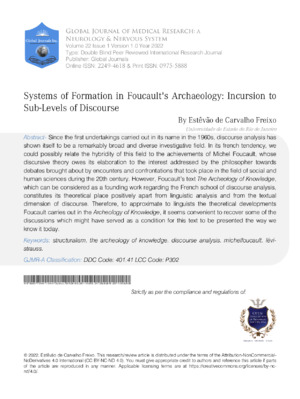
Since the first undertakings carried out in its name in the 1960s, discourse analysis has shown itself to be a remarkably broad and diverse investigative field. In its french tendency, we could possibly relate the hybridity of this field to the achievements of Michel Foucault, whose discursive theory owes its elaboration to the interest addressed by the philosopher towards debates brought about by encounters and confrontations that took place in the field of social and human sciences during the 20th century. However, Foucault’s text The Archeology of Knowledge, which can be considered as a founding work regarding the French school of discourse analysis, constitutes its theoretical place positively apart from linguistic analysis and from the textual dimension of discourse. Therefore, to approximate to linguists the theoretical developments Foucault carries out in the Archeology of Knowledge, it seems convenient to recover some of the discussions which might have served as a condition for this text to be presented the way we know it today.

Funding

No external funding was declared for this work.

Conflict of Interest

The authors declare no conflict of interest.

Ethical Approval

No ethics committee approval was required for this article type.

Data Availability

Not applicable for this article.

Estevao de Carvalho Freixo. 2026. \u201cSystems of Formation in Foucaults Archaeology: Incursion to Sub-Levels of Discourse\u201d. Global Journal of Medical Research - A: Neurology & Nervous System GJMR-A Volume 22 (GJMR Volume 22 Issue A1): .

Download Citation

High-quality image of Foucault's archaeological research system.
Journal Specifications

Crossref Journal DOI 10.17406/gjmra

Print ISSN 0975-5888

e-ISSN 2249-4618

Keywords
Classification
GJMR-A Classification: DDC Code: 401.41 LCC Code: P302
Version of record

v1.2

Issue date

April 11, 2022

Language

English

Experiance in AR

The methods for personal identification and authentication are no exception.

Read in 3D

The methods for personal identification and authentication are no exception.

Article Matrices
Total Views: 1627
Total Downloads: 31
2026 Trends
Research Identity (RIN)
Related Research

Published Article

Since the first undertakings carried out in its name in the 1960s, discourse analysis has shown itself to be a remarkably broad and diverse investigative field. In its french tendency, we could possibly relate the hybridity of this field to the achievements of Michel Foucault, whose discursive theory owes its elaboration to the interest addressed by the philosopher towards debates brought about by encounters and confrontations that took place in the field of social and human sciences during the 20th century. However, Foucault’s text The Archeology of Knowledge, which can be considered as a founding work regarding the French school of discourse analysis, constitutes its theoretical place positively apart from linguistic analysis and from the textual dimension of discourse. Therefore, to approximate to linguists the theoretical developments Foucault carries out in the Archeology of Knowledge, it seems convenient to recover some of the discussions which might have served as a condition for this text to be presented the way we know it today.

Our website is actively being updated, and changes may occur frequently. Please clear your browser cache if needed. For feedback or error reporting, please email [email protected]
×

This Page is Under Development

We are currently updating this article page for a better experience.

Request Access

Please fill out the form below to request access to this research paper. Your request will be reviewed by the editorial or author team.
X

Quote and Order Details

Contact Person

Invoice Address

Notes or Comments

This is the heading

Lorem ipsum dolor sit amet, consectetur adipiscing elit. Ut elit tellus, luctus nec ullamcorper mattis, pulvinar dapibus leo.


High-quality academic research articles on global topics and journals.

Systems of Formation in Foucaults Archaeology: Incursion to Sub-Levels of Discourse

Estevao de Carvalho Freixo

Research Journals





























































