I. INTRODUCTION
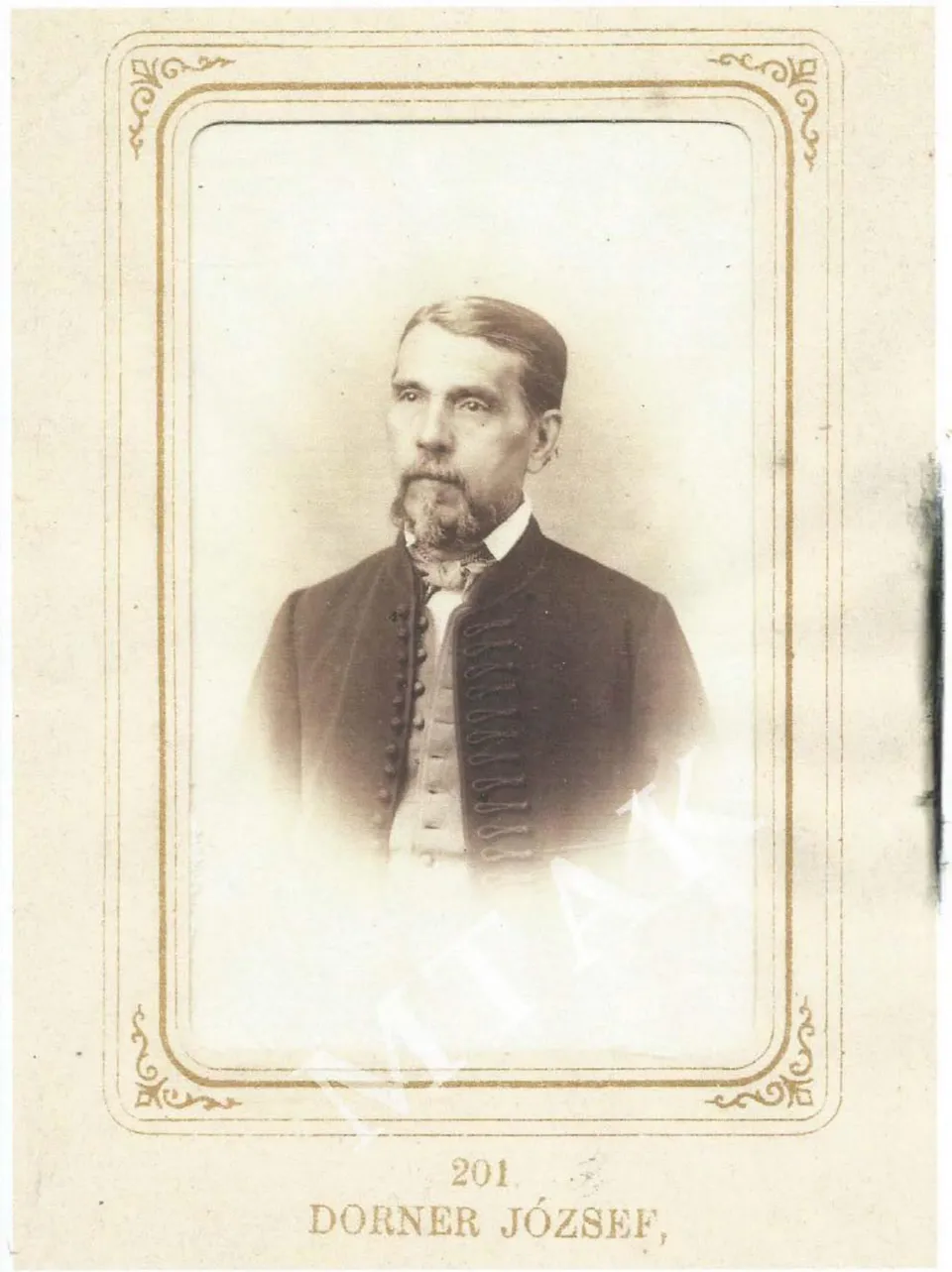
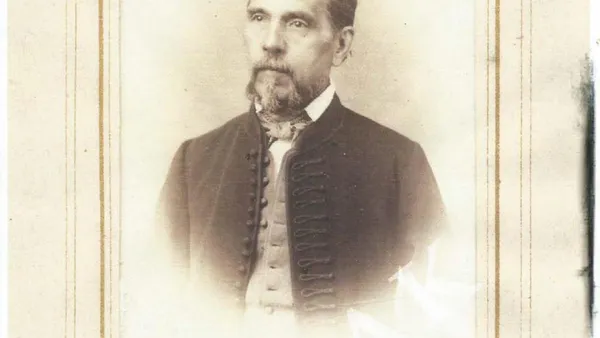
The author describes the kife and scientific work of the hungaryan pharmacist, Józaef Dorner (1808-1873). Dorner worked for 16 years a general pharmacist. But then turned to a special discipline of his profession and became an excellent botanist. He performed at first floristic research, but later concentrated his attention to plant anatomy and physiology, by systematic application of the microscope, be inaugurated a in new aspect in botanica. Very soon, already in 1853, was Dorner discussing bioenergetics. He was selected to Corresponding Member of the Hungarian Academy of Sciences and was a distinguished botanical expert of the Roval Association of Natural Sciences. He has had been estimated as an excellent teacher as well.
Life path until 1849
József Dorner was of German nationality. Its original name was József Thurner junior wohl 1834. The time of the name change. Was confirmed by a letter from the Lutheran parish of Györ-Hungary, Was born in Györ on November 2, 1808 (1). His father József Thurner senior merchant in Györ. The mother Susanna Schmidt. He completed primary scholl at his birthplace and then an at Lutheran grammar school in Sopron. Here he liked botany, he studied the flora around Sopron with great interest (2, 3).
At that time was enough to complete 6 high school classes to enter the profession of pharmacist. In 1824, they practiced a Hungarian Crown Pharmacy in Sopron. Here lenarned the Latin names of Medicines and took part in the formulations Technologist also performed an opüeration (4). After 3 three, he passed the internship successfully. Between 1827 and 1831, he was an assistant in Pest and Bratislava (today Slovakia,) the old Hungarian name: Pozsony, German: Pressburg). After his time an assistant, he enrolled at the University Vienna, where he obtained a degree in pharmacy in 1832. In Vienna, he met the chief physician István Endlicher (1804.-1849), a botanist, who had a significant influence on the Work of József Dorner.
In addition to German, he also spoke French. He was in contact not only with Hungarian botanists, but also with many foreing scientitif. He became friendly with the famous botanist of those times: József Sadler (1792-1849) professors of botany at Pest university and János Heuffel physicians botanist and Antal Rochel (1770-1847) warden of the botanical garden ib Pest and Ferenc Adoll Láng (1795-1863). pharmacist botanist. He kept up a correspondence with foreign scientists, including the botanists Eduard Fenzl (1808-1870) of Vienna and H. G. Ludwig Reichenbach (1793-1873) in Leipzig, His father bought the Golden Crown Pharmacy in Bartislava, in 1836. Here owned 4 four, In 1840 he sold the Pharmacy
Mediated by Antal Rochel in 1835, he visited of southern Hungary, Bánát. He met János Heuffel, with whom they sesarched the local flora. He euhred his Herbarium with the plants collected were. His book on his expencienses was published in 1839, Pressburg. "Das Banat in toographisch-naturhistorischer Beziehung, mit besordener Berücksichtigung der Herculesbäder{nachst Mehadia und ihrer Umgebungen." It was such a succens that it aroused the interest of contemporary scientists. This has already been very much notices in the country. In 1840, he sold bis chemist's shop and took a post in the health department of the Governor's Council in Buda. (3,5).
He published two books on chemical technology: 1. on the theory and practice of vinegar production. 1841.-2. the process of brandy with mashing, making malt and years, Pesth, 1843. (1).
In 1842 the Hungarian Academy of Sciences announced a tender for the change of the Climate. of Hungary about, the flora and fauna- Dorner observed weather data every 2v hours, a day for 5 years wird directions. He also often recorded the temperates of the water in a well in Buda, Tabán. He continued this work later until 1850. Was valuable because it dealt extensively with 100 gold honors by Academy in 1847 (5, 6, 7).
In 1846 he decided to compile and publish a manul on the flora of Hungary. Heuffel and Sadler welcomed Dorner's plan and offered to collaborate with him, but due to Sadler's death in 1848 and Heuffel's illness, the plan was never realized. Dorner could not undertake the enormous work alone (1, 4).
On March 13 the 1847, was elected a member of the Royal Hungarian Society of Natural Sciences. As one of the notabilities of the botanical committee. He was invited to take over the book collections of the Society. He organized the enlargement of the collections trough exchange (8).
In 1848 during the was of independence the wars invited me as a ministerial secretary to the Ministry of Religion and Public Education. However, after the capitulation of 1849. He retook privacy, At that time he devted all his to botany. (3, 9).
His life and work from 1851 until his death In 1851-53 he gave several lectures in the Hungarian Society of Natural Sciences: parasitic plants, fertilization of plants and plant cells (10.11). In 1853 a book was published on grape diseases.
In 1853 he delivered a lecture at the Royal Hungarian Society of Natural Sciences with the title "The plant kindom and nan". In a paper published in the journal "Uj Magyar Múzeum" (New Hungarian Museum) hr discussed the Darwinist theory of evolution:
";The times when botany was confined to the identification, of genera and species... have passed. The new science has assumed a higher standing. It no longer satisfies itself with the classification of forms..., but searches for their inner relationships."
In the paper ";The plant cell". He wrote: ";The study of cells in the most remarkable part of the science of botany, which with the introduction of the microscope has become a most interesting subject. There exists in the cell a remarkable moving force, so far physically unidentified, whereby the cell content spreads in different ways unnocited in the body of the plant."
József Dorner realized that the tissue structure of plants would only become phenomenon of plants, which is based on motion and metabolism. At that time it was still novel in botany.
On December 15, 1858, he was elected a corresponding member of the Hungarian Academy of Sciences. The title of his inaugural lecture was: "Online of the history and application of the microscope."
In the 1853, He taught natural science (biological subjects) es in the Lutheran grammar school in Szarvas, Békés country. The from 1860 in a similar school in Pest. Both shools taught in Hungarian, but he also taught Chemistry, Physics, German and French.
Textbooks
- Elements of Botany, 1864. Pest,
- Elementents of Mineralogy: 1858, 1865, Pest,
- Elements of Zoology:
- Uninhabited: 1864, Pesh,
- Reptiles, fish, birds.
- Pesth,
- Mammals: 1863. 1874, Pesth (2).
Dorner knows first-hand scientific achievements of the page. He advocated the need for permanence knowledge.
"We don't want to train botanists and zoologists. We educate young people enriched with touring background, who are capable of self-education" (9).
In 1855 published an article on the history of the fertilization of seed plants. He highlighted the role seeds Here (3).
In 1860 he a very interesting article entitled, "The Hungarian Great Plain, especially the area around Szarvas." Whit a historical introduction, Hungary a country of peculiarities and extremes. At the time this settlement was nig village.
Discussed in detail the natural village conditions (bedrock, climate, agricultural production) and the situation pessanty. Worked out the population date of the area. He also pointed and the benefits of urbanization. Perceived differences in social classes.
He described the conditions of the poor and wasteful lives of the nobles (9).
In one of his last works, he compared the flora of Pest country that of Lower Austria. This study was completed with a detailed list of plants (1862).
In his paper ";Oak-trees of Budapest", published in 1862, he gave a summary of the Quercus species occurring in the environs of Budapest on the basis of his observations (3).
In 1863 at the IXth Congress of Hungarian Physicians and Natural Scientists, held in Pest, Dorner delivered a lecture on the "Cuscuta varieties of the Hungarian meadow."
He pointed out that owing, to their parasitic nature, the dodder, species differ from dicotyledons in their tissue structure. He presented details of the germination and development of the dodder, and mentioned the prevention of dodder infestation. During the lecture, he showed mature specimens of Cuscuta. This lecture was a great success and aroused the interest of many of foreign botanist as well (12).
Dorner taught the Hungarian botanical terminology to Paul Ascherson (1843-1913,) a botanist from Berlin, who then translates "Cuscuta varieties of Hungarian meadow" into German (5).
In 1868, in one of his last academic lectures, he came up with som rare plants from Hungary. Anthemis neilreichii was also detected in Hungary, met was discovered in Lower Austria a few years ago. He also founded the species Cuscuta obstugiflora Hunp et Bonl, which had already discovered by Paul Ascherson and Viktor Janka in the Lower Tisza (13).
He was constantly enrchting shholl has. The grammar shas Budapest kept is herbarium of 48 fascicules, 15 thousand flat. Today it is in the Budapest Gallery of the Natural History-Museum. He also wrote book reviews.
József Dorner's human characteristics, disease, and death
He was a highly educated, and a very well-prepared humble man. He also acknowledged supertiosus customs. Trough his scholarly figure he can easily recognize superstars habits as well. He was always a success with the skill of an excellent performer. He was characterized by beautiful Hungarian speech. He justified what he had to say, He calced humor to his performentes. He wo speak to hin listened intetly to hin.
He married in 1845, but had no children from marriage. His wife died early, so so he lived alone. He also taught it has long illness. He had an incurable heart problem. So died on 9 th October, 1873. Fume Road in Budapest, his heas still rest in public cemetery today. The memory Hungarian Pharmacist Pantheon is preserved.
II. SUMMARY
József Dorner was one of the first Hungarian researches in plant morphology and physiology with a degree in pharmacy. An then time, he was not yet able to teach anthe university as sn academy. But with a pen and word, he made great. He was an excellent instructor. I wrote in English so that, readers could get to know the work of Hungarian pharmacists.
"Respect for the greats and noble tradition of the past, the main guarantee our ascension."
(Vilmos Milkó Hungarian doctor-professor, 1878-1956)
LITERATORY
Communion of Lutheran parish, Győr, 62/1978, 3 August, 1978.
Szinnyei József: A magyar irók életeés munkái. http://mek.oszk.hu/03650/03630/html/index.html.
Karlbrenner Károly: Dorner József emléke. Értekezések a természettudományok kórból. VI. volume, 11. nummer, 1-10 (1875).
Sopron city Archives, Acta Politica, Fasc, VI. N° 550/B
Gombocz Endre: A magyar botanika története, Budapest, 476-478, (1936).
Vigilia, Budapest, 39. 8, 540-543 (1974).-https://vigilia.hu/archivum
Buda videkének, s illetoleg Magyarországnak égaljviszonyai. A Kiralyi Magyar Természetudományi Társulat Évkönyve, Pest, 153-176 (1851).
Kátai Gábos: A Királyi Magyar Természettudományi Társulat története alapításától fogva maig. Pest, 91 (1868).
Bilibok Péterne: Dorner József mūködése a szarvasi gimnáziumban. Békési Élet, Békés-csaba, 16, 4, 479-482 (1981).
Kátai Gábor: cited work 120, 127, 129.
Üj Magyar Múzeum, Pest, 3, 365-365, 574-588 (1853).
A Magyar Orvosok és Természetvizsgálók 9. naggyúlésénék jegyzőkönyve. Pest, 181-182 (1865).
A Magyar Tudományos Akadémiai Almanach az 1868-as évre. Pest, 239 (1868).