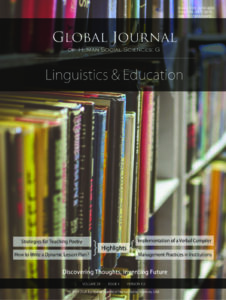
Talent Management Practices in Institutions of Higher Learning: Impact of Recruitment and Culture on Employee Performance in Adamawa State Nigeria

α
Abdulkarim S. Praise

Send Message

To: Author

Talent Management Practices in Institutions of Higher Learning: Impact of Recruitment and Culture on Employee Performance in Adamawa State Nigeria

Article Fingerprint

ReserarchID

QB0OC

Talent Management Practices in Institutions of Higher Learning: Impact of Recruitment and Culture on Employee Performance in Adamawa State Nigeria Banner

AI TAKEAWAY

Connecting with the Eternal Ground
  • English
  • Afrikaans
  • Albanian
  • Amharic
  • Arabic
  • Armenian
  • Azerbaijani
  • Basque
  • Belarusian
  • Bengali
  • Bosnian
  • Bulgarian
  • Catalan
  • Cebuano
  • Chichewa
  • Chinese (Simplified)
  • Chinese (Traditional)
  • Corsican
  • Croatian
  • Czech
  • Danish
  • Dutch
  • Esperanto
  • Estonian
  • Filipino
  • Finnish
  • French
  • Frisian
  • Galician
  • Georgian
  • German
  • Greek
  • Gujarati
  • Haitian Creole
  • Hausa
  • Hawaiian
  • Hebrew
  • Hindi
  • Hmong
  • Hungarian
  • Icelandic
  • Igbo
  • Indonesian
  • Irish
  • Italian
  • Japanese
  • Javanese
  • Kannada
  • Kazakh
  • Khmer
  • Korean
  • Kurdish (Kurmanji)
  • Kyrgyz
  • Lao
  • Latin
  • Latvian
  • Lithuanian
  • Luxembourgish
  • Macedonian
  • Malagasy
  • Malay
  • Malayalam
  • Maltese
  • Maori
  • Marathi
  • Mongolian
  • Myanmar (Burmese)
  • Nepali
  • Norwegian
  • Pashto
  • Persian
  • Polish
  • Portuguese
  • Punjabi
  • Romanian
  • Russian
  • Samoan
  • Scots Gaelic
  • Serbian
  • Sesotho
  • Shona
  • Sindhi
  • Sinhala
  • Slovak
  • Slovenian
  • Somali
  • Spanish
  • Sundanese
  • Swahili
  • Swedish
  • Tajik
  • Tamil
  • Telugu
  • Thai
  • Turkish
  • Ukrainian
  • Urdu
  • Uzbek
  • Vietnamese
  • Welsh
  • Xhosa
  • Yiddish
  • Yoruba
  • Zulu

References

33 Cites in Article
  1. P Acar,M Yener (2016). Theoretical journey on talent mana gement: Egalitarian and Elite approach.
  2. N Ahlrichs (2000). Becoming an Employer of Choice.
  3. H Aguinis (2009). Performance Management.
  4. Stanley Aibieyi,Muhammad Bin Dost,Chaudhary Abdul Rehman (2015). Talent Management and Employees Retention in Nigerian Universities.
  5. A Ari,M Uddin (2016). Talent management and organizational performance: An empirical study in retail sector in Sylhet City, Bangladesh, Semantic scholar paper.
  6. M Armstrong,A Baron (2004). Managing Performance: Performance Management in Action.
  7. Oghogho Ikponmwosa,Omughele Reuben,Otuagoma Smith O.,Okpare Anthony. O.,Oyubu Oyubu,Eyenubo Jonathan,Efenedo Gabriel I.,Okpeki Kazeem U.,Ufuoma Okieke,Ebimene E. E.,Akporhonor Kevin,Aloamaka Chukwudi,Anamonye G.U. (2013). SMART DISTRIBUTOR SYSTEM FOR MICRO GRID CONTROL.
  8. L Berger,D Berger (2004). The talent management handbook: creating organizational excellence by identifying, developing, and promoting your best people.
  9. L Berger,D Berger (2004). 13 Creating Sustainable Competitive Advantage Through People and Culture.
  10. M Bryant (2004). The portable di sserta tion advisor.
  11. B Butterfield (2008). Talent management: emphasis on action. Talent management strategies for attracting and retaining the best and the brightest.
  12. (2012). Yarnton, David Nigel, (born 25 Feb. 1959), Managing Director, Equinox Talent (formerly Global Talent Group), since 2012.
  13. David Collings,Kamel Mellahi (2009). Strategic talent management: A review and research agenda.
  14. J Creswell,Clark Plano (2007). Designing and conducting mi xed m ethods research.
  15. Brent Davies,Barbara Davies (2010). Talent management in academies.
  16. E Gallardo-Gallardo,N Gonzalez-Cruz,T (2013). What is the meaning of talent in the world of work?.
  17. B Groysberg,D Bell (2013). Talent management: Board give their companies an.
  18. H Haim,A Abubakar (2017). Strategic talent management and university performance: A theoretical perspective.
  19. Joseph Hair,G Hult,Christian Ringle,Marko Sarstedt,Nicholas Danks,Soumya Ray (2017). Partial Least Squares Structural Equation Modeling (PLS-SEM) Using R.
  20. J Henseler,C Ringle,M Sarstedt (2015). A new criterion for assessing discriminant validity in variance-based structural equation modeling.
  21. A Hewitt (2012). Higher Education survey: The state of human resource effectiveness from www.
  22. Charl Wolhuter,Hannes Van Der Walt,Ferdinand Potgieter,Louisa Meyer,Thapelo Mamiala (2015). What inspires South African student teachers for their future profession?.
  23. Michael Lynch,Kate Lynch (2007). Can a smart insole fit into standard treatment pathways?.
  24. J Maina (2016). Influence of organizational culture on performance of commercial banks in Kenya: University of Nairobi.
  25. J Mwanzi,S Wamitu,M Kiama (2017). Influence of talent management on organizational growth.
  26. W Nafei (2016). The impact of talent management on organizational performance: Evidence from the industrial companies in Egypt.
  27. Falola H.O,Oludayo O.A,Igbinoba E.E,Salau O.P,Borishade T.T (2018). Measuring work engagement strategies and employees’ behavioural outcomes in Nigerian Universities.
  28. S Riccio (2010). Talent management in higher education: developing emerging leaders within the administration at private colleges and universities.
  29. C Ringle,M Sarstedt,R Mitchell,S Gudergan (2019). Partial least squares structural equation modeling in HRM research: the International Journal of human resource management.
  30. Jamil Salmi (2009). The Challenge of Establishing World Class Universities.
  31. M Sarstedt,P Bengart,A Shaltoni,S Lehmann (2018). the use of sampling methods in advertising research: a gap between theory and practice.
  32. Marko Sarstedt,Christian Ringle,Joseph Hair (2017). Partial Least Squares Structural Equation Modeling.
  33. Selman Tetik (2016). Talent Management: A Review of Theoretical Perspectives and a Guideline for Practioners.

Funding

No external funding was declared for this work.

Conflict of Interest

The authors declare no conflict of interest.

Ethical Approval

No ethics committee approval was required for this article type.

Data Availability

Not applicable for this article.

How to Cite This Article

Abdulkarim S. Praise. 2020. \u201cTalent Management Practices in Institutions of Higher Learning: Impact of Recruitment and Culture on Employee Performance in Adamawa State Nigeria\u201d. Global Journal of Human-Social Science - G: Linguistics & Education GJHSS-G Volume 20 (GJHSS Volume 20 Issue G4): .

Download Citation

Issue Cover
GJHSS Volume 20 Issue G4
Pg. 39- 47
Journal Specifications

Crossref Journal DOI 10.17406/GJHSS

Print ISSN 0975-587X

e-ISSN 2249-460X

Keywords
Classification
GJHSS-G Classification: FOR Code: 930199
Version of record

v1.2

Issue date

May 18, 2020

Language
en
Experiance in AR

Explore published articles in an immersive Augmented Reality environment. Our platform converts research papers into interactive 3D books, allowing readers to view and interact with content using AR and VR compatible devices.

Read in 3D

Your published article is automatically converted into a realistic 3D book. Flip through pages and read research papers in a more engaging and interactive format.

Article Matrices
Total Views: 2345
Total Downloads: 1183
2026 Trends
Related Research

Published Article

Abstract not found

Our website is actively being updated, and changes may occur frequently. Please clear your browser cache if needed. For feedback or error reporting, please email [email protected]

Request Access

Please fill out the form below to request access to this research paper. Your request will be reviewed by the editorial or author team.
X

Quote and Order Details

Contact Person

Invoice Address

Notes or Comments

This is the heading

Lorem ipsum dolor sit amet, consectetur adipiscing elit. Ut elit tellus, luctus nec ullamcorper mattis, pulvinar dapibus leo.

High-quality academic research articles on global topics and journals.

Talent Management Practices in Institutions of Higher Learning: Impact of Recruitment and Culture on Employee Performance in Adamawa State Nigeria

Abdulkarim S. Praise

Research Journals