Loading menu…

Teachers’ Perception about the New Approaches of Primary Mathematics Textbooks of Bangladesh

§ University of Dhaka

Send Message

To: Author

Teachers’ Perception about the New Approaches of Primary  Mathematics Textbooks of Bangladesh

Article Fingerprint

ReserarchID

FF085

Teachers’ Perception about the New Approaches of Primary  Mathematics Textbooks of Bangladesh Banner

Key Research Insights

Synthesized scholarly intelligence & interactive research assistant
  • English
  • Afrikaans
  • Albanian
  • Amharic
  • Arabic
  • Armenian
  • Azerbaijani
  • Basque
  • Belarusian
  • Bengali
  • Bosnian
  • Bulgarian
  • Catalan
  • Cebuano
  • Chichewa
  • Chinese (Simplified)
  • Chinese (Traditional)
  • Corsican
  • Croatian
  • Czech
  • Danish
  • Dutch
  • Esperanto
  • Estonian
  • Filipino
  • Finnish
  • French
  • Frisian
  • Galician
  • Georgian
  • German
  • Greek
  • Gujarati
  • Haitian Creole
  • Hausa
  • Hawaiian
  • Hebrew
  • Hindi
  • Hmong
  • Hungarian
  • Icelandic
  • Igbo
  • Indonesian
  • Irish
  • Italian
  • Japanese
  • Javanese
  • Kannada
  • Kazakh
  • Khmer
  • Korean
  • Kurdish (Kurmanji)
  • Kyrgyz
  • Lao
  • Latin
  • Latvian
  • Lithuanian
  • Luxembourgish
  • Macedonian
  • Malagasy
  • Malay
  • Malayalam
  • Maltese
  • Maori
  • Marathi
  • Mongolian
  • Myanmar (Burmese)
  • Nepali
  • Norwegian
  • Pashto
  • Persian
  • Polish
  • Portuguese
  • Punjabi
  • Romanian
  • Russian
  • Samoan
  • Scots Gaelic
  • Serbian
  • Sesotho
  • Shona
  • Sindhi
  • Sinhala
  • Slovak
  • Slovenian
  • Somali
  • Spanish
  • Sundanese
  • Swahili
  • Swedish
  • Tajik
  • Tamil
  • Telugu
  • Thai
  • Turkish
  • Ukrainian
  • Urdu
  • Uzbek
  • Vietnamese
  • Welsh
  • Xhosa
  • Yiddish
  • Yoruba
  • Zulu
Reading Preferences
Font Size
Line Spacing
Background
This converted HTML version may contain rendering inconsistencies. Please refer to the PDF for the authoritative version, or click here to provide feedback.

Abstract

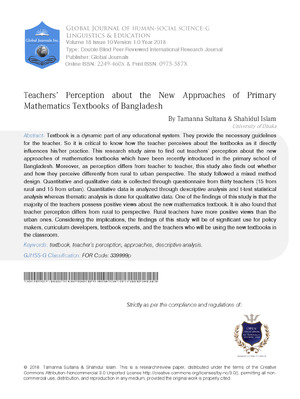
Textbook is a dynamic part of any educational system. They provide the necessary guidelines for the teacher. So it is critical to know how the teacher perceives about the textbooks as it directly influences his/her practice. This research study aims to find out teachers’ perception about the new approaches of mathematics textbooks which have been recently introduced in the primary school of Bangladesh. Moreover, as perception differs from teacher to teacher, this study also finds out whether and how they perceive differently from rural to urban perspective. The study followed a mixed method design. Quantitative and qualitative data is collected through questionnaire from thirty teachers (15 from rural and 15 from urban). Quantitative data is analyzed through descriptive analysis and t-test statistical analysis whereas thematic analysis is done for qualitative data. One of the findings of this study is that the majority of the teachers possess positive views about the new mathematics textbook. It is also found that teacher perception differs from rural to perspective. Rural teachers have more positive views than the urban ones. Considering the implications, the findings of this study will be of significant use for policy makers, curriculum developers, textbook experts, and the teachers who will be using the new textbooks in the classroom.

References

28 Cites in Article
  1. 1. K Al-Jardani (2011). Developing a Framework for Curriculum Evaluation in Oman. English Linguistics Research, 1(2)
  2. 2. J Bell (2005). Doing your Research Project. Doing your Research Project
  3. 3. Sybilla Beckmann (2004). Solving Algebra and Other Story Problems with Simple Diagrams: A Method Demonstrated in Grade 4-6 Texts Used in Singapore. THE MATHEMATICS EDUCATOR, 14(1), 42-46.
  4. 4. A Bishop (1989). Review of research on visualization in Mathematics Education. Focus on Learning Problems in Mathematics, 11(1), 7-15.
  5. 5. M Brune (2010). The inquiry learning model as an approach to mathematics instruction. The inquiry learning model as an approach to mathematics instruction
  6. 6. K Cheesman (2005). Exercise and Learning. From Seatwork to Feetwork: Engaging Students in Their Own Learning, 37-52.
  7. 7. Ron Comfort (1990). On the Idea of Curriculum Modification by Teachers. Academic Therapy, 25(4), 397-405.
  8. 8. J Creswell (2012). Qualitative Research. Qualitative Research, 387-415.
  9. 9. M Johansson (2006). E-Textbooks in/for Teaching and Learning Mathematics: A Potentially Transformative Educational Technology. Handbook of International Research in Mathematics Education, 648-673.
  10. 10. M King-Sears (2001). Three steps for gaining access to the general education curriculum for learners with disabilities. Intervention in School and Clinic, 37(2), 67-76.
  11. 11. R Marzano (2004). Building background knowledge for academic achievement: Research on what works in schools. Building background knowledge for academic achievement: Research on what works in schools
  12. 12. A Mendaglio (2014). RETRACTED ARTICLE: Young students' drawings reveal perceptions of mathematics class in Finland and the USA. Research in Mathematics Education, 16(1), 18-37.
  13. 13. (2010). the People's Republic of Bangladesh. the People's Republic of Bangladesh
  14. 14. (2011). National Curriculum and Textbooks: An Evaluation of English Textbook for Class X by Sindh Textbook Board, Jamshoro. Journal of Literature, Languages and Linguistics
  15. 15. (2016). National Curriculum and Textbooks: An Evaluation of English Textbook for Class X by Sindh Textbook Board, Jamshoro. Journal of Literature, Languages and Linguistics
  16. 16. (2000). National Council of Teachers of Mathematics: NCTM Affiliated-Group Officers. The Mathematics Teacher, 68(4), 338-349.
  17. 17. J Pang (2004). Development and characteristics of Korean elementary mathematics textbooks. 10th Annual Meeting of the International Congress of Mathematics Education
  18. 18. K Paterson (2009). Jumpstart the problem-solving attitude. Jumpstart! Thinking Skills and Problem Solving, 21-69.
  19. 19. Z Reed (2014). The New West Point. West Point, 164-174.
  20. 20. Barbara Reys,Robert Reys (2004). Recruiting Mathematics Teachers: Strategies to Consider. The Mathematics Teacher, 97(2), 92-95.
  21. 21. Rmerc (1999). The Curriculum for the 10-year Compulsory School in Norway. The Curriculum for the 10-year Compulsory School in Norway
  22. 22. H Salehi,M Amini (2016). Teachers' perceptions of the new English textbook named prospect 1 used in Iranian junior high schools. Modern Journal of Language Teaching Methods, 6(6)
  23. 23. P Singh,A Rahman,T Hoon (2010). Languages and Mathematics Achievements Among Rural and Urban Primary Four Pupils: A Malaysian Experience. Journal of Science and Mathematics, Education in Southeast Asia, 33(1), 65-85.
  24. 24. J Smith,Iii (1996). Efficacy and teaching mathematics by telling: A challenge for reform. Efficacy and teaching mathematics by telling: A challenge for reform
  25. 25. Akihiko Takahashi (2006). Lesson Study in North America. Japanese Lesson Study in Mathematics, 25, 194-197.
  26. 26. Alba Thompson (1992). Teachers’ Beliefs and Conceptions: A Synthesis of the Research. Handbook of Research on Mathematics Teaching and Learning, 127-146.
  27. 27. Marja Van Den Heuvel-Panhuizen,Paul Drijvers (1998). Realistic Mathematics Education. Encyclopedia of Mathematics Education, 713-717.
  28. 28. H Wenglinsky (2001). Teacher Classroom Practices and Student Performance: How Schools Can Make a Difference. Teacher Classroom Practices and Student Performance: How Schools Can Make a Difference, 8541.

Funding

No external funding was declared for this work.

Conflict of Interest

The authors declare no conflict of interest.

Ethical Approval

No ethics committee approval was required for this article type.

Data Availability

Not applicable for this article.

How to Cite This Article

Tamanna Sultana, Shahidul Islam. 2018. "Teachers’ Perception about the New Approaches of Primary Mathematics Textbooks of Bangladesh". Global Journal of Human-Social Science - G: Linguistics & Education GJHSS-G Volume 18 (GJHSS Volume 18 Issue G10).
More Citation Formats

Download Citation

Journal Specifications

Crossref Journal DOI 10.17406/GJHSS

Print ISSN 0975-587X

e-ISSN 2249-460X

Keywords
Classification
GJHSS-G Classification FOR Code: 339999p
Version of record
v1.2

Issue date
November 1, 2018

Language
English
Order Article Reprint
Experience in AR

Explore published articles in an immersive Augmented Reality environment. Our platform converts research papers into interactive 3D books, allowing readers to view and interact with content using AR and VR compatible devices.

Read in 3D

Your published article is automatically converted into a realistic 3D book. Flip through pages and read research papers in a more engaging and interactive format.

Article Matrices
Total Views: 704
Total Downloads: 58
All Trends

Request Access

Please fill out the form below to request access to this research paper. Your request will be reviewed by the editorial or author team.
X

This is the heading

Lorem ipsum dolor sit amet, consectetur adipiscing elit. Ut elit tellus, luctus nec ullamcorper mattis, pulvinar dapibus leo.


High-quality academic research articles on global topics and journals.

Teachers’ Perception about the New Approaches of Primary Mathematics Textbooks of Bangladesh

Tamanna Sultana
Tamanna Sultana University of Dhaka
Shahidul Islam
Shahidul Islam <p>University of Dhaka</p>