Teaching Language and Cultural Creativity through the Textual Composition of the Hispanic American Tale Epistemological Reasoning and Subjective Imagination
Summery-Currently, the search for alternatives that allow the teaching of creativity is subject of discussion in the scientific research community. Due to the attention that this is having in the educational field, including the discipline of Spanish as foreign language (ELE), it is necessary to provide new approaches and possible solutions that cope with this view. The objective of this research is to present a manuscript that serves as a reference for the teaching Spanish language and cultural creativity through the textual composition of the Hispanic American Tale. To achieve this objective, an analysis of this theme has been carried out in juxtaposition with the hypothesis that the research presents. The result of which, straits the acquisition of cognitive and affective domains of the target language. The research has used a combined qualitative and quantitative method for the collection and analysis of literary materials from the hand and work of prominent Hispanic American writers, scientific and academic publications, and accredited websites. This documentation is in absolute correspondence with the objective presented in this research study.
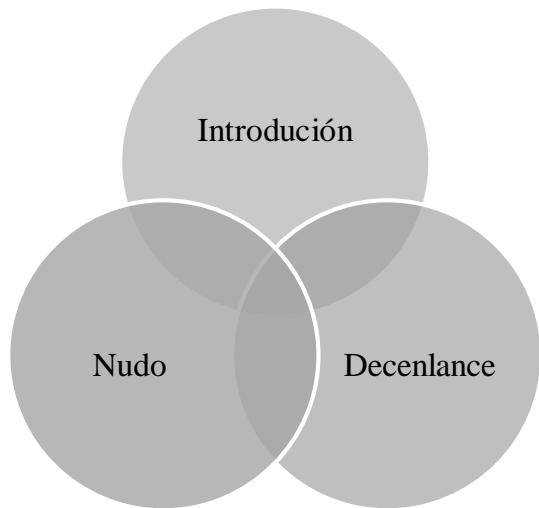
Diagrama 1: Estructura del Relato Corto
Tal y como podemos observar, el cuento presenta varias características que lo diferencian de otros géneros narrativos. El cuento puede dar cuenta de hechos reales o fantásticos, pero siempre partiendo de la base de ser un acto de ficción, o mezcla de ficción. Siendo así, pudiéramos decir que el elemento principal de todo cuento es precisamente la ficción. A esto le sigue la parte argumentativa, la cual refleja la historia de los acontecimientos que se encadenan en una sola sucesión de hechos. Después viene la estructura central, a través de la cual se perfila y enriquece la narración y el argumento que, con mayor peso desarrollará el protagonista principal. Aunque puede haber otros personajes, la historia del cuento suele hablar de uno en particular. De ahí el sentido de héroe. A continuación, nos encontramos con la unidad de efecto, lo que supone una lectura de principio a fin. Es decir, el cuento se escribe para ser leído de esta forma. Quizás sea la razón por la que, a partir de la aparición de la escritura, el formato de los cuentos modernos sea la prosa. Cuya forma toma naturalmente el lenguaje (tanto oral como escrito) para expresar los conceptos afines al público lector. Por ejemplo, el lenguaje coloquial y humorístico son algunos de los rasgos que distinguen este tipo de prosa, y que podemos encontrar en muchos de los cuentos
hispanoamericanos. Sin embargo, para lograr poner en práctica todas estas características, el contexto del cuento debe realizarse con brevedad y sencillez. De ahí que exista un límite sobre la extensión de palabras. El cual no debe exceder las 20.000 palabras. Aunque esta limitación se desestima al tratarse de microrrelato. A pesar de etas diferencias, las mismas no alteran la estructura [Introducción / Nudo / Desenlace] que al igual que la novela, conforman el formato escrito del género-cuento. La introducción por su parte, nos presenta un esbozo sobre el lugar, los personajes, y el principio de la acción. El nudo supone la puesta en marcha del conflicto o el problema de la historia. Mientras el desenlace presenta el momento en donde se resuelve el conflicto.
Aunque ese saber resulta útil, no sería bien correspondido si dejásemos a un lado el reseñar aspectos y recomendaciones sobre la composición textual del relato corto. Tema sobre el cual presentamos los excelentes trabajos de escritores y ensayistas de la talla de (Edgard Allan Poe); (Antón Pávlovich Chéjov); (Horacio Quiroga). Ver la tabla 1: Método de composición: Poe, 1846. Tabla 2: Consejos a Un Escritor: Chéjov, 2005. Tabla 3: Decálogo del perfecto cuentista: Quiroga, 1927. Así como la composición textual-fragmentos del cuento hispanoamericano.
Tabla 1: Método de composición: Poe, 1846
<table><tr><td>Launidad de impresión o de efecto. Lo primero que hay que elegir es el efecto que se quiere causar en el lector, las emotaciones más profundas.</td></tr><tr><td>Es importante trazar previamente un plan de descriutura que lleve a un desenlace. Tanto el inizio como el final del cuerto deben tener una intencion definida de antemano.</td></tr><tr><td>Para producir el efecto deseado, estaunidad de impresión, hay que buscar el tono adecuado.</td></tr><tr><td>La brevedad. El cuerto debe poder ser leído de una sola sentada y cada palabra contribuir al efecto que se ha propuesto el escritor.</td></tr><tr><td>Determinar un escenario, el tema y el clímax de la受害者.</td></tr><tr><td>En un cuerto solo deben aparecer los personajes que Sean necessarios para provocar el efecto deseado.</td></tr></table>
Tabla 2: Consejos a Un Escritor: Chéjov, 2005
<table><tr><td>Elegir un tema. No haber de lo que no se conoce ni se comprende.</td></tr><tr><td>Ser breve.</td></tr><tr><td>Concentrarse en los detailles para Obtener un efecto determinante.</td></tr><tr><td>Eliminar los lugares comunes.</td></tr><tr><td>Mantener en suspensor al lector y confiar en que va a completar por su cuenta los elementos subjectivos que faltan en el=cuento.</td></tr><tr><td>El NarradorDebe relegated a unsegundo plano.</td></tr><tr><td>Laaculartiene un gran peso en el=cuento y nodebe recaer en más de dos personajes.</td></tr><tr><td>Veracidad en la descripción de los personajes y de las cosas. No profundizardemasiado enla psicología dellospersonajes.</td></tr><tr><td>Máxima concisión,audacia yoriginalidad. Rechazarloconvencional.</td></tr><tr><td>No pulir ni limar demasiado el texto.</td></tr><tr><td>El principal y el final son importantes.</td></tr><tr><td>Noocumented para los créticos.</td></tr><tr><td>No ser un charlatán, no todo se entiende en este mundo.</td></tr></table>
Cree en un maestro —Poe, Maupassant, Kipling, Chejov— como en Dios mismo.
<table><tr><td>Cree en un maestro — Poe, Maupassant, Kipling, Chejov — como en Dios本身就是.</td></tr><tr><td>Cree que su arte es una cima inaccessible. No sueñas en domarla. Cuando能把 hacerlo, lo consiguiós sin saberlo tú本身就是.</td></tr><tr><td>Resiste cuando能把 a la imitación, pero imita si el influjo es demasiado fuerte. Más que ningunaarta相关政策, el descarrollo de la personalidad es una larga paciencia.</td></tr><tr><td>Ten fe ciega no en tu capacité para el triunfo, sino en el ardor con que lo deseas. Ama a tu Arte como a tu novia, dándole todo tu corazón.</td></tr><tr><td>No empieces a escribir sin saber desde la primera palabra a sobre vas. En un*cuento bien logrado, las tres primeras lineas tienen casi la importancia de las tres ultimas.</td></tr><tr><td>Si querres expresar con exactitud esta circunstancia: "Deceive el río solplaba el viento frío", no hay en lengua humana más palabras que las apuntadas para expresarla. Una vez bajo de tuspalabras, no te preocupo de observar si son entre sconzonantes o asonantes.</td></tr><tr><td>No adjetives sin necesidad. Inútilles serán cuantas colas de color adheras a un sustantivo débil. Si hallas el que es preciso,él solo tendrá un color incomparable. Pero hay que hallarlo.</td></tr><tr><td>Toma a tuspersonajes de la mano y llévalos firmamente hasta el final, sin ver othera相关政策 que el camino que les trazaste. No te distraigas viendo tú lo que ellos��den o no les importa ver. No abuses del lector. Un*cuento es una novela depurada de ripios. Tenesto por una verdad absoluta,exceptique no lo sea.</td></tr><tr><td>No writes bajo el imperio de la emoción. Déjala morir,yevocala luego. Si eres capazoniafterces de revivirla talcual fue,haslegado en artea la mitad del camino.</td></tr><tr><td>No pienses en tusamicigos al Scribir, ni en la impresiónque hara tu historia.Cuenta como si tu relato no tvviera interés más que para ellittle ambiente de tuspersonajes,de losque pudiste haber sido uno.No de othero modo se obtiene la vida del*cuento.</td></tr></table>
### El balcón, Felisberto Hernández
música: pasaba entre los sonidos como un gato con su gran cola negra y los dejaba llenos de intenciones. Al final de uno de esos conciertos, vino a saludarme un anciano tímido. Debajo de sus ojos azules se veía la carne viva y enrojecida de sus párpados caídos; el labio inferior, muy grande y parecido a la baranda de un palco, daba vuelta alrededor de su boca entreabierta. De allí salía una voz apagada y palabras lentas;
además, las iba separando con el aire quejoso de la respiración"...
#### Viaje Olvidado, Silvina Ocampo
“Quería acordarse del día en que había nacido y fruncía tanto las cejas que a cada instante las personas grandes la interrumpían para que desarrugara la frente. Por eso no podía nunca llegar hasta el recuerdo de su nacimiento. Los chicos antes de nacer estaban almacenados en una gran tienda en París, las madres los encargaban, y a veces iban ellas mismas a comprarlos. Hubiera deseado ver desenvolver el paquete, y abrir la caja donde venían envueltos los bebés, pero nunca la habían llamado a tiempo en las casas de los recién nacidos. Llegaban todos achicharrados del viaje, no podían respirar bien dentro de la caja, y por eso estaban tan colorados y lloraban incesantemente, enrulando los dedos de los pies”..
#### La doble y única mujer, Pablo Palacio
“Mi espalda, mi atrás, es, si nadie se opone, mi pecho de ella. Mi vientre está contrapuesto a mi vientre de ella. Tengo dos cabezas, cuatro brazos, cuatro senos, cuatro piernas, y me han dicho que mis columnas vertebrales, dos hasta la altura de los omóplatos, se unen allí para seguir - robustecida- hasta la región coxígea. Mi espalda, mi atrás, es, si nadie se opone, mi pecho de ella. Mi vientre está contrapuesto a mi vientre de ella. Tengo dos cabezas, cuatro brazos, cuatro senos, cuatro piernas, y me han dicho que mis columnas vertebrales, dos hasta la altura de los omóplatos, se unen allí para seguir - robustecida- hasta la región coxígea...
#### El Aleph, Jorge Luis Borges
antes hubo un árbol, vi una quinta de Adrogué, un ejemplar de la primera versión inglesa de Plinio, la de Philemon Holland, vi a un tiempo cada letra de cada página (de chico, yo solía maravillarme de que las letras de un volumen cerrado no se mezclaran y perdieran en el decurso de la noche), vi la noche y el día contemporáneo, vi un poniente en Querétaro que parecía reflejar el color de una rosa en Bengala, vi mi dormitorio sin nadie, vi en un gabinete de Alkmaar un globo terráqueo entre dos espejos que lo multiplican sin fin, vi caballos de crin arremolinada, en una playa del Mar Caspio en el alba, vi la delicada osatura de una mano, vi a los sobrevivientes de una batalla, enviando tarjetas postales, vi en un escaparate de Mirzapur una baraja española, vi las sombras oblicuas de unos helechos en el suelo de un invernáculo, vi tigres, émbolos, bisontes, marejadas y ejércitos, vi todas las hormigas que hay en la tierra, vi un astrolabio persa, vi en un cajón del escritorio (y la letra me hizo temblar) cartas obscenas, increíbles, precisas, que Beatriz había dirigido a Carlos Argentino, vi un adorado monumento en la Chacarita, vi la reliquia atroz de lo que deliciosamente había sido Beatriz Viterbo, vi la circulación de mi oscura sangre, vi el engranaje del amor y la modificación de la muerte, vi el Aleph, desde todos los puntos, vi en el Aleph la tierra, y en la tierra otra vez el Aleph y en el Aleph la tierra, vi mi cara y mis vísceras, vi tu cara, y sentí vértigo y lloré, porque mis ojos habían visto ese objeto secreto y conjetural, cuyo nombre usurpan los hombres, pero que ningún hombre ha mirado: el inconcebible universo)”...
#### Casa tomada, Julio Cortázar
El ahogado más hermoso del mundo, Gabriel García Márquez
jugado con él toda la tarde, enterrándolo y desenterrándolo en la arena, cuando alguien los vio por casualidad y dio la voz de alarma en el pueblo. Los hombres que lo cargaron hasta la casa más próxima notaron que pesaba más que todos los muertos conocidos, casi tanto como un caballo, y se dijeron que tal vez había estado demasiado tiempo a la deriva y el agua se le había metido dentro de los huesos. Cuando lo tendieron en el suelo vieron que había sido mucho más grande que todos los hombres, pues apenas si cabía en la casa, pero pensaron que tal vez la facultad de seguir creciendo después de la muerte estaba en la naturaleza de ciertos ahogados. Tenía el olor del mar, y sólo la forma permitía suponer que era el cadáver de un ser humano, porque su piel estaba revestida de una coraza de rémora y de lodo”..
### Viaje a la semilla, Alejo Carpentier
"Los cuadrados de mármol, blancos y negros volaron a los pisos, vistiendo la tierra. Las piedras con saltos certeros, fueron a cerrar los boquetes de las murallas. Hojas de nogal claveteadas se encajaron en sus marcos, mientras los tornillos de las charnelas volvían a hundirse en sus hoyos, con rápida rotación. En los canteros muertos, levantadas por el esfuerzo de las flores, las tejas juntaron sus fragmentos, alzando un sonoro torbellino de barro, para caer en lluvia sobre la armadura del techo. La casa creció, traída nuevamente a sus proporciones habituales, pudorosa y vestida. La Ceres fue menos gris. Hubo más peces en la fuente. Y el murmullo del agua llamó begonias olvidadas. El viejo introdujo una llave en la cerradura de la puerta principal, y comenzó a abrir ventanas. Sus tacones sonaban a hueco. Cuando encendió los velones, un estremecimiento amarillo corrió por el óleo de los retratos de familia, y gentes vestidas de negro murmuraron en todas las galerías, al compás de cucharas movidas en jícaras de chocolate. Don Marcial, el Marqués de Capellanías, yacía en su lecho de muerte, el pecho acorazado de medallas, escoltado por cuatro cirios con largas barbas de cera derretida”...
#### El Jorobadito, Roberto Arlt
Los diversos y exagerados rumores desparramados con motivo de la conducta que observé en compañía de Rigoletto, el jorobadito, en la casa de la señora X, apartaron en su tiempo a mucha gente de mi lado. Sin embargo, mis singularidades no me acarrearon mayores desventuras, de no perfeccionarlas estrangulando a Rigoletto. Retorcerle el pescuezo al jorobadito ha sido de mi parte un acto más ruinoso e imprudente para mis intereses, que atentar contra la existencia de un benefactor de la humanidad. Se han echado sobre mí la policía, los jueces y los periódicos. Y ésta es la hora en que aún me pregunto (considerando los rigores de la justicia) si Rigoletto no estaba llamado a ser un capitán de hombres, un genio o un filántropo. De otra forma no se explican las
crueldades de la ley para vengar los fueros de un insigne piojoso, al cual, para pagarle de su insolencia, resultaran insuficientes todos los puntapiés que pudieran suministrarle en el trasero una brigada de personas bien nacidas. No se me oculta que sucesos peores ocurren sobre el planeta, pero ésta no es una razón para que yo deje de mirar con angustia las leprosas paredes del calabozo donde estoy alojado a espera de un destino peor. Pero estaba escrito que de un deforme debían provenirme tantas dificultades. Recuerdo (y esto a vía de información para los aficionados a la teosofía y la metafísica) que desde mi tierna infancia me llamaron la atención los contrahechos. Los odiaba al tiempo que me atraían, como detesto y me llama la profundidad abierta bajo la balconada de un noveno piso, a cuyo barandal me he aproximado más de una vez con el corazón temblando de cautela y delicioso pavor. Y así como frente al vacío no puedo sustraerme al terror de imaginarme cayendo en el aire con el estómago contraído en la asfixia del desmoronamiento, en presencia de un deforme no puedo escapar al nauseoso pensamiento de imaginarme corcoveado, grotesco, espantoso, abandonado de todos, hospedado en una perrera, perseguido por traíllas de chicos feroces que me clavarían agujas en la giba... Es terrible..., sin contar que todos los contrahechos son seres perversos, endemoniados, protervos..., de manera que al estrangularlo a Rigoletto me creo con derecho a afirmar que le hice un inmenso favor a la sociedad, pues he librado a todos los corazones sensibles como el mío de un espectáculo pavoroso y repugnante”...
#### El Ojo Silva, Roberto Bolaño
Si bien es cierto que todo lo planteado nos permite conocer con cierta profundidad lo que supone el género-cuento, también lo es el hecho de que el potencial lingüístico y cultural que podemos encontrar en la composición textual del cuento hispanoamericano
viene a ser como la fórmula deseada para logar acceder la creatividad que yace en el estado mental del individuo. Como hemos explicado con anterioridad, la creatividad es una habilidad típica de la cognición humana. Creemos con toda firmeza que la misma tiene como trasfondo el uso del razonamiento epistemológico e imaginación subjetiva. También creemos que estos arquetipos de pensamientos son esenciales para poner en práctica el sentido o esencia de la creatividad. So, como podría beneficiar esto la enseñanza y aprendizaje del español lengua extranjera (ELE) es lo que nos
hemos propuesto mostrar desde una perspectiva de enseñanza de la creatividad lingüística y cultural a través de la composición textual del relato corto hispanoamericano, así como el efecto directo y también beneficioso que tiene en la adquisición y desarrollo de la habilidad cognitiva y afectiva de la lengua meta. En este sentido, presentamos la metodología que hemos creado y que entendemos sea la adecuada para llegar a concretar lo dicho. Ver Tabla 4: Borrador del Curso ELE. Tabla 5: Unidad Didáctica, y a continuación todas sus referencias en materia de aplicación.
Tabla 4: Borrador del Curso ELE
<table><tr><td colspan="2">Nombre del Cuorso</td><td colspan="2">ELE en Contexto del Relato Corno Hispanoamericano</td></tr><tr><td colspan="2">Código</td><td colspan="2">-</td></tr><tr><td colspan="2">Grado</td><td colspan="2">C1</td></tr><tr><td colspan="2">Synopsis</td><td colspan="2">Este camino se centra en laenseñanza de la creatividad lingüística y cultural basándose en el razonimiento epistemológico e imaginación subjética que tiene como trasfondo el acto de creatividad. Utiliza la composición textual del relato corno hispanoamericano con la finalidad de poteciar la adquisión y descrollo de la habilidad cognitiva y afectiva de la lengua meta.</td></tr><tr><td colspan="2">Versión</td><td colspan="2">-</td></tr><tr><td colspan="2">Acádemico-a</td><td colspan="2">Joel Laffita Rivera</td></tr><tr><td colspan="2">Semestre / Año Acádemico</td><td colspan="2">-</td></tr><tr><td colspan="2">Crédito</td><td colspan="2">3hrs</td></tr><tr><td colspan="2">Preréquisite</td><td colspan="2">A2 Terminado</td></tr><tr><td colspan="4">Objetivo: Equipar a los estudiantes con habilidades cognitivas que tienden aEAR valacapidad mental creatora con respecir a las quatre destrezas de la lengua española</td></tr><tr><td colspan="4">Justificación: Permitir el empondimiento de la creatividad como habilidad típica de la cognisión humana y su aplicación en materia de lingüística y cultura española</td></tr><tr><td colspan="2">Resultado Final del Aprendizaje (RFA)</td><td>Dominio</td><td>Nivel</td></tr><tr><td>RFA1:</td><td>Deducir el significado del lenguaje simbólico, coloquial, y humorísticoutilizando en differentescontextos del=cuentohispanoamericano a partir dediscursos hablados yleídos</td><td>Cognitivo</td><td>3</td></tr><tr><td>RFA2:</td><td>Realizar presentaciones orales utilizingoodemal central el relato cortehispanoamericano</td><td>Afectivo</td><td>3</td></tr><tr><td>RFA3:</td><td>Alicar correctamente la gramática y el vocabulario que permiten consolidarlearcritura y comprensión de la lengua ycultura española Dentro de la composicióntextual del relato corte hispanoamericano</td><td>Cognitivo</td><td>3</td></tr></table>
Tabla 5: Componentes de Unidad Didáctica
<table><tr><td>Túlico</td><td>iEncuentro con el Cuento Hispanoamericano!</td></tr><tr><td>Autor</td><td>Joel Laffita Rivera.</td></tr><tr><td>Nivel</td><td>C1</td></tr><tr><td>Competencias</td><td>Comunicativa; Sociocultural; Aprender a Aprender; Autonomía e Iniciativa Personal</td></tr><tr><td>Objectivos</td><td>Aprender a utiliser el coeficiente intelectual en función del acto de creatividad que supone el razonimiento epistemológico y la imaginación subjética en materia de producción lingüística y cultural</td></tr><tr><td>Tareas</td><td>- Análisis de obras literarias.
- Composición de ensayos.
- Composición y Publicación de artículos.</td></tr><tr><td>Gramática yestructuras</td><td>Pretérito perfecto e imperfecto; adjetivos descriptivos; oraciones simples, oraciones compuestos, oraciones... Uso de la metáfora, yuxtaposición...</td></tr><tr><td>Léxico</td><td>Folclor, misticismo, componente social, componenteístico, elementos artificiales, elementos naturales</td></tr><tr><td>Funciones</td><td>- Analizar elementos de esquamatización del,genero-cuento como introducción, nudo, y desenlace. Así como elementos de composición textual como tema, tiempo/espacío, y Narración.
- Analizar el uso del razonimiento epistemológico y la imaginación subjética en la producción del=cuento hispanoamericano.
- Analizarestructuras de esquamatización y guía para la composición de ensayos.
- Analizarestructuras de esquamatización y guía para la composición de artéculos de publicación</td></tr><tr><td>Contenidos culturales</td><td>Cuentos de costumbre,@cuentos románticos, el romanticismo, el modernismo, la vanguardia</td></tr><tr><td>Contenidos pragmáticos</td><td>Significado comunicacional del lenguaje simbólico, místico, coloquial, humorístico</td></tr><tr><td>Secciones</td><td>-</td></tr><tr><td>Materiales</td><td>Organador, Internet, Googleclassrrom, Microsoftteam</td></tr><tr><td>Evaluación</td><td>- Preparación académica progresiva.
- Entrega de tareas.
- Puntoación de aprobación o suspensión.</td></tr></table>
### a) Justificación de la unidad didáctica
Sin hacer a un lado la peculiaridad didáctica con la cual el profesorado de ELE desempeña su labor académica, cabe resaltar que la enseñanza del español lengua extranjera (ELE) implica conocer tanto de la lingüística como de la cultura que caracteriza el uso adecuado de esta lengua en un contexto comunicacional. Si bien es cierto que conocer el componente lingüístico a utilizar es importante, también lo es el cultural. De ahí que, en un ámbito como el de la literatura hispanoamericana, la presencia de estas dos variantes dentro de la composición textual de toda obra literaria concebida sea de vital importancia. En este sentido, y como ya hemos subrayado con anterioridad, creemos que el amplio caudal lingüístico y cultural que presenta la composición textual del cuento hispanoamericano viene a ser como la fórmula precisa
para logar acceder la creatividad que yace en el estado mental del individuo. Por lo tanto, desde el punto de vista académico, la puesta en marcha de una metodología que permita hacer uso de tal filosofía no entraría en conflicto con la búsqueda de nuevas alternativas educativas que beneficien la enseñanza de la creatividad. Ya que, y como bien lo subraya el objetivo de la unidad didáctica, nuestra prioridad es que el estudiante aprenda a utilizar el coeficiente intelectual en función del acto de creatividad que supone el razonamiento epistemológico y la imaginación subjetiva en materia de producción lingüística y cultural. Lo que supone dirigir la actividad académica hacia un modelo de enseñanza que utilice este referente, en la manera en que lo indica en el diagrama 3: Esencia Subyacente de la Creatividad Mental:
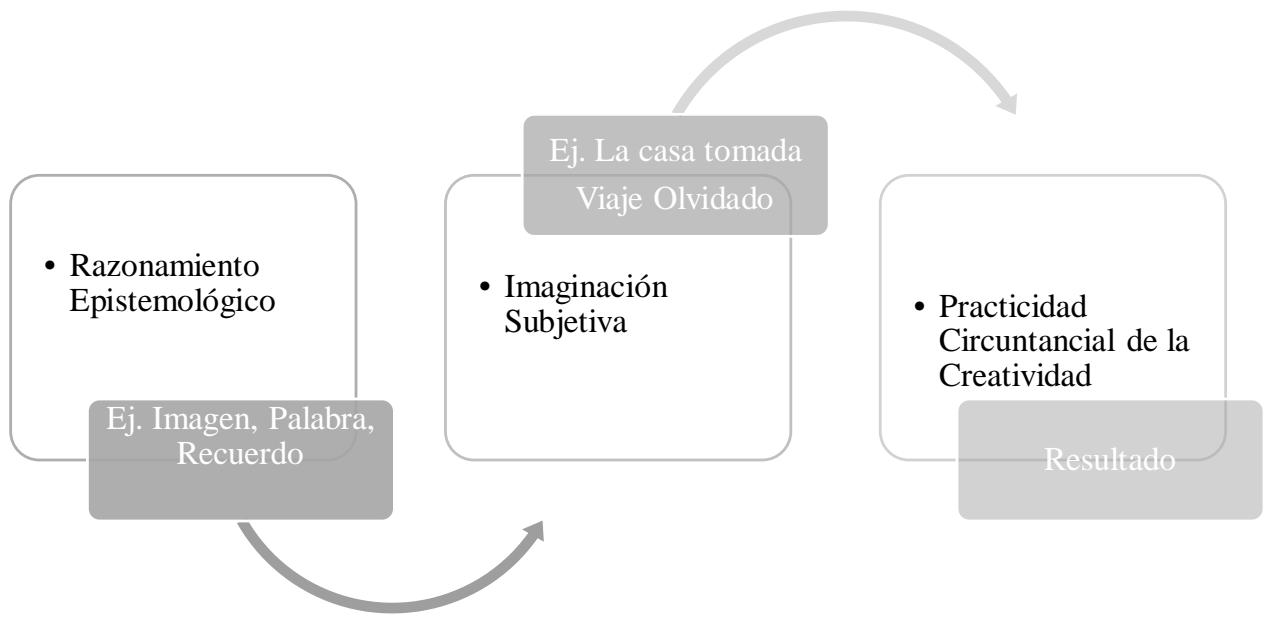
Diagrama 3: Esencia Subyacente de la Creatividad Mental
El razonamiento epistemológico consiste en el modo en que el individuo utiliza el pensamiento del mundo circundante de manera referencial y lógica. Por ejemplo, una imagen puede ser descrita de muchas maneras, pero lo cierto es que no deja de ser referente de algo a lo que la lógica nos lleva a definir exactamente como lo que es en realidad. Por ejemplo, si a nuestra mente llega la imagen de una casa, podríamos hacer una descripción detallada de esta en caso o no de que la imagen de esta nos haya sido de algún modo familiar. Simplemente porque la concepción que tenemos de tal imagen forma parte de nuestra memoria. Todos sabemos lo que es una casa y los compartimentos que la conforman. Lo mismo sucede con la palabra que utilizamos para nombrarla, o del recuerdo que tengamos de esta. En otras palabras, “El orden de las cosas no altera el producto”. Esto sin lugar a dudas es el resultado del razonamiento epistemológico. Ahora bien, existe cierta conectividad entre este pensamiento y la imaginación subjetiva, lo que conduce según se expone en el diagrama a la practicidad circunstancial de la creatividad. Acto que consiste en elevar el pensamiento a un grado de inteligencia superior, ya sea de manera realista o surrealista. So, basándonos en este análisis, creemos que de este modo podemos acceder esa capacidad innata del ser humano que es la creatividad, la cual tiene como trasfondo tanto el razonamiento epistemológico como la imaginación subjetiva, y a partir de ahí, poner en marcha la enseñanza de la creatividad lingüística y cultural en el aula de ELE. De ahí la elección del relato corto hispanoamericano para reseñar como hasta ahora hemos hecho, la viabilidad de esta idea.
### b) Recomendación de Métodos para la Unidad Didáctica
Para lograr obtener el resultado sobre la practicidad circunstancial de la creatividad que hemos expuesto en el anterior diagrama, creemos adecuado utilizar metodologías cuyo enfoque didacta se ajusten a este planteamiento. Por esta razón, proponemos la utilización de aspectos metódicos procedentes del Método Directo y del Método de Aprendizaje Combinado.
Por su parte, el método directo es el más conocido de los diferentes métodos basado en un enfoque “natural", un producto de las ideas introducidas por el movimiento de reforma, surgido a finales del siglo XIX, y de los principios para la enseñanza de lenguas. Fue uno de los primeros intentos de construir una metodología de la enseñanza de lenguas basada en la observación del proceso de adquisición de la lengua materna por parte de los niños (Sánchez, 1997). El método Directo Fue introducido en Francia y Alemania a principios del siglo XX y ampliamente conocido en los Estados Unidos gracias a L. Sauveur y a M. Berlitz, quienes lo aplicaron en sus escuelas, incorporando así una nueva orientación en la enseñanza de lenguas al otorgar una absoluta prioridad a la lengua oral y propugnar la enseñanza en la lengua meta. Para (Melero, 200o) la lengua se aprende mediante la imitación de un modelo lingüístico y la memorización de frases y pequeños diálogos; el léxico se adquiere mediante asociaciones y las reglas gramaticales se inducen de la observación de los ejemplos. Esto es algo que creemos cierto y además eficiente cuando de enseñanza y aprendizaje del
español lengua extranjera (ELE) se trata. Ver Tabla 6:
Especificidades del Método Directo:
Tabla 6: Especificidades del Método Directo
<table><tr><td>1° Enfoque</td><td>Uso exclusivo de la lengua meta.</td></tr><tr><td>3° Enfoque</td><td>Enseñanza inductiva de la gramática.</td></tr><tr><td>4° Enfoque</td><td>Desarrollo de las destrezas de communicatoración oral de forma progresiva y graduada mediante el intercambio de preguntas y respuestos entre profesores y alumnos.</td></tr><tr><td>5° Enfoque</td><td>Énfasis en la pronunciation y en la gramática.</td></tr></table>
Las especificidades expuestas en la tabla 6 tienden hacer hincapié en la importancia del lenguaje hablado como prioridad en el aula de ELE. Dado a estas peculiaridades para propiciar y potenciar el desarrollo del lenguaje hablado a través de la interacción preguntas/repuestas. La enseñanza de la expresión y comprensión oral. Así como la enfatización en la pronunciación y la gramática, consideramos que sea una vía adecuada para el desarrollo de carga lectiva que pueda ser despeñada a través de la otra metodología a utilizar en la unidad didáctica: el Aprendizaje Combinado, conocida en inglés como Blended Learning (BL). Es una metodología que mescla el uso de las TiC con la enseñanza tradicional, para lo cual ha de disponerse de ordenador u otros aparatos
electrónicos como teléfonos inteligentes y tabletas con conexión a Internet. Estas señalizaciones permiten concretar parte de la carga lectiva de la asignatura a impartir en o fuera del aula. Es una metodología instructiva, cuyo beneficio es el de asistir el sistema educacional en general. Dado a la correspondencia que tiene con las tendencias actuales de enseñanza y aprendizaje de lenguas, y de resultados avalados por prestigiosas publicaciones científicas y académicas (Lothridge, 2013); (Lopez, 2011); (Banados, 2006); (Carmen, 2012) el usarla facilitaría la labor docente relacionada con las características del curso que hemos presentado. Ver diagrama 4: Concepto Cognitivo del Aprendizaje Combinado. Diagrama 5: Didáctica del Aprendizaje Combinado
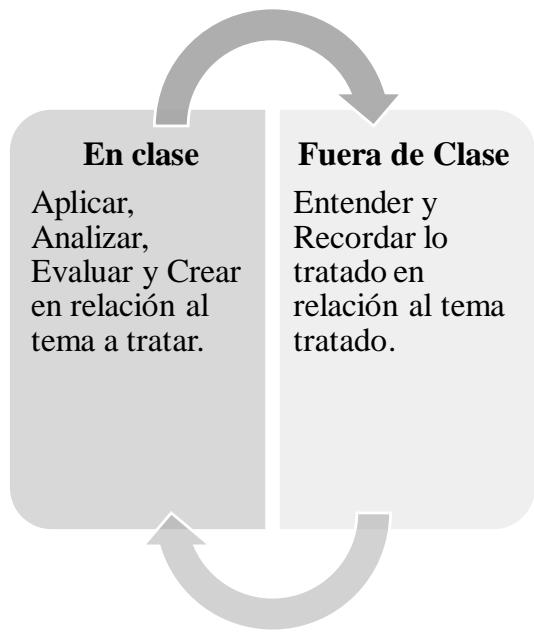
Diagrama 4: Concepto Cognitivo del Aprendizaje Combinado
Contenido Online
Selección del material adecuado.
Dar instrucciones precisas para el tema a tratar.
Uso adecuado de tiempo y espacio
Tutoria
Proveer asistencia profesional con vista a profundizar el conocimiento acquirido. Por ejemplo, hacer del
aula un espacio para desarrollar habilidades
Evaluación
Pruebas Presenciales. Pruebas online
#### Diagrama 5: Didáctica del Aprendizaje Combinado
Algunas de las ventajas asociadas con la aplicación del Aprendizaje Combinado incluyen el fácil acceso al conocimiento, mejorar la pedagogía, rentabilidad, facilidad de revisión de contenidos de aprendizaje sin presencia personal, esto último permite que los alumnos muestren una mayor motivación e interés por la enseñanza cuando se reúnen cara a cara y durante las discusiones en clase con sus compañeros de aula. La utilización de este método tiende a abrir nuevos potenciales para el aprendizaje autónomo/ autodidacta, y con ello elevar el rendimiento académico de los estudiantes. Estudios realizados han confirmado que la aplicación exitosa del método en el aprendizaje de idiomas puede resultar en la notable mejora de la expresión oral en conjunto con las otras destrezas. Todo esto no debería sorprendernos si tomamos en consideración el impacto académico que está teniendo esta metodología en materia de enseñanza y
aprendizaje de segundas lenguas, referencia de uso didáctico que se muestra en los Diagramas anteriormente expuestos. Hoy en día, las TIC como vehículo para transmitir información y comunicación son probablemente las más usadas en la enseñanza de lenguas extranjeras, por lo que no considerar el uso de estas en las clases de ELE contrastaría con el sentido de pedagogía que la Era Digital demanda. Cabe señalar que ambas metodologías están además en correspondencia con las disposiciones trazadas por el Marco Común de Referencia Europeo para la enseñanza lenguas extranjeras (Consejo de Europa, 2001), y el American Council on the Teaching of Foreign Languages (American Council on the Teaching of Foreign Languages, 2012). Ambos sistemas comparten niveles de correspondencia para la enseñanza y aprendizaje de la lengua española. Ver tabla 7: Correspondencia de Niveles:
Tabla 7: Correspondencia de Niveles
<table><tr><td colspan="6">CORRESPONDENCIAS</td></tr><tr><td>NIVELES</td><td>D.I.E. ORAL</td><td>D.I.E. ESCRITO</td><td>D.I.E. ONLINE- ESCRITO</td><td>Marco Común Europeo de Referencia para las Lenguas</td><td>ACTFL American Council on the Teaching of Foreign Languages</td></tr><tr><td rowspan="2">Elemental</td><td>1</td><td></td><td></td><td></td><td>Novice Low</td></tr><tr><td>2</td><td>Elemental</td><td>Elemental</td><td>A1</td><td>Novice Mid</td></tr><tr><td rowspan="2">Básico</td><td>3</td><td></td><td></td><td></td><td>Novice High</td></tr><tr><td>4</td><td>Básico</td><td>Básico</td><td>A2</td><td>Intermediate Low</td></tr><tr><td rowspan="2">Intermedio</td><td>5</td><td></td><td></td><td></td><td>Intermediate Mid</td></tr><tr><td>6</td><td>Intermedio</td><td>Intermedio</td><td>B1</td><td>Intermediate High</td></tr><tr><td rowspan="2">Avanzado</td><td>7</td><td></td><td></td><td></td><td>Advanced Low</td></tr><tr><td>8</td><td>Avanzado</td><td>Avanzado</td><td>B2</td><td>Advanced Mid</td></tr><tr><td>Superior</td><td>9</td><td>Superior</td><td>Superior</td><td>C1</td><td>Advanced High</td></tr><tr><td>Dominio</td><td>10</td><td>Dominio</td><td>Dominio</td><td>C2</td><td>Superior</td></tr><tr><td>Especializados</td><td>- Negocios - Turismo - Salud</td><td>Especializado</td><td>Especializado</td><td>-</td><td>-</td></tr></table>
- C1: Es capaz de comprender una amplia variedad de textos extensos y con cierto nivel de exigencia, así como reconocer en ellos sentidos implícitos. Sabe expresarse de forma fluida y espontánea sin muestras muy evidentes de esfuerzo para encontrar la expresión adecuada. Puede hacer un uso flexible y efectivo del idioma para fines sociales, académicos y profesionales. Puede producir textos claros, bien estructurados y detallados sobre temas de cierta complejidad, mostrando un uso correcto de los mecanismos de organización, articulación y cohesión del texto.
### c)Desglose de la Unidad Didáctica
## i. Competencias
En esta unidad didáctica se trabajarán las siguientes competencias:
- Competencia comunicativa: expresarse de forma coherente durante la presentación de trabajos asignados, discusión, e intercambio de ideas.
- Competencia sociocultural: reconocer el componente sociocultural que se utiliza el lenguaje literario del cuento hispanoamericano.
- Competencia para aprender a aprender: estrategias lingüísticas para asimilar y poner en práctica los conocimientos adquiridos.
- Competencia autonomía e iniciativa personal: análisis investigativo para la realización y posterior presentación y entregas de textos.
## i. Objetivos
A partir de las competencias señaladas, los objetivos a desarrollar son los siguientes:
- Comprender, memorizar, y usar elementos de esquematización que componen la estructura del género-cuento, incluyendo el cuento hispanoamericano.
- Hacer y responder preguntas basadas en el análisis de obras literarias.
- Reconocer elementos socioculturales utilizados en la composición textual del cuento hispanoamericano.
- Extraer de textos del cuento hispanoamericano elementos lingüísticos que se utilizan para lograr el efecto de embellecimiento entre muchos otros.
- Redactar ensayos y artículos de publicación.
- Expresarse coherentemente a través de la comunicación y discusión de ideas.
- Asimilar los concejos del aprendizaje.
## iiI. Contenidos
Los objetivos planteados se adquirirán a través de los siguientes contenidos y destrezas.
## iv. Lingüístico, Social, Cultural
Trayectoria del cuento hispanoamericano en el ámbito literario.
- Lo lingüístico, lo social, y cultural dentro de los cuentos de costumbre y cuentos románticos. El romanticismo, el modernismo, la vanguardia.
## i. Funcionales
-Analizar elementos de esquematización del génerocuento como introducción, nudo, y desenlace, y elementos de composición textual como tema, tiempo/espacio, y narración.
- Analizar el uso del razonamiento epistemológico y la imaginación subjetiva en la producción creativa del cuento hispanoamericano.
## Estructuras de esquematización y guía para la composición de ensayos
Introducción: Le indica al lector: El propósito del escritor, el acercamiento al tema y la organización que seguirá el ensayo. La introducción consiste en generar ideas, pero icuidado!: se trata de generar ideas sobre una pregunta concreta y no sobre un tema muy amplio. Por lo tanto, habrá que limitar el tema y enfocarlo, es decir, organizarlo de acuerdo con una cierta perspectiva y mediante una serie de preguntas que el escritor se hace a sí mismo. Al enfocar el tema es posible elaborar la tesis: una frase que consiste en la respuesta a una pregunta de enfoque. Ahora bien, para llamar la atención del lector esa tesis puede hacer uso de las siguientes estrategias (Gamboa, 1997):
- Sorpresa: Cuando manifiesta el hecho más notable o imprevisto del ensayo.
- Confirmación: Cuando se basa en la información que el lector ya conoce a fin de que le sea más fácil aceptar el resto de la argumentación.
- Contradicción: Cuando empieza con una idea común y aceptada por una mayoría, para seguidamente demostrar que es errónea y corregirla.
- Suspenso: Cuando se presentan los datos poco a poco dejando abierta la pregunta clave, tal vez planteándosela al lector.
La introducción, que no se extenderá más de un párrafo (a lo sumo dos), contendrá las siguientes partes: Primero, una breve introducción general al tema. Seguidamente la tesis, la cual indicará la interpretación de las implicaciones de la pregunta, así como el orden que seguirá el ensayo. A continuación, un ejemplo de tesis correspondiente a preguntas concretas:
Pregunta 1: Describa al personaje principal del Poema de Mío Cid.
Tesis 1: El Cid, personaje principal del Poema, se distingue por su fortaleza física, propia de guerrero, y su fortaleza interna que lo vuelve símbolo del padre y del esposo cristiano.
Esta tesis indica lo que el escritor considera fundamental en la personalidad del Cid, y a la vez indica
la organización del ensayo que consistirá en un párrafo destinado a la fortaleza física, otro destinado a la fortaleza interna, y una conclusión. Por cierto, utiliza la estrategia de sorpresa al aunar fortaleza física e interna.
Pregunta 2: Compare los personajes de Don Quijote y Sancho Panza.
Tesis 2: En general, los personajes de DQ y SP parecen totalmente opuestos: DQ representa al ser idealista y SP al realista. Sin embargo, hay momentos en la novela en que los papeles parecen invertirse.
Esa tesis indica que un párrafo se dedicará a desarrollar el idealismo de DQ por medio de ejemplos sacados de la obra, el otro a desarrollar el realismo de SP, el otro a comparar los puntos de contacto entre ambos y, por último, se encontrará la conclusión. Este es un ejemplo de ensayo de comparación y contraste en el que dos párrafos están dedicados al contraste y uno a la comparación. Utiliza la estrategia de contradicción.
En los ensayos de tarea/examen el título es la pregunta misma. Sin embargo, cuando escriba un ensayo con otros propósitos debe tener presente la gran importancia del título, el cual es una guía o señal retórica para el lector. El título por sí solo puede despertar el interés o apatía del lector y es también importante porque transmite, desde el principio, la impresión que quiere comunicar el escritor.
Nudo o cuerpo: En el nudo/cuerpo tiene lugar el desarrollo de los aspectos que se indicaron en la introducción. Por lo general, cada aspecto mencionado en la tesis ocupará un párrafo del ensayo. Ahora bien, la organización del nudo/cuerpo variará algo según se escoja una u otra estrategia de argumentación. Es una sección muy importante del ensayo pues demuestra la capacidad de organización y argumentación del escritor. Así pues, son cruciales en esta sección, el uso adecuado de transiciones y el buen manejo de la lógica. Existen diferentes estrategias de organización del nudo/cuerpo, con frecuencia, se utilizan varias de ellas en el mismo ensayo. El ensayo académico no suele hacer uso de la descripción ni de la narración sino de la exposición, es decir, incluye una declaración general (tesis) y la evidencia específica para apoyarla. So, dependiendo del propósito, el escritor utilizará una u otra estrategia de argumentación:
- El análisis. Consiste en la descripción de partes o componentes de una entidad. Es una técnica propia del estudio de la literatura. Así pues, el análisis de una novela incluiría los personajes, el argumento, el punto de vista y demás elementos que componen la novela.
- Comparación y contraste. Sirve para señalar semejanzas y diferencias entre dos o más conjuntos o entidades.
- Definición. Aclaración de un término o concepto que el lector puede desconocer. Los diferentes modos de definir incluyen: la situación de un concepto dentro de una clase, la ilustración por medio de ejemplos, el uso de sinónimos y la etimología.
- Clasificación. Se parece mucho al análisis, pero en vez de preguntarse por las partes de que se compone la totalidad se pregunta por las diferentes clases de la entidad. Por ejemplo, la novela picaresca se podría estudiar como una clase dentro de la novela en general en tanto que es un subgrupo o género.
- La causa y el efecto. Examina un objeto o fenómeno y busca sus orígenes y consecuencias.
Conclusión: La conclusión es el último párrafo del ensayo y debe recoger (o recapitular) las ideas que se presentaron en la tesis, en la introducción. En la conclusión se invierte la fórmula de la introducción: se empieza con un breve resumen del ensayo y se termina con una frase bien pensada que llame la atención del lector sobre el punto clave del artículo. Esta última frase debe reflejar bien el enfoque del ensayo y a menudo servir para situar la idea central dentro de un contexto más amplio.
### Criterios de Evaluación para El ensayo
- 1Un contenido relevante y bien documentado.
- Un argumento apropiado y bien organizado.
3. El uso correcto e idiomático del lenguaje.
Estructuras de esquematización y guía para la composición de artículos de publicación
Título / Resumen / Palabras claves
### 1. Introducción
Esta sección debe incluir una descripción del marco teórico, definiciones y principios, cuestiones y controversias primarias, información de antecedentes y contextos, etc.
Revisión de la literatura (si es necesario)
Una sección dedicada a los recursos bibliográficos significativos, consultados o empleados, que contribuyeron al estudio. Examina artículos académicos, libros y otras fuentes (por ejemplo, disertaciones, actas de conferencias) relevantes para un tema, área de investigación o teoría en particular, proporcionando una descripción, resumen y evaluación crítica de cada trabajo. El propósito es ofrecer una visión general de la literatura significativa publicada sobre un tema específico.
Material y Métodos
Una sección destinada a contener una descripción detallada de todos los métodos, materiales, colaboradores y participantes en el estudio. Los protocolos utilizados para la adquisición de datos,
técnicas y procedimientos, parámetros investigados, métodos de medición y aparatos deben describirse con suficiente detalle para permitir que otros científicos comprendan, analicen y comparen los resultados.
#### 4Resultados y Discusión
Un análisis comparativo o descriptivo del estudio basado en resultados, en estudios previos, etc. Los resultados deben presentarse en una secuencia lógica, dados los hallazgos más importantes primero y abordando los objetivos establecidos. El número de tablas y figuras debe limitarse a las absolutamente necesarias para confirmar o impugnar la premisa del estudio. Los autores deben tratar solo aspectos nuevos o importantes de los resultados obtenidos. El material de la sección Resultados no debe repetirse, ni introducirse material nuevo. Debe abordarse la pertinencia de los hallazgos en el contexto de la literatura existente o la práctica contemporánea.
#### 5. Recomendaciones
Esta sección contiene recomendaciones teóricas y prácticas, ideas de investigación adicionales, nuevos enfoques, sugerencias y preocupaciones con respecto a los posibles impactos sociales y culturales, etc.
#### 6. Conclusión
En esta sección final, los principales hallazgos se reiteran de manera concisa. Sólo deben incluirse las conclusiones respaldadas por los hallazgos del estudio.
#### 7. Agradecimientos
Las personas que contribuyeron al trabajo de alguna manera para la preparación del manuscrito, pero no cumplen con los criterios de autoría, deben enumerarse en la sección de agradecimientos mencionando sus contribuciones. Estos también incluyen la(s) fuente(s) de financiamiento de cada autor y describen la participación del organismo u
organización de financiamiento en todo el trabajo. Se recomienda reconocer al editor si algún manuscrito fue revisado para correcciones de idioma. Los permisos deben obtenerse de todos aquellos que se reconocen en esta sección.
Sobre el (los) autor(es)
Una sección en la que se pueden presentar de forma detallada las actividades de los autores, intereses de investigación, membresías y afiliaciones, investigaciones publicadas, etc.
#### Gramaticales
- Todos los tiempos verbales y respectivas conjugaciones. Énfasis en los pretéritos perfecto e imperfecto.
- Pronombres, artículos, y adjetivos. Énfasis en el uso del género y número.
- Conjunciones, preposiciones, palabras exclamativas e interrogativas.
#### Textuales
- Análisis de obras literarias.
- Composición de ensayos.
- Composición y publicación de artículos de investigación.
#### Pragmáticos
Significado comunicacional del lenguaje simbólico, místico, coloquial, y humorístico.
#### En el aula
Los contenidos y destrezas a alcanzar se desarrollarán a través de modalidades de enseñanza abiertas, es decir, se deja a disposición elegir la forma en la que se desea conducir la carga lectiva, ya que tanto el borrador del curso como todo lo referente a la unidad didáctica puede ser interpretado como se requiera. Esto debido a que “cada profesor tiene su propio librito". So, las siguientes actividades son un ejemplo de lo que se podría hacer de manera sucesiva si así se dispone. Ver tabla 9: Aplicación de la Carga Lectiva:
Tabla 9: Aplicación de la Carga Lectiva
<table><tr><td colspan="3">Nombre</td><td colspan="2">Joel Laffita Rivera</td></tr><tr><td colspan="3">Tema</td><td colspan="2">1a Sección iEncuentro con el Cuento Hispanoamericano!</td></tr><tr><td colspan="3">Duración</td><td colspan="2">2 hrs. Dividirla entre minutos según convenga</td></tr><tr><td colspan="3">Resultado del aprendizaje</td><td colspan="2">Al final de esta sesión los estudiantes podrán: - Conocer aspectos relevantes relacionados con la trayectoria del cuento hispanoamericano en el ámbito literario. - Conocer la importancia que tiene la aplicación del razonamiento epistemológico e imaginación subjética en la producción creativa literaria.</td></tr><tr><td colspan="3">Metodología</td><td colspan="2">Ejercicios Prácticos e Interactivos</td></tr><tr><td colspan="3">Materialrequerido</td><td colspan="2">Power Point, pizarra, marcador, ordinador, Internet.</td></tr><tr><td colspan="5">Guía del profesor</td></tr><tr><td>Hora</td><td>Tema</td><td colspan="2">Descripción de Actividades</td><td>Recursos de Capacitación</td></tr><tr><td>30 min</td><td>Introduccion</td><td colspan="2">Presentaciones y saludos de bienvenida. Muestra de formación académica por ambas partes, profesor y estudiantes. Pedir a los estudiantes partir motivos de INTERES por el camino, para de este modo teneras notas en cuando a perspectivas académicas se refiere.Esta es una parte del programa de presentación que el profesorDebe saber como gestionar desde el punto de vista psicológico, ya que la misma pertenece a la prima sección de camino a partir</td><td>PowerPoint</td></tr><tr><td rowspan="2">1hr</td><td>Unidad Didactica. Objetivo y Resultado del Aprendizaje</td><td colspan="2">El profesor presenta la Unidad didactica. Explica el objetivo y el resultado del aprendizaje</td><td rowspan="2">PowerPoint</td></tr><tr><td>Contenido.</td><td colspan="2">- Análisis del componente lingüístico, social, y cultural dentro de los cuentos de costumbre y cuentos románticos.- El profesor presente el contenido de la sección. Brinda explicaciones para que los estudiantes procedan al encasillamiento de aspectos relevantes, y posterior realización de ejercicios practicos e interactivos basados en las destrezas de escritura y lectura</td></tr><tr><td rowspan="2">30min</td><td>Resumir</td><td colspan="2">Revisión de resultados.Preguntas/respectas.Quiz basado en el topicenseñado.</td><td rowspan="2">Kahoot</td></tr><tr><td>Conclusión.</td><td colspan="2">El profesor da una conclusión.</td></tr></table>
### d) Sección Ejemplificativa de Ejercicios Prácticos e Interactivos
Partimos de la idea de que la aplicación del razonamiento epistemológico y la imaginación subjetiva que conlleva la ejecución del acto de creatividad debe ser usada para que los estudiantes de ELE visualicen, comprendan, y utilicen estos arquetipos de pensamientos, los cuales sabemos que forman parte del estado mental del individuo. So, esto implica que todos los ejercicios prácticos e interactivos basados, en este caso en las destrezas de escritura y lectura como se señala en esta parte del desglose de la unidad didáctica "Aplicación de la Carga Lectiva", sean diseñados en correspondencia con esa idea, la cual se expone en el [Diagrama 3: Esencia Subyacente de la Creatividad Mental] y subsecuente explicación, pg. 12 de este trabajo de investigación. De este modo lograríamos que la creatividad se ponga de manifiesto, y no sea vista como un acto exclusivo de genialidad. De lograrse esto de manera exitosa, tendría un impacto directo en la adquisición y desarrollo de la habilidad cognitiva y afectiva de la lengua meta y, por consiguiente, en la producción lingüística y cultural de esta. En este sentido, se propone la realización sistemática de ejercicios orientados, para lo cual nos pueden servir cada una de las obras del cuento hispanoamericano anteriormente señaladas. Cabe recordar que buscamos hacer de la enseñanza un laboratorio para desarrollar la creatividad. Ver la sincronización de los ejercicios conformados para respaldar lo dicho:
Ejercicio A: Diga que le sugiere el título de esta obra según la aplicación del pensamiento epistemológico y
la imaginación subjetiva en el logro de su composición textual. Tomando en cuenta este conocimiento, realice luego un ejercicio escrito en el cual exponga, al menos, 3 ejemplos de títulos creados por su propia autoría.
Ejercicio B: Observe este fragmento de "El balcón" y extraiga las (frases/oraciones) que supongan la aplicación del pensamiento epistemológico y la imaginación subjetiva en el logro de la composición textual de este.
"El teatro donde yo daba los conciertos también tenía poca gente y lo había invadido el silencio: yo lo veía agrandarse en la gran tapa negra del piano. Al silencio le gustaba escuchar la música; oía hasta la última resonancia y después se quedaba pensando en lo que había escuchado....
Ejercicio C: Busque información sobre el carácter social y cultural que caracterice el contenido literario del cuento “El balcón”, y prepare un ensayo escrito de, al menos 500 palabras, en el cual aborde esos temas.
## i.Actividad Docente
Ejercicio B: Observe este fragmento de "Viaje Olvidado” y extraiga las (frases/oraciones) que supongan la aplicación del pensamiento epistemológico y la imaginación subjetiva en el logro de la composición textual de este.
“Quería acordarse del día en que había nacido y fruncía tanto las cejas que a cada instante las
personas grandes la interrumpían para que desarrugara la frente. Por eso no podía nunca llegar hasta el recuerdo de su nacimiento....
Ejercicio C: Busque información sobre el carácter social y cultural que caracterice el contenido literario del cuento "Viaje Olvidado", y prepare un ensayo escrito de, al menos 500 palabras, en el cual aborde esos temas.
## i.Actividad Docente
Introducción: El cuento hispanoamericano que nos servirá de base para reseñar el uso del razonamiento epistemológico e imaginación subjetiva en el logro de su composición textual es "La doble y única mujer", Pablo Palacio (1906 -1947).
Ejercicio A: Diga que le sugiere el título de esta obra según la aplicación del pensamiento epistemológico y la imaginación subjetiva en el logro de su composición textual. Tomando en cuenta este conocimiento, realice luego un ejercicio escrito en el cual exponga, al menos, 3 ejemplos de títulos creados por su propia autoría.
Ejercicio B: Observe este fragmento de "La doble y única mujer" y extraiga las (frases/oraciones) que supongan la aplicación del pensamiento epistemológico y la imaginación subjetiva en el logro de la composición textual de este.
"Mi espalda, mi atrás, es, si nadie se opone, mi pecho de ella. Mi vientre está contrapuesto a mi vientre de ella. Tengo dos cabezas, cuatro brazos, cuatro senos, cuatro piernas, y me han dicho que mis columnas vertebrales, dos hasta la altura de los omóplatos, se unen allí para seguir - robustecida- hasta la región coxígea...
Ejercicio C: Busque información sobre el carácter social y cultural que caracterice el contenido literario del cuento "La doble y única mujer", y prepare un ensayo escrito de, al menos 500 palabras, en el cual aborde esos temas.
## iv. Actividad Docente
Ejercicio B: Observe este fragmento de "El Aleph” y extraiga las (frases/oraciones) que supongan la aplicación del pensamiento epistemológico y la imaginación subjetiva en el logro de la composición textual de este.
Ejercicio C: Busque información sobre el carácter social y cultural que caracterice el contenido literario del cuento "El Aleph”, y prepare un ensayo escrito de, al menos 500 palabras, en el cual aborde esos temas.
### . Actividad Docente
Introducción: El cuento hispanoamericano que nos servirá de base para reseñar el uso del razonamiento epistemológico e imaginación subjetiva en el logro de su composición textual es "Casa tomada, Julio Cortázar (Bruselas, 1914 - París, 1984).
Ejercicio A: Diga que le sugiere el título de esta obra según la aplicación del pensamiento epistemológico y la imaginación subjetiva en el logro de su composición textual. Tomando en cuenta este conocimiento, realice luego un ejercicio escrito en el cual exponga, al menos, 3 ejemplos de títulos creados por su propia autoría.
Ejercicio B: Observe este fragmento de "Casa tomada” y extraiga las (frases/oraciones) que supongan la aplicación del pensamiento epistemológico y la imaginación subjetiva en el logro de la composición textual de este.
“Lo recordaré siempre con claridad porque fue simple y sin circunstancias inútiles. Irene estaba tejiendo en su dormitorio, eran las ocho de la noche y de repente se me ocurrió poner al fuego la pavita del mate. Fui por el pasillo hasta enfrentar la entornada puerta de roble, y daba la vuelta al codo que llevaba a la cocina cuando escuché algo en el comedor o la biblioteca."...
Ejercicio C: Busque información sobre el carácter social y cultural que caracterice el contenido literario del cuento “Casa tomada”, y prepare un ensayo escrito de, al menos 500 palabras, en el cual aborde esos temas.
## vi. Actividad Docente
Ejercicio B: Observe este fragmento de "El ahogado más hermoso del mundo" y extraiga las (frases/ oraciones) que supongan la aplicación del pensamiento epistemológico y la imaginación subjetiva en el logro de la composición textual de este.
“Los primeros niños que vieron el promontorio oscuro y sigiloso que se acercaba por el mar, se hicieron la ilusión de que era un barco enemigo. Después vieron que no llevaba banderas ni arboladura, y pensaron que fuera una ballena. Pero cuando quedó varado en la playa le quitaron los matorrales de sargazos, los filamentos de medusas y los restos de cardúmenes y naufragios que llevaba encima, y sólo entonces descubrieron que era un ahogado.”...
Ejercicio C: Busque información sobre el carácter social y cultural que caracterice el contenido literario del cuento "El ahogado más hermoso del mundo", y prepare un ensayo escrito de, al menos 500 palabras, en el cual aborde esos temas.
## vii. Actividad Docente
Introducción: El cuento hispanoamericano que nos servirá de base para reseñar el uso del razonamiento epistemológico e imaginación subjetiva en el logro de su composición textual es Viaje a la semilla, Alejo Carpentier (Lausana, Suiza, 26 de diciembre de 1904 - París, Francia, 24 de abril de 1980).
Ejercicio A: Diga que le sugiere el título de esta obra según la aplicación del pensamiento epistemológico y la imaginación subjetiva en el logro de su composición textual. Tomando en cuenta este conocimiento, realice luego un ejercicio escrito en el cual exponga, al menos, 3 ejemplos de títulos creados por su propia autoría.
Ejercicio B: Observe este fragmento de "Viaje a la semilla” y extraiga las (frases/oraciones) que supongan la aplicación del pensamiento epistemológico y la imaginación subjetiva en el logro de la composición textual de este.
“Los cuadrados de mármol, blancos y negros volaron a los pisos, vistiendo la tierra. Las piedras con saltos certeros, fueron a cerrar los boquetes de las murallas. Hojas de nogal claveteadas se encajaron en sus marcos, mientras los tornillos de las charnelas volvían a hundirse en sus hoyos, con rápida rotación. En los canteros muertos, levantadas por el esfuerzo de las flores, las tejas juntaron sus fragmentos, alzando un sonoro torbellino de barro, para caer en lluvia sobre la armadura del techo”...
## viii. Actividad Docente
Introducción: El cuento hispanoamericano que nos servirá de base para reseñar el uso del razonamiento
epistemológico e imaginación subjetiva en el logro de su composición textual es El Jorobadito, Roberto Arlt, (1900-1942).
Ejercicio A: Diga que le sugiere el título de esta obra según la aplicación del pensamiento epistemológico y la imaginación subjetiva en el logro de su composición textual. Tomando en cuenta este conocimiento, realice luego un ejercicio escrito en el cual exponga, al menos, 3 ejemplos de títulos creados por su propia autoría.
Ejercicio B: Observe este fragmento de “El Jorobadito” y extraiga las (frases/oraciones) que supongan la aplicación del pensamiento epistemológico y la imaginación subjetiva en el logro de la composición textual de este.
“Los diversos y exagerados rumores desparramados con motivo de la conducta que observé en compañía de Rigoletto, el jorobadito, en la casa de la señora X, apartaron en su tiempo a mucha gente de mi lado. Sin embargo, mis singularidades no me acarrearon mayores desventuras, de no perfeccionarlas estrangulando a Rigoletto. Retorcerle el pescuezo al jorobadito ha sido de mi parte un acto más ruinoso e imprudente para mis intereses, que atentar contra la existencia de un benefactor de la humanidad."...
Ejercicio C: Busque información sobre el carácter social y cultural que caracterice el contenido literario del cuento “El Jorobadito”, y prepare un ensayo escrito de, al menos 500 palabras, en el cual aborde esos temas.
## ix. Actividad Docente
Introducción: El cuento hispanoamericano que nos servirá de base para reseñar el uso del razonamiento epistemológico e imaginación subjetiva en el logro de su composición textual es El Ojo Silva, Roberto Bolaño, (Santiago de Chile, 28 de abril de 1953-Barcelona, 15 de julio de 2003).
Ejercicio B: Observe este fragmento de "El Ojo Silva” y extraiga las (frases/oraciones) que supongan la aplicación del pensamiento epistemológico y la imaginación subjetiva en el logro de la composición textual de este.
## x. Actividad Docente
Introducción: El cuento hispanoamericano que nos servirá de base para reseñar el uso del razonamiento epistemológico e imaginación subjetiva en el logro de su composición textual es La muñeca menor, Rosario Ferré (1938-2016).
Ejercicio A: Diga que le sugiere el título de esta obra según la aplicación del pensamiento epistemológico y la imaginación subjetiva en el logro de su composición textual. Tomando en cuenta este conocimiento, realice luego un ejercicio escrito en el cual exponga, al menos, 3 ejemplos de títulos creados por su propia autoría.
Ejercicio B: Observe este fragmento de "La muñeca menor" y extraiga las (frases/oraciones) que supongan la aplicación del pensamiento epistemológico y la imaginación subjetiva en el logro de la composición textual de este.
“El médico que la examinó aseguró que no era nada, probablemente había sido mordida por una chágara viciosa. Sin embargo, pasaron los días y la llaga no cerraba. Al cabo de un mes el médico había llegado a la conclusión de que la chágara se había introducido dentro de la carne blanda de la pantorrlla, donde había evidentemente comenzado a engordar...
Ejercicio C: Busque información sobre el carácter social y cultural que caracterice el contenido literario del cuento "La muñeca menor", y prepare un ensayo escrito de, al menos 500 palabras, en el cual aborde esos temas.
Actividad Docente destinada a la aplicación del concepto teórico de la creatividad expuesto en esta investigación. Esta actividad, al igual que las anteriores, puede repetirse de manera sincronizada, utilizando como base el siguiente ejemplo:
Introducción: Observe el siguiente título y respectivo fragmento, cuya redacción ha sido posible gracias al conocimiento adquirido sobre la aplicación del pensamiento epistemológico y la imaginación subjetiva. ¿Puede escribir el suyo propio?
### El tren, Joel Laffita Rivera
“Sí, no fue un tren cualquiera, más el de las 4am en el que ocurrieron cosas sorprendentes, imposibles de imaginar, pero ciertas. Yo fui testigo de ella...
## IV. METODOLOGÍA
Para llevar a cabo esta investigación de manera satisfactoria, se utilizó una metodología que combina aspectos procedentes de la metodología cualitativa y cuantitativa. La metodología cualitativa es una de
las dos metodologías de investigación que tradicionalmente se han utilizado en las ciencias empíricas. Se contrapone a la metodología cuantitativa. Se centra en los aspectos no susceptibles de cuantificación. Este tipo de metodología es característico de un planteamiento científico fenomenológico. La investigación cualitativa ahonda en la interpretación de los datos: supone un estudio más profundo y detenido de los datos observados, y tiene sus propios medios de conseguir validez, como es el empleo de la triangulación, esto es, cotejar los datos desde diferentes puntos de vista, lo cual ayuda además a profundizar en la interpretación de los mismos. Se pueden agrupar las técnicas de recogida de datos de la investigación cualitativa en tres grandes categorías, basadas respectivamente en la observación directa, las entrevistas en profundidad y el empleo de documentos. Los instrumentos de recogida son variados, como pueden ser las parrillas de observación, o bien cuestionarios, entrevistas, diarios, entre otros. Por su parte, la metodología cuantitativa, que también es una de las dos metodologías más usadas en cuanto a investigación académica y científica se refiere, se centra en los aspectos observables susceptibles de cuantificación, y utiliza la estadística para el análisis de los datos. Se contrapone a la metodología cualitativa o interpretativa. Este tipo de metodología es característico de un planteamiento científico positivista. El postulado fundamental del positivismo es que el conocimiento válido sólo puede establecerse por referencia a lo que se ha manifestado a través de la experiencia.
A pesar de que la metodología cualitativa y la cuantitativa suelen contraponerse, en realidad tanto la orientación de tipo cuantitativo como la de tipo cualitativo pueden considerarse interdependientes. De esta manera, puede iniciarse un estudio cualitativo exploratorio, y posteriormente emplear métodos cuantitativos para ir ordenando lo que se va descubriendo. O, a la inversa, iniciar un estudio cuantitativo y a lo largo de su desarrollo precisar las aportaciones cualitativas que permitan una visión más profunda de la realidad objeto de estudio.
Ese planteamiento viene a confirmar que el uso combinado de ambas metodologías en el proceso de investigación puede producir resultados de interpretación que favorezcan la labor investigativa. Algo que supone dar una mejor repuesta de credibilidad a las preguntas que se puedan formular, así como la validación de los resultados obtenidos. En este sentido a continuación presentamos los parámetros utilizados:
- Recopilación y análisis de materiales literarios.
- Recopilación y análisis de publicaciones académicas y científicas.
- Rastreo y selectividad de Páginas webs acreditadas.
- Formulación de enunciados y preguntas bases.
Empleando principios de investigación combinados de corte cualitativo y cuantitativo, se procedió a la revisión metódica de materiales literarios de obras del género-cuento hispanoamericano, todas ellas procedentes de la autoría de ilustres escritores también hispanoamericanos. El análisis de estas obras giro en torno a los principios literarios que componen este género literario, pero con énfasis en la creatividad como trasfondo de su proceso de composición y producción. En la misma medida, se realizó la recopilación y análisis de publicaciones académicas y científicas, el cual giro entorno a la creatividad como tema de investigación, pero con énfasis en lo que representa esta habilidad innata de la cognición humana en el ámbito de enseñanza de lenguas, especialmente la diciplina español lengua extranjera
(ELE). También como parte del proceso de investigación, se efectuó la recopilación y análisis de páginas webs. Esta se llevó a cabo en la medida en que la investigación se ponía en curso. Se utilizaron técnicas de navegación a través de Google e Internet, las cuales implicaron el rastreo y la selectividad de todas estas páginas webs.
Toda la documentación examinada y seleccionada gurda estrecha relación con el tema tratado en la presente investigación, lo que supone un vínculo cuantitativo en cuanto a compatibilidad, innovación, y resultados. Todos estos patrones pueden ser perfectamente calculados utilizando un sistema de comparabilidad cuando de recoger y proveer muestras de estadísticas se trata. Ver tabla 10: Sistema cuantitativo:
Tabla 10: Sistema Cuantitativo
<table><tr><td>Patrones</td><td>Antecedentes</td><td>Comparabilidad</td><td>Quantificación</td></tr><tr><td>Compatibility</td><td rowspan="3">Publicaciones académicas y@cintidas</td><td>Tema</td><td>%</td></tr><tr><td>Innovacion</td><td>Nueva idea</td><td>%</td></tr><tr><td>Resultados</td><td>Aporte al campo deinvestigacion asignado</td><td>%</td></tr></table>
Formulación de Enunciados y Preguntas Bases
Como en todo trabajo de investigación, el manejo de esta siempre ha contado entre sus acápites con preguntas que usualmente sirven de base para llevar a cabo el proceso de investigación. A continuación, se enumeran los site enunciados y respectivas preguntas que sirvieron de base para desarrollar el presente trabajo de investigación:
- La mayoría de nosotros asociamos la creatividad con la forma de hacer arte, pero ¿Qué es en realidad la creatividad?
- Si es cierto que la creatividad es una habilidad típica de la cognición humana, ¿Qué patrones de pensamiento tiene esta como trasfondo?
- Si la realización del acto de creatividad conlleva la aplicación de esos patrones de pensamiento, ¿Qué muestra de ello podríamos usar para validar esta hipótesis?
- El ámbito literario, especialmente el género-cuento es reflejo del uso de la creatividad. So, ¿Cómo se vislumbra está cualidad en cuanto a producción literaria se refiere?
-El estrecho vínculo que existe entre lengua y cultura es conocido por todos. Un ejemplo de ello es la concepción del cuento hispanoamericano. Entonces, ¿Podría su composición textual servirnos para enseñar la creatividad en este sentido?
- Como se puede observar, el contexto literario del relato corto hispanoamericano se destaca por poseer un lenguaje que podríamos catalogar como
impresionista y expresionista. Dado a las características lingüísticas propias de la lengua española y su aplicación en materia de fonética, léxico, y gramática; ¿Se podría inducir el acto de creatividad usando los arquetipos de pensamientos que tiene esta como trasfondo?
- La enseñanza de la disciplina español lengua extranjera (ELE) requiere conocer tanto de lingüística como de cultura. Siendo así, ¿Se podrían diseñar metodologías para enseñar la creatividad lingüística y cultura? ¿A partir de que base? ¿Beneficiarían la adquisición y desarrollo de la habilidad cognitiva y afectiva de la lengua meta?
## VI. REsultados y Discusión
El llevar a cabo este trabajo de investigación conto con el uso de los de los siguientes parámetros de comprobación: Objetivo de la investigación: 1). Conocimiento y Dominio de la materia. 2). Metodología. 3). Resultados y discusión. 4). De este modo se hizo posible el presentar de manera clara y coherente el análisis y tratamiento del tema tratado, cuya funcionalidad ha quedado demostrada a través de todos estos parámetros.
El objetivo de la investigación ha sido el presentar un manuscrito que sirva de referencia para la enseñanza de la creatividad lingüística y cultural a través de la composición textual del cuento hispanoamericano. Para lograr este objetivo en la forma en que se ha deseado, se realizó un análisis de esta temática en yuxtaposición con la hipótesis que la investigación ha planteado sobre el [razonamiento
epistemológico e imaginación subjetiva] que conlleva a la realización del acto de creatividad, y el aporte que esto puede tener en la adquisición y desarrollo cognitivo y afectivo de la lengua meta. En este sentido, la idea que la hipótesis presenta sobre esos arquetipos de pensamientos se presenta de modo único y renovador. De manera lógica sostiene que los mismos son el componente por necesidad que nos permite mostrar esa habilidad típica de la cognición human que es la “creatividad”. La cual, como bien sabemos forma parte de un sistema inherente a la capacidad de pensamiento que, en el caso de los seres humanos, y a diferencia de cualquier especie del reino animal, tiene como trasfondo el uso de esos arquetipos de pensamientos. Lo que es cierto y que se podría explicar, por ejemplo, con la concepción del relato corto, especialmente el fantástico. A través de la cual podemos observar la fusión de estos arquetipos de pensamientos cuando de crear literatura de este corte se refiere. Es decir, el individuo da riendas sueltas al sentido práctico de la creatividad que yace en su estado mental. Referente que como bien se ha afirmado, puede verse aplicado de manera explícita en las magníficas obras provenientes de la mano de escritores Hispanoamericanos. Algunas de la cuales han sido citadas en forma de fragmentos para visualizar el sentido del acto de creatividad en correspondencia con el uso del razonamiento epistemológico e imaginación subjetiva. So, teniendo en cuenta el conocimiento y dominio de la materia en discusión, y la viabilidad que supone esta hipótesis en el campo educativo, se diseñó la didáctica para la enseñanza de la creatividad lingüística y cultural en el aula de ELE. En este sentido, se han presentado auténticos patrones de enseñanza para el español lengua extranjera (ELE) que incluyen el Borrador del Curso de ELE ilustrado en la tabla 4. Así como La Unidad Didáctica tabla 5. Esta unidad didáctica presenta un desglose en correspondencia con la hipótesis planteada y su aplicación en materia académica.
Por lo tanto, creemos apropiado el uso de estas metodologías en la enseñanza de la creatividad lingüística y cultural, ya que las ideas planteadas en esta son el resultado de un estudio sobre el impacto directo que tienen en la adquisición y desarrollo de la habilidad cognitiva y afectica de la lengua meta. Como todos sabemos, las actividades de aprendizaje cognitivo ayudan a los estudiantes a procesar y analizar críticamente la información proporcionada y contribuyen al fortalecimiento de su conocimiento relacionado con ese ámbito. Mientras los enfoques de aprendizaje afectivo son utilizados por los estudiantes para lidiar con las respuestas emocionales que siguen el proceso de aprendizaje. De ahí que los ejercicios expuestos en el desglose de la unidad didáctica estén dirigidos a propiciar al estudiante la inducción y reflexión sobre el uso del razonamiento epistemológico y la imaginación
subjetiva, y como estos pueden ser utilizado como guía para el logro exitoso de la producción literaria. Cabe recordar que la creatividad es una capacidad típica de la cognición humana, y que el acto de esta cualidad tiene como trasfondo, en el caso especial de los seres humanos, el uso de esos arquetipos de pensamientos. So, estamos en presencia de un conocimiento cuyo impacto es de alto valor cognitivo y afectivo, ya que el saber utilizar esos arquetipos de pensamientos que, de hecho, yacen en el estado mental del individuo, ayudaría a los estudiantes a comprender mucho mejor la concepción del acto de creatividad, y la ejecución de este en materia de producción literaria. Lo que favorecería en gran medida la enseñanza de la creatividad lingüística y cultural en al aula de ELE. Objetivo prioritario de este trabajo de investigación, y que fue posible realizar gracias a la metodología utilizada.
Como bien sabemos, se puede iniciar un estudio cualitativo exploratorio, y posteriormente emplear métodos cuantitativos para ir ordenando lo que se va descubriendo. O, a la inversa, iniciar un estudio cuantitativo y a lo largo de su desarrollo precisar las aportaciones cualitativas que permitan una visión más profunda de la realidad objeto de estudio. Ese planteamiento no viene a confirmar que el uso combinado de ambas metodologías es variable para llevar a cabo el proceso de investigación, So, hasta qué punto se pudiera considerar esto favorable, es algo que ha sido mostrado a través de los parámetros [Recopilación y análisis de materiales literarios. Recopilación y análisis de publicaciones académicas y científicas. Rastreo y selectividad de Páginas webs acreditadas. Formulación de enunciados y preguntas bases] que han sido presentados conjuntamente con la oportuna explicación. Todo esto, supone dar una mejor repuesta de credibilidad a las preguntas formuladas y a las que se puedan formular por parte de la comunidad científica, así como validar los resultados obtenidos cuya finalidad busca beneficiar el ámbito académico y la investigación científica respectivamente.
## VII. CoNclusioN
En conclusión, se podría decir que este manuscrito representa una importante fuente de datos cuyos resultados, además de cumplir con la exigencia académica del curso MÁsTER en Literatura Hispanoamericana y su Aplicación a la Docencia, han de beneficiar el ámbito académico y la investigación científica respectivamente. En este sentido, la subjetividad con la cual se aborda el tema en cuestión en esta investigación se refleja en la hipótesis presentada. Para lo que se ha realizo de manera convincente una valorización y validación de la misma en materia de enseñanza de la creatividad. De ahí que tanto el análisis del tema como los planteamientos que se hacen en términos del tratamiento metodológico se
correspondan con el objetivo principal de este estudio, siendo así una muestra viable de lo que esto aportaría para la enseñanza de la disciplina español lengua extranjera (ELE). Por lo tanto, este manuscrito es una modesta contribución al campo de la Lingüística y Literatura, y como tal, se pone a disposición de los lectores y de los críticos especializados para su evaluación.
## VIII. RECoMENDACIoNES
Los resultados de la presente investigación no son más que una muestra representativa de como enseñar la creatividad lingüística y cultural en el aula de ELE. Por supuesto, a partir del concepto científicamente probado de que la creatividad es una habilidad típica de la cognición humana. De esta forma, y luego de un estudio de este tema, se concibe la idea de que la realización del acto creativo tiene como trasfondo el uso del razonamiento epistemológico e imaginación subjetiva, y que la aplicación de estos arquetipos de pensamientos puede ayudar al estudiante a elevar el rendimiento académico. Esto desde luego, no solo supuso el proveer resultados que validasen la viabilidad de esta teoría, sino que además abre las puertas a la realización de nuevos estudios de investigación que tomen como punto de partida este referente, ya que el mismo puede ser aplicado a otras disciplinas educativas.
### AgraDECimiENtos
El autor de este trabajo de investigación está verdaderamente agradecido a todo el personal que en cualquier modo que haya contribuido a la realización de este estudio. En este sentido, la presente investigación no presenta conflicto de intereses académico ni científico. Tampoco ha sido financiada por fuente monetaria alguna que, no sea el patrocinio exclusivo e interés profesional de su propio autor.
#### BIOGRAFÍA
1. American Council on the Teaching of Foreign Languages, 2012 (ACTFL) https://www.actfl.org/publications/guidelines-and-manuals/actfl-proficiencyguidelines-2012 2. 1998 All Our Futures: Creativity, Culture, and Education (The Robinson Report). ISBN 1841850349 3. Banados, E.(2006). A blended learning pedagogical model for teaching and learning EFL successfully through an online interactive multimedia environment, CALICO Journal, 23(3), 533-550. 4. Bijeikiene, V., Rasinskiene, S., & Zutkiene, L.(2011). Teachers' attitudes towards the use of blended learning in general English classroom. Studies
#### Páginas Webs Acreditadas
1. https://www.elconfidencialdigital.com/articulo/an/pa radoja-creativa-creatividad-puede-ensenar-es-cuali dad-innata/20220217212252351456.html
- 2https://www.fundacionaquae.org/fuera-barreras/
3. https://www.creatividad.cloud/definiciones-de-creat ividad-y-algunos-secretos-para-empezar-a-desarro llarla/
4. https://www.significados.com/creatividad/
5. https://concepto.de/creatividad-2/
6. https://en.wikipedia.org/wiki/Creative_education#:~:text $=$ Creative%20education%20is%20when%20stu dents,various%20solutions%20to%20a%20problem.
7. http://avempace.com/wiki/index.php/El_cuento_en Hispanoam%C3%A9rica._Desarrollo_y_evoluci%C3 %B3n
8. https://www.dejamebesarteconletras.com/caracteris ticas-principales-del-relato-breve/
9. https://www.unipiloto.edu.co/descargas/archivo_ad ministracion_de_empresas/guia_ensayos.pdf
10. https://cvc.cervantes.es/ensenanza/biblioteca_ele/d iccio_ele/diccionario/metodologiacuantitativa.htm#: ~:text $=$ La%20metodolog%C3%ADa%20cuantitativa %20es%20una,el%20an%C3%A1lisis%20de%20los %20datos.
## II. Literatura EspeCialiZada
(La Paradoja Creativa, 2022) es una plataforma dedicada a educar en todo lo referido a la creatividad y el arte. Según el esbozo que presenta sobre la creatividad, esta es un proceso que, en mayor o menor medida, está presente en todas las personas. A la pregunta ¿hasta qué punto la creatividad es una cualidad innata o aprendida? Su repuesta, que desde luego encontramos bastante concisa, señala que hay diferentes teorías que intentan responder a esta pregunta, pero que la mayoría de ellas coinciden en que se trata de una habilidad que se puede desarrollar y potenciar a través de la enseñanza. Especialistas que se han dedicado al estudio profundo del proceso creativo afirman que la creatividad es una habilidad innata en todos los seres humanos, pero que el sistema educativo termina matando (Robinson, 1998). En las palabras de este investigador, los niños nacen con una capacidad extraordinaria para la innovación y esto es principalmente porque un niño no está limitado por el miedo a equivocarse. Sin embargo, el dilema está en que, actualmente, la educación estigmatiza el error e infunda en los estudiantes el temor a la equivocación, lo que termina afectando su capacidad de ser creativos. Algo que, desde el punto de vista educacional difiere con el carácter filosófico de la educación, ya que este apunta a propiciarle al estudiantado el entorno para el desarrollo de habilidades que, en caso de tornarse en un espacio para la enseñanza y el aprendizaje de la creatividad, creemos que pudiesen lograrse mejores
resultados académicos. Según el criterio de (Ramón, 2022), la creatividad ha sido sepultada por reglas y regulaciones. El mismo autor señala que nuestro sistema educativo fue diseñado durante la Revolución Industrial hace más de 200 años, para capacitarnos para ser buenos trabajadores y seguir instrucciones. De ahí que muchos especialistas coinciden en la necesidad de dejar a un lado viejos patrones de enseñanza de corte estructural que suelen frenar el desarrollo de la creatividad, y moverse hacia un sistema educacional más creativo (Gibson, Robyn, 2010); (Chan, Zenobia, 2013); (Kristen, 2018); (Zhong, Chen, Dijksterhuis, Galinsky, Adam, 2008). Estas, como también muchas otras valoraciones provenientes de investigadores y académicos acentúan el papel que puede jugar el sistema educativo en este sentido, lo cual no hace excepta la enseñanza y aprendizaje de español lengua extranjera (ELE). So, consecuentemente con esto, la búsqueda de alternativas como la que el objetivo de esta investigación busca alcanzar, basándose en una hipótesis que pretende mostrar una visión educacional innovadora sobre la adquisición y desarrollo cognitivo y afectivo de la lengua meta. Algo de necesaria importancia, y que en similitud ha sido valorado en otros trabajos de investigación académica y científica (Bialystok, 1981); (Dominic, 2009); (Halliday, Jonathan, 2006); (Lachman & Butterfield, 1979); (Laffita Rivera, 2021).
Aunque todos esos trabajos de investigación académica y científica han aportado valiosas indicaciones con relación al tema que tratamos, en ninguno, el mismo se discute y presenta de la manera en que aquí lo hacemos. Ya que, nos hemos valido del carácter-subjetivo que debe distinguir todo trabajo investigativo para de este modo, mostrar las nuevas reseñas y posibles soluciones que nos hemos pretendido. En este sentido, la hipótesis en la cual la investigación se apoya guarda correspondencia con el concepto de Educación que se conoce, cuyo proceso es facilitar el aprendizaje o la adquisición de conocimientos, así como habilidades, valores, creencias y hábitos. De lo cual se han hecho eco (Dewey, John, 1944); (Leidy, 2018); (Collins English Dictionary, 2020). Además, con la lingüística, la cual estudia las estructuras fundamentales del lenguaje humano, sus variaciones a través de todas las familias de lenguas (las cuales también identifica y clasifica), y las condiciones que hacen posible la comprensión y la comunicación por medio de la lengua natural, esto último es particularmente cierto en el enfoque generativista (Chomsky, 2002). Así como en el estudio sobre la adquisición y desarrollo de habilidades cognitivas y afectivas hecho por investigadores como (Boekaerts, 1995); (Iran, 1990); (Vermunt & Verloop, 1999).
hipótesis que presentamos. Lo que supone que hagamos además una valorización y validación de la misma. Siendo así, partimos de la convicción de que la idea que la hipótesis presenta sobre el [razonamiento epistemológico e imaginación subjetiva] es el componente por necesidad que nos permite mostrar esa habilidad típica de la cognición human que es la “creatividad”. Algo que, se pone de manifiesto en la creación de toda clase de obra que hemos sido capaces de concebir. Precisamente debido a esa cualidad innata que, como bien hemos dicho con anterioridad, forma parte de un sistema inherente a la capacidad de pensamiento que en el caso de los seres humanos tiene como trasfondo el uso del razonamiento epistemológico e imaginación subjetiva. De no ser esto cierto, no se podría explicar, por ejemplo, el porqué de la concepción del relato corto, especialmente el fantástico. A través de la cual se puede observar la fusión de estos arquetipos de pensamientos cuando de crear literatura de este corte se refiere. Es decir, el individuo da riendas sueltas al sentido práctico de la creatividad que yace en su estado mental. Referente que podemos ver aplicado en las magníficas obras provenientes de la mano de escritores Hispanoamericanos. Desde el primer cuento americano, El Matadero, del autor argentino Esteban Echevarría, hasta la renovación que supone para el relato breve las obras como Bestiario, Historias de cronopios y famas o Deshoras, libros de Julio Cortázar, y de Jorge Luis Borges como Ficciones o El Aleph.
## III. CONNOTACiÓN Y PROyECCIÓN DE lA TEmática Tratada
geográficos. Lo que dice mucho sobre el verdadero origen de este género. En cuanto a su definición, no existe un acuerdo común y tampoco una explicación cerrada de lo que es un cuento, ya que las definiciones han ido variando a lo largo de los siglos. De ahí que, se podría decir que las valoraciones que se han hecho al respecto hasta el momento vienen a formar parte de ese amplio y valioso abanico que supone el término de conceptualizad. So, así como ya han teorizado sobre este género literario personajes ilustres de la talla de Augusto Monterroso (Decálogo del escritor) y Ricardo Piglia (Los dos hilos); el género-cuento seguirá acaparando la atención de muchos otros intelectuales que deseen hacer lo mismo. Y aunque es cierto que resulte difícil hacer un estudio filológico, histórico, sociológico o psicológico de qué es el cuento, esto no sería motivo de impedimento para si llevar a cabo un estudio sobre esta temática en yuxtaposición con la hipótesis que esta investigación se plantea sobre el [razonamiento epistemológico e imaginación subjetiva], y el aporte que esto puede tener en la adquisición y desarrollo cognitivo y afectivo de la lengua meta. Ya que a partir de la composición textual que posee el relato corto hispanoamericano, sí que podemos acceder esos arquetipos de pensamientos en cuanto a innovación se refiere. Desde luego, con el objetivo de potenciar la enseñanza de la creatividad lingüística y cultural en el aula de ELE. Ver el Diagrama 1: [Características del Relato Corto] y Diagrama 2: [Estructura del Relato Corto] que a modo de referencia académica a continuación se ofrece:
"El teatro donde yo daba los conciertos también tenía poca gente y lo había invadido el silencio: yo lo veía agrandarse en la gran tapa negra del piano. Al silencio le gustaba escuchar la música; oía hasta la última resonancia y después se quedaba pensando en lo que había escuchado. Sus opiniones tardaban. Pero cuando el silencio ya era de confianza, intervenía en la
“En la parte inferior del escalón, hacia la derecha, vi una pequeña esfera tornasolada, de casi intolerable fulgor. Al principio la creí giratoria; luego comprendí que ese movimiento era una ilusión producida por los vertiginosos espectáculos que encerraba. El diámetro del Aleph sería de dos o tres centímetros, pero el espacio cósmico estaba ahí, sin disminución de tamaño. Cada cosa (la luna del espejo, digamos) era infinitas cosas, porque yo claramente la veía desde todos los puntos del universo. Vi el populoso mar, vi el alba y la tarde, vi las muchedumbres de América, vi una plateada telaraña en el centro de una negra pirámide, vi un laberinto roto (era Londres), vi interminables ojos inmediatos escrutándose en mí como en un espejo, vi todos los espejos del planeta y ninguno me reflejó, vi en un traspatio de la calle Soler las mismas baldosas que hace treinta años vi en el zaguán de una casa en Fray Bentos, vi racimos, nieve, tabaco, vetas de metal, vapor de agua, vi convexos desiertos ecuatoriales y cada uno de sus granos de arena, vi en Inverness a una mujer que no olvidaré, vi la violenta cabellera, el altivo cuerpo, vi un cáncer en el pecho, vi un círculo de tierra seca en una vereda, donde
“Lo recordaré siempre con claridad porque fue simple y sin circunstancias inútiles. Irene estaba tejiendo en su dormitorio, eran las ocho de la noche y de repente se me ocurrió poner al fuego la pavita del mate. Fui por el pasillo hasta enfrentar la entornada puerta de roble, y daba la vuelta al codo que llevaba a la cocina cuando escuché algo en el comedor o la biblioteca. El sonido venía impreciso y sordo, como un volcarse de silla sobre la alfombra o un ahogado susurro de conversación. También lo oí, al mismo tiempo o un segundo después, en el fondo del pasillo que traía desde aquellas piezas hasta la puerta”...
“Los primeros niños que vieron el promontorio oscuro y sigiloso que se acercaba por el mar, se hicieron la ilusión de que era un barco enemigo. Después vieron que no llevaba banderas ni arboladura, y pensaron que fuera una ballena. Pero cuando quedó varado en la playa le quitaron los matorrales de sargazos, los filamentos de medusas y los restos de cardúmenes y naufragios que llevaba encima, y sólo entonces descubrieron que era un ahogado. Habían
“Lo que son las cosas, Mauricio Silva, llamado el Ojo, siempre intentó escapar de la violencia aun a riesgo de ser considerado un cobarde, pero de la violencia, de la verdadera violencia, no se puede escapar, al menos no nosotros, los nacidos en Latinoamérica en la década del cincuenta, los que rondábamos los veinte años cuando murió Salvador Allende”.. El caso del Ojo es paradigmático y ejemplar y tal vez no sea ocioso volver a recordarlo, sobre todo cuando ya han pasado tantos años. En enero de 1974, cuatro meses después del golpe de Estado, el Ojo Silva se marchó de Chile. Primero estuvo en Buenos Aires, luego los malos vientos que soplaban en la vecina república lo llevaron a México en donde vivió un par de años y en donde lo conocí. No era como la mayoría de los chilenos que por entonces vivían en el D.F.: no se vanagloriaba de haber participado en una resistencia más fantasmal que real, no frecuentaba los círculos de exiliados"...
. Actividad Docente
Introducción: El cuento hispanoamericano que nos servirá de base para reseñar el uso del razonamiento epistemológico e imaginación subjetiva en el logro de su composición textual es El balcón, Felisberto Hernández (1902-1964).
Introducción: El cuento hispanoamericano que nos servirá de base para reseñar el uso del razonamiento epistemológico e imaginación subjetiva en el logro de su composición textual es "Viaje Olvidado", Silvina Ocampo (1906-1993)
Introducción: El cuento hispanoamericano que nos servirá de base para reseñar el uso del razonamiento epistemológico e imaginación subjetiva en el logro de su composición textual es “El Aleph”, Jorge Luis Borges (1899-1986).
Ejercicio C: Busque información sobre el carácter social y cultural que caracterice el contenido literario del cuento "Viaje a la semilla”, y prepare un ensayo escrito de, al menos 500 palabras, en el cual aborde esos temas.
Ejercicio C: Busque información sobre el carácter social y cultural que caracterice el contenido literario del cuento “El Ojo Silva”, y prepare un ensayo escrito de, al menos 500 palabras, en el cual aborde esos temas.
Generating HTML Viewer...
References
31 Cites in Article
(2012). ACTFL ARABIC PROFICIENCY GUIDELINES.
Darren Webb (1998). Utopian pedagogy: possibilities and limitations <b>Hope, Utopia and creativity in higher education: pedagogical tactics for alternative futures</b> , by Craig Hammond, London, Bloomsbury, 2018, 207 pp., £28.99 (pbk) ISBN 978-1-3500-7972-4.
E Banados (2006). A blended learning pedagogical model for teaching and learning EFL successfully through an online interactive multimedia environment.
Vilma Bijeikienė,Svetlana Rašinskienė,Lina Zutkienė (2011). Teachers’ Attitudes Towards the Use of Blended Learning in General English Classroom.
M Boekaerts (1995). Self-regulated learning: Bridging the gap between metacognitive and metamotivation theories.
Chaves Palacio,Julián (2004). Desarrollo tecnológico en la primera revolución industrial.
G Campos (2010). Déjà Lu: La literatura fantástica, revisitada.
Zenobia Chan (2013). Exploring creativity and critical thinking in traditional and innovative problem-based learning groups.
Carmen Roig Diferencias entre cuento y novela Archivado el 21 de diciembre de 2012 en Wayback Machine.
A Chejov,Gabaldoń Garciá,; Jesuś,E Piquero Cuadros,J García Gabaldón,E Piquero Cuadros (2005). Consejos a Un Escritor: Cartas Sobre El Cuento.
John Dewey (1916). Democracy and Education (en inglés).
Robyn Gibson (2010). The ‘art’ of creative teaching: implications for higher education.
Y Gamboa (1997). Communicatio: South African Journal for Communication Theory and Research, Pieter J. Fourie (Ed.), Pretoria, South Africa, University of South Africa, ISSN 0250-0167.
Kristen Hicks (2018). Why Creativity in the Classroom Matters More Than Ever.
Asghar Iran-Nejad (1990). Active and Dynamic Self-Regulation of Learning Processes.
R Lachman,J Lachman,E Butterfield (2015). Cognitive Psychology and Information Processing.
Leidy Viviana,Muñoz Hurtado (2018). Las construcciones de autoridad en el aula y su interrelación con los procesos de enseñanza.
M López-Pérez,M Pérez-López,Lázaro Rodríguez-Ariza (2011). Blended learning in higher education: Students’ perceptions and their relation to outcomes.
(2022). ¿Que es la creatividad?.
Joel Rivera (2021). A Linguistic and Culture Panorama of Interconnected Disciplines.
Kevin Lothridge,Jamie Fox,Eileen Fynan (2013). Blended learning: efficient, timely and cost effective.
Cristina Avelino (2001). Un premier bilan de l’introduction du CECRL. Le cas du Portugal.
P Melero (2000). Métodos y enfoques en la enseñanza/aprendizaje del español como lengua extranjera.
Noam Chomsky,A Belletti,Rizzi (2002). On Nature and Language.
Daniel Smith (2020). THE HIDDEN MEANING OF CODESWITCHES IN SPANISH ENGLISH CONVERSATIONS.
E Poe,F Bores,E López Castellón,Cuervo (2016). Seguido De Filosofía De La Composición.
(2022). Creatividad definicion.
Jan Vermunt,Nico Verloop (1999). Congruence and friction between learning and teaching.
Chen-Bo; Zhong,Dijksterhuis,; Ap,Galinsky,D Adam (2008). The Merits of Unconscious Thought in Creativity.
A Sánchez (1997). Los métodos en la enseñanza de idiomas. Evolución histórica y análisis didáctico.
Jonathas Da Silva Maciel,Jessé Carvalho Costa (2010). https://sbgf.org.br/mysbgf/eventos/expanded_abstracts/IV_SimBGf/session/PROCESSAMENTO%20DE%20DADOS%20S%C3%8DSMICOS/Medidas%20de%20coer%C3%AAncia%20para%20an%C3%A1lise%20de%20velocidade%20na%20migra%C3%A7%C3%A3o%20em%20tempo.pdf.
No ethics committee approval was required for this article type.
Data Availability
Not applicable for this article.
How to Cite This Article
Joel Laffita Rivera. 2026. \u201cTeaching Language and Cultural Creativity through the Textual Composition of the Hispanic American Tale Epistemological Reasoning and Subjective Imagination\u201d. Global Journal of Human-Social Science - A: Arts & Humanities GJHSS-A Volume 23 (GJHSS Volume 23 Issue A5): .
Explore published articles in an immersive Augmented Reality environment. Our platform converts research papers into interactive 3D books, allowing readers to view and interact with content using AR and VR compatible devices.
Your published article is automatically converted into a realistic 3D book. Flip through pages and read research papers in a more engaging and interactive format.
Summery-Currently, the search for alternatives that allow the teaching of creativity is subject of discussion in the scientific research community. Due to the attention that this is having in the educational field, including the discipline of Spanish as foreign language (ELE), it is necessary to provide new approaches and possible solutions that cope with this view. The objective of this research is to present a manuscript that serves as a reference for the teaching Spanish language and cultural creativity through the textual composition of the Hispanic American Tale. To achieve this objective, an analysis of this theme has been carried out in juxtaposition with the hypothesis that the research presents. The result of which, straits the acquisition of cognitive and affective domains of the target language. The research has used a combined qualitative and quantitative method for the collection and analysis of literary materials from the hand and work of prominent Hispanic American writers, scientific and academic publications, and accredited websites. This documentation is in absolute correspondence with the objective presented in this research study.
Our website is actively being updated, and changes may occur frequently. Please clear your browser cache if needed. For feedback or error reporting, please email [email protected]
Thank you for connecting with us. We will respond to you shortly.
Lorem ipsum dolor sit amet, consectetur adipiscing elit. Ut elit tellus, luctus nec ullamcorper mattis, pulvinar dapibus leo.
Teaching Language and Cultural Creativity through the Textual Composition of the Hispanic American Tale Epistemological Reasoning and Subjective Imagination