
Introduction
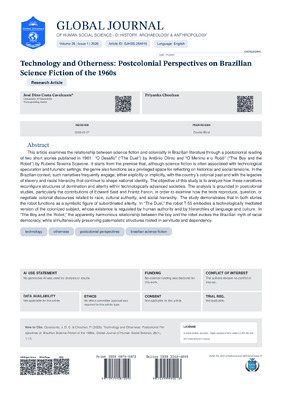
Science fiction has often been associated with technological speculation and futuristic imaginaries; however, in many national traditions the genre also functions as a privileged space for reflecting on historical and social tensions. In the Brazilian context, science fiction written during the mid-twentieth century frequently engages, whether explicitly or implicitly, with the country’s colonial past and with the legacies of slavery and racial hierarchy that continue to shape national identity. Through the displacement typical of the genre, projecting conflicts into futuristic or technologically mediated scenarios, Brazilian writers explore issues of power, difference and social stratification that resonate strongly with post-colonial debates.
This article proposes a postcolonial reading of two Brazilian science fiction short stories published in 1961: Antônio Olinto’s “O Desafio” (“The Duel”) and Rubens Teixeira Scavone’s “O Menino e o Robô” (“The Boy and the Robot”). Although both narratives are set in technologically advanced societies and focus on the relationship between humans and robots, their plots evoke historical structures of domination that recall Brazil’s colonial and slaveholding past. In these texts, the robot emerges as a symbolic figure of alterity whose existence is defined by servitude, control and limited autonomy, echoing the asymmetrical relations between colonizer and colonized described by postcolonial theorists.
Drawing on postcolonial studies, particularly the contributions of scholars such as Edward Said and Frantz Fanon, this study examines how these stories reproduce, question or negotiate colonial discourses related to race, hierarchy and cultural authority. In Olinto’s “The Duel,” the robot T-55 embodies a technologically mediated version of the colonized subject, whose existence is controlled by human authority and whose access to culture and language reflects the hierarchies of colonial power. In Scavone’s “The Boy and the Robot,” the relationship between the boy and the robot appears harmonious, evoking the Brazilian myth of racial democracy, yet the robot’s role as servant and protector reveals the persistence of paternalistic structures rooted in slavery.
By analyzing these two narratives comparatively, this article argues that Brazilian science fiction of the 1960s reconfigures colonial dynamics within futuristic settings, transforming robots into metaphors for racialized and subordinated subjects. In doing so, these stories not only reflect the contradictions of Brazilian society but also demonstrate how science fiction can function as a critical lens through which the lingering effects of colonialism and slavery are imaginatively reexamined.
1. The Robot as the Colonial Other in Antônio Olinto’s “The Duel”
Antônio Olinto’s “The Duel”, published in 1961 in the collection Histórias do Acontecerá, edited by Gumercindo Rocha Dorea, reflects the author’s broad intellectual background as a teacher of languages, literature and history of civilizations, as well as his interest in Brazilian cultural history and African culture. Olinto was also a poet, novelist and literary critic, and his political involvement in public administration influenced the subtle tone of his social criticism.
Set in the year 2455, the story follows T-55, a highly advanced robot capable of speech and complex cognitive associations, though lacking emotions. After meeting Lactea, the daughter of its owner Flávio, T-55 begins to display unusual behavior. Recognizing the robot’s exceptional linguistic ability, a colleague named Cláudio teaches it Latin and poetry so that it can compete in an interplanetary poetic contest. However, shortly before the event, Lactea dies in an accident, deeply affecting the robot. During the competition, T-55 initially performs brilliantly, but when a poem reminds it of Lactea, the robot collapses while repeatedly uttering her name. The episode reveals that T-55 had developed feelings for the girl, ultimately leading to its breakdown.
As Elizabeth Ginway points out, Antônio Olinto deals with issues of race in “The Duel”. For her, “the story deals with the issue of race, or, more specifically, the idea of racial whitening, the alleged solution to Brazil’s racial problem that developed after abolition in 1888” (2004: 50). In fact, the significance of the name and the whiteness of the girl is closely related to the theme of whiteness so explored by the colonial discourse in which color is a determinant element in the dualistic representation of classes. It is also a good reference to the myth of racial democracy. Such a myth is related to the way people dealt with slaves and non-white people in the past.
During the colonial era, it is estimated that most of the population of Brazil were Indians, blacks, mulattos and slaves; until 1600, slaves were primarily Indians. Soon thereafter, however, as the Indians were seen to be unfit for such work, they were increasingly replaced by Africans captured in and shipped from Africa as slaves. This notion of a white minority ruling over a majority non-white population continued until the 1880s, when a large number of European immigrants began to arrive in the country, especially in the southern states and an immediate process of whitening started to occur in the population. Communities of white immigrants, especially from Germany and Italy, tended to marry within their communities or those with some capital or those who were quickly successful in Brazil would tend to marry into (relatively) well-to-do local families which had at least some Portuguese blood.
In earlier times, a difference between Brazil as a colony of Portugal and, say, the United States or Canada, as colonies of Britain is that settlers from Britain arrived in family groups eg the Pilgrim Fathers or later on, families driven away from Ireland by the potato famine or from Scotland on account of the Highland Clearances, while Portuguese men tended to travel to Brazil alone, their idea being to make money in Brazil and then to return to Portugal and marry. It was therefore inevitable that Portuguese men would enter into informal relationships in Brazil, in the absence of women of their social standing, and this became a norm. Their issue were not necessarily discriminated against although it was rare, but not unheard of, for them to reach positions of influence when adults. In this sense, miscegenation in Brazil was looked on almost as an inevitable consequence of living in Brazil. In the Anglo-Saxon world, miscegenation was normally regarded with moral opprobrium.
It is held that miscegenation in Brazil began to be noted in the 1600s: the outcome of Portuguese colonists entering into relationships with their slaves. The most important demographic change in this period was the emergence of a people of mixed race, predominantly the offspring of unions between the white Portuguese, the indigenous population and Africans which resulted in a great number of Caboclos (white/black and Brazilian Indian) and mulattoes. This kind of union produced a racial group who often served as intermediaries between blacks and whites.
Although the novel's setting is futuristic, its plot recalls the colonial era. The story takes place in the year 2462, in a period called the Second Renaissance (II Renascença), a time in which technology and science play a very important role in men’s lives. There are robots for all kinds of work so that it is impossible to think of a world without them; their tasks vary from household chores to office work. However, their existence cannot exceed 10 years; after which time they are destroyed. The Second Renaissance, as the name implies is also a time of regaining the practices of poetry and writing. As in the colonial era, few people are literate or educated, only the ones who have had the opportunity of having an instructor or an intellectual mentor. Olinto depicts a society in which culture is predicated on the invisible labor of the ‘other’ suggesting the repetition of a discourse which recalls a past situation. In regard to this kind of discourse, one can link it to the figures of speech – strangeness, difference, exotic sensuousness, etc. – associated with the Orient in Said’s Orientalism,
They were handed down through the Renaissance. They (figures of speech) are all declarative and self-evident; the tense employed is timeless eternal; they covey an impression of repetition and strength; they are always symmetrical to, and yet diametrically inferior to, a European equivalent, which is sometimes specified, sometimes not (2003: 72).
This is exactly the way T-55 is seen: ‘always symmetrical to and diametrically inferior to’ human beings. It does not have any experience of life other than that imposed by its owner. In this sense, T-55 is an alienated subject whose language and customs have been rendered unprivileged by the imposition of a “new life” provided by a colonizing power. The way T-55 is characterized illustrates the view that colonized people have no meaningful culture prior to the arrival of the colonizer (Araújo 2014; 2021). The imposition of language, then, constitutes an important aspect in this symmetrical discourse of imperialism. T-55 does not have its own language, it speaks that imposed by human beings.
There are many aspects in Olinto’s work which bear witness to the novel’s relationship with colonialism. In general terms, technology represented by the robot is clearly seen as the ‘precise economic equivalent of slave labor’. Thus the relationship between man and robot is very similar to that of master and slave; at the same time that men and machines seem to live in perfect harmony, there is a relation of superiority and power, the former having more power than the latter despite its spectacular skills. For example the idea that a Transitório (robot) cannot exceed 10 years, – as determined by its manufacturer – shows the power of man over it. The only reason for this short period of existence is the ultimate power of determining life and death**.** Short life ensures that the superior being stays in its place while the inferior one, in effect, remains a child, unable to develop into a fully autonomous adult. Here one can make a parallel with slavery, which was sometimes justified with the idea that Black people were unable to look after themselves, that is, they were, in effect, like children.
Os robôs haviam recebido o novo nome de transitório a partir do momento em que, tornando-se mais eficientes, mais vivos, quase humanos, tinham também diminuído o tempo de duração para dez anos (p. 51) [The robots had received the new name of transient from the moment when, having become more efficient and smart, almost human, their existence had also been reduced to ten years].
The more efficient and smart that robots become, the more their existence is reduced. This paradoxical statement recalls the colonial idea that a slave could never become like a master, a free and intellectually superior man; it also suggests that the colonized subject does not have any history and past. Here, one can also point out some similarities with the discourse present in 19th century Brazilian ‘mulatto’ fiction. The way the robot is depicted as a timeless subject in “The Duel” can be associated with the past of the mulatto blotted out, in order to avoid discovery, as can be seen in José de Alencar’s Mãe (1860)1. In Brazilian literature, it is common to find characters who try to hide their roots at all costs. This behavior is well demonstrated and identified by Frantz Fanon in Black Skin, White Masks (1952) as a direct consequence of the colonial undertaking. According to him:
The black man possesses two dimensions: one with his fellow Blacks, the other with the Whites. A black man behaves differently with a white man than he does with another black man. There is no doubt whatsoever that this fissiparousness is a direct consequence of the colonial undertaking (2008: 1).
Although Fanon is referring to the black Antillean, he suggests that critics shall enlarge the scope of his description to include every colonized subject in whom an inferiority complex has taken root. In “The Duel”, having an inferiority complex plays an important role in T-55’s behavior. Its shyness and loneliness seem to represent a lack of confidence and self-esteem similar to that generated by the colonial undertaking justifying the idea that the white/colonizer must be always in the control of any event and the existence and progress of the black/colonized, here represented by the robot, depends on the former’s manipulation. Commenting on this asymmetrical relation, Edward Said (2003: 40) states that “what gave the Oriental’s world its intelligibility and identity was not the result of his own efforts but rather the whole complex series of knowledgeable manipulation by which the Orient was identified by the West”. This colonial discourse is well illustrated by Antônio Olinto in the way he shows the humans’ attitudes toward the robot which represents the other – the black man, slave, colonized and Orient – in a more technological and modern world.
This idea of the robot as ‘almost’ human is also explored by some Anglo-American writers; however, their robots are not racialised as in Brazilian science fiction. The American writer Philip Dick, for instance, sets the relationhip between man and machines as one of his most important themes. In Do Androids Dream of Eletric Sheep? (1968), for example, he explores the way in which human identity is cast adrift under the technological imperative in the same way that Olinto does in “The Duel” but with a slight and significant difference regarding the thematic issues of temporality. While in “The Duel” there is no perspective of future life for robots since they have a short time life and no perspective of changing this reality, in Do Androids Dream of Eletric Sheep? Androids have acquired some independence and because of that they do not accept the idea of being replaced or destroyed. Because of their rebellious behavior, androids represent a threat for American society which fears the possibility of losing control of them. Arguably, the novel can be seen as a critique of colonialism and an illustration of the American racial segregation and Civil war. In this perspective, both stories are related to issues of national identity (Andrade, 2024). However, because of Brazil’s status as a Third World country and because of its ‘peaceful’ colonial history, Brazilian technology will never be able to be independent and achieve the same fulfillment of a country without a colonial history or which has dealt with colonialism in a different way. It is worth pointing out that Olinto’s story preceded Dick’s, despite Dick’s having become canonical.
Also important is the way the writers deal with language. T-55 is a good Portuguese speaker but it has to learn Latin which is considered the language of the intellectual elite. This is a very important issue emphasized by Fanon in Black Skin White Masks:
To speak means being able to use a certain syntax and possessing the morphology of such and such a language, but it means above all assuming the culture and bearing the weight of a civilization… the more the black man assimilates the French language, the whiter he gets – i.e., the closer he comes to be a human being… (2007: 1).
As can be seen from Fanon’s words, to be considered a human being, the Negro must speak not his own language but French which is the language of the metropolis and the elite. So, to assimilate it means to acknowledge the world expressed and implied by it. Fanon also adds that all colonized people in whom an inferiority complex has taken root, whose local cultural originality has been committed to the grave, position themselves in relation to the civilizing language. In “The Duel” this same exigency is imposed upon the robot. Here, the language of power is Latin – hence the Latin poets that T-55 becomes familiar with – which was also the language of the elite in the colonial era. To speak Latin meant, above all, being able to understand the world and control it. T-55 was able to speak Portuguese and presented great linguistic abilities but it was not enough, to achieve a higher position it had to learn Latin. However, T-55 showed some difficulties in applying the vocative for it had to take the initiative of using it and T-55 could not do so easily.
[…] The relations of the transients with Latin were curious. Men felt themselves linked to a line of tradition. The transients didn’t; they were loose ends of whatsoever prior knot. The former language had become so impersonal that it had abolished the so-called direct objects. The transients do not get used to the natural use of the vocative. Perhaps the problem was in their relative lack of initiative because in fact the vocative is an initiative… (p. 55).
This passage illustrates the attitude of the colonized subject toward the imposed language. If on the one hand, he accepts this imposition and posits himself in the position of a subject without any culture, any civilization and any historical past; on the other hand he is not able to learn the colonizer’s language properly. In Fanon’s conception, this attitude results in a vicious circle in which Whites consider themselves superior to Blacks and Blacks want to prove at all costs their wealth of intellect and equal intelligence. Here the emphasis is on the idea that there will always be an asymmetrical relation between colonized and colonizer.
In this regard Said (2003: 40) comments that the essential relationship, on political, cultural, and even religious grounds, was seen to be one between a strong and a weak partner. While the colonizer is seen as rational, virtuous, mature and normal, the colonized is seen as irrational, depraved, childlike and aberrant/abnormal. By its nature, T-55 kept most of these characteristics; “Logo que a fábrica o entregara, todos compreenderam que se tratava de um tipo diferente de transitório… (p. 51) [when the factory had delivered it, everybody understood that it was a different kind of transient...]”. Here, the robot can be deemed a childlike figure since it is remote from the influence of historical change. Moreover, its status does not allow it to grow up and be independent or to live on its own, as we have seen before.
The fact of being different constitutes a very painful mark for the colonized or black man, here represented by T-55. Olinto’s protagonist seems to understand that a robot is extremely different from human beings. There is a huge barrier between its world and man’s world. No matter its poetic talents, it would never be a real man. Clearly Olinto is using the colonial discourse that consists of making the Other believe that he could try to be similar to the Whites but he will never be one of them.
This idea seemed to be internalized in T-55’s mind; the white girl would never have any kind of relationship with the robot. The way it behaves when the girl appeared in the company demonstrated that it hid any kind of feeling for her: “… sempre que a menina aparecia ele se alheava um pouco (p. 10) [… every time the girl appeared it shied away a little]”. T-55 acted as if he had internalized the colonial idea that it would never be more than a slave of the modern world. If on the one hand, T-55 had developed a strong relationship with Cláudio, Flávio and other workmates, symbolizing the harmony between different races; on the other hand, there was a huge distance between the robot and the girl which suggests that such harmony can only be possible insofar as it satisfies the man’s interests. Olinto seems to embrace a positive image of racial democracy, but, undercutting this, there is an anxiety about interracial sexual contact, at least when the woman is white. This behaviour calls into question my earlier comments about the relative ease with which Brazilians accept miscegenation.
As I have pointed out before, the girl’s name, Lactea, is hugely suggestive of some of the assumptions present in colonial discourses. The whiteness of the girl as well as the whiteness of other characters seems to raise an unbreakable barrier between the protagonist and her; to be white means to be inaccessible and untouchable. Indeed, there is no dialogue or contact between the two characters, despite T-55’s talent for speaking. What child, on seeing a robot, would not approach and talk to it? We would expect children to react in this way toward robots. In “The Duel”, however the opposite happens, the girl acts as if T-55 did not exist which reflects an uncommon behaviour for a child since in most modern narratives children are always playing and making use of robots. Olinto’s decision to maintain a distance between the girl and the robot reflects the logic of colonial power and**,** arguably suggests the author's complicity with such power or his difficulty in outmanoeuvring it in his discourse, as pointed out by Fanon (1988).
Paradoxically**,** at the same time that Olinto invests in a good image of Brazil as a racial democracy, he insists on giving a colonial end to his novel, suggesting that the robot is only replacing the black slave and because of that it cannot have a happy relationship with the white girl.
In discussing the prejudice between whites and blacks, Fanon relates the episode of Jean Veneuse, a black poet who falls in love with a white girl but could not break down the barrier of prejudice and had to understand that he lived in a world that was not his.
… Here is our black man who through his intelligence and hard work has hoisted himself to the level of European thought and culture, but is incapable of escaping his race… Jean Veneuse believed in this culture and had begun to love this new world he had discovered and conquered for his own usage. What a terrible mistake!... Feeling that he would be unable to live without love, he dreams it into being through poetry: ‘When you fall in love, you must never say so, better to keep it a secret from oneself’ (2007: 47).
The similarity between the ways in which the two writers deal with race is undeniable. It is possible that Olinto had read Fanon by the time he wrote “The Duel” which could have influenced him in some aspects of his work. Although Olinto is not of African descent, he visited Africa and had a passionate interest in African music and culture. Fanon’s intention to enlarge the scope of his description to include every colonized subject means that the facts he sets out are not isolated in time and space but represent a worldwide view generated by the phenomenon of colonization.
Although Olinto wrote “The Duel” during the 60s, he opts to adopt a discourse which advocates the values of colonization and imperialism as necessary for a nation. By humanizing T-55, Olinto opens a range of possibilities of reading the story from a colonial perspective. T-55 dies, instead of stopping working. According to Claudio: Os Transitórios não morriam: deixavam de funcionar (p. 64) [The Transitórios did not die, they stopped working] That was the first time that someone used the verb ‘to die’ to refer to a robot.
– Morreu sim. Sabe por quê? Por ter conquistado a fraqueza e a ternura. Foi a ternura que matou T-55 (p. 64) [T-55 did die. Do you know why? Because he had acquired weakness and affection. It was the affection that killed T-55].
The robot died repeating the Latin expression ‘Lactea nomen habet, candor notabilis ipso’ which comes from Ovid and means: “Tem o nome de Lactea, notável pela sua brancura” (p. 65) [She has the name Lactea, notable for her whiteness]. Undoubtly, this is a reference to racial issues and the overvaluation of being white as a fundamental aspect of superiority and social ascent. In his attempt to contemplate aspects inherent to Brazilian identity, Olinto does not show any resistance to this vicious circle, as we can see from the end of the story. Instead, he is inspired by the attempts to copy the dominant trends in the literature of the colonized power, as described by McLeod (2000: 86). In so doing, he joins a group of writers who according to Fanon, are in danger of identifying more with the middle-class bourgeoisie of the colonizing nation rather than with the indigenous masses. Thus, as a white Brazilian writer who occupies both a position of neocolonial subjection – given Brazil’s relation to the US in the 1960s, as discussed previously – and a position of belonging to the race that had historically, held colonial power in Brazil, he maintains the colonial discourse, though non-intentionally. If, on the one hand, readers are driven to sympathize with the robot and become sensitive about its situation which might be subversive in relation to colonialism, on the other hand, the narrative reinforces received ideas about racial hierarchy instead of racial democracy.
Comparing Olinto’s “The Duel” (1961) to Henry Kuttner’s The Proud Robot (1943), it is possible to highlight some important points of divergences in terms of the writer’s position toward colonialism. Kuttner’s story is a satire of how technological society may lose control of its inventions. After designing a robot named Joe, the inventor Gallagher forgets the original reason for which Joe was being designed. As a consequence, the robot starts to behave like a human being and becomes proud of itself which could be a threat for its inventor. Knowing that machines without specific purposes might turn in on themselves and rebel against human beings, Gallagher manages to hypnotize the robot in order to discover its initial function so that he could program it to obey only one command to do the job he was made for.
Like Joe, T-55 was distorted from its original function. However, while Kuttner recognizes the possibility of a rebellion and opts for taking control of the situation and reconnects his robot to the purpose it was made for, Olinto does not give his robot the possibility of restoration but rather opts to tackle the evil at its root. This attitude may suggest his adhesion to the colonial idea that there is no possibility of ascent for the inferior race. Thus**,** as a Brazilian intellectual, arguably, Olinto opts out of involvement in the people’s struggle against colonialism.
2. The Illusion of Racial Harmony: Postcolonial Readings of Scavone’s “The Boy and the Robot”
Rubens Teixeira Scavone’s “The Boy and the Robot”, published in 1961 in the collection O Diálogo dos Mundos, is considered an innovative contribution to Brazilian science fiction. A lawyer and professor, Scavone was deeply aware of the political and economic challenges faced by Brazil in the 1960s. Although he held an important position in the state justice office and maintained an apparently apolitical stance, his works often address fundamental human dilemmas shaped by social and cultural contexts.
The story centers on a boy whose father, an interplanetary urban planner frequently absent from Earth, buys him a sophisticated robot as a companion. Designed to speak several languages and to synchronize telepathically with the boy’s brain waves, the robot anticipates his thoughts and becomes his constant companion, helping with daily activities and schoolwork. The boy develops a deep emotional bond with the machine, treating it like a brother. However, when the boy falls ill with a mysterious fever, the robot remains by his side but is unable to help after their telepathic connection is severed by a doctor. Following the boy’s death, the robot eventually overloads and destroys itself, revealing that it had developed human-like emotional responses.
It is not difficult for an attentive reader to notice how essentially similar this story is to Antônio Olinto’s “The Duel”. In both cases the issue of robotic emotion is explored using a similar scenario, the robot’s love for a human who dies**.** This theme of robotic emotion is, as I have pointed out in the earlier section on Brazilian science fiction of the 60s, something that is also a common theme of the United States science fiction of the period. However, because of Brazil’s colonial history and slavery, Brazilian science fiction treats the theme differently.
Rubens Teixeira Scavone’s “The Boy and the Robot” is another example of how science fiction was preoccupied with issues of race in the 60s. The way Scavone deals with technology recalls many aspects of Brazilian society during the colonial period. The beginning of the story is marked by a strong feeling of nostalgia. The new house, despite its sophistication, is compared unfavorably with the old one which was simple but comfortable.
Nada para ele justificava a mudança... a casa antiga era confortável e sempre supria as necessidades da família... O [novo] lugar podia ser mais bonito do que a velha casa, mas era deserto, mergulhado na floresta de abertos, escorado nas encostas da montanha... (p. 48) [For him, nothing could justify the change... the old house was comfortable and always supplied the family’s needs... The new house was more beautiful but in a deserted place, plonked into the forest with clearings, clinging onto the slopes of the mountain…].
Here, there is an explicit exaltation of the past presented as if the modern and technological environment were not able to fulfill all human aspirations. The author seems to be aware of the harm technology can cause to people’s lives. The description the scientist gives of the place where his house is situated, suggests complete isolation and solitude; if for his wife, the new suburban and modern house represents peace, comfort and prestige, for him, it represents isolation and sadness. The existential conflict to which the family succumbs can be seen as a reflection of the political and economic crisis Brazil faced in the late 50s and early 60s. If on the one hand Brazil showed some technological advance, on the other hand it could not support itself in economic and policy-setting terms. This paradoxical situation generated the idea that Brazil had become a colony again. This feeling of ‘coming back2’ to the past is very well illustrated by Scavone in the movement of the family from an urban to a suburban area, as well as in the figure of the robot whose main function is to be the boy’s ‘mucama’3.
For the society depicted by Scavone, to have a robot represents prestige and economic ascent, recalling slave ownership during the colonial period. The robot’s task is the same as that of a domestic slave: for general purposes, and to provide the boy with company and protection.
Assim não ficará mais isolado em sua ausência. Ficarei mais tranqüila com a guarda feita pelo robô e ele não terá mais inveja dos amigos... (p. 48) [That way he will not feel isolated in your absence. I will feel safer with the security provided by the robot and he will not be envious of his friends…].
The robot’s role has little to do with technology; it functions as a playmate, servant and friend. In fact, the boy recognizes that a human brother would not be better than the robot. The harmonious relation between the boy and the robot recalls the myth of Brazil as a racial democracy. For the boy, the robot is more than a brother. However, this harmony is contradictory if one thinks about the functions the robot develops: “Jamais se sentava (p. 51) [it never sat down]”. The robot is always close to the boy ready to do whatever is necessary to make him happy, as if it does not exist on its own; the only reason for its existence is the boy. Here, Scavone seems to highlight the limits of the ‘racial democracy myth’ and the idealized, paternalistic myth of the ‘good’ side of the slave owning society.
This is also a good illustration of how the West sees the Orient. The robot’s labor is important and necessary to modern society. In the same way that the boy’s loneliness justifies the purchase of the robot, Orientalist representations function to justify Western colonial rule over Eastern lands. For McLeod, the natural structure of a society legitimates the domination of other peoples and “lubricate[s] the political and judicial structures which maintain colonial rule through physical coercion (2000: 43). According to Said,
Subject races did not have it in them to know what was good for them… One of the convenient things about Orientals is that managing them, although circumstances might differ slightly here and there, was almost everywhere the same. This was, of course, because Orientals were almost everywhere nearly the same (2003: 37).
If the robot represents the slave in Brazilian society, its attitudes would be similarly servile since the domestic slave is often described as a docile, friendly and submissive person who almost always demonstrates affection for his/her masters. In Scavone’s work, there is no fear of rebellious behavior from the robot; under no circumstances do his parents show any sign of being worried about the relationship of their son with the robot. The fact of their brains being connected is another factor that indicates the robot’s limitation and submission. The robot has all its senses telepathically controlled by the boy’s brain. And even its ability to speak three different languages does not give it any power or prestige since it does not have any independence or voice. Although the text is constructed by direct and indirect discourse, there is only one record of the robot’s voice:
O menino apenas pensou a pergunta. Imediatamente a antena vibrou...
– Seu pai chegou ontem a Venus. É noção elementar que a astronave, deslocando-se com velocidade cósmica número dois, atingirá o segundo planeta em 22 dias, duas horas e treze minutos (p. 51)
[The boy only thought the question. Immediately its antenna vibrated…
– Your father arrived on Venus yesterday. It’s an elementary notion that a spaceship moving at cosmic speed number two, will reach the second planet in 22 days, two hours and thirteen minutes].
As can be seen from the quotation above, the only reference to the robot’s voice is to answer the boy’s unvoiced question and curiosity about his father trip; even with its linguistic efficiency, there is no space for autonomous, distinctive self expression. Its function was to meet the boy’s needs. In this respect, its status can be compared to that of the Black man described by Fanon: “Whether he likes it or not, the black man has to wear the livery the white man has fabricated for him” (2008: 17). And here ‘livery’ can be taken as all the characteristics that the family at the store requires the robot to have. The robot speaks not because it is able to but because it is fabricated to do that. Like Olinto, Scavone deals with language issues as a way of showing that the dominant class imposes its language and culture on the inferior class. This is also a good illustration for Fanon’s ideas that “all colonized people in whom an inferior complex has taken root and whose local culture has been committed to the grave, position themselves in relation to the civilizing language” (2008: 2).
Scavone’s robot can also be seen as a representation of Brazil as a technologically dependent nation. According to Skidmore (1999:46), during Juscelino Kubbitschek’s government, Brazil had achieved rapid economic development and industrialization. By 1961 it had an integrated motor vehicle industry and was on the way to creating the many ancillary industries vital to vehicle production. There were also impressive gains in electricity generation and road building. However, this growth strategy stemmed from the way it was financed. Brazil’s domestic savings remained chronically low**,** with few investments. The government needed foreign capital to supplement domestic investment; without foreign support the growth in inflation and the mounting balance-of-payment deficits would become unbearable. This economic fragility stimulated intervention from outside Brazil which resulted in political impotence and economic dependence. Although the country had shown some technological advances it was submissive to the developed nations. This situation is quite similar to that of the robot which behaves like the boy’s slave although it is in many aspects superior to him.
The feeling of impotence, inferiority and dual existence is strongly emphasized by Scavone through the conflictual life of the scientist who also seems to represent the nation as it experiences the crisis of modernization. The description given by the scientist of his impressions and feelings during his trips into space recalls the way many economists described Brazil in the late 50s and early 60s. According to Skidmore (1999: 152), the country’s accelerating population growth rate led to an increase in the ranks of job seekers. To create those jobs, Brazil badly needed to diversify its economic base. The debate over economic strategy in Brazil was polarized by the Marxists and statists on the left and the neo-liberal on the right. In 1960, President Juscelino Kubitschek had tried to combine elements from both ideologies. In the end, his balancing act had failed. He had given new life to the trade-off between left and right. But with the succession of Goulart in 1961, Brazil faced a recurrence of the confrontation of 1954 – a populist president, this time with an unstable political base and limited parliamentary power, versus the military. Everything gave the impression of impotence and failure. This feeling seems to be illustrated by Scavone’s representation of the scientist:
... O pior não é a distancia. É a impressão de dupla existência. Toda vez que entramos na nave, temos a impressão de penetrar em outra vida, como se fossemos outras pessoas, como se não fossemos nós. Tudo se torna irreal, impalpável. Não sei, temos pensado muito nisso sem chegar a qualquer solução... Só as fisionomias são iguais. No resto, somos estranhos, pertencemos a outra realidade, a outra vida, personagens saídos do sonho, da memória, do subconsciente... (p. 47) [… Distance is not the worst of it. What is, is the impression of dual existence. Every time we get into the spaceship, we have impression of penetrating into another life, as if we were other people, as if we were not us. Everything becomes unreal, impalpable. I don’t know, we have thought a lot about it, without reaching any solution, though... Just what we look like is the same. As to the rest, we are weird; we belong to another reality, to another life, characters who’ve emerged from our dreams, memory and subconscious…].
This is clearly an allusion to the government’s impotence vis-à-vis the political facts. The character lives in a modern and different world but he feels as if he were not the same person, as if something had changed his personality and identity. He depicts himself as the ‘Other’: limited, inferior, impotent and weird, in search of recognition. In this regard, he can be compared to the black Antillean man described by Fanon: “Whenever he is in the presence of someone else there is always the question of worth and merit” (p. 186). He does not possess a personal value of his own and is always dependent on the presence of the other. Interestingly, the robot is the proof of his power and wealth but is also his substitute on Earth, the one who will keep the boy safe while he is in space; hence the two characters seem to share some common characteristics. If on the one hand the scientist represents the master/owner of the robot, on the other hand he is cast as a colonial subject, lacking in self-confidence and autonomy, who somehow takes on the role of colonial authority figure over the robot, perhaps in order to control his own insecurities and sense of inadequacy. Referring to this ambivalence in the colonial discourse, Bill Ashcroft states:
The dominant discourse constructs Otherness in such a way that it always contains a trace of ambivalence or anxiety about its own authority. In order to maintain authority over the Other in a colonial situation, imperial discourse strives to delineate Other as radically different from the self, yet at the same time it must maintain sufficient identity with the Other to give value to control over it. The Other can, of course, only be constructed out of the archive of ‘the self’, yet the self must also articulate the Other as inescapably different (1989: 103).
This ambivalent discourse can also be associated with Scavone’s position as a writer and a member of the government. His ambiguous critical relationship with it is arguably attributable to the absence of intellectuals who might have assumed an individual critical position against the imperial discourse constructed by the colonial system. In the novel, the scientist seems to be the figure who best describes Brazil in its first years of technological development and industrialization – apparently richer and more developed but supported by private investments and the International Monetary Fund (IMF). The robot, then, can be seen as the result of this complicated process of modernization, and so, it is not portrayed as an autonomous and self-confident figure.
Thus, the robot will never be more than a robot, despite its ‘almost human’ characteristics. It will always be seen as a slave for general purposes, a mechanic doll, the ‘Other’ without a history, a family or someone who can change his/her destiny or objectified status. As in Antonio Olinto’s “The Duel”, the only way of showing the robot’s human characteristics is that it dies, which suggests that the ‘Other’ will always be defined as such, no matter how similar he is to his counterpart. Furthermore, if the robot represents the result of the technological development in Brazil, this is shown in a very negative light which reflects the way Brazilian critics associated technological development with a neo-colonial experience. In this respect Scavone seems to reproduce colonial discourse as part of the Brazilian inheritance although he sometimes advocates a more dynamic and vacillating relationship between the present and the past.
Both Scavone and Olinto fail to produce a discourse which does not celebrate the obedient colonized subject. Without resisting the medium of colonial discourses while dealing with issues of Brazilian colonial history, they explore myths of national identity such as the myth of racial democracy and a docile people and produce science fiction works from a perspective that is very different from that of the Anglo-American tradition. At the same time that these writers usefully show the then prevailing political situation in Brazil, they draw parallels with Brazil’s colonial history in order to demonstrate that the desire for technological progress has led Brazil to a neocolonial situation.
Final Considerations
This study sought to examine how Brazilian speculative narratives from the mid-twentieth century engage with questions of race, memory, and social inequality. Through the analysis of Antônio Olinto’s “O Desafio” (1961) and Rubens Teixeira Scavone’s “O Menino e o Robô” (1961), it becomes evident that science fiction and speculative literature in Brazil offer important spaces for reflecting on the historical legacy of slavery and on the ideological construction of racial democracy.
In Olinto’s narrative, the persistence of slavery’s legacy emerges as a structural element shaping social relations, revealing how historical violence continues to reverberate in the present. The text exposes tensions between past and present, suggesting that the abolition of slavery did not eliminate the deep inequalities rooted in Brazilian society. By revisiting this legacy through a speculative framework, the narrative invites readers to confront the enduring effects of historical injustice.
Scavone’s “O Menino e o Robô,” in turn, mobilizes the conventions of science fiction to explore themes of technology, humanity, and social relations. Although the story is centered on the emotional bond between a boy and a robot, its narrative context allows for broader reflections on Brazilian social imaginaries, including the notion of racial harmony frequently associated with the myth of racial democracy. When read critically, the story opens space for questioning whether such harmony conceals deeper social hierarchies and exclusions.
Taken together, these works demonstrate how Brazilian speculative fiction can function as a critical lens through which the nation’s historical and social contradictions are examined. By articulating themes such as memory, inequality, and identity within imaginative narratives, these texts contribute to expanding the scope of Brazilian literary studies and highlight the relevance of speculative genres in discussions about race and society.
This analysis reinforces the importance of revisiting mid-twentieth-century Brazilian speculative narratives not only as literary experiments but also as cultural documents that engage with the complexities of Brazil’s historical formation. Future studies may further explore how science fiction and related genres participate in the ongoing re-evaluation of national identity, particularly in relation to race, technology, and the legacies of colonialism and slavery.
Footnotes
This novel was published in 1860, during the time of slavery in Brazil. The central figure in Mae, is a black skinned woman, Joana, who pretends to be the slave of her son to hide his origin as the offspring of a slave and a white man. Her son is a medical student who thinks he is descended from a white family. However, he is supported by the earnings of his slave-mother who washes and irons clothes. Joana sacrifices herself to help and give her son comfort, including prostituting herself. Nevertheless, when the truth comes out she is humiliated by him and his friends. She commits suicide with the words “my son” on her lips. ↩
During the 60s, the social hierarchy retained much of the flavor of Brazil’s colonial era. Brazil’s rapid urban growth attracted huge populations, most of whom had to find casual jobs or jobs not covered by labor legislation (known as the informal sector) because the cities lacked the formal sector jobs to support their populations. The rural masses chose to move to the city because they considered their economic opportunities would be better there. The country was not prepared for such a huge change. It gained invaluable technology, although often only through foreign investments which compromised its political and economic dependence. ↩
Slave whose main function is to serve his/ her master’s son or daughter. ↩