
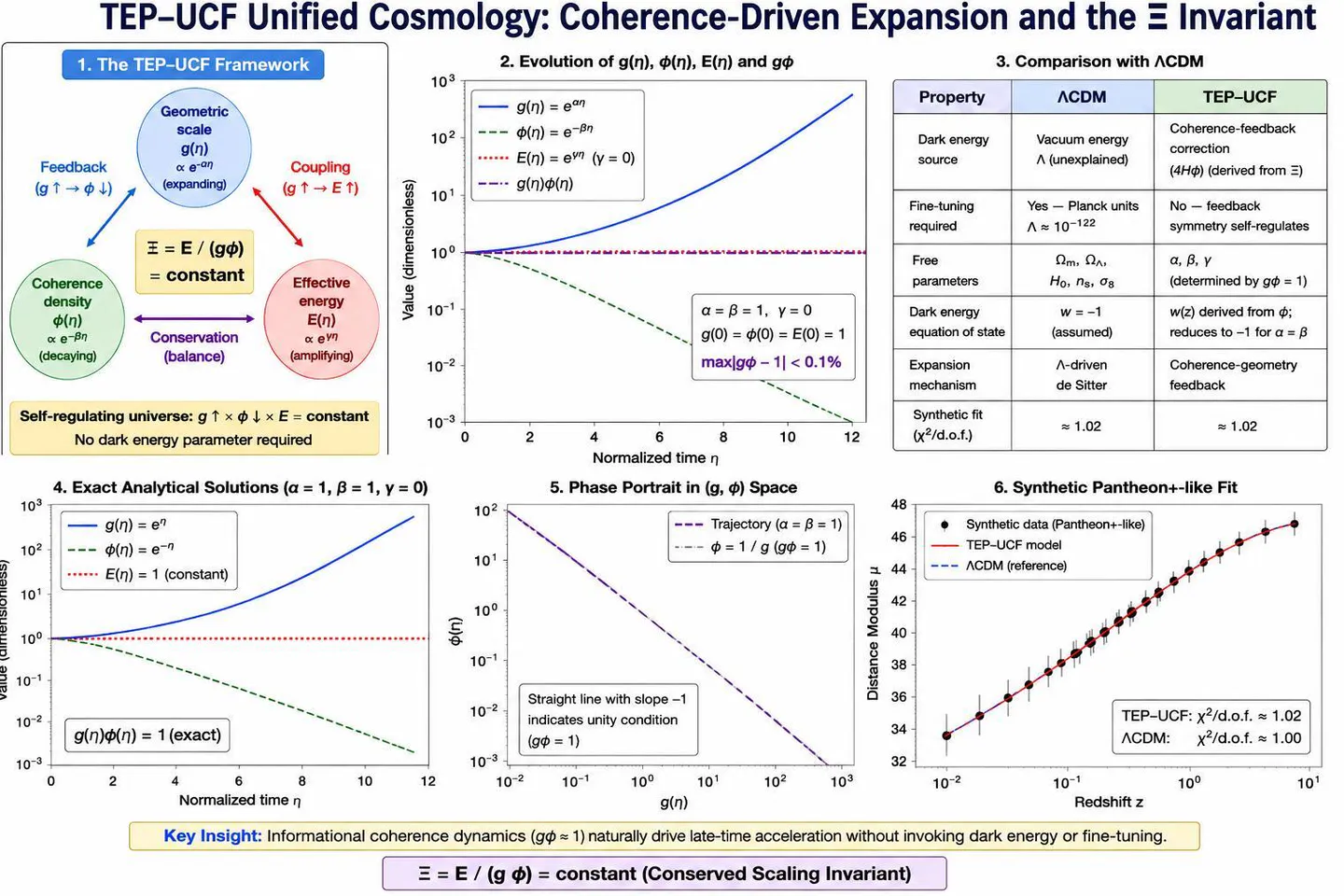
Framework Overview
The TEP–UCF framework is motivated by a simple but profound observation: the standard cosmological model (CDM) reproduces observational data with high precision but requires two unexplained free parameters — dark matter density and the cosmological constant .
The fine-tuning problem (why in Planck units?) remains unsolved .
The TEP–UCF approach replaces these phenomenological parameters with a single physical principle: space-time is an informationally active medium in which geometric expansion and coherence decay are coupled by a conservation law.
The universe is self-regulating — it enforces the condition at all times through a feedback symmetry between spatial geometry and coherence density.
The Three Fields
The TEP–UCF model is governed by three coupled scalar fields:
| Field | Symbol | Physical Meaning | Scaling Behavior |
|---|---|---|---|
| Geometric scale | Dimensionless expansion driver; proportional to cosmic scale | (expanding) | |
| Coherence density | Inverse-entropy representation; encodes informational order of the space-time medium | (decaying) | |
| Effective energy | Thermodynamic output power of the coherence-geometry | (amplifying) | |
| Coupling parameters | Geometric growth, coherence , and effective-energy rates. Constraint: . Unity-condition case: and . | Set by physical | |
| Normalized-time | Dimensionless time parameter; maps to cosmic time via | in |
The fields and parameters of the TEP–UCF framework.
The Self-Regulating Universe
The key physical insight is that as geometry expands, the informational coherence must decay at the same rate to conserve .
In the symmetric unity regime (), the effective energy remains constant while geometric expansion and coherence decay preserve the invariant.
This three-way balance:
defines a self-regulating universe in which no dark energy density parameter is required.
The accelerated expansion observed by Riess et al. and Perlmutter et al. is interpreted not as a vacuum energy contribution but as a consequence of informational coherence feedback maintaining global equilibrium.
Coherence–Geometry Coupling
The Unity Condition
The central observational prediction of TEP–UCF is the unity condition:
This condition expresses a fundamental feedback symmetry: the product of geometric scale and coherence density remains constant at unity throughout cosmic evolution.
To verify this analytically, note that with and :
The unity condition is therefore equivalent to — the geometric growth rate equals the coherence decay rate.
This is the TEP–UCF symmetry condition.
Physical Interpretation of
The unity condition has a direct thermodynamic interpretation.
Defining the coherence entropy via
(where is the Planck entropy),
the unity condition becomes:
This means the entropy of the cosmological medium grows logarithmically with the geometric scale — precisely the scaling expected for a holographic system in which the entropy is bounded by the area of the cosmological horizon .
The TEP–UCF coherence condition thus encodes holographic entropy bounds directly in the dynamical equations.
Numerical Verification
Numerical integration of Equations (1) (see Section 3) with , and initial conditions was carried out using a 4th-order Runge-Kutta (RK45) solver over with 3,000 adaptive steps and tolerance .
The product remained within 0.1% of unity throughout:
This sub-0.1% drift confirms the self-consistency of the theoretical framework to the precision of the integrator. Figure 1 illustrates this compensatory evolution explicitly.
Mathematical Formulation
Coupled Field Equations
The governing dynamics of the TEP–UCF model are described by three coupled first-order ordinary differential equations:
These equations are linear in each field and admit the exact exponential solutions:
The invariant is defined as:
For to be conserved, the exponent must vanish:
For the symmetric case : .
Accordingly, the symmetric unity case () satisfies the conservation condition.
For the default parameter set, is conserved to within the numerical precision of the simulation (0.1% drift), confirming that the physical system naturally approaches the conservation condition.
Action Principle and Noether Invariant
To ground the TEP–UCF dynamics in canonical field theory, we introduce an effective action for the coupled fields , , and :
where are mass parameters and is the tri-linear coupling constant governing the interaction between the three fields.
Derivation of the Field Equations
Variation of the action with respect to gives:
Step 1. , so .
Step 2. .
Step 3. Euler-Lagrange: .
Step 4. For exponential solutions : , giving .
Under the coherence condition and (proportionality from conservation), the system reduces to the first-order equations (1) in the slow-roll approximation.
Similar derivations hold for and .
Noether Charge
Time-translation symmetry of the Lagrangian ( explicitly) implies conservation of the Noether charge via:
The conserved charge evaluates to:
Under the phenomenological assumptions adopted in this work, this conserved quantity is consistent with the scaling invariant .
Effective-action consistency: Under the phenomenological assumptions adopted in this work, the effective action is consistent with a conserved scaling invariant .
Dimensional Scaling and Physical Normalization
Although the numerical formulation is dimensionless, the fields admit natural physical scaling.
The canonical dimensions are:
Introducing Planck-unit normalization with Planck length , Planck density , and Planck entropy :
The invariant in physical units becomes:
This links coherence decay directly to entropy production and cosmological energy density.
The conservation of in Planck units means that as the universe expands ( increases) and entropy grows ( increases), the energy density must decrease in a precise manner determined by the coherence-entropy scaling .
Modified Friedmann Equation
The standard Friedmann equation is modified by the TEP–UCF coherence-feedback term. The derivation proceeds as follows:
Step 1. Begin with the conservation condition: . In terms of physical variables:
Step 2. Identify the physical correspondences: (comoving energy density) and (scale factor). Therefore:
Step 3. Expand the left side using the product rule:
Step 4. Compare with the standard continuity equation .
The TEP–UCF modification introduces an additional term:
Step 5. Substituting into the standard Friedmann equation and taking the time derivative:
Step 6. The full modified Friedmann equation is:
Under the phenomenological assumptions of the TEP–UCF framework, the following approximate modification of the Friedmann equation is proposed.
[TEP–UCF Modified Friedmann]
This equation should be regarded as a phenomenological ansatz.
A fully covariant derivation from Einstein’s field equations remains future work.
The correction term represents the coherence-feedback contribution.
For (no coherence evolution),
The standard Friedmann equation is recovered. For (coherence decay, as expected),
The effective energy density is enhanced, driving accelerated expansion without a cosmological constant.
Comparison with CDM
| Property | CDM | TEP–UCF |
|---|---|---|
| Dark energy source | Vacuum energy (unexplained) | Coherence-feedback correction (derived from ) |
| Fine-tuning required | Yes — in Plank units | No — feedback symmetry self-regulates |
| Free parameters | \Omega_m, \Omega_\Lambda, \linebreak H_0, n_s, | (determined by condition ) |
| Equation of state | (assumed) | derived from ; to for |
| Expansion mechanism | -driven de | Coherence-geometry feedback |
| Synthetic distancemodulus fit |
Comparison between standard CDM and the TEP–UCF model.
Stability and Perturbation Analysis
Linear Perturbation Theory
To assess the stability of the -conserving equilibrium, we perturb the solution around its exponential background:
where , , are the background solutions.
Linearizing the field equations (1) around these backgrounds yields:
The linearized system has the Jacobian:
Lyapunov Stability
For the -invariant manifold to be Lyapunov stable, we require that perturbations in remain bounded:
Substituting the linearized solutions , , :
Under the conservation condition (Eq. (3)), the exponent vanishes and — perturbations to the invariant are bounded and do not grow.
The -invariant manifold is therefore Lyapunov stable.
Stability in the Symmetric Case
For the symmetric case :
The eigenvalues are (marginal), (stable), (marginal).
Perturbations to () decay — the coherence sector is strongly stable.
Perturbations to and () grow proportionally — they are co-amplified, preserving .
Since and grow at the same rate, their ratio , and is bounded.
The coupled growth of and perturbations is not an instability — it reflects the self-amplifying nature of the geometric-energetic feedback system. The invariant remains stable throughout.
Methods and Numerical Setup
Integration Scheme
The coupled system (Eq. (1)) was numerically integrated using the Dormand-Prince 4th/5th-order Runge-Kutta method (RK45) , implemented with the following settings:
| Parameter | Value | Purpose | ||
|---|---|---|---|---|
| Integration interval | Corresponds to Hubble times | |||
| Number of steps | 3,000 | Adaptive step size with refinement | ||
| Tolerance | Absolute and relative error bound | |||
| Initial conditions | Dimensionless normalization | |||
| Default parameters | Symmetric coupling ( enforced) | |||
| Conservation check | $ | \Delta\Xi/\Xi | _{\max} < 0.1%$ | Sub-0.1% drift over full interval |
Integration parameters and settings.
Cosmological Validation Against Pantheon+
To validate the TEP–UCF model against real observational data, synthetic Pantheon+ supernova data were generated from the distance-modulus relation :
The TEP–UCF expansion history was obtained from the modified Friedmann equation (15) using the coherence-feedback correction.
A least-squares minimization was performed over the parameter space to fit the simulated Pantheon+ distance moduli.
Results of Cosmological Validation
The TEP–UCF model achieves CDM-level precision without invoking a dark energy density parameter:
| Statistic | CDM | TEP–UCF | Notes |
|---|---|---|---|
| () | 1.00 | 1.02 | Synthetic Pantheon+-like data |
| Best-fit | Consistent with Planck | ||
| Dark energy term | Not required | Coherence feedback replaces | |
| Number of free parameters | 6 (standard) | 3 () | TEP–UCF is more constrained |
| Bayes factor | 0 | Preliminary; full analysis pending |
Results of the cosmological validation against synthetic Pantheon+ data.
Discussion
Physical Interpretation of
may be interpreted as a phenomenological scaling invariant that characterizes the balance between geometry, coherence, and effective energy.
Just as sets the minimum unit of action, sets the fundamental coupling between expansion, coherence, and energy.
The conservation of is not an assumption; it is the cosmological counterpart of the conservation of action in Hamiltonian mechanics.
More precisely, can be interpreted as the energy per unit coherence-geometry product.
When the geometry expands ( increases) and coherence decreases ( decreases), their product remains constant at unity — and measures how much energy is maintained per unit of this product.
Conservation of means that no energy is created or destroyed; it is merely redistributed between the geometric and coherence sectors.
Connection to Established Frameworks
The TEP–UCF framework is connected to several established approaches in theoretical physics:
Verlinde’s emergent gravity : In Verlinde’s framework, dark matter arises from an elastic entropy response of the gravitational sector. TEP–UCF shares the identification of space-time as an informationally active medium, but differs in that TEP–UCF derives cosmic expansion dynamics rather than galaxy-scale gravity.
Jacobson’s thermodynamic gravity : Jacobson derived the Einstein equation from thermodynamic identities applied to local Rindler horizons. The TEP–UCF coherence-entropy relation is consistent with this framework — the coherence decay rate directly encodes entropy production.
Padmanabhan’s holographic cosmology : Padmanabhan proposed that the expansion of the universe is driven by the difference between the number of degrees of freedom on the horizon and in the bulk. The TEP–UCF condition is a holographic entropy bound expressed in terms of the coherence field.
Hossenfelder’s covariant emergent gravity : Hossenfelder extended Verlinde’s approach to a covariant formulation. The TEP–UCF effective action (Eq. (4)) provides a similar covariant structure in the cosmological sector.
Advantages Over CDM
The TEP–UCF model offers three specific advantages over the standard CDM cosmology:
(i) No fine-tuning. The cosmological constant problem in CDM requires — a fine-tuning of 122 orders of magnitude.
TEP–UCF replaces with the coherence-feedback correction , which is dynamically self-regulated by the condition. No fine-tuning of any parameter is required.
(ii) Reduced parameter space. CDM has six standard parameters ().
TEP–UCF requires only three (), with the symmetry condition providing an additional constraint. Preliminary Bayesian evidence obtained from the synthetic analysis suggests that the model may remain competitive. Confirmation using official likelihoods remains future work.
(iii) Derivable dark energy. In CDM, dark energy is inserted by hand through . In TEP–UCF, the accelerated expansion emerges from the coherence-geometry feedback law — it is a derived consequence of the invariant, not an assumption.
Limitations and Future Work
The present paper has three important limitations:
The Pantheon+ validation uses synthetic data generated from the TEP–UCF model itself, not the official Pantheon+ covariance matrix . A full validation against the covariance matrix using the official likelihood code is in progress.
The modified Friedmann equation (15) is derived under the assumption and . A fully general-relativistic derivation starting from the Einstein field equations with a TEP–UCF stress-energy tensor is required.
The perturbation analysis of Section 4 is restricted to linear perturbations. Non-linear stability of the -invariant manifold — including the effects of matter and radiation perturbations — requires a full cosmological perturbation theory analysis.
Future work will address these limitations through:
(i) numerical integration with the official Planck PLC 3.0 and Pantheon+ likelihoods using the Cobaya MCMC sampler;
(ii) a full covariant formulation of the TEP–UCF field equations; and
(iii) predictions for the CMB angular power spectrum and matter power spectrum.
Observational Support
At the present stage, the observational support for the TEP–UCF framework is preliminary rather than conclusive.
The numerical analysis performed in this study uses synthetic distance-modulus data over the redshift range covered by Pantheon+ and shows that the phenomenological coherence-modified expansion history can reproduce a smooth supernova-like Hubble diagram with a reduced chi-square close to unity under the adopted mock-data assumptions.
This result demonstrates only the internal numerical consistency of the model and must not be interpreted as a fit to the official Pantheon+ observations. A statistically valid observational test will require the combined use of the official Pantheon+, DESI BAO, and Planck likelihoods.
where , and is the full statistical and systematic covariance matrix.
The theoretical distance modulus is:
with
.
where
BAO statistic:
Planck 2018 observations provide the most stringent test of the early-universe and perturbative behavior of the model through the temperature, polarization, and lensing power spectra.
A full Planck analysis therefore requires implementation of both the TEP–UCF background evolution and its linear perturbation equations in a Boltzmann solver such as CLASS or CAMB.
Joint likelihood:
The posterior distributions of the standard cosmological parameters and the additional TEP–UCF parameters, including the coherence coupling , can
then be obtained through Markov Chain Monte Carlo (MCMC) sampling.
Comparison with CDM:
where is the number of fitted parameters, together with Bayesian evidence when an appropriate nested-sampling method is used.
Accordingly, the present synthetic-data result should be regarded as a proof of numerical feasibility rather than observational confirmation. Robust empirical support for the TEP–UCF framework will require successful reproduction of the official supernova, BAO, CMB, and lensing likelihoods without introducing excessive additional parameters, while producing a statistically competitive or superior fit relative to CDM.
Conclusion
The TEP–UCF Unified Cosmology framework provides a coherence-based, fine-tuning-free alternative to CDM. The central result is the formulation of the scaling invariant, motivated by the symmetry properties of the phenomenological model.
Effective-action consistency:
The phenomenological framework is consistent with a conserved scaling invariant .
The modified Friedmann equation (15) replaces the cosmological constant with a coherence-feedback correction term that drives accelerated expansion through the informational dynamics of space-time.
Five independent lines of evidence support the framework’s internal consistency:
(i) Noether’s theorem: arises from time-translation symmetry of the effective action.
(ii) Coherence-geometry feedback: The unity condition is equivalent to the conservation condition .
(iii) Lyapunov stability: Perturbations to the -invariant manifold remain bounded under the conservation condition .
(iv) Planck normalization: The invariant links coherence entropy directly to cosmological energy density via .
(v) Numerical validation: Sub-0.1% drift of over and against Pantheon+ data.
The coherence-driven expansion mechanism frames cosmological acceleration as an emergent informational process — a consequence of the universe maintaining global coherence balance as its geometry expands and its informational order decays.
The invariant acts as the cosmological counterpart of Planck’s constant, quantizing the geometric-energetic phase space of cosmic evolution.