1. Introduction
Uniting text and image, alongside the creation of new languages, was one of the Russian ’savant-garde’s main strategies. G. Klutsis, E. Lissitzky, V. Mayakovsky and others got an amazing amount of freedom because of that. It was not only about creating posters and producing applied art, but also about the freedom to experiment in every creative area, which led to the establishment of the Russian Futurist Book phenomenon.
This movement became the perfect opposition to the bibliophile editions cherished by artists like A. Benois, who called the Futurist books “joker albums”. However, the global impact of that short creative outburst is still valued and continues to influence many artists. Avant-garde artists literally revolutionized the image of a book by using new materials, edition numbers, and design approaches. This became a creative boost for future artists who use text as an expressive medium.
Conceptual art, which originated in the 1960s, became the next stage in this development. It fully legitimized text as an independent art medium. M. Duchamp developed the basic ideas of Conceptual art at the beginning of the 20th century. Sh. Shukurov’s paper “Marcel Duchamp: The Tactile Depth” [1].
Within that practice in the 2nd half of the 20th century. artists like J. Kosuth not only transformed the familiar language of an exhibition tag by adding blocks of text to installations like “One and Three Chairs” (1965), but also offered a theoretical approach. Here we can highlight Kosuth’s text “Art After Philosophy” [2], where the artist investigates that the “old” Hegelian methods do not apply to artworks produced in the 20th cen., and that the conceptual element became the main element in such works. He notes that the function of contemporary art changed after Duchamp introduced ready-made objects to the creative community. In Kosuth’s view, that is one of the pivotal moments when philosophy ends and art begins in terms of an idea coming first before the realization, hence leading to the creation of conceptual art, where text plays a vital role in visual representation. Another important moment is S. LeWitt’s thesis that “Perception is subjective…” [3], which clarifies the nature of many text-oriented pieces of visual art of the 2nd half of the 20th century. These theoretical works helped us identify two main strategies used by contemporary artists: object-oriented and ephemeral. By object-oriented strategy, we mean pieces in which artists work with physical media. By ephemeral, we mean works where artists work with digital code and time-based media.
Although we outline these strategies as separate, they often overlap. Artists who use text as a creative gesture usually present it as an open form of art, which allows viewers to interpret it freely. That is why the ephemeral strategy may include object elements, and object works can include ephemera. Both methods will be reviewed below.
2. Text as an object
This strategy means an artist works with categories like sculpturness/objecthood. By this, we mean that artists use sculptural elements or book elements in their works.
By the term object, we mean a product of contemporary visual art from the area of plastic arts that cannot be categorised as classical sculpture. However, the term sculpture was once used as an umbrella term for all plastic arts. R. Krauss was one of the first theorists who spotlighted this flaw in her essay “Sculpture in the Expanded Field” [4]. There, she notes that sculpture cannot be used as a unified term, so new creative practices need new definitions.
The term object, on its own, developed from ready-made, which M. Duchamp coined at the beginning of the 20th century. Back then, the artist defunctionalized a factory-made urinal by giving it the qualities of an art piece (exhibiting it in a gallery space). In this way, he showed how a common utility item, signed by an artist and placed on a podium in a gallery, can become an art piece. Yet because the artist never crafted the work himself, the ready-made term seemed the most accurate definition. This radical move at the time allowed a revision of practices in plastic art, as well as a broader understanding of what can be defined as a “piece of art” by referring to an item that belongs to a certain category of artefacts [5] с.~244. This object becomes an independent creative form that continues the logical progression Duchamp started.
“Lexicon of Non-Classics” dictionary gives its own definition to the term object. It states that “O. are usually separate, spacious items of art activity, static compositions and mixed media constructions which include objects <…> and elements of utility use” [6] с.~325. Of course, we do not need to forget the term art object, which remains an umbrella term used to define pieces of contemporary art in general.
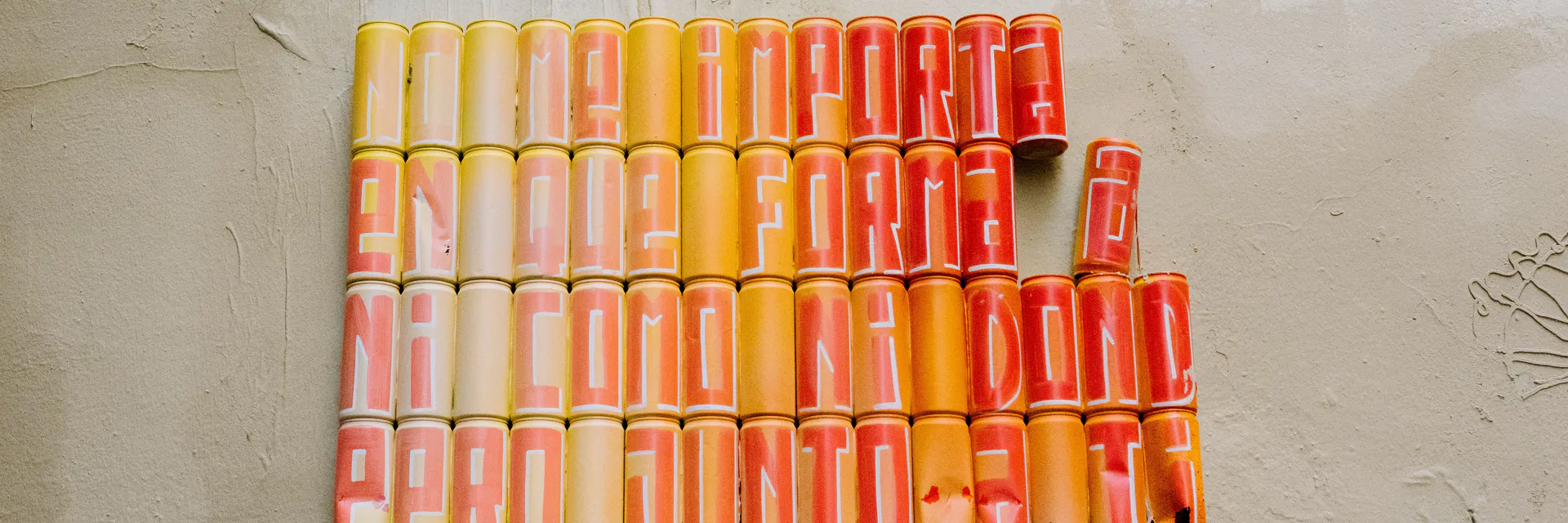
Cans produced by D. A. Prigov, which are covered by typewriter-made text. We can also look at Prigov’s “Pit”, in which the artist cuts a square hole in the book’s paper section as if it were a pit, and in the text itself, he goes over what this word stands for in every language. In this case, we can refer to the “aesthetic neutral” term, which is typical of representatives of conceptual art like L. Weiner. However, we can highlight the lyrical part, typical of the Moscow conceptual art school, that Prigov adds to this piece. He unites text and image as his main expressive feature in this piece, and because of that, the text itself becomes objectified. That method demonstrates that the object part is the main one, when the text is more of an element, which switches the common hierarchical arrangement of an illustrated edition: text is the main, illustration is secondary.
But producing objects that look like a book is not only about cutting through the block of text or presenting it as an independent work of art. For artist Elena Pavlova (Potanina), it is typical to transform the book codex into a sculptural composition. Although the book as an object does not leave the artist’s focus, it becomes a sort of soil, a base where the characters appear.
The characters she creates have no portrait features; just vague images that remind us of sketch drawings that may fill a classical illustrated edition. In this case, the so-called illustration sits in the foreground, focusing the viewer’s attention on a pivotal moment in the chosen novel. This approach is similar to one Prigov used, but with its own nuances. Pavlova is interested in classical literature, so her method is quite illustrative. For her, the text is more of a starting point for a creative assumption, because the plot is well known to the spectators and does not need extra comment. This points out that the artist uses a tradition in which text is the main source for the image, which sublimates the main scenes.
Polina Nochka’s piece «Restoring Perspectives» (2024) works with archival-type language. She offers the viewer a format of “attentive study” of a catalog because word and object coexist inseparably in her work. Although the artist presents the audience with a complete plastic art composition in a chamber format, it refers to the analytical aesthetics of H. Haacke, as presented in his piece “Shapolsky et al. Manhattan Real Estate Holdings, a Real-Time Social System, as of May 1, 1971” (1971). Similar to Haacke, she studies a phenomenon connected with real-life events that matter for her, yet in this case we do not see a series of prints that can be hung in a gallery space - she produces an object that can be interacted with and can be exhibited only as a separate item, where images are accompanied by catalog cards.
Objecthood in text-oriented works can be demonstrated differently. Katerina Seryoznaya’s series “ABC” (2019) represents a typical visual strategy for this artist. She studies the theme of national identity using glass as a medium. Seryoznaya demonstrates an image familiar to the audience from their childhood: a set of blocks with letters on them, where each letter stands for a word that starts with it (img. 1). In that object series, we can see a citation of Rimma and Valery Gerlovins, the classics of the Russian contemporary underground art scene and a bit of Prigov’s oeuvre. However, she adds something new – the fragility of the material she uses. As a result, the creative environment the artist creates is like a house of cards, where any wrong move can demolish the whole structure.
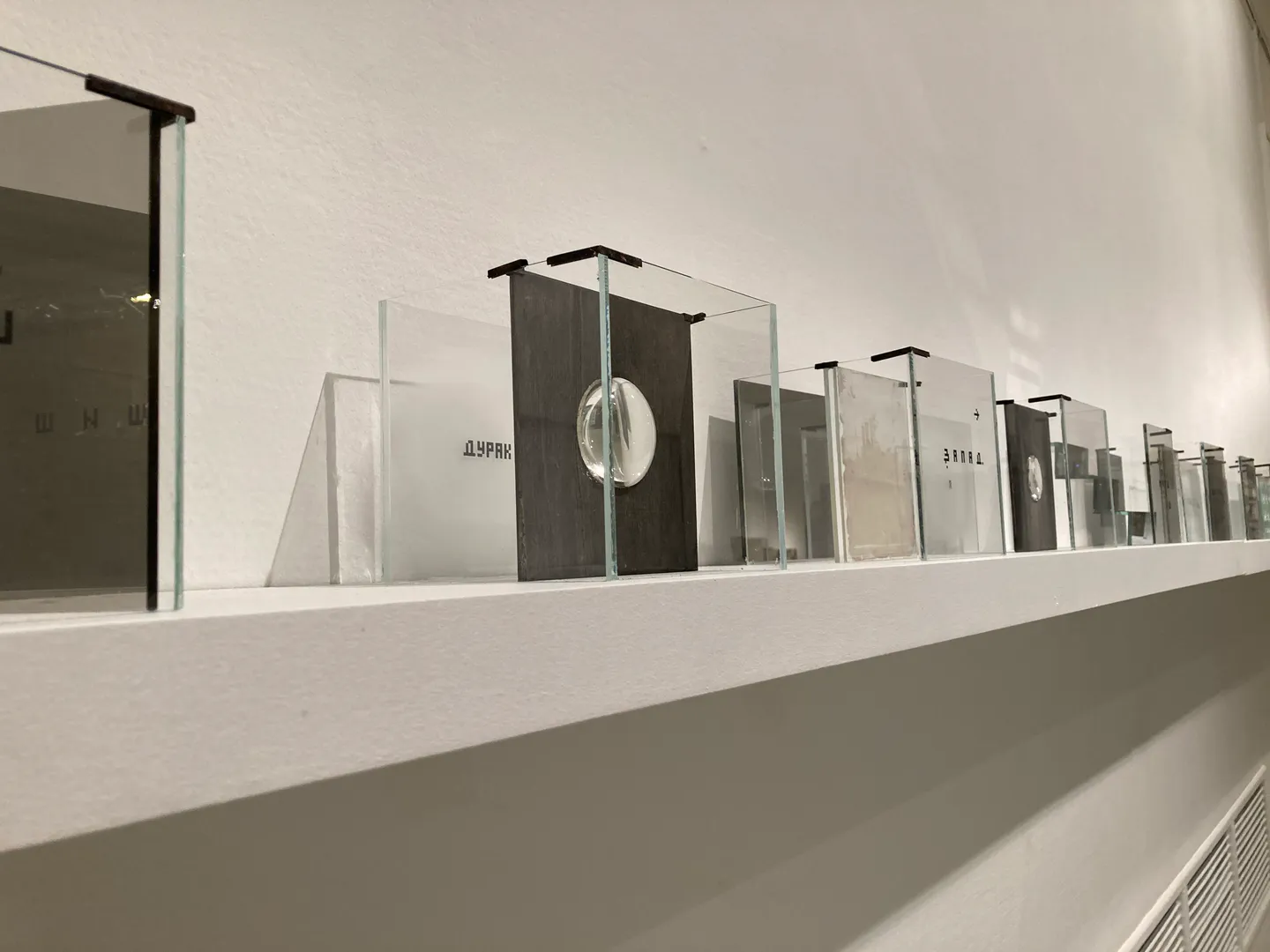
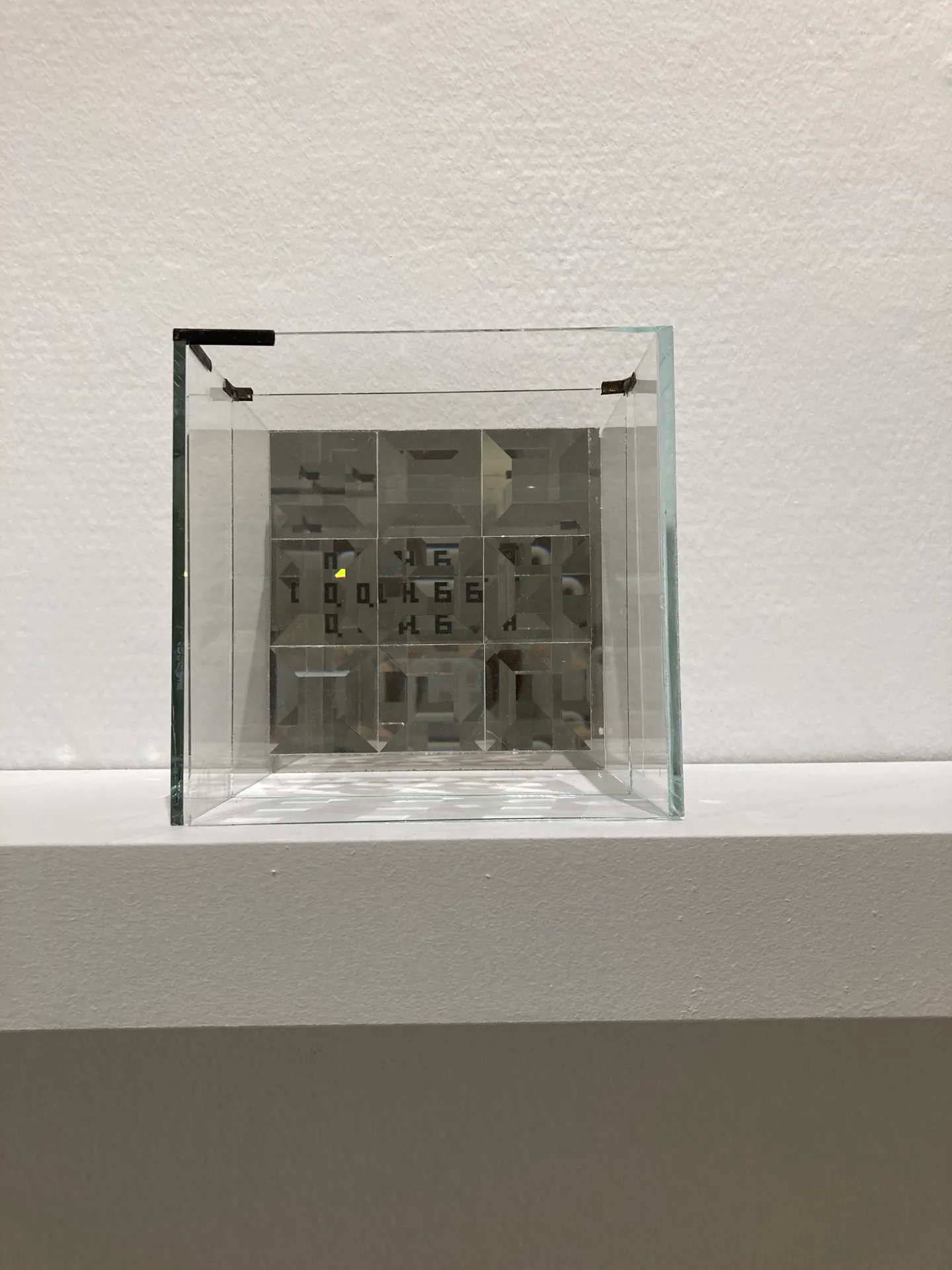
Seryoznaya also mentions that it is not only the Russian cultural code, but the glitch aesthetic that interests her as well, and she applies it a lot in “ABC.” Blocks like “Ya” - I in Russian, “O” - mistake (oshibka) (img. 2), “M” - march demonstrate it. It is quite notable that she uses only the words that are strongly associated with linguistic peculiarities and cultural paradigms of Russia: nonentity (shish), yearning (toska), counting on a miracle (avos’), etc.
From this, we can conclude that strategy in text-oriented artworks often involves using works that resemble codexes and archival materials. Furthermore, artists appeal to objects associated with learning the alphabet in a game form. Because of these approaches, the synthesis of the terms “text” and “object” becomes more visible and precise in creative gestures.
3. Text as an ephemera
The other strategy observed in this paper focuses on artists who work with new media, where text is only a provisional physical component. Such pieces can use certain text transmitters and be more technological. From an analytical point of view, these artworks require not only formal methods but also categories like atmosphere and auto-curation, coined by contemporary philosophy of art.
The term “atmosphere” was offered by the German philosopher G. Böhme [7]. He pointed out that it was necessary because the term “aura”, created by W. Benjamin,[8] can only be used in reference to non-reproducible and non-copyable pieces of art. Yet, atmosphere actually deals with works that were produced with the use of new media; hence, it is correct.
The paper by B. Chattopadhyay [9] uses the term auto-curation. In his opinion, auto-curation allows the viewer to build the missing elements of a demonstrated piece. Auto-curation is a separate term from A. Badiou’s inaesthetics [10], which holds that an artwork generates its own ideas and senses. In this case, we refer to an open dialogue, inviting the viewer to create a chain of senses in an open art form.
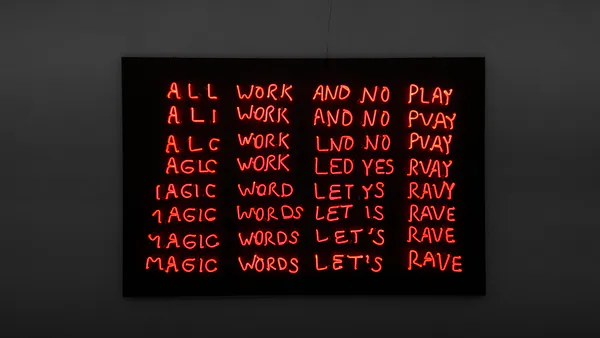
In the video piece by Alexander Tarasenko from his ongoing series “It is Stronger Than You” (2019/2025) (img. 3), text is an ephemeral element. The 20-minute work contains a powerful message about OCD. In this case, we can point out that the artist uses an approach that shapes personalized perception in the future. D. O. Martinova and A. A. Ageev’s opinion on that states that it “unpacks the horrible in the existential case as a destroyed border between the viewer and something terrifying” [11] с.~30. The text here is the baseline of the liminal process that Tarasenko studies.
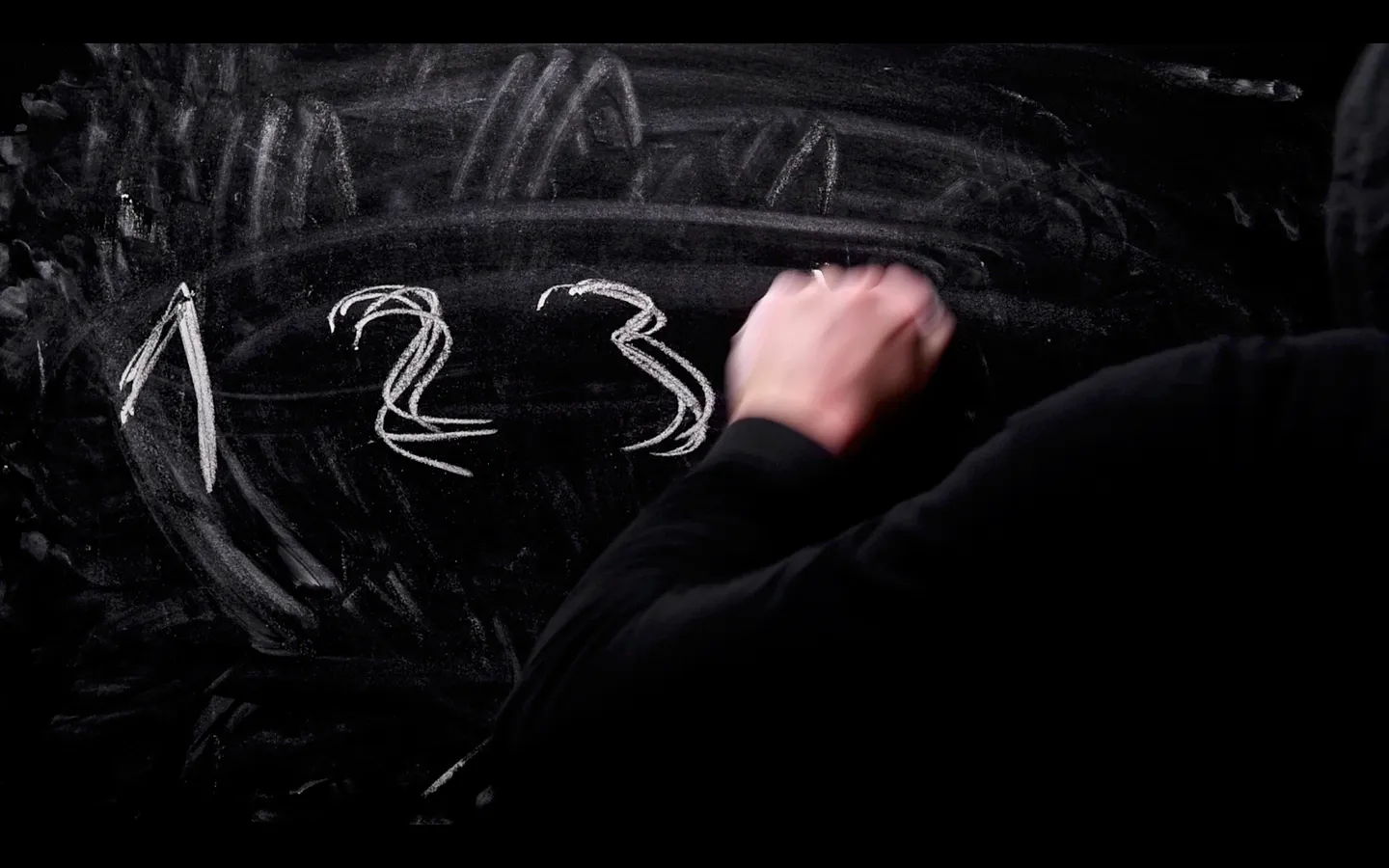
The artist remains in the sequence, repeatedly writing text on a chalkboard and erasing it. This absurdist tactic also appears in certain video art pieces, e.g., Bruce Nauman’s early works. However, unlike his predecessor, Tarasenko fills his project with dramaturgy that illustrates fixation on an action from a moral-suffering perspective. The text here not only serves a processual function but also illustrates a psychological disorder the artist researched.
The ephemera strategy here appears in two moments: in Tarasenko’s piece, the text has no fixed form, so the artwork is constantly transforming. The other moment is the format itself: the video file can be edited and transformed as well, if needed for an exhibition, which also highlights a hypothetical materiality.
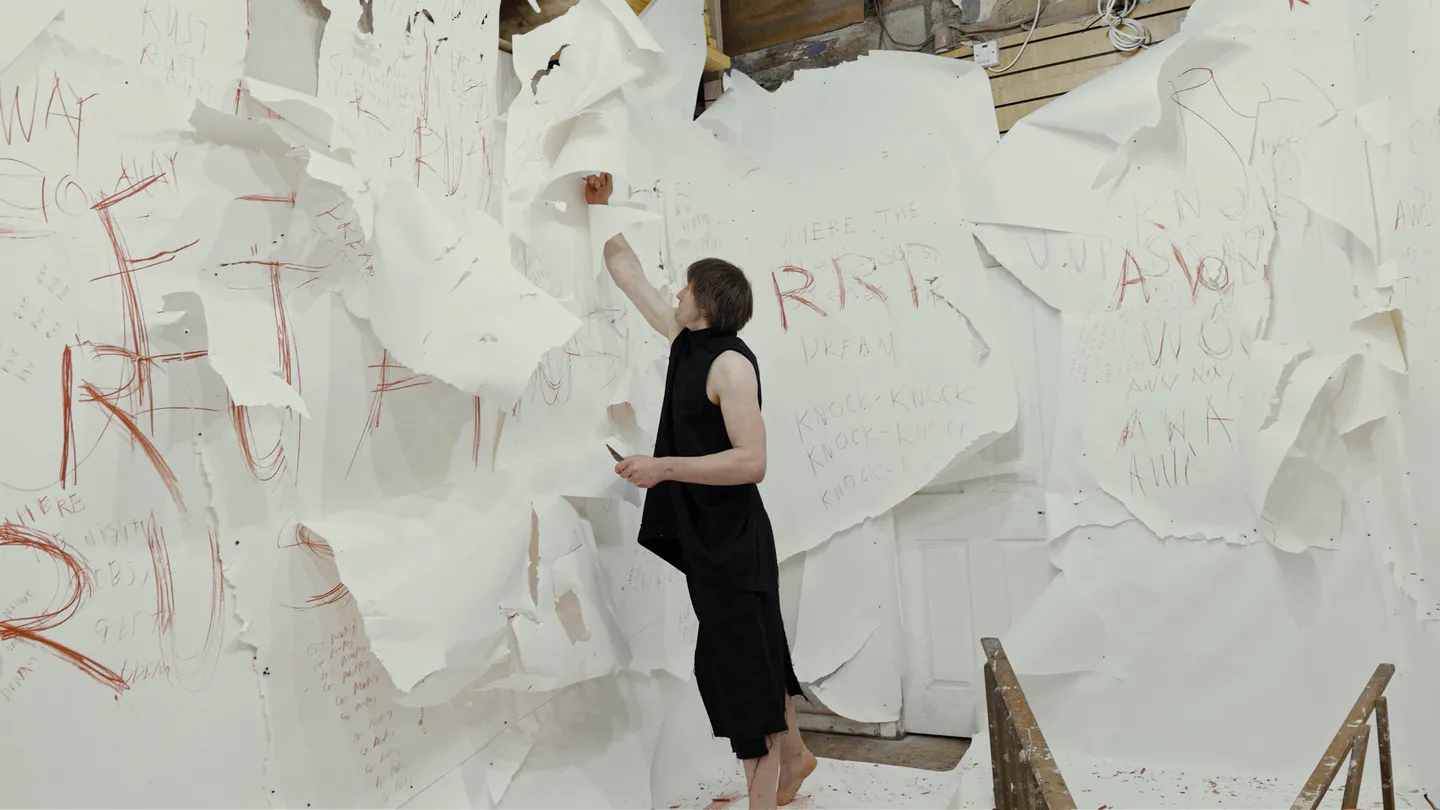
The atmosphere concept that the piece creates is filled with anxiety that the artist transfers to the viewers. However, the video file itself is a more stable art form, which the artist clearly understands, so in 2025 he did a performance in Glasgow as part of the series in order to give more volume to the piece. This way he managed to combine Benjamin’s aura and Böhme’s atmosphere in an exhibition space where both works were demonstrated at the same time (img. 4).
Dmitry Kavarga’s work “Absorbing the Concepts. Selfreflecting Mystificator of Sokal” (2017) can also be interpreted as book art, even though in the description the artist does not manifest it. The appearance of his art piece presents a complex construction with many tubes, which spill some paint on a canvas once in a while. The annotation to the work at the exhibition “Daemons in the Machines” (Moscow Museum of Modern Art, 2018) offers to “’observe’ a sheet of text”. The artist developed software that can analyze academic concepts. The more interesting and richer with concepts a text is, the more colorful the reaction it gets, spitting paint out of the tubes. In this case, we see a futuristic model in which the artist delegates the analysis of a human-created text to the AI by making it the reader and consumer of knowledge. That is why we can talk about the reverse usage of the A. Badiou’s inaesthetic model here. This is because the aesthetic neutrality connected with the appliance in the work, with a non-human agent as a mediator, functions to generate text-based expression. Hence, we see an inversion of a book, a possible scenario of a machine uprising, which has been described not once in sci-fi literature and cinema.
The physical part of the piece is necessary to illustrate the artist’s idea. It is an obvious crossover with the object strategy described above. However, text is the basis of the technological piece and is absent in its final form, as is familiar.
Another example of collaboration between text and technology is Medina Mammakhmedova’s “Emotional Processor” (2023). Here, the artist offers the viewer/reader the choice to choose an emotion and ask a question about it. In this way, the artist creates an illusion of empathy within technological art. This strategy is typical of artists working in the field of robotic art. The artist packages a familiar emotional experience into a machine to create a unique experience, adding a section where the viewer can write a commentary. This interactive element allows viewers to visualize the auto-curation construct: the uncontrollable perception and interpretation of a piece of art. By writing their thoughts on the paper, the viewer becomes an object and a subject at the same time. Unlike her predecessor, Sol LeWitt, Mammakhmedova does not offer certificates signed by her as a creator of the idea. Every printed piece is to be taken by the viewer as a memento or destroyed later. This way, she highlights that the ideas produced during the 1960s by Conceptual art representatives, where every piece, even the one where the audieces are involed, needs to be signed by an artist, can become the viewers’ personal item when the new media is involved.
As another example, we chose a work by the art group Where Dogs Run? “The Day After Tomorrow (2017-2018). This installation offers a look at a literature piece in a technological context.
The supporting text at the “Daemons in the Machines” exhibition (Moscow Museum of Modern Art, 2018) states: “Dante’s ‘The Divine Comedy’ is transformed into an electronic scheme, which consists of three parts: hell, in-between and heaven. This is a container of the lost in the world of knowledge written in a forgotten language. Cargo internet people cannot read it, but can observe it. The verse still supplies the cargo internet.
From that, we see a context that forms this way: a request is sent before the apocalypse, and the search material is the poem’s text. An answer in the form of a screenshot was printed on a slide. The result was a collection of 100 screenshots as if it were a full capacity of cargo internet in a post-apocalyptic world.
The artists offer the viewer a “product” of cold media (M. McLuhan’s term), and a literature piece became its basis. The exterior of the artwork is presented as a finished item, even though we can trace the elements of an open art form within it.
Firstly, the microschemes produced by the artists already demonstrate an auto-curation context to the viewer because they create an atmosphere that can be compared with the atmosphere of hell described by Dante, according to the authors of the paper. Secondly, the internet, as a space of personalised search, can also be characterised as an open form.
From this part, we can conclude that the image of text present in new media gains more “volume” and complexity, because it allows work with more categories and concepts. It is also important to mention that the complex nature of installation artworks sometimes makes viewers part of a piece, with which they interact, and thus gain the qualities of both object and subject at the same time.
4. Conclusion
In conclusion, it is important to note that text in contemporary art had an applied function at first. Today’s situation shows that it can take various forms. In this way, the classical formula “text and image” is no longer a fixed model in a general overview of contemporary creative practices. This has been analysed through two main strategic blocks, where text can be a part of an object environment and an ephemera as well. Although the strategies are divided, there are cases where they interfere with each other. This is especially clear in technological art. Text there can become a formality or a product of generative software, hence a piece produced by a non-human agent, in which artists add object elements.
This variety of strategic approaches demonstrates that by the middle of the 21st century. we can see a tendency toward a total synthesis of art, presented in text-oriented artworks. Using the historical background, we can highlight that these processes started to form at the beginning of the 20th century. They have since become fully developed creative strategies.