The warehousing system is an important aspect of the supply chain that requires the attention of environmental engineers to assess the environmental impacts of the warehousing activities. This paper aims to address the application of environmental management system in a warehousing organization within Saudi Aramco Oil Company. The main finding was that the successful implementation of environmental management system allows the organization to proactively address environmental impacts and have better control over environmental consequences.
## I. INTRODUCTION
When considering the environmental impacts in supply chain logistics, most attention is given to the transportation. On the other hand, the environmental impact of the warehousing and storage is usually overlooked (Dentch, 2016). According to (Fichtinger, Ries, Grosse, & Baker, 2015), both transportation and storage are considered main drivers of environmental pollution in the global supply chain.
Warehousing is a critical aspect of the supply chain logistics. It allows organizations to tap into the triple bottom line by identifying the value-added activities and capitalizing on them. Although their environmental aspects are usually marginalized by some organizations, it is critical for warehousing organizations to determine their environmental activities to monitor and control their negative environmental impacts and remain sustainable. A sustainable warehouse is a one that achieve the desired profit and customer service level, without compromising the ability of the future generations to meet their need. One of the sustainability main pillars is the Environmental Sustainability, which considers all aspects related to the environment in the product life cycle (Muthu, 2020).
Fortunately, establishing an internal environmental program can help organizations understand their environmental contributions and ensure compliance with local laws and regulations.
The environmental management system was built to "protect the environment and respond to changing environmental conditions in balance with socio-economic needs" (ISO, 2016). In today's world, environmental sustainability is an important business practice, and green supply chain is desirable to gain an edge on the market (Fernando & Saththasivam, 2017). Those benefits have been sensed since early 2000s. Several companies, such as Ford, IBM, Honda etc, have reported positive feedback on their business figures after using EMS (Morrow & Rondinelli, 2002). In this paper, a case study of the environmental management system (EMS) implementation in a Warehousing Organization within Saudi Aramco will be examined. This study presents a literature background of EMS that provide effective approaches to control environmental risks within the warehouse.
## II. LITERATURE REVIEW
The environmental management systems provide an effective tool to measure and control the environmental impacts in businesses, regardless of the size of the company. This literature review is established from the review of multiple journals, books, and websites concerned with supply chain, warehousing, and the environment. Keywords that were used in this research include, "warehousing", "green supply chain", "environmental management system", "warehousing environmental impacts." This literature consists of an overview of environmental considerations of warehousing activities, and EMS framework.
### a) Environmental Impacts of Warehousing Activities
When considering the environmental impacts of warehousing activities, it is important to understand the corporate supply chain strategy. For example, the number of warehouses and their locations are highly dependent on whether the organization is utilizing a responsive or an efficient supply chain. According to the Association of Supply Chain Management, the responsive supply chain utilizes more safety capacity to mitigate the risk of uncertain demand. Therefore, these response-focused supply chain organizations may require multiple warehouses placed at close proximity to customer. In addition, high degree of agility might be needed as well as speedy product delivery. On the other hand, the efficient supply chain is characterized with lower demand uncertainty, lower product variety, and longer product life cycle [8]. The response-focused supply chain requirements are usually accompanied with higher environmental impacts. More warehouses mean more energy consumption that needs to be monitored. Similarly, speedy, and frequent deliveries are associated with higher CO2 and other greenhouse emissions.[8] places most organizations in the middle of the spectrum of efficient and responsive supply chain. Organizations will need to assess their capability to pinpoint the right balance between efficiency and responsiveness. Determining this balance and position is important in identifying the environmental impacts relevant to their associated warehousing practices.[8] lists the seven activities which may take place in warehouses as Receiving, Prepackaging, Put-away, Storing, Order picking, Moving, and Shipping. According to (Fichtinger, Ries, Grosse, & Baker, 2015), one area of environmental impacts is caused by material handling equipment during the warehousing activities. These are closely related to the choice of equipment, and warehouse throughput. However, the environmental impacts from warehousing are majorly generated from heating, cooling, air conditioning, and lighting, and these are associated with the warehouse size and quantity. This is also influenced by the inventory management, inventory requirements, and warehouse design.
Although the abovementioned aspects are considered common, it is important to consider other environmental aspects in order to stay reputable and ensure environmental competency. (Muthu, 2020)identified several major drivers for environmental sustainability including raw materials, energy consumption, water consumption, Wastewater discharge and water pollution, Soil or land pollution, Emissions to air. Greenhouse gas (GHG) or carbon footprint, Hazardous waste management, Toxic and hazardous chemical management, etc.
The study in (Ries & Grosse, et al., 2016) shows that a typical warehouse consumes energy levels between 1025 and 1265 MWh and emits between 888 and 1087 tCO2 annually. Simply by replacing luminaires from the known standard incandescent lamps to fluorescents or other alternative such as LEDs might result in a significant reduction in the lighting energy by $80\%$ to $90\%$ which eventually leads to decreasing emissions of between $20\%$ and $34\%$ for the median warehouse. Similarly, improving building's insulation yield a noticeable impact as well; improvements of $9\%$ in energy consumptions and $8\%$ in emissions.
Managing environmental risks requires establishing a systematic approach to managing the environment that tackles the unique challenges of organization's industry. The establishment of an environmental management program can untangle these complexities through following a systematic approach that align with local regulatory requirements and environmental protection laws.
### b) EMS Framework - ISO 14001
The International Standard Organization has developed special standards for implementing the environmental management system called ISO 14001. The ISO 14001 is a global standard that provide guidelines to establish an environmental management system. ISO defines the EMS as "part of the management system used to manage environmental aspects, fulfil compliance obligations, and address risks and opportunities" (ISO, 2016). Furthermore, ISO defines aspects as elements that can interact with the environment.
The ISO 14001:2015 covers 7 main sections for the establishment of the environmental management system as illustrated in figure 1 (ASQ, 2023). (ISO, 2016) and (Dentch, 2016) explains each of these requirements in details. This paper will provide a high-level description of the requirements under each section.
1. Context of the Organization: This section requires the organizations to understand their context, determine the needs and expectations of interested parties, and determine the scope of the EMS program.
2. Leadership: Is the commitment of top management to the EMS program. It also requires the explaining of the stakeholder roles and responsibilities and implementing environmental policies.
3. Planning: This is when the identification of aspects, and objectives takes places. Determining the risks involved and establishing compliance obligations are needed for the completion of this section.
4. Support: In this section, the organization will need to determine and provide the needed resources, and proper training to and competency of its employees based on their responsibility level. The organization will need to also form their communication plan and create their documentation program.
5. Operation: Establishing the operating criteria is an essential area as it is the key to the creation of and enforcing the operation control measures. This section mandates organizations to have an emergency response plan as well for counteract any environmental impact deviations from the establish target level.
6. Performance Evaluation: The organization shall evaluate and analyze its environmental performance through regular monitoring to the aspects, program audits, and management review meetings. The ISO 14001 establishes the standards to implement the EMS without specifying environmental performance criteria.
Therefore, it is the organization's responsibility to set their own criteria and strategy that match their vision and mission as well as the environmental laws and regulations using the set forth ISO standards.
7. Improvement: This section's goal is for the program to have continuous improvement by reviewing the gaps and deficiencies from the previous section and generating corrective actions that address the issues thoroughly and solve the root cause of the problems to prevent them from recurring.
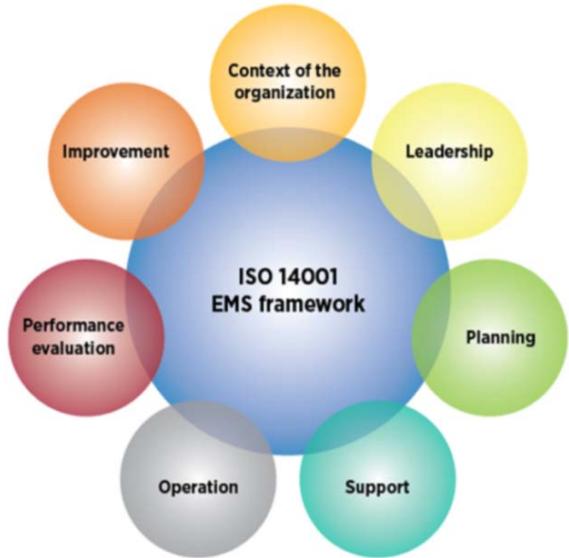 Figure 1: ISO 14001 Environmental Management Systems (EMS) Framework (ASQ, 2023)
The environmental management system foundation is built on the basis of the Plan-Do-Check-Act (PDCA) model. This model drives the iterative process needed to achieve continuous improvements in the environmental program. Furthermore, organizations can apply this model to the whole program, or to each individual element (ISO, 2016).
"Plan" in the model refers to establishing the environmental objectives, aspects, and targets in accordance with the environmental policies and scope determined by top management. These objectives along with operational controls are implemented in the "Do" phase. During the "Check" phase, management reviews and audits are conducted, and reports are initiated to analyze the program position against the established criteria, and issue action items. The corrective actions are implemented in the "Act" phase to rectify any deficiencies and to continually enhance the EMS program. Figure 2 provides an illustration to the PDCA model association with EMS Framework (Dentch, 2016).
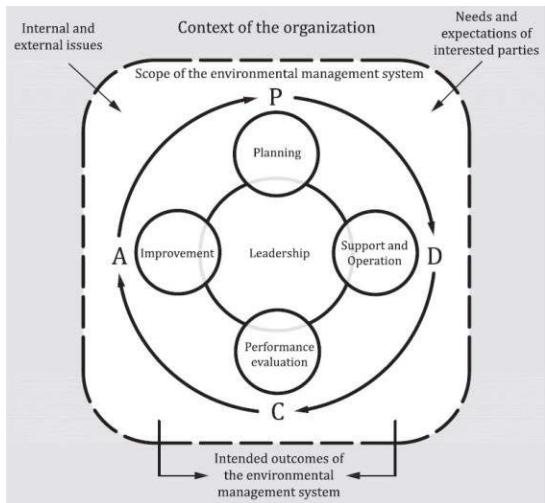
Figure 2: Relationship between PDCA Model and EMS Framework (ISO, 2016) "The Figure Taken from ISO 14001: 2015 is Reproduced with the Permission of the International Organization for Standardization, ISO. This Standard can be obtained from any ISO member and from the website of the ISO Central Secretariat at the following address: www.iso.org. Copyright Remains with ISO"
Originally, the purpose of the EMS is to protect the environment and respond to changing environmental conditions in a systematic way. The ISO 14001 was revised in 2015 with an additional focus. The new revision emphasizes on adopting lifecycle thinking, along with other elements such as leadership and stakeholder. This adoption is likely to drive sustainable development through the environmental management system (Bravi & Santos, et all, 2020; Ciravenga & Martins, et all, 2015; Mosgaard & Bundgaard, et all, 2022). This new version (ISO 14001: 2015) seeks to enhance the strategic approach to the EMS through incorporating lifecycle thinking, corporate social responsibilities (CSR), and circular economy (CE) (Kristensen & Mosgaard, et all, 2021; Mosgaard & Bundgaard, et all, 2022).
## III. RESEARCH METHODOLOGY
This paper embraces a qualitative approach to evaluate the adoption of the recently established environmental management system in a Warehousing Organization that operates within Saudi Aramco Company. It will be referred to as Warehousing Organization (WO) in this paper. The environmental management system that is being adopted in the Warehousing Organization is ISO 14001:2015.
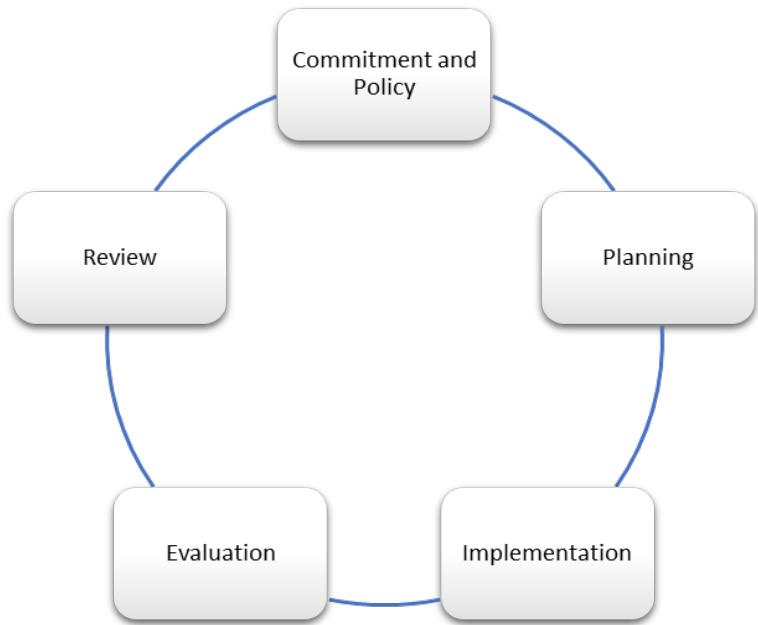 Figure 3: EMS Five Stages
## IV. FINDINGS & DISCUSSION
The findings and discussion of this section will be reviewed in accordance with the EMS five staged as shown in Figure 3 (EPA, 2022).
Stage One: Commitment and Policy
Saudi Aramco has established a guideline for Environmental Protection Policy Implementation. This guideline serves as the source for establishing the environmental policy for the environmental management system. The policy requires to address the commitments to comply with regulations, continuous improvements, pollution prevention, worker protection, and environmental and public health protection.
All environmental activities and aspects under the Warehousing Organization adhere to one or more of these policies. Through these policies, the Warehousing Organization strives for full compliance with environmental regulations and maintaining a green operation in warehousing.
Stage Two: Planning
Prior to the development of the action plan, the Warehousing Organization reviews the legal requirements and references. This also includes a review to the latest updates to the ISO 14001 family of standards. Then, the Warehousing Organization starts the process of identifying the aspects and impacts, which includes listing all their environmental activities, products, and services that may have a positive or negative influence on the environment. Based on the identified aspects and legal requirements, the Warehousing Organization sets their objectives targets, and performance measures which are translated later into an action plan with milestones. These milestones are constantly administered by the organization's environmental coordinators and monitored and reviewed by the
Director of the Warehousing Organization on quarterly basis through the Management Review Meetings in Stage Four.
This stage also involves the identification of relevant internal EMS program procedures and forms. The Warehousing Organization has established 12 procedures that covers the requirements of ISO sections in details. These procedures are created throughout the EMS five stages mentioned in figure 3.
Stage Three: Implementation
After creating the action plan, the Warehousing Organization assigns action plan responsibilities to the appropriate entity to ensure that the environmental management system conforms to the requirements of the identified standards. In addition, the Warehousing Organization establishes operational controls as well as emergency controls to manage their environmental aspects in the action plan and ensure the environmental impacts are mitigated or controlled. After that, the needed training is provided to the employees, and the policies as well as the new action plan is communicated to all stakeholders.
Stage Four: Evaluation
The Warehousing Organization plans for and maintains operational licenses, such as the authorization and license to store chemical materials. The management review, and nonconformity & corrective action procedures are established in this step. Periodic monitoring is required for this step which includes conducting management reviews, and auditing the EMS program.
Stage Five: Review In this stage, the Warehousing Organization establishes the internal EMS assessment procedure and conducts the internal assessment and compliance evaluation to measure the EMS program performance. The EMS program is audited internally and on corporate level to continually improve the EMS program. The objective of these audits is to determine the progression level of the organization through predetermined EMS levels. Management reviews are also a key part in ensuring the successful EMS program standing in terms of the established key performance indicators. These eventually will ensure that environmental procedures are updated and revised.
Figure 4 is an edited version of figure 1. It is created to show the interlink among PDCA, ISO 14001 framework and EMS stages used to evaluate the Warehousing Organization. The figure shows in what EMS stage the WO addresses the 7 main areas in ISO 14001 framework. The WO combined the requirements of the 7 ISO sections into the EMS five stages as applicable to their operation and organizational size. Based on the literature review of the ISO framework and the details of the WO EMS stages, the WO addresses the requirements of ISO standards sufficiently in the proposed EMS stage. The next step for the WO is to have their EMS program audited by an ISO certifying body to obtain the ISO certification.
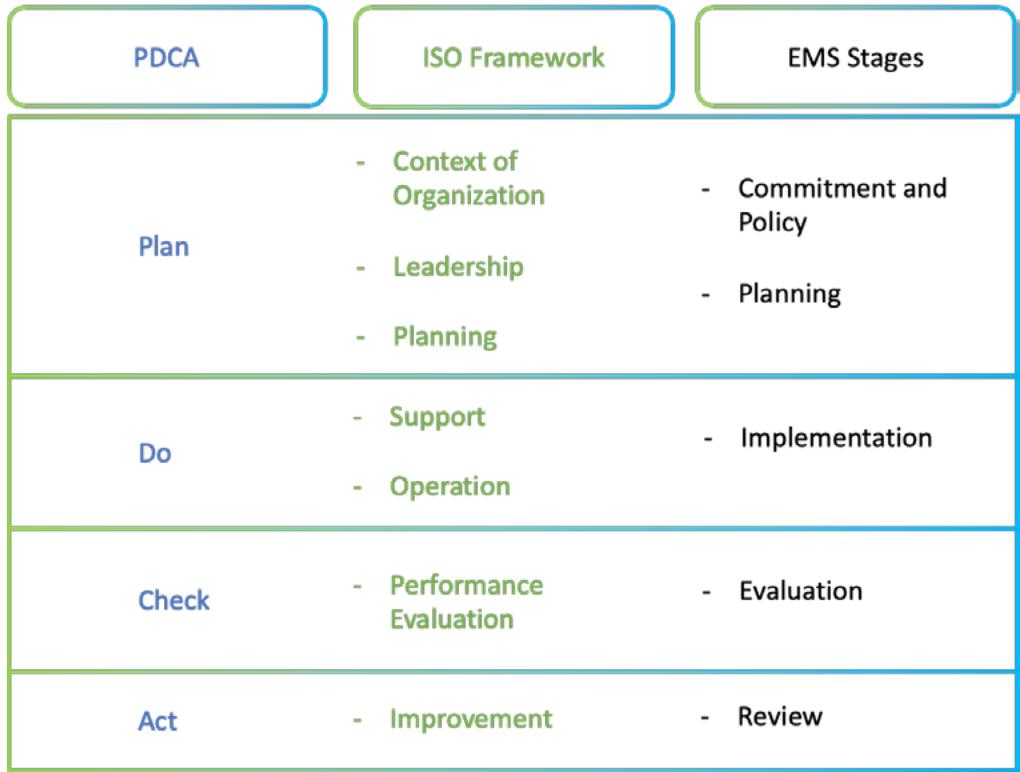 Figure 4: Link Between PDCA, ISO 14001 Framework, and EMS Five Steps
The Warehousing Organization applied the environmental management system effectively that resulted in an improved environmental impact identification and control. The Warehousing Organization has proved their environmental competency internally through successfully achieving the environmental excellence performance level during the last conducted corporate audit with no major nonconformities. As a result of effective implementation and monitoring of the Hazardous Materials program under EMS, the Warehousing Organization maintained the chemical warehouse license and regulatory approval to import, handle, and store hazardous and chemical materials. This authorization was granted after displaying capability in handling such hazardous materials and proving compliance to the environmental laws and regulations.
Furthermore, the established environmental initiatives continue to lower potential environmental impacts. For example, the warehouse intra-movement initiative has demonstrated a considerable positive environmental impact. By applying the Lean Six Sigma approach, the Warehousing Organization managed to reduce the annual intramovements between warehouses and forklift runtime by $10\%$ along with reducing the associated CO2 emissions and energy consumptions. Such initiatives do not only yield evident environmental benefits, but also provide the Organization with additional resources to allocate towards other business aspects.
## V. CONCLUSION
The environmental management system provides a comprehensive approach to managing environmental risks in storehouses, where different types of materials are stored, handled, and transported. Incorporating a well-established EMS as outlined in the ISO 14001: 2015 standard ensures compliance with environmental law and regulations and reduces undesired environmental impacts resulted from warehousing practices. Companies that embrace this system will notice the benefits in a short duration if applied correctly. This study provides a qualitative approach to reviewing the benefits of applying the environmental system. One of the limitations of this study is that it lacks the quantitative measures of the environmental benefits. Calculating the environmental benefits is not an easy task. Mega projects can be complex and difficult to quantify some of the benefits. According to (Dangelico & Pujari, 2010), using scientific and systematic methods for assessing the environmental impacts of a product is a difficult and complex process. Further studies need to be conducted on the standard methodologies of calculating environmental impacts.
Another area to investigate is the concept Design for the Environment (DFE) that is attracting more attention, warehousing organizations need to embrace this concept when purchasing their equipment. According to [8], the DFE concept includes provisions for reuse and recycling. Organizations can purchase eco-friendly pallets and packaging materials. The reduced energy consumption is another consideration in DFE concept. This is when organizations revisit their warehousing networks to enhance their critical path through utilizing Warehousing Management and Transportation Management Systems.
It is recommended to conduct benchmarking with other top-in-class organizations and attending environmental forums and conferences to identify potential environmental technologies and approaches to lower the environmental impacts. This will not only introduce the organizations to new environmental technologies and initiatives, but it will also help in finding the most effective method of calculating the benefit and dealing with environmental impacts.
### ACKNOWLEDGEMENT
"The authors wish to express appreciation to Saudi Aramco warehousing team for their commitment, support and cooperation during the conduct of this paper."
Generating HTML Viewer...
References
14 Cites in Article
Sander Gerald G (2016). International Organization for Standardization (ISO).
S Muthu (2020). Woodhead Publishing Series in Textiles.
Johannes Fichtinger,Jörg Ries,Eric Grosse,Peter Baker (2015). Assessing the environmental impact of integrated inventory and warehouse management.
Laura Bravi,Gilberto Santos,Alessandro Pagano,Federica Murmura (2020). Environmental management system according to<scp>ISO</scp>14001:2015 as a driver to sustainable development.
Ciravegna Martins Da Fonseca,L (2015). ISO 14001:2015: An improved tool for Sustainability.
H Kristensen,M Mosgaard,A (2021). Integrating circular principles in environ-mental management systems.
Mette Mosgaard,Anja Bundgaard,Heidi Kristensen (2022). ISO 14001 practices – A study of environmental objectives in Danish organizations.
(2020). Supply Chain Execution: Planning.
Y Fernando,G Saththasivam (2017). Green Supply Chain Agility in EMS ISO 14001 manufacturing firms: Empirical justification of social and environmental performance as an organisational outcome.
David Morrow,Dennis Rondinelli (2002). Adopting Corporate Environmental Management Systems:.
Rosa Dangelico,Devashish Pujari (2010). Mainstreaming Green Product Innovation: Why and How Companies Integrate Environmental Sustainability.
M Dentch (2016). The ISO 14001:2015 implementation handbook: Using the process approach to build an environmental management system.
Jörg Ries,Eric Grosse,Johannes Fichtinger (2016). Environmental impact of warehousing: a scenario analysis for the United States.
U.S. Department Of Energy,U.S. Environmental Protection Agency,National Science Foundation (2022). Energy Positive Water Resource Recovery Workshop Report.
No ethics committee approval was required for this article type.
Data Availability
Not applicable for this article.
How to Cite This Article
Dr. Hussain, Hussain I. 2026. \u201cThe Adoption of ISO 14001 Environmental Management System in Supply Chain Warehousing: A Case Study\u201d. Global Journal of Computer Science and Technology - G: Interdisciplinary GJMBR-G Volume 23 (GJMBR Volume 23 Issue G2): .
Explore published articles in an immersive Augmented Reality environment. Our platform converts research papers into interactive 3D books, allowing readers to view and interact with content using AR and VR compatible devices.
Your published article is automatically converted into a realistic 3D book. Flip through pages and read research papers in a more engaging and interactive format.
The warehousing system is an important aspect of the supply chain that requires the attention of environmental engineers to assess the environmental impacts of the warehousing activities. This paper aims to address the application of environmental management system in a warehousing organization within Saudi Aramco Oil Company. The main finding was that the successful implementation of environmental management system allows the organization to proactively address environmental impacts and have better control over environmental consequences.
Our website is actively being updated, and changes may occur frequently. Please clear your browser cache if needed. For feedback or error reporting, please email [email protected]
Thank you for connecting with us. We will respond to you shortly.