This article analyses the introductory and supplementary texts (known as paratexts) in Justus Lipsius’ edition of Politica, with the aim of better understanding how he organises his work and the ideas he proposes about the education and formation of a ruler. Specific biographical details about Lipsius, which are discussed in the article, play an important role in contextualising the text within its historical and intellectual background. The article also examines how he employs a writing technique known as cento (which consists of assembling quotations from other authors) as a key element in constructing his political argument. Particular attention is paid to the frequency and manner in which Lipsius incorporates excerpts from the Roman historian Tacitus, as well as how he sets out principles of good government through these paratexts. Ultimately, the article shows how these elements come together to provide an overall picture of Lipsius’ political thought.
## I. INTRODUCTION
This work aims to examine the paratexts present in the edition of Justus Lipsius' Politica, with the purpose of highlighting how the author constructs his work and what theoretical principles he establishes in relation to the training of a ruler.
First, I will contextualise the *Politica* within its historical and editorial framework, focusing on specific biographical details that will shed light on his approach to literary work. Next, I will examine the cento methodology used in the construction of *Lipsius*' political discourse, a fundamental resource in his writing. Next, I will address the paratexts *De consilio et forma nostri operis*, Monita quaedam sive *Cautiones* and his *Notae*, where Lipsius offers clues about the development of his work. At this point, I will pay special attention to the role of Tacitus, as well as the systematic and functional incorporation of his fragments within *Lipsius*' text.
Subsequently, I will address the question of the formation of the ruler, based on the reflections that Lipsius sets out in his Notae. In a complementary line of inquiry, I will analyse the foundations of good government according to the author, as presented in his first letter-prologue addressed to rulers, which addresses issues such as political power and public utility. Finally, I will comment on the excesses present in the political discourse of the prologue letter De consilio et forma nostri operis, thus concluding the overview of the paratextual elements that structure and guide Lipsius' work.
The treatise *Politica* is the ideal starting point for examining the evolution of Justus Lipsius' writing on government and the organisation of power. The treatise was so wide-ranging not only because of its content, but also because of its form. Lipsius organised quotations from ancient authors using concise definitions, summaries and marginal references, thus creating a coherent but flexible discussion of practical and relevant political issues of his time.
This treatise remains his main contribution to European political thought, particularly to the tradition of raison d'etat. Some of its features are equally accessible and appealing to a modern audience. Many aspects of the Politica point to a work situated at the threshold of modernity; moreover, it is the product of a scholarly mind oriented towards an analysis of the laws of practical political behaviour and apparently free from confessional or doctrinal loyalties. Academic interest in the work was reinforced by its exceptional popularity among European political elites across confessional boundaries, as evidenced by the numerous editions and translations it underwent, as well as by concrete signs of its political influence.[^1]
## II. HISTORICAL CONTEXT AND PUBLICATION OF THE POLITICA
Lipsius wrote in the context of the Revolt in the Netherlands and other similar conflicts that threatened to erupt in different other regions. Regarding his own era, he experienced a strong sense of chaos and constant insecurity. During the period in which he wrote the Politica (1586-1589), he was a professor of history and law (from 1578 to 1591) at the newly founded University of Leiden.2 His work De Constantia also appeared during this period of his stay in Holland.3 The birth of this university was inextricably linked to the Revolt, and its main objective was to train the country's future leaders. All students had to study at the Faculty of Arts before specialising in another discipline. Consequently, as a professor of Latin, Lipsius occupied a central position at the university. Thanks to his influence, many of his students adopted a "Tacitian" Latin style (much to the chagrin of later professors such as Scaliger), and Tacitism[^62][^59][^60]4 soon became important in the intellectual life of the young Dutch Republic. Lipsius' chair in Leiden was one of the main sources of the close connections between Tacitism,5 Leiden University and the Dutch Republic.6 Subsequently, the way in which Tacitus' work was received in Flanders, primarily through the interpretation of Justus Lipsius, constitutes the essential pillar for understanding its actual reception in the 17th century. The Tacitean model, which represents a true paradigm of political historiography, could only be reborn under the protection of a humanist as versatile as Lipsius and in an environment as open as 17th-century Amsterdam.7 Furthermore, our scholar was a central figure in the political Stoicism of his time, offering a structured and pragmatic response to a context marked by fratricidal conflicts among Christians, where theological arguments had lost their effectiveness and violence prevailed as a means of resolving disputes. Amid this spiritual and social crisis, the Neo-Stoicism he promoted presented itself as a rational approach to restoring both internal and collective order. Tacitism and Neo-Stoicism represent two sides of the same intellectual reaction to the early modern world's crisis: the former focused on the art of governing with prudence, while the latter emphasized the formation of a firm and virtuous character in the face of adversity.8 Through his closely related works De Constantia and Politica, he formulated a coherent ideology inspired by classical Roman sources. In it, he proposed a model of absolutist state, albeit with moderation, which clearly articulated the role of the bureaucracy, the army and sovereign authority. He also defended a theory that legitimised the power of the prince and regulated relations between the state and the Church.9 It is important to note that until 1576, when he graduated in law from Leuven, he not only devoted himself to
deepening his knowledge of Roman law but also came into direct contact with the thinking of the Spanish scholastic jurist-philosophers who formed part of the so-called School of Salamanca, $^{10}$ such as Francisco de Vitoria, Domingo de Soto and Fernando Vázquez de Menchaca, $^{11}$ whose works had spread throughout the military occupation of the Dutch territories at the time, sources that served him admirably at a later stage in completing and substantiating his ideas on the rights of the monarch and those of the subject. $^{12}$
It is worth noting a biographical detail that explains Lipsius' contact with Machiavelli's writings and his extensive knowledge of Tacitus. His decision to dedicate his first publication, Variarum lectionum libri quattor, to Cardinal Granvela was crucial in establishing a connection that led to his appointment as the cardinal's Latin secretary. This important position granted him access to key libraries such as the Vatican, the Farnese, and the Sforza. The two years he spent in Granvela's service proved to be among the most productive of his life, allowing him to refine his Latin skills while also giving him the unique opportunity to study the original works of Tacitus, Seneca, Plautus, and Terence, as well as contemporary authors like Machiavelli and Guicciardini.[^13] This experience enriched both his philological expertise and his practical philosophical understanding, the latter reflecting the contemporary meaning of "politics," a term frequently used by him and his peers. Regarding his relationship with Machiavelli,[^14] or more specifically with ethical-political Machiavellianism, Justus Lipsius maintained an ambiguous stance. On one hand, he accepted some of Machiavelli's ideas partially; on the other, he rejected others, sometimes out of personal conviction and sometimes out of prudence.[^15] It is important to note that Machiavelli went so far as to justify methods such as poison or murder to gain and retain power. In contrast, Lipsius argued that any state lacking an ethical foundation was inevitably doomed to decline.
Justus Lipsius' work *Politicorum* sive *Civilis Doctrinae libri* sex. Qui ad Principatum maxime spectant was first published in Leiden in July 1589. However, in 1590 the Vatican included it in the *Index Librorum Prohibitorum* (Index of Prohibited Books), although Lipsius was not aware of this decision until 1593. Before he was notified, there had already been internal debates among the censors about whether it should really remain on that list. Between 1593 and 1595, he revised his work and modified the censored passages, while endeavouring to preserve the essence of the original text. The new revised edition was published in Antwerp in early 1596. This version was followed by subsequent editions in 1599, 1604, 1610, 1623 and 1637, all based on this corrected version, which continued to be republished throughout the 17th and 18th centuries.[^16] Specifically, I will refer to the revised edition of 1599, published in Antwerp by the publisher Christophe Plantin.
## III. POETICS OF THE CENTO: A THEORETICAL AND CRITICAL REFLECTION
As Sagrario López Poza[^17] notes regarding Lipsius' Politica, some contemporary readers attempt to discern the author's authentic voice within its dense network of quotations, while others dismiss the work as merely a cento, a patchwork of borrowed texts lacking original authorship. However, as I will argue, such views fail to do justice to Politica.
I begin with Harald Braun's analysis, in which he argues that the work recalls the commonplace books familiar to readers of the time.[^18] Yet, Politica also distinguished itself from much of the conventional literature of its era by appealing to a more intellectually demanding audience.
The use of the cento form enabled a dynamic interplay between quotation and commentary. Unbound by rigid theological or legal-constitutional frameworks, Politica granted readers an unprecedented freedom to engage with and apply pagan political thought to their contemporary realities. Lipsius grounded his practical advice exclusively in classical sources, with a particular emphasis on Tacitus. But the humanist scholar did not settle for a merely formal or philological study of these texts; rather, through philology, he moved toward philosophy, guided by a careful historical analysis.
As for the choice of the cento[^19] as a literary form, it is important to note that in the 16th century, students were encouraged by their teachers, following the detailed guidance of Erasmus,[^20] Luis Vives,[^21] Justus Lipsius[^22] and others, to record in notebooks any material from their readings that might prove useful. This included profound sayings and maxims, witty remarks, proverbs, notable figures, cities, animals, plants, gems, tricky expressions and interpretive doubts.
This notebook of notes was usually called a codex excerptorius or personal portfolio. Still, astute printers soon realised that it could be good business to offer the best illustrative examples of text fragments, taken from many authors and the Holy Scriptures, organised by theme, which they published with metaphorical titles such as garden with many flowers (polyanthea, following Greek etymology, or florilegium if the Latin etymology was preferred). Writers, priests, teachers, students and, of course, poets and writers in general turned to this type of work when they had to produce their creations or a speech, sermon or essay, either in search of suggestions for the inventio or to find quotations with which to adorn their writing with erudition.[23] In this regard, the contributions of British researcher Ann Moss' work on books of commonplaces,[24] together with Jan Waszink's study,[^25] offers crucial insights into understanding this work.
- 19 (Tucker, 2010, pp. 163-164).
- 20 "Ratio colligendi exempla: addideris locos comunes siue sententias, iam quicuid usquam obuium erit, in ullis autoribus, praecipue si sit insignius, mox suo loco annotabis, siue erit fabula, siue apologus, siue exemplum, siue cassus novus, siue sententia, siue lepide aut aliququi mire dictum dictum, siue paraemia, siue metaphora, aut parabola. Atque ad eum modum pariter fiet, ut et altius insideant animo quae legeris et adsuescas uti lectionis opibus". (Erasmus, 1553, fols. 178v-179r).
- 21 "Itaque unusquisque puerorum habebit librum chartae vacuum, in partes aliquot divisum, ad ea accipienda, quae ex ore praecetoris cadent, utique non viliora, quam gemma: in parte una reponet verba separata, et singula; in altera proprietates loquendi atque idiomata sermonis, vel usus quotidiani, vel rara, vel non omnibusnota, atque exposita in alia parte historias; in alia fabulas; in alia dicta, et sententias graves; in alia salsas et argutas; in alia proverbia; in alia viros famosos ac nobiles; in alia urbes insignes; in alia animantes, stirpes, gemmas peregrinas; in alia locos auctorum difficiles explicados; in alia, dubia nondum soluta". (Vives, 1785, p. 310).
- 22 "Tertius, Dictionis, quam diuido in duas partes, Phrasium et Verborum. Phrases quidem enotari velim, quaecumque insigniores aut nitidiores occurrent". (Lipsius, 1591, p. 22). 23 (López Poza, 2016, pp. 8-10).
- 24 (Moss, 1996, pp. vii-viii); (Moss, 1998, pp. 421-436). Both works suggest that Lipsius' use of books of commonplaces contributed to the development of his political ideas and to the broader intellectual culture of the time. By analysing the relationship between Lipsius' methods and his published work, the article sheds light on the role of practical knowledge management in shaping political thought in the Early Modern period.
Moss explains that, for a 16th- or 17th-century reader familiar with humanist educational practices, reading Lipsius would not have seemed unusual. It was a work of inventio and dispositio, in which the author selects, organizes, and arranges material taken from other authors, following the methods typical of commonplace books. Typography plays a fundamental role in distinguishing his own words, set in roman type, from quotations, set in italics. In addition, the inner margins contain short sentences that summarise or guide interpretation without imposing a single reading, thus allowing for the coexistence of multiple perspectives. The outer margins record the exact sources of the quotations, providing a flexible and adaptive framework for the argument.
Waszink, on the other hand, examines how Lipsius adopted and transformed methods of reading and selecting classical texts, particularly those of Tacitus and Sallust, and argues that this methodology was applied deliberately and with a remarkable capacity for manipulation.
According to Waszink's analysis, Lipsius composed his work in two distinct stages. The first involved dealing with the abstract or theoretical content: identifying and arranging the key principles, ideas, and arguments he intended to present. These aspects correspond to what rhetorical theory refers to as inventio and dispositio. However, in the Politica, this stage was followed by a second and more extensive phase, namely the collection and organisation of the actual quotations through which Lipsius articulated his theory. In other words, it involved a second round of inventio and dispositio, this time applied not to abstract concepts but to the concrete material that constitutes the text itself.
Following Waszink, it seems unlikely that Lipsius would have had all this material memorised and readily available at the time of writing, especially considering the length of the Politica (around 400 pages in modern editions).[^26] Although Lipsius appears to have quoted from memory in a significant number of cases, Waszink suggests that Ms. Lips. 58, fascicle 2: Justi Lipsii Exemplorum et Consiliorum Liber Imitabilium Florilegium was likely one of the commonplace book collections he used as a source for the Politica.[^27]
Waszink's perspective is certainly valuable. However, I would argue that additional factors should be considered when preparing his edition. The personal portfolio goes beyond the mere physical accumulation of texts; it is a mental construct in which the author's literary production is organised and developed, forming an integral part of the portfolio in its most abstract sense. The extensive body of data I present enables me to support this claim in a solid and well-substantiated way.
With regard to the use of sources, it is important to remember that, at the time Lipsius was writing the Politica, he was serving as a professor of law and history at the University of Leiden. As such, his teaching responsibilities likely involved the preparation of instructional materials, which may have facilitated the process of gathering and organising the sources later used in the composition of the Politica.
Creative processes continually inform and reinforce one another across Lipsius's various editions, drawing on previously published works as sources. His remarkable ability to handle such material was honed through his prolific output. One notable example is his edition of Somnium, published in 1581. In this work, the use of sources is not limited to inserting quotations that merely showcase his well-known erudition. On the contrary, classical sources are often integrated directly into the discourse itself.
In many cases, this use of classical material takes the form of a technique that might be described as a "collage of quotations", where sources are juxtaposed in such a way that it appears the classical authors speak for themselves, without any interpretative mediation.[^28] This centonic approach reached its height in the Politica, published in 1589. Earlier, in 1574, Lipsius had published his edition of Tacitus, where he demonstrated his skill in working with commonplace materials. In addition to his great talent for crafting speeches and presenting a wide range of commonplaces, I am reminded of the oratio he delivered before Archdukes Isabella Clara Eugenia and Albert in 1599. Lipsius gave the archdukes a master class on Seneca (Sen. Cl. 1, 3) at the University of Leuven on the duties and virtues of the prince, which he improvised. The text was published as Dissertatiuncula apud Principes in 1600, in Antwerp by Christophe Plantin.[^29] Later, Lipsius would refer to his Dissertatiuncula speech in his notes to the edition of Seneca, published in 1605, where he describes what a prince should be like in the motto "Excubare pro" (Sen. Cl. 1, 3).[^30]
Also, about this method of using his own works as sources, it should be remembered that his work
Monita et exempla politica, published in 1605 after his return to Leuven, was conceived as an illustration of Lipsius' political thought as set out in *Politica.*[^31] The Monita should be read in connection with his *Politica*, as Lipsius himself says in his letter to the reader that his *Monita* have been written to offer *lux* and *assertatio*[^32] to his *Politica.*[^33]
Further information regarding the development of his works can be found in the Leiden University Library, which preserves Lipsius' autograph work *Demagistratibus veteri Populi Romani* with the call number: Hs BPL Lips.
31. If we compare the manuscript with the edition published in 1592, the manuscript has marginal notes that do not appear in his published work. In short, Lipsius demonstrates great erudition in his manuscript, which he himself filters into his edition.
## IV. DESIGNING THE POLITICA: THE INTELLECTUAL ARCHITECTURE OF LIPSIUS
Next, I will examine the paratexts De consilio et forma nostri operis, Monita quaedam sive Cautiones (listed below), and Notae, the latter of which are appended at the end of the discourse. I will start by discussing the recommendations the Flemish scholar offers to the reader under the title De consilio et forma nostri operis:
Cum venia igitur nos quoque hac scribimus: prasertim alio quodam et nouo plane modo. Nam inopinatum quoddam stili genus instituimus: in quo vere possim dicere, omnia notre esse, et nihil. Cum enim inventio tota et ordo a nobis sint, verba tamen et sententias varie conquisivimus a scriptoribus priscis. Idque maxime ab Historicis: hoc est, ut ego censeo, a fonte ipso Prudentia Civilis. Nec huc ambitio nos aut novitatis ventus impulit (ingenue id testor) sed tuus fructus. Quid utilius potui, quam tot sententias in unum conducere; pulchras, acres, et, ita me Salus amet, ad Salutem natas generis humani? Nam quod ego eadem dicerem: ecquando mihi eadem vis aut fides? Ut in uno aliquo telo aut gladio multum interest, a qua manu veniat: sic in sententia, ut penetret, valde facit robustae alicuius et receptae auctoritatis pondus. Atqui ea veretibus adest [=Suet. Cal. 53, 2]. Nec vero nudas aut sparsas sententias dedimus, ne disfluerent, et esset, quod dicitur, Arena sine calce: sed eas aut inter se haud indecenter vinximus, aut interdum velut caimento quodam commisimus nostrorum verborum. Ad summam, ut Phrygiones e variis coloris filo unum aliquod aulaeum formant: sic nos e mille aliquot particulis uniforme hoc et cohaerens corpus. Quod ipsum figuris etiam et vario sermonis ductu ornare ausus sum: ut non colorem solum, sed quasi spiritum et vitam. Hoc totum quam arduum, in ardua ista a materie, mihi fuerit, frustra dixerim apud non expertum.[^34]
In the text above, the Flemish author acknowledges that he has developed a distinctive and innovative style in his work, one that may seem unusual or unexpected to his readers. The document presents a programmatic reflection on the structure and purpose of his treatise. In it, he explains how he conceived, organized, and composed his political work, introducing what he himself describes as a "new genre of style": "Nam inopinatum quoddam stili genus instituimus: in quo vere possim dicere, operis. omnia nostra esse, et nihil. Cum enim inuentio tota et ordo a nobis sint, verba tamen et sententias varie conquisiuimus a scriptoribus priscis".[^35]
One can discern the possible influence of the speculum principum ("mirror for princes"),[^36] an ancient literary genre that can be understood as a manual of instruction, combining historical lessons and narrative fiction with a moral or doctrinal purpose.[^37]
The clarity with which Lipsius explains his procedure reveals his intention to legitimise a particular form of writing which, while not entirely original in content, is original in structure and purpose. Lipsius begins the text with a statement of modesty and novelty: "Cum venia igitur nos quoque hac scribimus: praesertim alio quodam et novo plane modo".[^38] He is writing, yes, like others before him, but in a different and completely new style. He defines this form of composition as "inopinatum quodam stili genus"\[^39\]("an unexpected style"), and characterises it as a synthesis between the familiar and the unfamiliar: "omnia nostra esse, et nihil"\[^40\]("everything is ours and nothing is"). This apparent contradiction reveals the core of Lipsius' method, which is the creation of a new work from existing materials. The scholar clarifies that although the invention, meaning the selection of themes, and the structure of the work are entirely his own, the sentences and expressions that comprise it have been drawn from ancient authors such as Tacitus, Seneca, and Sallust. Nevertheless, he claims authorship in having carefully selected, connected, and organized these elements into a coherent whole to produce an effective discourse. At the same time, he explicitly distances himself from any pursuit of empty originality or innovation for its own sake: "Nec huc ambitio nos aut novitatis ventus impulit [...] sed tuus fructus".[^41] The motive behind his undertaking is the reader's benefit: to offer them a compendium of practical wisdom oriented towards the common good, "in the service of the health of the human race" ("ad salutem natas generis humani").[^42] "Furthermore, he emphasises that the same ideas he could express on his own would not have the same effectiveness: "ecquando mihi eadem vis aut fides?"."[^43] The authority of the ancients is indispensable for reaching the reader's mind. Like a sword whose effectiveness depends on the hand that wields it ("gladio multum interest, a qua manu veniat"),[^44] a sentence gains strength when it comes from a recognized and respected source. One of the most significant aspects of this paratext is the attention that the humanist devotes to the formal organisation of the content. He has not collected "bare or scattered" ("nudas aut sparsas") sentences,[^45] which would result in a disjointed text, an "arena without lime", a metaphor taken from Suetonius (Suet. Cal. 53.2), but has instead brought them together in a dignified manner and, where necessary, bound them together with "a kind of cement" made from his own words. Ultimately, the aim is not to accumulate maxims but to construct a coherent body of thought, an organic whole that derives its meaning from its structure and becomes more than the mere sum of its parts. This idea is vividly illustrated in the most visual moment of the text, where the author compares his work to a tapestry woven by Phrygian craftsmen, "the Phrygiones",[^46] a richly coloured fabric, or "aulaeum", in which threads of many hues come together to form a single, unified image.[^47] This metaphor very clearly expresses the idea of structured composition, in which the diversity of sources and voices is integrated into a single work, with a defined form and internal harmony: "e mille aliquot particulis uniforme hoc et cohaerens corpus".[^48] Lipsius has not only compiled and organised his work, but also embellished it, endowing it with style, rhetorical figures and linguistic variations so that the reader perceives not only the content, but also "the colour, spirit and life" ("non colorem solum, sed quasi spiritum et vitam"),[^49] that is, he wants to give the work a soul, so that it is not only beautiful, but also alive, animated, practical, and formative.
It is a perfect example of humanist rhetoric serving moral and political teaching. The author concludes by emphasising the difficulty of his undertaking, which is to transform diverse and ancient materials into a coherent, beautiful and functional whole; he values his work as an arduous task, even more so because of the subject matter (politics), and such difficulty can only be understood by those who have attempted something similar. The humanist, in his Monita ad lectorem, also seeks to guide the timeless recipient of the treatise toward a proper reading of the volume. At the same time, he acknowledges that certain passages may present difficulties. While reaffirming his fidelity to the original text and noting that he was not at liberty to modify it, he provides auxiliary resources such as commentary and explanatory notes to aid the reader's understanding. This approach is a clear reflection of his humanistic and pedagogical outlook: "Tu simul, Lector, instruendus, ut magis ex tuo meoque usu me legas [...] Ego quid facerem? ponere illa talia, lex mei operis iussit, mutare aut addere, religio non permisit. Tamen huic rei subsidia haec cape".[^50] In the same vein of providing guidelines for accessing his work, in the section of his Notae, which appears at the end of the discourse in the 1599 edition, in his first scholia,[^51] the author compares the first part of each of the books that make up the treatise to a common vestibule ("commune προαύλιουν"), using the Greek word "προαύλιουν" to emphasise the idea of an entrance or preparation space. This "vestibule" does not belong to a single form of government, but serves any political system. Moreover, this section includes precepts or rules that broadly govern all aspects of civil life, extending beyond the specific concerns of the principality or particular forms of government. This suggests that the discourse engages not only with distinct political matters but also with overarching principles that shape the conduct and organization of society as a whole: "Tamen librorum prior pars velut commune ροαύλιουν ad quamque Rempublica est: et passim praecpta ad omnem civilem vitam".[^52] The scholar then explains in his "Notae" how he built the structure of the discourse. Although he borrowed stones and beams from others, the overall construction and design of the building are entirely his own, comparable to an architect who gathers materials from many sources to create a unique work: "Lapides et ligna ab aliis accipio: aedificii tamen exstructio et forma, tota notrea. Architectus ego sum, sed materiam varie undique condux".[^53] Continuing with the metaphor of construction, the humanist adds that he has used two fundamental pillars on which to structure his work: virtus and prudentia. According to Lipsius, these are
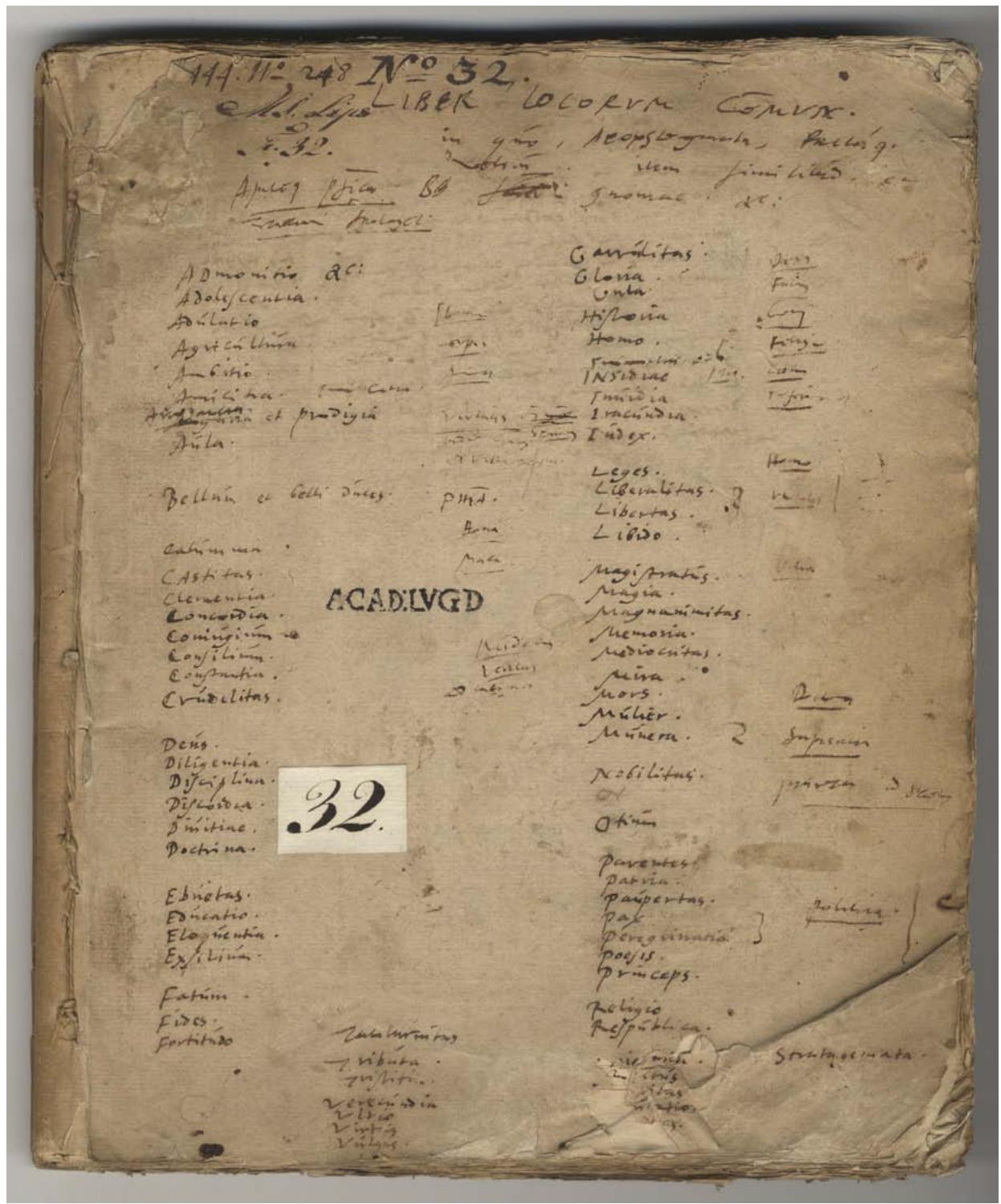
indispensable for the stability of the state. By adopting the cento as his literary form, Lipsius was able to convey his ideas with deliberate ambiguity when addressing controversial issues, likely using this approach as a protective strategy against potential misunderstandings or negative reactions.[54] An example of the aforementioned personal notebook can be found in Leiden under the reference number Lipsius No. 32 (olim
Manus. Lips. No. 248) fol. Justi Lipsii Liber Librorum communium, apothegmata ex ordine alaphabetico autographa. Ms. Lips. 32 is a general notebook of commonplaces, carefully organised in advance: a selection of keywords and topics (libertas, Patria, Pax, Princeps et Pricipatus, Respublicica, leges, libertas et servitus, etc.).
## V. TACITUS AS A PRIVILEGED SOURCE IN LIPSIUS' POLITICA
In his work *Politica*, Lipsius weaves together a mosaic of quotations from Tacitus and other classical authors, seamlessly integrating them with commentary that situates these excerpts within his own discourse. In the *Auctorum Syllabus* section of the treatise, he highlights Tacitus as the most significant contributor to his work, surpassing all others. According to Lipsius, this is due to Tacitus' prudence and his unparalleled wealth of maxims: "Plus unus ille nobis contulit, quam ceteri omnes. Caussa in prudentia viri est, et quia creberrimus sententii".[^55]
It is important to recall that in 1574 he edited Tacitus, a publication that instantly propelled him to fame across Europe (both Catholic and Protestant) as a distinguished man of letters and a humanist of the highest caliber. Evidence of his impact lies in the remarkable fact that no other edition of the Roman historian's works was published thereafter.[^56]
Tacitus would be the means by which, from then on, he would no longer attempt to present historical events from a purely speculative point of view, but would seek to reflect the pragmatic or practical aspect. It could be suggested that Lipsius promoted the use of the Annals due to the positive influence he hoped the work would have on the contemporary political climate.
In response to the violent and turbulent conditions of their era, they favored Tacitus over Cicero as a guide in political matters, since for them Justice, Freedom, and Glory were no longer the ultimate aims of politics, and Peace had become the paramount goal.
They viewed a strong monarch capable of pacifying the warring factions as the only way to escape chaos. Such a monarch was permitted only in times of necessity to override moral or constitutional norms, provided that this served the common good with peace as the ultimate priority. For this reason, they regarded the traditional criticisms of Tacitus, particularly those targeting the amoral exempla in his work, such as accounts of the excessive use of power, as secondary concerns.
The Roman historian shows how imperial power really works; throughout his texts, there are allusions to intrigue, betrayal, control of public discourse and the use of fear. Tacitus became a guide for those seeking to understand, navigate, or survive the inner workings of power, offering a model of political analysis that was compatible with the principles of absolute monarchy.
Naturally, for our Belgian scholar and his contemporaries, who saw many crucial similarities between the period described in the Annals and their own era, $^{57}$ the Roman past provided abundant observations that could be used in the service of the state and public life $^{58}$ ("similitudo et imago plurima temporum nostrorum"). $^{59}$
# VI. THE EDUCATION OF THE PRINCE
In the section of his Notae, $^{60}$ Lipsius clearly articulates his position on language teaching within the framework of his humanist and political thought. He maintains that only those languages most commonly spoken among a nation's subjects or neighboring peoples should be learned. The goal, therefore, is not the accumulation of linguistic knowledge for the sake of display, but for practical and political utility.
Lipsius distances himself from examples such as that of King Mithridates, who boasted of knowing all the languages of his domains. For him, this is nothing more than rhetorical excess, a display that is more pompous than helpful. In contrast, he approvingly cites the example of ancient Roman leaders who had little command of languages beyond Latin and Greek, since these two languages were widely spoken and understood across much of the known world. This emphasis on linguistic practicality is particularly significant in an era when vernacular languages were rapidly gaining prominence as symbols of national identity and political power.[61] In this context, Lipsius makes a strong case for learning Latin, especially for the prince. Not so much to speak it fluently, although that would be useful if necessary, but above all to be able to read it. Furthermore, he warns that translations do not always capture the force, tone or character of the original. Therefore, direct access to Latin remains essential. However, Lipsius does not propose rigid or overloaded learning. On the contrary, he insists that Latin can be learned relatively easily, provided that one has a sensible teacher who knows how to avoid unnecessary rules or grammatical mazes. A few basic rules are sufficient and, above all, reading, as it is through reading that true mastery is acquired. He adds that this language (Latin) should be learned even more so because it continues to function, even in his time, as a common link that unites Europe through the exchange of letters and language. Our humanist mentions that he knew several princes who, in their maturity, decided to study Latin when they discovered its usefulness, which they had overlooked or neglected in their youth. But his argument does not stop there; he goes further and establishes a direct relationship between the cultivation of Latin, reading, and the acquisition of prudence, that political virtue par excellence. This prudence, he says, is achieved mainly through two paths: politics and history. The first offers precepts, the second examples, and it is from the combination of both that a truly prudent and superior mind will draw its nourishment, for the benefit it will obtain, both for itself and for those it governs, will be extraordinary:
De Linguis censeo, non nisi eas discendas, quarum apud subditos aut vicinos crebrior usus. Mithridates hic se iactauerit, qui omnes suarum ditionum: superfluum est, et pompa magis, quam usus. Romanos illos proceres, vix lego alias calluisse a Latina et Graeca: et sufficiebant, quia sparsae et communes fere per terrarum orbem. Noster Latinam inter omnes discat, catenus ut leuiter (si opus) in sermone uti possit, sed maxime ad legendum. Qua Disciplina melior, non comprehensa hoc sermone? Nec versiones vim illam aut indolem semper habent. Addiscenda est, et facile potest, si Praeceptor adsit iudicio probus, qui non circumducat per varia et superuacua praecepta. Pauca haec, et lectio, in breui eam dabunt. Addiscenda autem eo magis, quia etiam nunc quasi commune vinculum est, quod Europam inter se commercii litterarum et sermonis iungit. Scio viros Principes in grandioriiam aetate, cum usum viderent, assumpisse, spretam aut neglectam male in iuuente. Sed pergo. Ad Prudentiam palam faciunt Politica, et Historiae, quas dixeris eorum fontem. Quod illa praeceptis complexa sunt, hae praiuerunt exemplis: et prudens aliqua meliorque mens hauriet semper ex istis. Haec propria et peculiaris lectio ac palaesthesia Principum: se atque otium hic exerceant incredibili suo et alieno fructu. Sed in quibus auctoribus aut libris? de HistoricisIAM diximus: de Politicus, nemo mihi ante Aristotelem.62
## VII. FOUNDATIONS OF GOOD GOVERNMENT IN JUSTUS LIPSIUS: POLITICAL POWER AND PUBLIC UTILITY
The first letter-proem serves as a solemn dedication and warning addressed to emperors, kings and princes, the natural recipients of his reflections on the art of governing. Furthermore, it fulfils the dual function of rhetorical dedication and doctrinal declaration. First, Lipsius opens with a solemn statement that frames the role of the ruler: "Amplum et illustre vestibrum munus est, quod sustinetis".[^63] "Great and illustrious is the office you hold". The use of the adjectives "amplum" and "illustre" is not accidental; the ruler is presented as a central figure in political life.
The author then further elevates the value of the office by asking a rhetorical question in an exalted tone: "Quid maius inter homines, quam unum praeesse pluribus; leges et iussa ponere, maria, terras, pacem, bella moderari?"[^64] "What is greater among men than one who rules many, who imposes laws and orders, who regulates the seas, the lands, peace and war?" This formulation places the exercise of power as the supreme function in human life. To govern is to shape society, impose order, maintain peace or decide on war. Lipsius draws here on the legacy of Roman thought, particularly that of Seneca and Tacitus, and aligns himself with the classical ideal of the princeps as arbiter of collective destiny.
However, his praise is neither absolute nor naive. He introduces a fundamental nuance by declaring that this dignity seems "almost divine": "Divinitas quaedam videtur haec dignitas: et est profecto, si salutariter atque ex usu pubbido administretur".[^65] "This dignity seems almost divine, and indeed it is, if it is exercised for the public good and in a healthy manner". Here, the central thesis of Lipsius' political thought is stated: power is only truly dignified if it is exercised rationally, usefully and for the common good ("ex usu pubbido"). The ruler should not be guided by caprice or self-interest, but by an ethic of service, in line with the Stoic ideals of reason and public virtue.
The next step in the argument is a warning: "Sed hoc quam arduum sit, tum ratio docet, tum exempla".[^66] Lipsius points out that, although noble, the task of governing is extremely difficult. He appeals to both ratio and exempla ("historical experience").
Lipsius develops the theme of "ratio" in his work De Constantia. He defines it as an "excellent power of understanding and judging".[^67] Furthermore, our scholar believes that "ratio" leads to the conviction that everything that happens is ultimately just.[^68] In this treatise, he establishes a difference between "opinio" and "ratio". The former is by its nature mutable, fragile and superficial, whereas "ratio" is based on firm judgement and right reason ("iudicio et recta ratione"): "Constantiam hic appello rectum et immotum animi robur, non elati externis aut fortuitis, non depressi robur, non elati externis aut fortuitis, non dedepressi robur dixi; et intellego firmitudinem insitam animo, non ab Opinion, sed a iudicio et recta Ratione".69 "Here I call constancy the strength of mind that is upright and unshakeable, not strength exalted by external or fortuitous causes, nor depressed strength; I did not say strength exalted by external or fortuitous causes, nor depressed strength; and I understand the firmness that is inherent in the mind, not derived from opinion, but from judgement and right reason".
Returning to the text of the *Politica*, the passage culminates in a powerful rhetorical image, the metaphor[^70] of the "single head" that must contain many, alluding to the challenge of order in the face of human chaos.[^71] The "multitudo inquieta" represents the people, unstable by nature, who require firm and rational authority. In short, rather than flattering princes, Lipsius exhorts them, reminding them that their mission is to govern with justice and prudence, not for privilege, but for the common good:
Amplum et illustrre vestrum munus est, quod sustinetis. Quid maius inter homines, quam unum praeesse pluribus; leges et iussa ponere, maria, terras, pacem, bella moderari? Divinitas quaedam videtur haec dignitas: et est profecto, si salutariter atque ex usu publico administretur. Sed hoc quam arduum sit, tum ratio docet, tum exempla. Illam si inspicimus, quantaemolis est, ab uno capite tot capita coerceri, et universam illam multitudinem inquieta.[72]
The letter ends with a reference to words attributed to Alfonso V of Aragon, also known as Alfonso I the Magnanimous (1394-1458).[^73] Lipsius says that when the king was asked who he considered to be the best advisors, he replied: "the dead", referring, of course, to books and other works of this kind, which do not flatter, do not hide anything and offer the pure truth without artifice: "Alphonsus olim, eximius ille regum, interrogatus, Qui essent optimi consilii? Mortui, respondit. libros scilicet et haec talia monimenta intelligens, qui nihil blandientes, nihil celantes, puram meramque[^74] propinant veritatem".[^75]
- 69 (Lipsius, 1616, p. 8).
- 70 "Ilam si inspicimus, quantae molis est, ab uno capite tot capita coerceri, et universam illam multitudinem inquietam". (1599, fol. A2r).
- "If we observe it closely, how much effort it takes for a single head to contain so many others and to govern that whole restless multitude!".
- 71 Lewis says: "the legal personality of the group must necessarily have been placed where medieval thinkers placed it: in the ruler, who alone could give any sort of unity to an otherwise amorphous and discordant mass of individuals". (Lewis, 1938, p. 858).
- 72 (Lipsius, 1599, fol. A2r).
- 73 (Lipsius, 1599, fol A3v).
- 74 The expression puram meramque reinforces the idea of total purity and sincerity, meaning "without flattery" or "concealment".
- 75 (Lipsius, 1599, fol A3v).
## VIII. Kaipoc, TRADITION AND IGNORANCE: A CRITIQUE OF THE EXCESSES OF POLITICAL DISCOURSE
The following letter-proem De Consilio et Forma Nostri Operis has already been discussed in part in the section dealing with Lipsius' contributions to the development of his Politics. The following section of this document will be devoted to a critical analysis of the excesses characteristic of political discourse.
The author opens the passage by saying that ancient treatise writers wrote "de Republica universa et communiter", that is, "about the republic as a whole and in general terms". In contrast to them, he claims to have chosen a specific part of this vast field of study ("magnus ager"), specifically the principality ("Principatum") as the particular object of analysis. This agricultural image, of classical heritage, reinforces the idea of careful, deliberate and situated work, far removed from general models. The author thus positions himself as a cultivator of a specific plot within the political terrain, suggesting both methodological modesty and a desire for precision: "Sed hi tamen de Republica uniuersa et communiter scripserunt: ego velut partem aliquam magni huius agri colendam mihi sumpsi, PRINCIPATVM".[^76]
He then refers to ancient models, described as "prisci aut barbari ritus" ("ancient or barbaric rites"), which, he claims, do not fully conform ("haud usqueque convenienter") to the demands of the present. He asserts that the ancient can retain value, but only if it is filtered through judgment and historical adaptation. In the same vein, he questions those who "nuper aut here id tentaverunt", that is, modern people who have attempted, perhaps enthusiastically but without prudence, to revive or replicate these models. It is said of them that "non me tenent aut terrent" ("they neither persuade nor intimidate me"), which amounts to intellectual disavowal: "Addo, quod in priscis aut barbaris illis ritibus, haud usquequeconuenieter ad hoc aevum. Nam qui nuper aut here id tentaverunt, non me tenent aut terrent. In quos, si vere loquendum est, Cleobuli illud vetus convenient: 'Aurosigma tio paoov mepoc eBpotoiov/loyowv te paoov opkoei. Ppvovt Kevov' m npataioc axapis yevoeoai7 [= D.L. 1, 91 (Cleobulus)]. Inscitia in pleresque, et sermonum multitudo".78
This critical gesture culminates in the invocation of a maxim by Cleobulus, taken from Diogenes Laertius: "Amuovia to $\pi \lambda \varepsilon o\nu$ $\mu \acute{e}\rho o\varsigma$ ev $\beta p o t o i \sigma i v / \lambda o y o v$ te $\pi \lambda \tilde { n } 9 o s$, $\alpha \lambda \lambda ^ { \prime }$ - kaipoc apkoei. / $\varphi \rho o v e i$ ti k8dvov, m' maataoacxapic $\gamma \varepsilon \varepsilon \sigma \theta a i$. (D.L. 1, 91) (Cleobulus).79 "Lack of education
- 76 (Lipsius, 1599, fol. $\ast$ B1r).
- 77 (Bergk, 1878, p. 271).
- 78 (Lipsius, 1599, fol. \*B1r).
- 79 (Bergk, 1878, p. 271).
is what abounds most among men; there is a multitude of words, but the right moment is enough. Think of something useful, do not be vain or insipid". The sentence reinforces the criticism of grandiloquent but empty words, of eloquence without knowledge, of speeches that overflow in form but lack substance and opportunity ("kaipóvars").
Later, in a similar vein, Aristotle in his Rhetoric emphasizes that rhetorical effectiveness depends not only on the quality of the content but also on the mastery of the concept of $\kappa \alpha \rho \delta \varsigma$ ("the right moment"). A strong argument, if delivered at the wrong time, may fail to persuade. Conversely, a brilliant rhetorical device can lose its impact if it is not attuned to the context, the audience, or the emotional climate of the moment: "τὸ δ' ενκαίρως ἡ μή ενκαίρως χρησθαι κοινόν ἀπάντων τῶν εἰδών ὅτουν". (Arist. Rhe. 1408b).[^80] Later, along the same lines, the Greek philosopher from Stagira, in his Rhetoric, underscores that rhetorical effectiveness relies not only on the strength of the content but also on the speaker's mastery of kairos, the opportune moment. A well-crafted argument may fail if presented at the wrong time, just as a brilliant rhetorical device can lose its force if it is not adapted to the specific context, the audience, or the emotional atmosphere of the situation.
In light of the above, Lipsius concludes his argument with a Latin phrase that summarises his judgement: "inscitia in plerisque, et sermonum multitudo" ("ignorance in the majority, and an excess of words"). This conclusion reveals not only a deficiency in practical knowledge but also a crisis of rhetorical judgment: there is abundant speech, yet it lacks meaning and fails to suit the moment. In such a context, political thought becomes hollow, reduced to mere rhetorical spectacle or a vacuous repetition of conventional formulas.
## IX. CONCLUSIONS
The analysis of Justus Lipsius' Politica reveals a work deeply structured around the formation of the politician, in which prudence is established as an essential virtue for the exercise of power. Far from being a merely theoretical treatise, Lipsius proposes a model of government based on public utility, the stability of the state and the control of passions, all in line with his adherence to neo-Stoicism.
From a methodological point of view, the work responds to a poetics of cento, through which fragments of classical authors, with Tacitus as the central figure, are integrated in a systematic and functional manner. This technique not only reinforces Lipsius' discourse, but also gives it authority by anchoring his thinking in the Roman tradition.
On the other hand, Tacitus, due to his wealth of maxims and his lucid view of power, occupies a privileged place in Lipsius's argumentative apparatus. His constant presence in *Politica* confirms a political reading that transcends historiography and seeks to shape the judgement of the ruler.
Likewise, the work incorporates an implicit critique of the excesses of contemporary political discourse, emphasising the importance of the term καιρός ("the opportune moment") and practical intelligence as counterweights to ignorance and improvisation in government. Finally, the study of the Politica cannot be separated from its editorial and historical context. The multiple editions, together with its European reception, demonstrate the lasting influence of Lipsius's thought on modern political theory, especially with regard to the articulation between power, morality and raison d'etat. In short, Lipsius' Politica allows us to understand not only the construction of an ideal of government in times of crisis, but also the discursive mechanisms through which late humanism reworks the classical tradition to respond to the political urgencies of nascent modernity.
[^1]: (Braun, 2011, pp. 135-137). _(p.1)_
[^13]: Machiavelli expanded his theoretical foundations based on his experience in the secretariat of the second chancellery of the Republic of Florence (between 1498 and 1512) and also on the teachings of history, especially of Roman institutions, which he considered exemplary in many respects and which, according to him, could serve as a model for implementing reforms in Florence. Francesco Guicciardini, on the other hand, although he considers that the past cannot be extrapolated as an ideal model and total reference point for the Florentine republic, recognises that history can be relevant to the institutional order and organisation of a city and can teach procedures which, although insufficient if they are to be imitated as they are, can at least be inspiring for the present. (Fernández Muñoz, 2025, pp. 95-97). _(p.2)_
[^14]: Machiavelli seeks to demonstrate that politics constitutes an autonomous sphere, with its own rules, independent of other disciplines, including morality. According to his approach, both political thought and action must be oriented primarily towards the self-sufficiency of power and the preservation of the state's welfare. (Echandi Gurdian, 2008, p. 129). _(p.2)_
[^15]: Machiavelli and Lipsius wrote in very different historical and geographical contexts, so it would be incorrect to place them within the same ideological current. (Mikunda Franco, 1990, p. 365). _(p.3)_
[^16]: (López Poza, 2008, pp. 211-212). _(p.3)_
[^17]: (López Poza, 2008, pp. 217-218). _(p.3)_
[^18]: (Braun, 2011, pp. 135-137). _(p.3)_
[^25]: (Waszink, 1997, pp. 141-162). _(p.4)_
[^26]: (Mikunda Franco, 1990, p. 361). _(p.4)_
[^27]: (Waszink, 1997, pp. 144-145). _(p.4)_
[^28]: (Macias Villalobos, 2023, pp. 202-203). _(p.4)_
[^29]: (Robles, 2025, pp. 5-6). _(p.4)_
[^30]: "Excubare pro.] Plutarchus, Ad Principem indoctum[=Moralia]: kai ovtos eotiv o fofoic tov apxovtoc vlaovpwoos kai ook ayevnis, vinep tov apxouevovd eidevai m h athomega i baaevtcs, / os de kovc npi ipa nla dvoopnoovtae avbli, / thpo6 akobovntcs kpatepoppovoc. / oix vinep abtwv all'inep tov vlaatouevov[=Plu. Ad Princ. ind. 781C]. Ille est benignus et generosus Principis metus, timere subditis ne laedantur ignaro ipso. Sicut canes in vestibulo sedulo excubant et laborant, cum feram trucem audierint, non pro se, sed pro ovibus, quas custodiant. Plura in hanc sententiam ego, conventu et auditorio procerum hic Lovanii, cum Principes N[omen] N[ominadum] Albertus et Isabella Austriaci imperium auspicaretur; et subito aptassem et dilatassem". (Lipsius, 1605, p. 190). _(p.4)_
[^31]: Marijike Janssens considers the Monita to be part of the tradition of the speculum principium, characterised by its didactic nature and practical application with ethical and political implications, as already indicated in relation to his work Politica. (De Bom, Janssens, Van Houdt & Papy, 2010, pp. 6 and 11). _(p.5)_
[^32]: "Est scilicet eadem divisio, et ordo, qui in Politica nostris fuit: quorum luci aut assertioni haec scribuntur". (Lipsius, 1605, fol. *3v). _(p.5)_
[^33]: (De Bom, Janssens, Van Houdt & Papy, 2010, p. 9). _(p.5)_
[^34]: (Lipsius, 1599, fol. *B1v-2r). _(p.5)_
[^35]: (Lipsius, 1599, fol. *B1v). _(p.5)_
[^36]: (López Poza, 2008, p. 225). _(p.5)_
[^37]: Compendiums on the art of governing during the Baroque period, unlike those from the Renaissance, employ the concepts of "justice" and "truth" primarily in a political rather than a moral sense. (Álvarez, 2010, p. 12). _(p.5)_
[^38]: (Lipsius, 1599, fol. *B1v). _(p.5)_
[^39]: (Lipsius, 1599, fol. *B1v). _(p.5)_
[^40]: (Lipsius, 1599, fol. *B1v). _(p.5)_
[^41]: (Lipsius, 1599, fol. *B1v). _(p.6)_
[^42]: (Lipsius, 1599, fol. *B1v). _(p.6)_
[^43]: (Lipsius, 1599, fol. *B1v). _(p.6)_
[^44]: (Lipsius, 1599, fol. *B1v). _(p.6)_
[^45]: (Lipsius, 1599, fol. *B1v). _(p.6)_
[^46]: (Lipsius, 1599, fol. *B1v). _(p.6)_
[^47]: (Lipsius, 1599, fol. *B1v). _(p.6)_
[^48]: (Lipsius, 1599, fol. \*B1v). _(p.6)_
[^49]: (Lipsius, 1599, fol. *B1v). _(p.6)_
[^50]: The section Monita quaedam, fiue Cautiones. (Lipsius, 1599, fol. *B2r). _(p.6)_
[^51]: "Tamen librorum prior pars velut commune προαλιον ad quamque Rempublica est: et passim praecpta ad omnem civilem vitam". (Lipsius, 1599, Notae p. 7) _(p.6)_
[^52]: (Lipsius, 1599, Notae p. 7). _(p.6)_
[^53]: (Lipsius, 1599, Notae p. 7). _(p.6)_
[^55]: (Lipsius, 1599, p. 19). _(p.8)_
[^56]: (Mikunda Franco, 1990, pp. 358-361). _(p.8)_
[^63]: (Lipsius, 1599, fol. A2r). _(p.9)_
[^64]: (Lipsius, 1599, fol. A2r). _(p.9)_
[^65]: (Lipsius, 1599, fol. A2r). _(p.9)_
[^66]: (Lipsius, 1599, fol. A2r). _(p.9)_
[^67]: (Pozuelo Calero, 2020, 289). _(p.9)_
[^68]: Neo-Stoicism was characterised, as we know, by a notable contempt for the common people, that is, those ordinary men, without moral or intellectual excellence, who follow the given opinion, unthinkingly, and do not exercise judgement ("iudicium") or right reason ("recta ratio"), which is always independent, solid and leads to truth and goodness. (Andrés Ferrer, 2013, p. 120). _(p.9)_
[^70]: For biographical information on Lipsius, see: (Lipsius, 2000, p. 15).
[^71]: For biographical information on Lipsius, see: (Lipsius, 2000, p. 15).
[^73]: For biographical information on Lipsius, see: (Lipsius, 2000, p. 15).
[^74]: For biographical information on Lipsius, see: (Lipsius, 2000, p. 15).
[^75]: For biographical information on Lipsius, see: (Lipsius, 2000, p. 15).
[^59]: "Nec utiles omnes nobis parti gradu. ea, ut censeo, maxime, in qua similitudo et imago plurima temporum nostrorum. Ut in pictura faciem praeuifam facilius agnoscimus: sic in historia noti moris exempla. Cuius generis si ulla eft fuitque, inter Graecos aut Latinos: eam esse Cornelii Taciti Historiam adfimate apud vos dico, Ordines Illustres". (Lipsius, 1585, fol. *2r). _(p.8)_
[^60]: (Lipsius, 1599, p. 20). _(p.8)_
[^62]: (Lipsius, 1599, p. 20). _(p.9)_
Generating HTML Viewer...
References
42 Cites in Article
Lipsius (1599). Unknown Title.
Lipsius (1599). Justus Lipsius.
Lipsius (1599). Unknown Title.
Lipsius (1599). Unknown Title.
Lipsius (1599). Unknown Title.
Lipsius (1599). Unknown Title.
Lipsius (1599). Unknown Title.
Lipsius (1599). Unknown Title.
Lipsius (1599). Unknown Title.
A Álvarez (2010). La invención de las pasiones Consideraciones sobre la recepción del tacitismo político en la Cultura del Barroco. Astrolabio.
Antón Martínez,B (2000). Velut theatrum hodiernae vitaela similitudo temporum y el auge de Tácito en los siglos XVI y XVII.
Aristóteles (2002). Retórica. Méjico.
J Belda Plans (2023). ¿Qué es la Escuela de Salamanca? Nuevas perspectivas.
Th Bergk (1878). Poetae Lyrici Graeci.
E Braun (2011). Justus Lipsius and the Challenge of Historical Exemplarity.
Adolfo Carrasco Martínez (2021). Fama y denigración póstumas de Justo Lipsio.
Erik De Bom,Marijke Janssens,Toon Van Houdt,Jan Papy (2010). Introduction: Towards A More Balanced View Of Justus Lipsius’s Political Writings And Their Influence.
M Echandi Gurdián (2008). La Autonomía de la Política y la "Razón de Estado" en la filosofía de Nicolás Maquiavelo.
D Erasmo (1553). De copia verborum et rerum libri duo.
Euripedes (2002). Euripedes.
Fernández Muñoz,J (2025). Razón, experiencia e historia en los Ricordi de Guicciardini: el camino hacia la libertad.
P Ferrer (2013). El Somnium de Lipsio y la rebelión de los personajes del refranero en el Sueño de la muerte de Quevedo.
L Gil Fernández (1997). Panorama social del humanismo español (1500-1800).
Ewart Lewis (1938). Organic Tendencies in Medieval Political Thought.
J Lipsius (1585). Comentarius ad Annales C. Taciti Liber. Antuerpiae.
J Lipsius (1591). Epistolica Institutio. Francofurti: apud Ioannem Wechelum.
J Lipsius (1599). Politicorum sive Civilis Doctrinae Libri Sex. Antuerpiae: ex officina Plantiniana apud Ioannem Moretum.
J Lipsius (1605). Justus Lipsius, Monita et exempla politica / Political Admonitions and Examples.
J Lipsius,L Annaei,Senecae Operae (1605). The Officina Plantiniana collection at the National Library of Lithuania.
L Lipsius,Libri De Constantia,Duo (1616). Lugduni Batavorum: ex officina plantianiana.
J Lipsius (2000). Leuven, beschrijving van de stad en haar universiteit.
S López Poza (2008). La Política de Lipsio y las Empresas políticas de Saavedra Fajardo.
S López Poza (2016). Los libros de emblemas: género editorial, género literario y fuente de erudición.
Macías Villalobos,C (2023). El Somnium de Justo Lipsio: la presencia de las fuentes clásicas y su uso.
Mikunda Franco,E (1990). J. Lipsio: neoestoicismo, iusnaturalismo y derechos humanos.
Ann Moss (1996). Commonplace-Books at School.
A Moss (1998). The Politica of Justus Lipsius and the Commonplace-Book.
B Pozuelo Calero (1515). O humanismo português e europeu: no 5º centenário do cicero lusitanus, Dom Jerónimo Osório.
M A Robles (2025). Lipsius Dissertatiuncula Apud Principes.
George Tucker (2010). Justus Lipsius And The Cento Form.
L Vives (1785). CAPVT XXXII.
J Waszink (1997). Inventio in the Politica: Commonplace-books and the shape of political theory.
No ethics committee approval was required for this article type.
Data Availability
Not applicable for this article.
How to Cite This Article
María Ángeles Robles. 2026. \u201cThe Art of Governing in Justus Lipsius Politica: Methodological Analysis and Political Leader Training\u201d. Global Journal of Human-Social Science - F: Political Science GJHSS-F Volume 25 (GJHSS Volume 25 Issue F4): .
Explore published articles in an immersive Augmented Reality environment. Our platform converts research papers into interactive 3D books, allowing readers to view and interact with content using AR and VR compatible devices.
Your published article is automatically converted into a realistic 3D book. Flip through pages and read research papers in a more engaging and interactive format.
This article analyses the introductory and supplementary texts (known as paratexts) in Justus Lipsius’ edition of Politica, with the aim of better understanding how he organises his work and the ideas he proposes about the education and formation of a ruler. Specific biographical details about Lipsius, which are discussed in the article, play an important role in contextualising the text within its historical and intellectual background. The article also examines how he employs a writing technique known as cento (which consists of assembling quotations from other authors) as a key element in constructing his political argument. Particular attention is paid to the frequency and manner in which Lipsius incorporates excerpts from the Roman historian Tacitus, as well as how he sets out principles of good government through these paratexts. Ultimately, the article shows how these elements come together to provide an overall picture of Lipsius’ political thought.
Our website is actively being updated, and changes may occur frequently. Please clear your browser cache if needed. For feedback or error reporting, please email [email protected]
Thank you for connecting with us. We will respond to you shortly.