
Before the archives became accessible to researchers, most historians of Iraq defined Saddam's Islamization "Faith Campaign" (1993-2003) as an ideological shift if not metamorphosis from secularism to Islam. Four, arguably five of the seven historians reviewed here believe that the archival information refutes this conclusion. Two of them see six decades of continuous, unbroken enmity to Islam, while three others see continuous, unbroken "deep love for Islam". Either way, the Alladin Cave of the archives brought three of the seven to regard the regime's open media, on which their predecessors base their conclusions, as deceptive. In other words, they believe that the regime had at the same time a false public and a true secret ideology. The archives convinced one of the seven also that regime-Shi'a relations were substantially better than what his pre-archives predecessors described.
This article argues, first, that there is truth and deception in both types of sources. The challenge is to tell truthfulness from deceit. Second, the high value of the archives notwithstanding, it is the regime's public media that should be the historian's main source for regime ideology. Third, some contradictions that three of the seven scholars found between the archives and the regime's public media are no contradictions, others are not changing the big picture. This article's conclusion is, therefore, that the "old" views that in the 1990s Saddam did perform an ideological U-turn, and that regime-Shi'a relations were extremely difficult, are correct. Namely, that the archives do not change the big picture.
Even those who believe in Saddam's initial love for Islam, believe that, to the end, he was a staunch opponent of Islamism. This article argues that during the last decade of his rule he was an Islamist himself.1 In fact, in addition to his Islam, he sponsored two other Islams. His nurture of moderate Sufis is well-known, but it is suggested here that his Faith Campaign radicalized some of them. Less know is his encouragement for pro-regime radical "Wahhabis". Finally, two of the historians suggest that the regime managed to Ba'thize Iraq and Islam. It is argued here that Saddam Islamized the Ba'th far more successfully.
It seems that most research mistakes resulted from over-enthusiasm over the newly accessible secret archives. This led to placing in them too much trust and underestimating or ignoring important open records. At the same time, occasionally even key archival records were ignored. Mistakes result also from occasional insufficient acquaintance with Ba'th history and codes. This article is trying to present a different picture.
INTRODUCTION
In 2010, two US-held archives from the Iraqi Ba'thist regime became accessible to researchers: The Ba'th Regional Command Collection (BRCC) at Stanford University's Hoover Institution and the Saddam Hussein Collection (SHC) at the National Defense
University-based Conflict Research Records Center (CRRC). By late 2024 seven books a few articles and PhD dissertations were based primarily on those archives. The privileged first few to access these archives produced valuable studies, each making a high-quality contribution to our understanding of Ba'thist Iraq. Yet, this article argues that mainly three of those scholars in parts of their studies skidded into a critical methodological mistake when they dismissed the regime's open sources, while uncritically lionizing its archival records.
This article reviews the existing studies through one lens: state-mosque relations in Ba'thi ideology and practice. This provides an opportunity to re-visit the party's ideology and practice between its inception in the 1940s and its demise in 2003. Other lenses like education, culture, state-tribe relations, Iraqi patriotism (al-Wataniya) versus Arab nationalism (al-qawmiya), social policies, party organization and membership, military history, cannot be examined here for reasons of space.
Mainly Joseph Sassoon, Aaron Faust, and Samuel Helfont believe that they found substantial contradictions between the newly accessible archives and what their predecessors found in the regime's public media to justify contradictory conclusions. In all such cases they see the archival records as the final arbiters. Helfont explicitly, Sassoon and Faust implicitly, conclude that the regime's public records are misleading. In other words, as they see it, the regime had at the same time a false public and a true secret ideology.2 If so, then the ramifications for the study of all totalitarian and authoritarian regimes before their archives became accessible to historians are enormous. The four other historians consider both source types as equally relevant.3
This article will try to show, first, that, contrary to the three scholars' preference for the archives, those are the public records that provide the main outlines of the regime's ideology. Obviously, taken together, the two types of sources combined offer the best picture. While neither source type furnishes the simple truth, sometimes the open sources are more trustworthy, while other times the archives are. I am offering a simple rule-of-the-thumb how to gauge the reliability of the information we find in both types of sources. Secondly, this article argues that contradictions between the public and archival sources are few and far between. While they require an explanation, they do not change the larger picture as represented by the regime's public media. Thirdly, contrary to the belief of four or five of the seven scholars reviewed here, that between the 1940s (or 1968) and 2003 there was no Ba'thi "ideological shift", this article argues that there was such a major "shift", even an ideological metamorphosis, from secularism to Saddam-style Islamism.
It is suggested here that most scholars' mistakes resulted from over-enthusiasm over the new source. As a result, three of the seven historians tend to believe that the archives provide straightforward answers, while the regime's open media is deceptive. This article argues that even when it comes to dictatorship, we can find truth in its public media. Conversely, often the dictatorship's secret archives lie. Moreover, because the open media is the main vehicle through which the regime can indoctrinate the population, the media, rather than the secret archives, is the main source for studying its ideology.
This article examines what in the open sources and archival documents convinced four or five of the seven historians that Saddam's 1990s Islamic "Faith Campaign" represented an uninterrupted ideological continuity. This article begins this historical journey by delving into the early lectures of Michel 'Aflaq, the party's Christian-born founder. It tries to decide whether he felt "deep love for Islam" and wanted Islam to serve as the party's legitimacy foundation, as believed by one, maybe two of our historians, or a staunch secularist as three other historians believe. There is a consensus that in the 1970s the Ba'th rule in Iraq was secular, but two historians, with some support from a third one, think that it was secretly Islamic, hiding behind a secular smoke screen. So, which was the Ba'th of the 1970s?
This article tries to shed light on research mistakes. In some cases, they result from scholars' failure to decipher regime codes. In others, their acquaintance with Ba'th history was insufficient. This article examines also what in the archives convinced one historian that his predecessors overstated the regime-Shi'a chasm. This article tries also to show that, in addition to the widely recognized two Islams that Saddam nurtured in the 1990s: a shari'a-light orthodoxy and Sufi Islam, he also promoted radical Salafi (or "Wahhabi") Islam. Finally, the conclusion of two of the historians is that the regime managed to Ba'thize Iraq, one believes that he Ba'thized Islam. This article argues that Saddam failed in his attempt to Ba'thize society, and his main success was that he Islamized the Ba'th.
I. PUBLIC OR ARCHIVAL RECORD AS THE HISTORIAN'S MAIN SOURCE FOR IDEOLOGY
Joseph Sassoon, Aaron Faust, and Samuel Helfont, with some support from David Jordan, challenge the view of most pre-archive access historians that Saddam's Islamic "Faith Campaign" was an about-face from the party's traditional secularism. Their predecessors blundered, they aver, when they trusted the regime's open media to gauge Ba'th ideology. Saddam led an extensive Islamization campaign over more than a decade. Yet, based on the archives, the three, maybe four, believe that it represented no meaningful ideological change.
Helfont states, correctly, that the Iraqi archives "are the only open archives of a modern Arab state." More problematically he states that those archives "suggest that relying on public policy and public statements - which is the standard method of studying such [authoritarian] states - is inadequate and can even be misleading."4 All the pre-archive historians erred, Helfont believes, because they wrongly made "the basic assumption" that "one can read public statements and surmise from them an ideology."5 Helfont further proclaims enthusiastically: "Fortunately, with the regime's internal documents we can differentiate between Saddam's tactical... views on religion" and his "more foundational stances upon which the regime based its actual policies." Then: "Public appearances were misleading."6 For understanding the 1990s "Faith Campaign," he points out, we "no longer need to rely solely on the vague picture provided by the tightly controlled Iraqi press" or "one-off statements by regime officials, and other open-source materials." At long last, he concludes, "the archival records provide straightforward information on this topic."7 As will be shown below, while less emphatic, Sassoon and Faust, too, follow this line of thinking.
This article seeks to show that this view is mistaken, as are the conclusions derived from it. Below I shall try to show that the picture provided by the regime's open media on the "Faith Campaign" was anything but "vague" and that the Baghdad media was not "tightly controlled" as claimed. Saddam's Baghdad was not Joseph Stalin Moscow. Furthermore, I suggest that even in Stalin's Moscow, the truly tightly controlled media represented his ideology. Finally, Saddam was not just some "regime official" as Helfont presents it. Also, his Islamist rhetoric and policies were anything but "one off" events. They were pervasive and, from June 1990, consistent.8 Sassoon goes even further than Helfont in arguing that, even when the internal archival sources report on regime public policies and statements, they should be seen as misleading.9 Faust lends much more credence to studies based on the regime's open sources,10 yet even he lends far more weight to those found in the archives, that he believes contradict the open sources.11
If we adopt this approach, then all studies of nondemocratic regimes made before they disintegrate, and their archives are pried open, are very likely wrong. This is because they are based on the regimes' public media, which Sassoon, Helfont, and to an extent Faust, see as mere smoke and mirrors. To them, the truth lies in the archives. If they are right, we would need to trash all the existing histories of Communist China, Egypt since 1952, Erdogan's Turkey, maybe even the USSR, to mention only a few examples. In their stead we shall be left with a black hole. Still, if these historians are correct, then so be it. I argue, though, that they are mistaken. The public media statements of the Ba'th and their onthe-ground policies are not smokescreens and studying them is not a trap. This, because the public face of the regime was all that the public knew. Worse, while disparaging the regime's public records, ironically all three historians seem to show blind faith in the regime's newly accessible archives. As Helfont puts it most explicitly, they "provide straightforward information."16 Below I shall try to show that both facets of this approach represent a methodological snare.
II. IDEOLOGICAL CONTINUITY OR METAMORPHOSIS?
Joseph Sassoon, the first historian to publish an archives-based book, reports that the archival documents "allow us a more nuanced understanding... in every aspect of life in Iraq."12 This is certainly true, but Sassoon goes far beyond nuance. In the light of the new archives, he reveals a profound error in the analysis of his pre-archive predecessors, who regarded the Faith
Campaign to be an ideological U-turn from secularism to Islam. His innovation is a claim for Ba'th uninterrupted ideological continuity between 1968 and 2003 of hostility to Islam. He does not deny Islamization steps during the "Faith Campaign", but to him the Campaign was smoke and mirrors. "The regime", he writes, "publicly launched a faith campaign" in the 1990s. Yet, "simultaneously, behind the scenes, continued to be anti-religious and to repress any sign of real religiosity."18
Aaron Faust, too, admits that, since 1979, when he became president and until the 2003 end, Saddam waved an Islamic flag. In this he "did not try to apply traditional Ba'thist ideology." Yet, the change was not real. Saddam merely "pursued a Hussein Ba'thist version" of Islam.13 This version included "tribal and religious rhetoric," as well as "policies to back up its words." He admits that "in some ways" Saddam "did 'tribalize' and 'Islamize' his regime."14 Yet, he insists, the BRCC archive tells him that "Hussein's regime "did not so much 'Islamize' in the 1990s as expand its ongoing policy to Ba'thize religion."15 "The BRCC records", he sums up, "show that Hussein embraced Islam in order to suffocate it."16 By "embraced" he means "venerating religion in... rhetoric; patronizing cooperative religious leaders, institutions and educational systems; supporting unthreatening religious customs and rituals and spreading his own Hussein Bathist version of Islam." By "suffocating" he means "intense surveillance of religious clerics, institutions, and rites, cracking down hard when they felt threatened by a preacher or practice."17 So, with some limited deviations from party doctrine, like Sassoon, Faust, too, sees some six decades of continuity of Ba'th anti-religious ideology and practice.
Helfont and Jordan have a contrasting view. They, too, believe that their pre-archive predecessors erred when they identified a U-turn, but the continuity they see is that of 'Aflaq's "deep love for Islam".18 Saddam, Helfont insists, followed loyally in his mentor's footsteps. "Aflaq's Ba'thist interpretation of Islam, with some slight variations, was the official religion of Saddam's Iraq. It remained so until the regime's downfall in 2003."19 "The Iraqi archival records reveal", he contends, "that Saddam's increasing instrumentalization of Islam [in the 1990s] should not be attributed to an ideological shift."20 Namely, what looked to the pre-archive historians like an ideological shift from secularism to Islam in Saddam's Islamic "Faith Campaign" was no shift at all, only an "Instrumentalization" of an old Islamic, but not "Islamist" dream.21 Blaydes agrees that "there is no evidence that Hussein or the Ba'th regime... displayed any sympathy for Islamism, Salafism or Wahhabism". Moreover, Saddam, she reports, "had an aversion to any form of Islamization throughout his time in power."22 Jordan supports this thesis wholeheartedly.23 He asserts that "promotion of Islamism" during Saddam's "Faith Campaign" was "nonexistent". Likewise, he is in full support of Helfont's thesis according to which, from the 1940s to the end, the party promoted "an abstract Ba'thi ideological understanding of an Arab Islam."24 This "Arab Islam," Jordan tells us, rested on "secular principles."25 To Jordan, Helfont "argues convincingly that the increasing role of Islam in Ba'th politics" in the Faith Campaign "reflects the regime's gradual and successful establishment of control over Iraq's religious landscape." This "high level of control during the 1990s", he goes even further than Helfont, "enabled the Ba'th to implement its own Faith Campaign to accelerate the spread of the original Ba'thi interpretation of an Arab Islam without the need for any ideological deviation or shift."26
Below we shall return to the issues of Islam, "Islamization and "Islamism". For now, it may be summed up that, while Sassoon and Faust see some six decades of continuous, uninterrupted ideological enmity to Islam, Helfont and Jordan, maybe Blaydes too, see some six decades of continuous, uninterrupted ideological love for Islam. Love for Islam notwithstanding, though, Helfont, Blaydes, and Jordan believe that there was no "Islamism" in the 1990s. If we accept Jordan's analysis, Saddam's Islam could not be "Islamism", because it was "secular" and "abstract".27
Unlike the four historians who see no significant ideological change, using both the archives and open media I see change so profound that, by 2003, the regime was no longer Ba'th. Saddam dragged the Ba'th kicking and screaming into an ideological and political metamorphosis. I see the Ba'th journey from the 1940s (or 1968) to 2003 as a tortured Odyssey from secularism to Saddam-style Islamism.
What is "Islamism" then? I suggest that it is simply political Islam, or a meaningful dose of Islam in domestic politics. In addition to rhetoric and state symbols, it should be found in law, education, and culture. In addition to metaphors, it must be felt by the citizens in their daily lives. Below I shall try to show, first, that what Saddam did in the 1990s was political Islam. Secondly, that it was a clear U-turn from what Jordan defines correctly as the original Ba'th "secular principles". Thirdly, that Saddam failed in his effort to create what Helfont and Jordan call a "religious landscape," being a wide network of loyal 'ulama who would adopt and implement his Islam. Finally, for further study it is suggested here that Saddam failed in "Ba'thizing Islam". His "Ba'thist Islam" disappeared with him, and the phoenix birds that rose from the ashes of his regime were a Sunni-Shi'i civil war, extremist Sunni Salafi insurgents, and violent and corrupt Shi'i militias.
III. GROUND ZERO
Among the seven scholars discussed here, Helfont and I deal most with the thinking of Michel 'Aflaq (1910-89). Baram sees him as a staunch secularist.28 As mentioned above, Helfont argues that from the party's beginnings in the 1940s and throughout his political life, 'Aflaq "clearly had a deep love for Islam".29 Helfont therefore argues that what looks like an ideological shift from secularism toward Islam in the Islamic "Faith Campaign" of the 1990s was no shift at all. Rather, this was a late "Instrumentalization" of an old Islamic dream.30 In his dissertation and book Helfont repeats it multiple times, occasionally a few times in one page, as if repetition is evidence.31 David Jordan supports this thesis.32 For their part, Sassoon and Faust understood from the same archives that the Ba'th always was and remained hostile to Islam.33
I argue that, while Sassoon and Faust are correct in that, until the early 1980s, the Ba'th was secularist, even in some ways anti-Islamic, the pressures of the Iraq-Iran War and Saddam's perception of a growing religiosity in Iraq induced him to immerse country and party in Islam. The defeat in Kuwait and the international embargo deepened the crisis. By 2003 Saddam transformed Ba'th ideology and practice from secularism to Islam.
To understand what really happened between the 1940s and 2003 it is necessary to delve briefly into the Bath's ideological foundations. Helfont's claim that 'Aflaq was imbued with "deep love for Islam" presents two difficulties. Firstly, 'Aflaq, a Christian-born-and-educated Damascus, completed his higher studies in the Sorbonne in Paris. According to Hanna Batatu, there he was enamored with Marxism, and close to the French Communist Party. Back in Damascus, he abandoned Communism because the French Left had forsaken Syria.34 It may equally be suggested that, being a shrewd politician, 'Aflaq realized that communist atheism had little appeal in the traditional Arab world. In a 1958 interview Aflaq disclosed that he was "deeply influenced" by the "universalist" thinking of Nietzsche and Marks, but upon returning home he realized that nationalism was "misunderstood" in Europe. So, he became a nationalist.35 What he probably meant was that Arab nationalism that was not atheistic proved more attractive than Marxist internationalist atheism.
On that basis, it is difficult to believe that he wanted Islam involved in his founding of the Ba'th more than a necessary minimum. Secondly, as even Helfont admits, the 'Aflaqite branch of the Ba'th established a highly secular political system soon after they came to power in Baghdad in 1968.36 If the party's founders were enamored with Islam, why did the Ba'th not set up its form of Islamic rule straightaway, rather than waiting until Saddam did so in the 1990s?
'Aflaq's public lectures in the 1940s and early 1950s and the Ba'th 1947 founding constitution are the best sources for the founder's early thinking, with supporting evidence in the writings and memoirs of Ba'th veterans. It is suggested here that what these indicate is that, rather than loving Islam, 'Aflaq was terrified by it. One party veteran points out that his Christian background "gave a pause to many and was used against the party in conservative circles."43 Another senior Ba'thist reported that the Islamists accused 'Aflaq of being both an atheist and a Christian missionary and so, either way, an enemy of Islam.37
Still, whether he loved Islam or feared it, 'Aflaq, the Christian-born "founding father" of the Ba'th praised Islam profusely, which convinced Helfont of his "deep love for Islam." Whether out of love or fear, 'Aflaq had an additional reason to praise Islam. To recruit young Muslim-born members he needed to penetrate the Muslim majority community. Thus, a senior Iraqi party member remembers that, in 1959, 'Aflaq received a young religious Muslim recruit from Baghdad in Beirut and assured him of "the connection between the Ba'th and Islam and the fear of God," whatever that meant.
'Aflaq's homage or lip service to Islam in the 1940s and 1950s sometimes went very far. Thus, for example, in 1943 he could be understood as calling for Salafist Islam, a return to the imagined pristine Islam of the forefathers when he said: "Every Arab presently is capable of living the life of the Arab Messenger." On the same occasion he also said: "Muhammad was all the Arabs, may all the Arabs today be Muhammad."38 This could be Salafism but, equally, something else. If every Arab could be "living the life of the Prophet", rather than, say, "follow in the Prophet's footsteps", then Muhammad was not all that special. This could be seen as demeaning the Prophet. 'Aflaq said: "The Islamic movement as represented by the life of the esteemed Messenger is not a mere historical event for Arab life." Rather, it is "a true form and total, eternal expression of the nature of the Arab soul."39 He also prophesized: "The Christian Arabs will [one day] know... that Islam to them is national culture with which they must fill themselves until they... love it" so that they "will be as dedicated to it as to the dearest thing in their Arab identity," and he added: "There will come a day when the Arab nationalists find themselves as the only defenders of Islam."40 This may be understood as Islamizing Arab nationalism, but also as a call to save Islam and keep it purely spiritual by separating it from politics and from religious precepts, and turning it into a personal and spiritual matter. It may also reflect a modernist belief in secularization, that is, the eventual disappearance of Islamic religiosity in favor of Islam as mere national-cultural-historical-spiritual heritage. Below I shall try to show that, while here 'Afaq went far, he did not go beyond what Brubaker defines as religious language and imagery that can be understood metaphorically.41
In 1950 'Aflaq published in the party's weekly an article that, for those who were not acquainted with his equivocal style, could mean profound Islamic devotion. "Observe how the Arabs were in the old days", he wrote. "They desired the sky and [therefore] ruled the earth." Then they lost both. "Today," he offered the educational lesson, "the Arabs will not rule their lives until they believe in Eternity. Ownership of their land will not return until they believe again in Paradise."42 This could be interpreted as deep religiosity, but also metaphorically. By "Paradise" he probably meant the future united Arab mega-state. By believing in "eternity" he certainly meant believing in the eternity of the Arab nation. His twin slogans "One Arab nation with an eternal message", and "Nationalism is an eternal truth, not an historical phase" may serve as evidence. Yet, As one of his most impressive disciples explained, and as will be shown below, Islam to him was one of the past images of Arab nationalism.43 Islam was the most powerful Arab cultural-historical memory, but it should still be treated as a memory. Indeed, in later years 'Aflaq expressed this notion when he replaced "Islam" with "heritage."44 'Aflaq also makes it crystal clear that "the secularism (al-ilmaniya) that we demand for the state" would succeed in "liberating religion from the vagaries of politics."45
Again, 'Aflaq argued: "As long as there is a tight connection between Arabism and Islam and we see in Arabism the body, whose spirit is Islam, there is no room for fear that the Arabs will be separated from their pan-Arab nationalism (al-qawmiya)."54 Does this mean that Arab nationalism equates to Islam? If we go no deeper, we can make Helfont's mistake of reading such quotations as indeed "deep love" for contemporary Arab Islam.55 However, 'Aflaq's close associates understood this as love for the historical legacy of Islam that brought the Arabs to great heights, rather than as a wish to practice it.[56] Yet, such expressions brought many to suspect that he converted to Islam.46
To avoid such an interpretation, 'Aflaq also emphasized that Islam was only one phase in the glorious history of the Arab nation. "This nation," he explained, "expressed itself... many different times, in Hammurabi's enactment, jahiliya poetry, Muhammad's religion, and the civilization of al-Ma'mun's [rationalist] era." During all those great epochs, the Arabs had "one sentiment" and "one purpose."47
Likewise, in a lecture in 'Abd al-Nasser's Cairo in 1957, he proclaimed: "Calling for pan-Arab nationalism does not mean at all that we ignore or discard the heritage of the Pharaohs."59 Arab "heritage" was Islam but other cultures too. This means that heathen Babylon, Pharaonic Egypt, polytheistic Arabia, and the religion of that Arab man, Muhammad, represented the same "sentiment" and "purpose." Islam was one of many displays of Arab power, humanity, and creativity throughout 4,000 years of history. It is not clear also where is God in 'Aflaq's narrative of Arab history. In his doctoral thesis and his book Helfont does not take these and many other secular or even atheistic hints in 'Aflaq's lectures into account,60 but detractors of the Ba'th did. The Shi'ite Islamic Da'wa party, for example, dubbed the Ba'th regime "neo-jahili."61
'Aflaq offered his most explicit support for secularism when he discussed the daily lives of the Ba'thists. He rejected atheism because it was toxic in the Arab world of the 1940s and 1950s, as shown by the limited success of the Syrian Social Nationalist Party (SSNP) and the Arab communist parties. However, he also rejected the Islam of the shara: "Maybe we [Ba'thists] are not seen praying with the ones who pray or fasting with the ones who fast, but we believe in God because we are in dire need and painful yearning for Him."62
Helfont relates to this sentence writing that "Aflaq's ideas departed significantly from traditional interpretations and practices of Islam." Also: "His Islam did not rest on the scriptural or legal base of the Islamic tradition."63 This is obfuscating 'Aflaq's message. In the first place, in this sentence 'Aflaq implies that the Ba'thists believe in God not because He exists but because they need Him. This comes very close to atheism. In another lecture on God 'Aflaq exposes something else beneath his ostensible demonstration of piety: "The Muslim Arabs at the dawn of Islam won with a small number because God sent for them unseen warriors that the enemies could not see." Nowadays, however, "the unseen warriors fighting alongside the pioneers are the interests of the majority."64 This means at least that God's miracles are no longer needed, and maybe that God is no longer needed.
Secondly, by exempting the comrades from religious duties 'Aflaq is draining Islam of its main content, its societal duties. Islam's most important precepts are widely considered to be its "five pillars": Reciting the shahada, which is part of the prayers, praying, observing the Ramadan fast, the haj pilgrimage, and paying the zakat religious tax. Zakat, however, is paid only once a year and not by the poor. The haj is required only once in one's lifetime and only from those who can perform it. So, fasting and praying are a must. Islam is a social religion, and its practicing needs to be seen in public. Therefore, joining the collective Friday prayer is very important. Eating during daylight during the month of Ramadan, especially in public, is sinful. 'Aflaq implied therefore that party members were not necessarily practicing Muslims.
Furthermore: in Islam, alongside "commanding acknowledged virtues" (al-amr bi-l-ma'ruf), there is also "forbidding evil" or "forbidding from sin" (al-nahi 'an almunkar), or avoiding the forbidden (haram). For example, avoiding daylight eating during Ramadhan, or consuming alcohol48. Muslim-born Ba'thists drank alcohol. In his memoirs, Hani al-Fukayki, an Iraqi Shi'i, complains that the Ba'th leadership was extremely strict - "close to Hanbalis" - in their demand that members must be respected and fully accepted members of their societies. Part of this was that members must not be known to heavily indulge in drinking alcohol (al-shirab),49 so moderate drinking was acceptable. Indeed, al-Fukayki tells us also that his first taste of 'Aruk Zahlawi was in a party meeting in a member's private home in Deir al-Zor in eastern Syria,50 so party veterans introduced new recruits to alcohol, it seems. This evinces no "deep love for Islam."
'Aflaq was trying to recruit his young Muslim-born disciples through ostensibly exhilarating Islamic symbolism and rhetoric. He invoked their Muslim childhoods' emotional world in the service of his secular pan-Arabism. He was clearly walking a fine line between nurturing his followers' Arab Islamic identity and rejecting Islam as a political identity and religious practice. "Islam," he explained, "is the spiritual heritage" of Arab nationalism and its "inspiration, its spiritual source." At the same time, though, referring to the Islamists, he warned, "the religious ideologies... are not serving the national cause, nor will they lead to a positive result."51 'Aflaq knew his Muslim-born disciples well. Many years later Saddam expressed this kind of emotional attachment to the great history of early Islam. In his case it was the military aspect, and he was even critical of the Prophet, but he lived in history. In a conversation with his military General Staff he spoke with deep emotion on the unfortunate end of the military career of the fabled Khali'd bin al-Walid and the deaths of great heroes: "I am miserable and feel pain, because of the [unjust] removal [by the Prophet] of Khalid from command and the martyrdom of Hamza."52
I agree with Hanna Batatu when he suggests that what 'Aflaq did was "the harnessing of the emotions called forth by Islam in the service of the Arab national movement."70 Still, he took a risk. Two of the four main movement's slogans that 'Aflaq formulated were double-edged swords. "Nationalism is love before anything else"71 is not inspired by Islam. It seems to be inspired by the concept of agape (αγαπη), or unconditional love, that was borrowed from polytheistic ancient Greece and developed by early Christianity. In Christianity it means the highest form of love, the love of God for man and of man for God. 'Aflaq had a thorough traditional Christian education during his primary and middle schooling. His choice of the Christian love concept was, probably, unconscious. In any case, it had no Islamic resonance.
"Unity, Freedom, Socialism" is a secular slogan. Yet "one Arab nation with an eternal message" (umma "arabiyya wāhida dhat risāla khālida")53 is very different, as is "Arab nationalism is an eternal truth" (al-qawmiyya al-arabiyya haqiqa khālida).54 Umma has been used since the Prophet's days to denote the Islamic nation and risāla is redolent of Muhammad the Messenger (al-rasūl)'s message, with khālida having strong religious connotations too. 'Aflaq stopped short of fully endorsing the most secular slogan that many Ba'thists believed represented the party, though he did not reject it either: "Religion is God's, the homeland is everyone's" (al-dīn lillāh wal-watan lil-jamī).55 This means complete separation between "God" and the "homeland", or religion and state. When the "Father Founder" mentioned it, he was aware that in Iraq the Ba'thi state's constitution of July 1970 stipulated that "Islam is the religion of the state". As will be shown below, the constitution was secular and yet, the regime made this concession. In the 1940s and 1950s, when the party was a tiny group of young men in opposition to the old social order, this separation between state and religion was a popular slogan. After the party became the state, 'Aflaq had to be more careful.
Al-Fukayki tells us that upon reading 'Aflaq's call to the Arab youth - "Let all the Arabs be Muhammad!" - he felt as if every Ba'thist was a little prophet:
I shuddered... as if I heard the [divine] revelation again... I saw perfection and omniscience and loftiness and prophecy in every Ba'thist. Despite my belief in secularism, I found no separation between pan-Arab nationalism and Islam. As little prophets, our eternal message meant the resurrection of the Arab nation.56 As 'Aflaq very soon found out, this secular-religious combination was combustible. Already in July 1957, a restricted-access report prepared by a special party committee revealed that "in the minds of many, the meaning of the [Ba'thist] 'Arab Mission' has become confused with Islam."57 As I show later, this came back to haunt 'Aflaq in Baghdad until his death in 1989.
What was secularism to 'Aflaq? Educated in France, it is likely that it was the strict version of secularism, the French laïcité, or complete separation between religion, as a purely personal issue, and all state affairs. Thus, for example, while in the US the slogan "In God We Trust" appears on every dollar note, this is unthinkable in France. In his early lectures he rarely was explicit in warning against religion in politics, but he still did: "The Arabs today," he said emphatically, "do not want their nationalism to be religious, because religion... is not the unifying connection for the nation (al-umma). Rather, it is the opposite: it might separate the one people (al-qawm)."77 'Aflaq introduced this idea even more clearly into the most binding document of the Ba'th, the party's 1947 founding constitution, which says:
The national bond (al-rabita al-qawmiya) is the only bond existing in the Arab state... which struggles against all other loyalties, [like] denominational and sectarian solidarities [al-asabiya al-madhhabiya wa-l-ta'ifiya]... [and] tribalism.58
The party's constitution also explicitly promises full equality to all religions in the future Arab state. This means that article like "Islam is the state's religion", cannot exist in the state's constitution.
The party's founding constitution urges members "to aspire to a more glorious and exemplary (amjad wa amthal) future than the Arabs had ever achieved."59 The Sunni Muslims see the Prophet's era as the peak of humanity's past and future. Calling upon the comrades to go beyond the Prophet was close to apostasy. God, Islam, and the shari'a are not mentioned once, even when education, family, and social values are discussed. Thus, for example, under "Social Policy," procreation is "a trust given... to the family and then to the state" and "marriage is a national duty." Under "The Party's Policy in Education," education will be "based on scientific reasoning, free from superstition and reactionary traditions."60 So, apparently, religion was there but hiding under "superstitions".
Helfont overlooks this evidence, including the point about "the only bond." Some 30 years later, in a party discussion in Ba'thist Baghdad, a comrade asked 'Aflaq: "How shall we reconcile the positive position towards religion with Ba'th secularism?" The founding father stated clearly that "Islam is our history and our heroism" and spoke of "an organic connection between Arabism and Islam," yet opined that "secularism means that the constitution and the laws do not prefer one faith, or school (madhbab) over another."61 As will be shown below, in the 1990s many new laws did favor one faith over others. Helfont also ignores the fact that the Ba'th founding constitution left out God and Islam: It is implicitly atheistic.
Helfont is deeply impressed by 'Aflaq's wish to reform Islam: "Aflaq maintained that Ba'thism was a return to a clear and sound religion which is completely applicable to its original goals."82 Helfont believes a Christian-born secularist, Communist-leaning, probably an atheist, intended to reform Islam. However, the Islam for which 'Aflaq felt "deep love" was not Islam at all, because it was strictly personal, devoid of religious precepts, and separate from politics. The only aspects of Islam that 'Aflaq urged were the cherishing of historical memory, spirituality, and a nebulous belief in some kind of God because the Ba'thists emotionally needed one.
Perhaps 'Aflaq's most bewildering sentence on this topic was: "[T]here is no Arab who is not a Muslim." So, the Christians, the Druze, and the 'Alawites, whose mother tongue is Arabic, are all Muslims too. A careful reading of the text, though, reveals it is not what it seems. The Ba'th situated Islam, he explains, "as a decisive moral, intellectual and social revolution in history." As such, Islam is "at the heart of Arab nationalism." "In this meaning, there is no Arab who is not a Muslim... Arabism means Islam in that sublime interpretation."62 So, Islam to Arab nationalists is a cherished cultural heritage, but did all his readers fully understand this? Because of his equivocal rhetoric and profuse praise of Islam, 'Aflaq left an ambiguity in his wake that has beguiled and bewildered many, including Helfont.
Around half a century after he had sculpted the strictly secular founding constitution, 'Aflaq, in a 1986 secret pan-Arab leadership discussion, expressed an uneasy suspicion that Saddam could take advantage of his past ambiguous statements. He said, "I recently understood," why, in its early days, "the party [read: I] turned Islam into the most important thing in its platform." He admitted that in this way the party "expressed the popular... need." However, he warned, the Ba'th did this "without having the intention to practice it."63 So, this was the same, true 'Aflaq after all those decades. He was a committed secularist to the end; He wanted no religious precepts, no shari'a, and no Islamic state symbols. He wanted Islam removed from politics, as a historical memory, as a central part of Arab cultural and emotional worlds, but with the clerics and their rites confined to the mosques. So, how did his disciples interpret him when the Ba'th came to power in Baghdad in 1968?
IV. DID THE 1968 BATH REGIME PERFORM A RELUCTANT "RETREAT" FROM ISLAM?
Helfont offers a highly innovative analysis of the Ba'th regime's approach to state-Islam relations during their first decade or so in power. When it came to power in 1968, because 'Aflaq felt such "deep love for Islam,"64 the Ba'th committed themselves to the shari'a, and generally aspired "to tie the regime's legitimacy to Islam."65 Yet, they did not. Why? As Helfont tells us, they did not dare satisfy their craving for Islam for fear that this would empower the "religious opposition" who "attacked Ba'thism as unislamic." "After clashing with these religious leaders," we are told, "the Ba'thists made a tactical retreat on matters of religion and attempted to remove Islam from the public sphere."66 So, to Helfont, because the fledgling regime was so weak and vulnerable, and the "religious opposition" so powerful and dangerous, the Ba'thists decided to protect themselves by hiding their genuine craving for Islam, and pretended to be very secular. Another reason for the reluctant tactical retreat from Islam, we are told, was the regime's wish for Soviet favor.67 Only in the 1990s Saddam, at long last, managed to create the needed foundation for an Islamic Iraq, so says Helfont. In his words, this was when Saddam achieved the "integration of Iraq's religious landscape", the religious establishment, into the regime's system. Helfont believes that this is what enabled Saddam, at long last, to implement in the 1990s the party's original dream of an Islam-rich regime. By "integration," Helfont means creating many "reliable" and "loyal" Ba'thi "Islamic scholars."68
There are a few difficulties with this theory. Most importantly, Helfont forgets to tell his readers that no document has ever been found in the archives to support this thesis. To prove that the Ba'th performed such a momentous tactical retreat from commitment to Islam into fake, anti-Islamic secularism, he bases himself only on the regime's open media. This is inconsistent with his dismissal of this media as a legitimate source.69 Nor is there either archival or open media evidence that the Soviets encouraged the Ba'th regime to shift to secularism. Still, as I see it, had
Helfont's thesis been solidly based on the regime's public media, there would have been no problem with it. Yet, his evidence is based on a succession of historical mistakes.
The first historical evidence that Helfont provides to prove that the Ba'th desired Islam galore but retreated is the first (1968) Iraqi constitution under the Ba'th. Indeed, as he reports, it contains many Islamic components, including commitment to shara'.70 However, this had nothing to do with the Ba'th party's "deep love for Islam" or wish "to tie the regime's legitimacy to Islam." Helfont forgot to consider the power balance in the ruling elite during the first months of Ba'th rule. The 1968 constitution was dictated by the most powerful state institution, the Revolutionary Command Council (RCC). All its five members were middle-aged generals. President Ahmad Hassan al-Bakr and the others were all religious Sunni Muslims. Not all five joined the party, and even those who did, did so at a relatively ripe age (for example, al-Bakr was 46 when he did). Their connections with the party were tenuous. Nine months after an earlier (1963) Ba'th-'Arif coalition gained power, the "Ba'thist" General al-Bakr collaborated with General 'Abd al-Salam Arif to remove the Ba'thists from the government and tossed many, including Saddam, into jail. In 1968, the Ba'thists swallowed their pride and collaborated with al-Bakr against the 'Arif regime, but al-Bakr was not a Ba'thist. I suggest that the RCC generals were in a hurry to issue a constitution in July 1968 and therefore borrowed almost the entire text on state-Islam relations from the constitution of their predecessor, the religiously minded 'Abd al-Rahman Arif. Indeed, in terms of state-Islam relations, the two constitutions are almost identical.71 Whatever the reason, the 1968 constitution was not Ba'thist.
Only in November 1969 the true Ba'thists - the Regional Leadership (RL) - assumed control of the RCC. RL Deputy Secretary General and Security czar Saddam Hussein became now also Iraq's vice president and deputy RCC chairman. Thus, the two leading institutions, the RCC and RL, came under the control of the young Ba'thists, 'Aflaq's disciples. The July 1970 second constitution was composed by Saddam and those younger Ba'thists, including, for example, the Christian Tariq 'Aziz, 'Izzat Ibrahim al-Douri, Taha Yassin Ramadan, and 'Abd al-Khaliq al-Samarra'i. As a result, in the 1970 constitution Islam was eradicated almost entirely, and the shari'a disappeared. The young Ba'thists used this change as a battering ram against radical religious circles, rather than in any way out of purported fear of their formidability.
Helfont uses also the Ba'th's 1963 short-lived rule in Baghdad to support his claim that the nascent party was Islamically inclined. In 1963, he argues, they "repealed the Personal Status Law of 1959 because it was not in accordance with Islamic law."72 In fact, the 1963 Arif-Ba'th coalition never repealed the law. It only introduced limited changes regarding polygamy and removed the non-Islam-compliant articles granting women equality in inheritance. All other provisions favorable to women remained in force.73 Most importantly, the main clause of the 1959 law that had essentially moved matters of personal status from the religious to the state courts remained in place.
Helfont seems unaware also that the 1963 regime was not Ba'thist but a coalition with Arab nationalist officers like 'Abd al-Salam 'Arif, most of whom were religious Sunnis. This meant that the Ba'thists had limited clout within the 1963 regime. Helfont seems likewise unaware that, because the party considered them a deviation from Ba'th doctrine, the changes in the law caused a profound rift in the ruling coalition. According to two RL members at the time, the RL objected strongly even to these limited changes. However, the religious generals overrode Ba'th objections.74 So, unlike what Helfont says, the Ba'th party was against repealing even one non-shari'a clause of the 1959 Personal Status Law.
More broadly speaking, the very concept of retreating from Islam out of fear of the Islamists is counterintuitive. Without documented support it cannot stand even as an assumption. We can learn what happens when a secular Arab regime is truly worried about Islamist opposition from the example of the Ba'th regime in 1970s Damascus. In 1972, President Hafiz al-Assad erased the sentence stating that "Islam is the state religion" from the constitution. Following massive Sunni demonstrations that threatened the regime, he backtracked and introduced a sentence stipulating that "the religion of the president of the republic is of the Islamic religion."75 Had the Baghdad-based Ba'this feared the Islamists, as Helfont claims, they would have tried to appease them as al-Assad did. Instead, they became flagrantly secularist and crushed the Islamists with arrests, mass expulsions, and executions. Unsurprisingly, their secular policies enraged religious circles, Sunni as well as Shi'ite.76 Had the Ba'th retreated into secularism to protect themselves against formidable "religious opposition," as Helfont suggests, it would have been suicidal.
Finally, David Jordan supports Helfont's thesis strongly but, inadvertently, provides evidence against it. He asserts that "the increasing role of Islam in Ba'th politics [in the 1990s] in fact reflects the regime's... successful establishment of control over Iraq's religious landscape", meaning over the religious establishment. Jordan agrees with Helfont that, at long last, this control "enabled the Ba'th to implement its Faith Campaign" that it always desired.77 At the same time Jordan describes in detail how, beginning in 1971 but mainly since 1975, the regime succeeded in controlling the religious establishment, and in "secularizing" all "religious education". This was done with crushing effectivity as part of the "nationalization" of Islam.78 So, if by 1975 the regime gained already tight control over the religious establishment, Jordan should ask why did they not introduce their alleged long-desired "Ba'thi Islam" then? Why wait for the second half of the 1980s or even the 1990s? Saddam could launch his "Faith Campaign" in 1968 or 1970, including crash-indoctrination of a loyal "religious landscape". Compared with 1973, in 1975 Iraq's oil revenues were almost quadrupled. The regime had all the resources it needed, but instead, as Jordan himself reports, they marginalized the 'ulama and launched a highly secular system.
Jordan accepts what many wrote before him, that 'Aflaq "considered Islam not as a religion in its... practices, but rather abstractly as the foundational spirit of Arabism."79 This is a good definition. However, Jordan ignores Helfon's thesis that the fledgling Ba'th regime wanted to establish its legitimacy on Islam, including the shari'a.80 This does not sound very abstract or spiritual. Unlike what Helfont and Jordan tell us, then, until the failure in Iraq's war against Iran, the party never sought much Islam. In fact, it was genuinely very secular, if not atheistic and even hostile to Islam, as the Central Report of the Party Regional Congress tells us as late as June 1982. The Iran-Iraq War, then the Kuwait crisis changed everything.
V. THE BATH REGIME 1968-83 AND ISLAM: WHAT REALLY HAPPENED?
Sassoon's, Faust's, and my understanding of the secularism of the Ba'thi regime in its first 15 years is diametrically opposed to Helfont's and Jordan's. Faust states that, in 1968, the Ba'th was genuinely highly secularist and "pursued expressly anti-religious policies in line with the party's original national, socialist, secular ideology."81 Among their anti-religious policies, he mentions "attacking the Shi'i religious establishment, expelling... students and preachers, murdering Sunni and Shi'i clerics... arresting the clerics' supporters... banning the call for prayer, [and] allowing the sale of alcohol in Shi'i shrine cities."[104] All of this does not sound like Helfont's description of fear of the religious opposition. Sassoon implies a similar line to Faust's when he says that, in the 1990s, "behind the scenes, [Saddam] continued to be anti-religious."82 So, he was anti-religious before the 1990s as well.83 Helfont admits, as we saw, that the regime's policies were secular, but he struggles with a troubling question. If those policies clashed with the innate Ba'th "deep love for Islam", why were they supported by the comrades? He has an explanation: "The difficulty the Ba'thists faced – at least in Saddam's mind – was that their Party's view of religion was widely misunderstood."84 In other words, to Helfont the comrades did not understand Saddam's and 'Aflaq's "deep love for Islam." Here again, Helfont provides no evidence, neither from archival nor from open sources. Below I show that, if we accept Helfont's view, then Saddam, too, did not understand his own "deep love for Islam."
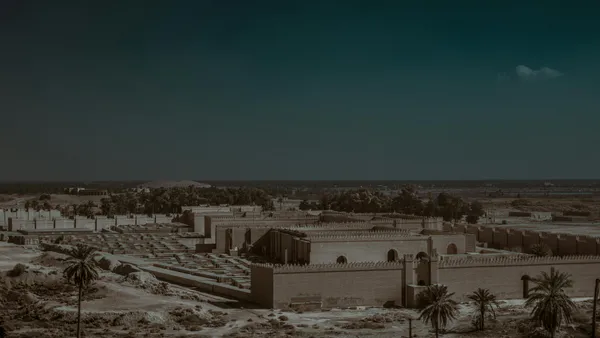
The available evidence points in one direction: In the 1968-83 period the Ba'thists understood 'Aflaq and Saddam well and sought a secular state. Limited concessions to Islam notwithstanding, they achieved it. In 1969, the young Ba'thists introduced an entirely secular penal code85 and, as already pointed out, the July 1970 Interim Constitution eliminated almost all mention of Islam. By the mid-1970s, they had developed highly secular cultural and educational systems, with the latter downgrading religious studies to the lowest level. State education, media, state-sponsored figurative art, poetry, theater, military units and state ceremonies celebrated ancient Mesopotamian figures. Ishtar (Astarte), the Sumero-Akkadian goddess of sex and war, Tamuz, the god of re-birth, Gilgamesh, Hammurabi, Sannherib, Sargon, and Nebuchadnezzar became household figures. A German century envisioning of Nebuchadnezzar's Babylon rose from the flat sands and salt marsh of the ancient city. A larger-than-life statue of the 'Abbasid wine poet Abu Nuwas was established on the bank of the Tigris.86 In 1974, and more so 1977, the Shi'ite South exploded in massive anti-regime demonstrations. A decade later, in a closed-door meeting, Foreign Minister Tariq 'Aziz reminded his comrades why in the 1970s Saddam had defined the Ba'th secular doctrine more clearly than ever: "We had a powerful religious [Shi'i] movement that hit us with bullets, so it became imperative... that we present an ideological position against it." Indeed, in 1977, in a series of internal lectures to party cadres that were soon made fully public, Saddam, like 'Aflaq before him, paid homage to Islam and dissociated himself from atheism. At the same time, though, he warned against any attempt to imitate the religious parties and mix religion with politics: "We should go back to the origin of our ideology," he said.
What was "the origin of our ideology" to Saddam in 1977? The party, he explained, should be "proud of religion, without adopting policies for religion." He fulsomely rejected the shari'a, arguing that the Ba'th must not build "the theory of modern life... on the teachings of ancient jurisprudence." He argued:
We should not force our treatment of the present worldly aspects of life into a framework of religious jurisprudence. The current social problems that we face... are quite different from those of the early Islamic times when the rules of jurisprudence were laid down... This... cannot be the rule for present life."111
This is consonant with the party's origins, like 'Aflaq's demand for "secularism" and in the text of the 1947 Ba'th Constitution. A few years later, in meetings with senior aids behind closed doors, Saddam even denied any need by the Ba'thists for "religiosity". What was needed, he said, was pride in the heroic achievements of early Islam. He added that "Allah is neither Sunni nor Shi'i,... neither Catholic nor Protestant." He opined that most people (in the world) were no longer religious. Rather, they were following "other philosophies."87
The last time the party issued a secular, even anti-religious communique was in June 1982.88 A sub-chapter in a party report entitled "The Religious-Political Phenomenon in Iraq"89 is an atheistic psychological analysis of people who turn to religion and a broadside attack on all religions. Confronting the allure of Khomeini's Islamic Republic, veteran Ba'thists tossed aside 'Aflaq 's cautious claim to a non-specific, non-binding belief in God: "The religious phenomenon... among the youth and other social strata is... normal... given the romantic aspect distinguishing most of the youth during the adolescence." So, for the party, religiosity was the result of immaturity. The report adds that a "drastic transition from one era into another creates a state of confusion, tension, and imbalance.... In such conditions, many phenomena, including the religious one, appear." It further argues: "Religion and the religious attitude form an... atmosphere for attracting... negative cases." Furthermore, in religion, the Report explains, "an individual confused and puzzled by social transformations can find psychological ease."90 So, religiosity represented mental affliction.
In "The Attitude Towards the Religious-Political Phenomenon," the party's Ninth Congress is caustic about the situation in Iraq.91 Its resolutions are scathing against "some party members who are trying to appear religious." The party expresses concern. "Religious concepts began... to overcome Party concepts,"92 and the "religious-political phenomenon" is growing "at all levels of the party."93 The report asks: "If the religious conception and practices were considered by some comrades as moral and ideological alternatives to the Arab Ba'th Socialist Party... why did they choose the Ba'th party?"94 This religiosity contradicted the party's ideology, as there was not "any basis for this in the party's doctrine and tradition."95
So, unless we accept Helfont's idea that the Ba'th leadership "misunderstood" Saddam's and 'Aflaq's Islam, between the 1940s and the early 1980s there was, indeed, secular continuity. Even Khomeini's rise to power in Tehran changed little. Until early 1982, Saddam was still very optimistic that Iraq would win the war and thus saw no need for any political or ideological concessions to mass religious sentiment.
The June 1982 military withdrawal from Iran and the ensuing stalemate changed everything. The military stalemate tainted the Ba'th's prestige, and the economy was hit hard. This was when Saddam decided to sacrifice the Ba'th secular ideology on the altar of popular support. Initially it was limited, the result of a cynical calculation. In later years, following the shocking military defeat in Kuwait, the international embargo, and a renewed threat of a US invasion, the Islamization campaign was escalated.
VI. SADDAM'S "FAITH CAMPAIGN": PREAMBLE
The first foretaste of a deviation from Ba'thist secularism came at an international "Popular Islamic Conference" that the regime convened in Baghdad in April 1983. This was a crisis moment in the Iraq-Iran war, with Iraq forced to withdraw its forces from Iranian territory. The conference's politicization of Islam represented a major departure from established party doctrine. As Helfont describes it well, Saddam went even further when he addressed the conference. The very convening of the congress was a deviation from Ba'th ideology. Moreover, Saddam also promised that he would accept its resolution on how to end the Iran-Iraq War even before he knew what that decision was. It will be remembered that party ideology rejected any clerical involvement in political decision-making. To justify this, Saddam argued that consensus (ijma') among Muslims was a central principle of Islamic law, it superseded secular considerations. Therefore, he announced that it would be the basis for one of his regime's most vital political decisions, whether to end the war. "In doing so," Helfont explains correctly, Saddam "suggested that Islamic law overrode secular law."96 Saddam admitted what he was doing was highly unusual and even apologized for it. His justification was that a consensus among Muslims "must be the right one."97 Saddam went on to organize more such Islamic conferences in 1985, 1987, and 1990. Correctly again, Helfont points out that this was nothing short of accepting "the Iraqi regime's references and allusions to
Islamic law as a binding set of rules." This is very clearly irreconcilable with the Ba'th's foundations, as already shown, and seemingly why Saddam apologized for it. It is a mystery how Helfont sees in it continuity.
In July 1986, Saddam made an additional overture toward Islam at another crisis point in the war. This happened in a meeting of the party's pan-Arab Leadership.98 Surprisingly, he met with strong opposition. He suggested an alliance with a hated and feared enemy, the powerful Egyptian and Sudanese Muslim Brotherhood (MB). This had become necessary, he explained, as people were turning to Islam. "There is a public that is being influenced by what the men of religion are saying." The "men of religion" had "power to influence the people. Their prestige now has risen." In people's eyes, they have become "more precious than before." Religiosity had penetrated even into the ruling Arab regimes, he warned. This necessitated an overture to the MB.99 Blaydes observes that in the meeting Saddam explains his initiative to befriend the Sunni Islamists in terms of an urgent political necessity: the "increase in piety among Iraqis", and the fact that the 'ulama "benefited from a... shift towards religion".100 So, Saddam's Islamization was motivated by a cynical calculation. This seems to contradict Helfont's claim in his dissertation and book, with David Jordan's support,101 that, like 'Aflaq, Saddam, too, from day one, was motivated by love for Islam.
One member supported the president, but most remained silent. Helfont offers that 1986 meeting as proof that 'Aflaq supported Saddam's suggestion, further proving his original leanings toward Islam. Helfont sees befriending the MB as consonant with the party's original deep love for Islam.102 However, Helfont ignores 'Aflaq's tortured ambivalence evident throughout that meeting. For example, he jibed: "If we compromise, they [the MB] will not compromise as much."103 Later he made it clear that befriending the MB was the opposite of the existing party policy: "We are coming close to laying down [new] strategy for decades... We want to have a dialogue with them and strengthen those [among them] who are the least bad and least mistaken." So, to 'Aflaq the MB are all "bad" and "mistaken", but some of them are less so. Then he implied reluctance and surrender: "when we understand the strategic guidelines [Saddam's?] we will have no other choice but to proceed along these lines."130 As already shown above, 'Aflaq explicitly warned in the discussion against the state "practicing" Islam.
Helfont ignores all this, as well as the strong opposition to Saddam's suggestion from two leadership figures. Foreign Minister Tariq 'Aziz and Secretary of the Sudanese Ba'th Badr al-Din al-Muddathir were emphatic that the MB was an existential threat and that no ties with it were possible. They turned their fire on the MB's core concept, the Islamic state. They argued forcefully that the MB's "religious state" and the Ba'th's "national state" were mutually exclusive.104 'Aziz reminded participants that the Ba'th was committed to the "democratic, national, pan-Arab (qawmiya) state and that Saddam himself had given speeches in the 1970s making it clear that the Ba'th position was diametrically opposed to that of the Brethren's "religious state."105 Saddam had to calm his comrades' fear that he was jumping the secular ship, declaring: "We are establishing a state not through religion but rather a state for life." He assured them that the Ba'th "believes in religion," but only "as rituals." The Ba'th, he emphasized, "is not interpreting [politics] according to religion."106
Only in 1995, as part of his "Faith Campaign," Saddam made a landmark announcement that the Ba'th no longer opposed the Islamic state and pan-Islamic unity, provided that Arab unity came first.107 This was only one of many other ideological changes that, as will be shown below, Saddam introduced in his 1990s Islamic "Faith Campaign." Even though Helfont uses this 1986 document in his Ph.D. dissertation, he missed these parts of it.
Helfont insists that, for the Ba'th since its inception, like for other Arab nationalists of his era, in the choice between the pan-Arab or the pan-Islamic state, "Precedence is the key word. The ideas were not mutually exclusive." As a glaring example he brings 'Abd al-Rahman al-Bazzaz, who did not exclude a pan-Islamic state.108 Jordan agrees with Helfont.109 This I suggest is a mistake. The window to Pan-Islam was open to the moderately religious al-Bazzaz, or even to the sworn secularist Sati al-Husari, because both were Muslim-born. The same was true when it comes to other
Muslim-born Arabs. This window, however, was hermetically shut to the Cristian-born 'Aflaq, and therefore to his disciples in the original Ba'th, as well as to the 'Alawite Ba'this Hafiz and Bashar al-Assad. Indeed, as shown above, in the 1986 Leadership meeting, 'Aflaq, Saddam, 'Aziz and Muddathir emphasized that pan-Arabism and pan-Islam were mutually exclusives. In 1995 Saddam went where Bazzaz did before him. Even this ideological change alone between 1986 and 1995 means that, contrary to Helfont's and Jordan's thesis, after 1986 there was a meaningful "ideological shift.
On February 23, 1988, the regime launched the first of eight stages of a war against the rebellious Kurds. The code name given to this series of battles was Anfal, or "Spoils of War," being the name of the seventh Qur'an Sura that celebrates an early victory in 624 CE of the Prophet's army over the Meccan idol worshippers. Legitimizing a bloody operation that cost the lives of tens of thousands of civilians by implying that the Kurds were idol worshippers was another public indication of which way the regime was going.
In 1988 Saddam established Saddam University for Islamic Studies to educate a new generation of clerics who would "counter Khomeinism". The University was to belong to the Ba'thi and Saudi-sponsored Organization of the Popular Islamic Conference.110 The establishment of an Islamic university was unprecedented under Ba'th rule.
That something even stranger was happening in Baghdad became evident in June 1989, when Baghdad announced the death of Michel 'Aflaq. The pan-Arab leadership issued a communiqué that, prior to his death, "the late 'Aflaq... embraced Islam as his religion." He and his comrades in the command did not want to announce this "out of... concern that this... would be given a political interpretation."111 Had the leadership not wanted to give it "a political interpretation," it could simply have refrained from any mention of this deathbed conversion. As was disclosed to this author by Ambassador April Glaspie, who had served in Baghdad in 1989, 'Aflaq's elder son told her that he was taken by complete surprise: his father never told him of his conversion.112 Apparently, having a Christian founding father became a cross too heavy for Saddam to carry.
In June 1990, on the eve of his occupation of Kuwait, Saddam provided the most indicative hint that he was entering an Islamic era. His speech at the 1990 Popular Islamic Conference that he convened in
Baghdad could not sound more distant from his 1977 advocacy of a shari'a-free state. "We are the party of God (hizballah) here and the party of God is the greatest and most powerful of all parties," he exclaimed. By 1990 Hezbollah, Khomeini's creation in Lebanon, had already earned worldwide renown, so Saddam's choice of identity for the Ba'th was nothing short of breathtaking:
We here, my brothers, are the party of God. I am one of you and whatever the Muslim clerics (al-'ulamā' al-muslimūn) will decide we shall turn into our way!... Whenever any local law clashes with the supreme law (al-qānūn al-a'lā), the local law must be declared null and void... Whenever state patriotism (al-wataniya) in Iraq clashes with the supreme principles of Islam, it will be declared null and void... Whenever the practice (sulūk) that comes under the definition of pan-Arab (qawmi) practice clashes with the supreme principles of Islam, this pan-Arab practice must be changed and declared null and void in favor of the general [Islamic] law.113
So, the shari'a must reign supreme both in Iraq and across the Arab world. None of the historians discussed here mentions this speech. When compared to his 1977 that the shari'a is not applicable, in it, Saddam unequivocally declares for political Islam. This is a complete departure from the party's secular doctrine, and this was only the preamble.
VII. THE ISLAMIC "FAITH CAMPAIGN" IN FULL SWING 1993-2003
Sassoon provides a report of the regime's "Faith Campaign," as reflected in its archives. In the 1990s, Sassoon reports, as part of the campaign, the Ba'th regime "publicly supported all religious activities and called for more conservatism and religiosity." Saddam, Sassoon goes on, adopted Islam "as part of his political oratory and used it to great effect."114 However, Sassoon reports also of policies that go far beyond oratory. New mosques were built, and repairs were made to existing ones. Saddam even initiated the construction of the Mother of All Battles Mosque in Baghdad, intended to be the largest mosque in the world, and a 605-page copy of the Qur'an with a text written with his blood. This Pharaoh-style mosque-building spree began during the international embargo years that caused a severe economic crisis. Sassoon also reports that the Iraqi flag was redesigned to include the inscription allahu akbar. The rules regarding opening restaurants and nightclubs in Ramadan were tightened. One hour a day of broadcasts was dedicated to religious programs. Important religious festivals, "such as the Prophet's birthday were celebrated under the auspices of the president."142
Sassoon Continues: In 1994 the president established the Saddam Institute for the Study of the Holy Qur'an that would soon become "part of the hierarchy of the party." At a graduation ceremony, Vice President Izzat Ibrahim announced that the Ba'th was "not a religious party", but then: "We are the party of the Islamic message (risala) and of the Arab message."115 Hundreds of its students were middle- and higher-middle-level party cadres. Moreover, these party activists were given a year or two of leave to devote to studying at the Institute.116 So, Saddam went beyond oratory and invested a great deal of the party's manpower, time, and treasure in his Islamization of the party cadres. As will be remembered, already in 1957, to the leadership's chagrin, many Ba'thists confused the party's secular "eternal message" with the Islamic one; Ibrahim's embrace of the Islamic message was a dramatic about-face.
Sassoon overlooked additional archival evidence. For example, some show how the entire state school curriculum was imbued with an Islamic spirit and children had to study the Qur'an throughout their school years. He also failed to consider laws forcing judges and major merchants to pass tests in the sharia or lose their licenses.117 Sassoon also overlooks the party's internal order to members "not to charge interest (al-ribā)" on loans because these are "the instructions of Islam."118
Sassoon neither studied the open Iraqi media nor did he interview Iraqis. Doing so would have added much, including Islamization inside the party. For example, a report of Saddam's injection of Islam into the party by General Hussein Kamil, Saddam's close aide and the son of his paternal first cousin, who defected to Amman in 1995. In a meeting with United Nations Special Commission (UNSCOM) officials, he stated: "The government of Iraq is instigating fundamentalism in the country... Every party member must pass a religious exam. They even stopped party meetings for prayers."147
It is clear from Kamil's report that this was new and alien to the comrades.
In the summer holidays, elementary and high school students were sent to regime-approved mosques to memorize the Qur'an and study simple exegesis in a traditional way. Pupils were taught how to pray, but only in Sunni fashion.119 The regime's media reported on the new RCC Decree No.82 of July 7, 1994, that closed all places of entertainment not only during Ramadan, but throughout the year. Even though alcoholic drinks were still on sale in special shops, consumption of them in public was banned, with offenders punished severely.120 In the public media, leading clerics endorsed the decree for bringing the Iraqi people back to Islam, thus implying that beforehand both people and leadership strayed from the right path.121 To disarm those Ba'thists who were still secularists, the regime's media provided also a social justification for the bans, arguing that the places of entertainment tempted the youth into crime.122 The permission to buy spirits was probably the most important concession Saddam made to traditional Ba'th values. This concession was the result of a warning he received from his generals that "a total ban on alcohol will lead to a military revolt." As a result, officers kept 'arak and whiskey in drawers in their offices, and alcoholic drinks were available in the Army and Navy Officers' Clubs (al-nadi al-'askari and al-nadi al-bahri).123
Surprisingly, Sassoon also fails to mention the law imposing the amputation of the right hand at the wrist for theft.124 Faust, too, is providing a long list of Islamization steps, but, amazingly he, too, is ignoring the shari'a-prescribed amputations.125 This was the first in a host of measures that Islamized the secular Ba'thi 1969 Penal Code. In a later closed-door meeting, there was a proposal made to brand the amputees' foreheads. Saddam provided a secular argument that amputation and branding would curb widespread property-related crimes. Replying to questions, however, the president stressed that amputation was what the Qur'an commanded, end of story. Saddam was no Qur'anic scholar, so he must have prepared himself well, because he quoted the relevant Qur'anic verse precisely. The letter of the law did not mention the shari'a, but the Iraqi media justified amputation in the same two ways: As a measure to end property crimes and as a fulfillment of the Qur'anic precept. Gory photography of bleeding amputated wrists and the shocked amputees appeared on Iraqi television. Even in the Ba'th archives, one finds cases of "thieves" having their hands amputated. Finally, no law was enacted forcing women to wear the hijab. Yet, Saddam strongly encouraged women to "dress properly before God". A visiting journalist reported that, due to the travails of the embargo and regime efforts, "More and more Iraqis are going to the mosque; more and more Iraqi women are wearing the veil." Indeed, it emerges from interviews that many women began to wear the veil. The starting pistol was fired by Manal Yunis, the ultra-secular Ba'thi head of the women's union. To sum it up so far, it seems that, unlike what we are told by Sassoon and Faust, Helfont and Jordan, maybe Blaydes, between 1982 and 2003 there was a significant ideological change, even metamorphosis from secularism to Islamism. Why did those historians err?
VIII. DO REGIME ARCHIVES INVALIDATE ITS PUBLIC MEDIA?
Let us examine the main evidence presented by Sassoon, Faust and Helfont (with some support from Blaydes and Jordan), that the "Faith Campaign" represented no ideological change.
One: Using the archives as his Punctum Archimedis, in a 2012 article Helfont reports that, contrary to the conclusion of pre-archives' historians, Saddam's "Faith Campaign" was neither an ideological change nor was it Islamism. Rather, it was mere "instrumentalization of Islam."126 The main evidence for that is the fact that Islamization was limited to Iraq's foreign relations and, therefore, it did not apply to the Iraqis. This brings him to the conclusion that the regime's Islamization was a mere technicality devoid of "ideological conviction."127 Hence, there was no "Islamization". This thesis is supported by Blaydes, who agrees with Helfont that "Hussein had an aversion to any form of Islamization through his time in power, suggesting an instrumental regime motivation for the policy shift."164 However, even in the same article, and much more so in his Ph.D. dissertation and book, Helfont admits that there was also extensive domestic Islamization during the "Faith Campaign."165 Indeed, already in his 2012 book Sassoon reported extensive domestic Islamization.166 Helfont had studied Sassoon's book before he published his Middle East Journal article.167 Yet, he still reported that Islamization was limited to foreign policy. So, if domestic Islamization is the criterion for "ideological conviction", then there was much "ideological conviction" behind the Islamization after all, and there was an ideological change from the 1970s.
Two: A "behind the scenes" piece of evidence that convinced Helfont that what you see in the public media is not what you get is a 1996 closed-door meeting. In it, Saddam spontaneously responds to someone mentioning Louis Farrakhan's Islam: "By God, I do not like them. I do not like those who engage in politics under the guise of religion. I don't trust them." Helfont concludes that this proves his thesis that the open media is deceitful: "public appearances [of Islamism?] were misleading."128 In his Ph.D. dissertation and book Helfont tells us that Saddam was always a closet lover of Islam, who secretly wished "to tie the regime's legitimacy to Islam,"129 but that only in the 1990s he managed to implement, or "Instrumentalize" this Islamic dream.130 However, when discussing Saddam's Farrakhan quip he seems to tell us that, in the 1990s, Saddam was in fact a closet secularist. Helfont makes no attempt to explain this baffling contradiction. He leaves us only with his sweeping conclusion that "public appearances" by Saddam were "misleading". Namely, when you see a
public appearance of Islamism, do not believe it. Then he announces triumphantly:
"Fortunately, the regime's internal documents help to clarify which positions Saddam took for tactical reasons... and which views on religion represented more foundational stances on which the regime based its actual policies."171
So, was the Farrakhan quip "tactical" or "foundational"? What will it be, political Islam or separation of mosque and state? Helfont reports also, for example, that school textbooks described Saddam as a latter-day Caliph or prophet.131 Was that "tactical" or "foundational"? Was chopping healthy right hands for theft "tactical" or "foundational"? When is "Tactical" becoming "foundational"?
Confusion reigns, but there is still need to explain Saddam's baffling Farrakhan quip. In the first place, this author does not agree that one secular quip in a closed-doors meeting proves that over a decade of Islamist speeches, laws, education, and culture "were misleading." Still, a historian must ask why did Saddam denounce his own policy? I suggest that he was aware that many party old timers were uneasy about his Islamic "Faith Campaign." He was given notice about the party's old-timers' objection already in the 1986 meeting of the pan-Arab leadership. Conveniently, 'Afaq died in 1989, but others still objected.132 Saddam wanted to indicate to them that deep inside he was still the same old secular Ba'thi Saddam. This is why he did not even define his campaign as "Islamic," but vaguely as "Faith." I doubt that his bizarre Farrakhan alibi convinced the comrades, but it convinced Helfont that the Iraqi leader was against "politicizing religion."133 The Farrakhan quip betrayed a dilemma Saddam had, but it did not change the regime's new Islamic ideology and practice.
Three: The third evidence that convinced Helfont that "public appearances were misleading" is very important and should give us a pause. This evidence, though, contradicts Helfont's thesis and supports that of Sassoon's and Faust's, as it suggests that the party was and remained "to the end" anti-religious. As late as 1997, well into the Faith Campaign, Helfont found in the curriculum of party courses that the Ba'th retained some of its secular ideology. Helfont reports that a course on Islam included four "books" by Michel 'Aflaq from the mid-twentieth century, one "book" from 1977 by Saddam, and part of the 1982 report of the Ninth Ba'th Congress.
The most interesting and confusing lecture, "In Memory of the Arab Prophet" (1943), is among those that were included in the curriculum.134 In it, 'Aflaq says: "Muhammad was all the Arabs, let all the Arabs today be Muhammad," and more such Islamist-sounding sentences. But he also says: "Maybe we are not seen praying with those who pray or fasting with those who fast."135 When found in a 1997 curriculum, this clashed head-on with Saddam's Faith Campaign.
The 1977 lecture by Saddam that was found on the course reading list, Saddam defined the Islamic jurisprudence as passee de mode. This, too, clashed with his Faith Campaign. Another source that was retained was the anti-religious chapter titled "The Religious Question" in the secular Resolutions of the 1982 Nineth Regional Congress. The party warned that "Religious concepts" began "to overcome Party concepts." The growing "religious-political phenomenon" was spreading "at all levels of the party," when the party was facing the "hostile religious-political phenomenon." Also, as shown above, the Report includes an atheistic attack against religion.
Helfont's interpretation of those secular and anti-religious texts is surprising. He sees all of them as blueprints for Saddam's Islamic "Faith Campaign."136 But can Saddam's 1977 no-shar'a doctrine, or the Nineth Congress' assault on all religions, be a blueprint for his June 1990 commitment to the shari'a, and over a decade of Islamization? If anything, those documents, too, may show that Sassoon and Faust are correct and that in the 1990s Saddam had a secret anti-religious ideology.
Assuming that these reading assignments were taught, and not just left on the list, an explanation is in order. One possibility is that this was the initiative of angry senior Ba'thist old-timer, who protested in this way the leader's Islamization. There was enough disorder in the party in the 1990s that such an initiative could slip through the net. More likely, though, is the possibility that the curriculum was approved by Saddam himself. Saddam's Iraq was not the USSR under Joseph Stalin. Unlike Stalin in his 1938 The History of the All-Union Communist Party (Bolsheviks) - Short Course, Saddam never tried to change the party's history to suit political expediency. For example, he never eradicated from the party's records the names of central comrades whom he later ordered to execute or assassinate.137 Likewise, he never disowned his own speeches and decisions, even when they became politically awkward. He regarded the preservation of the legacy of the party as a matter of honor even when it became null and void.138 So, it is possible that the party tutors told the young recruits that secularism had been the Ba'th doctrine but under the "Faith Campaign" it changed. If that was the case, we can only imagine the confusion of a junior party recruit.
Four: As we saw, to Sassoon and Faust Saddam's Islamic "Faith Campaign" was a smoke screen, behind which he "continued to be anti-religious and to repress any sign of real religiosity."139 The evidence that convinced them was two-fold. Faust sees the establishment of religious institutions that promoted Saddam's Islam, and the cooptation of other 'ulama as one arm.140 Both conclude that, despite the Islamizing façon, the regime continued to repress religious activists, movements, and practices.141 The repression was indeed real, but there are three questions that the two historians refrain from asking. Firstly, whom did the regime repress. Secondly, was the repression secret, so that we are learning about it only from the secret archives. If it was no secret, then their predecessors must have already factored it in. Thirdly, was Saddam exceptional? Were there also other regimes that were generally recognized as Islamic, that repressed religious activities? If so, then maybe we cannot define Saddam of the 1990s as "anti-religious."
Sassoon tells us: "Religious ceremonies and special religious processions during Muharram... particularly in southern Iraq," were "mostly prohibited by the security organization, because they attracted large gatherings that could not be easily controlled. These were "anti-religious activities." True, but the reader is not told that "southern Iraq" is almost entirely Shi'i, and that there are only Shi'i mass gatherings on Muharram, mainly the 'Ashura. Faust is more precise, explaining that the Shi'a were often the target, but he also claims imprecisely that generally the regime "suppressed popular religious practices they did not like."
The 'Ashura is the mourning of the murder of the most beloved Shi'i Imam, al-Hussein bin Ali, at the hands of the "Sunni" Umayyad Caliphate. These are potentially anti-Sunni events. Because the Ba'th regime was Sunni-hegemonic, anti-regime demonstrations on the 'Ashura were common. So, prohibiting it had nothing to do with "suspicion" of "any person with religious beliefs." Rather, this was about suspicion of any Shi'i person who participates in those mass gatherings. We are also told that the authorities "were concerned [even] about funerals, realizing that large processions in Karbala could develop."142 Here again we are not told that Karbala is a world Shi'i burial site. So, again, we are not alerted that the limitations are imposed only on Shi'i religious mass gatherings. We are told also that the regime defined certain religious ceremonies as "negative," or "deviant" practices that represented "defiance of Islam."143 Indeed, many internal security instructions explain why such practices must be stopped.144 However, again, we are not told that these derogative descriptions were applied exclusively to Shi'i religious ceremonies, never to practices that are common to all Muslims. For example, no derogative expressions were ever directed against the Ramadan fast-breaking (Iftar) evenings, or the two great festivals of 'id al-Fitr and 'Id al-Adhha, or the Prophet's birthday. Sassoon also reports that there were orders to prevent "the spread of pictures of prophets and Imams."145 Again, Sassoon does not tell us that no Muslim would produce the Prophet's pictures, and only the Shi'is print and hang pictures of their Imams and religious leaders.
Furthermore, all those reports of restrictions clash with Sassoon's reports of other archival revelations describing the regime's generous support for other religious gatherings. For example, we are told that the important religious occasion of the Prophet's birthday was given lavish official support.146 This is correct, and similar reports appeared in the open Ba'thi media. Where, then, is the regime's repression of "any sign of real religiosity?" The answer is that, in contrast to the Shi'i religious mass-occasions, the Ba'th regime provided rich support for celebrations of generic all-Islamic festivals, even in the Shi'i holy cities.147 Also, unlike the Shi'i 'Ashura and Arba'in, the generic Prophet's birthday, 'Id al-Fitr and 'Id al-Adhha have no sectarian anti-Sunni (and anti-regime) connotation. Therefore, no Shi'i riots against the Ba'th regime could be expected. Defining the regime as being "anti-religious" because it suppressed Shi'i religious mass-occasions therefore may be a mistake.
Furthermore, the reader is not told that the Prophet's birthday has been turned by the Sunni community in modern Iraq into a very central religious festival. The Iraqi monarchy already introduced it as a national holiday on 12 Rabi' al-Awwal. Al-Fukayki reports that the Sunnis "were pushed to exaggerate" celebrating the Prophet's birthday, when the Shi'i migrants flooded Baghdad under Qassem's regime, as a Sunni response to the Shi'i mass-commemorations in the capital's streets.148 For the Ba'th Sunni-hegemonic regime, supporting the all-Islamic, but Sunni-colored Prophet's birthday was therefore a useful way to demonstrate both Sunni identity and generic Islamic religiosity.
Sassoon relates to this suppression as if it were a secret, that only the archives revealed to the new historian. This, too, is a mistake. The anti-Shi'i suppression was anything but a well-guarded regime secret. The proof of that is hidden in plain sight in Sassoon's own account. He reports of mass coercion and that in the "[Shi'ite] south and the [Kurdish] north" the regime "made an example of anyone caught giving help" to the opposition.149 If mass coercion was meant to make an example of offenders, it had to be public.150 The archives only add details. Sassoon claims that "the [archival] documents... clearly indicate that the declared policies... had other dimensions of which we were unaware."151 While lionizing the archives and the new historian, the claim that the archives exposed hidden dimensions that show that the regime repressed "any sign of real religiosity" seems, therefore, to be a mistake.
We are told that the archival documents "give a remarkable insight into Saddam's obsession with the activities of religious groups in spite of the faith campaign." Reportedly, "religious activities of any kind were considered dangerous, and all mosques were kept under surveillance."152 The archives, we are told, uncover "the suspicion with which the regime regarded any person with religious beliefs."153 The regime "monitored mosques" and "religious movements."154 Monitoring was applied equally to Sunnis and Shi'is, we are told.155
These facts are well-founded, but not the analysis. The security organizations were on the lookout not because the groups were "Wahhabi" or Salafi, but because they were suspected of hostility to the regime. There is evidence that the regime sponsored at Saddam's Islamic University at least one Salafi, or "Wahhabi" group.156 Support for Sunni Salafis or "Wahhabi" could even be found in the regime's open media. It was made public by 'Uday Saddam Hussein, who used an "anonymous letter to the editor" from a "reader" to criticize his uncle, the Minister of the Interior, for allowing "Wahhabi" to assemble and operate freely.157 Unreported by Sassoon, even the archives confirm this phenomenon. For example, in a 2000 private letter to the president, Barazan Ibrahim Hassan al-Tikriti, Saddam's half-brother, objected to the president's policy of encouraging radical Salafi Islam.158 There is also a recording in the archives of a private conversation between Saddam and a senior party official who complains that "Wahhabi" are being tolerated, even allowed to preach from the pulpit in (Sunni) mosques. Saddam did not seem surprised.159 Maybe those were not exactly Wahhabi, but the descriptions leave no doubt that they were Salafi Islamists. This way the regime was trying to fight fire with fire.
Sassoon reports that "Wahhabism was banned from the early 1990s and the death penalty imposed on its followers."209 While Wahhabism was, indeed, banned, and some were executed, there is no evidence of any law that imposed "the death penalty" on Wahhabis. This is very meaningful, because, by contrast, RCC Decree No. 461 of March 31, of 1980 imposed capital punishment for membership in the Shi'i al-Da'wa Islamic Party.160 The execution was automatic. Not so for real or presumed Wahhabis. To the security organs there were good "Wahhabis" and bad "Wahhabis," but only bad Shi'i opposition activists. So, contrary to what Sassoon says, executions of Sunnis and Shi'is were not even remotely "egalitarian."161
Finally, Saddam and the Ba'th regime were not unique in suppressing hostile religious movements. The same practice was adopted even by regimes that were originally carried to power on Islamic wings. Thus, for example, Ayatollah Ruhollah Khomeini repressed the Mujahidin Khalq and the Hojatiya, both very religious Shi'i groups. Likewise, in 1989 the Sudanese Islamic coup d'etat of General Omar al-Bashir and Hassan al-Turabi arrested Prime Minister Sadiq al-Mahdi and his supporters. Al-Mahdi was imam of the Ansar, a Sufi order that pledges allegiance to the deceased Sudanese mahdi. In 1999, al-Bashir ousted his former ally Hassan al-Turabi, the leader of the Sudanese sister movement of the Muslim Brethren. And yet, no historian claimed that Khomeini, al-Bashir, and others were "anti-religious" and "repressed any sign of real religiosity." It is suggested here, therefore, that, however cynical Saddam may have been about his religiosity during the last decade of his rule, Iraq of his "Faith Campaign" was more Islamic by far than it had ever been since it became a nation-state in 1920.
IX. DECEPTION AND TRUTH IN THE ARCHIVES AND THE OPEN MEDIA
Can the historian see the regime's public rhetoric and public action as representing its true ideology? At least regarding state-Islam ideology, Sassoon, Faust, Helfont and, arguably Jordan, suggest that the public media cannot be trusted. This author disagrees. There is deception in the regime's media, but the dictator has no other means to educate or indoctrinate the people on how he wants them to think of themselves and of him. Ideology can be misleading, conjured merely to serve a quest for power, or it may be genuine, a reflection of the regime's true goals, but either way, this is the regime's ideology. To complete the picture the people and the historian can observe the regime's "operational ideology," namely, its policy "on the ground". This makes it possible to gauge the regime's commitment to its rhetorical ideology, and the public may accept or reject the leader's sincerity. Thus, for example, when Saddam's Republican Guard occupied Kuwait, people questioned the sincerity of the Ba'th public commitment to voluntary pan-Arab unity. Yet, whether deceptive, genuine, or checkered, what the public sees and hears is the regime's true ideology. By comparison, while of great interest for the historian, whatever the dictator says to his close associates behind closed doors carries far less weight. If we find a contradiction between the public and behind-closed-doors ideology, as long as the classified remains classified, preferring it over the public is therefore a profound methodological mistake. I suggest that public rhetoric and public action are far more important than classified records, because they are the only facets that the public is aware of.
Are the archival records "straightforward"? Sassoon, Faust and Helfont, maybe Jordan, seem to see the archival documents as the fountain of truth. If so, then this, too, is a mistake. On the value and limits of the Ba'th archives an experienced historian, who had the opportunity to study archives before, has this to say:
What emerges... is a picture of a state and a party awesome in their ability to monitor and control dissent and... to reward loyal citizens... But that is more a picture that the state and the party wanted to believe than it is reality.162
Both kinds of sources must be read critically. The contribution of the archives is tremendous, but they are anything but inclusive, as we have only parts of them. Moreover, they are anything but "straightforward." Internal reports coming from the bottom to the top are sometimes false, designed to please the boss or push embarrassing facts under the carpet. At the same time, we sometimes find embarrassing confessions in the archives that ring true. While the open media usually provides regime propaganda, whether explicitly or implicitly, it often provides reliable information. One rule of thumb on how to identify a more credible report is to gauge how embarrassing it is to the regime. The more embarrassing the report, the more truthful it is likely to be because it exposes chinks in the regime's armor.
One example is refuting the party's claim that for the Ba'th, all Arabs, Sunnis, and Shi'is alike, are equal. In an audio recording of a private meeting with Saddam, a senior party official complains that only Shi'i, but no Sunni Islamists are being executed.[213] This is very embarrassing because it exposes the regime's hypocrisy. Ergo, this is very likely true. At the same time, taking at face value internal party officials' reports to the boss can be a mistake. For example, Sassoon accepts at face value archival reports that, following the 1991 Shi'ite mass uprising, the state of the party was good.
As he puts it, the internal reports "do not indicate a fundamental change in the party's role, or that it was weakened, as some [pre-archives historians] have argued."214 Yet, even as late as 1994, Saddam and a few senior party officials told the whole nation on the radio and television and in the press, that the party was going through a devastating crisis.215 In such cases, this author's advice is to believe Saddam and his public media. At least, the historian must always suspect sanguine internal reports and be acquainted with the public media.
Another example of deception in the archives is that of party membership numbers. Sassoon again accepts the internal reports at face value. "Many have argued that the party weakened after the 1991 uprising, but the statistics clearly illustrate that recruitment continued at an intensified pace."163 Indeed, following the 1991 uprising, the party bosses urged each branch to mass recruit. Yet, even two years after the uprising, the party's public daily newspaper complained that many of those counted as members shirked activities.164 Even four years after the uprising, Saddam and senior officials still complained in the public media that many of those recruited were not committed Ba'this.165 To Faust's credit, he found some internal reports that admitted that only "few party members reported to their posts to defend Ba'thists and government installations."166 Publicly admitting failure was not easy. I suggest that, unlike Sassoon, Saddam and his senior comrades were not fooled by the sanguine reports of their underlings. Apparently, they thought that papering over the profound crisis in the party may end in disaster.
A case in which the secret archives corroborate highly sensitive information that had appeared in the regime's public media is that of the sectarian profile of the party. Sassoon reports from the archives that even after the 1991 Shi'ite mass-uprising, "many Shi'is were [still] part of the system to the [2003] end."220 This information is correct. Sassoon is mistaken, however, in his conviction that this archive-based conclusion represents an innovation. Basing themselves on the regime's open media, two pre-archives' historians found out that Shi'is had meaningful representation in the party's leadership already in 1977 and at least until 1995. It was still substantially lower than the Shi'i representation in the population, but it was meaningful. Following the 1991 uprising it shrank somewhat, but Shi'is were still there. These historians reached that conclusion 23 and 15 years respectively before Sassoon discovered it in the archives.167
There were cases in which the Iraqi public media revealed embarrassing events that were not found in the party's internal records. In 1994, in its entertainment pages, the Iraqi press reported stage shows in Baghdad by transvestites. Saddam's strong hostility toward such people, whom he saw as offensive to Iraqi and Arab honor, was ignored. Likewise, in 1998 the media reported students' protests against Saddam's Islamic conservatism.168 So far, no one found mention of either event in the party's internal records. Likewise, the historian can find in the Iraqi press strong attacks against the president's Islamization policies.169 The Iraqi press, including the party's daily newspaper, also launched severe criticism of Saddam's policies of reviving the tribes and their shaykhs. It reported and defined those policies as nothing short of disastrous for national cohesion.170 No such criticism has been found so far in the archives. So, the archives are not all that "straightforward", and Saddam's press was not as "tightly controlled" as Helfont thinks.171 All the historian needs to do is read it.
A case where the international open media and the Shi'i opposition are the historian's only guides is that of the blood-drenched repression of the Shi'i March 1991 uprising. Sassoon says that the archives taught him that some of his pre-archives predecessors "overstated the Sunni-Shi'i chasm" under the Ba'th.172 He also became convinced that "Saddam Hussein was almost 'egalitarian' in his treatment of anyone considered or suspected of disloyalty."173 In both observations Sassoon is lionizing the archives, while belittling the open sources, and in both cases he is mistaken. While the archives discuss the uprising,174 no mention of its bloody suppression was found. It involved the killing and mass execution of 100,000–250,000 Shi'ites.175 A similar massacre took place in Kurdistan, but no such cataclysmic event took place in the Sunni-Arab areas. Size matters. Consulting open sources would have provided Sassoon with the information that was too embarrassing for both the party's secret correspondence and open regime media to report.176
The conclusion of two post-archives historians is very different from Sassoon's regarding his claim that his predecessors "overstated" the "Sunni-Shi'i chasm" under the Ba'th. We are told by Lisa Blaydes that the Iraq-Iran War (1980-88) exacerbated the already-existing Shi'i alienation from the regime. From internal reports of war casualties it emerges that "Iraqi Shi'a were more likely than their Sunni counterparts" to have died. "The differential war costs", she suggests, created "the conditions for the 1991 Uprising which represented a critical political rupture" between the Shi'a and the regime.177 But Blaydes in fact reports that even before the war, "under Ba'thist rule" Iraq witnessed a "sharpening [Sunni-Shi'i] religious group attachment."178 Her account is that of a saga of perennial crisis between large segments of the Shi'i population and religious leadership and the regime throughout Ba'th rule.179 So, perhaps Sassoon's pre-archives predecessors did not "overstate the Sunni-Shi'i chasm" after all.
Trusting the internal reports unquestionably led Helfont to conceive his most central thesis. As he sees it, since 1968 Saddam's ideological conviction led him to plan for the Islamization of Iraq, in the way that he did eventually in the 1990s. However, for that he needed first to prepare a large loyal cadre of clerics. At long last, between the late 1980 and early 1990s, he achieved it. Then he launched his long-delayed "Faith Campaign". The new Ba'thi Islamic education institutions, Helfont tells us, "focused on ensuring that all students and staff were loyal to the regime and possessed the correct political orientation."234 At long last, "[t]he regime could fully indoctrinate these budding religious leaders" and "weed out those who had other agendas."235 Helfont is impressed by the sanguine internal party reports that the Ba'th officials managed to create a cadre of "reliable" and "loyal" Ba'thi "Islamic scholars," 'ulama'. In Helfont's words, this represented the "integration of Iraq's religious landscape" into the regime's system.236 In this case Faust, too, takes at face value sanguine party reports that, by 1995, only 70 out of the 1,501 imams in the country...had any negative notations next to their names in the Bath files."237 Jordan supports Helfont's theory.238 As we saw above, since the indoctrination of the 'ulama' was so successful, Helfont believes that this enabled Saddam, at long last, to implement the party's original dream of an Islam-rich regime., to Helfont there never was, therefore, an ideological metamorphosis, only "instrumentalization," the technical ability to implement an old dream.239
Yet, the archives often lay traps for the unsuspecting historian. Helfont's account of the indoctrination, monitoring and organization of the regime-sponsored clergy is a valuable contribution to our understanding of the regime. There is no reason to doubt his report that party officials reported both their activities and success.180 However, much like Sassoon, he, too, mistook officials' reports for reality. So, a reality check is essential. Helfont himself is telling us that the first phase of recruitment failed: the regime tried to convince Ba'this to become clerics, but they refused.181 In its secular days, the party did a thorough job hammering anticlerical views into the members' consciousness. Having failed to recruit comrades, the regime turned to other men, apparently less loyal and more religious. Unlike Helfont, Saddam was not fooled by his underlings' reports. He knew or suspected that, despite his deep concessions to Islam, the efforts to "Ba'thize" the clerics failed. There is no other way to explain one of his last orders before the US invaded Iraq, in which he reveals his true judgment. He ordered that if the coalition forces entered Baghdad, in addition to destroying the country's infrastructure, the comrades should infiltrate and "assassinate the imams and preachers of the Friday mosques and [other] mosques."182 Had Saddam trusted his "loyal" 'ulama', he would have ordered to protect them, so that under the American occupation they could use the pulpits to demand his return to power, but he did the opposite. So much for Saddam's trust in his "loyal" and "reliable" clerics. Helfont's whole thesis, supported by Jordan,183 hinges on the theory that Saddam delayed the implementation of an alleged original Ba'hist Islamic dream until he had a "loyal" cadre of 'ulama'. Given Saddam's mass assassination order, this whole theory collapses under its own weight. This means that there had to be another explanation for the Islamic "Faith Campaign."
Remarkably, Saddam provided the explanation in the 1986 pan-Arab leadership meeting. As shown above, he explained that there was a need to befriend Sunni Islamists like the Muslim Brotherhood because the public had become more religious and the clerics more prestigious. Already then, some comrades feared that he was contemplating Islamization to win popularity. However, to impose his newly found Islam, he needed a collaborative cadre of 'ulama'. Helfont, Blaydes, and Jordan got everything in reverse. Instead of nurturing a cadre of "loyal" 'ulama' to implement an old Ba'thi Islamic dream, Saddam did the opposite. In his search for popularity in a difficult moment, apparently in the late 1980s he decided to launch his Faith Campaign, being a massive deviation from the Ba'th secular tradition. To assist him in this endeavor he tried to create a loyal "religious landscape".184
X. MISUNDERSTANDING THE BA'THIST CODES
The Ba'th party and later its Iraqi branch under Saddam developed unique codes. By immersing oneself in their public media, any researcher can easily crack these codes because they were meant to be cracked. However, in important cases, mainly Sassoon and Helfont did not do this. Only three examples are given here. One is, as discussed above, Helfont's misunderstanding the Bathi code of lavish praise showered on Islam, while trying to lock it up in the mosque, then control the mosque.
Another is a phenomenon that convinced Sassoon that "many" of his pre-archives' predecessors "overstated the Sunni-Shi'i chasm."185 Sassoon noticed that there is no "Sunni or Shi'i" rubric in the party's "official forms in the archives." Sassoon concluded from that the Sunni-Shi'i problem was less significant than what his predecessors thought.186 However, Sassoon should not have been surprised: the regime's media never added "Sunni" or Shi'i" to citizens' names. So, why should it be added to a roster of party members? Sassoon, though, is surprised. He confesses that he "could not understand... why sectarian identification was not referred to in the audiotapes of the leadership's private meetings when the Shi'i [1991] intifada... was discussed."187 There were cases of such mention in unscripted closed-door meetings that Sassoon missed,188 but such cases were very rare. The terms "Shi'i" and "Sunni" appear even more rarely in the party's written documents. Sassoon is puzzled: "My first reaction," he reports, was that "a high official had ordered these words to be excluded." That is, this exclusion was the initiative of a creative individual official. Sassoon's other guesses are that some senior Shi'i officials might be offended and that Saddam emphasized "loyalty rather than religious affiliating." This does not explain what could be so offensive to a senior Shi'i official if the definitions "Shi'i" and "Sunni" are part of an application form. Finally, Sassoon says that Saddam's "persecution and repression of the Shi'i is stemmed from his incorrect belief that many would be influenced by the ideology of... Ayatollah Khomeini."189 However, if the Shi'i were indeed suspected as a collective, then including "Shi'i" in party application forms and personal reports could serve as a useful security screening or warning, but this never happened.
In fact, the policy of silence over sect, particularly the Sunni/Shi'i complex, existed in the regime's public media from its inception. This was also the case in Ba'thi Syria, with its Sunni-majority and 'Alawite hegemony problem. The split among Arabic speakers along religious lines, Christian versus Muslims, had been treated extensively by 'Aflaq in his early days, but he avoided the Sunni-Shi'i-'Alawite-Druze divide. The 1947 Constitution recognized the problem, but the solution was just forbidding "sectarianism." In Iraq, Shi'ites represent three out of every four Arabs. Refraining from using the sectarian affiliation did not stem from a reality in which sect became meaningless: the opposite was the case. Sectarianism represented a formidable threat to pan-Arabism and Iraqi unity. Silence over sect was the result of the Harry Potter Voldemort syndrome of "He who Must Not be Named." The party dreaded it so much that it preferred to deny its very existence by erasing almost all mention of it.
This problem was particularly embarrassing during the first years of Ba'th rule, as Shi'is were absent from the two highest institutions, the RCC and the RL. Since 1977, even though the regime remained Sunnihegemonic, Vice President, Deputy Secretary General of the party's Regional Leadership, and Deputy Chairman of the RCC Saddam Hussein elevated a few Shi'i oldtimers to the RCC and RL. It was convenient, therefore, to stick to the party's code of silence, implying that because all Arabic speakers were just Arabs, the sectarian affiliation of the leadership was irrelevant. However, because the party could not describe the new members of the top institutions explicitly as "Shi'is," they made sure that their names, birthplaces, and careers, would be enough to indicate their Shi'i affiliation. This was another part of the Ba'thist code. Most or all Iraqis easily cracked it because the regime wanted them to crack it.
An example of reading Saddam's lips selectively as well as misunderstanding him and his regime in the wider context is Helfont's report of a closed-door meeting in March 1979. From Saddam's words in that meeting he concludes that, after a decade of reluctant secularism, Saddam at long last revealed his deep love for Islam. What Helfont saw in the archive contrasted "the Ba'thists' public statements." In 1979-1980, he reports, the regime's public secularism did not "reflect what the regime was doing behind closed doors." To prove it he quotes Saddam, who emphasized the importance of "religion, men of religion, and holy places." Behind closed doors the regime stressed "the importance" of "attending mosques" as well as "understanding the importance of religious occasions and participation in them."190 But Helfont misunderstood the context and missed contrary Saddam quips. The context: six weeks earlier, on February 1, Saddam's nemesis, Ayatollah Khomeini, returned to Tehran. Saddam was deeply worried about his influence on the Iraqi Shi'a majority. Archival documents from late 1979 and early 1980 told Sassoon that Saddam believed "that the Ba'th Party was losing young [Shi'i] people to religion and that this constituted a serious threat..."191 Saddam's sudden respect for religion reflected a true moment of hesitation and re-assessment. Ba'th secularism, even more so than its Sunni hegemony, alienated many or most Shi'is. Saddam seems to have believed that maybe by injecting Islam the regime might win Shi'i support. Eight years later he will return to the same reassessment. However, in late 1979 and the early 1980s he decided to stick to his secular guns. In one internal party meeting, for example, he said: "A Ba'thist does not need religiosity for [mental] immunity". Instead, he offered pride in 'Umar, the second Caliph (whom traditionally the Shi'a reviled), apparently meaning Arab historical greatness. In another he was strongly against party members attending the mosque "as a group."192 So, rather than coming out of the closet and revealing his secret love for the mosque, as Helfont suggests, facing a new mortal menace Saddam's 1979 was a year of distress and oscillation. Still, his security policy was to order that the party's most qualified spies infiltrate the mosques much more than before. This conclusion is supported by Blaydes, who reports that "the Ba'thists sought to both punish and penetrate religious groups targeted for monitoring."193 Blaydes reports also that, just before the September 1980 start of the Iraq-Iran War, the Ba'thists recognized that "clerics could support regime interests", if they received "appropriate direction" from senior party members.194 In other words, rather than becoming more religious in 1979, as suggested by Helfont, the Ba'thists were meeting with religious leaders, not to return to Islam but, rather, to provide the clerics with "appropriate direction" or, simply, political guidance.
Khoury, too, is reporting that, following Khomeini's rise to power the regime increased its efforts to infiltrate the mosques, especially in the Shi'i south. She reports, for example, that on December 1, 1979, the Revolutionary Command Council held an extraordinary session. It addressed "the appeal of the Islamic Revolution" and delineated "a policy to combat it". This policy included "infiltrating mosques, establishing good relations with religious scholars."195 Likewise, as we saw above, Sassoon reports from the same archives that "Religious ceremonies and special religious processions" were "mostly prohibited."196 So much for "the importance of religious occasions and participation in them."
As shown above, the June 1982 Central Report of the Ninth Regional Congress, the highest party institution, was anti-religious. Although originally this was a secret internal document, Helfont and others may claim that the Report was eventually part of the deceitful public Ba'thi media. Yet, this was what all party members read and learned. Furthermore, there is much archival evidence that remained secret that, even a few years after Khomeini's rise to power and into the Iraqi war, the party remained secular. Sassoon reports that at least until 1982 Saddam and his comrades still expressed anti-religious views in closed-door meetings.197 Helfont read Sassoon's book but missed this part.198 The problem with Sassoon's reporting here is that he thinks that Saddam's secular, even anti-religious approach remained "to the end."199 In fact, since the second half of the 1980s no anti-religious expressions were found.
XI. DID SADDAM BA'THIZE ISLAM AND IRAQOR ISLAMIZED THE BA'TH?
Sassoon gives the regime much credit. While he reports, convincingly that people had to say things in which they did not believe, less convincingly he also opines that the regime "succeeded to a large extent in forcing the majority... to adjust their values in order to survive."200 It seems to this author that parroting regime slogans or keeping quiet is very different from adjusting one's core values. Faust is more emphatic. He argues that when the regime "embraced" Islam, it did this "in order to suffocate it." In Islam's place Saddam was "spreading his own Hussein Ba'thist version of Islam."201 This is true, but was the regime successful? Faust reports that "the preponderance of evidence from the BRCC suggests that the Ba'thification of religion was, on balance, successful". Already by 1989, the Shi'i Muhamram activities "almost ceased completely". Then, after 1996 "the regime succeeded in keeping them under control", and they "never again seriously threatened the Ba'th as they did in the 1970s."202
Even if "Ba'thification" to Faust is mere deterrence through terrorizing, he is mistaken. In 1991 the whole Shi'i south exploded in revolt that threatened the regime as never before. Likewise, Blaydes reports that in February 1999, following the assassination of Ayat Allah Sadiq al-Sadr, public protests lasted "into the summer". This aroused great regime concern as it included mass demonstrations, damage to property and even killing party members.203 Those were not Muharram gatherings, but they were still sect-based protests. So, deterrence worked only very partially.
Still, much like Sassoon, Faust, too, defines regime success in far deeper terms than coercion. As we saw, he admits that it made concessions to Islam, but it "did not so much 'Islamize' in the 1990s as expand its ongoing policy to Ba'thize religion."264 Moreover: "The BRCC documents show that by 2003 Ba'thification had destroyed or emasculated most of Iraq's pre-1968 governmental, civil, social and familial institutions and value systems", replacing them with "Husseini Ba'thist versions".265
So, both historians seem to agree that the regime was not only anti-religious but, also, succeeded, either to "suffocate" and "Ba'thize" Islam, or force most Iraqis to "adjust their values." All this was revealed to them by the secret BRCC archive, in which the Ba'thi officials congratulated themselves and their bosses for a resounding success.
Yet, in the most important public Ba'thi disclosure of the 1980s it came out that the bosses were not fooled. Khoury and I provide ample details on how the 1982 Nineth Regional Congress sounded the alarm because many comrades were succumbing to religion.204 The historian must not uncritically accept sanguine internal reports or easily reject open sources.
In 1986 Saddam, no other, reported to the Pan Arab Leadership that the Iraqis were becoming more religious and the clerics more influential. In 1990 he jumped on the Islamic bandwagon and declared that the shari'a will reign supreme. In 1993 he launched his Islamic "Faith Campaign", which gave religiosity an extra push. Finally, on the eve of the American invasion Saddam ordered the assassination of all clerics if the regime is lost.205 This evidence, that most of our historians ignore, seems to kill the thesis that Saddam Ba'thized Islam or succeeded in creating a loyal "religious landscape". The president himself knew that, despite regime indoctrination, at least the clerics did not buy into his "Ba'thized religion". It seems, therefore, that, while true that, through coercion and rewards, Saddam "Ba'thized" religion to an extent, for example by imposing political guidelines on clerics, or ignoring the shari'a in certain cases, or introducing noncontroversial Shi'i-inspired elements. However, he seems to have failed in his mission to "Ba'thize" Islam and Iraq. Even still under the Ba'th, the Shi'i revolts of 1991 and 1999 provided evidence of it. What happened with Ba'thism after 2003 requires much more study, but at least the religious establishments, Sunni and Shi'i, have not continued any of Saddam's religious innovations. Outside the Sunni zones, Saddam's efforts to "Ba'thize" Iraqi society, too, seem to have failed. At the same time, Saddam managed to "Islamize" his party and regime in rhetoric and state symbolism, law, culture, education, and even party indoctrination. As a result, the
Ba'th became less Ba'th than ever, if it was still Ba'th at all.
XII. CONCLUSION
This article tries to answer two main questions. First, when studying regime ideology, what should be the relative weight of open versus archival sources? Second, does the Islamic "Faith Campaign" represent a Ba'thi continuity or is it an ideological "shift" or even a volte-face?
a) The Relative Importance of Open Vs. Archival Records
This article argues that for the study of regime ideology, while the archives add nuance, the open records are the main source. I suggest that this is the case also with aspects of ideology mentioned here only in passing, like culture, education, and gender issues.206 While Khoury, Blaydes, Jordan, and Baram do not discuss this issue explicitly, implicitly all four consider both types of records equally relevant. Sassoon, Faust, and Helfont opine that in certain periods, at least each being a decade long, the regime's public media and on-the-ground public action did not represent its true ideology. They believe that during the Faith Campaign, behind a smokescreen of religious ideology, the regime remained anti-religious. Helfont, for his part, is convinced that the Ba'th Party was religious from its inception, but during its first decade in power it cloaked its religiosity with a false mantle of secularism. Only in the 1990s, he argues, could it expose its true religious nature. In this article I tried to show that the evidence provided does not support the claim to a secret ideology, Islamic or secular. In other words, what you see in public is what you get.
As opposed to the secret records, the regime's open media and modus operandi, or operational ideology, were what the people saw and experienced in their daily lives, and what the public believed to be the regime's ideology. Secret meetings and operations, together with internal party indoctrination programs, represent part of the picture, but the public record represents the regime's main ideology. I also tried to show that contradictions between the public and the party's classified records are few and far between, and that the Islamization was imposed inside the party even more so than in the public sphere.
Rhetoric is manipulative, sometimes deceptive. Yet, the public and the historian can always judge theory against practice. The more rhetoric and practice complement each other, the more the public and the historian understand that this is the regime's true ideology. What party members are whispering to each other in the party's branches provides an important nuance, but this is not the mainstream regime ideology.
Imagine that an historian would find a secret confession by Joseph Stalin two years into his Collectivization project (1928-1940) that it was a disaster. As long as the policy and rhetoric continued, should this change the historian's view of Bolshevik ideology? In fact, on March 2, 1930, Pravda published Stalin's article "Dizzy with Success," in which he attacked operatives for collectivizing too fast. Still, collectivization continued unabated for an extra decade. Stalin's confession did not change the bulk of the Soviet rhetorical and operative ideology. Historians' view about Soviet ideology, therefore, did not change either. In Saddam's Iraq, despite public protests in the party and in universities, and despite his own closed-doors secular quips, the Faith Campaign kept marching on, to 2003. So, Islamization was Saddam's true ideology.
b) Ideological Continuity or Metamorphosis?
The secret 1986 Pan-Arab Leadership meeting provides us with Saddam's motive for his Islamization. It was nothing like "personal religious epiphany."207 Rather, this was a pragmatic (or cynical) decision in a difficult moment. The war with Iran was going badly and the regime needed public support. Saddam identified growing religiosity in Iraq and decided to jump on its bandwagon. In later years, under the hammer blows of the defeat in Kuwait, the international embargo, and a threat of an American invasion, he seemed to have changed. Did he become a "born-again Muslim?"208 A better definition is probably that he decided to hedge his bets and placate God, in case that He existed.209 And yet, apparently to indicate to the party old timers that he was still the same old Saddam, he was seen occasionally on TV drinking with his closest underlings a colorless liquid from a glass. Was it water? Was it Zahlawi 'Arak? This strange display demonstrated the dilemma of a leader that introduced an ideological revolution hated by many party comrades.
Far more important than the personal convictions of the dictator were his Islamizing policies. Saddam's Islam was not that of the Muslim Brotherhood, Khomeini, or the Wahhabis. Rather, this was a compromise between Ba'th secularism and traditional orthodoxy, or a post-Ba'thi compromise with the shari'a. For example, one could still legally purchase a bottle of 'arak in Iraq, and Saddam never retreated from his fascination with the glory that was heathen Mesopotamia. Family matters could still be tried in the civil courts, and the constitution was not touched. It also contained some Sunni-Shi'i ecumenism like homage to Imams Ali and al-Hussein, supporting Shi'i shrines, and state commemoration of the 'Ashura.210 And yet, what he introduced in the 1990s was Sunni-inclined political Islam, or Islamism.211 For the secular Ba'th this was a new ideology. 'Uday Saddam Hussein's complaint that his father was turning Baghdad into "a Saudi city" was an overstatement, but a dramatic about-face did take place.
To comprehend the full scale of the transformation, it is necessary - even if in a nutshell - to compare the 1970s with the 1990s. On the rhetorical and symbolic levels, in the 1940s 'Aflaq demanded "secularism for the state". In 1986, three years before his death, he did not change, as he warned not to "practice" Islam. The Ba'th 1947 Foundational Constitution warns against religion in politics, and in 1977 Saddam announced that the shari'a is passee de mode. Helfont and Jordan missed all that. Likewise, they missed the 1970s highly provocative secular culture that Saddam sponsored. For example, in 1972 the state commemorated Abu Nuwas, the Abbasid-era wine poet. In 1979 the party invited young couples to spend their honeymoons in the temple of Ishtar-Astarte, "the ancient Babylonians' goddess of love," where they will be inspired by "the atmosphere of love."212 Islam was among the most neglected subjects in the educational system.213 All this does not look like secret "deep love for Islam", but Helfont and Jordan do not consider it.
The most visible turning point to Islam came in 1990, when the president declared in his programmatic speech that Islamic law would trump state law every time. This is political Islam.
Helfont and Jordan, who believe that Saddam was Islamic but not an Islamist, could define it as meaningless rhetoric.214 Sassoon and Faust, who believe that Saddam remained anti-Islamic, could define it as a smokescreen. But all four needed at least to consider this programmatic speech. They do not even mention it.
Another critical issue of ideological U-turn that escaped Sassoon, Faust, Helfont and Jordan was brought up in the 1986 Leadership meeting, when Saddam and others emphasized that the contradiction between the "religious state" and the "national state" was irreconcilable. In 1995 and 1996 Saddam supported the ideal of a pan-Islamic state.
It may be argued again that those and other metamorphoses were merely rhetorical and that even the 1991 Islamization of the flag was merely abstract symbolism. I disagree because this will be the equivalent of saying that the Swastika or the Hammer and Sickle are mere abstractions. Yet, even if we accept this notion, the Ba'th regime went much further than rhetoric when it introduced practices that affected the daily lives of all citizens. Khoury reports that, since the late 1980s, the state repealed a few non-Islamic regulations that favored a widow of war martyr over his agnatic family.215 Likewise, certain cases of bigamy no longer required court permission, and the justification was religious.216 In the year 2000, after 32 years in which the regime encouraged women to join the workforce, Saddam ordered women out of government jobs. He argued that "keeping women at home gives the highest meaning to humanistic values". The Ba'thi General Union of Iraqi Women supported it.217 Between the mid-1980s and 2003 sex education in schools stopped and family planning institutions were closed.218 This, after decades of progressive family enactment. These, and other traditional gender regulations, brought Iraq close to what Friedland and Brubaker term "religious nationalism".219 When in 1994 car thieves, but then even private bankers were seen on TV shocked after they lost their healthy right hands, this forced people to take Saddam's Islamization very seriously. Indeed, the whole secular penal code of 1969 changed. Iraq of the 1990s saw Islamic punishments and punishments for infringements of Islamic precepts.
The public could no longer attend bars. Party comrades could no longer have social meetings over a bottle of 'arak. Parents of primary school children heard that classes became gender separate. The pupils were forced to study Qur'an, including surahs about hell that gave them nightmares, and were sent to the mosque in summer.220 Children's education, the crown jewel of any political system, was Islamized. Party indoctrination was abruptly thrown from strict secularism into compulsory Islamic immersion. The 'ulama were catapulted at a neck-breaking speed from isolation and disdain to power and prestige. All those changes went beyond rhetoric and symbolism, touching most Iraqis in their daily lives.
It seems that the "Faith Campaign" radicalized some groups. Saddam sponsored three Islams. His own, Salafi ("Wahhabi") Islam, and Sufism. Jordan shows that during the 1980s and the 1990s, when the Ba'th looked for "moderate Islam", they "ushered in a full revival of Sufism in Iraq."[283] But Jordan seems unaware of the significance of his report that under the regime's guidance "Sufi scholars promoted a shari'a-minded Sufism."[284] So, the "Faith Campaign" radicalized even some moderate Sufis. How "secular" is that?
The way the public saw the Islamization was not as a continued "anti-religious" policy, as Sassoon and Faust suggest, nor as continuous wish for an Islam-rich Iraq, as Helfont, Jordan and maybe Blaydes do. The public saw it as change. Some Shi'is believed that Saddam's Faith Campaign was meant to impose Sunni Islam.[285] Other Shi'is found that the Faith Campaign made it easier to attend the mosque and lead a religious life.[286] At least in Mosul, a Sunni-majority city, Sunni Islamists understood the "Faith Campaign" as permission to demonstrate strong sectarian bigotry, including anti-Christian attacks.[287] Whether approvingly or reluctantly, Iraqis saw the Faith Campaign as the regime's new policy or ideology.
For those four or five historians who see only little uninterrupted continuity, here is Saddam in his own voice. In a recording of a private discussion in 2002 with a visiting Sudanese Islamist cabinet minister, Saddam was frustrated. "Because the [Faith] Campaign went very smoothly," he complained, "our Arab and Muslim brothers did not notice the extent of the upheaval (al- inqilāb) that we caused in the lives of the Iraqi people."288 So, as Saddam described it, he gave Iraq and the party nothing less than a big jolt. Then he charged into the details how he imposed Qur'an studies and sharīʿa tests on society.289 Even though this recording was in the public eye since 2014, none of the "No Ideological Change" historians mention this archival document. It may be argued that Saddam was exaggerating to impress his visitor, but the reader does not have to take Saddam's word for it. As shown above, his open media and archives confirm that he did impose a profound change. An Iraqi Shi'i scholar who lived there at the time supports Saddam's account. He tells us that indeed, in the 1990s Saddam introduced an Islamic about-face that astonished people.290
Finally, to what extent did Saddam's Islamic Faith Campaign contribute to the Sunni Islamist opposition to the American occupation and the Shi'ihegemonic new Iraq? Helfont and Jordan believe that there was no connection. Baram thinks otherwise.[291] So far, no evidence was found that in the 1990s Saddam planned for post-Ba'th Islamist insurgencies. Yet, after close to two decades of Islamization, with the disappearance of the regime, people and groups took it from there each in its own way. Here only two such groups will be mentioned. One is analyzed by Ronen Zeidel and Hisham al-Hashimi, two of the most reliable historians of post-Saddam Iraq. They showed that the military leadership of Al-Qaida in Iraq (AQI), later ISIS, consisted of Saddam's military, mostly Military Intelligence officers.[292] I suggest that almost two
- 288 Baram, A. Saddam Husayn and Islam, pp. 258-59, based on CRRC SH-PDWN-D-000-409, between April 27 and May 7, 2002. See also a senior Ba'thi admitting that the party performed an Islamic U-turn, Baram, A. Saddam Husayn and Islam, p. 252, quoting Kim Ghattas, "Iraqis Seek Refuge in Religion: Regime Has Co-opted Growing Religious Mood," BBC, April 25, 2002, reproduced in Washington Kurdish Institute, a Washington-based electronic archive, April 26, 2002.
- 289 Baram, A. Saddam Husayn and Islam, pp. 258-59, based on CRRC SH-PDWN-D-000-409, p.
- The meeting took place between April 27 and May 7, 2002. See also CRRC SH-PDWN-D-000-812, p.195.
- 290 See a critique by a scholar at the Research Center of Grand Ayatollah Shirazi in Karbala, analyzing Baram's 2011 WWC provisional article, Hamid, 'A. (2019). "Al-Iraq min al-ilmaniya al-mutashaddi dila al-Islam al-siyasi 1968-2003" [Iraq from militant secularism to political Islam 1968-2003], Karbala, 2019, in http://shrsc.com and https://m.annabaa.org/arabic/authorsarticles/18970, accessed April 22, 2019.
- 291 See Jordan, D. State and Sufism in Iraq. pp. 2-3, reporting well the debate between him and Helfont on the one hand side, and Baram on the other.
- [292] Zeidel, R. "The Dawa'ish: A Collective Profile of Islamic State Commanders", Perspectives on Terrorism, Vol. 11, no. 4 (August, 2017), http://www.terrorismanalysts.com/pt/index.php/pot/article/view/619/1220
- Zeidel, R. and Al-Hashimi, H. "A Phoenix Rising from the Ashes? Daesh after its Territorial Losses in Iraq and Syria", Perspectives on Terrorism, Vol.13, No. 3 (June, 2019), https://www.universiteitleiden.nl/binaries/content/ assets/customsites/perspectives-on-terrorism/2019/issue-3/03---zeidel--al-hashimi.pdf.
decades of Islamization made it easier even for secular military officers to use ultra-Salafi organizations as vehicles. The other group is Jaysh Rijal Al-Tariqa al-Naqshbandiya, the heart of Jordan's book. Based on Jordan's report, I suggest that the Campaign radicalize some of them. With the evaporation of the Ba'th regime, from a religious Tariqa, some Naqshbandis quickly metamorphosed into a radical Islamic or Islamist fighting machine. Finally, as shown above, already in 1982, the party rang all the alarm bells because religion was infiltrating to its ranks at the expense of party ideology. In 1986 Saddam reported that the public was becoming more religious. This recorded discussion is one example of the high value of the archives, but recorded conversations must be fully listened to. The years following the Kuwait crisis, including the international embargo, added to the Iraqis' woes. A visiting journalist reported in 2002: "More and more Iraqis are going to the mosque; more and more women are wearing the veil." The journalist summed it up: "Iraqis Seek Refuge in Religion: Regime Has Co-opted Growing Religious Mood."221 Borrowing from a different universe, the laws of physics tell us that when one jumps on a bandwagon, one provides it with extra kinetic energy. This, I suggest, is what happened with Iraq's Islam during Saddam's Islamic "Faith Campaign".
LIST OF REFERENCES
a) Archival Sources
b) Primary Sources
Ba'th Regional Command Collection (BRCC), Stanford University, Hoover Institution. Saddam Hussein Collection, Conflict Research Records Center (CRRC), National Defense University.
Foreign Broadcast Information Service (FBIS)-Near East and South Asia (NES), an electronic US government service available in public libraries.
'Aflaq, Michel. (1974). Fī Ḥabīl al-Ba'th [On the path of the Ba'th], Beirut: Dar al-Tali'a
'Aflaq, Michel. (1976). Al-Ba'th wal-Turath [The Ba'th Party and heritage], Baghdad: Dar al-Huriya.
Al-Aysami, Shibli. (1973). Fil-Thawra al-Arabiya [On the Arab Revolution], ed., Beirut:Dar al-Tali'a. Al-Da'wa Chronicle, No. 3, July 1980.
Al-Fukayki, Hani. (1993). Awkar al-Hazima: Tajribat fi Hizb al-Ba'th al-'Iraqi [The sources of defeat: My experience in the Iraqi Ba'th Party], London and Cyprus: Riad el Rayyes Books.
Al-Jundi, Sami. (1969). Al-Ba'th, Beirut: Dar al-Nahar.
Al-Wa'ili Isma'il. (ed.). (2004). Dustur al-Sadr: Majmu Khuttab al-Juma'a allati Alqah al-Shahid al-Sayyid Muhammad al-Sadr fi Masjid al-Kufa [Al
- Sadr's constitution: An anthology of the Friday sermons delivered by the martyr Muhammad al-Sadr in the Kufa Mosque], Najaf: Maktabat Dar al-Mujtaba.
Arab Ba'th Socialist Party of Iraq, (1983). The Central Report of Ninth Regional Congress June 1982, Lausanne: SARTEC (translated from the Arabic).
Hizb al-Ba'th al-Arabi al-Ishtiraki [Arab Ba'th Socialist Party], (1971). Nidal Hizb al-Hamid, Ali. (2019). "Al-Iraq min al-Ilmāniya al-mutashaddida ilā al-Islām al-siyāsī 1968–2003" [Iraq from militant secularism to political Islam 1968–2003], Kabala, https://m.annabaa.org/arabic/authorsarticles/18970, accessed April 22, 2019.
Hussein, Saddam. (1981). On History, Heritage and Religion, Baghdad: Translation and Foreign Languages Publishing House.
Kingdom of Iraq (1936). Dali al-mamlaka al-'Irqiya li-sannat 1935–36 al-maliya [Indicators for the Kingdom of Iraq for the 1935–36 financial year], Baghdad: Government Press.
Refworld.org (2023). "Iraq: Penal Code, No. 111 of 1969, July 1969," https://www.refworld.org/docid/452524304.html, accessed August 19, 2023
United Nations Assistance Mission for Iraq (2009). "Mass graves," Human Rights Report, January 1-June 30.
c) Secondary Sources
Abu Jaber, Kamel S. (1966). The Arab Ba'th Socialist Party - History, Ideology and Organization, Syracuse, NY: Syracuse University Press.
Al-Aqeqdi, Rasha. (2016). "The Once and Future Mosul," The American Interest online, https://www.the-american-interest.com/2016/09/26/the-once-and-future-mosul/ accessed August 20, 2023.
Amnesty International (1993). "Iraq: 'Disappearance' of Shi'a clerics and students," https://www.amnesty.org/fr/wp-content/uploads/2021/06/mde140021993en.pdf, accessed July 18, 2022.
Anderson, James Norman Dalrymple. (1960). "A Law of Personal Status for Iraq," International and Comparative Law Quarterly, 9, 542-63.
Baram, Amatzia. (1989). "The Ruling Political Elite in Ba'thi Iraq 1968-1986," International Journal of Middle Eastern Studies, 21, 447-93.
Baram, Amatzia. (1991). Culture, History and Ideology in the Formation of Ba'thi Iraq 1968-89, New York, NY: St. Martin's Press.
Baram, Amatzia. (2014). Saddam Husayn and Islam 1968-2003 - Ba'thi Iraq from Secularism to Faith, Washington DC: Woodrow Wilson Center Press/Johns Hopkins University Press.
Batatu, Hanna. (1978). The Old Social Classes and the Revolutionary Movement of Iraq, Princeton, NJ: Princeton University Press.
Rohde, Achim. (2013). "Change and continuity in Arab Iraqi education: Sunni and Shi'll Rohde, Achim. (2016). "Gays, cross-dressers, and emos: Nonnormative masculinities in militarized Iraq," Journal of Middle East Women's Studies, 12, 3, 433-49.
Sassoon, Joseph. (2012). Saddam Hussein's Ba'th Party: Inside an Authoritarian Regime, Cambridge: Cambridge University Press.
Zeidel, Ronen. (1997). "The Iraqi Ba'th Party 1948-1995: Personal and organization Aspects," Master's dissertation, University of Haifa.
Zeidel, Ronen. "The Dawa'ish: A Collective Profile of Islamic State Commanders", Perspectives on Terrorism, Vol. 11, no. 4 (August, 2017), http://www.terrorismanalysts.com/pt/index.php/pot/article/view/619/1220
Zeidel, Ronen. and Al-Hashimi, Hashim. "A Phoenix Rising from the Ashes? Daesh after its Territorial Losses in Iraq and Syria", Perspectives on Terrorism, Vol.13, No. 3 (June, 2019), https://www.universiteit teiden.nl/binaries/content/ assets/customsites/perspectives-on-terrorism/2019/issue-3/03---zeidel--al-ha shimi.pdf
Footnotes
Sassoon, J. Saddam Hussein's Ba'th Party, p. 3. (p.4) ↩
By contrast, Khoury, D.R. Iraq in War Time, pp. 130-31, and Baram, A. Saddam Husayn and Islam, pp. 210-221, see those speeches as signifying an ideological change. (p.28) ↩
To his credit, Faust dug deeper and found in the archive such a party crisis, see Faust, A.M. Ba'thification of Iraq, p. 5. (p.22) ↩
Helfont, S. "Compulsion in religion: The authoritarian roots," p. 3. See also Helfont, S. S.R. Compulsion in Religion: Saddam Hussein, pp. 2-3. (p.3) ↩
Helfont, S. "Compulsion in religion: The authoritarian roots," p. 23. See also pp. 22-4. (p.3) ↩
Helfont, S. S.R. "Compulsion in religion: The authoritarian roots," pp. 234-5, 247; Helfont, S. Compulsion in Religion: Saddam Hussein, p. 183. (p.3) ↩
Helfont, S. S.R. & Brill, M. "Saddam did not create ISIS," 5. (p.3) ↩
See also Abu Jaber, K.S. (1966). The Arab Ba'th Socialist Party - History, Ideology and Organization, Syracuse, NY: Syracuse University Press, p. 13. (p.6) ↩
Sassoon, J. Saddam Hussein's Ba'th Party, p. 3. (p.3) ↩
For example, Faust, A.M. Ba'thification of Iraq, pp. xviii, 5-6, 10, 40, 142-3. (p.3) ↩
For example, Faust, A.M. Ba'thification of Iraq, p.129. (p.3) ↩
Sassoon, J. Saddam Hussein's Ba'th Party, p. 3. (p.3) ↩
Faust, A.M. Ba'thification of Iraq p. 11. Also p. 131. (p.4) ↩
Faust, A.M. The Ba'thification of Iraq, pp. 16-17. (p.4) ↩
Faust, A.M. The Ba'thification of Iraq, p. 131. (p.4) ↩
Faust, A.M. The Ba'thification of Iraq, p. 131. (p.4) ↩
Faust, A.M. The Ba'thification of Iraq, p. 131. (p.4) ↩
in the translation. The letter was never made public and is very likely still buried in the southern wall of Saddam's Mother of All Battles Mosque in Baghdad. (p.27) ↩
Helfont, Compulsion in Religion: Saddam Hussein, p. 28. (p.4) ↩
Helfont, S. "Compulsion in religion: Saddam Hussein," p. 2. (p.4) ↩
Helfont, S. "Compulsion in religion: The authoritarian roots," p. 17; Helfont, S. Compulsion in Religion: Saddam Hussein, p. 2; See also Helfont, S. "Compulsion in religion: The authoritarian roots," pp. i, and 2, 3, 11, 13, 14, 21, 23, 25, 30, 138, 139, 141, 144; Helfont, S. Compulsion in Religion: Saddam Hussein, pp. 14, 105, 108, 110, 112, 113, 114. (p.4) ↩
Blaydes, L. State of Repression: p. 238, also p. 252. (p.4) ↩
Jordan, D. State and Sufism in Iraq, p. 5. (p.4) ↩
Jordan, D. State and Sufism in Iraq, p. 3. (p.4) ↩
For an identical approach see al-Thawra al-Arabiya, the internal party magazine, July 1980, pp. 13-18. (p.12) ↩
Jordan, D. State and Sufism in Iraq, p. 5. My emphasis, A.B. (p.4) ↩
Jordan, D. State and Sufism in Iraq, pp. 2-3; Helfont, S.R. Compulsion in Religion: Saddam Hussein, pp. 2, 20, 37, 72, 106-7, and more. (p.4) ↩
minutes into the recording. (p.14) ↩
Helfont, S. "Compulsion in religion: The authoritarian roots," p. 35; Helfont, S. Compulsion in Religion: Saddam Hussein, p. 27. (p.5) ↩
financial year], Baghdad: Government Press, 56, 772; Al-Fukayki, H. Awkar al-Hazima, p. 124. Under the Ba'th regime see Law No. (p.20) ↩
Confusingly, though, in an earlier magazine article, the "Instrumentalization" of Islam means something very different: that the introduction of Islam was to be found only in foreign relations and, therefore, it was purely technical, utilitarian, and lacking in "conviction." See Helfont, S. "Saddam and the Islamists," p. 353. (p.5) ↩
Jordan, D. State and Sufism in Iraq, p. 5. (p.5) ↩
Sassoon, J. Saddam Hussein's Ba'th Party pp. 3, 223-24, 263-68; Faust, A.M. Ba'thification of Iraq, pp. 131-32. (p.5) ↩
Batatu, H. (1978). The Old Social Classes and the Revolutionary Movement of Iraq, Princeton, NJ: Princeton University Press, pp. 725-26. (p.5) ↩
minutes into the discussion. (p.14) ↩
Helfont, S. "Compulsion in religion: The authoritarian roots," pp. 28-29; Helfont, S.R. Compulsion in Religion: Saddam Hussein, pp. 21-22. (p.5) ↩
A four-hour interview with Tālib Shabīb (1934–1997), a Ba'th Regional Leadership (RL) member and foreign minister of Iraq during the 1963 reign of the Ba'th and military officers' coalition. The interview took place at the home of a Syrian UN diplomat in New York, on the night of September 19, 1994. See also Al-Da'wa Chronicle, 22, February 1982, 1, accusing the Ba'th of adopting a "Christian and secular" ideology, with the intention of "the elimination of Islam as a political force." (p.6) ↩
Helfont, S. Compulsion in Religion: Saddam Hussein, pp. 189-90. (p.18) ↩
"Aflaq, M. "Dhikrat al-rasul al-Arabi," p. 124. (p.6) ↩
"Aflaq, M. "Dhikrat al-rasul al-Arabi," p. 131. (p.6) ↩
Brubaker, R. (2012), “Religion and Nationalism: Four Approaches”, Nations and Nationalism, Volume18, Issue1, January 2012, pp. 10-13. https://doi.org/10.1111/j.1469-8129.2011.00486.x (p.6) ↩
Oron, Y. "Mifleget Ha-Tehiya Ha-Arvit," p. 250, quoting 'Aflaq's article in Al-Ba'th, June 17, 1950. (p.6) ↩
A lecture by Yasin al-Hafiz, a Syrian party old-timer, at the party's branch in Deir al-Zor, east Syria, al-Ba'th weekly, March 28, 1950, quoted in Oron, y. "Mifleget Ha-Tehiya Ha-Arvit," p. 250. (p.6) ↩
See for example a whole book dedicated to Islam as "heritage": 'Aflaq, M. (1976). Al-Ba'th wal-Turath [The Ba'th and heritage], Baghdad: Dar al-Hurriya. (p.6) ↩
Aflaq, M. "Dhikrat al-rasul al-Arabi," p. 167. (p.6) ↩
Oron, y. "Mifleget Ha-Tehiya Ha-Arvit", p. 244. (p.7) ↩
'Aflaq, M. Fi §abil al-Ba'th, pp. 98-99. (p.7) ↩
Qur'an, 5:90 says that alcoholic beverages, among other things, must be avoided: "O believers! Intoxicants, gambling, idols, and drawing lots for decisions are all evil of Satan's handiwork. So shun them so you may be successful." See https://quran.com/en/al-maidah/90. (p.7) ↩
Al-Fukayki, H. Awkar al-Hazima, p. 69. (p.7) ↩
Al-Fukayki, H. Awkar al-Hazima, p. 144-45. Opening our NY meeting, Talib Shabib poured for both of us glasses of Johnnie (p.7) ↩
'Aflaq, M. (1976). Al-Ba'th wal-Turath [The Ba'th Party and heritage], Baghdad: Dar al-Huriya, p. 21. (p.8) ↩
Baram, A. Saddam Husayn and Islam, p. 31. Based on an audio recording, CRRC SH-PDWN-D-00-028, recorded on August 25, 1981. Saddam meant the hero Hamza ibn 'Abd al-Muttilib ibn Hashim ibn Abd Manaf al-Qurashi (568-625), paternal uncle of the Prophet, who gave him the title "Lion of God and His Messenger." He was killed in the Battle of Uhud while protecting the Prophet. See similar nostalgia SH-SHTP-A-000-631, a discussion with senior officers in July or August 1988; SH-SHTP-D-000-757, with senior officers discussing the Arab way of war, sometime in 1993. (p.8) ↩
The two latter slogans appeared on the top left side of every issue of Al-Thawra, the party's daily newspaper in Baghdad, 1968-2003. (p.8) ↩
Hizb al-Ba'th al-Arabi al-Ishtiraki [Arab Ba'th Socialist Party], "Dustur Hizb al-Ba'th al-Arabi al-Ishtiraki, April 7, 1947" [The Constitution of the Arab Ba'th Socialist Party, April 7, 1947], in Nidhal Hizb al-Ba'th al-Arabi al-Ishtiraki 'Abra Mu'tamarati-hi al-Qawmiya 1947-1964 [The struggle of the Arab Ba'th Socialist Party through its Pan-Arab Congresses] (Beirut: Dar al-Tali'a, 1971), Article Three. (p.8) ↩
Aflaq, M. Al-Ba'th wal-Turath, pp. 48-49. (p.8) ↩
Al-Fukayki, H. Awkar al-Hazima, p. 79. (p.8) ↩
Batatu, H. The Old Social Classes, p. 823. (p.8) ↩
Ba'th, Dusur Hizb al-Ba'th, 27. (p.9) ↩
Ba'th, Dustur Hizb al-Ba'th, 27. (p.9) ↩
Ba'th, Dustur Hizb al-Ba'th, 27. (p.9) ↩
Faust, A.M. The Ba'thification of Iraq, p. 141, and Blaydes, L. State of Repression, pp. 248-49, describe the regime's 1980s near-destruction of the Shi'i religious universities in Najaf and Karbala. (p.23) ↩
Aflaq, M. al-Ba'th wal-Turath, p. 28. (p.9) ↩
A recording of a Ba'th Pan-Arab Leadership meeting, Conflict Records Research Center (CRRC) SH-SHTP-A-001-167, July 24, 1986, 73 to 75 minutes into the discussion. Helfont read or listened to this recording in his Ph.D. dissertation (p. 20) but missed this part of 'Aflaq's words. (p.9) ↩
Helfont, S. "Compulsion in religion: The authoritarian roots," p. 35; Helfont, S.R. Compulsion in Religion: Saddam Hussein, p. 27. (p.10) ↩
Helfont, S. "Compulsion in religion: The authoritarian roots," p. 28-29; Helfont, S.R. Compulsion in Religion: Saddam Hussein, p. 21. See also p. 22. (p.10) ↩
Helfont, S. "Compulsion in religion: The authoritarian roots," p. 29; Helfont, S. Compulsion in Religion: Saddam Hussein, pp. 21-22. (p.10) ↩
Helfont, S. "Compulsion in religion: The authoritarian roots," p. 29; Helfont, S. Compulsion in Religion: Saddam Hussein, p. 22. (p.10) ↩
Helfont, S. "Compulsion in religion: The authoritarian roots," pp. 15, 45, 48, also 1-2; Helfont, S. Compulsion in Religion: Saddam Hussein, pp. 2-3, 131 (p.10) ↩
Helfont, S. "Compulsion in religion: The authoritarian roots", pp. 23-24. (p.10) ↩
Helfont, S. "Compulsion in religion: The authoritarian roots," pp. 28-29. Helfont, S. Compulsion in Religion: Saddam Hussein, p. 21, see also 22. (p.10) ↩
Sassoon's passion to demonstrate the omniscience of the archives and the treachery of the public media led him to misread and misreport Baram's media-based analysis (compare Baram, A. Culture, History, and Ideology, 15, with Sassoon, J. Saddam Hussein's Ba'th Party, p. 3, note 5). (p.22) ↩
Helfont, S. "Compulsion in religion: The authoritarian roots," p. 28; Helfont, S. Compulsion in Religion: Saddam Hussein, p. 21. (p.11) ↩
Al-Waqāī' al-Iraqiya, 785 (21 March 1963), 1 (p.11) ↩
Al-Fukayki, H. Awkar al-Hazima, pp. 129-30. This was confirmed in my interview with Talib Shabib, New York, September 19, 1994. (p.11) ↩
Al-Thawra, February 21, 1973. Significantly, the regime of Islamist Jabhat al-Nusra under "Abu Muhammad al-Julani" (Ahmad al-Shara'), in power in Damascus since December 2024, adopted precisely this Assad definition in his provisional constitution. (p.11) ↩
See for example, Ayat Allah Muhammad Baqir al-Sadr in 1979 accusing the Ba'th of violating the shari'a as part of their enmity to Islam and calling for a united Islamic Sunni-Shi'i revolution, Al-Da'wa Chronicle, No. 3, July 1980, 2. (p.11) ↩
Jordan, D. State and Sufism in Iraq, p. 5. (p.11) ↩
Jordan, D. State and Sufism in Iraq, pp. 71-73 and Chapter Two. (p.11) ↩
Jordan, D. State and Sufism in Iraq, p.6. (p.11) ↩
Helfont, S. "Compulsion in religion: The authoritarian roots," pp. 28-29. Helfont, S.R. Compulsion in Religion: Saddam Hussein, p. 21, see also p. 22. (p.11) ↩
Faust, A.M. Ba'thification of Iraq, p. 129. 104 Faust, A.M. Ba'thification of Iraq, p. 129. (p.12) ↩
Sassoon, J. Saddam Hussein's Ba'th Party, p. 3. And see Baram, A. Saddam Husayn and Islam, pp. 47-80. (p.12) ↩
Sassoon, J. Saddam Hussein's Bath Party, pp. 223-24, 259-60, 267-68. (p.12) ↩
Helfont, S. "Compulsion in religion: The authoritarian roots," p. 31; Helfont, S. Compulsion in Religion: Saddam Hussein, p. 23. (p.12) ↩
See Iraq: Penal Code, No. (p.12) ↩
For a detailed description and analysis see Baram, A. (1991). Culture, History and Ideology in the Formation of Ba'thi Iraq 1968-89, New York, NY: St. Martin's Press. (p.12) ↩
Sassoon, J. Saddam Hussein's Ba'th Party, pp. 259-60. Sassoon does not acknowledge, however, that these atheistic views disappeared in the mid-1980s. (p.13) ↩
Arab Ba'th Socialist Party of Iraq, (1983). The Central Report of Ninth Regional Congress, June 1982, Lausanne: SARTEC (translated from the Arabic), pp. 245-83. (p.13) ↩
Ba'th, Central Report of Ninth Regional Congress, pp. 271-76. (p.13) ↩
Ba'th, Central Report of Ninth Regional Congress, pp. 274-75. (p.13) ↩
Ba'th, Central Report of Ninth Regional Congress, pp. 279-82. (p.13) ↩
Ba'th, Central Report of Ninth Regional Congress, p. 279. (p.13) ↩
Ba'th, Central Report of Ninth Regional Congress, pp. 279-80. (p.13) ↩
Ba'th, Central Report of Ninth Regional Congress, p. 281-82. (p.13) ↩
Ba'th, Central Report of Ninth Regional Congress, p. 282. (p.13) ↩
Helfont, S. "Compulsion in religion: The authoritarian roots," p. 254; Helfont, S. Compulsion in Religion: Saddam Hussein, p.196-97. (p.13) ↩
Helfont, S. "Compulsion in religion: The authoritarian roots," p. 255; Helfont, S. Compulsion in Religion: Saddam Hussein, p.197. (p.13) ↩
First mentioned in Baram, A. Saddam Husayn and Islam, pp. 190-207. See a recording of a Ba'th Pan-Arab Leadership meeting, Conflict Records Research Center (CRRC) SH-SHTP-A-001-167, July 24, 1986, 73 to 75 minutes into the discussion. (p.14) ↩
CRRC SH-SHTP-A-001-167, July 24, 1986, 65 (p.14) ↩
Blaydes, L. State of Repression, p. 247. (p.14) ↩
Jordan, D. State and Sufism in Iraq, p. 5. (p.14) ↩
Helfont, S. "Compulsion in religion: The authoritarian roots," p. 20. This document disappears in his 2018 book. (p.14) ↩
CRRC SH-SHTP-A-001-167, July 24, 1986, 29 minutes into the discussion. (p.14) ↩
CRRC, SH-SHTP-A-001-167, July 24, 1986, 31 (p.14) ↩
CRRC, SH-SHTP-A-001-167, 'Aziz, beginning 41 and ending 55 minutes into the recording. (p.14) ↩
CRRC, SH-SHTP-A-001-167, 8 to 10 minutes into the recording. (p.14) ↩
CRRC SH-SPPC-000-660, January 25, 1995. (p.14) ↩
Helfont, S. "Compulsion in religion: The authoritarian roots," p. 235; Helfont, S. Compulsion in Religion: Saddam Hussein, pp. 183-84. (p.14) ↩
Jordan, D. State and Sufism in Iraq, p. 5. (p.14) ↩
A report sent by the Ministry of the Endowment and Religious affairs to the Secretary of the President, BRCC 029-1-6-0088, May 30, 1988. See also BRCC, 029-1-6-0078, August 6, 1988. (p.15) ↩
Baghdad Voice of the Masses in Arabic, June 24, 1989, in Foreign Broadcast Information Service (FBIS)-Near East and South Asia (NES), June 26, 1989, 10. (p.15) ↩
A three hours' Interview with Ambassador April Glaspie, Tel Aviv, March 29, 1995. (p.15) ↩
Saddam in a public televised address to an Islamic Conference in Baghdad, "al-Thawra, al-Jumhuriya," June 19, 1990. See also Baghdad Domestic Service in Arabic, June 18, 1990, in FBIS-NES, June 19, 1990, 19-20, 22. (p.15) ↩
Sassoon, J. Saddam Hussein's Ba'th Party, p. 265. (p.15) ↩
Sassoon, J. Saddam Hussein's Ba'th Party, p. 266. (p.16) ↩
Sassoon, J. Saddam Hussein's Ba'th Party, p. 267. (p.16) ↩
CRRC SH-PDWN-D-000-409, Saddam meeting with a guest, between April 27 and May 7, 2002. (p.16) ↩
BRCC 01-2982-0000-0447, January 4, 1997. Helfont admits "the regime's attempt to limit usurious loans," and that usury is "traditionally forbidden in Islamic law." Yet, he adds: "However, the Ba'thists had forbidden these loans in their original constitution published in 1947." See Helfont, S. Compulsion in Religion: Saddam Hussein, p. 196. This is a mistake: the 1947 Ba'th Constitution forbids usury due to the socialist ideology of the party. Some 50 years later, legitimacy grew from Islamic law. (p.16) ↩
A series of telephone interviews and e-mail exchanges in 2022 with Ban Ali, who was a primary school student in the 1990s. See also Baram, A. Saddam Husayn and Islam, 254, 321. (p.16) ↩
Front page, Al-Thawra, July 8, 1994. (p.16) ↩
For example: al-Qadisiyya, July 9, 1994. (p.16) ↩
For example: al-Thawra, July 8, 1994. (p.16) ↩
An interview with Najm al-Jubburi, one of Saddam's generals, Washington, DC, June 24, 2011. (p.16) ↩
RCC Decree No. (p.16) ↩
Conveniently Faust mentions "draconian punishments". Faust, A.M. Ba'thification of Iraq, p.132. (p.16) ↩
See Helfont, S. (2014). "Saddam and the Islamists: The Ba'thist regime's instrumentalization of religion in foreign affairs," Middle East Journal, 68, 3, 352-366, in particular 352. The same thesis is very central also to Helfont's 2015 dissertation and 2018 book. (p.17) ↩
Helfont, S. "Saddam and the Islamists," p. 353. (p.17) ↩
Helfont, S. "Compulsion in religion: The authoritarian roots," pp. 22, 235; Helfont, S. Compulsion in Religion: Saddam Hussein, p. 183. (p.17) ↩
Helfont, S. "Compulsion in religion: The authoritarian roots," p. 28-29. Helfont Compulsion in Religion: Saddam Hussein, p. 21. See also p. 22. (p.17) ↩
Helfont, S. "Compulsion in religion: The authoritarian roots," p. 17. See also pp. i, 2, 3, 11, 13, 14, 21, 23, 25, 30, 138, 139, 141, 144; Helfont, S.R. Compulsion in Religion: Saddam Hussein, pp. 2, 4, 11, 13, 21-22, and more in chapters 6, 7. The meaning of "instrumentalize" changed radically between Helfont's MEJ article and his later publications. See below. (p.17) ↩
Helfont, S. "Compulsion in religion: The authoritarian roots," pp. 249-51. Helfont, S. Compulsion in Religion: Saddam Hussein, pp. 193-94. (p.18) ↩
See for example "Abu Sirhan," 'Uday Saddam Husssein's pen name, speaking for party veterans, Babil, July 19, 1994, quoted in Baram, A. Saddam Husayn and Islam, pp. 289-90. (p.18) ↩
Faust, for his part, was not fooled. His conclusion is that Saddam "tended to say the same things in public as he did behind closed doors." See Faust, A.M. Ba'thification of Iraq, p. 11. (p.18) ↩
Aflaq, M. "Dhikrat al-rasul al-Arabi," pp. 122-34. (p.18) ↩
Aflaq, M. "Dhikrat al-rasul al-Arabi," p. 134. (p.18) ↩
Helfont, S. Compulsion in Religion: Saddam Hussein, p. 190. (p.18) ↩
Following the 1991 defeat in Kuwait, the mass-uprising of the Shi'a and the Kurds in March 1991, and the profound crisis in the party, Saddam ordered the publication of the party's history, based on its internal records. All the names of past and present party luminaries and their roles appeared there with no attempt to twist or conceal any of it: See "Adwa 'alā Nidāl al-Ba'th" [Shedding light on the struggle of the Ba'th Party] in al-Thawra, October 4, 11, 1992; January 3, July 7, 1993; April 10, 1994, and much more. (p.19) ↩
See, for example, his conversation with the Sudanese Islamist Hassan al-Turabi, CRRC SH-SPPC-D-000-217, July 18, 1991. (p.19) ↩
Sassoon, J. Saddam Hussein's Ba'th Party, p. 3; Faust, A.M. Ba'thification of Iraq, p. 131. (p.19) ↩
Faust, A.M. Ba'thification of Iraq, pp. 131-41. (p.19) ↩
Sassoon, J. Saddam Hussein's Ba'th Party, pp. 3, 223-24, 264-65; Faust, A.M. Ba'thification of Iraq pp. 131-32. (p.19) ↩
Sassoon, J. Saddam Hussein's Ba'th Party, pp. 223-24. (p.19) ↩
Sassoon, J. Saddam Hussein's Ba'th Party, p. 264. (p.19) ↩
See, for example, a top-secret order to prevent the traditional "marches on foot" to the Shi'i holy places because this is "a non-civilized, un-Islamic phenomenon," BRCC 01-3134-0002-0008; --0009; -00032; -00048, all in 1997. (p.19) ↩
Sassoon, J. Saddam Hussein's Ba'th Party, p. 223. (p.19) ↩
Sassoon, J. Saddam Hussein's Bath Party, p. 265, see also 223-24, 262-64. (p.19) ↩
See Baram, A. Saddam Husayn and Islam, pp. 73-80. (p.20) ↩
Kingdom of Iraq (1936). Dalil al-mamlaka al-Iraqiya li-sannat 1935 (p.20) ↩
Sassoon, J. Saddam Hussein's Ba'th Party, p. 224. (p.20) ↩
See, for example, Isma'il al-Wa'ili (ed.) (2004). Dustur al-sadr: Majmu Khuttab al-Juma'a allati Alqha al-Shahid al-Sayyid Muhammad al-sadr fi Masjid al-Kufa [Al-sadr's constitution: An anthology of the Friday sermons delivered by the martyr Muhammad al-sadr in the Kufa Mosque], Najaf: Maktabat Dar al-Mujtaba, p. 67. (p.20) ↩
And similar admissions of a deep crisis see Al-Thawra, July 22, Aug. 19, 1991; Jan. 8, 13, 1993, in Zeidel, "Iraqi Ba'th Party," 204 (p.22) ↩
Sassoon, J. Saddam Hussein's Ba'th Party, p. 11. (p.20) ↩
Sassoon, J. Saddam Hussein's Ba'th Party, p. 223. (p.20) ↩
Sassoon, J. Saddam Hussein's Ba'th Party, p. 223. (p.20) ↩
Sassoon, J. Saddam Hussein's Ba'th Party, p. 224, also 223. (p.20) ↩
Interview and e-mail, May 28, 2019, 10:47 AM from Ambassador Miroslav Zafirov, who served as a UN diplomat in Baghdad in 2014 and 2015. Zafirov interviewed many Iraqis who had been in the know under Saddam. (p.20) ↩
Baram, A. Saddam Husayn and Islam, p. 290, based on Babil, June 12, 1994, 12, quoted in FBIS-NES-DR JN1606122494, June 16, 1994. (p.20) ↩
Baram, A. Saddam Husayn and Islam, p. 334, based on Barazan's diary, last entry, dated October 21, 2000, CRRC SH-MISC-D-000-950, 4 (65 in the original diary). (p.20) ↩
CRRC SH-SHTP-A-001 (p.20) ↩
Amnesty International (1993). "Iraq: 'Disappearance' of Shi'a clerics and students," https://www.amnesty.org/fr/wp-content/uploads/2021/06/mde140021993en.pdf, accessed July 18, 2022. The archives report many executions on the legal grounds of Da'wa membership. (p.21) ↩
Sassoon, J. Saddam Hussein's Ba'th Party, p. 3. (p.21) ↩
Khoury, D.R. Iraq in War Time Iraq in War Time, p. 17. 213 CRRC SH-SHTP-A-001-574, a meeting in the mid-1990s. (p.21) ↩
Sassoon, J. Saddam Hussein's Ba'th Party, p. 51. (p.22) ↩
Al-Thawra, May 28, 1993. Zeidel, "Iraqi Ba'th Party," 204-07. (p.22) ↩
Al-Thawra, Feb. 26, Dec. 17, 18, 1993; Nov. 6, 1995; in Zeidel, "Iraqi Ba'th Party," 204-07. (p.22) ↩
Faust, A.M. The Ba'thification of Iraq, p. 5. (p.22) ↩
See Baram, A. "The Ruling Political Elite in Ba'thi Iraq 1968-1986," 447-93; Baram, A. (1991). Culture, History and Ideology in the Formation of Ba'thi Iraq 1968-89, New York, NY: St. Martin's Press, p. 15; Zeidel, "Iraqi Ba'th Party," pp. 277, 287 (p.22) ↩
Rohde, A. (2010). State-Society Relations in Ba'thist Iraq: Facing Dictatorship, London and New York, NY: Routledge, pp. 116-17; Achim Rohde, A. (2016). "Gays, cross-dressers, and emos: Nonnormative masculinities in militarized Iraq," Journal of Middle East Women's Studies, 12, 3, 433-49. (p.22) ↩
"Abu Sirhan," Uday's pen name, Babil, July 19, 1994, quoted in Baram, A. Saddam Husayn and Islam, p. 289-90. (p.22) ↩
See, for example, Bābil, October 21, 1992, October 10, 17, November 1, 1993; Al-Thawra, October 15, December 3, 1992. (p.22) ↩
Helfont, S. & Brill, M. "Saddam did not create ISIS," p. 5. (p.22) ↩
Sassoon, J. Saddam Hussein's Ba'th Party, pp. 2-3. (p.22) ↩
Sassoon, J. Saddam Hussein's Ba'th Party, p. 3. (p.22) ↩
Sassoon, J. Saddam Hussein's Ba'th Party, pp. 259-60, 283. (p.23) ↩
An interview with General Wafiq al-Samarra'i, Saddam's Chief of Military Intelligence who fled Iraq, in FBIS-NES-DR, December 20, 1994. The numbers are rising, though. In 2009 officials at the Iraqi Ministry of Human Rights indicated that there may be around 270 known but still-unopened mass grave sites in Iraq. See United Nations Assistance Mission for Iraq, Human Rights Report, January 1-June 30, 2009, "Mass Graves," 10. For the human cost and destruction see also Jabar, F.A. (2003). The Shi'ite Movement in Iraq, London: Saqi Books, pp. 270-71. (p.23) ↩
Sassoon himself reports in other places that "after the 1991 [Shi'i] uprising, repression of the Shi'is increased significantly" (Saddam Hussein's Ba'th Party, p. 260). Also, Saddam "became obsessed" with the possibility of another Shi'i uprising (Saddam Hussein's Ba'th Party, p. 143). (p.23) ↩
Blaydes, L. State of Repression, p. 81. See also pp. 82-130. (p.23) ↩
Blaydes, L. State of Repression, pp. 237-238. (p.23) ↩
For an extensive treatment of this issue see her chapters. 4, 5, and 9. And see Baram, A. Saddam and Islam, pp. 81-138, 270 (p.23) ↩
Helfont, S. "Compulsion in religion: The authoritarian roots," p. 2; Helfont, S. Compulsion in Religion: Saddam Hussein, p. 3. (p.23) ↩
Helfont, S. "Compulsion in religion: The authoritarian roots," p. 124; Helfont, S. Compulsion in Religion: Saddam Hussein, p. 97. (p.23) ↩
Baram, A. Saddam Husayn and Islam, p. 297, based on CRRC SH-PDWN-D-000-012, January 23, 2003. A top-secret communiqué no. 549, from the Presidential Office. (p.24) ↩
Jordan, D. State and Sufism in Iraq, p. 5. (p.24) ↩
Helfont studied the 1986 pan-Arab leadership's meeting record, but he missed Saddam's explanation. See "Compulsion in religion: The authoritarian roots," p. 20. It disappears in his 2018 book. Baram (pp.190-207) and Blaydes (p. 247) acknowledge its importance to the understanding of Saddam's motivation for Islamization. Blaydes identified it correctly, but still, as we saw, supported Helfont's theory. Jordan ignores the 1986 document altogether. (p.24) ↩
Sassoon, J. Saddam Hussein's Ba'th Party, pp. 2-3. (p.24) ↩
Sassoon, J. Saddam Hussein's Ba'th Party, p. 3. (p.24) ↩
Sassoon, J. Saddam Hussein's Ba'th Party, p. 283. (p.24) ↩
See the excellent BRCC-based study by Abbas Kadhim, A. (2013). "The Hawza under siege: A study in the Ba'th Party Archive," Occasional Paper 1 (June), Boston, MA: Boston University Institute for Iraqi Studies. Sassoon was unaware of this file. See also Saddam's private conversation with a senior Sunni party member, CRRC SH-SHTP-A-001-574, mid-1990s. (p.24) ↩
Sassoon, J. Saddam Hussein's Ba'th Party, p. 283. (p.24) ↩
Helfont, S. "Compulsion in religion: The authoritarian roots," p. 19; Helfont, S. Compulsion in Religion: Saddam Hussein, pp. 22-24, basing himself on BRCC, 003-1 (p.25) ↩
Sassoon, J. Saddam Hussein's Ba'th Party, pp. 267-68. (p.25) ↩
Sassoon, J. Saddam Hussein's Ba'th Party, p. 259. (p.25) ↩
Blaydes, L. State of Repression, p. 238. (p.25) ↩
Blaydes, L. State of Repression, p. 246 (p.25) ↩
Khoury, D.R. Iraq in War Time, p. 64, based on BRCC 023-4-4-0518, 0519 and 0522, BRCC 003-1-1 (p.25) ↩
Sassoon, J. Saddam Hussein's Ba'th Party, p. 265. (p.25) ↩
Sassoon, J. Saddam Hussein's Ba'th Party, pp. 259-60. (p.26) ↩
Helfont, S. "Saddam and the Islamists," 354. (p.26) ↩
Sassoon, J. Saddam Hussein's Ba'th Party, pp. 3, 223-24, 263-68. (p.26) ↩
Sassoon, J. Saddam Hussein's Ba'th Party, p. 226. (p.26) ↩
Faust, A.M. Ba'thification of Iraq, pp. 131-32. (p.26) ↩
Faust, A.M. The Ba'thification of Iraq, p. 141. (p.26) ↩
Blaydes, L. State of Repression, pp. 260-262: (p.26) ↩
Khoury, D.R. Iraq in War Time, p. 59; Baram, A. Saddam Husayn and Islam, pp. 156-61. (p.26) ↩
Baram, A. Saddam Husayn and Islam, p. 297, based on CRRC SH-PDWN-D-000-012, January 23, 2003. A top-secret communiqué no. 549, from the Presidential Office. (p.26) ↩
For gender see for example, Efrati, "Negotiating Rights in Iraq". For culture and gender, see Rohde, State-Society Relations; Rohde, "Gays, Cross-Dressers, and Emos". For education, see, for example, Achim Rohde, A. (2013). "Change and continuity in Arab Iraqi education: Sunni and Shi'i discourses in Iraqi textbooks before and after 2003," Comparative Education Review, 57, 4, pp. 711-34; Baram, A. Culture, History and Ideology; Baram, A. Saddam Husayn and Islam, pp. 281-88; Helfont, S. "Compulsion in religion: The authoritarian roots," pp. 248-51. (p.27) ↩
Blaydes, L. State of Repression, p. 238, misquoting Baram. Compare Baram, A. Saddam Husayn and Islam pp.190-208. (p.27) ↩
Baram raised this question in Baram, A. Saddam Husayn and Islam, pp. 328-338. (p.27) ↩
See Saddam's secret letter to God, CRRC SH-PDWN-D-000-499, 2002, pp. 43-44 in the original, 22 (p.27) ↩
Baram, A. Saddam Husayn and Islam, pp. 94-104, 270 (p.28) ↩
Children at school, for example, were taught to pray the Sunni way. See Baram, A. Saddam Husayn and Islam, pp. 282-83. Likewise, except for 'Ashura, no other central Shi'i occasions, like the Arbain, or 'Id al-Ghadir, were mentioned. (p.28) ↩
Al-Thawra, July 26, 1979. (p.28) ↩
Baram, A. Saddam Husayn and Islam, pp. 66-70. (p.28) ↩
See for example Helfont, S.R. Compulsion in Religion: Saddam Hussein, pp. 103-104, and Ch. (p.28) ↩
Khoury, D.R. Iraq in War Time, pp. 175-77. (p.28) ↩
Baram, A. Saddam Husayn and Islam, p. 58. Marrying widows even if such marriages necessitated taking on a second wife was justified by arguing that Iraqi men were merely following the example of the Prophet. See Khoury, D.R. Iraq in War Time, p. 177. (p.28) ↩
Rohde, A. State-Society Relations, p. 105. The state institutions were reluctant to implement this act. See Baram, A. Saddam Husayn and Islam, pp. 301-302. (p.28) ↩
Baram, A. Saddam Husayn and Islam, pp. 303-305. (p.28) ↩
Friedland R. 2002, "Money, Sex, and God: TheErotic Logic of Religious Nationalism", Sociological Theory, 20, 3, pp. 381-425. https://doi.org/10.1111/0735-2751.00169. (p.28) ↩
Brubaker, R. 2012, "Religion and Nationalism: Four Approaches", Nations and Nationalism18, 1, p. 2-20. https://doi.org/10.1111/j.1469-8129.2011.00486.x. (p.28) ↩
Baram, A. Saddam Husayn and Islam, p. 252, quoting Kim Ghattas. (p.30) ↩