
I. INTRODUCTION
The rise of climate emergencies has driven countries and economic blocs to seek measures to combat them. Among the main international drivers, some stand out on this journey, such as the European Union (EU), which has been creating trade, forestry, and climate sustainability policies. Through these policies, the EU aims to be a pioneer in meeting the Sustainable Development Goals (SDGs), according to elements expressly described in the EU's Communication, preamble to regulations, and intentions.
Once the SDGs have been implemented, they could be an example for third countries to follow and a "green" influence on the world. This influence is sometimes exerted through regulations, in which the EU Parliament and the Council establish normative texts with a sustainability bias so that not only member states but also third countries comply through sustainable trade policies.
Since the EU is one of the world's largest markets and one of the most attractive, creating trade regulations would go beyond the member states and affect third countries wishing to maintain trade relations with the EU. In other words, in the interests of third countries maintaining or establishing new trade relations with the EU, it is necessary to comply with the regulations imposed by the EU. This is how the EU's influence on sustainability reaches other countries outside its borders. This unilateral power of the EU is called the Brussels Effect. This effect can be an important coping mechanism in the search for mechanisms to deal with the climate emergency, helping third countries establish higher sustainability standards and preventing undesirable climate effects.
Nevertheless, certain principles must be respected to be considered an effective mechanism. The Principle of a High Level of Ecological Protection (NEPE), as described by Aragão (2006), is an important benchmark to be followed, as it must be considered at the time of primary legislation (juridification of a new fact) or secondary legislation (at the time of revision of a regulation). As the Brussels Effect necessarily goes through the legislative phase of establishing sustainable normative texts, protecting natural legal assets through the NEPE principle must be respected.
A further principle to be observed is that of Non-Retrogression. As the EU's influence will reach third countries, for this principle to be respected, it is necessary to prove that there was governance at the time of the legislation and that the possible risks were considered and mitigated.
Moreover, the EU's pursuit of environmental sustainability has consequences beyond its borders and, in the process, can1234 "leave no one behind"1, even though it did not intend to. In this context, the "Just Transition Fund" was created to support those affected by the transition to renewable energies, the circular economy, environmental restoration, and more sustainable agricultural production within the Member States.
As an offshoot of the abovementioned principles, the analysis of the Principle of European Ecological Responsibility is pertinent to the proposed study. This article aims to analyze the Brussels Effect as a legal mechanism for implementing global sustainability, looking at the principles of NEPE, European Ecological Responsibility and Non-Retrogression from the governance perspective.
To this end, a dogmatic-teleological methodology will be used analyzing the legislative moment of EU sustainability policies. The study will be conducted from the post-positivist perspective of NEPE, a concept developed by Alexandra Aragão.
It is hoped that the Brussels Effect will prove important for the international community in combating the climate emergency, provided that the principles of NEPE, European Ecological Responsibility, and Non-Retrogression are observed in the governance process prior to the influential regulations.
II. THE BRUSSELS EFFECT CONCEPTS, ELEMENTS AND ITS APPLICABILITY AS A SUSTAINABILITY MECHANISM
The Brussels Effect is a theory developed by author Anu Bradford, who 2012 published an article entitled The Brussels Effect and in 2020 published a book on the same subject. Bradford describes the Brussels Effect as "the unilateral power of the EU" to regulate the world market. The Brussels Effect, in other words, is a phenomenon in which the EU transports internal trade regulations beyond its borders2 and it does so based on five elements. The first element is regulatory capacity, which establishes that the EU has the institutional capacity to develop normative texts with a global impact through the EU Parliament and Council. Regulatory capacity also translates the volitional element, i.e. the will that the EU has to structure normative texts that generate trans-territorial effects. As seen below, this will is based on principles and responsibilities assumed by the EU, which wants to be a global pioneer in sustainability and artificial intelligence regulations.
The second element is the size and attractiveness of the EU market, as it is the largest economy in the world, according to the European Commission's website (n.d.).
It is the economic bloc with the most trade relations with other countries. Its latent attractiveness makes the world's most diverse companies want to export their products to the EU.
Strict regulatory texts are the third element of the Brussels Effect. With each new EU regulation in trade terms, the rigidity in search of a more "fair and sustainable" market is elaborated.
Regarding inelastic targets, both products and producers must comply with European regulations if they want to trade with the EU. In other words, if a company intends to export its products to the EU, it must follow the regulatory texts adopted by the EU, with no room for flexibility - or elasticity.
Non-divisibility relates to the production line of a particular good and the unfeasibility of differentiating between the goods that will be exported. For example, suppose a company exports its products to regions such as Asia, Africa, the United States and the EU. Each area has a specific production method to meet the regulations. In that case, having four different production lines will be challenging. To solve this obstacle, the company will opt for a single production line that follows the strictest standards, often those coming from the EU.
Bradford believes all five elements are necessary for the Brussels Effect to exist. As a background to its existence, the EU has significant motivations to excel in sustainability. One of the main ones is the EU's desire to be a pioneer in implementing the Sustainable Development Goals (SDGs). The EU understands that if it is the leader in implementing the SDGs, the rest of the world will follow its standards, and it will have market preference. This is stated in the European Commission's Communication entitled Reflection Paper - Towards a Sustainable Europe by 2030[^3](2019a, p. 15), where it formalizes that " The EU can set the standards for the rest of the world if it takes the lead in the implementation of the SDGs and the transition to a sustainable economy".
Therefore, the Brussels Effect is a tool by which the EU has to "export" beyond its borders its normative texts and, through them, its values and interests in the axiological context that is consistent with the wording of Article 3 (5) of the Treaty on European Union (TEU). The leading role in the implementation of the SDGs has been essential for maintaining a sustainable environmental standard in the global order, and, as a result, the EU has built sustainable policies of great importance to the world. It is the pioneer in many matters of environmental sustainability, including tackling climate change, with the structuring of climate policies that serve as an example and impetus for other countries and blocs. Through the European Green Deal, the New EU Forest Strategy 2030 and the EU Biodiversity Strategy 2030, the EU has demonstrated that it is proactively moving towards implementing the SDGs while strengthening social standards for environmental sustainability at the global level.
However, this "export" can generate spillovers, which are side effects, in various areas because, by reflecting their sustainability values and interests worldwide, not all countries and regions will have sufficient structures to implement these regulations. In this context, the Leave No One Behind principle is necessary for a just transition for all those affected by the Brussels Effect, especially the countries of the Global South.
III. BASIC PRINCIPLES FOR IMPLEMENTING THE GLOBAL SUSTAINABILITY MECHANISM
To ensure that the Brussels Effect does not generate unwanted side effects, a set of principles is formulated below to be applied at the legislative moment when the text of the rule is created or reformulated.
The Principle of a High Level of Ecological Protection (NEPE) aims to protect emerging legal goods and "is a principle of ecological public order, which corresponds to an advanced civilizational level of defense of the human right to the environment, in which ecological protection is a collectively assumed imperative" (Aragão, 2006, p. 779). When drawing up new public policies, respect for this principle at the primary legislative stage is imperative for the legal protection of the environment, which the legislator has a duty to pursue. In the secondary legislative moment of revising normative texts, two other principles come into play: the Principle of No Ecological Retrogression, which would be the minimum degree of NEPE, and the Principle of Ecological Progress, which would be the maximum degree (Aragão, 2006, p. 782).
In other words, NEPE must be characterized at the legislative stage, with a view to ensuring that ecological goods are effectively and fairly protected in any policy created within the EU with an environmental bias. NEPE is linked to the cohesion objective set out in Article 3(3) of the TEU5 and the Precautionary Principle aimed at protecting ecological goods for future generations.
Another critical point analyzed by Aragão is that there has been a change in the treatment of the perspectives that generate protective policies. Instead of reactive policies, they are becoming "anticipatory and integrated in managing material flows". Instead of policies being created in the face of a major catastrophe or damage that has occurred and is a measure to react to that fact, the shift towards the creation of anticipatory and integrated policies for the conservation of ecological goods is a measure linked to NEPE and is more effective and just.
This effectiveness is called legality, which is of essential importance for ecological goods.
The EU's Principle of Ecological Responsibility and the Leave No One Behind Principle are interconnected. The EU's ecological responsibility lies in its commitment to preserving and protecting ecological goods within its borders and in countries colonized in the past. Recognizing the ecological impacts caused centuries ago by the overexploitation of its colonies now translates into mitigating these negative impacts through ecological responsibility beyond its Member States. This is the quest for ecological and environmental justice.
This same quest for ecological and environmental justice is reflected in the Leave No One Behind Principle, which aims for sustainable development in the context of the 2030 Agenda of Sustainable Development Goals (SDGs). This principle aims not to cause even more inequality during the implementation of the SDGs, especially for vulnerable and marginalized groups. It is a process to be pursued inclusively and equitably by all countries without further exacerbating existing inequalities. The social aspect is essential so that "no one is left behind".
Even with a global and European framework on sustainable development, conceptualization and applicability are major challenges. Sustainable development is a multifaceted issue that encompasses several areas of knowledge and contains obstacles that are difficult to resolve. The obstacles include market failures, with environmental and social costs not being internalized, a lack of international cooperation that considers the particularities of developing countries, failures in popular participation by vulnerable populations, and various others.
Additionally, when the EU applies these principles, the concept and the interpretation of sustainable development will be carried out, considering its values and interests. This can influence external actors and disregard their particularities and distinct values. What the EU considers sustainable, other non-EU countries and blocs may not be due to cultural, economic, political, and social differences.
In this regard, the SDGs have been considered guiding principles for conceptualizing and directing global sustainability, and the EU uses them and aims to be a pioneer in their application (European Commission, 2019b). However, when analyzing the social and ecological dimensions of sustainable development and cooperation between different countries, the concept of cooperation continues to be an obstacle and a topic neglected about the ecological and economic dimensions (Haider et al., 2018). In the same vein, Lehtonen (2004) considers the social dimension the weakest in sustainable development, particularly regarding its analytical and theoretical foundations.
Indeed, when analyzing the conceptual part, even in the context of legal diplomas and the application of the social dimension, it is undeniable that the social aspect is neglected concerning the other dimensions, especially the economic one. A study on the EU bioeconomy found that the environmental and social dimensions do not prevail over the economic dimension (Ramcilovic-Suominen & Pülzl, 2018). This fact extends to sustainable development.
In addition, when structuring or reviewing a policy with an environmental bias, respect for the NEPE, Non-Retrogress, Ecological Progress, EU Ecological Responsibility, and Leave No One Behind principles need more attention, as will be analyzed in the section below.
IV. GOVERNANCE FOR FAIR IMPLEMENTATION
Ecological justice is conceptualized as the sphere of human and living rights. It aims at equity and a healthy environment that encompasses the differences between the Global North and South, focusing on the vulnerable and minorities (Jahnichen, 2022). From Aragão's (2006, p.28 and 266) perspective, ecological justice is understood "as the balanced, lasting and reasonably sustainable relationship between Man and Nature", likewise highlighting the geographical division of countries in the southern and northern hemispheres. Ecological justice is based more on natural goods and from a social perspective.
When considering the Global South and North's temporal, historical and cultural contexts, each of the three dimensions of sustainability (economic, social and environmental) will have its own developments, challenges and profiles. The asymmetries that exist in this division are latent. While the Global North comprises countries with developed industrial centers and social problems that are better addressed, the Global South faces the "tragedy of the commons", as they are countries that are overexploited in environmental and ecological terms and still pursue commodity-based economic activities. Many of the Global South's blemishes derive from colonization, and managing to break away from the "colonial" exploitation profile of its economy is a very complex mission, far removed from the reality of these countries.
Therefore, a country or bloc with influence outside its borders should prioritize sustainability and ecological justice proportional to the asymmetries between the global North and South when applying a single regulation.
That is because justice, which refers to the preservation of nature, is not only the responsibility of the "poor state, which is also in a state of need" that faces losses in the exploitation of its ecological goods but is a global problem, because it has "much wider consequences" (Aragão, 2006, p. 276).
Since the EU is one of the major players in environmental matters, it must pay attention to ecological justice in favor of more equitable sustainable development and in such a way as to serve not only domestic interests but the whole, in a holistic ecocentric vision. Given all this complexity of values and interpretations, if this vision is not respected when drawing up and applying the policy mix, and if the subjective needs of all the parties involved in sustainable development policies are not considered, the result will certainly not achieve the primary objective of sustainability. Economic intentions can often precede social intentions since, in many cases, the arguments put forward by the populations involved in the policy are not considered or weighed up.
Although there is an intention to give effect to social rights, as was seen in the European Pillar of Social Rights initiative6, in 2017, effective implementation is not yet a reality due to the lack of concrete measures and governance to include trade unions and civil societies on this stage (Rasnaca, 2019). This lack of prominence of the social dimension leads to the weakening of sustainable development, leading humanity into an era of Anthropocene emergency. The limits of the Earth's system are at significant risk of collapsing. It must be recognized that the substitution between economic capital and natural resources will not solve the problem (Jovovic et al., 2017), a factor that places sustainability on another level of synergy integrating the three dimensions of sustainable development in terms of political decision-making (United Nations, 2015). The social dimension is one of the interfaces of sustainable development that generates the most spillovers because, as well as being one of the most neglected elements within sustainable development, there is still the major obstacle of the latent issues that differentiate the Global South and North.
To combat spillovers, the EU has some tools, such as Impact Assessments, which study the possible impacts a certain policy may cause and form part of the legislative process. In this context, the principles analyzed in the previous section also serve as parameters for structuring environmental policies in the EU to prevent ecological and environmental injustices.
However, the Brussels Effect acting as a top-down mechanism and being discussed only at the European level, even with the normative Impact Assessment (European Commission, 2021), can affect other countries and blocs. If, during the prior phase of legislative debate, there is no governance towards the affected countries, there could be "Negative consequences of this influence include market uncertainty, trade disruptions due to new bureaucratic requirements, the displacement of non-certified forest products, exacerbation of the North-South disparity" (Trevizan, 2024, p. 20).
For example, when analyzing the case of the Regulation on Deforestation-free Products, a forestry regulation that previously dealt only with wood, it was revised to include cattle, cocoa, soy, palm oil, coffee, rubber and derivatives and has been in force since June 2023. The countries most likely to be affected are Malaysia, Brazil, the Democratic Republic of Congo and Indonesia. According to World Bank data (pp. 64-65, 2022), these are the countries with the highest concentration of extreme poverty, as shown in the figure below:
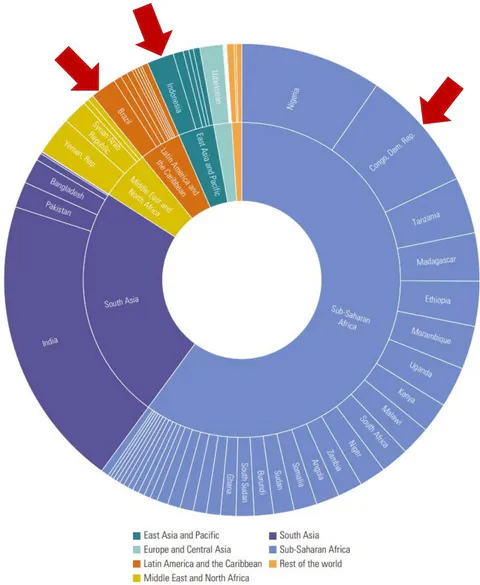
Source: World Bank, Poverty and Inequality Platform, https://pip.worldbank.org.
The difference between the Global North, in the case of the EU, and the Global South lies here. There is no denying that extreme poverty is concentrated in a geographically delimited place, the Global South. It is made up of countries that face great economic inequalities, unemployment, serious problems in relation to hunger, health, education, lack of city structures, and the marginalization of the minority and vulnerable, who make up the majority within these societies.
In the Global North, there will be another group of challenges, such as immigration, the energy transition, and overconsumption. By replicating its values, if ecological and environmental justice is not taken into account, the EU could have terrible adverse effects, particularly in the social sphere, by affecting the basic economy of several cities and, consequently, the jobs that sustain that economy.
The figure above and the countries with the arrows, Brazil, Indonesia and Congo, are significant. All three have high levels of extreme poverty and are among the four countries that export the most native tropical timber (ITTO, 2024, p.24). This trade is already facing a reduction due to the new EU regulation (Regulation on Deforestation-Free Products). In fact, in both the Impact Assessment and the public consultation process (European Commission, 2021), there was no system of proactive governance in these countries, summoning them to debates on the problem of deforestation and environmental degradation. Furthermore, through the Brussels Effect, the EUDR will have the capacity to affect the economy of the Global South and cause unexpected spillovers.
V. DISCUSSION
To address sustainable development's conceptual and applicability inaccuracies, it is necessary to strengthen sustainability by densifying its definition in the environmental and social dimensions and considering the biases arising from cultural differences and ecological justice (Ramcilovic-Suominen & Pülzl, 2018). It should also be noted that the EU's application of sustainable development in the legislative sphere has not yet achieved strong ecological and environmental justice sustainability, as it does not have inclusive governance.
The EUDR's example shows that governance has been fragmented. Despite following the prior rites of the Impact Assessment and public consultations (European Commission, 2021), no proactive diligence towards the countries that the EUDR will most impact was found in the reports and on the European Commission's websites.
Similarly, no documents were found that discussed forestry terms in each of these countries to understand the real problems of deforestation and forest degradation. It is important to note that each country has its complex forestry peculiarities, depending on the biomes and forestry guidelines that make them up.
The EU, in building a trade and forestry policy aimed at sustainable development and combating climate change while preserving forests, as in the case of the EUDR, could have given greater importance to the governance of the Global South. Firstly, given the Brussels Effect, the countries of the Global South would be the recipients of this normative text, and their economic bases eminently depend on the primary products provided by the EUDR. Secondly, because they are countries with different forestry systems and have the world's most extensive tropical forests, which suffer most from deforestation and forest degradation, they should be asked about the natural causes of these problems.
Not delving into the real causes of deforestation and forest degradation will make the regulation less effective. Governance based on the principles of NEPE, Non-Regression, Ecological Progress, EU Ecological Responsibility, and Leaving no one behind was not enough in this case.
VI. CONCLUSION
The existence of the EUDR is necessary to combat climate change, and the EU has been a leader in implementing an ambitious and sustainable agenda. The Brussels Effect as a mechanism for promoting sustainability internationally is a possible way forward.
However, for spillover effects to be reduced, compliance with the principles of NEPE, non-retrogress, ecological progress, and EU ecological responsibility, as well as leaving no one behind in the legislative phase of prior governance, is essential. Without these elements, the effectiveness of any EU regulation aimed at the environment could be tainted by distorted views of the problem to be tackled. This is because the reality faced in the Global South is different and more complex when the triple conjunction of "environmental, economic and social" is evaluated.
"Exporting" normative environmental texts through the Brussels Effect without considering the reality of each of the countries and blocs of the Global South will not achieve ecological and environmental justice. It will also lead to spillovers, exacerbating the differences between the Global North and disrespecting the abovementioned principles.
Consolidating a Committee within the EU structure that thoroughly assesses the Brussels Effect and its spillovers could be essential for enforcing the principles of NEPE, EU Ecological Responsibility and Leave No One Behind.
Footnotes
A possible approach to the issue is from the perspective of the principle of common but differentiated responsibility. (p.4) ↩
On the subject, Soromenho-Marques describes that each of the three pillars of the sustainability triangle "has a specific nature, they are qualitatively different and cannot be amalgamated into a numerical equality, which would conflict with their particular essence". See: Marques, V. S. (2005). Metamorphoses: between collapse and sustainable development. Europa-América, Portugal. (p.4) ↩
It can be conceptualized as spillover. (p.2) ↩
"Leave no one behind" is a principle has been implemented by the EU's 2030 Agenda. (p.1) ↩
TEU, Article 3° (3): The Union shall establish an internal market. It shall work for the sustainable development of Europe based on balanced economic growth and price stability, a highly competitive social market economy, aiming at full employment and social progress, and a high level of protection and improvement of the quality of the environment. It shall promote scientific and technological advance. (p.3) ↩
Held at the Juncker Commission in 2017. (p.4) ↩