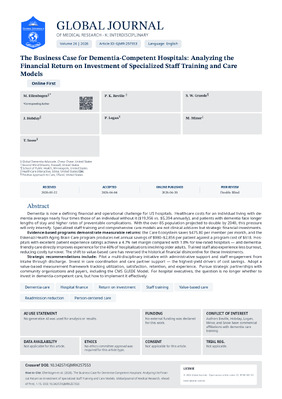

An Economic Argument for Specialized Cognitive Care Training in Hospitals and Medical Centers
The financial landscape of modern healthcare is increasingly defined by the growing prevalence of chronic conditions and complex patient populations. Among these, the rising incidence of various forms of dementia presents a profound challenge and, simultaneously, a strategic opportunity. Yearly average healthcare costs in the US for an individual living with dementia, $19,956, were found to be nearly quadruple the costs for an individual without dementia, $5394.1 This immense financial burden on the healthcare system is often mirrored by a severe personal financial crisis for affected individuals and their families. For example, within the first eight years of diagnosis, people living with dementia can see their out-of-pocket healthcare spending more than double, while their net worth can decline by over 60%.2 This acute financial distress is so significant that it leads to a near doubling of enrollment in Medicaid, the safety-net program for individuals living in poverty.2 This personal financial crisis for those living with dementia and their care partners is not a problem external to the hospital but a direct driver of financial challenges to hospital systems around the country. When a patient’s net worth is eroded and they transition to public assistance programs like Medicaid, the hospital’s payer mix can shift toward lower-reimbursing sources. This transition creates a hidden operational burden, as the hospital must manage a portfolio of more complex claims with diminished revenue potential per patient and a higher risk of uncompensated care. Therefore, addressing the financial viability of a hospital’s care for this population requires a holistic understanding that the patient’s financial stability is intrinsically linked to the health system’s bottom line. The profound impact of dementia on hospital finances is not limited to the payer mix. Patients living with dementia present with a unique set of challenges that can directly and negatively affect key operational metrics. Data from a large national cohort study show that patients with dementia faced a substantially higher risk of mortality within 30 days of discharge.3 The higher prevalence of complex comorbidities further complicates care for patients living with dementia, contributing to longer lengths of stay and more intricate treatment pathways. For instance, patients with dementia have significantly higher rates of conditions such as heart failure, chronic kidney disease, hypertension, and ischemic heart disease compared to their non-dementia counterparts.3 With these factors in mind, the authors assert that there is a currently unmet need for collaborative care management programs for dementia due to the significant increase in dementia-related care costs. Specifically, specialized staff training in dementia-friendly practices should be seen as a strategic intervention to help reduce costs. By equipping staff with skills to help reduce patient agitation (one contributor to falls, injuries, and delirium), hospitals may prevent some costly complications.4 Readmissions incur significant costs for which hospitals may not be fully reimbursed, especially under emerging value-based payment models.5 The sheer number of dementia patients with comorbid conditions means these individuals require more complex and expensive care, making any intervention that reduces unnecessary utilization a direct contributor to improved fiscal resilience.3 Current estimates show that patients living with dementia receive their diagnosis, on average, 4 years into active symptoms of the disease.6 During this significant span between onset of symptoms and diagnosis, hospital resources are often used ineffectively, incurring large unnecessary costs.
Foundational Interventions and Evidence-Based Care Models
Recognizing and responding to the substantial financial and operational challenges posed by dementia care, several evidence-based care models and staff training programs have been developed. These interventions move beyond a narrow focus on pharmacological solutions to embrace person-centered, collaborative approaches that help address the full spectrum of patient and care partner needs. The goal is to not only equip staff with more effective evidence-based approaches to care, but to also lower the length of time a patient is hospitalized, reduce the need for the use of antipsychotic medication interventions, and ultimately reduce the costs associated with this patient mix—including readmissions. The key is providing staff with training in proven, evidence-based training programs to accomplish these outcomes.
A. Typology of Staff Training Initiatives
Effective staff training is not a uniform concept, but a diverse set of pedagogical models tailored to different audiences and objectives. One key model in dementia education is the Train-the-Trainer (TTT) approach, which is designed to increase the reach of dementia training by empowering a core group of trainers to educate their peers and other staff members. One controlled pilot of a TTT program for hospital staff found lower staff-rated agitation among trained-ward patients at day 4 to 5, an effect that was not maintained at the day 8 measurement, where the between-group difference was not significant.4,7 The effectiveness of this TTT model stems from its ability to be tailored to local contexts and to foster a team-based approach where skills are shared and embedded into daily practice.4
In contrast, Expert-Led Programs involve direct training from clinical or lived-experience specialists. In one study, a two-day interactive program for inpatient nurses, led by an expert, resulted in a reduction in role strain and improved confidence for the participants involved.4 Both TTT models and expert-led models were shown to improve staff knowledge and confidence.4
Given economic pressures on hospitals, Online Training and Certification Programs have also become an important aspect of staff education throughout the country. Evidence-based online programs offer scalability, consistent content delivery, and flexibility for staff to complete modules at their own pace, which can be particularly valuable for hospitals with high staff turnover or geographically dispersed teams. However, online formats often lack the interactive, hands-on elements of live training, such as role-playing, immediate feedback, and the nuanced observation of behavioral cues of patients with dementia.8 Studies comparing online to in-person dementia training have produced mixed results. While knowledge acquisition has been shown to be comparable between modalities in some studies,8 other research has found greater improvement following in-person training over six months for primary care nurses.4 Staff in mixed-methods research have consistently reported that interactive face-to-face learning methods are most effective for behavior change, with some identifying passive methods such as e-learning and self-directed workbooks as barriers to applying knowledge in practice.8 Many organizations choose to adopt a blended approach, using online modules to provide foundational knowledge while reserving in-person sessions for practical application and interdisciplinary discussion.
The most effective hospital initiatives may integrate these approaches into a multi-component, blended, and interdisciplinary framework where online modules provide foundational knowledge while reserving in-person sessions for practical application and interdisciplinary discussion. For example, Wisconsin-based Fort HealthCare created an interdisciplinary task force that includes staff from nursing, radiology, and volunteer services to ensure broad organizational buy-in and a holistic approach to dementia-friendly planning.9 This inclusive model, which also connects with community organizations and incorporates the perspectives of patients and families, ensures that a commitment to dementia-friendly care is not confined to a single department but becomes a part of the hospital's operational ethos.9
B. Core Elements of Comprehensive Dementia Care Models
The financial gains from specialized training are most pronounced when staff skills are integrated into comprehensive care models that extend beyond the hospital walls. These models are built on several core principles:
Care Coordination and Navigation: Programs like the Care Ecosystem and the Benjamin Rose Institute (BRI) Care Consultation utilize dedicated navigators or care consultants—often social workers, nurses, or other specialists—to coordinate complex care plans for patients and their care partners.10 This systematic approach ensures that patients' needs are met across different care settings. Although a recognized approach for families, care coordination is not necessarily a valid approach for education or skill training of hospital staff members.
Care Partner Support: Research demonstrates the critical role of family care partners, who provide an average of 45 hours of unpaid care per month for people with dementia, compared to 13 hours for their peers.2 Programs like the Living With Dementia Program, which was adapted from the Care Ecosystem model, are explicitly designed to enhance care partner self-efficacy and reduce their burden.11
Standardized Staff Training. Central to the authors' recommendations for the effectiveness of comprehensive dementia care models in professional settings is the implementation of standardized, evidence-based staff training. Structured programs ensure that all personnel, regardless of role or experience level, acquire a consistent foundation of knowledge and practical skills in dementia care. Evidence indicates that such training improves staff confidence, reduces reliance on pharmacological interventions, and enhances patient outcomes, including fewer behavioral incidents and higher satisfaction among care partners.
Psychosocial and Non-Pharmacological Interventions: The shift from a purely "deficit-oriented biomedical model" to one of person-centered care (PCC) is fundamental to these programs.12 These interventions, including emotional and social support, home-based exercise, and information about the condition, have been shown to be the most cost-effective.12
In summary, the characteristics associated with effective hospital dementia training include person-centered care approaches, interactive and varied teaching methods, and supporting conditions such as champions, action plans, and care policies; blended, face-to-face delivery with interactive components was found more effective than online-only formats. Sustained change across the organization, however, was demonstrated in a minority of studies and remains inadequately evaluated.13
Quantifying the Financial Return on Investment (ROI)
The authors' strategic argument for investing in dementia-friendly initiatives rests on a compelling body of evidence to help reduce costs and provide a reasonable return on investment (ROI). This evidence demonstrates that specialized training and comprehensive care models generate a positive financial return through a combination of direct cost savings from reduced utilization and indirect benefits related to patient experience and workforce management.
A. Direct Cost Savings from Proactive Education
The most direct financial benefit of these programs is their ability to reduce the need for high-cost, avoidable care. In one research study that investigated the value of the Care Ecosystem model, the demonstrated mean savings was $475.80 per member per month over a 12-month period compared to a control group.14 These significant savings were directly attributed to a reduction in ED, outpatient, and professional visits, validating the program's effectiveness in shifting care from reactive, expensive settings to proactive, managed ones.14
Similarly, in a separate study focused on a comprehensive interdisciplinary dementia care program at Eskenazi Health in Indianapolis, the annual program cost was approximately $618 per patient, with net annual savings per patient of between $980 and $2,856.15 The savings were substantial and were achieved by reducing symptom burden and avoiding costly hospitalizations and ED visits.15
This evidence points to a single, powerful mechanism: a shift in the care model from reactive intervention to proactive prevention through staff education. A single ED visit or inpatient stay costs exponentially more than a month of coordinated care management. The documented savings are a direct testament to the value of investing in the upfront costs of training and care coordination to prevent a costly extension of the patient's stay and avoid unnecessary high-acuity care. The financial viability of these interventions stems from their capacity to act as a cost multiplier, where a relatively small investment in training and coordinated care generates outsized savings by preventing or delaying the need for the most expensive forms of care.
B. The Value for Hospitals in Delaying Long-term Care Placement
The financial case for these programs extends beyond short-term utilization metrics to the long-term benefit of also delaying institutionalization to long-term care settings. In the home setting, for example, a multicomponent caregiver intervention, which included emotional support and home-based exercise, resulted in a total cost decrease of approximately $11,360.87 and was found to be cost-effective with a 96% probability.12 A major factor in these savings was the program's ability to delay nursing home admission and reduce the use of social and health care resources.12
In the hospital setting, a care model that provides the training and support needed to keep a patient at home for longer creates a significant win-win for both the medical center and family. Although the Genworth/CareScout Cost of Care Survey does not separately track memory care as a distinct category, industry analyses consistently estimate that memory care runs 20–30% higher than standard assisted living, which had a national median of $74,400 per year in 2025,16 placing memory care in the estimated range of $89,000–$97,000 annually. The lifetime cost of care for a person living with dementia exceeds $405,000, with approximately 70% of those costs borne by families through unpaid caregiving and out-of-pocket expenses.17 When a hospital's care model enables a patient to remain in their home, it reduces the patient's reliance on high-cost, long-term care and diminishes the immense financial burden on families and government programs like Medicaid.18 These outcomes position hospitals as community-focused providers and strengthen their performance under value-based payment arrangements, including the GUIDE Model from Center for Medicare & Medicaid Services (CMS).19
C. The Holistic ROI Engine: Patient Experience and Workforce Management
The direct cost savings from reduced utilization and delayed institutionalization represent only part of the full financial picture. The most successful initiatives also generate powerful indirect financial benefits that improve the hospital's overall financial health and operational sustainability.
A strong link exists between patient-reported experience and hospital profitability. Research from Deloitte found that hospitals with "excellent" patient ratings had a net margin of 4.7%, on average, compared to just 1.8% for hospitals with "low" ratings.20 This financial correlation is driven by several mechanisms, including increased patient volume, strengthened customer loyalty, and improved reputation through word-of-mouth referrals.21,22 Older adults account for about 40% of hospital stays,23 so gains in this group's experience apply to a large share of a hospital's patient volume.
This financial viability is further amplified by improved workforce management. Strained staff resources due to under-resourced patient care lead to a stressful work environment, which fosters employee burnout and costly turnover.24 The financial burden of recruiting, onboarding, and training new staff is a heavy and recurring cost that strains an already precarious revenue cycle.24 Training staff on dementia-friendly care, particularly aspects that enhance nurse-patient engagement, reduces the stress associated with caring for complex patients and improves family satisfaction with the hospital or medical center. This, in turn, improves staff morale and retention, creating a self-reinforcing cycle. A highly engaged staff provides better care, which improves patient experience, and better patient experience is linked to higher profitability.20 The ROI is not a single, isolated metric but a holistic improvement to the hospital's reputation, workforce, and financial performance.
| Model Name | Annual Program Cost per Patient | Net Annual Savings per Patient | Primary Source of Savings |
|---|---|---|---|
| Aging Brain Care (ABC) Program 15 | ~$618 | ~$980 to $2,856 | Reduced hospital admissions and ED visits. |
| Care Ecosystem Program 14 | ~$975.36 | ~$4,734.24* | Fewer ED, outpatient, and professional visits. |
| Multicomponent Caregiver Intervention 12 | Not specified | ~$11,360** | Delayed nursing home admissions, reduced social and health care costs. |
The ROI of Leading Dementia Care Models
Note. All financial figures are reported in U.S. dollars. The figures, time frames, and methodologies vary across the cited studies, and direct comparison between programs should be made with caution. Program structures, patient populations, settings, and measurement approaches differ substantially.
*$4,734.24 is the net annual savings per patient: the study's modeled difference-in-differences reduction in cost of care, $475.80 per member per month, minus the program cost of $81.28 per member per month, which equals $394.52 per member per month, multiplied by 12 months.14 The study reports the gross cost-of-care savings ($5,709.60 per year) and the program cost ($975.36 per year) separately. The same study also reports an overall return on investment of 5.85, a broader measure that adds risk-adjusted payment revenue to the cost-of-care savings; that broader figure is not used here.
**Total cost decrease of approximately $11,360.87 converted from the original study value of €10,437, reported in Birkenhäger-Gillesse et al.12 The figure represents a one-time total cost reduction observed during the multi-year study period, not a recurring annual savings. The intervention was a multicomponent caregiver training program; the cost reduction was driven by reduced healthcare and social care utilization over the first year following the intervention, with a trend toward fewer nursing home admissions.
| Benefit Category | Financial Metric | Quantitative Evidence | Causal Pathway |
|---|---|---|---|
| Direct Cost Savings | Reduced Utilization | Care Ecosystem showed mean savings of $475.80 per member per month (PMPM) through fewer ED and outpatient visits.14 | Care Coordination -> Proactive management -> Fewer avoidable, high-cost visits. |
| Indirect Revenue Gain | Higher Patient Experience Ratings | Hospitals with "excellent" ratings had a 4.7% net margin vs. 1.8% for "low" ratings.20 | Improved care -> Higher patient satisfaction -> Increased loyalty, referrals, and patient volume. |
| Workforce Efficiency | Lower Staff Turnover and Burnout | Strained resources and high patient-to-staff ratios lead to burnout and costly turnover.24 | Specialized training -> Increased staff confidence and reduced stress -> Improved morale -> Higher retention -> Reduced recruitment and training costs. |
| Market Positioning | Alignment with Payer Goals | CMS GUIDE Model aims to reduce Medicare/Medicaid expenditures by lowering hospitalizations and ED use.19 | Patient-centered care models -> Alignment with value-based payment goals -> Increased opportunity for new revenue streams. |
Key Financial and Operational Drivers of the Business Case
Strategic and Operational Considerations
While the financial case for specialized training is compelling, the implementation and measurement of these initiatives are not without complexity. An expert analysis must address the inherent challenges of proving a direct causal link and the barriers to successful implementation.
A. The Challenges of Measuring ROI in Healthcare
Quantifying the return on investment in healthcare is uniquely difficult. The financial return often lies beyond the reach of traditional financial metrics, with challenges in formally distinguishing ROI from cost-benefit analyses.25,26 It is nearly impossible to isolate the impact of a single intervention in a complex system where a patient's improved outcome may be influenced by new medications, coordinated care, and community-based support all at once. This challenge is compounded by the fact that the most valuable benefits—such as a nurse's compassionate care or the long-term trust a hospital builds within its community—are intangible and resist easy capture in a spreadsheet.
The foundation of any robust ROI measurement is high-quality, integrated data, which many healthcare organizations lack. Critical information is often fragmented across incompatible systems, with patient data in Electronic Health Records (EHRs), financial data in billing systems, and quality metrics in departmental databases. This lack of a unified data infrastructure makes comprehensive analysis difficult and may lead to questionable results. The challenge here is not that interventional programs lack a return but that traditional measurement methods are ill-equipped to capture their full value.27 A hospital's financial analysis must therefore shift from a narrow, fee-for-service perspective to a value-based care framework that tracks a broader portfolio of metrics, including patient utilization, caregiver satisfaction, staff retention, and patient experience scores.27
B. Barriers to Implementation
Beyond measurement, there are real-world operational barriers to launching and scaling these initiatives. On the staff side, common challenges include a lack of dedicated time for training and difficulty in stepping away from clinical care to attend training sessions, underscoring the need for flexible, self-paced or on-the-job learning models.4,8
At the organizational level, initiatives can fail due to a lack of institutional support and dedicated financial resources.8 Executives must provide support from the outset and allocate funds not just for the initial training but for ongoing education and equipment.9 The traditional fee-for-service model creates a disincentive for implementing programs with services like case management that are often not reimbursed.10 However, these very challenges are evolving into key opportunities.
Reviews of dementia-care training report small and inconsistent effects on resident aggression and on staff wellbeing, of variable study quality, with gains that often fade after the intervention.28
Navigating the Shift to Value-Based Care
The healthcare landscape is in a fundamental shift, moving away from a traditional fee-for-service model toward value-based care. This transition directly supports the business case for specialized dementia care. CMS is actively piloting new payment structures, such as the GUIDE Model, which focuses on comprehensive, coordinated dementia care.19 This model aims to reduce Medicare and Medicaid expenditures by lowering hospitalizations, ED use, and the need for post-acute or long-term care.19 By aligning with these new models, health systems can overcome the financial barriers to implementing and scaling dementia-friendly initiatives and can even create new, sustainable revenue streams that reward better patient outcomes.
Conclusion and Strategic Recommendations
The analysis indicates that specialized staff training and comprehensive care models for individuals living with dementia are not merely clinical best practices, but financially sound strategic investments. The financial return is derived from a combination of direct cost savings achieved through reduced utilization and powerful indirect benefits that improve patient experience, staff morale, and market reputation. While traditional fee-for-service metrics struggle to capture this holistic value, the shift to value-based care models and emerging payment structures provides a clear financial pathway forward.
Based on this evidence, health system executives should consider implementing the following multi-component, blended, interdisciplinary strategic recommendations to build a successful and financially viable dementia-friendly hospital:
Pilot a Multi-Disciplinary Initiative: Do not limit the focus to nursing departments. Form an interdisciplinary task force with administrative support from the outset, engaging staff from every department that interacts with patients, from intake to discharge.9 This approach ensures broad organizational buy-in and embeds dementia-friendly principles into the hospital's culture.
Invest in Care Coordination and Care Partner Support: The data consistently demonstrates that the most significant cost savings come from preventing institutionalization and reducing avoidable utilization. Allocate resources for dedicated care navigators and programs that provide ongoing support and education to family caregivers, recognizing their immense value as partners in care.10
Leverage a Value-Based Care Framework: Recognize that the ROI for these initiatives cannot be captured by a single financial metric. Shift the focus of analysis to a portfolio of key performance indicators that includes patient utilization, care partner satisfaction, staff retention rates, and patient experience scores.27 This will provide a more comprehensive and accurate picture of the program's value.
Pursue Strategic Partnerships: Connect with community-based organizations, dementia-competent coalitions, and government payers to align with new payment models like the CMS GUIDE Model. Such collaborations can provide not only valuable resources and expertise but also access to new revenue streams that are directly tied to the very outcomes these programs are designed to achieve.29