Neural Networks and Rules-based Systems used to Find Rational and Scientific Correlations between being Here and Now with Afterlife Conditions
Neural Networks and Rules-based Systems used to Find Rational and
Article Fingerprint
ReserarchID
9JCAY
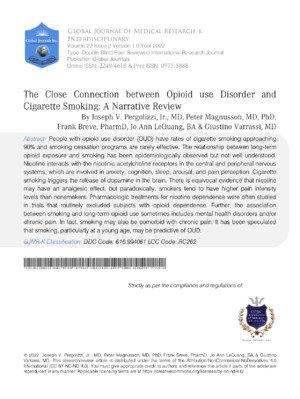
People with opioid use disorder (OUD) have rates of cigarette smoking approaching 90% and smoking cessation programs are rarely effective. The relationship between long-term opioid exposure and smoking has been epidemiologically observed but not well understood. Nicotine interacts with the nicotinic acetylcholine receptors in the central and peripheral nervous systems, which are involved in anxiety, cognition, sleep, arousal, and pain perception. Cigarette smoking triggers the release of dopamine in the brain. There is equivocal evidence that nicotine may have an analgesic effect, but paradoxically, smokers tend to have higher pain intensity levels than nonsmokers. Pharmacologic treatments for nicotine dependence were often studied in trials that routinely excluded subjects with opioid dependence. Further, the association between smoking and long-term opioid use sometimes includes mental health disorders and/or chronic pain. In fact, smoking may also be comorbid with chronic pain. It has been speculated that smoking, particularly at a young age, may be predictive of OUD. While smoking is also associated with other forms of substance abuse, the association between OUD and tobacco is particularly intriguing and likely involves common neurobiological pathways.
Joseph V. Pergolizzi. 2026. \u201cThe Close Connection between Opioid use Disorder and Cigarette Smoking: A Narrative Review\u201d. Global Journal of Medical Research - K: Interdisciplinary GJMR-K Volume 22 (GJMR Volume 22 Issue K2): .
Article file ID not found.
Crossref Journal DOI 10.17406/gjmra
Print ISSN 0975-5888
e-ISSN 2249-4618
The methods for personal identification and authentication are no exception.
Total Score: 135
Country: United States
Subject: Global Journal of Medical Research - K: Interdisciplinary
Authors: Joseph V. Pergolizzi, Peter Magnusson, Frank Breve, Jo Ann LeQuang, Giustino Varrassi (PhD/Dr. count: 0)
View Count (all-time): 121
Total Views (Real + Logic): 1497

Total Downloads (simulated): 30

Publish Date: 2026 01, Fri
Monthly Totals (Real + Logic):
Neural Networks and Rules-based Systems used to Find Rational and
A Comparative Study of the Effeect of Promotion on Employee
The Problem Managing Bicycling Mobility in Latin American Cities: Ciclovias
Impact of Capillarity-Induced Rising Damp on the Energy Performance of
People with opioid use disorder (OUD) have rates of cigarette smoking approaching 90% and smoking cessation programs are rarely effective. The relationship between long-term opioid exposure and smoking has been epidemiologically observed but not well understood. Nicotine interacts with the nicotinic acetylcholine receptors in the central and peripheral nervous systems, which are involved in anxiety, cognition, sleep, arousal, and pain perception. Cigarette smoking triggers the release of dopamine in the brain. There is equivocal evidence that nicotine may have an analgesic effect, but paradoxically, smokers tend to have higher pain intensity levels than nonsmokers. Pharmacologic treatments for nicotine dependence were often studied in trials that routinely excluded subjects with opioid dependence. Further, the association between smoking and long-term opioid use sometimes includes mental health disorders and/or chronic pain. In fact, smoking may also be comorbid with chronic pain. It has been speculated that smoking, particularly at a young age, may be predictive of OUD. While smoking is also associated with other forms of substance abuse, the association between OUD and tobacco is particularly intriguing and likely involves common neurobiological pathways.
We are currently updating this article page for a better experience.
Lorem ipsum dolor sit amet, consectetur adipiscing elit. Ut elit tellus, luctus nec ullamcorper mattis, pulvinar dapibus leo.