
I. INTRODUCTION
According to UNDP (2014), the number of people in absolute poverty has been turning down for around 25 years, yet in Africa it is still increasing. The challenge of poverty reduction in Africa is of a different order from that elsewhere and will require different strategies (Berg E., 1981). During the present decade African growth has accelerated, although not sufficiently rapidly to prevent continuing divergence. This may mark a decisive turnaround in the region's economic performance (World Food Program, 2006).
On average over the period 1960-2000 Africa's population-weighted per capita annual growth of GDP was a mere (Nuno, 2001). It stagnated while other regions experienced accelerating growth. Indeed, between 1980 and 2000 the annual rate of divergence was a surprising . Africa's growth failure has attracted competing explanations. During the 1980s the World Bank diagnosed the problem as inappropriate economic policies, offering the first clear statement of this position. Because Africa is land-abundant yet low-income, natural resource endowments loom large (Berg, 2016).
Rwanda also has been following a fertile pathway towards poverty reduction. After independence, she received a significant amount of foreign aid which raised the GNP from 5% in 1973 to 22% in 1991 and accounted for more than three-quarters of capital expenditures (D. Malunda & S. Musana, 2012). Aid-financed health care improved and infant mortality was reduced. Aid also financed reforestation and land reclamation, and agricultural productivity increased. High world prices for coffee, tea, and tin, the three core Rwandan export products, created rising wealth.
It is paradoxical, noted Golooba M. (2009) for a short of natural resources, landlocked country, one of Africa's poorest and in a process of rapid change, and impossible to understand the reasons behind the rapid changes without considering its historical backdrop of extreme exclusionary politics based on the dissemination of ethnic hatred. During the years 1994-1998, the country was in shambles and trust had to be rebuilt helped with donors who mainly supplied emergency support channeling money through Non-Governmental Organizations.
To ensure a rapid growth of economy a series of policy were undertaken including working in associations and cooperatives for work effectiveness and fostering investment. The Financial Sector Development Strategy outlines in detail how the financial sector will be strengthened, improving access to financial services for firms of all sizes, MINECOFIN (2013). Low income population however were refrained from.
As reported by Rwanda Development Board (RDB), despite the contribution of Rwandan Government supported the establishment of Village Group Savings Cooperatives as a way of providing financial accessibility to rural Rwandans who cannot afford big loans from the banking institutions in order to support their micro business, performance of SME's in the rural areas is still low (RDB report, 2014). Low income people have got very limited access to financial loans. They are incapable to endure microfinance's loan standards, broader collaterals and increasing interest rates refrain from loan access.
According to Sibomana and Shukla(2016), VSLAs have proven to be very effective in accelerating growth and building local capacity. VSLA members have access to highly responsive and safe financial services, and this enables them to upscale economic activities, improve household health and welfare, acquire business skills, educate their children, and improve the quality of their social lives both within the family and the surrounding community.
Non-governmental organizations engage in VSLA to organize low income generating communities to access money services. Plan International Rwanda has been supporting women and youth to enhance households' economy through the establishment of Village Savings and Loan Association (VSLA). During afive years long period his organization has to some extent improved the socioeconomic status of house hold members and empowered the woman in its operation area of Bug sera District.
II. OBJECTIVES
The general objective of this study was to assess the contribution of VSLA's methodology on household welfare improvement of Bugesera District. Specifically,
To analyze the effectiveness of determinants of VSLA in Bugesera District.
To assess the level of indicators of household welfare improvement in Bugesera District.
To establish the relationship between households welfare and VSLA in Bugesera District.
III. LITERATURE REVIEW
Bradshaw (2006) opined that theories of poverty may originate from five sources including individual deficiencies, cultural belief systems that support subcultures in poverty, political-economic distortions, geographical disparities or cumulative and circumstantial origins. This has eventually resulted in a cyclical poverty.
The vicious cycle of poverty states that the poor man is poor because he is poor or a country is underdeveloped because it is underdeveloped. The theory states that there are circular relationships known as the "vicious cycle of poverty" that tend to perpetuate the low level of development in less developed countries (LDCs). The trajectory is that poverty is caused by low income. Low income engenders low savings and this in turn leads to low investment. The latter provokes low productivity and the cycle continues.
According to Jhingan (2003), the basic vicious cycle stems from the facts that in LDCs total productivity is low due to deficiency of capital, market perfections, economic backwardness and underdevelopment. Addressing capital deficiency, VSLAs interventions break the cycle of poverty at income phase for poor members.
According to the Canadian Fact Book on Poverty (1984) the most learned perspective equates poverty with the inability to participate in society with dignity. According to classical economist Adam Smith poverty is a lack of those necessities that the custom of the country renders it indecent for creditable people, even of the lowest order, to be without.
The Nobel Prize laureate Amartya Sen (2002) argues that the poor cannot participate adequately in communal activities, or be free of public shame from failure to satisfy conventions. VSLA's pro-poor background are designed to create a society within which low income people flourish and locally work to address financial deficiency and subsequently tackle household welfare and interpersonal rapports, (Ashe, 2002).
Robert Chambers (2006) in the paper named "Power, knowledge and policy influence: reflections on an experience" said that poverty is taken to mean depends on who asks the question, how it is understood, and who responds. Through this perspective, Robert C. divided it into different clusters:
a. Income poverty: This needs no elaboration. When many, especially economists, use the word poverty they are referring to these measures. Poverty is what can be and has been measured, and measurement and comparisons provide endless scope for debate.
b. Material lack or want: Besides income, this includes lack of or little wealth and lack or low quality of other assets such as shelter, clothing, and furniture, personal means of transport, radios or television, and so on. This also tends to include no or poor access to services.
c. Capabilities deprivation: Derives from Amartya Sen, referring to what we can or cannot do, can or cannot be. This includes but goes beyond material lack or want to include human capabilities, for example skills and physical abilities, and also self-respect in society. A fourth cluster takes a yet more broadly. Development thus can be seen as shifting from ill-being to wellbeing with equity, with interventions to enhance wellbeing possible at any of the five points as illustrated by Robert C.
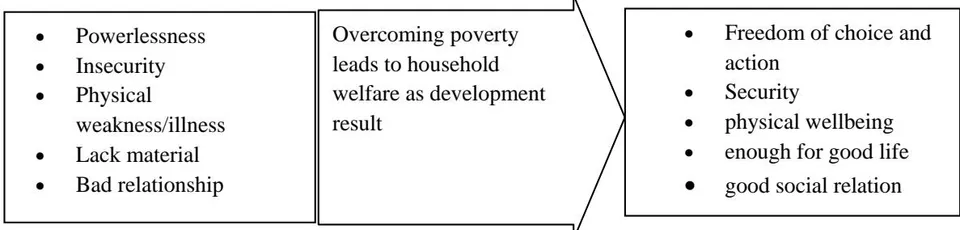
Ill-being and wellbeing are widely used in addition to poverty and wealth, which are only one part of them. It is for repeated participatory processes to enable local people, especially the poorest, most marginalized and most vulnerable, to analyze and monitor the quality of their lives, and for this to be fed back regularly to policy-makers. Sometimes poverty measurement uses monetary system, this makes the capability approach consider money as an individual well-being instead focuses on indicators of freedom to live a value life.
In poverty also, we look the concept of social exclusion where describe the processes of marginalization and deprivation that can arise even in rich countries with comprehensive welfare provisions. The social exclusion focuses intrinsically on the process and dynamics that allow deprivation to arise and persist. Social exclusion points to excluders as well as excludes and this describe a contrast to a world without analyzing or attributing responsibility. Attributing responsibility are possible through the participatory approach (PA) which aims to get people themselves to participate in decision making about what it mean to be poor and the magnitude of poverty. And, the PA help to define an appropriate minimum basket of commodities for the monetary approach, a list of basic capabilities in the capability approach and the social exclusion can be applied.
Hiilamo (2012) depicts solidarity as a fellowship of responsibilities and interests. Solidarity is an act of individual virtue, but it can find expression at various institutional levels, family, neighborhood, voluntary organization, municipality, nation state or international entity.
According to Ashe (2002), VSLAS standards are inspired by and built on the idea of solidarity, which at least hypothetically, has brought neighboring residents together in groups to improve members' financial condition. Upon successful implementation, VSLA impacts household's safety.
IV. RESEARCH DESIGN
To examine the contribution of VSLA to the household welfare and women empowerment in Rwanda, the researcher conducted a descriptive research where VSLA approaches was identified and analyzed in order to find their contribution to the household welfare.
The descriptive research describes characteristics of a population or phenomenon being studied. The study used descriptive method because the researcher based on answers from respondents to describe how VSLA is used as an approach for poverty alleviation leads to improved household welfare conditions.
The study based on information gathered from VSLA beneficiaries in Ruhuha sector, using questionnaires which was distributed to direct beneficiaries and staff including local leaders and non-Governmental Organizations staff, respondents were selected and administered sharp questionnaires and structured interview. Secondary data was collected from publications and reports statements and were analyzed to draw valid conclusion.
V. TARGET POPULATION
The whole population who have been benefiting from VSLA Plan International Rwanda intervention was 300 individuals, including 58 males and 237 females from 10 VSLAs group and 5 local leaders, staff and partners (2 males and 3 females) who had a close involvement in VSLA program as shown in the table below.
| Categories of respondents | Males | Females | Total population |
| Beneficiaries of VSLA | 58 | 237 | 295 |
| Staff, local leaders and partners | 2 | 3 | 5 |
| Total | 60 | 240 | 300 |
a) Primary data
Primary data comprise the information that the researcher gathered directly from Ruhuha sector of Bugesera District through respondents as first-hand information collected using tools such questionnaires and interviews.
b) Secondary data
The researcher analyzed information from reports and other publications available from Bugesera District, internet, books and articles containing relevant data which provided reliable information to conduct properly this research. The researcher also considered previous researches and official statistics sources to support field data.
c) Sampling techniques
The researcher selected respondents from beneficiaries' lists, local leaders, stakeholders and staff members, using proportionate stratified random sampling for each number of populations to get equal chance of being selected.
d) Stratified sampling technique
The number of sampled was proportional to the number of members of VSLAs in Ruhuha Sector and staff, local leaders and partners in matter. To determine the ideal sample size from our population, we followed the Slovin's formula:
Where: n = samples size which is VSLA members 75 respondents e = margin of error/the margin error estimated is 10% or 0.1.
N= total population which is 300 persons who received the loan from VSLAs and 5 local leaders, Plan staff and stakeholders were used as respondents
| Categories of population under study | N population of strata(Np) | Sample of strata(npc) |
| Beneficiaries of VSLAs in Ruhuha sector | 300 | 75 |
| Staff,local leaders and partners | 5 | 5 |
| Total | 305 | 80 |
The sample size of the research representing 80 respondents distributed in all strata of respondents in close involvement of VSLAs in Bugesera District corresponding to 100% as N targeted population
e) Purposive sampling techniques
This research sample was determined based on the title role, size of respondents group and expected information significance they have, 75 respondents are direct beneficiaries who benefited the VSLA from the beginning up to date of research, 5 leaders and staff are day to day deal with the implementation of VSLA in Ruhuha Sector. Both respondents contribute to complete information provision.
VI. DATA COLLECTION INSTRUMENTS
a) Questionnaire
The researcher established and used a questionnaire to collect data from VSLA beneficiaries on how they perceive its contribution, to poverty alleviation for a welfare conditions in Rwanda especially in Ruhuha Sector of Bugesera District, and regarding the profitability and sustainability of VSLA methodology.
b) Interview
The researcher designed a series of questions in a way that both qualitative and quantitative information got collected. Interview was given to key informants as Plan staff, stakeholders and local leaders.
c) Documentation
As a method, the researcher has analyzed evidences of social-economic indicators of improvement from Bugesera District reports, Plan International Rwanda and PAJER Project reports related to medical insurance cards, paying easily children school fees, access to food, newly built or rehabilitated house etc. The documentation guide was used for consistence purposes.
d) Validity
To ensure that the instrument measured what it was supposed to measure in this research, the questionnaire was checked by the researcher to ensure its validity. However, for further improvement, the questionnaire was presented to the supervisor of this work who is considered also as the research advisor.
e) Reliability
Pre-testing the questionnaire was done in order to ensure that it would really test what it was supposed to test: omission, irrelevance or ambiguities. Imperfection were corrected. Printed questionnaires was selected, issued and better responded quite concomitantly to avoid peer leverage or hierarchy influences while answering. The researcher practiced approachability to capture respondents' full trust and attention.
Hence, the pilot study to test the reliability of the instrument was conducted to some VSLA members and for this study 10 percent of the sample was taken for the pilot study. Ten respondents represented the sample and a questionnaire was administered to them to capture their views that helped to make the final friendly questionnaire.
VII. STATISTICAL TREATMENT OF DATA
The researcher used descriptive statistics to analyze quantitative and draw logical graphs. Primary data was also treated through appropriate software as Statistical Package for Social Science (SPSS 18), confronted with interviews and secondary data and reported using tables and graphs for easy understanding and interpretation. Content analysis questions were used to analyze open-ended questions. Hypotheses were verified through data analysis using Spearman's correlation coefficient to determine relationship between variables denoted and constrained as: -1 <= rs <= +1 In addition, we referred to Pearson's correlation coefficient using regression as statistical technique to determine the linear relationship between two or more variables. In its simplest (bivariate) form, regression has shown the relationship between one independent variable (X) and a dependent variable (Y), as explained in this formula:
VIII. ETHICAL CONSIDERATIONS
For ethical considerations, the researcher communicated local leaders and particularly target people the intention, process, settings and preserved respondents' anonymity by not mentioning their names while answering questions. Respondents were ensured that the research was for academic purpose and their answers would remain confidential.
IX. FINDINGS, DISCUSSIONS & RESULTS
This section relates the views, opinion and comment of the data collected from VSLAs' members as perinterview that was given to them on how to analyze the contribution of VSLA for Household welfare in Ruhuha Sector of Bugesera District.
a) Financial Capacity building of respondents on VSLAs in Ruhuha Sector
This subsection attempted to show trainings for VSLAs beneficiaries in Ruhuha Sector showed in the tables below:
| Frequency | Percent | ||
| Valid | VSLA's life cycle management | 75 | 100 |
| Training on how to fill the passbooks | 75 | 100 | |
| On how to share out (dividends) | 75 | 10 | |
| Financial management | 75 | 100 | |
| Business planning | 75 | 100 | |
| Entrepreneurship | 75 | 100 | |
The table above showed that all respondents (100%) agree with trainings that they received namely about, VSLA's life cycle management, passbooks filling, dividends share out, Financial management, Business planning and Entrepreneurship. This means that VSLAs have strong impact on household welfare in Bugesera district.
| Before joining VSLA | After joining VSLA | ||||
| Frequency | Percent | Frequency | Percent | ||
| Valid | In house | 51 | 68 | 0 | 0 |
| Bank account | 14 | 19 | 18 | 24 | |
| SACCO | 10 | 13 | 57 | 76 | |
| Total | 75 | 100% | 100 | 100% | |
Based on the table 4 above the largest number of respondents put their savings in bank account representing 19% of the total respondents; 68% of respondents conserved their money in house and 13% of respondents save their money in SACCO. After joining VSLA, none of respondents kept his savings at home.76% have joined SACCO and 24% are saving in commercial banks. This means that SACCO increased membership up to 63% and commercial bank increased by 5%. This evidenced that joining VSLAs has improved respondents' mindset for beneficiaries. They have learnt to save their money and avoid risks of mismanagement.
In addition, a good number has now accessed higher level banking.
| Before VSLA | After VSLA | ||||
| Frequency | Percent | Frequency | Percent | ||
| Valid | Food | 54 | 72% | 75 | 100% |
| Medical expenses/health | 35 | 47% | 75 | 100% | |
| Paid off debts | 28 | 37% | 75 | 100% | |
| Income generating Activities | 15 | 20% | 75 | 100% | |
| School fees | 45 | 60% | 75 | 100% | |
| Household asset | 10 | 13% | 75 | 100% | |
| Family celebration/ceremony | 32 | 43% | 75 | 100% | |
| Gave to spouse | 15 | 20% | 75 | 100% | |
| House construction/rehabilitation | 10 | 13% | 75 | 100% | |
Findings in the table above showed that all the respondents (100%) confirm that VSLA share out contribute to access Food, Medical expenses/health insurance, Paid off debts, Income generating activities, School fees, Household asset, Family celebration/ceremony, Gave to spouse, House construction/rehabilitation, Lending to another and Savings. Previously respondents' access to amenities was, 72% for food, Medical expenses/ medical insurance47%, Paid off debts37%, Income generating activities20%, School fees60%, Household asset13%, Family celebration/ceremony43%, Gave to spouse20%, House construction/rehabilitation13%, Lending to another and Savings. This means that VSLAs have strong impact on household welfare in Bugesera district.
| Frequency | Percent | |
| Agriculture | 30 | 40 |
| Business (sales and Trade) | 15 | 20 |
| Transport | 8 | 11 |
| Carpentry and masonry | 16 | 21 |
| Tailoring | 6 | 8 |
| Total | 75 | 100 |
Based from the table above, all respondents agree with type of IGA that they invested or are engaged in Agriculture (40%), Business (sales and trade) (20%), transport (11%), carpentry, masonry (21%) and tailoring (8%). This indicates that joining VSLAs was profitable for beneficiaries because these help them to invest loans acquired in income generating activities and hence improve their households.
b) Perception of respondents on impact on HH Welfare HH ASSETS
The table below shows new household assets respondents have owned from VSLA payout and/or loans in terms of livestock, transportation, electronics, agriculture and other goods.
| Before VSLA | After VSLA | |||
| Assets household get from VSLAs | Frequency | Percentage | Frequency | Percentage |
| Livestock | ||||
| Cows | 18 | 24% | 27 | 36% |
| Goats | 2 | 2% | 7 | 9% |
| Sheep | 4 | 5% | 6 | 8% |
| Chicken | 9 | 12% | 17 | 23% |
| Pig | 9 | 12% | 18 | 24% |
| Transportation | ||||
| Bicycle | 27 | 36% | 55 | 73% |
| Motorcycle | 11 | 14% | 20 | 27% |
| Electronics | ||||
| Radio | 10 | 13% | 25 | 33% |
| Television | 5 | 6% | 6 | 8% |
| Mobile phone | 20 | 26% | 44 | 59% |
| Agriculture material | ||||
| Hoes | 30 | 40% | 32 | 43% |
| Irrigation pump | 10 | 13% | 19 | 25% |
| Pesticide displaying pump | 16 | 17% | 24 | 32% |
| Other goods | ||||
| Mattress | 31 | 41% | 41 | 55% |
| Water and electricity | 28 | 37% | 34 | 45% |
As shown on this table, before VSLA introduction respondents owned, in terms of livestock, 24% for cows, 5% for goats, 2% for sheep, 12% for chicken and 24% for pig. In terms of transportation, respondents' household equipment was bicycles (36%) and motorcycles (14%).
Owned electronics assets were radios (13%), television (6%) and mobile phone (26%). In terms of agricultural materials there were, hoes (40%), irrigation pump (13%) and Pesticide displaying pump (17%). For other goods, beneficiaries of VSLAs possessed mattress (31%) and connection to water and electricity (28%).
The table show percentages of households after VSLA pay out and/or loan expressed in terms of livestock, 36% for cows, 9% for goats, 8% for sheep, 23% for chicken and 24% for pig. Concerning transportation, household get from VSLAs are used to purchase bicycles (73%) and motorcycles (27%). About electronics, assets get from VSLAs help beneficiaries to buy radios (33%), television (8%) and mobile phone (59%). Concerning agricultural activities, assets get from VSLAs help the beneficiaries to purchase hoes (43%), irrigation pump (25%) and Pesticide displaying pump (32%). For other goods, beneficiaries of VSLAs purchase mattress (55%), water and electricity (45%). We note a positive change in every household asset. For each item of asset investigated there has been an observable growth in number. Findings above showed that pay out or loan got from VSLAS has help beneficiaries to purchase new asset and subsequently contribute to the improvement of living standard and household welfare.
c) The welfare improvement of beneficiaries of VSLAs in Ruhuha Sector
The figure below shows how respondents 'households have improved their welfare in terms of diet.
| Frequency | Percent | |
| Improved | 55 | 73 |
| Stayed the same | 20 | 27 |
| Worsened | 0 | 0 |
| Total | 75 | 100 |
Before VSLA introduction, our respondents had different household welfare levels and living standards. Findings in the figure above have showed that the welfare of VSLA's beneficiary has changed in terms of diet as follows: 73% of respondents have improved diet, 27% of respondents 'condition stayed the same and none worsened. This proves that assets get from VSLAs contribute significantly to the improvement of welfare of beneficiaries in Ruhuha Sector.
| Before VSLA | After VSLA | ||||
| Frequency | Percent | Frequency | Percent | ||
| Valid | None | 0 | 0 | 0 | 0% |
| Below 5,000Frw | 28 | 37% | 6 | 8% | |
| 5001-20,000Frw | 25 | 33% | 21 | 28% | |
| 20,001-35,000Frw | 12 | 16% | 30 | 40% | |
| 35,001-50,000Frw | 5 | 7% | 13 | 17% | |
| 50,001 and above | 5 | 7% | 5 | 7% | |
| Total | 75 | 100% | 75 | 100% | |
Table above showed how much households spent on education expenses during these last 12 months from VSLA share out/ loan as compared to previous periodin Bugesera district. For our respondents, before VSLA households' expenditures on education were 37% for under 5000Frw, 33% for 5001-20000Frw, 16% for 20,001-35,000Frw, 7% for 35,001-50,000Frw and 7% for 50,001. Every household spent an amount of money on education.
After VSLA, these last 12 months, every household spent bigger amount as follows: 8% for under 5000Frw, 28% between 5001-20,000Frw, 40% between 20,001-35,000Frw, 17% between 35,001 and 50.000Frw, and 7% for 50,001 and above. Every household has been spending an amount of money on education.
Not all the respondents' households have student, but have contributed to school construction and given school fees or valuable gift to family member's children attending school. The above table therefore authenticate that a bigger number of household have been spending bigger amount compared to previous period. This means that share out and/or loans acquired from VSLAs in Ruhuha Sector contributed to enabling beneficiaries to pay most probably, fees for quality schools, better uniforms, books, or other materials of their Children for better future living condition.
d) Challenges and limitations faced VSLAs in Ruhuha Sector
The table below showed challenges and limitations that face VSLAs in Ruhuha Sector of Bugesera District.
| Frequency | Percent | |
| Delay of loan payment | 15 | 20 |
| Difficult in paying back loan | 22 | 29 |
| Inadequate mobilization by local Leaders | 6 | 8 |
| No easy access to VSLA by individuals of the first category of Ubudehe | 18 | 24 |
| Dishonest of VSLA Managers | 14 | 19 |
| Total | 75 | 100 |
The Table above showed challenges and limitations faced VSLAs in Ruhuha Sector expressed by the respondents in terms of following: Delay of loan payments (20%), Difficult in paying back loan (29%), Poor mobilization by local leaders (8%), No easy access to VSLAs by individuals of the first category of ubudehe (24%) and Dishonest of some managers of VSLAs (19%). This means that loans acquired from VSLAs in Ruhuha Sector, if non repaid at timely should discourage the VSLAs members and decline the sustainability of the approach which can be the barrier household welfare.
| Frequency | Percent | ||
| Valid | Respect time of payments | 15 | 20 |
| Manage effectively loan distribution | 22 | 29 | |
| Mobilize people on benefits of VSLAS | 6 | 8 | |
| Help individuals of the first category of ubudehe on access to VSLAs | 18 | 24 | |
| Training managers of VSLAs on integrity | 14 | 19 | |
| Total | 75 | 100 |
Table above showed possible solutions to overcome challenges and limitations faced VSLAs in Bugesera district expressed by the respondents in terms of following: Respect time of payments (20%), Manage effectively loan distributed (29%), Mobilize people on benefits of VSLAS (8%), Help individuals of the first category of ubudehe on access to VSLAs (24%) and Training managers of VSLAs on integrity (19%). This means that solutions above as well implemented in Ruhuha Sector, assets of VSLAs should increase the life skills of beneficiaries and improve their household welfare.
e) Results from Local leaders, Plan staff and Partner's particular attitude on VSLA For Plan staff, VSLA is made of individuals from neighboring families brought together for mutual support with the little money they gain and so make a pro-poor village bank version. They regularly contribute money which they lend to members at low interest rates and flexible deadline. The role of NGO was to initiate, promote, train and organize in early days.
Local leaders perceive VSLAs as a kind of bank decentralization vis-à-vis official and rigorous bank structures. It has financially educated and improved the community. Mutual trust holds members' contract. Gender is proportionately represented. The dominant number of women mobilizes to work in associations and speed up the whole family development. Local leaders have noted a remarkable role of Plan International and its partner implementer PAJER work in financial literacy, promoting entrepreneurship and small income generating activities, ensuring regular follow up and basic material provision to early VSLAs.
VSLA members manage to tackle internal conflicts before they escalate beyond the association. Group members have been safeguarding social cohesion through constant conflict resolution between group members or households and exerting influences on neighborhood.
f) Relationship between VSLA and Household welfare condition
Here below we establish the relationship between VSLA services and observed indicators of household welfare in Ruhuha Sector.
| Model | R | R Square | Adjusted R square | Std. Error of the Estimate |
| 1 | 0.753 | 0.657 | 0.194 |
i. Predictors: (Constant), VSLAs services such as savings, loans, financial literacy and IGAs.
Adjusted R squared is coefficient of determination which tells us the variation in the dependent variable due to changes in the independent variable, from the findings in the above table the value of adjusted R squared was 0.753, an indication that there was variation of 75.3% on household welfare due to the VSLA methodology. This shows that 75.3% changes the VSLAs' members could be accounted by improving living conditions. A strong positive relationship between the study variables marked by R=0.868 is shown in table 14.
| Model | Sum of Squares | Df | Mean Square | F | Sig. | |
| 1 | Regression | 1.724 | 4 | 0.431 | 5.731 | |
| Residual | 0.526 | 12 | 0.044 | |||
| Total | 2.25 | 16 | ||||
From the table above, ANOVA test shows a p-value of 0.023 less than alpha (5%), the significance level. This means the given data fit well with the multiple regression model. Decision may be based on the comparison of F-calculated (Fisher value) and F-tabulated. The calculated value was greater than the critical value (5.731 >3.26) an indication that VSLAs, savings loans, financial literacy significantly influence living standards of VSLAs' members. The significance value was less than 0.05, an indication that the model was statistically significant.
| Model | Unstandardized Coefficients | Standardized Coefficients | T | Sig. | ||
| B | Std. Error | Beta | ||||
| 1 | (Constant) | 1.947 | 1.581 | -1.232 | 0.258 | |
| Saving | 0.526 | 0.233 | 0.526 | 2.256 | 0.059 | |
| Access to loan | 0.421 | 0.196 | 0.421 | 2.144 | 0.069 | |
| Job creation | 0.105 | 0.209 | 0.122 | 0.505 | 0.629 | |
| Business promotion | 0.474 | 0.189 | 0.474 | 2.51 | 0.04 | |
From the data in the above table the established regression equation was:
From the above regression equation, it was revealed that holding financial literacy, saving, loans and Income Generating Activities for household welfare to a constant zero, the household welfare of VSLAs' members would be 1.947. Indeed, this constant called y-intercept is not realistic. But, it is a needed parameter in the model. Also, a unit increase in saving would lead to increase the household welfare of VSLAs' members by a factor of 0.526, a unit increase in access to loan would lead to increase household welfare of VSLAs' members by a factor of 0.421, and a unit increase in financial literacy and Income Generating Activities would lead to increase household welfare of VSLAs' members by a factor of 0.105. The study also found that all the p-values were less than 0.05, this indication that all the variables were statistically significant in influencing household welfare of VSLAs' members.
From research finding, the calculated value was greater than the critical value (5.731 >3.26) an indication that saving, loan, financial literacy and Income Generating Activities significantly influence welfare VSLAs' members. The significance value was of 0.023 which was less than 0.05. This is an indication that the model was statistically significant. The significance of the variables was supported by the t values whose significance values were less than 0.05 which indicates that the variables were statistically significant in influencing household welfare of VSLAs' members.
Our research aimed at assessing the indicators of household welfare, analyzing determinants of VSLA methodology and establishing the affinity between indicators of household welfare and determinants of VSLA methodology in Bugesera District. Therefore, we consider the six fundamentals of VSLA approach has shaped beneficiaries through participation in financial literacy and resulted with effective change of practices leading to a real household welfare.
Self-selection: Plan International which is a development organization introduces the concept of savings and loan services in Ruhuha sector and then facilitates the formation of VSLAs comprised by 15 to 30 persons basing on mutual trust between members. The organization trained and follow up to help members define the VSLA's full structure setup and run, to collect savings and make loans, record transactions, and hold weekly meetings.
VSLAs were self-governed, a chairperson, secretary, treasurer, and two money-counters who form its executive committee. In addition, members select three others and entrust each with a key to one of the three locks on the cashbox where the group's funds are kept. This governance structure serves as an internal control system. All transactions –the collection of member savings and the disbursement of loans – are carried out at weekly meetings in front of all members, ensuring transparency and accountability.
Financial Services as collecting weekly savings from members. Savings are accumulated in the form of shares at a price agreed upon by the group. The use of shares simplifies recordkeeping. The group determines if the emergency funds are distributed as grants or as interest-free loans with flexible repayment. Action audit was conducted to pay out savings and earnings from interest and fees, close its books, and disband processes. The action audit was usually timed to provide a lump sum to members at critical times as school fees or inputs at the start of the agricultural season. After the first year, the first VSLA group graduated and operated independently.
After this multiple data analysis, assorted indicators of household welfare have been verified. The researcher investigated among others, household financial improvements (table 6, 7 and figure 8), household payout and/or loans (table 8), education assets,), diet, IGA etc., have all proved strictly improved from the activity and outcome of VSLA work effect. They constitute a source of household welfare.
Trained VSLA members have acquired knowledge and skills in forming their level banking (saving and loan) system. They overcome a number of financial difficulties. With regular savings or/ and loans they can afford to buy or sell different goods and services they could not access otherwise and have consolidated social affinities. In so doing they contribute to their household welfare. The observance of rules and regulations of VSLA's mode has led to household welfare improvement. There is a cause-to-effect link between indicators of household welfare and determinants of VSLA approaches in Ruhuha sector.
X. CONCLUSION AND RECOMMENDATIONS
VSLAs methodology has proven to be very effective in accelerating growth and building local capacity. VSLA's members have access to highly responsive and safe financial services, and this enables them to upscale economic activities, improve household health and welfare, acquire business skills, educate their children, and improve the quality of their social cohesion both within the family and the surrounding community.
Poor people have turned to Village savings and loans associations under NGO guidance. The underlying logic is that by providing microfinance services, poor people will be able to participate in the economic market through forming their small businesses. Consequently, they will be able to generate income and improve their households, self-esteem and worth. All members investigated affirmed that VSLAs play a vital role in improving their life skills and household welfare in Ruhuha Sector/Bugesera District.
Changes were observed from members of the VSLA such as improvement in diet (73%), home assets provision increased at 12%, purchasing capacity, financial education (100% members), medical insurance provision increased at 53%, newly built or rehabilitated house (87%), education expenses between 20,001-35,000Fw (increased at 24%), etc., which are among others household welfare indicators.
From research finding, the calculated value was greater than the critical value (5.731 >3.26) an indication that saving, loans, financial literacy and Income generating activities significantly influence household welfare of VSLAs' members. The significance value was of 0.023 which was less than 0.05. This is an indication that the model was statistically significant. This is to prove that assets get from VSLAs contribute to the improvement of household welfare of its members.
XI. RECOMMENDATIONS
To RuhuhaSector: On the basis of the research findings, the following are suggestions to be implemented for enabling benefit from VSLAs to remain financially stable and competitive strong within the Sector while promoting the welfare of members. Concerning the service of saving, local leaders of Ruhuha Sector of Bugesera District and management of VSLAs groups should encourage all the members to save as a way of investment. This could be done through trainings and sensitization speeches after community work (umuganda).
As a way of better management of loan, the management of VSLAs needs to mobilize their members and advise them to always pay back the borrowed money as agreed to avoid credit or loan delinquency. This could be done by performing the internal rules and regulations including set punishments that would face those fail to refund when the payment date goes beyond.
To the Government of Rwanda: VSLAs should be promoted in different areas of the country to tackle financial difficulties particularly in rural areas where poor people cannot access bank conditionality to afford loans they need.