INTRODUCTION
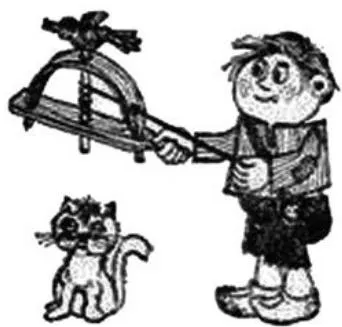
t all started with a toy bird - a swallow (helidon) that the children in the villages around Asenovgrad town use to celebrate the coming spring and Baba Marta (Grandma March - a symbolic figure believed to mark the end of the winter.
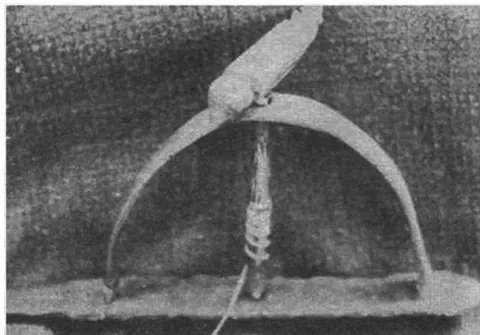
The popularity of the swallow toy rivals that of the traditional martenitsa (red and white threads weaved in different shapes) in this region. At that time, my focus of interest as a lecturer in toy design was on the history of toys and games. The morphological analysis of the toy takes into consideration the profound symbolism and the allegorical nature of all the elements rooted in its formation. As if its structure, although not complicated at all, contains all the fundamental symbols: the rainbow-shaped element representing the sky and the celestial rainbow that sweeps over us like a magic semicircle bridge; the horizontal element, fundamental and supporting the whole construction, and ends as a handle, representing the earth as a symbol of stability; the vertical placed axis reminding us of the World Cosmic Tree (Axis mundi), representing the connection between the higher spiritual heaven realm and the lower earthly material substance.
There is also a balancing element, personification of the underworld 'chthonic' forces. The bird is not at all randomly placed on the highest edge of the Cosmic Axis and above the heaven. It is the divine heavenly messenger bringing the good news that Baba Marta is coming and the winter is finally defeated. The thread that helps the toy come to life could be also interpreted as a symbol that recalls the tale of Ariadne's thread in its winding and unwinding. With its constant humming, the toy guides the little brave hero and he, as a messenger and mediator, enhances our affection with this magical act. (fig.1), (fig.2)
(This analysis - interpretation of deductive reasoning was presented in 1998 as part of a presentation report at a conference in Sweden with a focus on issues of the design for children and at a later stage, this resulted in redesign and update of the ancient folk toy, winning an award at the Trieste Contemporary Design Biennale - Italy 2000.)
This ritual also implies some distant connection with the boys' initiation rites – the transformation of the boy to adult, taking the role of the "Heros", who makes the transition between the earth of men and the heavens of gods through his remarkable deeds. Balarama, an ancient Hindu deity, god of farming, who appeared in the world from a white hair that the principal god Vishnu pulled out from his head, is holding in his hands a halo (plough) and a musala (pestle). Musala is the name of the highest peak of the Balkan region. Amazingly, the pestle reminds and corresponds semantically with the penknife "chekich" of the boys in Asenovgrad town, a symbol of the agricultural work.
This toy, embracing so much symbolic meaning in its architectonics, was in fact the first piece in a series of a puzzle which spurred more profound search for the symbolic meaning of common objects, passed on to us through the depths of ancient times. Gradually, more elements were added, and part of the "curtain" was more widely opened with publications of Dr. Tacho Tanev on historical books and columns in "Avitohol" journal. My attention was drawn by the in-depth research of the Bulgarian embroidery ornament "Elbetitsa"- this ornament spreads through the centuries the cosmogonic ideas of the ancient Bulgarians, bearers of an ancient, age-old culture.
The geometric construction is most likely directly incarnated in the functional and decorative pattern of many of the artifacts inherited from our ancestors and we may presume it was a core building element in the structure of the entire material world surrounding them. They have aspired to symmetry and balance with Heaven or God. Or, as the Lord prayer reads: 'on earth as it is in heaven'.
It is the foundation of the architectonics of the major and most prominent buildings - temples and palaces, the traditional Bulgarian portable round dwelling - the yurt; it is found in the structure of composition of the Bulgarian alphabets (starting from the Runic and going through the Glagolitic and Cyrillic alphabet), in the functional structure of a number of tools, items and weapons, in the symbol elements of the most widely used ornaments for decoration of craftsmen works, and even in the structure of ritual and festive meals - round ritual loans served at major calendar holidays. (fig.3)
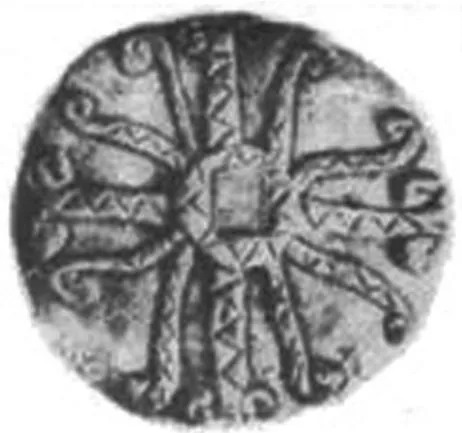
As it turned out, other authors (Prof. Vasil Yonchev, Dr. Tacho Tanev, Yordan Tabov, etc.) had also independently reached more or less to its presence although in different varieties. Just one more tiny push was necessary to structure these individual insights into an integrated system. The next step was to look for the semantics of the symbols of the individual varieties, to unravel the meaning and the essence of the images, their philosophical and religious substance, to interpret them in a comprehensive and modern language.
The "Belief in Heaven" of the Bulgars is deeply encoded in the cosmological concepts and notions, and in the uniform harmonious model of the universe (macrocosm). A harmony, which reflects the relationship between the universe and the micro-world of the individual little person, contemplated as part of a divine cosmic order. A concept that sounds sustainable and modern nowadays.
The restless vibrant life - this is the main source of "the proto-art", "the well forgotten old" - according to Saint Porphyrios. The ancient Greek philosopher Pythagoras has also possessed extraordinary sensitivity and was able to "hear the harmony of the spheres and the cosmic music" according to Aristotle
"The organization of the Universe represents in itself a symmetrical harmony of numerical order and their relations", believe the Pythagoreans. "Rhythmicity represents synchronization and adaptation to time and is as essential as the cellular structure in the universe" - Prof. Fr. Halberg.
How about the steps in the fast-swirling folk dances? And the zigzags of the bright vivid embroidery (shevitsa), the rugs and carpets, the wavelike patterns of the pottery, aren't they an outburst of that urge, aspiration and manifestation of the inherent feeling of the cosmic rhythm vibrations? Rhythm... Time...
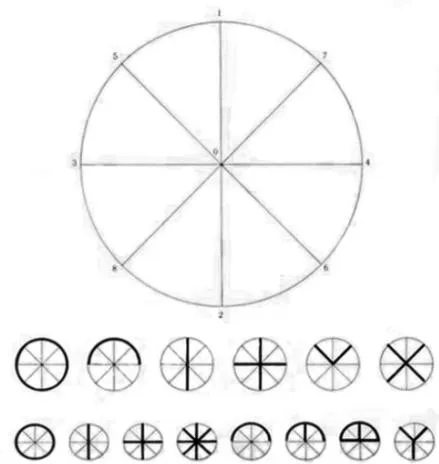
How can we depict time? Which is the most accurate symbol? Literally, it would probably bear closest similarity to a flying arrow. However, we can see the wheel of life painted on the wall of a monastery in Bulgaria (Transfiguration Monastery) (or on the old banknotes of BGN 100); even in our everyday speech we use the term "rounding" when it refers to periods of time and years. Time and the units of time do not just move - they "are rolling". And only an oval or circular form can roll. These arguments bring about the conclusion that the circle is associated not only with the sun, but also with time - the change of the seasons, years, months, hours. And this explains the common division of a circle into equal parts - three, four, eight, twelve, etc. Hence, we see how the major modular element naturally evolves by adding axes of symmetry. Axes may be deleted or halves and quarters modules may be added. The achieved module structure is in compliance with all the principles of the modern modular design and at the same time, it represents a complex multi-layered semantic model where the knowledge of astronomy is woven into the spiritual life and concepts of the Bulgarians. The system fully reflects the ideas about the structure of the Cosmos and the fundamental forces of its construction struggling with the forces of Chaos.
The primary central element in this system is the point, which evolves naturally into the oval shape of the circle, and represents the heavens and a complex group of stars that form constellations. And indeed, if we gaze at the sky, particularly in a flat location, it will look like a large round lid. The added horizontal plane would represent the Earth - the passive female power bringing the creative energy and fertility. The horizontal plane divides the sky into two parts - "higher earth" and "lower earth", black and white, good and evil. If a vertical line is extended above the horizontal, it signifies the male energy and its origin of creativity - the "Tree of Life". It emerges from the dark underworld kingdom, passes through the human world of the humans and soars above to the divine heavens. This module is identified as the "Cross of Life" for a reason. It represents the divine harmony: Earth - Heaven - Human - Lord. Four major initial points, four seasons, four cardinal directions, four colors. The modular structure could be further elaborated by adding more axes. It is not restricted by presenting it only as a symbol of time. It further corresponds to the concept of space for the ancient Bulgarians. The four-part division is a symbol of the cardinal directions: East, West, North, South. (fig.4)
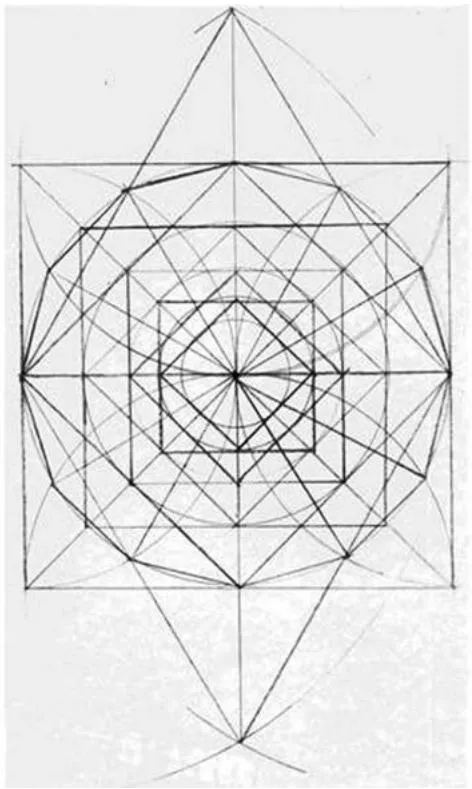
Analyzing its graphic image, we cannot ignore the fact that the calendar is most likely the foundation upon which this modular element stands. The circular form and the rotation, the division of the circle into two, four and twelve parts is perfectly consistent with the calendar division (and the division of the primary module). We can find evidence of the existence of this module in all spheres of life of our distant ancestors: residential dwellings, furniture, decorative design in clothing, weapons and even toys.
The most typical and genuine presence of the module system can be found in the structure of composition of the Bulgarian letter signs. There is no room for discontent in this aspect as we the Bulgarians, unlike other nations, have had over time not one but three alphabets. Among the most outstanding contributions of Bulgaria to the world cultural heritage is the Bulgarian script, widely used by number of Slavic and non-Slavic languages in many countries like Russia, Ukraine, Belarus, Moldova, Macedonia, Mongolia, etc. Many Bulgarian and foreign scholars have explored the origin and composition of the so-called Bulgarian runic signs and for all the years since the Liberation of Bulgaria, a vast literature and large number of studies have been collected on this subject (Karel Skorpil, Fyodor Uspensky, Vatroslav Jagic, Kr. Mityaev, Geza Feher, D. Bogdan, M. Komsha, V. Yonchev, P. Dobrev, B. Shkodrov, etc.).
Prof Dr. Lyudmila Doncheva - Petkova, archaeologist, has collected and described all the discovered signs (42 tables containing in total 1337 signs, of which 783 have been identified as runic, 14 - as Glagolitic, and 185 as signs of the Cyrillic or Greek scripts). Many of the facts reveal that these runes have been used by end of the 11th century, and their inception could be traced back to earlier times of the Bulgarian state.
Prof.
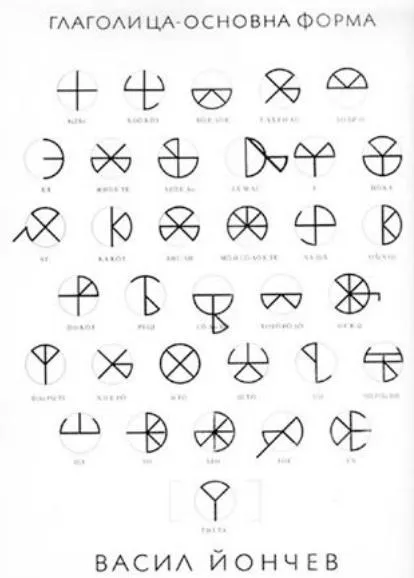
V. Yonchev, author of several fundamental works on the Bulgarian letter designs, has studied in a comprehensive and detailed manner their composition structure and, following extensive research over several decades, he has proved that this large inventory of seemingly incoherent graphic symbols, although presumed by number of scholars to have represented arbitrary drawings, kinship and artisan signs and scribbles, were in fact integrated into a strictly organized, logically developed alphabetic system, which can be brought down to a single basic module. It represents a geometric figure recreating in detail the circle with two intercepted crosses inside it....the majority of these seemingly incoherent signs is in fact incorporated into a strictly organized logically structured system that could be finally brought down to a single geometric symbol – module." (V. Yonchev, 1982, 37)
The module figure of the Glagolitic script is a hypothetical model, a basis for the development and identification of all signs in the Glagolitic alphabet. It was proposed in 1982 by Prof. Vasil Yonchev in his paper: 'Ancient and Modern Bulgarian Letter Design'. Prof. Yonchev presented his work at the National Exhibition of Illustration and Bulgarian Book Design in 1984. (fig.5)
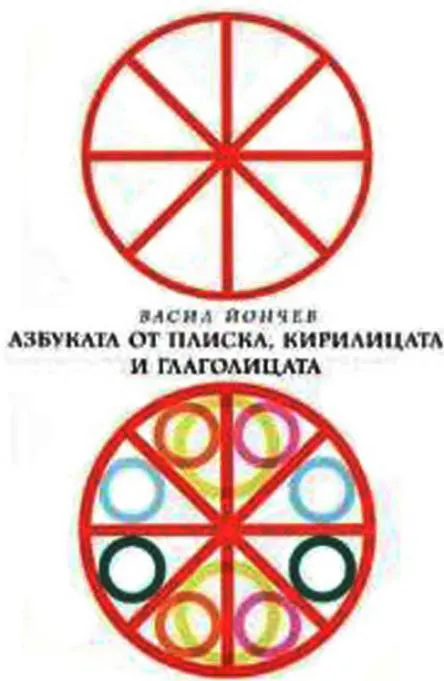
For more than two decades Prof. Yonchev has been exploring the origin of the Glagolitic and Cyrillic alphabets. He has examined the shape of the letter signs in all the epigraphic sources of the First Bulgarian Kingdom and Glagolitic manuscripts that have come down to us and arranged them in order ranked by their similarity through tracing the historical development of the key composition and constructive changes of the letter signs. Thus, Prof. Yonchev reached to the module figure, which represents in his opinion, "a graphic symbol of the Universe and the Earth". At its base are the letters and : (fig.6)
Prof. Yonchev asserts that the module figure the Glagolitic is the highest peak in the development of the Proto-Bulgarian letters: the whole process bears historical, graphic and linguistic attributes, i.e. from
- Alphabet from Pliska through
- Cyrillic letters comes to
- Glagolitic alphabet. (fig.7)
According to Prof. Yonchev, the module figure determines the main cycles in the work of Constantine Cyril the Philosopher:
- Ccreation of the universe;
- Structure of the space;
- Evolution and history of life on the Earth;
- Universe and time;
- Origination of life in water and air;
- Origination of life on land,
and in addition, some other cycles. Prof. Yonchev refers to the Cyrillic alphabet as 'developed' by Constantine Cyril the Philosopher - it consists of 24 letters that have parallel letters in the Greek alphabet, and additional 14 new letters. (fig.8)
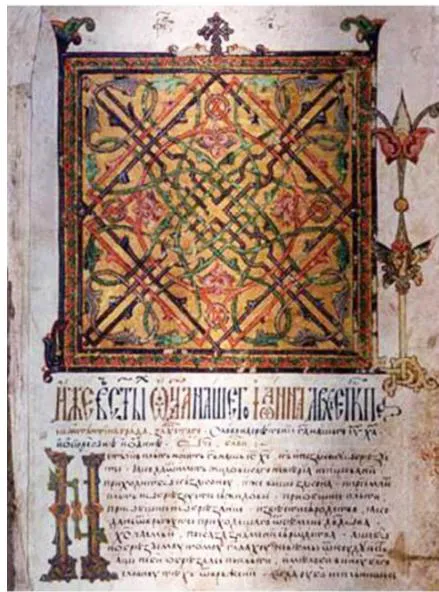
Couple of centuries later, Saint Cyril the Philosopher used that same fundamental module underlying the runic characters to create the Glagolitic alphabet. He updated the graphic symbolism through the introduction of a new meaning into it, originating from the Christian beliefs and a new sequence in the application of the basic module. Engineer Radi Panayotov states in an article published in journal "Naroden budiltel": "...every Glagolitic letter sign is linked to all other signs united by a 'key-module' and it reflects in a graphic system the structure of the Universe, the solar system, the characteristics of the planetary orbits... and further, the frequency spectrum, colors, musical tones and so on." (R. Panayotov, 2000 journal "Naroden buditel" issue 2)
"The Belief in God Heaven" of our distant ancestors forms an essential component of their cosmological conceptions and a model of the Universe existing in harmonious unity. A harmony reflecting the relationship between the universe and the microcosm of the individual as a small representation of a higher cosmic order. The entire existence of the Bulgars was guided by their reverence for the powers of nature - Heaven, Earth, Sun, Moon and stars. Even if awareness for this succession over time is not always present, the essence of this cultural model seeking harmony between Heaven, Earth and Man, has been preserved and was passed down from generation to generation.