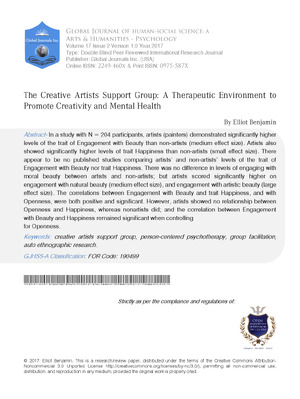
The Creative Artists Support Group: A Therapeutic Environment to Promote Creativity and Mental Health

Elliot Benjamin
Elliot Benjamin

Send Message

To: Author

The Creative Artists Support Group: A Therapeutic Environment to Promote Creativity and Mental Health

Article Fingerprint

ReserarchID

A29KN

The Creative Artists Support Group: A Therapeutic Environment to Promote Creativity and Mental Health Banner

AI TAKEAWAY

Connecting with the Eternal Ground
  • English
  • Afrikaans
  • Albanian
  • Amharic
  • Arabic
  • Armenian
  • Azerbaijani
  • Basque
  • Belarusian
  • Bengali
  • Bosnian
  • Bulgarian
  • Catalan
  • Cebuano
  • Chichewa
  • Chinese (Simplified)
  • Chinese (Traditional)
  • Corsican
  • Croatian
  • Czech
  • Danish
  • Dutch
  • Esperanto
  • Estonian
  • Filipino
  • Finnish
  • French
  • Frisian
  • Galician
  • Georgian
  • German
  • Greek
  • Gujarati
  • Haitian Creole
  • Hausa
  • Hawaiian
  • Hebrew
  • Hindi
  • Hmong
  • Hungarian
  • Icelandic
  • Igbo
  • Indonesian
  • Irish
  • Italian
  • Japanese
  • Javanese
  • Kannada
  • Kazakh
  • Khmer
  • Korean
  • Kurdish (Kurmanji)
  • Kyrgyz
  • Lao
  • Latin
  • Latvian
  • Lithuanian
  • Luxembourgish
  • Macedonian
  • Malagasy
  • Malay
  • Malayalam
  • Maltese
  • Maori
  • Marathi
  • Mongolian
  • Myanmar (Burmese)
  • Nepali
  • Norwegian
  • Pashto
  • Persian
  • Polish
  • Portuguese
  • Punjabi
  • Romanian
  • Russian
  • Samoan
  • Scots Gaelic
  • Serbian
  • Sesotho
  • Shona
  • Sindhi
  • Sinhala
  • Slovak
  • Slovenian
  • Somali
  • Spanish
  • Sundanese
  • Swahili
  • Swedish
  • Tajik
  • Tamil
  • Telugu
  • Thai
  • Turkish
  • Ukrainian
  • Urdu
  • Uzbek
  • Vietnamese
  • Welsh
  • Xhosa
  • Yiddish
  • Yoruba
  • Zulu
Font Type
Font Size
Font Size
Bedground

Abstract

In a study with N = 204 participants, artists (painters) demonstrated significantly higher levels of the trait of Engagement with Beauty than non-artists (medium effect size). Artists also showed significantly higher levels of trait Happiness than non-artists (small effect size). There appear to be no published studies comparing artists’ and non-artists’ levels of the trait of Engagement with Beauty nor trait Happiness. There was no difference in levels of engaging with moral beauty between artists and non-artists; but artists scored significantly higher on engagement with natural beauty (medium effect size), and engagement with artistic beauty (large effect size). The correlations between Engagement with Beauty and trait Happiness, and with Openness, were both positive and significant. However, artists showed no relationship between Openness and Happiness, whereas nonartists did; and the correlation between Engagement with Beauty and Happiness remained significant when controlling for Openness.

References

26 Cites in Article
  1. Elliot Benjamin (2008). Art and Mental Disturbance.
  2. Elliot Benjamin (2013). The creative artist support group: a case study.
  3. E Benjamin (2014). The creative artists support group.
  4. Elliot Benjamin (2014). Transpersonal Psychology and an Agnostic Experiential Exploration of Mediumship and the Ostensible Phenomenon of Life after Death.
  5. E Benjamin (2014). The creative artist, mental disturbance, and mental health: A narrative, Auto ethnographic case study of one year in the life of my son the struggling actor.
  6. E Benjamin (2015). The creative artists support group: A follow-up report.
  7. Elliot Benjamin (2015). Transpersonal Psychology and an Agnostic Experiential Exploration of Mediumship and the Ostensible Phenomenon of Life after Death.
  8. E Benjamin (2016). A college psychology teacher's experience of cell phone addiction in the classroom: Auto ethnographic reflections.
  9. S Bradborn (2010). Creative arts in group work.
  10. D Burkus,J Tokien,C Lewis (2016). How your friends affect your creative work.
  11. J Cameron (1992). The artist's way. A spiritual path to higher creativity.
  12. R Chang (2008). Auto ethnography as method.
  13. C Ellis (2007). Telling secrets, revealing lives: Relational ethics in research with intimate others.
  14. C Ellis (2009). Revision: Auto ethnographic reflections of life and work.
  15. D Grant (2011). rights-groups-celebrate-the-extension-of-the-child-support-grant-to-all-those-born-in-1994-mar-16-2010.
  16. John Mazzeo (2013). :<i><i>Qualitative Inquiry and the Conservative Challenge</i></i>. Norman K. Denzin, Michael D. Giardina (eds.). Walnut Creek, CA: Left Coast Press, 2006. xxxi+309 pp. (Cloth US$65.00; Paper US$29.95) <i>Ethical Futures in Qualitative Research: Decolonizing the Politics of Knowledge</i>. Norman K. Denzin, Michael D. Giardina (eds.). Walnut Creek, CA: Left Coast Press, 2007. 256 pp. (Cloth US$65.00; Paper US$29.95).
  17. C Lapin (2016). CREATIVE ACTIVITIES IN GROUP THERAPY.
  18. E Maisel (2012). Your artist support group.
  19. Abraham Maslow (1962). Toward a psychology of being..
  20. W Miller,S Rollnick (2013). Motivational interviewing: Helping people change.
  21. C Rogers (1961). On becoming a person.
  22. C Rogers (1965). Rogers, Carl R. Client-centered therapy. Boston: Houghton-Mifflin, 1951, pp. 560. $4.00.
  23. C Rogers (1973). Carl Rogers on encounter groups.
  24. (2015). The handbook of humanistic psychology: Theory, research, and practice.
  25. C Wagner,K Ingersoll (2013). Motivational Interviewing in Groups.
  26. A Zuckoff (2015). Finding your way to change: How the power of Motivational Interviewing can reveal what you want and help you get there.

Funding

No external funding was declared for this work.

Conflict of Interest

The authors declare no conflict of interest.

Ethical Approval

No ethics committee approval was required for this article type.

Data Availability

Not applicable for this article.

How to Cite This Article

Elliot Benjamin. 2017. \u201cThe Creative Artists Support Group: A Therapeutic Environment to Promote Creativity and Mental Health\u201d. Global Journal of Human-Social Science - A: Arts & Humanities GJHSS-A Volume 17 (GJHSS Volume 17 Issue A2).

Download Citation

Journal Specifications

Crossref Journal DOI 10.17406/GJHSS

Print ISSN 0975-587X

e-ISSN 2249-460X

Keywords
Classification
GJHSS-A Classification FOR Code: 190499
Version of record

v1.2

Issue date
June 23, 2017

Language
en
Experiance in AR

Explore published articles in an immersive Augmented Reality environment. Our platform converts research papers into interactive 3D books, allowing readers to view and interact with content using AR and VR compatible devices.

Read in 3D

Your published article is automatically converted into a realistic 3D book. Flip through pages and read research papers in a more engaging and interactive format.

Article Matrices
Total Views: 3569
Total Downloads: 1837
2026 Trends
Related Research
Our website is actively being updated, and changes may occur frequently. Please clear your browser cache if needed. For feedback or error reporting, please email [email protected]

Request Access

Please fill out the form below to request access to this research paper. Your request will be reviewed by the editorial or author team.
X

Quote and Order Details

Contact Person

Invoice Address

Notes or Comments

This is the heading

Lorem ipsum dolor sit amet, consectetur adipiscing elit. Ut elit tellus, luctus nec ullamcorper mattis, pulvinar dapibus leo.


High-quality academic research articles on global topics and journals.

The Creative Artists Support Group: A Therapeutic Environment to Promote Creativity and Mental Health

Elliot Benjamin
Elliot Benjamin

Research Journals