




The Current Status of the Examination System for Evaluating the Russian Language Proficiency, the Knowledge of the History as well as the Fundamentals of the Russian Legislation

Send Message

To: Author

The Current Status of the Examination System for Evaluating the Russian Language Proficiency, the Knowledge of the History as well as the Fundamentals  of the Russian Legislation

Article Fingerprint

ReserarchID

0L80S

The Current Status of the Examination System for Evaluating the Russian Language Proficiency, the Knowledge of the History as well as the Fundamentals  of the Russian Legislation Banner

Key Research Insights

Synthesized scholarly intelligence & interactive research assistant
  • English
  • Afrikaans
  • Albanian
  • Amharic
  • Arabic
  • Armenian
  • Azerbaijani
  • Basque
  • Belarusian
  • Bengali
  • Bosnian
  • Bulgarian
  • Catalan
  • Cebuano
  • Chichewa
  • Chinese (Simplified)
  • Chinese (Traditional)
  • Corsican
  • Croatian
  • Czech
  • Danish
  • Dutch
  • Esperanto
  • Estonian
  • Filipino
  • Finnish
  • French
  • Frisian
  • Galician
  • Georgian
  • German
  • Greek
  • Gujarati
  • Haitian Creole
  • Hausa
  • Hawaiian
  • Hebrew
  • Hindi
  • Hmong
  • Hungarian
  • Icelandic
  • Igbo
  • Indonesian
  • Irish
  • Italian
  • Japanese
  • Javanese
  • Kannada
  • Kazakh
  • Khmer
  • Korean
  • Kurdish (Kurmanji)
  • Kyrgyz
  • Lao
  • Latin
  • Latvian
  • Lithuanian
  • Luxembourgish
  • Macedonian
  • Malagasy
  • Malay
  • Malayalam
  • Maltese
  • Maori
  • Marathi
  • Mongolian
  • Myanmar (Burmese)
  • Nepali
  • Norwegian
  • Pashto
  • Persian
  • Polish
  • Portuguese
  • Punjabi
  • Romanian
  • Russian
  • Samoan
  • Scots Gaelic
  • Serbian
  • Sesotho
  • Shona
  • Sindhi
  • Sinhala
  • Slovak
  • Slovenian
  • Somali
  • Spanish
  • Sundanese
  • Swahili
  • Swedish
  • Tajik
  • Tamil
  • Telugu
  • Thai
  • Turkish
  • Ukrainian
  • Urdu
  • Uzbek
  • Vietnamese
  • Welsh
  • Xhosa
  • Yiddish
  • Yoruba
  • Zulu
Reading Preferences
Font Size
Line Spacing
Background

I. INTRODUCTION

This item dwells on the system of evaluating the proficiency of the Russian language, as well as the knowledge of the Russian history and legislation (hereinafter – the Exam). An analysis of the current course and the status of the system for linguistic-didactic testing in general were the focus of another article by this author [1]. This article, in turn, is aimed at presenting the outcomes of a research focusing on one component of the linguistic-didactic test system – a regional system for the Exam. The objects of the study here include the implementation of the provisions of Paragraph 8, Clause 15.1 of the Federal Law "On the Legal Status of Foreign Citizens in the Russian Federation" (Federal Law #115-FZ of July 25, 2002) by public authorities, institutions and other parties involved [2].

The aim of this study is to describe the current practice of employing the said provisions in 85 subjects of the Russian Federation to develop recommendations for their further improvement.

Subject to Par. 8, Cl. 15.1 of the Federal Law "On the Legal Status of Foreign Citizens in the Russian Federation" (Federal Law #115-FZ of July 25, 2002), foreign citizens applying to obtain a patent can prove their command of the Russian Language, the history and legislation of Russia not only with a certificate yet also with a "document certifying their successful completion of the examination revealing their knowledge of the Russian Language, the history and legislation of the Russian Federation" [2]. During that, the Federal Law states that the requirements for the minimal level of knowledge needed to pass the exam successfully, as well as the respective form of the document are to be approved by "an executive body in charge of developing the public policy and regulations in the area of education" [2]. As the above suggests, the powers on setting the minimal level of knowledge to pass the Exam, as well as on approving the document itself reside in the Ministry of Education and Science of the Russian Federation (similarly to the federal system for arranging comprehensive examinations). However, the right of approving the list of "academic institutions authorized to arrange the examination in order to test the Russian language proficiency, as well as to check the knowledge of the history and the basics of the Russian legislation", as well as the arranging the procedure and the type of hosting such exams has been delegated to the supreme executive bodies of the respective regions of the Russian Federation. This means that the adoption of Federal Law #357- FZ of 24/11/2014 [3] resulted in establishing a separate regional system for certifying foreign nationals' Russian Language proficiency, as well as their knowledge of the Russian history and the legislation basics, whereas such separate system operates along with the federal system for holding comprehensive exams (Par. 1.1, Cl. 15.1, Federal Law #15- FZ of July 25, 2002).

The following methods were employed through this research: analysis of regulatory legal acts, including local ones, as well as samples of standard and other documents; statistical analysis; polls among employees of authorized organizations, executive authorities, and foreign citizens.

Over 120 regulatory acts were analyzed during this study, with 509 respondents interviewed, 412 of them representing organizations authorized to conduct the Exam, and another 97 being employees of regional departments of the Ministry of Internal Affairs.

II. MINIMAL REQUIREMENTS FOR THE KNOWLEDGE LEVEL

Following Par. 8, Cl. 15.1 of the Federal Law "On the Legal Status of Foreign Citizens in the Russian Federation" (Federal Law #115-FZ of July 25, 2002) [2], the requirements for the minimal level of knowledge required to pass the Exam successfully shall be approved by the Ministry of Education of the Russian Federation.

As of now, no regulatory legal act has been issued, which would set the requirements mentioned above. This means that there are no single requirements available concerning testing foreign citizens' level of communication competency during the Exam through the entire territory of the Russian Federation, which results in stratification of language skills, the emergence of regional deviations, and blurred language standards.

Lack of such requirements is nothing but an unacceptable gap in the current legislation, specifically when talking of a situation where the federal system of arranging comprehensive exams has a minimal level of knowledge requirements, as well as the form and procedure for arranging the exam, approved by Order of the Ministry of Education and Science of the Russian Federation (#1156 of August 29, 2014) "On approval of the form, procedure for arranging the exam in Russian as a foreign language, the history of Russia and the basics of the legislation of the Russian Federation, as well as the requirements for the minimal knowledge level required to successfully pass the specified exam".

An analysis of regulatory legal acts effective in various subjects of the Russian Federation shows the following ways available to eliminate this gap at the regional level. 35 out of the 85 Russian subjects, for instance, have no regulatory legal acts concerning the Exam. The respective regulations of 34 subjects (out of the 50 subjects where there have been regulatory legal acts regarding the Exam issued), contain a reference to an act of the Ministry of Education and Science of the Russian Federation, which does not exist (the requirements for the minimum level of knowledge in these subjects, therefore, are also not established, which does not prevent the Exam from being held in 24 of such subjects).

Regulatory acts of the Republic of Karelia [4], the Republic of Sakha [5], the Tomsk Oblast [6] mention no minimal requirements, while the entire regional regulatory base of the Republic of Tatarstan [7] limits itself with nothing more than a list of the authorized organizations (neither the procedure no type of Exam is set). 12 subjects of Russia have regulatory acts that have some reference requirements to the Order #1156 by the Ministry of Education and Science of the Russian Federation "On approval of the form, procedure for holding the exam in Russian as a foreign language, the history of Russia and the basics of the legislation of the Russian Federation, the requirements for the minimum level of knowledge required to successfully pass the specified exam" dated August 29, 2014 [8]. Besides, it is to be noted that the said order was issued subject to Par. 4 of Cl. 15.1 of the Federal Law "On the Legal Status of Foreign Citizens in the Russian Federation" (Federal Law #115-FZ of July 25, 2002) [2] and sets the minimal requirements for the level of knowledge needed to pass the exam within the federal system. These subjects, actually, only try to bridge the gap by just referring to the provisions of the respective federal law.

Following Par. 2, Cl. 3 of the Federal Law "On the general principles of the organization of legislative (representative) and executive bodies of Public Authority in the subjects of the Russian Federation" (Federal Law #184-FZ of October 6, 1999) [9], the subjects of Russia are within their full right of introducing their own legal regulation on issues of joint management of the Russian Federation and its subjects. This right, however, is granted to the Russian subjects only until there are respective federal laws adopted (i.e. until Federal Law #115 of July 25, 2002 was adopted). As a result, the supreme executive bodies of the Russian subjects, by referring, in their regional regulatory acts, the Order by the Ministry of Education and Science of Russia (Order #1156 of August 29, 2014), actually contradict Par. 8 of Cl. 15.1. of Federal Law #115-FZ of July 25, 2002, which, in turn, results in a collision between the federal legislation and that of the administrative subjects of Russia, thus contributing to mismanagement and violation of the legality principles.

III. FORM OF DOCUMENT

According Par. 8 of Cl. 15.1 of Federal Law #115-FZ of July 25, 2002, the form of the document issued by respectively authorized organizations is to be approved by the Ministry of Education and Science of the Russian Federation [2]. Unlike the requirements for the minimal level of knowledge, the form of the document was approved by the Ministry of Education and Science of the Russian Federation, subject to the Order "On approval of the form of the document for passing the exam for proficiency in the Russian language, knowledge of the history and fundamentals of the legislation of the Russian Federation" (Order #21 of January 26, 2015) [10].

As of today, in all the subjects of Russia that hold the Exam, the form of the document is similar to that approved by the Ministry of Education and Science of the Russian Federation subject to Order #21 of January 26, 2015). However, in 2016, a number of organizations, which belong to the list of those authorized to arrange the Exam, issued documents that did not meet the requirements set within the Order mentioned above, which was a serious violation of the federal law. Mention should be made here that according to the order of the Ministry of Education and Science of the Russian Federation, the document on passing the Exam is not a protected polygraphic product, which means it incorporates no effective anti-counterfeit protection mechanisms. In most organizations, the said document is printed on conventional office paper used for laser printers, copiers and fax machines, with no polygraphic equipment used. Apart from the lack of requirements concerning the degree of protection for the Exam document, there are other gaps in the regulatory legal act issued by the Ministry of Education and Science of the Russian Federation, for instance, total absence of any requirements for the procedure for issuing a document, the area and the term of its validity.

These gaps are cannot be allowed, since as early as when preparing the regulatory legal act, it was obvious that there would be need to have the above requirements approved, and yet it all remained neglected. Another thing worth mentioning is that the Order of the Ministry of Education and Science of the Russian Federation #1154 "On approval of the form, procedure for issuing a certificate of proficiency in the Russian language, knowledge of the history of Russia and the basics of the legislation of the Russian Federation and the respective technical requirements" of August 29, 2014, issued earlier to regulate the federal Examination system [11] featured no such gaps.

The regional regulatory documents, too, have no validity period specified for the document. The validity term of the issued document across the studied regions varies from 1 to 5 years. According to the data obtained through phone surveys carried out among authorized organizations, 9 subjects of the Russian Federation have an indefinite term of validity for the document they issue. The validity term varies both among the subjects of the Russian Federation and within the regions. 6 of the organizations authorized to operate in the Belgorod Oblast, for instance, reported that the document is valid for 1 year, while one organization claimed their document is valid for 5 years, and another 9 organizations issue the document for an indefinite term.

In the Altai Krai, representatives of the Regional state budgetary professional educational institution Rubtsovsky College of Agriculture and Industry, and of the Regional state budgetary professional educational institution Altai College of Industry and Economics reported through a telephone survey that they were not aware of the validity period for the document they issue. A similar situation is to be observed regarding the period of issue and the area of validity for the document. 11 out of the 50 studied subjects of the Russian Federation, have respective normative legal acts approving the term for issuing the document (the Republic of Altai, the Republic of Dagestan, the Republic of Mordovia, the Republic of Khakassia, the Kamchatka Krai, as well as the Kursk, Irkutsk, Oryol, Penza, Tomsk, and Tyumen Oblasts).

Subject to the decisions by the Governments of the Saratov [12] and Leningrad [13] Oblasts, the term for issuing the document shall be approved by the authorized organization. In the remaining 37 subjects, there is no term set for issuing the document in regulatory legal acts. As the surveys showed, the term for issuing the document in the subjects of the Russian Federation varies from 1 working day to 2 weeks. In the Altai Krai, for instance, as reported by representatives of the Polzunov Altai State Technical University, the document is issued within 10 working days.

The Regional state budgetary professional educational institution Barnaul State Pedagogic College issues the document on the day the Exam is passed. Other authorized institutions of the Altai Krai failed to offer a specific answer regarding the term of issuing the document. The area of validity for the document is specified within regulatory acts for the Amur [14] and Arkhangelsk Oblasts only [15]. In the Belgorod Oblast, 4 organizations reported their document is valid all over the Russian Federation; 6 organizations claim their document is valid across the Belgorod Oblast; another 4 organizations state they have no details concerning the area of validity for the document. 35 of the subjects involved into the study have their documents valid exclusively across their respective subject.

Since the issue of certifying the Russian language proficiency, the knowledge of the history of Russia and the basics of the Russian legislation belongs to the joint jurisdiction of the Russian Federation and its subjects, the issue of identifying the area for the document validity appears a complicated one. As a result, the lack of a direct indication of the document validity period in the respective regulatory legal acts of the Ministry of Education of the Russian Federation, as well as in the respective acts of the Russian subjects results in significant uncertainty in terms of legal regulation. Besides, the lack of an indication of the validity period, the term of issue and the validity area expands the discretionary powers enjoyed by the Ministry of Internal Affairs, which is a potential corruption-triggering factor.

Apart from the legal issues, the regional examination system faces another one, which is much more serious – an issue of methodology. Any language testing, for instance, has to follow a key principle – the principle of validity. Validity here mans that the respective test results match for the purpose for which the testing was carried out [16].

The fact that there are different validity periods applied to a document that is meant to be used for a single shared purpose (certifying a foreign citizen's command of all types of speech activity, as well as their knowledge of the Russian history and basics of legislation in view of the requirements for the minimum level of knowledge to be allowed a work permit or a patent) is a direct violation of this principle. Besides, the lack of minimal requirements for the knowledge level means we are not within our right of speaking about any concept of validity taken as the match between the test materials and the evaluation purpose, since the evaluation purpose (compliance with the minimum level of knowledge) has not been set. As a result, we can witness the lack of equality guarantees for foreign citizens when they come to take the Exam.

IV. LIST OF EDUCATIONAL INSTITUTIONS

Unlike the document form and the requirements for the minimal level of knowledge required to pass the Exam, the right to approve the list of "educational organizations entitled to conduct an exam for the Russian language proficiency, the knowledge of the Russian history and the basics of the Russian legislation" shall be granted to the supreme executive bodies of public authority in the respective subjects of the Russian Federation.

The study revealed that the lists of organizations were approved in 50 subjects, yet the Exam is actually held only in 36 subjects of the Russian Federation. All the attempts to obtain information about the Exam in the Republic of Dagestan, as well as in the Republic of

Mordovia, failed, because the organizations authorized to hold the Exam replied to neither the phone calls nor to the E-mails sent to them. Nor is there any data about the Exam available on the websites of these organizations. All in all, there are 234 organizations authorized to hold the Exam in 85 regions of Russia.

In the Belgorod Oblast, there are 4 organizations are authorized to hold the Exam for all foreign citizens, while 24 general education schools arrange the Exam for citizens of Ukraine only (these organizations are part of the previously named 234 authorized entities). Such differentiation based on the citizenship principle is not envisaged within federal legislation and contradicts the equality principles. As telephone interviews suggest, only 44% (103) of the organizations do actually hold the Exam.

70% (163 organizations) out of the 234 authorized organizations have no structural units focusing specifically on studying, teaching of the Russian language, Russian as a foreign language. There are Russian Language Departments functioning in 25 (11%) of the authorized organizations only; 57 organizations (24%) have Departments of Russian Language (some organizations run both a Department of Russian Language and a Department of Russian as a foreign language). 41% of the organizations that do actually hold the Exam are professional academic institutions (colleges); 30% are educational organizations of higher education (universities); 20% are general education institutions (schools); 6% are organizations of additional professional education (institutes of advanced training), and another 3% are organizations of additional education (see Fig.1).
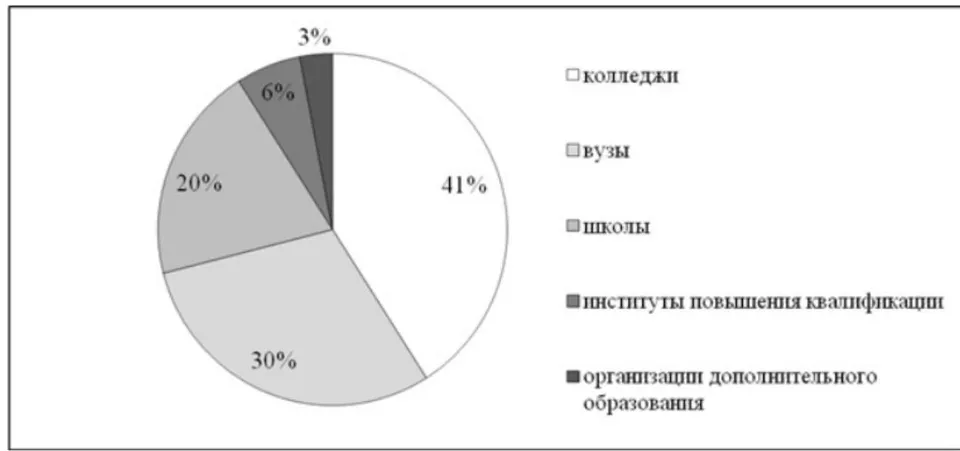
Колледжи – colleges Вузы – universities Школы – schools Институты повышения квалификации – institutes of advanced training Организации дополнительного образования – organizations of additional education

Fig. 1: Distribution of organizations authorized to hold the Exam

Openly available sources contain no information about the competitive selection process when composing the list of authorized organizations. Unlike the federal system of holding a comprehensive exam, where the application-based procedure is employed to select the list of educational organizations to hold a comprehensive exam subject to the Order #1153 "On approval of the procedure and criteria for putting educational organizations on the list of educational organizations holding the exam in Russian as a foreign language, the history of Russia and the basics of the Russian legislation" of August 29, 2014 [17], the procedure for putting organizations on the regional list is currently regulated at neither the federal nor regional level.

It appears that putting composing the regional list of organizations authorized to hold the Exam should be performed so that those truly intending to hold the above-mentioned exam should have a true opportunity to join the selection. In other words, developing the list of organizations should be subject to offering equal access to all those interested parties. This statement has been proven through other studies. As an article focusing on anti-competitive requirements for the selection of those to provide services on transporting and storing detained vehicles, "judicial and administrative practice revealed negative effects of such legal uncertainty affecting the procedure for the selection of entities to offer respective services" [18]. In particular, the said study offers a view at the stance of Arbitration courts of various subjects of the Russian Federation "on the inadmissibility of free choice of those who will be offered respective services in conditions where equal access is not enjoyed by other members of the market" [Ibid., p. 50].

Given the current situation of lacking a legally set procedure for putting organizations on the regional list, there are also signs of antimonopoly legislation violation to be observed as well. When issuing a regulatory legal act on the list of educational organizations enjoying the right to hold the Exam within a respective Russian subject, by failing to specify the order for putting organizations on this list, the respective public authority's supreme executive body, actually, restricts the choice of organizations for foreigners seeking to take the Exam, and creates a situation of discrimination. Such actions may violate Par. Par. 5 and 8 of Part 1, Cl. 15 of Federal Law #135-FZ "On Protection of Competition" of July 26, 2006 [19].

As a result, officials representing public authorities of the respective subjects of the Russian Federation may be held liable for violating the antimonopoly legislation subject to the provisions of Clause 14.9 of the Russian Code of Administrative Offence [20]. Here mention should also be made concerning the ambiguous qualification of the Exam in view of its legal nature. On the one hand, the Exam is a service offered to foreign citizens and persons with no citizenship, in order to evaluate their level of language proficiency and the degree of communication competency, for their further access to a work permit or patent and getting employment in the Russian Federation. Holding the Exam, therefore, can be attributed to so-called public services (for more details concerning public services, see the studies by E.

V. Talapina and Yu. A. Tikhomirov [21], L. K. Tereschenko [22], N.

V. Putilo [23]), as the Exam "offers activities of a generally significant orientation", "has an unlimited range of subjects using them", and is also "carried out either by a public and municipal authority or another body" [24].

The issue of defining and distinguishing the concepts of common and public services is rather new both for the theory of law and for legal practice. Research works often operate the concepts of common and public services as synonymous (see, for example, the article by I. N. Bartsits [25]). Another theoretical and scientific approach (L. K. Tereshchenko [26], N.

V. Putilo [27]) views public and common services as a part and the whole. According to the latter, for instance, public services bear the same features as common services, the difference being that "public service, first of all, characterizes the subject that offers the service: it is always a public body" [28].

In view of the above, from a theoretical stance, the Exam can be seen as a public service on the one hand, and as a non-governmental service ensuring activities of a generally significant orientation, on the other. As a result, approaches to studying and carrying out legal analysis of the Exam can vary significantly depending on the chosen approach.

An analysis of the current legislation reveals a confusion of the concepts of the public and common services. According to Par. 2 (d) of Clause 1 of the Russian President's Decree #314 "On the System and Structure of Federal Executive Authorities" of March 9, 2004, the functions of offering public services are to be interpreted as "the provision, by federal executive authorities, directly or through federal state institutions or any other organizations that are their subordinate, free of charge or at prices regulated by public authorities, of services to citizens and organizations, pertaining to the field of education, healthcare, social welfare, as well as in other areas as envisaged by federal laws" [29].

Public services, therefore, can be offered by organizations that do not belong to the executive authority bodies. Federal Law #210-FZ "On arranging the provision of public and municipal services" of July 27, 2010, however, defines public services as follows: "a public service offered by a federal executive authority, a body of a public state extra-budget fund, an executive body of a public authority of a certain subject of the Russian Federation, as well as by a local government body while exercising certain public powers transferred by federal laws and laws of the subjects of the Russian Federation <...>, - activities on the implementation, respectively, the functions of a federal executive authority, a body of a public state extra-budget fund, an executive body of a public authority of a certain subject of the Russian Federation, as well as by a local government body exercising certain official public powers transferred by federal laws and laws of the subjects of the Russian Federation, <...>, which are carried out upon requests from applicants within the limits of the powers granted to bodies providing public services as set by the regulatory legal acts of the Russian Federation and the regulatory legal acts of the subjects of the Russian Federation" [30].

In other words, as is stated by the Federal Law, no transfer of powers allowing provision of public services, shall be envisaged from public authorities to other organizations. The difference in approaches to the definition of public services in the above regulatory legal acts results in a conflict between the federal law and the Russian President's decree (this was also pointed at in the article by I. A. Rudenko [31]).

As traditionally, in case of a contradiction between a federal law and subordinate legal acts, the federal law prevails, it would be reasonable to discuss further the status and the legal regulation of the Exam as a non-governmental common service. The choice of this approach is also due to practical considerations.

The potential introduction of a public service mode in relation to the Exam implies that the Exam is to be held as part of a public assignment – a document setting requirements for the composition, the quality and the procedure for providing public services. Therefore, the introduction of the public service mode in relation to the Exam should be consistent with the requirements of the Budget Code of the Russian Federation (namely, Clause 69.2, which focuses on the development and content of the public assignment task) [32], as well as the provisions of Federal Law #210-FZ "On arranging the provision of public and municipal services" of July 27, 2010 [30].

One of the inevitable features of a common service is the generally significant orientation of the service. Holding the Exam is definitely an activity of a generally significant orientation. Mandatory test of language integration for foreign citizens arriving in the Russian Federation is a crucial part of foreigners' integration into Russian society, since no adjustment will be possible for newly coming foreigners with no language proficiency and knowledge of the cultural and historical foundations of the host country.

The introduction of requirements implying certification of language command contributes to the implementation of the main public assignment – ensuring public safety. Besides, this measure, as is claimed by A. A. Parfenov in his article, is aimed "at maintaining the national identity of the host society itself and serves to ensure interethnic harmony within the state" [33]. As a result, lack of a set procedure for putting organizations on the list does not allow talking about effective implementation of the public service (holding the Exam), and, consequently, about solving the above-mentioned public assignment; this leads to worsening public security, undermines the national identity foundations, provokes violation of the legality and equality principle, and does not stand any criticism from the stance of legal technique. In reality it results in levelling the Exam process itself, whereas all respective Russian and international standards for language testing are neglected. Now, having established that the criteria and the procedure for putting the organizations on the list are an integral part of the entire Exam system, it is important to have a look at the issue of the content of these criteria and the choice of a certain inclusion procedure for organizations.

Since the right to approve the list resides in the supreme executive bodies of the public authorities of the respective Russian subjects, technically, each of them should be independent in setting the criteria and procedure for approving the list of such organizations. On the other hand, though, the inclusion criteria for organizations should be established based on the requirements for the minimum knowledge level required to pass the Exam (has to be approved by the Ministry of Education and Science of the Russian Federation subject to Par. 8 of Clause 15.1, Federal Law #115-FZ [2]), based on the capacity of organizations that intend to hold the Exam, as well as based on the needs for holding this Exam in each specific subject of the Russian Federation [34].

It is obvious that the requirements for the minimum knowledge level required to pass the Exam should be the same for all parts of Russia. The application procedure for putting organizations on the list, along with market mechanisms (the Exam service is paid), would allow meeting the needs of each specific region in holding the Exam. From this stance, the criteria to put organizations on the regional list should be the same as well.

Applying different criteria in different parts of the Russian Federation will lead to a difference in the level of testing organizations in the regions in terms of their competence in the field of Russian as a foreign language, and Exam experience, and, therefore, will lead to differences in evaluating the proficiency level demonstrated by foreign citizens in terms of their Russian language command and the degree of their communication competence. This, in turn, will lead to inefficient implementation of the main public assignment, which implies holding the Exam mentioned above.

Approving identical regulatory legal acts on the inclusion criteria in each particular subject of the

Russian Federation seems impractical due to the load of the regulation-making stress imposed on supreme executive bodies in respective parts of the Russian Federation, as well as due to the subsequent costs related to ensuring control and supervision by the federal executive authorities of the Russian Federation (including legal expert evaluation of regulatory legal acts in the parts of the Russian Federation).

During that, the federal system of holding comprehensive exams incorporates an order by the Ministry of Education and Science of the Russian Federation (#1153 of August 29, 2014 [17], which lists the criteria and the procedure for putting educational organizations on the federal list. These criteria set the minimum qualifications level for educational organizations, which would allow them to hold comprehensive examinations for foreign citizens wishing to obtain a patent or work permit, temporary or permanent residence permit. In this regard, there are several ways to overcome the gap, which is due to the lack of legal norms establishing criteria and procedures to be employed for including organizations in the list.

One of the ways, for instance, could be a direct use of the provisions from the order by the Ministry of Education and Science of the Russian Federation dated (Order #1153 of August 29, 2014) [Ibid.]. As a result, organizations intending to hold the Exam in any subject of the Russian Federation, in order to be included in the list by the supreme executive body of this particular subject will have to meet a set of criteria identical to the set meeting the requirements of the federal system. With this approach, though, regional organizations will have no reason to be included in regional lists, since the criteria for being put on the federal list – which allows holding comprehensive exams throughout Russia – would be basically identical to the criteria to be included in regional lists. During that, a potential reason to reject the idea of being included in the federal list in favor of being put on the regional testing system may be some corruption-related factors at the level of a particular part of the Russian Federation. This means that the elimination of a legislative gap by issuing an order identical to Order #1153 would result in duplicating the functions of the Ministry of Education and Science of the Russian Federation, increase the regulatory burden on the supreme executive bodies of regional public authorities, as well as increase the risk of corruption at the regional level.

The development of criteria for including organizations in the list for the regional system should be performed by competent authorities, in view of the experience of issuing similar regulations. The Order #1153, however, approves the criteria for including organizations in the list of those authorized to hold the Exam for foreign citizens seeking not only to obtain a work permit or a patent, yet also those who want to obtain a temporary stay permit and a residence permit.

This means that organizations intending to hold the Exam only for those seeking to obtain a work permit or a patent, could enjoy some softer criteria. Given the lack of experience featured by the supreme executive authorities of the Russian subjects in terms of developing such criteria, such an order should be issued by the Ministry of Education and Science of the Russian Federation. This, in turn, would take amending Par. 8 of Clause 15.1 of Federal Law #115-FZ "On the Legal Status of Foreign Citizens in the Russian Federation" [2], granting the Ministry of Education and Science respective powers.

V. FORM AND PROCEDURE TO HOLD THE EXAM

As far as the form and procedure of the Exam are concerned, the situation is similar to that with the organizations list approval. The right to approve the form and procedure of the Exam is subject to the provisions of Par. 8 of Clause 15.1, Federal Law #115-FZ [2] to the supreme executive bodies of the public authorities in the respective part of the Russian Federation. The form and procedure of the Exam have been established in 49 subjects of the Russian Federation, that is, in all regions of Russia where lists of organizations have been approved, except the Republic of Tatarstan. The regional regulatory basis of the Republic of Tatarstan [7] is limited only to identifying the list of authorized organizations, while the form and the procedure of the Exam have not been set.

In 31 subjects of the Russian Federation, as prescribed by respective regulatory acts, the Exam is held verbally (as an interview) and in writing (as a test), including with computer and remote technologies; in 9 subjects, a similar form has been approved for the Exam, yet with no remote technologies employed; in 3 subjects, a similar form of the Exam has been approved, while without computer and remote technologies (Kirov Oblast [35], Khanty-Mansi Autonomous Okrug – Yugra [36], Tyumen Oblast [37]).

In the Amur [14], Belgorod [38], Bryansk [39] and Oryol [40] Oblasts, as well as in the federal city of Moscow [41] a written test has been approved, including computer and remote technologies; no part of the Exam is held verbally. In the Tula Oblast, the Exam is held both verbally and in writing, while the verbal part is approved as "Listening" [42].

It is to be noted that this form implies testing, above all, listening skills and does not allow any complete assessment of the speech production activity. As could be concluded based on the information obtained in the Moscow Oblast through telephone conversations, the entire Exam includes 20 questions. In 39 out of the 50 subjects of the Russian Federation, the time allocated to complete the tasks is set by the authorized organizations. The regulatory legal acts of the Altai Republic [43], the Leningrad [13], Penza [44], Saratov [12], Tomsk [6] Oblasts, as well as of the Republic of Tatarstan [7] offer no details as to the duration of the Exam, as well as about the body in charge of setting this factor. In the Republic of Udmurtia [45], City of Moscow [41], the Oryol [40], Tyumen [37], and the Sakhalin Oblasts [46] the duration of the Exam is set by the government of these respective subjects.

Further analysis shows that the duration of the Exam varies within the region, even in parts of the Russian Federation where the time offered to complete the tasks is approved by the local supreme executive authority.

In the Tyumen Oblast, for instance, following the Order by the Government of the Tyumen Oblast of April 20, 2015 (Order #136-p "On establishing the procedure and form of holding in the Tyumen Oblast the exam for proficiency in the Russian language, knowledge of the Russian history and the basics of the Russian legislation" [37], the Exam duration is 75 minutes. However, the information obtained during the study of control and measuring materials of the Tyumen State University pointed at the fact that the duration of the Exam is 100 minutes. In the Sakhalin Oblast, representatives of the authorized organization the Sakhalin Technical School of Service reported on the phone that the Exam duration is 30 minutes while 90 minutes are mentioned officially in the regulatory act approved by the Government of the Sakhalin Oblast [46].

When having the Exam duration approved by respectively authorized organizations, the time allowed for the Exam varies across the regions from 60 to 130 minutes. However, this difference could be observed not among regions only yet also with a subject of the Russian Federation. In the Ulyanovsk Oblast, for instance, the Exam time varies from 80 to 130 minutes.

The significant differences in the form and procedure of testing, both among different Russian subjects and within some of them, suggest lack of a unified system for holding the Exam. As a result, when approving the form and procedure for the Exam at the level of each individual subject of the Russian Federation, the situation becomes similar to the approval of the criteria and procedure for authorizing organizations. Differences in the Exam form and procedure in different parts of the Russian Federation imply different approaches to assessing foreigners' level of the Russian language proficiency and the degree of their communication competence. This can result, as noted above, in ineffective completion of the main objective pursued through holding the Exam, in deteriorated public safety, as well as in undermined foundations of the national identity and violated legality and equality principles.

A logical solution to the problem could be having an approved - at the federal level (by the

Russian Ministry of Education and Science) – form and procedure for the Exam (this would entail amendments in Par. 8 o Cl. 15.1 of Federal Law #115-FZ [2]), or holding a legal expert evaluation of the regulatory acts in the regions of Russia followed by introducing respective amendments and bringing the Exam form and procedure to a single shared standard in all subjects of Russia. The latter measures might be attributed to the regulatory & methodological responsibilities of the Russian Ministry of Education and Science, and would require extra funding, therefore.

VI. OTHER ISSUES FACED BY THE REGIONAL SYSTEM FOR HOLDING THE EXAM

Apart from the issues and gaps described above, which are related to Par. 8 of CI 15.1 of Federal Law #115-FZ [3], the regional examination system also features some other issues of legal nature.

a) Price of the Exam

One of such issues is the procedure for setting the price of the Exam. The regulatory acts of all the subjects of the Russian Federation embraced by the study failed to offer any information concerning the body setting the price of the Exam.

The regulatory acts of 42 subjects out of the 50, for instance, mention nothing regarding the price of the Exam; the regulatory acts of the Belgorod Oblast [38] and of the Zabaikalsky Krai [47] indicate that the price is to be set following the current effective legislation of the Russian Federation; in the Arkhangelsk [15], the Jewish Autonomous [48] Oblasts, as well as in the Republic of Sakha (Yakutia) [5] have the fee for the Exam set by the organization in charge of holding the Exam itself.

In the Oryol Oblast, the price of the Exam is set by the Department of Education of the said subject [40], whereas in the Republic of Udmurtia, the Exam price is calculated by the Institute for Education Development, an Autonomous Educational Institution for Additional Professional Education.

The minimal price of the Exam for Ukrainian citizens was observed in the Belgorod Oblast, for all foreign citizens – in the Leningrad Oblast (200 Rubles). The maximum Exam price was 6000 Rubles (in the Kamchatka Krai). The average price of the Exam in the 50 subjects of the Russian Federation is 1003 Rubles.

Out of 234 organizations, only 2 organizations (the Chukotka Institute for the Development of Education and Advanced Training; the Khakassia Institute for the Development of Education and Advanced Training) offer the calculation of the Exam price in open access. All the other organizations offer no explanation for the price. The fluctuations in pricing revealed through the study point at different quality in arranging the major and the secondary procedures in the organization as well as in holding the Exam, both in different subjects of the Russian Federation and within the same subject.

According to the provisions of Clause 15 of Federal Law #135-FZ of July 26, 2006 "On Protection of Competition" [19] the supreme executive bodies of the public authorities in the regions of the Russian Federation have no right to take actions and issuing any acts restricting competition. The direct setting of the Exam price, therefore, leads to a violation of the provisions of Clause 15 of Federal Law #135-FZ.

When classifying an Exam as a service that is required and mandatory in terms of the provision of public or municipal services, the procedure for setting the fee for such services is to be established by a regulatory legal act by the supreme executive body of the public authority of the respective subject of the Russian Federation (according to Clause 9 of Federal Law #210-FZ of July 27, 2010 "On arranging the provision of public and municipal services" [30]. The list of services, which are required and mandatory for the provision of public and municipal services is also approved by the regulatory legal act of the respective subject of the Russian Federation. The lack of the Exam in these lists of the Russian subjects does not allow classifying this service as required and mandatory for the provision of public and municipal services.

The document certifying the command of the Russian language, the knowledge of the Russian history and the legislation fundamentals, actually, talking objectively, is not the only one required to apply for a work permit or a patent. The full list of documents confirming the required command knowledge of the Russian language, as well as the knowledge of the history of Russia and the fundamentals of the Russian legislation is set out in Paragraph 1 of Clause 15.1 of Federal Law #115-FZ "On the Legal Status of Foreign Citizens in the Russian Federation" [2]. This list, namely, also includes a certificate of the Russian language proficiency, the knowledge of the Russian history and the basics of the Russian legislation, which is issued after upon successful completion of the comprehensive exam in the federal system.

b) Procedure for control & measuring materials development

Another issue related to holding the Exam in the regions of the Russian Federation is the lack of shared uniform approved requirements for methodological support and control materials (hereinafter – CMM). 29 of the 50 subjects of the Russian Federation studied, do have a procedure set for the development of CMM. 21 parts of the Russian Federation offer no information about the procedure for CMM development. The analysis shows that all the CMM-development procedures can be broken into three types: CMM development by a special commission in charge of ensuring methodological support; CMM development by a specially authorized organization, and CMM development by organizations holding the Exam.

Open sources contain no data regarding the approval of the members of the commissions functioning in all the 29 subjects of the Russian Federation that employ this mechanism for the development of CMM. Nor open sources contain any information about holding the competitive procedures for approving organizations authorized to develop CMM; there are no criteria for selecting such organizations, as well as any other information explaining the respective decision. None of the authorized organizations has any structural unit specializing in the field of linguodidactic testing.

In the regions where the development of CMM lies within the scope of powers of organizations holding the Exam, out of 12 organizations, only 2 have structural units specializing in studying and teaching the Russian language; 1 organization has a structural unit specializing in Russian as a foreign language.

In the Zabaikalsky Kari, the Exam is held by 5 organizations, using 2 tests that differ in their structure [48]. In one of the educational organizations, the test structure does not include such subchapters as Speaking, Writing and Listening. In all subjects there is no information about holding any public discussion while developing CMM.

The above suggests there are no sufficient grounds to believe that all stakeholders were involved in the development of CMM, while there was no comparative analysis of CMM carried out regionally. There were no procedures implemented to ensure compliance of all available test materials with the existing scientific and methodological standards. The above points at discriminatory conditions created through CMM development, and, consequently, a violation of Paragraph 8, Part 1 of Clause 15 of Federal Law #135-FZ "On Protection of Competition" of July 26, 2006 [19].

Neither the regulatory legal acts effective in the respective subjects of the Russian Federation nor open sources offer information showing whether the development of CMM was carried out on a paid basis. In the event the development of CMM is carried out subject to an order placed by public bodies on a paid basis, then the choice of the contractor organization in charge of developing CMM should be done in view of the provisions of Federal Law #44-FZ of April 05, 2013 "On the contract system in procurement of goods, works, services for public and municipal needs" [49].

The analysis of regulatory legal acts of the Russian regions also allows making judgements regarding potential violations of the legislation on the personal data protection of foreign citizens and stateless persons, copyright. In 21 subjects of the Russian Federation, for instance, the only requirement for personal data storage and transfer implies that such data must be stored in an authorized organization. In 20 subjects of the Russian Federation, the requirements hold it that personal data must be stored in authorized organizations for one year, in the Republic of North Ossetia-Alania [50] – for 3 years, in the Nizhny Novgorod Oblast [51] – for no less than 3 years, in the Altai Republic [43], Vologda [52] and Tomsk Oblasts [6] – for 5 years. In the Kirov Oblast [35] and in the Yamalo-Nenets Autonomous District [53] regulatory acts contain no data regarding the storage of personal data.

No Russian subject has set any requirements concerning the transfer of personal data (including via the Internet). The research has shown that consent to personal data processing is obtained in 11 parts of the Russian Federation out of the 50. In the other subjects, this information could be obtained neither from open sources nor from authorized organizations representatives. In 11 subjects of the Russian Federation, the control and measurement materials used by the respectively authorized organizations contain direct borrowings of the test tasks (more than 400) that have been approved and used as part of the comprehensive examination held within the federal system (control and measurement materials from 21 subjects of the Russian Federation were analyzed within the study).

VII. CONCLUSION

Given the results of the study, the following conclusions can be made regarding the current status of the regional system of the Exam. The analysis of the regulatory and legal acts has revealed a large number of violations of the Russian legislation, including Federal Law #115-FZ "On the Legal Status of Foreign Citizens in the Russian Federation"; Federal Law #135-FZ "On Protection of Competition" of July 26, 2006. Certain gaps were identified in Cl. 15.1 of Federal Law #115-FZ, legal collisions observed in federal laws and the laws of the legislation of the Russian Federation subjects, as well as a collision between federal laws provisions and Russian President's order. Besides, there have been issues identified and analyzed concerning the status of the activities aimed at holding the Exam, as well as concerning such activities classification within the existing theoretical approaches and in view of the available legal practice. Attempts have been made to resolve the detected conflicts and gaps in legislation.

As a result, conclusion can be made suggesting that the regional Examination system does not currently fulfill its main function – to provide a reliable assessment of the language proficiency and the communication competence demonstrated by foreign citizens and stateless persons, for their further obtaining a work permit or a patent, as well as employment in the Russian Federation.

Different subjects of the Russian Federation hold different exams assessing the Russian language proficiency, the knowledge of the Russian history and the basics of the Russian legislation, while the results of such exams are not comparable, which leads to the stratification of language competencies, disturbed principle of equality, potential corruption factors, which, in turn, leads to deterioration in public security, undermines the foundations of the national identity, and triggers violation of the legality and equality principle.

The above-described attempts aimed at solving each identified issue in the regional system will inevitably increase the amount of regulatory stress, control & supervision activities in both federal executive bodies of public authority and supreme executive bodies in respective subjects of the Russian Federation, which is impossible to be done successfully without extra funding, numerous legal expert evaluations, and events held to arrange public discussion will all the stakeholders focusing on respective changes.

There is a need to amend the legislation not at the level of the Russian Federation subjects alone, yet also at the federal level (namely, amendments to Federal Law # 115-FZ "On the Legal Status of Foreign Citizens in the Russian Federation"). Besides, the regional system for holding the Exam actually "competes with a more efficient and developed federal system of holding the comprehensive exam, and duplicates its functions" [1].

REFERENCES (TRANSLITARETAD)

  1. Parfenov A.A. O razvitii sistemy lingvodidakticheskogo testirovaniya v Rossiiskoi Federatsii // Pravo i politika.

  2. No 10. S. 1238-1246.

  3. O pravovom polozhenii inostrannykh grazhdan v Rossiiskoi Federatsii [Elektronnyi resurs]: feder. zakon ot 25 iyulya 2002 g. No 115-FZ // Sobr. zakonodatel'stva Ros. Federatsii.

  4. No 30. st.

  5. (v red. ot 7 marta 2017 g.). Dostup iz sprav.-pravovoi sistemy «Konsul'tant Plyus».

  6. O vnesenii izmenenii v Federal'nyi zakon «O pravovom polozhenii inostrannykh grazhdan v Rossiiskoi Federatsii» i otdel'nye zakonodatel'nye akty Rossiiskoi Federatsii [Elektronnyi resurs]: feder. Zakon ot 24 noyab. 2014 g. No 357-FZ // Sobr. zakonodatel'stva Ros. Federatsii.

  7. No 48. st. 6638. (v red. ot 3 iyulya 2016 g.). Dostup iz spav.-pravovoi sistemy «Konsul'tant Plyus».

  8. Ob ustanovlenii obrazovatel'noi organizatsii, imeyushchei pravo na provedenie ekzamena na vladenie russkim yazykom, znanie istorii Rossii i osnov zakonodatel'stva Rossiiskoi Federatsii, i utverzhdenii Poryadka i formy provedeniya ekzamena na vladenie russkim yazykom, znanie istorii Rossii i osnov zakonodatel'stva Rossiiskoi Federatsii [Elektronnyi resurs]: postanovlenie Pravitel'stva Respubliki Karelii ot 23 yanv. 2015 g. No 12-P // Ofitsial'nyi informatsionnyi internet-portal Pravitel'stva Respubliki Kareliya. URL: http://www.gov.karelia.ru/Legislation/lawbase.html?lid=13251 (data obrashcheniya: 14.01.2017).

  9. Ob utverzhdenii Poryadka i formy provedeniya ekzamena na vladenie russkim yazykom, znanie istorii Rossii i osnov zakonodatel'stva Rossiiskoi Federatsii dlya inostrannykh grazhdan i Perechnya obrazovatel'nykh organizatsii, imeyushchikh pravo na provedenie ekzamena na vladenie russkim yazykom, znanie istorii Rossii i osnov zakonodatel'stva Rossiiskoi Federatsii dlya inostrannykh grazhdan, na territorii Respubliki Sakha (Yakutiya) [Elektronnyi resurs]: ukaz Glavy Respubliki Sakha (Yakutiya) ot 29 maya 2015 g. No 469//Ofitsial'nyi informatsionnyi internet-portal Respubliki Sakha (Yakutiya). URL: http://old.sakha.gov.ru/sakha/documents/4098?page=6 (data obrashcheniya: 14.01.2017).

  10. Ob utverzhdenii Poryadka, formy provedeniya na territorii Tomskoi oblasti ekzamena na vladenie russkim yazykom, znanie istorii Rossii i osnov zakonodatel'stva Rossiiskoi Federatsii dlya inostrannykh grazhdan, obrashchayushchikhsya za polucheniem patenta, i perechnya obrazovatel'nykh organizatsii, imeyushchikh pravo na provedenie ekzamena na vladenie russkim yazykom, znanie istorii Rossii i osnov zakonodatel'stva Rossiiskoi Federatsii dlya inostrannykh grazhdan, obrashchayushchikhsya za polucheniem patenta [Elektronnyi resurs]: postanovlenie Administratsii Tomskoi oblasti ot 14 yanv. 2015 g. No 3a // Ofitsial'nyi informatsionnyi internet-portal Administratsii Tomskoi oblasti. URL: http://old.tomsk.gov.ru/ru/dokumenty/normativno-pravovye-akty?page=29 (data obrashcheniya: 14.01.2017).

  11. Ob utverzhdenii perechnya obrazovatel'nykh organizatsii, imeyushchikh pravo na provedenie ekzamena na vladenie russkim yazykom, znanie istorii Rossii i osnov zakonodatel'stva Rossiiskoi Federatsii dlya inostrannykh grazhdan i lits bez grazhdanstva na territorii Respubliki Tatarstan [Elektronnyi resurs]: postanovlenie Kabineta ministrov Respubliki Tatarstan ot 16 yanv. 2015 g. No 12 // Ofitsial'nyi informatsionnyi internet-portal Pravitel'stva Respubliki Tatarstan. URL: http://prav.tatarstan.ru/rus/docs/post/post1.htm?page=3 &pub_id=291523 (data obrashcheniya: 14.01.2017).

  12. Ob utverzhdenii formy, poryadka provedeniya ekzamena po russkomu yazyku kak inostrannomu, istorii Rossii i osnovam zakonodatel'stva Rossiiskoi Federatsii i trebovanii k minimal'nomu urovnyu znanii, neobkhodimykh dlya sdachi ukazannogo ekzamena [Elektronnyi resurs]: Prikaz Min-va obrazovaniya i nauki Ros. Federatsii ot 29 avg. 2014 g. No 1156 // Rossiiskaya gazeta. No 217. 24 sent. 2014 g. Dostup iz spav.-pravovoi sistemy «Konsul'tant Plyus».

  13. Ob obshchikh printsipakh organizatsii zakonodatel'nykh (predstavitel'nykh) i ispolnitel'nykh organov gosudarstvennoi vlasti sub"ektov Rossiiskoi Federatsii [Elektronnyi resurs]: feder. zakon ot 6 oktyab. 1999 g. No 184-FZ // Sobr. zakonodatel'stva Ros. Federatsii.

  14. No 42. st. 5005. (v red. ot 1 yanv. 2017 g.). Dostup iz sprav.-pravovoi sistemy «Konsul'tant Plyus».

  15. Ob utverzhdenii formy dokumenta o prokhozhdenii ekzamena na vladenie russkim yazykom, znanie istorii i osnov zakonodatel'stva Rossiiskoi Federatsii [Elektronnyi resurs]: prikaz Min-va obrazovaniya i nauki Ros. Federatsii ot 26 yanv. 2015 g. No 21 // Dostup iz spav.-pravovoi sistemy «Konsul'tant Plyus».

  16. Ob utverzhdenii formy, poryadka vydachi sertifikata o vladenii russkim yazykom, znanii istorii Rossii i osnov zakonodatel'stva Rossiiskoi Federatsii i tekhnicheskikh trebovanii k nemu [Elektronnyi resurs]: Prikaz Min-va obrazovaniya i nauki Ros. Federatsii ot 29 avg. 2014 g. No 1154 // Rossiiskaya gazeta. No 235. 15 okt. 2014 g. Dostup iz spav-pravovoi sistemy «Konsul'tant Plyus».

  17. Ob ustanovlenii perechnya obrazovatel'nykh organizatsii, imeyushchikh pravo na provedenie ekzamena na vladenie russkim yazykom, znanie istorii Rossii i osnov zakonodatel'stva Rossiiskoi Federatsii [Elektronnyi resurs]: postanovlenie Pravitel'stva Saratovskoi oblasti ot 30 dekabrya 2014 g. No 748-P (v red. ot 10 iyunya 2015 g.) // Rossiiskii pravovoi portal. URL: http://ipravo.info/saratov1/acts/537.htm (data obrashcheniya: 16.01.2017).

  18. Ob utverzhdenii Perechnya gosudarstvennykh obrazovatel'nykh organizatsii, imeyushchikh pravo na provedenie ekzamena na vladenie russkim yazykom, znanie istorii Rossii i osnov zakonodatel'stva Rossiiskoi Federatsii dlya inostrannykh grazhdan, a takzhe Poryadka i formy provedeniya v Leningradskoi oblasti ekzamena na vladenie russkim yazykom, znanie istorii Rossii i osnov zakonodatel'stva Rossiiskoi Federatsii dlya inostrannykh grazhdan [Elektronnyi resurs]: postanovlenie pravitel'stva Leningradskoi oblasti ot 30 marta 2015 g. No 81 (v red. ot 17 avg. 2015 g.) // Rossiiskii pravovoi portal. URL: http://www.ipravo.info/petersburg1/legal71/082.htm (data obrashcheniya: 16.01.2017).

  19. Ob utverzhdenii poryadka i formy provedeniya ekzamena na vladenie russkim yazykom, znanie istorii Rossii i osnov zakonodatel'stva Rossiiskoi Federatsii dlya inostrannykh grazhdan [Elektronnyi resurs]: postanovlenie Pravitel'stva soi oblasti ot 30 marta 2015 g. No 129 // Ofitsial'nyi internet-portal pravovoi informatsii. URL: http://publication.pravo.gov.ru/Document/View/2800201504020003) (data obrashcheniya: 15.01.2017).

  20. Ob utverzhdenii perechnya obrazovatel'nykh organizatsii, imeyushchikh pravo na provedenie ekzamena na vladenie russkim yazykom, znanie istorii Rossii i osnov zakonodatel'stva Rossiiskoi Federatsii, a takzhe Polozheniya o poryadke i forme provedeniya ukazannogo ekzamena na territorii Arkhangel'skoi oblasti [Elektronnyi resurs]: postanovlenie Pravitel'stva Arkhangel'skoi oblasti ot 19 yanv. 2016 g. No 4-pp (v red. ot 25 fevr. 2016 g.) // sait upolnomochennogo po pravam cheloveka v Arkhangel'skoi oblasti. URL: www.pomorupolnom.ru/doki/61-pp.docx (data obrashcheniya: 16.01.2017).

  21. Avanesov V.S. Znaniya kak predmet pedagogicheskogo izmereniya // Pedagogicheskie izmereniya. No3, 2005g.

  22. Ob utverzhdenii poryadka i kriteriev vklyucheniya obrazovatel'nykh organizatsii v perechen' obrazovatel'nykh organizatsii, provodyashchikh ekzamen po russkomu yazyku kak inostrannomu, istorii Rossii i osnovam zakonodatel'stva Rossiiskoi Federatsii [Elektronnyi resurs]: prikaz Min-va obrazovaniya i nauki Ros. Federatsii ot 29 avg. 2014 g. No 1153 (v red. ot 31.07.2015) // Dostup iz spav.-pravovoi sistemy «Konsul'tant Plyus».

  23. Kodeks Rossiiskoi Federatsii ob administrativnykh pravonarusheniyakh [Elektronnyi resurs]: feder.

tsel'yu integratsii inostrannykh grazhdan v prinimayushchee obshchestvo [Elektronnyi resurs]: A. A. Parfenov. Yuridicheskie issledovaniya.

2016. No 9. URL: http://enotabene.ru/lr/article_20075.html.

  1. Kovalev A.

V. Antikonkurentnye trebovaniya k otboru lits dlya okazaniya uslug po peremeshcheniyu i (ili) khraneniyu zaderzhannykh transportnykh sredstv // Sovremennaya konkurentsiya.

2015. Tom 9. No 4(52). S. 47-64.

  1. Ob utverzhdenii Poryadka i formy provedeniya v Kirovskoi oblasti ekzamena na vladenie russkim yazykom, znanie istorii Rossii i osnov zakonodatel'stva Rossiiskoi Federatsii dlya inostrannykh grazhdan i perechnya obrazovatel'nykh organizatsii, provodyashchikh v Kirovskoi oblasti ekzamena na vladenie russkim yazykom, znanie istorii Rossii i osnov zakonodatel'stva Rossiiskoi Federatsii dlya inostrannykh grazhdan [Elektronnyi resurs]: Postanovlenie Pravitel'stva Kirovskoi oblasti ot 23 yanv. 2015 g. No 22/20 // Ofitsial'nyi internet-portal pravovoi informatsii. URL: http://publication.pravo.gov.ru/Document/View/4300201501260003 (data obrashcheniya: 14.01.2017).

  2. Ob utverzhdenii Poryadka provedeniya ekzamena na vladenie russkim yazykom, znanie istorii Rossii i osnov zakonodatel'stva Rossiiskoi Federatsii dlya inostrannykh grazhdan i lits bez grazhdanstva i Perechnya obrazovatel'nykh organizatsii, imeyushchikh parvo na provedenie ekzamena na vladenie russkim yazykom, znanie istorii Rossii i osnov zakonodatel'stva Rossiiskoi Federatsii dlya inostrannykh grazhdan i lits bez grazhdanstva, na territorii Khanty-Mansiiskogo avtonomnogo okruga – Yugry [Elektronnyi resurs]: postanovlenie Pravitel'stva KhMAO-Yugry ot 5 dek. 2014 g. No 469-p // Rossiiskii pravovoi portal. URL: http://ipravo.info/khanty1/laws64/970.htm (data obrashcheniya: 16.01.2017).

  3. Ob ustanovlenii poryadka i formy provedeniya v Tyumenskoi oblasti ekzamena na vladenie russkim yazykom, znanie istorii Rossii i osnov zakonodatel'stva Rossiiskoi Federatsii [Elektronnyi resurs]: postanovlenie Pravitel'stva Tyumenskoi oblasti ot 20 aprelya 2015 g. No 136-p // Ofitsial'nyi informationsionnyi internet-portal Pravitel'stva Tyumenskoi oblasti. URL: https://admtyumen.ru/files/upload/%D0%9F%D0%BE%D1%81%D1%82%D0%B0%D0%BD%D0%BE%D0%B2%D0%BB%D0%B5%D0%BD%D0%B8%D0%B5%20%D0%9F%D1%80%D0%B0%D0%B2%D0%B8%D1%82%D0%B5%D0%BB%D1%8C%D1%81%D1%82%D0%B2%D0%B0%20%E2%84%96136-%D0%BF%20%D0%BE%D1%82%2020.04.2015%20(15162566%20v1).pdf (data obrashcheniya: 15.01.2017).

  4. Ob utverzhdenii Polozheniya o poryadke i forme provedeniya ekzamena na vladenie russkim yazykom, znanie istorii Rossii i osnov zakonodatel'stva Rossiiskoi Federatsii, predusmotrennogo punktom 8 stat'i 15.1 Federal'nogo zakona ot 25.07.2002 No115-FZ «O pravovom polozhenii inostrannykh grazhdan v Rossiiskoi Federatsii» [Elektronnyi resurs]: postanovlenie Pravitel'stva Belgorodskoi oblasti ot 26 yanv. 2015 g. No 12-pp//Ofitsial'nyi informatsionnyi internet-portal Pravitel'stva Belgorodskoi oblasti. URL: https://belregion.ru/ (data obrashcheniya: 15.01.2017).

  5. Ob utverzhdenii perechnya obrazovatel'nykh organizatsii Bryanskoi oblasti, imeyushchikh pravo na provedenie ekzamena na vladenie russkim yazykom, znanie istorii Rossii i osnov zakonodatel'stva Rossiiskoi Federatsii na territorii Bryanskoi oblasti, i Polozheniya o poryadke i forme provedeniya ukazannogo ekzamena [Elektronnyi resurs]: postanovlenie Pravitel'stva Bryanskoi oblasti ot 12 fevr. 2016 g. No 85-p // Ofitsial'nyi internet-portal pravovoi informatsii. URL: http://publication.pravo.gov.ru/Document/View/3200201602120012(data obrashcheniya: 15.01.2017).

  6. Ob utverzhdenii Poryadka provedeniya v Orlovskoi oblasti ekzamena na vladenie russkim yazykom, znanie istorii Rossii i osnov zakonodatel'stva Rossiiskoi Federatsii dlya inostrannykh grazhdan [Elektronnyi resurs]: postanovlenie Pravitel'stva Orlovskoi oblasti ot 28 maya 2015 g. No 234 // Elektronnyi fond pravovoi i normativnotekhnicheskoi informatsii Konsortsium-kodeks. http://docs.cntd.ru/document/428564652 (data obrashcheniya: 16.01.2017).

  7. Ob utverzhdenii poryadka, formy provedeniya v gorode Moskve ekzamen na vladenie russkim yazykom, znanie istorii Rossii i osnov zakonodatel'stva Rossiiskoi Federatsii dlya inostrannykh grazhdan i perechnya obrazovatel'nykh organizatsii, provodyashchikh v gorode Moskve ekzamen na vladenie russkim yazykom, znanie istorii Rossii i osnov zakonodatel'stva Rossiiskoi Federatsii dlya inostrannykh grazhdan [Elektronnyi resurs]: postanovlenie Pravitel'stva goroda Moskvy ot 22 dek. 2014 g. No 790-PP // Ofitsial'nyi informationsionnyi internet-portal Pravitel'stva goroda Moskvy. URL: http://www.old.mos.ru/search/index.php?source_id_9=3&document_type_id_9=6&sort by_9=date&from_4=46 (data obrashcheniya: 15.01.2017).

  8. Ob utverzhdenii perechnya obrazovatel'nykh organizatsii, imeyushchikh pravo na provedenie ekzamena na vladenie russkim yazykom, znanie istorii Rossii i osnov zakonodatel'stva Rossiiskoi Federatsii, a takzhe Poryadka i formy ego provedeniya na territorii Tul'skoi oblasti [Elektronnyi resurs]: postanovlenie Pravitel'stva Tul'skoi oblasti ot 25 marta 2015 g. No 126 // Ofitsial'nyi internet-portal pravovoi informatsii. URL: publication.pravo.gov.ru/

Document/GetFile/7100201608010011?type=pdf (data obrashcheniya: 15.01.2017).

  1. Ob utverzhdenii poryadka i formy provedeniya na territorii Respubliki Altai ekzamena na vladenie russkim yazykom, znanie istorii Rossii i osnov zakonodatel'stva Rossiiskoi Federatsii dlya inostrannykh grazhdan, obrashchayushchikhsya za polucheniem patenta, a takzhe perechnya obrazovatel'nykh organizatsii, imeyushchikh pravo na provedenie na territorii respubliki Altai ekzamena na vladenie russkim yazykom, znanie istorii Rossii i osnov zakonodatel'stva Rossiiskoi Federatsii dlya inostrannykh grazhdan, obrashchayushchikhsya za polucheniem patenta [Elektronnyi resurs]: postanovlenie Respubliki Altai ot 27 maya 2015 g. No 144 (v red. ot 25 sent. 2015 g. // Elektronnyi fond pravovoi i normativno-tekhnicheskoi dokumentatsii Konsortsium kodeks. URL: http://docs.cntd.ru/document/432801028. (data obrashcheniya: 16.01.2017).

  2. Ob ustanovlenii perechnya obrazovatel'nykh organizatsii, imeyushchikh pravo na provedenie ekzamena na vladenie russkim yazykom, znanie istorii Rossii i osnov zakonodatel'stva Rossiiskoi Federatsii, a takzhe poryadka i formy provedeniya ukazannogo ekzamena na territorii Penzenskoi oblasti [Elektronnyi resurs]: postanovlenie Pravitel'stva Penzenskoi oblasti ot 14 aprelya 2015 g. No 194-pP (v red. ot 14 dek. 2015 g.) // Elektronnyi fond pravovoi i normativnotekhnicheskoi informatsii Konsortsium-kodeks. URL: http://docs.cntd.ru/document/428523432 (data obrashcheniya: 16.01.2017).

  3. Ob utverzhdenii perechnya obrazovatel'nykh organizatsii v Udmurtskoi Respublike, imeyushchikh pravo na provedenie ekzamena na vladenie russkim yazykom, znanie istorii Rossii i osnov zakonodatel'stva Rossiiskoi Federatsii, a takzhe poryadka i formy provedeniya ukazannogo ekzamena [Elektronnyi resurs]: postanovlenie Pravitel'stva Udmurtskoi Respubliki ot 1 fevr. 2016 g. No 24 // Ofitsial'nyi internet-portal pravovoi informatsii. URL: http://publication.pravo.gov.ru/Document/View/1800201602080004 (data obrashcheniya: 14.01.2017).

  4. Ob organizatsii provedeniya ekzamena po russkomu yazyku kak inostrannomu, istorii Rossii i osnovam zakonodatel'stva Rossiiskoi Federatsii na territorii Sakhalinskoi oblasti [Elektronnyi resurs]: postanovlenie Pravitel'stva Sakhalinskoi oblasti ot 20 aprelya 2015 g. No126 // Ofitsial'nyi sait gubernatora i Pravitel'stva Sakhalinskoi oblasti. URL: tzn.sakhalin.gov.ru/uploads/files/Postanovlenie%20Pravitel'stva%20SO-126.rtf (data obrashcheniya: 16.01.2017).

  5. Ob ustanovlenii perechnya obrazovatel'nykh organizatsii, imeyushchikh pravo na provedenie ekzamena na vladenie russkim yazykom, znanie istorii Rossii i osnov zakonodatel'stva Rossiiskoi Federatsii, a takzhe poryadka i formy provedeniya ukazannogo ekzamena [Elektronnyi resurs]: postanovlenie Pravitel'stva Zabaikal'skogo kraya ot 10 fevr. 2015 g. No 47 // Ofitsial'nyi internet-portal pravovoi informatsii. URL: http://publication.pravo.gov.ru/Document/View/7500201502100001 (data obrashcheniya: 14.01.2017).

  6. O realizatsii stat'ya 15.1 Federal'nogo zakona ot 25 iyulya 2002 g. No 115-FZ «O pravovom polozhenii inostrannykh grazhdan v Rossiiskoi Federatsii» [Elektronnyi resurs]: postanovlenie Pravitel'stva Evreiskoi avtonomnoi oblasti ot 23 dek. 2014 g. No 671-PP // informatsionno-pravovaya sistema «Kodeks». URL: http://npa.eao.ru/law?d&nd=642230822 (data obrashcheniya: 16.01.2017).

  7. O kontraktnoi sisteme v sfere zakupok tovarov, rabot, uslug dlya obespecheniya gosudarstvennykh i munitsipal'nykh nuzhd [Elektronnyi resurs]: feder. zakon ot 5 apr. 2013 g. No 44-FZ // Sobr. zakonodatel'stva Ros. Federatsii.

  8. No 14. st. 1652. (v red. Ot 28 marta 2017 g.) Dostup iz sprav.-pravovoi sistemy «Konsul'tant Plyus».

  9. O Poryadke provedeniya v Respublike Severnaya Osetiya-Alaniya ekzamena na vladenie russkim yazykom, znanie istorii Rossii i osnov zakonodatel'stva Rossiiskoi Federatsii [Elektronnyi resurs]: postanovlenie Pravitel'stva Respubliki Severnaya Osetiya-Alaniya ot 26 dek. 2014 g. No 491. // Rossiiskii pravovoi portal. URL: http://ipravo.info/ossetia1/act/762.htm (data obrashcheniya: 16.01.2017).

  10. Ob utverzhdenii poryadka i formy provedeniya ekzamena na vladenie russkim yazykom, znanie istorii Rossii i osnov zakonodatel'stva Rossiiskoi Federatsii [Elektronnyi resurs]: postanovlenie Pravitel'stva Nizhegorodskoi oblasti ot 11 marta 2016 g. No 128 // Rossiiskii pravovoi portal. URL: http://ipravo.info/nizhny1/zakon/532.htm (data obrashcheniya 15.01.2017).

  11. Ob utverzhdenii Pravil provedeniya ekzamena na vladenie russkim yazykom, znanie istorii Rossii i osnov zakonodatel'stva Rossiiskoi Federatsii [Elektronnyi resurs]: postanovlenie Pravitel'stva Vologodskoi oblasti ot 18 maya 2015 g. No 409 // Rossiiskii pravovoi portal. URL: http://ipravo.info/vologda1/laws/606.htm (data obrashcheniya: 16.01.2017).

  12. O perechne obrazovatel'nykh organizatsii, imeyushchikh pravo na provedeniya ekzamena na vladenie russkim yazykom, znanie istorii Rossii i osnov zakonodatel'stva Rossiiskoi Federatsii dlya inostrannykh grazhdan, poryadke i forme provedeniya ekzamena na territorii Yamalo-Nenetskogo avtonomnogo okruga [Elektronnyi resurs]: postanovlenie Pravitel'stva Yamalo-

Nenetskogo avtonomnogo okruga ot 17 avg. 2015 g. No 773-P // Ofitsial'nyi internet-portal pravovoi informatsii. URL: publication.pravo.gov.ru/Document/GetFile/8900201508240014?type=pdf (data obrashcheniya: 16.01.2017)
References

23 Cites in Article
  1. 1. A Parfenov (2016). O razvitii sistemy lingvodidakticheskogo testirovaniya v Rossiiskoi Federatsii // Pravo i politika. O razvitii sistemy lingvodidakticheskogo testirovaniya v Rossiiskoi Federatsii // Pravo i politika
  2. 2. S Unknown Title.
  3. 3. (2002). feder. zakon ot 25 iyulya 2002 g. № 115-FZ // Sobr. zakonodatel'stva Ros. O pravovom polozhenii inostrannykh grazhdan v Rossiiskoi Federatsii, 30
  4. 4. Anatoliy Chavdarov (2015). Special Issue No. – 10, June, 2020 Journal > Special Issue > Special Issue No. – 10, June, 2020 > Page 5 “Quantative Methods in Modern Science” organized by Academic Paper Ltd, Russia MORPHOLOGICAL AND ANATOMICAL FEATURES OF THE GENUS GAGEA SALISB., GROWING IN THE EAST KAZAKHSTAN REGION Authors: Zhamal T. Igissinova,Almash A. Kitapbayeva,Anargul S. Sharipkhanova,Alexander L. Vorobyev,Svetlana F. Kolosova,Zhanat K. Idrisheva, DOI: https://doi.org/10.26782/jmcms.spl.10/2020.06.00041 Abstract: Due to ecological preferences among species of the genus GageaSalisb, many plants are qualified as rare and/or endangered. Therefore, the problem of rational use of natural resources, in particular protection of early spring plant species is very important. However, literary sources analysis only reveals data on the biology of species of this genus. The present research,conducted in the spring of 2017-2019, focuses on anatomical and morphological features of two Altai species: Gagealutea and Gagea minima; these features were studied, clarified and confirmed by drawings and photographs. The anatomical structure of the stem and leaf blade was studied in detail. The obtained research results will prove useful for studies of medicinal raw materials and honey plants. The aforementioned species are similar in morphological features, yet G. minima issmaller in size, and its shoots appear earlier than those of other species Keywords: Flora,gageas,Altai species,vegetative organs., Refference: I. Atlas of areas and resources of medicinal plants of Kazakhstan.Almaty, 2008. II. Baitenov M.S. Flora of Kazakhstan.Almaty: Ġylym, 2001. III. DanilevichV. G. ThegenusGageaSalisb. of WesternTienShan. PhD Thesis, St. Petersburg,1996. IV. EgeubaevaR.A., GemedzhievaN.G. The current state of stocks of medicinal plants in some mountain ecosystems of Kazakhstan.Proceedings of the international scientific conference ‘”Results and prospects for the development of botanical science in Kazakhstan’, 2002. V. Kotukhov Yu.A. New species of the genus Gagea (Liliaceae) from Southern Altai. Bot. Journal.1989;74(11). VI. KotukhovYu.A. ListofvascularplantsofKazakhstanAltai. Botan. Researches ofSiberiaandKazakhstan.2005;11. VII. KotukhovYu. The current state of populations of rare and endangered plants in Eastern Kazakhstan. Almaty: AST, 2009. VIII. Kotukhov Yu.A., DanilovaA.N., AnufrievaO.A. Synopsisoftheonions (AlliumL.) oftheKazakhstanAltai, Sauro-ManrakandtheZaisandepression. BotanicalstudiesofSiberiaandKazakhstan. 2011;17: 3-33. IX. Kotukhov, Yu.A., Baytulin, I.O. Rareandendangered, endemicandrelictelementsofthefloraofKazakhstanAltai. MaterialsoftheIntern. scientific-practical. conf. ‘Sustainablemanagementofprotectedareas’.Almaty: Ridder, 2010. X. Krasnoborov I.M. et al. The determinant of plants of the Republic of Altai. Novosibirsk: SB RAS, 2012. XI. Levichev I.G. On the species status of Gagea Rubicunda. Botanical Journal.1997;6:71-76. XII. Levichev I.G. A new species of the genus Gagea (Liliaceae). Botanical Journal. 2000;7: 186-189. XIII. Levichev I.G., Jangb Chang-gee, Seung Hwan Ohc, Lazkovd G.A.A new species of genus GageaSalisb.(Liliaceae) from Kyrgyz Republic (Western Tian Shan, Chatkal Range, Sary-Chelek Nature Reserve). Journal of Asia-Pacific Biodiversity.2019; 12: 341-343. XIV. Peterson A., Levichev I.G., Peterson J. Systematics of Gagea and Lloydia (Liliaceae) and infrageneric classification of Gagea based on molecular and morphological data. Molecular Phylogenetics and Evolution.2008; 46. XV. Peruzzi L., Peterson A., Tison J.-M., Peterson J. Phylogenetic relationships of GageaSalisb.(Liliaceae) in Italy, inferred from molecular and morphological data matrices. Plant Systematics and Evolution; 2008: 276. XVI. Rib R.D. Honey plants of Kazakhstan. Advertising Digest, 2013. XVII. Scherbakova L.I., Shirshikova N.A. Flora of medicinal plants in the vicinity of Ust-Kamenogorsk. Collection of materials of the scientific-practical conference ‘Unity of Education, Science and Innovation’. Ust-Kamenogorsk: EKSU, 2011. XVIII. syganovA.P. PrimrosesofEastKazakhstan. Ust-Kamenogorsk: EKSU, 2001. XIX. Tsyganov A.P. Flora and vegetation of the South Altai Tarbagatay. Berlin: LAP LAMBERT,2014. XX. Utyasheva, T.R., Berezovikov, N.N., Zinchenko, Yu.K. ProceedingsoftheMarkakolskStateNatureReserve. Ust-Kamenogorsk, 2009. XXI. Xinqi C, Turland NJ. Gagea. Flora of China.2000;24: 117-121. XXII. Zarrei M., Zarre S., Wilkin P., Rix E.M. Systematic revision of the genus GageaSalisb. (Liliaceae) in Iran.BotJourn Linn Soc.2007;154. XXIII. Zarrei M., Wilkin P., Ingroille M.J., Chase M.W. A revised infrageneric classification for GageaSalisb. (Tulipeae; Liliaceae): insights from DNA sequence and morphological data.Phytotaxa.2011:5. View | Download INFLUENCE OF SUCCESSION CROPPING ON ECONOMIC EFFICIENCY OF NO-TILL CROP ROTATIONS Authors: Victor K. Dridiger,Roman S. Stukalov,Rasul G. Gadzhiumarov,Anastasiya A. Voropaeva,Viktoriay A. Kolomytseva, DOI: https://doi.org/10.26782/jmcms.spl.10/2020.06.00042 Abstract: This study was aimed at examining the influence of succession cropping on the economic efficiency of no-till field crop rotations on the black earth in the zone of unstable moistening of the Stavropol krai. A long-term stationary experiment was conducted to examine for the purpose nine field crop rotation patterns different in the number of fields (four to six), set of crops, and their succession in crop rotation. The respective shares of legumes, oilseeds, and cereals in the cropping pattern were 17 to 33, 17 to 40, and 50 to 67 %. It has been established that in case of no-till field crop cultivation the economic efficiency of plant production depends on the set of crops and their succession in rotation. The most economically efficient type of crop rotation is the soya-winter wheat-peas-winter wheat-sunflower-corn six-field rotation with two fields of legumes: in this rotation 1 ha of crop rotation area yields 3 850 grain units per ha at a grain unit prime cost of 5.46 roubles; the plant production output return and profitability were 20,888 roubles per ha and 113 %, respectively. The high production profitabilities provided by the soya-winter wheat-sunflower four-field and the soya-winter-wheat-sunflower-corn-winter wheat five-field crop rotation are 108.7 and 106.2 %, respectively. The inclusion of winter wheat in crop rotation for two years in a row reduces the second winter wheat crop yield by 80 to 100 %, which means a certain reduction in the grain unit harvesting rate to 3.48-3.57 thousands per ha of rotation area and cuts the production profitability down to 84.4-92.3 %. This is why, no-till cropping should not include winter wheat for a second time Keywords: No-till technology,crop rotation,predecessor,yield,return,profitability, Refference: I Badakhova G. Kh. and Knutas A. V., Stavropol Krai: Modern Climate Conditions [Stavropol’skiykray: sovremennyyeklimaticheskiyeusloviya]. Stavropol: SUE Krai Communication Networks, 2007. II Cherkasov G. N. and Akimenko A. S. Scientific Basis of Modernization of Crop Rotations and Formation of Their Systems according to the Specializations of Farms in the Central Chernozem Region [Osnovy moderniz atsiisevooborotoviformirovaniyaikh sistem v sootvetstvii so spetsi-alizatsiyeykhozyaystvTsentral’nogoChernozem’ya]. Zemledelie. 2017; 4: 3-5. III Decree 330 of July 6, 2017 the Ministry of Agriculture of Russia “On Approving Coefficients of Converting to Agricultural Crops to Grain Units [Ob utverzhdeniikoeffitsiyentovperevoda v zernovyyee dinitsysel’s kokhozyaystvennykhkul’tur]. IV Dridiger V. K., About Methods of Research of No-Till Technology [O metodikeissledovaniytekhnologii No-till]//Achievements of Science and Technology of AIC (Dostizheniyanaukiitekhniki APK). 2016; 30 (4): 30-32. V Dridiger V. K. and Gadzhiumarov R. G. Growth, Development, and Productivity of Soya Beans Cultivated On No-Till Technology in the Zone of Unstable Moistening of Stavropol Region [Rost, razvitiyeiproduktivnost’ soiprivozdelyvaniipotekhnologii No-till v zone ne-ustoychivog ouvlazhneniyaStavropol’skogokraya]//Oil Crops RTBVNIIMK (Maslichnyyekul’turyNTBVNIIMK). 2018; 3 (175): 52–57. VI Dridiger V. K., Godunova E. I., Eroshenko F. V., Stukalov R. S., Gadzhiumarov, R. G., Effekt of No-till Technology on erosion resistance, the population of earthworms and humus content in soil (Vliyaniyetekhnologii No-till naprotivoerozionnuyuustoychivost’, populyatsiyudozhdevykhcherveyisoderzhaniyegumusa v pochve)//Research Journal of Pharmaceutical, Biological and Chemical Sciences. 2018; 9 (2): 766-770. VII Karabutov A. P., Solovichenko V. D., Nikitin V. V. et al., Reproduction of Soil Fertility, Productivity and Energy Efficiency of Crop Rotations [Vosproizvodstvoplodorodiyapochv, produktivnost’ ienergeticheskayaeffektivnost’ sevooborotov]. Zemledelie. 2019; 2: 3-7. VIII Kulintsev V. V., Dridiger V. K., Godunova E. I., Kovtun V. I., Zhukova M. P., Effekt of No-till Technology on The Available Moisture Content and Soil Density in The Crop Rotation [Vliyaniyetekhnologii No-till nasoderzhaniyedostupnoyvlagiiplotnost’ pochvy v sevoob-orote]// Research Journal of Pharmaceutical, Biological and Chemical Sciences. 2017; 8 (6): 795-99. IX Kulintsev V. V., Godunova E. I., Zhelnakova L. I. et al., Next-Gen Agriculture System for Stavropol Krai: Monograph [SistemazemledeliyanovogopokoleniyaStavropol’skogokraya: Monogtafiya]. Stavropol: AGRUS Publishers, Stavropol State Agrarian University, 2013. X Lessiter Frank, 29 reasons why many growers are harvesting higher no-till yields in their fields than some university scientists find in research plots//No-till Farmer. 2015; 44 (2): 8. XI Rodionova O. A. Reproduction and Exchange-Distributive Relations in Farming Entities [Vosproizvodstvoiobmenno-raspredelitel’nyyeotnosheniya v sel’skokhozyaystvennykhorganizatsiyakh]//Economy, Labour, and Control in Agriculture (Ekonomika, trud, upravleniye v sel’skomkhozyaystve). 2010; 1 (2): 24-27. XII Sandu I. S., Svobodin V. A., Nechaev V. I., Kosolapova M. V., and Fedorenko V. F., Agricultural Production Efficiency: Recommended Practices [Effektivnost’ sel’skokhozyaystvennogoproizvodstva (metodicheskiyerekomendatsii)]. Moscow: Rosinforagrotech, 2013. XIII Sotchenko V. S. Modern Corn Cultivation Technologies [Sovremennayatekhnologiyavozdelyvaniya]. Moscow: Rosagrokhim, 2009. View | Download DEVELOPMENT AND TESTING OF AUTONOMOUS PORTABLE SEISMOMETER DESIGNED FOR USE AT ULTRALOW TEMPERATURES IN ARCTIC ENVIRONMENT Authors: Mikhail A. Abaturov,Yuriy V. Sirotinskiy, DOI: https://doi.org/10.26782/jmcms.spl.10/2020.06.00043 Abstract: This paper is concerned with solving one of the issues of the general problem of designing geophysical equipment for the natural climatic environment of the Arctic. The relevance of the topic has to do with an increased global interest in this region. The paper is aimed at considering the basic principles of developing and the procedure of testing seismic instruments for use at ultralow climatic temperatures. In this paper the indicated issue is considered through the example of a seismic module designed for petroleum and gas exploration by passive seismoacoustic methods. The seismic module is a direct-burial portable unit of around 5 kg in weight, designed to continuously measure and record microseismic triaxial orthogonal (ZNE) noise in a range from 0.1 to 45 Hz during several days in autonomous mode. The functional chart of designing the seismic module was considered, and concrete conclusions were made for choosing the necessary components to meet the ultralow-temperature operational requirements. The conclusions made served for developing appropriate seismic module. In this case, the components and tools used included a SAFT MP 176065 xc low-temperature lithium cell, industrial-spec electronic component parts, a Zhaofeng Geophysical ZF-4.5 Chinese primary electrodynamic seismic sensor, housing seal parts made of frost-resistant silicone materials, and finely dispersed silica gel used as water-retaining sorbent to avoid condensation in the housing. The paper also describes a procedure of low-temperature collation tests at the lab using a New Brunswick Scientific freezing plant. The test results proved the operability of the developed equipment at ultralow temperatures down to -55°C. In addition, tests were conducted at low microseismic noises in the actual Arctic environment. The possibility to detect signals in a range from 1 to 10 Hz at the level close to the NLNM limit (the Peterson model) has been confirmed, which allows monitoring and exploring petroleum and gas deposits by passive methods. As revealed by this study, the suggested approaches are efficient in developing high-precision mobile seismic instruments for use at ultralow climatic temperatures. The solution of the considered instrumentation and methodical issues is of great practical significance as a constituent of the generic problem of Arctic exploration. Keywords: Seismic instrumentation,microseismic monitoring,Peterson model,geological exploration,temperature ratings,cooling test, Refference: I. AD797: Ultralow Distortion, Ultralow Noise Op Amp, Analog Devices, Inc., Data Sheet (Rev. K). Analog Devices, Inc. URL: https://www.analog.com/media/en/technical-documentation/data-sheets/AD797.pdf(Date of access September 2, 2019). II. Agafonov, V. M., Egorov, I. V., and Shabalina, A. S. Operating Principles and Technical Characteristics of a Small-Sized Molecular–Electronic Seismic Sensor with Negative Feedback [Printsipyraboty I tekhnicheskiyekharakteristikimalogabaritnogomolekulyarno-elektronnogoseysmodatchika s otritsatel’noyobratnoysvyaz’yu]. SeysmicheskiyePribory (Seismic Instruments). 2014; 50 (1): 1–8. DOI: 10.3103/S0747923914010022. III. Antonovskaya, G., Konechnaya, Ya.,Kremenetskaya, E., Asming, V., Kvaema, T., Schweitzer, J., Ringdal, F. Enhanced Earthquake Monitoring in the European Arctic. Polar Science. 2015; 1 (9): 158-167. IV. Anthony, R. E., Aster, R. C., Wiens, D., Nyblade, Andr., Anandakrishnan, Sr., Huerta, Audr., Winberry, J. P., Wilson, T., and Rowe, Ch. The Seismic Noise Environment of Antarctica. Seismological Research Letters. 2015; 86(1): 89-100. DOI: 10.1785/0220150005 V. Brincker, R., Lago, T. L., Andersen, P., and Ventura, C. Improving the Classical Geophone Sensor Element by Digital Correction. In Conference Proceedings: IMAC-XXIII: A Conference & Exposition on Structural Dynamics Society for Experimental Mechanics, 2005. URL: https://www.researchgate.net/publication/242452637_Improving_the_Classical_Geophone_Sensor_Element_by_Digital_Correction(Date of access September 2, 2019). VI. Bylaw 164 of the State Committee for Construction of the Russian Federation “On adopting amendments to SNiP 31-01-99 “Construction climatology”. URL: https://base.garant.ru/2322381/(Date of access September 2, 2019). VII. Chao Xu, Junbo Wang, Deyong Chen, Jian Chen, Bowen Liu, Wenjie Qi, XichenZheng, Hua Wei, Guoqing Zhang. The Electrochemical Seismometer Based on a Novel Designed.Sensing Electrode for Undersea Exploration. 20th International Conference on Solid-State Sensors, Actuators and Microsystems &Eurosensors XXXIII (TRANSDUCERS &EUROSENSORS XXXIII). IEEE, 2019. DOI: 10.1109/TRANSDUCERS.2019.8808450. VIII. Chebotareva, I. Ya. New algorithms of emission tomography for passive seismic monitoring of a producing hydrocarbon deposit: Part I. Algorithms of processing and numerical simulation [Novyye algoritmyemissionnoyto mografiidlyapassivnogoseysmicheskogomonitoringarazrabatyvayemykhmestorozhdeniyuglevodorodov. Chast’ I: Algoritmyobrabotki I chislennoyemodelirovaniye]. FizikaZemli. 2010; 46(3):187-98. DOI: 10.1134/S106935131003002X IX. Danilov, A. V. and Konechnaya, Ya. V. Analytical comparison of seismic instruments for stationary surveys in the Arctic [Sravnitel’nyyanalizseysmicheskoyapparaturydlyastatsionarnykhnablyudeniy v Arktike]. DSYS. URL: https://dsys.ru/upload/id254_docPDF_FranzJosefLand.pdf(Date of access September 2, 2019). X. Dew point temperature calculator. Maple Tech. International LLC. URL: https://www.calculator.net/dew-point-calculator.html?airtemperature=20&airtemperatureunit=celsius&humidity=0.34&dewpoint=&dewpointunit=celsius&x=51&y=14(Date of access September 2, 2019). XI. Frolov, A. S. Matching of wave fields recorded by different geophysical receivers [Soglasovaniyevolnovykhpoley, poluchennykh s primeneniyemrazlichnoyregistriruyushcheyapparatury]. Abstracts IX International scientific and technical conference competition of young specialists “Geophysics-2013”. Saint-Petersburg: Gubkin University, 2013. URL: https://www.gubkin.ru/faculty/geology_and_geophysics/chairs_and_departments/exploration_geophysics_and_computers_systems/files/2013_SPb_Frolov.pdf. (Date of access September 2, 2019). XII. Gibbons, S. J., Asming, V., Fedorov, A., Fyen, J., Kero, J., Kozlovskaya, E., Kværna, T., Liszka, L., Näsholm, S.P., Raita, T., Roth, M., Tiira, T., Vinogradov, Yu. The European Arctic: A laboratory for seismoacoustic studies. Seism. Res. Letters. 2015; 86 (3): 917–928. XIII. GOST 8.395-80. State system for ensuring the uniformity of measurements. Reference conditions of measurements while calibrating. General requirements [Gosudarstvennayasistemaobespecheniyaedinstvaizmereniy. Normal’nyyeusloviyaizmereniypripoverke. Obshchiyetrebovaniya]. Moscow: Standartinform, 2008. URL: http://gostrf.com/normadata/1/4294821/4294821960.pdf (Date of access September 2, 2019). XIV. Guralp 6TD. Operators’ Guide. Document Number: MAN-T60-0002, Issue J: April, 2017. Guralp Systems Limited. URL: https://www.guralp.com/documents/MAN-T60-0002.pdf (Date of access September 2, 2019). XV. Inshakova, A. S., Barykina, E. S., and Kozlov, V. V. Role of silica gel in adsorption air drying [Rol’ silikagelya v adsorbtsionnoyosushkevozdukha]. AlleyaNauki (Alley of Science). 2017; 15. URL: https://www.alley- science.ru/domains_data/files/November2017/ROL%20SILIKAGELYa%20V%20ADSORBCIONNOY%20OSUShKE%20VOZDUHA.pdf(Date of access September 2, 2019). XVI. Ioffe, D. and Pozdnyakov, P. Searching for Hidden Reserves of Modern Microchip Circuits. Part I [Poiskskrytykhrezervovsovremennykhmikroskhem. Chast’ I].Komponenty I tekhnologii (Components and Technologies). 2015; 4: 144-46. XVII. Jiang Xu, Xi Wang, Ningyi Yuan, Jianning Ding, Si Qin, Joselito M. Razal, Xuehang Wang, ShanhaiGe, Gogotsi, Yu. Extending the low temperature operational limit of Li-ion battery to −80 °C. Energy Storage Materials (IF0). Published 2019-04-27. DOI: 10.1016/j.ensm.2019.04.033. XVIII. Kouznetsov, O. L., Lyasch, Y. F., Chirkin, I. A., Rizanov, E. G., LeRoy, S. D., Koligaev, S. O. Long-term monitoring of microseismic emissions: Earth tides, fracture distribution, and fluid content. SEG, APPG Interpretation. 2016: 4 (2): T191–T204. XIX. Laverov, N. P., Bogoyavlenskiy, V. I., Bogoyavlenskiy, I. V. Fundamental Aspects of Rational Management of the Petroleum and Gas Resources of the Arctic and the Russian Continental Shelf: Strategy, Prospects, and Problems [Fundamental’nyyeaspektyratsional’nogoosvoyeniyaresursovneftiigazaArktiki I shel’faRossii: strategiya, perspektivyi problem].Arktika: ekologiya I ekonomika [Arctic: Ecology and Economy]. 2016; 2 (22): 4-13. XX. Lee, P. Low Noise Amplifier Selection Guide for Optimal Noise Performance, Analog Devices, Inc., AN-940 Application Note. Analog Devices, Inc. URL: https://www.analog.com/media/en/technical-documentation/application-notes/AN-940.pdf(Date of access September 2, 2019). XXI. Markatis, N., Polychronopoulou, K., Tselentis, Ak. Passive seismic tomography: A passive concept actively evolving. First Break. 2012; 30 (7): 83-90. XXII. Matveev, I. V. and Matveeva, N. V. Portable seismic recorder “SEISAR-5” with very low energy consumption for autonomous work in harsh climatic conditions [Portativnyyseysmicheskiyregistrator «Seysar-5» s ochen’ nizkimenergopotrebleniyemdlyaavtonomnoyraboty v slozhnykhklimatic heskikhusloviyakh]. Nauka I tekhnologicheskierazrabotki (Science and Technological Developments). 2017; 96 (3): 33-40. [Special Issue “Applied Geophysics: New Developments and Results. Part 1. Seismology and Seismic Exploration]. DOI: 10.21455/std2017.3-3. XXIII. Mishra, R. The Temperature Ratings of Electronic Parts.Electronics Cooling magazine. URL: http://www.electronics-cooling.com/2004/02/the-temperature-ratings-of-electronic-parts(Date of access September 2, 2019). XXIV. Moore, Sue E.; Stabeno, Phyllis J.; Van Pelt, Thomas I. The Synthesis of Arctic Research (SOAR) project. Deep-Sea Research Part II. 152: 1-7. DOI: 10.1016/j.dsr2.2018.05.013. XXV. MS-SPORT Viscous Silicone Lubricant with Fluoroplastic. ToR2257-010-45540231-2003. OOO VMPAUTO, URL: https://smazka.ru/attachments/get/469/ms-sport-tds.pdf(Date of access September 2, 2019). XXVI. New Brunswick™ Premium -86 °C Freezers. Operating manual. URL: https://www.eppendorf.com/product-media/doc/en/142770_Operating-Manual/New-Brunswick_Freezers_Operating-manual-86-C-Premium-Freezers.pdf(Date of access September 2, 2019). XXVII. New seismic digitizer/recorder for passive seismic monitoring applications. LandTech Enterprises. URL: http://www.landtechsa.com/Images/Instrument/SRi32L/SRi32L.pdf(Date of access September 2, 2019). XXVIII. Parker, T., Winberry, P., Huerta, A., Bainbridge, G., Devanney, P. Direct Burial Broadband Seismic Instrumentation for Polar Environments. Nanometrics Inc. URL: https://www.nanometrics.ca/sites/default/files/2017-11/direct_burial_bb_seismic_instrumentation_for_polar_environments.pdf. (Date of access September 2, 2019). XXIX. Peterson, J. Observation and Modeling of Seismic Background Noise. Albuquerque, New Mexico: US Department of Interior Geological Survey, 1993. XXX. Razinkov, O.G., Sidorov-Biryukov, D. D., Townsend, B., Parker, T., Bainbridge, G., Greiss, R. Strengths and Applications of Direct Burial Seismic Instruments [Preimushchestva I oblastiprimeneniyaseysmicheskikhpriborovdlyapryamoyustanovki v grunt] in Proc. VI Sci. Tech. Conf. “Problems of Complex Geophysical Monitoring of the Russian Far East”, Petropavlovsk-Kamchatskiy: Geophysical Survey, Russian Academy of Sciences, 2017. URL: http://www.emsd.ru/conf2017lib/pdf/techn/razinkov.pdf (Date of access September 2, 2019). XXXI. Roux, Ph., Wathelet, M., Roueff, Ant. The San Andreas Fault revisited through seismic-noise and surface-wave tomography. Geophysical Research Letters. 2011; 38 (13). DOI: 10.1029/2011GL047811. XXXII. Rubber O-ring seals for hydraulic and pneumatic equipment. Specifications [Kol’tsarezinovyyeuplotnitel’nyyekruglogosecheniyadlyagidravlicheskikh I pnevmaticheskikhustroystv. Tekhnicheskiyeusloviya]. GOST 18829-2017 Interstate standard. Moscow: Standartinform, 2017. URL: https://files.stroyinf.ru/Data/645/64562.pdf (Date of access September 2, 2019). XXXIII. Sanina, I., Gabsatarova, I., Chernykh, О.,Riznichenko, О., Volosov, S., Nesterkina, M., Konstantinovskaya, N. The Mikhnevo small aperture array enhances the resolution property of seismological observations on the East European Platform. Journal of Seismology (JOSE). 2011; 15 (3): 545-56. (DOI: 10.1007/sl0950-010-9211-х). XXXIV. SM-3VK Magnetoelectric Seismic Pickup. Specifications. ToR-4314-001-02698826-01. N. Laverov Federal Centre for Integrated Arctic Research, Russian Academy of Sciences. URL: http://fciarctic.ru/index.php?page=ckpg (Date of access September 2, 2019). XXXV. Sobisevich, A. L.,Presnov, D. A.,Agafonov, V. M.,Sobisevich, L. E. Autonomous geohydroacoustic ice buoy of new generation [Vmorazhivayemyyavtonomnyygeogidroakusticheskiy buy novogopokoleniya]. Nauka I tekhnologicheskierazrabotki (Science and Technological Developments). 2018; 97 (1): 25–34. [Special issue “Precise Geophysical Monitoring of Natural Hazards. Part 1. Instruments andTechnologies”]. DOI: 10.21455/ std2018.1-3. XXXVI. Zhukov, Y. V. Issues of resistance and reliability of electronic equipment products to the exposure factors [Voprosystoykosti i nadezhnostiizdeliyradioelektronnoytekhniki k vneshnimvozdeystvuyushchimfaktoram]. Provintsial’nyyenauchnyyezapiski (The journal Provincial scientific proceedings). 2019; 1 (9): 118-124. View | Download COMPARATIVE ANALYSIS OF RESULTS OF TREATMENT OF PATIENTS WITH FOOT PATHOLOGY WHO UNDERWENT WEIL OPEN OSTEOTOMY BY CLASSICAL METHOD AND WITHOUT STEOSYNTHESIS Authors: Yuriy V. Lartsev,Dmitrii A. Rasputin,Sergey D. Zuev-Ratnikov,Pavel V.Ryzhov,Dmitry S. Kudashev,Anton A. Bogdanov, DOI: https://doi.org/10.26782/jmcms.spl.10/2020.06.00044 Abstract: The article considers the problem of surgical correction of the second metatarsal bone length. The article analyzes the results of treatment of patients with excess length of the second metatarsal bones that underwent osteotomy with and without osteosynthesis. The results of treatment of patients who underwent metatarsal shortening due to classical Weil-osteotomy with and without osteosynthesis were analyzed. The first group consisted of 34 patients. They underwent classical Weil osteotomy. The second group included 44 patients in whomosteotomy of the second metatarsal bone were not by the screw. When studying the results of the treatment in the immediate postoperative period, weeks 6, 12, slightly better results were observed in patients of the first group, while one year after surgical treatment the results in both groups were comparable. One year after surgical treatment, there were 2.9% (1 patient) of unsatisfactory results in the first group and 4.5% (2 patients) in the second group. Considering the comparability of the results of treatment in remote postoperative period, the choice of concrete method remains with the operating surgeon. Keywords: Flat feet,hallux valgus,corrective osteotomy,metatarsal bones, Refference: I. A novel modification of the Stainsby procedure: surgical technique and clinical outcome [Text] / E. Concannon, R. MacNiocaill, R. Flavin [et al.] // Foot Ankle Surg. – 2014. – Dec., Vol. 20(4). – P. 262–267. II. Accurate determination of relative metatarsal protrusion with a small intermetatarsal angle: a novel simplified method [Text] / L. Osher, M.M. Blazer, S. Buck [et al.] // J. Foot Ankle Surg. – 2014. – Sep.-Oct., Vol. 53(5). – P. 548–556. III. Argerakis, N.G. The radiographic effects of the scarf bunionectomy on rearfoot alignment [Text] / N.G. Argerakis, L.Jr. Weil, L.S. Sr. Weil // Foot Ankle Spec. – 2015. – Apr., Vol. 8(2). – P. 89–94. IV. Bauer, T. Percutaneous forefoot surgery [Text] / T. Bauer // Orthop. Traumatol. Surg. Res. – 2014. – Feb., Vol. 100(1 Suppl.). – P. S191–S204. V. Biomechanical Evaluation of Custom Foot Orthoses for Hallux Valgus Deformity [Text] // J. Foot Ankle Surg. – 2015. – Sep.-Oct., Vol.54(5). – P. 852–855. VI. Chopra, S. Characterization of gait in female patients with moderate to severe hallux valgus deformity [Text] / S. Chopra, K. Moerenhout, X. Crevoisier // Clin. Biomech. (Bristol, Avon). – 2015. – Jul., Vol. 30(6). – P. 629–635. VII. Computer assisted planning and custom-made surgical guide for malunited pronation deformity after first metatarsophalangeal joint arthrodesis in rheumatoid arthritis: a case report [Text] / M. Hirao, S. Ikemoto, H. Tsuboi [et al.] // Comput. Aided Surg. – 2014. – Vol. 19(1-3). – P. 13–19. VIII. Correlation between static radiographic measurements and intersegmental angular measurements during gait using a multisegment foot model [Text] / D.Y. Lee, S.G. Seo, E.J. Kim [et al.] // Foot Ankle Int. – 2015. – Jan., Vol.36(1). – P. 1–10. IX. Correlative study between length of first metatarsal and transfer metatarsalgia after osteotomy of first metatarsal [Text]: [Article in Chinese] / F.Q. Zhang, B.Y. Pei, S.T. Wei [et al.] // Zhonghua Yi XueZaZhi. – 2013. – Nov. 19, Vol. 93(43). – P. 3441–3444. X. Dave, M.H. Forefoot Deformity in Rheumatoid Arthritis: A Comparison of Shod and Unshod Populations [Text] / M.H. Dave, L.W. Mason, K. Hariharan // Foot Ankle Spec. – 2015. – Oct., Vol. 8(5). – P. 378–383. XI. Does arthrodesis of the first metatarsophalangeal joint correct the intermetatarsal M1M2 angle? Analysis of a continuous series of 208 arthrodeses fixed with plates [Text] / F. Dalat, F. Cottalorda, M.H. Fessy [et al.] // Orthop. Traumatol. Surg. Res. – 2015. – Oct., Vol. 101(6). – P. 709–714. XII. Dynamic plantar pressure distribution after percutaneous hallux valgus correction using the Reverdin-Isham osteotomy [Text]: [Article in Spanish] / G. Rodríguez-Reyes, E. López-Gavito, A.I. Pérez-Sanpablo [et al.] // Rev. Invest. Clin. – 2014. – Jul., Vol. 66, Suppl. 1. – P. S79-S84. XIII. Efficacy of Bilateral Simultaneous Hallux Valgus Correction Compared to Unilateral [Text] / A.V. Boychenko, L.N. Solomin, S.G. Parfeyev [et al.] // Foot Ankle Int. – 2015. – Nov., Vol. 36(11). – P. 1339–1343. XIV. Endolog technique for correction of hallux valgus: a prospective study of 30 patients with 4-year follow-up [Text] / C. Biz, M. Corradin, I. Petretta [et al.] // J. OrthopSurg Res. – 2015. – Jul. 2, № 10. – P. 102. XV. First metatarsal proximal opening wedge osteotomy for correction of hallux valgus deformity: comparison of straight versus oblique osteotomy [Text] / S.H. Han, E.H. Park, J. Jo [et al.] // Yonsei Med. J. – 2015. – May, Vol. 56(3). – P. 744–752. XVI. Long-term outcome of joint-preserving surgery by combination metatarsal osteotomies for shortening for forefoot deformity in patients with rheumatoid arthritis [Text] / H. Niki, T. Hirano, Y. Akiyama [et al.] // Mod. Rheumatol. – 2015. – Sep., Vol. 25(5). – P. 683–638. XVII. Maceira, E. Transfer metatarsalgia post hallux valgus surgery [Text] / E. Maceira, M. Monteagudo // Foot Ankle Clin. – 2014. – Jun., Vol. 19(2). – P.285–307. XVIII. Nielson, D.L. Absorbable fixation in forefoot surgery: a viable alternative to metallic hardware [Text] / D.L. Nielson, N.J. Young, C.M. Zelen // Clin. Podiatr. Med. Surg. – 2013. – Jul., Vol. 30(3). – P. 283–293 XIX. Patient’s satisfaction after outpatient forefoot surgery: Study of 619 cases [Text] / A. Mouton, V. Le Strat, D. Medevielle [et al.] // Orthop. Traumatol. Surg. Res. – 2015. – Oct., Vol. 101(6 Suppl.). – P. S217–S220. XX. Preference of surgical procedure for the forefoot deformity in the rheumatoid arthritis patients–A prospective, randomized, internal controlled study [Text] / M. Tada, T. Koike, T. Okano [et al.] // Mod. Rheumatol. – 2015. – May., Vol. 25(3). – P.362–366. XXI. Redfern, D. Percutaneous Surgery of the Forefoot [Text] / D. Redfern, J. Vernois, B.P. Legré // Clin. Podiatr. Med. Surg. – 2015. – Jul., Vol. 32(3). – P. 291–332. XXII. Singh, D. Bullous pemphigoid after bilateral forefoot surgery [Text] / D. Singh, A. Swann // Foot Ankle Spec. – 2015. – Feb., Vol. 8(1). – P. 68–72. XXIII. Treatment of moderate hallux valgus by percutaneous, extra-articular reverse-L Chevron (PERC) osteotomy [Text] / J. Lucas y Hernandez, P. Golanó, S. Roshan-Zamir [et al.] // Bone Joint J. – 2016. – Mar., Vol. 98-B(3). – P. 365–373. XXIV. Weil, L.Jr. Scarf osteotomy for correction of hallux abducto valgus deformity [Text] / L.Jr. Weil, M. Bowen // Clin. Podiatr. Med. Surg. – 2014. – Apr., Vol.31(2). – P. 233–246. View | Download QUANTITATIVE ULTRASONOGRAPHY OF THE STOMACH AND SMALL INTESTINE IN HEALTHYDOGS Authors: Roman A. Tcygansky,Irina I. Nekrasova,Angelina N. Shulunova,Alexander I.Sidelnikov, DOI: https://doi.org/10.26782/jmcms.spl.10/2020.06.00045 Abstract: Purpose.To determine the quantitative echogenicity indicators (and their ratio) of the layers of stomach and small intestine wall in healthy dogs. Methods. A prospective 3-year study of 86 healthy dogs (aged 1-7 yrs) of different breeds and of both sexes. Echo homogeneity and echogenicity of the stomach and intestines wall were determined by the method of Silina, T.L., et al. (2010) in absolute values ​​of average brightness levels of ultrasound image pixels using the 8-bit scale with 256 shades of gray. Results. Quantitative echogenicity indicators of the stomach and the small intestine wall in dogs were determined. Based on the numerical values ​​characterizing echogenicity distribution in each layer of a separate structure of the digestive system, the coefficient of gastric echogenicity is determined as 1:2.4:1.1 (mucosa/submucosa/muscle layers, respectively), the coefficient of duodenum and jejunum echogenicity is determined as 1:3.5:2 and that of ileum is 1:1.8:1. Clinical significance. The echogenicity coefficient of the wall of the digestive system allows an objective assessment of the stomach and intestines wall and can serve as the basis for a quantitative assessment of echogenicity changes for various pathologies of the digestive system Keywords: Ultrasound (US),echogenicity,echogenicity coefficient,digestive system,dogs,stomach,intestines, Refference: I. Agut, A. Ultrasound examination of the small intestine in small animals // Veterinary focus. 2009.Vol. 19. No. 1. P. 20-29. II. Bull. 4.RF patent 2398513, IPC51A61B8 / 00 A61B8 / 14 (2006.01) A method for determining the homoechogeneity and the degree of echogenicity of an ultrasound image / T. Silina, S. S. Golubkov. – No. 2008149311/14; declared 12/16/2008; publ. 09/10/2010 III. Choi, M., Seo, M., Jung, J., Lee, K., Yoon, J., Chang, D., Park, RD. Evaluation of canine gastric motility with ultrasonography // J. of Veterinary Medical Science. – 2002. Vol. 64. – № 1. – P. 17-21. IV. Delaney, F., O’Brien, R.T., Waller, K.Ultrasound evaluation of small bowel thickness compared to weight in normal dogs // Veterinary Radiology and Ultrasound. 2003 Vol. 44, № 5. Р 577-580. V. Diana, A., Specchi, S., Toaldo, M.B., Chiocchetti, R., Laghi, A., Cipone, M. Contrast-enhanced ultrasonography of the small bowel in healthy cats // Veterinary Radiology and Ultrasound. – 2011. – Vol. 52, № 5. – Р. 555-559. VI. Garcia, D.A.A., Froes, T.R. Errors in abdominal ultrasonography in dogs and cats // J. of Small Animal Practice. – 2012. Vol. 53. – № 9. – P. 514-519. VII. Garcia, D.A.A., Froes, T.R. Importance of fasting in preparing dogs for abdominal ultrasound examination of specific organs // J. of Small Animal Practice. – 2014. Vol. 55. – № 12. – P. 630-634. VIII. Gaschen, L., Granger, L.A., Oubre, O., Shannon, D., Kearney, M., Gaschen, F. The effects of food intake and its fat composition on intestinal echogenicity in healthy dogs // Veterinary Radiology and Ultrasound. 2016. Vol. 57. № 5. P. 546-550 IX. Gaschen, L., Kircher, P., Stussi, A., Allenspach, K., Gaschen, F., Doherr, M., Grone, A. Comparison of ultrasonographic findings with clinical activity index (CIBDAI) and diagnosis in dogs with chronic enteropathies // Veterinary radiology and ultrasound. – 2008. – Vol. 49. – № 1. – Р. 56-64. X. Gil, E.M.U. Garcia, D.A.A. Froes, T.R. In utero development of the fetal intestine: Sonographic evaluation and correlation with gestational age and fetal maturity in dogs // Theriogenology. 2015. Vol. 84, №5. Р. 681-686. XI. Gladwin, N.E. Penninck, D.G., Webster, C.R.L. Ultrasonographic evaluation of the thickness of the wall layers in the intestinal tract of dogs // American Journal of Veterinary Research. 2014. Vol. 75, №4. Р. 349-353. XII. Gory, G., Rault, D.N., Gatel, L, Dally, C., Belli, P., Couturier, L., Cauvin, E. Ultrasonographic characteristics of the abdominal esophagus and cardia in dogs // Veterinary Radiology and Ultrasound. 2014. Vol. 55, № 5. P. 552-560. XIII. Günther, C.S. Lautenschläger, I.E., Scholz, V.B. Assessment of the inter- and intraobserver variability for sonographical measurement of intestinal wall thickness in dogs without gastrointestinal diseases | [Inter-und Intraobserver-Variabilitätbei der sonographischenBestimmung der Darmwanddicke von HundenohnegastrointestinaleErkrankungen] // Tierarztliche Praxis Ausgabe K: Kleintiere – Heimtiere. 2014. Vol. 42 №2. Р. 71-78. XIV. Hanazono, K., Fukumoto, S., Hirayama, K., Takashima, K., Yamane, Y., Natsuhori, M., Kadosawa, T., Uchide, T. Predicting Metastatic Potential of gastrointestinal stromal tumors in dog by ultrasonography // J. of Veterinary Medical Science. – 2012. Vol. 74. – № 11. – P. 1477-1482. XV. Heng, H.G., Lim, Ch.K., Miller, M.A., Broman, M.M.Prevalence and significance of an ultrasonographic colonic muscularishyperechoic band paralleling the serosal layer in dogs // Veterinary Radiology and Ultrasound. 2015. Vol. 56 № 6. P. 666-669. XVI. Ivančić, M., Mai, W. Qualitative and quantitative comparison of renal vs. hepatic ultrasonographic intensity in healthy dogs // Veterinary Radiology and Ultrasound. 2008. Vol. 49. № 4. Р. 368-373. XVII. Lamb, C.R., Mantis, P. Ultrasonographic features of intestinal intussusception in 10 dogs // J. of Small Animal Practice. – 2008. Vol. 39. – № 9. – P. 437-441. XVIII. Le Roux, A. B., Granger, L.A., Wakamatsu, N, Kearney, M.T., Gaschen, L.Ex vivo correlation of ultrasonographic small intestinal wall layering with histology in dogs // Veterinary Radiology and Ultrasound.2016. Vol. 57. № 5. P. 534-545. XIX. Nielsen, T. High-frequency ultrasound of Peyer’s patches in the small intestine of young cats / T. Nielsen [et al.] // Journal of Feline Medicine and Surgery. – 2015. – Vol. 18, № 4. – Р. 303-309. XX. PenninckD.G. Gastrointestinal tract. In Nyland T.G., Mattoon J.S. (eds): Small Animal Diagnostic Ultrasound. Philadelphia: WB Saunders. 2002, 2nd ed. Р. 207-230. XXI. PenninckD.G. Gastrointestinal tract. In: PenninckD.G.,d´Anjou M.A. Atlas of Small Animal Ultrasonography. Blackwell Publishing, Iowa. 2008. Р. 281-318. XXII. Penninck, D.G., Nyland, T.G., Kerr, L.Y., Fisher, P.E. Ultrasonographic evaluation of gastrointestinal diseases in small animals // Veterinary Radiology. 1990. Vol. 31. №3. P. 134-141. XXIII. Penninck, D.G.,Webster, C.R.L.,Keating, J.H. The sonographic appearance of intestinal mucosal fibrosis in cats // Veterinary Radiology and Ultrasound. – 2010. – Vol. 51, № 4. – Р. 458-461. XXIV. Pollard, R.E.,Johnson, E.G., Pesavento, P.A., Baker, T.W., Cannon, A.B., Kass, P.H., Marks, S.L. Effects of corn oil administered orally on conspicuity of ultrasonographic small intestinal lesions in dogs with lymphangiectasia // Veterinary Radiology and Ultrasound. 2013. Vol. 54. № 4. P. 390-397. XXV. Rault, D.N., Besso, J.G., Boulouha, L., Begon, D., Ruel, Y. Significance of a common extended mucosal interface observed in transverse small intestine sonograms // Veterinary Radiology and Ultrasound. 2004. Vol. 45. №2. Р. 177-179. XXVI. Sutherland-Smith, J., Penninck, D.G., Keating, J.H., Webster, C.R.L. Ultrasonographic intestinal hyperechoic mucosal striations in dogs are associated with lacteal dilation // Veterinary Radiology and Ultrasound. – 2007. Vol. 48. – № 1. – P. 51-57. View | Download EVALUATION OF ADAPTIVE POTENTIAL IN MEDICAL STUDENTS IN THE CONTEXT OF SEASONAL DYNAMICS Authors: Larisa A. Merdenova,Elena A. Takoeva,Marina I. Nartikoeva,Victoria A. Belyayeva,Fatima S. Datieva,Larisa R. Datieva, DOI: https://doi.org/10.26782/jmcms.spl.10/2020.06.00046 Abstract: The aim of this work was to assess the functional reserves of the body to quantify individual health; adaptation, psychophysiological characteristics of the health quality of medical students in different seasons of the year. When studying the temporal organization of physiological functions, the rhythm parameters of physiological functions were determined, followed by processing the results using the Cosinor Analysis program, which reveals rhythms with an unknown period for unequal observations, evaluates 5 parameters of sinusoidal rhythms (mesor, amplitude, acrophase, period, reliability). The essence of desynchronization is the mismatch of circadian rhythms among themselves or destruction of the rhythms architectonics (instability of acrophases or their disappearance). Desynchronization with respect to the rhythmic structure of the body is of a disregulatory nature, most pronounced in pathological desynchronization. High neurotism, increased anxiety reinforces the tendency to internal desynchronization, which increases with stress. During examination stress, students experience a decrease in the stability of the temporary organization of the biosystem and the tension of adaptive mechanisms develops, which affects attention, mental performance and the quality of adaptation to the educational process. Time is shortened and the amplitude of the “initial minute” decreases, personal and situational anxiety develops, and the level of psychophysiological adaptation decreases. The results of the work are priority because they can be used in assessing quality and level of health. Keywords: Desynchronosis,biorhythms,psycho-emotional stress,mesor,acrophase,amplitude,individual minute, Refference: I. Arendt, J., Middleton, B. Human seasonal and circadian studies in Antarctica (Halley, 75_S) – General and Comparative Endocrinology. 2017: 250-259. (http://dx.doi.org/10.1016/j.ygcen.2017.05.010). II. BalandinYu.P. A brief methodological guide on the use of the agro-industrial complex “Health Sources” / Yu.P. Balandin, V.S. Generalov, V.F. Shishlov. Ryazan, 2007. III. Buslovskaya L.K. Adaptation reactions in students at exam stress/ L.K. Buslovskaya, Yu.P. Ryzhkova. Scientific bulletin of Belgorod State University. Series: Natural Sciences. 2011;17(21):46-52. IV. Chutko L. S. Sindromjemocionalnogovygoranija – Klinicheskie I psihologicheskieaspekty./ L.S Chutko. Moscow: MEDpress-inform, 2013. V. Eroshina K., Paul Wilkinson, Martin Mackey. The role of environmental and social factors in the occurrence of diseases of the respiratory tract in children of primary school age in Moscow. Medicine. 2013:57-71. VI. Fagrell B. “Microcirculation of the Skin”. The physiology and pharmacology of the microcirculation. 2013:423. VII. Gurova O.A. Change in blood microcirculation in students throughout the day. New research. 2013; 2 (35):66-71. VIII. Khetagurova L.G. – Stress/Ed. L.G. Khetagurov. Vladikavkaz: Project-Press Publishing House, 2010. IX. Khetagurova L.G., Urumova L.T. et al. Stress (chronomedical aspects). International Journal of Experimental Education 2010; 12: 30-31. X. Khetagurova L.G., Salbiev K.D., Belyaev S.D., Datieva F.S., Kataeva M.R., Tagaeva I.R. Chronopathology (experimental and clinical aspects/ Ed. L.G. Khetagurov, K.D. Salbiev, S.D.Belyaev, F.S. Datiev, M.R. Kataev, I.R. Tagaev. Moscow: Science, 2004. XI. KlassinaS.Ya. Self-regulatory reactions in the microvasculature of the nail bed of fingers in person with psycho-emotional stress. Bulletin of new medical technologies, 2013; 2 (XX):408-412. XII. Kovtun O.P., Anufrieva E.V., Polushina L.G. Gender-age characteristics of the component composition of the body in overweight and obese schoolchildren. Medical Science and Education of the Urals. 2019; 3:139-145. XIII. Kuchieva M.B., Chaplygina E.V., Vartanova O.T., Aksenova O.A., Evtushenko A.V., Nor-Arevyan K.A., Elizarova E.S., Efremova E.N. A comparative analysis of the constitutional features of various generations of healthy young men and women in the Rostov Region. Modern problems of science and education. 2017; 5:50-59. XIV. Mathias Adamsson1, ThorbjörnLaike, Takeshi Morita – Annual variation in daily light expo-sure and circadian change of melatonin and cortisol consent rations at a northern latitude with large seasonal differences in photoperiod length – Journal of Physiological Anthropology. 2017; 36: 6 – 15. XV. Merdenova L.A., Tagaeva I.R., Takoeva E.A. Features of the study of biological rhythms in children. The results of fundamental and applied research in the field of natural and technical sciences. Materials of the International Scientific and Practical Conference. Belgorod, 2017, pp. 119-123. XVI. Ogarysheva N.V. The dynamics of mental performance as a criterion for adapting to the teaching load. Bulletin of the Samara Scientific Center of the Russian Academy of Sciences. 2014;16:5 (1): S.636-638. XVII. Pekmezovi T. Gene-environment interaction: A genetic-epidemiological approach. Journal of Medical Biochemistry. 2010;29:131-134. XVIII. Rapoport S.I., Chibisov S.M. Chronobiology and chronomedicine: history and prospects/Ed. S.M. Chibisov, S.I. Rapoport ,, M.L. Blagonravova. Chronobiology and Chronomedicine: Peoples’ Friendship University of Russia (RUDN) Press. Moscow, 2018. XIX. Roustit M., Cracowski J.L. “Non-invasive assessment of skin microvascular function in humans: an insight into methods” – Microcirculation 2012; 19 (1): 47-64. XX. Rud V.O., FisunYu.O. – References of the circadian desinchronosis in students. Ukrainian Bulletin of Psychoneurology. 2010; 18(2) (63): 74-77. XXI. Takoeva Z. A., Medoeva N. O., Berezova D. T., Merdenova L. A. et al. Long-term analysis of the results of chronomonitoring of the health of the population of North Ossetia; Vladikavkaz Medical and Biological Bulletin. 2011; 12(12,19): 32-38. XXII. Urumova L.T., Tagaeva I.R., Takoeva E.A., Datieva L.R. – The study of some health indicators of medical students in different periods of the year. Health and education in the XXI century. 2016; 18(4): 94-97. XXIII. Westman J. – Complex diseases. In: Medical genetics for the modern clinician. USA: Lippincott Williams & Wilkins, 2006. XXIV. Yadrischenskaya T.V. Circadian biorhythms of students and their importance in educational activities. Problems of higher education. Pacific State University Press. 2016; 2:176-178. View | Download TRIADIC COMPARATIVE ANALYSIS Authors: Stanislav A.Kudzh,Victor Ya. Tsvetkov, DOI: https://doi.org/10.26782/jmcms.spl.10/2020.06.00047 Abstract: The present study of comparison methods based on the triadic model introduces the following concepts: the relation of comparability and the relation of comparison, and object comparison and attributive comparison. The difference between active and passive qualitative comparison is shown, two triadic models of passive and active comparison and models for comparing two and three objects are described. Triadic comparison models are proposed as an alternative to dyadic comparison models. Comparison allows finding the common and the different; this approach is proposed for the analysis of the nomothetic and ideographic method of obtaining knowledge. The nomothetic method identifies and evaluates the general, while the ideographic method searches for unique in parameters and in combinations of parameters. Triadic comparison is used in systems and methods of argumentation, as well as in the analysis of consistency/inconsistency. Keywords: Comparative analysis,dyad,triad,triadic model,comparability relation,object comparison,attributive comparison,nomothetic method,ideographic method, Refference: I. AltafS., Aslam.M.Paired comparison analysis of the van Baarenmodel using Bayesian approach with noninformativeprior.Pakistan Journal of Statistics and Operation Research 8(2) (2012) 259{270. II. AmooreJ. E., VenstromD Correlations between stereochemical assessments and organoleptic analysis of odorous compounds. Olfaction and Taste (2016) 3{17. III. BarnesJ., KlingerR. Embedding projection for targeted cross-lingual sentiment: model comparisons and a real-world study. Journal of Artificial Intelligence Research 66 (2019) 691{742. doi.org/10.1613/jair.1.11561 IV. Castro-SchiloL., FerrerE.Comparison of nomothetic versus idiographic-oriented methods for making predictions about distal outcomes from time series data. Multivariate Behavioral Research 48(2) (2013) 175{207. V. De BonaG.et al. Classifying inconsistency measures using graphs. Journal of Artificial Intelligence Research 66 (2019) 937{987. VI. FideliR. La comparazione. Milano: Angeli, 1998. VII. GordonT. F., PrakkenH., WaltonD. The Carneades model of argument and burden of proof. Artificial Intelligence 10(15) (2007) 875{896. VIII. GrenzS.J. The social god and the relational self: A Triad theology of the imago Dei. Westminster: John Knox Press, 2001. IX. HermansH.J. M.On the integration of nomothetic and idiographic research methods in the study of personal meaning.Journal of Personality 56(4) (1988) 785{812. X. JamiesonK. G., NowakR. Active ranking using pairwise comparisons.Advances in Neural Information Processing Systems (2011) 2240{2248. XI. JongsmaC.Poythress’s triad logic: a review essay. Pro Rege 42(4) (2014) 6{15. XII. KärkkäinenV.M. Trinity and Religious Pluralism: The Doctrine of the Trinity in Christian Theology of Religions. London: Routledge, 2017. XIII. KudzhS. A., TsvetkovV.Ya. Triadic systems. Russian Technology Magazine 7(6) (2019) 74{882. XIV. NelsonK.E.Some observations from the perspective of the rare event cognitive comparison theory of language acquisition.Children’s Language 6 (1987) 289{331. XV. NiskanenA., WallnerJ., JärvisaloM.Synthesizing argumentation frameworks from examples. Journal of Artificial Intelligence Research 66 (2019) 503{554. XVI. PührerJ.Realizability of three-valued semantics for abstract dialectical frameworks.Artificial Intelligence 278 (2020) 103{198. XVII. SwansonG.Frameworks for comparative research: structural anthropology and the theory of action. In: Vallier, Ivan (Ed.). Comparative methods in sociology: essays on trends and applications.Berkeley: University of California Press, 1971 141{202. XVIII. TsvetkovV.Ya.Worldview model as the result of education.World Applied Sciences Journal 31(2) (2014) 211{215. XIX. TsvetkovV. Ya. Logical analysis and variable scales. Slavic Forum 4(22) (2018) 103{109. XX. Wang S. et al. Transit traffic analysis zone delineating method based on Thiessen polygon. Sustainability 6(4) (2014) 1821{1832. View | Download DEVELOPING TECHNOLOGY OF CREATING WEAR-RESISTANT CERAMIC COATING FOR ICE CYLINDER. JOURNAL OF MECHANICS OF CONTINUA AND MATHEMATICAL SCIENCES, spl10(1), 129.
  5. 5. (2016). postanovlenie Pravitel'stva Arkhangel'skoi oblasti ot 19 yanv. Ob utverzhdenii perechnya obrazovatel'nykh organizatsii, imeyushchikh pravo na provedenie ekzamena na vladenie russkim yazykom, 4.
  6. 6. V Avanesov,Znaniya (2005). kak predmet pedagogicheskogo izmereniya // Pedagogicheskie izmereniya. kak predmet pedagogicheskogo izmereniya // Pedagogicheskie izmereniya, 3
  7. 7. (2014). Ob utverzhdenii poryadka i kriteriev vklyucheniya obrazovatel'nykh organizatsii v perechen' obrazovatel'nykh organizatsii, provodyashchikh ekzamen po russkomu yazyku kak inostrannomu, istorii Rossii i osnovam zakonodatel'stva Rossiiskoi Federatsii [Elektronnyi resurs] : prikaz Min-va obrazovaniya i nauki. Ros. Federatsii ot, 29, 1153.
  8. 8. A Kovalev (2015). Antikonkurentnye trebovaniya k otboru lits dlya okazaniya uslug po peremeshcheniyu i (ili) khraneniyu zaderzhannykh transportnykh sredstv // Sovremennaya konkurentsiya. Antikonkurentnye trebovaniya k otboru lits dlya okazaniya uslug po peremeshcheniyu i (ili) khraneniyu zaderzhannykh transportnykh sredstv // Sovremennaya konkurentsiya, 9, 47-64.
  9. 9. O Sytar,O Olkhovych,O Karaushu,R Storandt,P Waldeck,N Taran (2006). Features of cell metabolism of Chlamydomonas reinhardtii CC-124 wild strain [137c] under mixotrophic and phototrophic cultivation. Algologia, 26(1), 33-45.
  10. 10. Kodeks Rossiiskoi (2002). feder. zakon ot 30 dek. 2001 g. № 195-FZ // Sobr. zakonodatel'stva Ros. feder. zakon ot 30 dek. 2001 g. № 195-FZ // Sobr. zakonodatel'stva Ros
  11. 11. E Talapina,E Publichnye,Yu Talapina,Tikhomirov (2002). Unknown Title. Pravo i ekonomika, 3-9.
  12. 12. L Tereshchenko,Uslugi (2004). gosudarstvennye, publichnye, sotsial'nye // L. K. Tereshchenko. Zhurnal rossiiskogo prava, 10, 15-23.
  13. 13. N Putilo (2007). Sistema publichnykh uslug. Sotsial'nye uslugi // N. V. Putilo. Publichnye uslugi: pravovoe regulirovanie (rossiiskii i zarubezhnyi opyt), 8-20.
  14. 14. L Tereshchenko,Uslugi (2004). gosudarstvennye, publichnye, sotsial'nye // L. K. Tereshchenko. Zhurnal rossiiskogo prava, 10, 15-23.
  15. 15. O Alekseeva (2013). Ekspertiza ob"ektov patentnogo prava v kontekste deystviy po predostavleniyu gosudarstvennykh uslug. Intellectual Rights: Challenges of the 21st century, 5-14.
  16. 16. L Tereshchenko,Uslugi (2004). gosudarstvennye, publichnye, sotsial'nye // L. K. Tereshchenko. Zhurnal rossiiskogo prava, 10, 15-23.
  17. 17. N Putilo (2007). Sistema publichnykh uslug. Sotsial'nye uslugi // N. V. Putilo. Publichnye uslugi: pravovoe regulirovanie (rossiiskii i zarubezhnyi opyt), 8-20.
  18. 18. L Tereshchenko,Uslugi (2004). gosudarstvennye, publichnye, sotsial'nye // L. K. Tereshchenko. Zhurnal rossiiskogo prava, 10, 15-23.
  19. 19. (2004). O sisteme i strukture federal'nykh organov ispolnitel'noi vlasti [Elektronnyi resurs]: ukaz Prezidenta Ros. Federatsii ot 9 marta. O sisteme i strukture federal'nykh organov ispolnitel'noi vlasti [Elektronnyi resurs]: ukaz Prezidenta Ros. Federatsii ot 9 marta, 314.
  20. 20. Anatoliy Chavdarov (2010). Special Issue No. – 10, June, 2020 Journal > Special Issue > Special Issue No. – 10, June, 2020 > Page 5 “Quantative Methods in Modern Science” organized by Academic Paper Ltd, Russia MORPHOLOGICAL AND ANATOMICAL FEATURES OF THE GENUS GAGEA SALISB., GROWING IN THE EAST KAZAKHSTAN REGION Authors: Zhamal T. Igissinova,Almash A. Kitapbayeva,Anargul S. Sharipkhanova,Alexander L. Vorobyev,Svetlana F. Kolosova,Zhanat K. Idrisheva, DOI: https://doi.org/10.26782/jmcms.spl.10/2020.06.00041 Abstract: Due to ecological preferences among species of the genus GageaSalisb, many plants are qualified as rare and/or endangered. Therefore, the problem of rational use of natural resources, in particular protection of early spring plant species is very important. However, literary sources analysis only reveals data on the biology of species of this genus. The present research,conducted in the spring of 2017-2019, focuses on anatomical and morphological features of two Altai species: Gagealutea and Gagea minima; these features were studied, clarified and confirmed by drawings and photographs. The anatomical structure of the stem and leaf blade was studied in detail. The obtained research results will prove useful for studies of medicinal raw materials and honey plants. The aforementioned species are similar in morphological features, yet G. minima issmaller in size, and its shoots appear earlier than those of other species Keywords: Flora,gageas,Altai species,vegetative organs., Refference: I. Atlas of areas and resources of medicinal plants of Kazakhstan.Almaty, 2008. II. Baitenov M.S. Flora of Kazakhstan.Almaty: Ġylym, 2001. III. DanilevichV. G. ThegenusGageaSalisb. of WesternTienShan. PhD Thesis, St. Petersburg,1996. IV. EgeubaevaR.A., GemedzhievaN.G. The current state of stocks of medicinal plants in some mountain ecosystems of Kazakhstan.Proceedings of the international scientific conference ‘”Results and prospects for the development of botanical science in Kazakhstan’, 2002. V. Kotukhov Yu.A. New species of the genus Gagea (Liliaceae) from Southern Altai. Bot. Journal.1989;74(11). VI. KotukhovYu.A. ListofvascularplantsofKazakhstanAltai. Botan. Researches ofSiberiaandKazakhstan.2005;11. VII. KotukhovYu. The current state of populations of rare and endangered plants in Eastern Kazakhstan. Almaty: AST, 2009. VIII. Kotukhov Yu.A., DanilovaA.N., AnufrievaO.A. Synopsisoftheonions (AlliumL.) oftheKazakhstanAltai, Sauro-ManrakandtheZaisandepression. BotanicalstudiesofSiberiaandKazakhstan. 2011;17: 3-33. IX. Kotukhov, Yu.A., Baytulin, I.O. Rareandendangered, endemicandrelictelementsofthefloraofKazakhstanAltai. MaterialsoftheIntern. scientific-practical. conf. ‘Sustainablemanagementofprotectedareas’.Almaty: Ridder, 2010. X. Krasnoborov I.M. et al. The determinant of plants of the Republic of Altai. Novosibirsk: SB RAS, 2012. XI. Levichev I.G. On the species status of Gagea Rubicunda. Botanical Journal.1997;6:71-76. XII. Levichev I.G. A new species of the genus Gagea (Liliaceae). Botanical Journal. 2000;7: 186-189. XIII. Levichev I.G., Jangb Chang-gee, Seung Hwan Ohc, Lazkovd G.A.A new species of genus GageaSalisb.(Liliaceae) from Kyrgyz Republic (Western Tian Shan, Chatkal Range, Sary-Chelek Nature Reserve). Journal of Asia-Pacific Biodiversity.2019; 12: 341-343. XIV. Peterson A., Levichev I.G., Peterson J. Systematics of Gagea and Lloydia (Liliaceae) and infrageneric classification of Gagea based on molecular and morphological data. Molecular Phylogenetics and Evolution.2008; 46. XV. Peruzzi L., Peterson A., Tison J.-M., Peterson J. Phylogenetic relationships of GageaSalisb.(Liliaceae) in Italy, inferred from molecular and morphological data matrices. Plant Systematics and Evolution; 2008: 276. XVI. Rib R.D. Honey plants of Kazakhstan. Advertising Digest, 2013. XVII. Scherbakova L.I., Shirshikova N.A. Flora of medicinal plants in the vicinity of Ust-Kamenogorsk. Collection of materials of the scientific-practical conference ‘Unity of Education, Science and Innovation’. Ust-Kamenogorsk: EKSU, 2011. XVIII. syganovA.P. PrimrosesofEastKazakhstan. Ust-Kamenogorsk: EKSU, 2001. XIX. Tsyganov A.P. Flora and vegetation of the South Altai Tarbagatay. Berlin: LAP LAMBERT,2014. XX. Utyasheva, T.R., Berezovikov, N.N., Zinchenko, Yu.K. ProceedingsoftheMarkakolskStateNatureReserve. Ust-Kamenogorsk, 2009. XXI. Xinqi C, Turland NJ. Gagea. Flora of China.2000;24: 117-121. XXII. Zarrei M., Zarre S., Wilkin P., Rix E.M. Systematic revision of the genus GageaSalisb. (Liliaceae) in Iran.BotJourn Linn Soc.2007;154. XXIII. Zarrei M., Wilkin P., Ingroille M.J., Chase M.W. A revised infrageneric classification for GageaSalisb. (Tulipeae; Liliaceae): insights from DNA sequence and morphological data.Phytotaxa.2011:5. View | Download INFLUENCE OF SUCCESSION CROPPING ON ECONOMIC EFFICIENCY OF NO-TILL CROP ROTATIONS Authors: Victor K. Dridiger,Roman S. Stukalov,Rasul G. Gadzhiumarov,Anastasiya A. Voropaeva,Viktoriay A. Kolomytseva, DOI: https://doi.org/10.26782/jmcms.spl.10/2020.06.00042 Abstract: This study was aimed at examining the influence of succession cropping on the economic efficiency of no-till field crop rotations on the black earth in the zone of unstable moistening of the Stavropol krai. A long-term stationary experiment was conducted to examine for the purpose nine field crop rotation patterns different in the number of fields (four to six), set of crops, and their succession in crop rotation. The respective shares of legumes, oilseeds, and cereals in the cropping pattern were 17 to 33, 17 to 40, and 50 to 67 %. It has been established that in case of no-till field crop cultivation the economic efficiency of plant production depends on the set of crops and their succession in rotation. The most economically efficient type of crop rotation is the soya-winter wheat-peas-winter wheat-sunflower-corn six-field rotation with two fields of legumes: in this rotation 1 ha of crop rotation area yields 3 850 grain units per ha at a grain unit prime cost of 5.46 roubles; the plant production output return and profitability were 20,888 roubles per ha and 113 %, respectively. The high production profitabilities provided by the soya-winter wheat-sunflower four-field and the soya-winter-wheat-sunflower-corn-winter wheat five-field crop rotation are 108.7 and 106.2 %, respectively. The inclusion of winter wheat in crop rotation for two years in a row reduces the second winter wheat crop yield by 80 to 100 %, which means a certain reduction in the grain unit harvesting rate to 3.48-3.57 thousands per ha of rotation area and cuts the production profitability down to 84.4-92.3 %. This is why, no-till cropping should not include winter wheat for a second time Keywords: No-till technology,crop rotation,predecessor,yield,return,profitability, Refference: I Badakhova G. Kh. and Knutas A. V., Stavropol Krai: Modern Climate Conditions [Stavropol’skiykray: sovremennyyeklimaticheskiyeusloviya]. Stavropol: SUE Krai Communication Networks, 2007. II Cherkasov G. N. and Akimenko A. S. Scientific Basis of Modernization of Crop Rotations and Formation of Their Systems according to the Specializations of Farms in the Central Chernozem Region [Osnovy moderniz atsiisevooborotoviformirovaniyaikh sistem v sootvetstvii so spetsi-alizatsiyeykhozyaystvTsentral’nogoChernozem’ya]. Zemledelie. 2017; 4: 3-5. III Decree 330 of July 6, 2017 the Ministry of Agriculture of Russia “On Approving Coefficients of Converting to Agricultural Crops to Grain Units [Ob utverzhdeniikoeffitsiyentovperevoda v zernovyyee dinitsysel’s kokhozyaystvennykhkul’tur]. IV Dridiger V. K., About Methods of Research of No-Till Technology [O metodikeissledovaniytekhnologii No-till]//Achievements of Science and Technology of AIC (Dostizheniyanaukiitekhniki APK). 2016; 30 (4): 30-32. V Dridiger V. K. and Gadzhiumarov R. G. Growth, Development, and Productivity of Soya Beans Cultivated On No-Till Technology in the Zone of Unstable Moistening of Stavropol Region [Rost, razvitiyeiproduktivnost’ soiprivozdelyvaniipotekhnologii No-till v zone ne-ustoychivog ouvlazhneniyaStavropol’skogokraya]//Oil Crops RTBVNIIMK (Maslichnyyekul’turyNTBVNIIMK). 2018; 3 (175): 52–57. VI Dridiger V. K., Godunova E. I., Eroshenko F. V., Stukalov R. S., Gadzhiumarov, R. G., Effekt of No-till Technology on erosion resistance, the population of earthworms and humus content in soil (Vliyaniyetekhnologii No-till naprotivoerozionnuyuustoychivost’, populyatsiyudozhdevykhcherveyisoderzhaniyegumusa v pochve)//Research Journal of Pharmaceutical, Biological and Chemical Sciences. 2018; 9 (2): 766-770. VII Karabutov A. P., Solovichenko V. D., Nikitin V. V. et al., Reproduction of Soil Fertility, Productivity and Energy Efficiency of Crop Rotations [Vosproizvodstvoplodorodiyapochv, produktivnost’ ienergeticheskayaeffektivnost’ sevooborotov]. Zemledelie. 2019; 2: 3-7. VIII Kulintsev V. V., Dridiger V. K., Godunova E. I., Kovtun V. I., Zhukova M. P., Effekt of No-till Technology on The Available Moisture Content and Soil Density in The Crop Rotation [Vliyaniyetekhnologii No-till nasoderzhaniyedostupnoyvlagiiplotnost’ pochvy v sevoob-orote]// Research Journal of Pharmaceutical, Biological and Chemical Sciences. 2017; 8 (6): 795-99. IX Kulintsev V. V., Godunova E. I., Zhelnakova L. I. et al., Next-Gen Agriculture System for Stavropol Krai: Monograph [SistemazemledeliyanovogopokoleniyaStavropol’skogokraya: Monogtafiya]. Stavropol: AGRUS Publishers, Stavropol State Agrarian University, 2013. X Lessiter Frank, 29 reasons why many growers are harvesting higher no-till yields in their fields than some university scientists find in research plots//No-till Farmer. 2015; 44 (2): 8. XI Rodionova O. A. Reproduction and Exchange-Distributive Relations in Farming Entities [Vosproizvodstvoiobmenno-raspredelitel’nyyeotnosheniya v sel’skokhozyaystvennykhorganizatsiyakh]//Economy, Labour, and Control in Agriculture (Ekonomika, trud, upravleniye v sel’skomkhozyaystve). 2010; 1 (2): 24-27. XII Sandu I. S., Svobodin V. A., Nechaev V. I., Kosolapova M. V., and Fedorenko V. F., Agricultural Production Efficiency: Recommended Practices [Effektivnost’ sel’skokhozyaystvennogoproizvodstva (metodicheskiyerekomendatsii)]. Moscow: Rosinforagrotech, 2013. XIII Sotchenko V. S. Modern Corn Cultivation Technologies [Sovremennayatekhnologiyavozdelyvaniya]. Moscow: Rosagrokhim, 2009. View | Download DEVELOPMENT AND TESTING OF AUTONOMOUS PORTABLE SEISMOMETER DESIGNED FOR USE AT ULTRALOW TEMPERATURES IN ARCTIC ENVIRONMENT Authors: Mikhail A. Abaturov,Yuriy V. Sirotinskiy, DOI: https://doi.org/10.26782/jmcms.spl.10/2020.06.00043 Abstract: This paper is concerned with solving one of the issues of the general problem of designing geophysical equipment for the natural climatic environment of the Arctic. The relevance of the topic has to do with an increased global interest in this region. The paper is aimed at considering the basic principles of developing and the procedure of testing seismic instruments for use at ultralow climatic temperatures. In this paper the indicated issue is considered through the example of a seismic module designed for petroleum and gas exploration by passive seismoacoustic methods. The seismic module is a direct-burial portable unit of around 5 kg in weight, designed to continuously measure and record microseismic triaxial orthogonal (ZNE) noise in a range from 0.1 to 45 Hz during several days in autonomous mode. The functional chart of designing the seismic module was considered, and concrete conclusions were made for choosing the necessary components to meet the ultralow-temperature operational requirements. The conclusions made served for developing appropriate seismic module. In this case, the components and tools used included a SAFT MP 176065 xc low-temperature lithium cell, industrial-spec electronic component parts, a Zhaofeng Geophysical ZF-4.5 Chinese primary electrodynamic seismic sensor, housing seal parts made of frost-resistant silicone materials, and finely dispersed silica gel used as water-retaining sorbent to avoid condensation in the housing. The paper also describes a procedure of low-temperature collation tests at the lab using a New Brunswick Scientific freezing plant. The test results proved the operability of the developed equipment at ultralow temperatures down to -55°C. In addition, tests were conducted at low microseismic noises in the actual Arctic environment. The possibility to detect signals in a range from 1 to 10 Hz at the level close to the NLNM limit (the Peterson model) has been confirmed, which allows monitoring and exploring petroleum and gas deposits by passive methods. As revealed by this study, the suggested approaches are efficient in developing high-precision mobile seismic instruments for use at ultralow climatic temperatures. The solution of the considered instrumentation and methodical issues is of great practical significance as a constituent of the generic problem of Arctic exploration. Keywords: Seismic instrumentation,microseismic monitoring,Peterson model,geological exploration,temperature ratings,cooling test, Refference: I. AD797: Ultralow Distortion, Ultralow Noise Op Amp, Analog Devices, Inc., Data Sheet (Rev. K). Analog Devices, Inc. URL: https://www.analog.com/media/en/technical-documentation/data-sheets/AD797.pdf(Date of access September 2, 2019). II. Agafonov, V. M., Egorov, I. V., and Shabalina, A. S. Operating Principles and Technical Characteristics of a Small-Sized Molecular–Electronic Seismic Sensor with Negative Feedback [Printsipyraboty I tekhnicheskiyekharakteristikimalogabaritnogomolekulyarno-elektronnogoseysmodatchika s otritsatel’noyobratnoysvyaz’yu]. SeysmicheskiyePribory (Seismic Instruments). 2014; 50 (1): 1–8. DOI: 10.3103/S0747923914010022. III. Antonovskaya, G., Konechnaya, Ya.,Kremenetskaya, E., Asming, V., Kvaema, T., Schweitzer, J., Ringdal, F. Enhanced Earthquake Monitoring in the European Arctic. Polar Science. 2015; 1 (9): 158-167. IV. Anthony, R. E., Aster, R. C., Wiens, D., Nyblade, Andr., Anandakrishnan, Sr., Huerta, Audr., Winberry, J. P., Wilson, T., and Rowe, Ch. The Seismic Noise Environment of Antarctica. Seismological Research Letters. 2015; 86(1): 89-100. DOI: 10.1785/0220150005 V. Brincker, R., Lago, T. L., Andersen, P., and Ventura, C. Improving the Classical Geophone Sensor Element by Digital Correction. In Conference Proceedings: IMAC-XXIII: A Conference & Exposition on Structural Dynamics Society for Experimental Mechanics, 2005. URL: https://www.researchgate.net/publication/242452637_Improving_the_Classical_Geophone_Sensor_Element_by_Digital_Correction(Date of access September 2, 2019). VI. Bylaw 164 of the State Committee for Construction of the Russian Federation “On adopting amendments to SNiP 31-01-99 “Construction climatology”. URL: https://base.garant.ru/2322381/(Date of access September 2, 2019). VII. Chao Xu, Junbo Wang, Deyong Chen, Jian Chen, Bowen Liu, Wenjie Qi, XichenZheng, Hua Wei, Guoqing Zhang. The Electrochemical Seismometer Based on a Novel Designed.Sensing Electrode for Undersea Exploration. 20th International Conference on Solid-State Sensors, Actuators and Microsystems &Eurosensors XXXIII (TRANSDUCERS &EUROSENSORS XXXIII). IEEE, 2019. DOI: 10.1109/TRANSDUCERS.2019.8808450. VIII. Chebotareva, I. Ya. New algorithms of emission tomography for passive seismic monitoring of a producing hydrocarbon deposit: Part I. Algorithms of processing and numerical simulation [Novyye algoritmyemissionnoyto mografiidlyapassivnogoseysmicheskogomonitoringarazrabatyvayemykhmestorozhdeniyuglevodorodov. Chast’ I: Algoritmyobrabotki I chislennoyemodelirovaniye]. FizikaZemli. 2010; 46(3):187-98. DOI: 10.1134/S106935131003002X IX. Danilov, A. V. and Konechnaya, Ya. V. Analytical comparison of seismic instruments for stationary surveys in the Arctic [Sravnitel’nyyanalizseysmicheskoyapparaturydlyastatsionarnykhnablyudeniy v Arktike]. DSYS. URL: https://dsys.ru/upload/id254_docPDF_FranzJosefLand.pdf(Date of access September 2, 2019). X. Dew point temperature calculator. Maple Tech. International LLC. URL: https://www.calculator.net/dew-point-calculator.html?airtemperature=20&airtemperatureunit=celsius&humidity=0.34&dewpoint=&dewpointunit=celsius&x=51&y=14(Date of access September 2, 2019). XI. Frolov, A. S. Matching of wave fields recorded by different geophysical receivers [Soglasovaniyevolnovykhpoley, poluchennykh s primeneniyemrazlichnoyregistriruyushcheyapparatury]. Abstracts IX International scientific and technical conference competition of young specialists “Geophysics-2013”. Saint-Petersburg: Gubkin University, 2013. URL: https://www.gubkin.ru/faculty/geology_and_geophysics/chairs_and_departments/exploration_geophysics_and_computers_systems/files/2013_SPb_Frolov.pdf. (Date of access September 2, 2019). XII. Gibbons, S. J., Asming, V., Fedorov, A., Fyen, J., Kero, J., Kozlovskaya, E., Kværna, T., Liszka, L., Näsholm, S.P., Raita, T., Roth, M., Tiira, T., Vinogradov, Yu. The European Arctic: A laboratory for seismoacoustic studies. Seism. Res. Letters. 2015; 86 (3): 917–928. XIII. GOST 8.395-80. State system for ensuring the uniformity of measurements. Reference conditions of measurements while calibrating. General requirements [Gosudarstvennayasistemaobespecheniyaedinstvaizmereniy. Normal’nyyeusloviyaizmereniypripoverke. Obshchiyetrebovaniya]. Moscow: Standartinform, 2008. URL: http://gostrf.com/normadata/1/4294821/4294821960.pdf (Date of access September 2, 2019). XIV. Guralp 6TD. Operators’ Guide. Document Number: MAN-T60-0002, Issue J: April, 2017. Guralp Systems Limited. URL: https://www.guralp.com/documents/MAN-T60-0002.pdf (Date of access September 2, 2019). XV. Inshakova, A. S., Barykina, E. S., and Kozlov, V. V. Role of silica gel in adsorption air drying [Rol’ silikagelya v adsorbtsionnoyosushkevozdukha]. AlleyaNauki (Alley of Science). 2017; 15. URL: https://www.alley- science.ru/domains_data/files/November2017/ROL%20SILIKAGELYa%20V%20ADSORBCIONNOY%20OSUShKE%20VOZDUHA.pdf(Date of access September 2, 2019). XVI. Ioffe, D. and Pozdnyakov, P. Searching for Hidden Reserves of Modern Microchip Circuits. Part I [Poiskskrytykhrezervovsovremennykhmikroskhem. Chast’ I].Komponenty I tekhnologii (Components and Technologies). 2015; 4: 144-46. XVII. Jiang Xu, Xi Wang, Ningyi Yuan, Jianning Ding, Si Qin, Joselito M. Razal, Xuehang Wang, ShanhaiGe, Gogotsi, Yu. Extending the low temperature operational limit of Li-ion battery to −80 °C. Energy Storage Materials (IF0). Published 2019-04-27. DOI: 10.1016/j.ensm.2019.04.033. XVIII. Kouznetsov, O. L., Lyasch, Y. F., Chirkin, I. A., Rizanov, E. G., LeRoy, S. D., Koligaev, S. O. Long-term monitoring of microseismic emissions: Earth tides, fracture distribution, and fluid content. SEG, APPG Interpretation. 2016: 4 (2): T191–T204. XIX. Laverov, N. P., Bogoyavlenskiy, V. I., Bogoyavlenskiy, I. V. Fundamental Aspects of Rational Management of the Petroleum and Gas Resources of the Arctic and the Russian Continental Shelf: Strategy, Prospects, and Problems [Fundamental’nyyeaspektyratsional’nogoosvoyeniyaresursovneftiigazaArktiki I shel’faRossii: strategiya, perspektivyi problem].Arktika: ekologiya I ekonomika [Arctic: Ecology and Economy]. 2016; 2 (22): 4-13. XX. Lee, P. Low Noise Amplifier Selection Guide for Optimal Noise Performance, Analog Devices, Inc., AN-940 Application Note. Analog Devices, Inc. URL: https://www.analog.com/media/en/technical-documentation/application-notes/AN-940.pdf(Date of access September 2, 2019). XXI. Markatis, N., Polychronopoulou, K., Tselentis, Ak. Passive seismic tomography: A passive concept actively evolving. First Break. 2012; 30 (7): 83-90. XXII. Matveev, I. V. and Matveeva, N. V. Portable seismic recorder “SEISAR-5” with very low energy consumption for autonomous work in harsh climatic conditions [Portativnyyseysmicheskiyregistrator «Seysar-5» s ochen’ nizkimenergopotrebleniyemdlyaavtonomnoyraboty v slozhnykhklimatic heskikhusloviyakh]. Nauka I tekhnologicheskierazrabotki (Science and Technological Developments). 2017; 96 (3): 33-40. [Special Issue “Applied Geophysics: New Developments and Results. Part 1. Seismology and Seismic Exploration]. DOI: 10.21455/std2017.3-3. XXIII. Mishra, R. The Temperature Ratings of Electronic Parts.Electronics Cooling magazine. URL: http://www.electronics-cooling.com/2004/02/the-temperature-ratings-of-electronic-parts(Date of access September 2, 2019). XXIV. Moore, Sue E.; Stabeno, Phyllis J.; Van Pelt, Thomas I. The Synthesis of Arctic Research (SOAR) project. Deep-Sea Research Part II. 152: 1-7. DOI: 10.1016/j.dsr2.2018.05.013. XXV. MS-SPORT Viscous Silicone Lubricant with Fluoroplastic. ToR2257-010-45540231-2003. OOO VMPAUTO, URL: https://smazka.ru/attachments/get/469/ms-sport-tds.pdf(Date of access September 2, 2019). XXVI. New Brunswick™ Premium -86 °C Freezers. Operating manual. URL: https://www.eppendorf.com/product-media/doc/en/142770_Operating-Manual/New-Brunswick_Freezers_Operating-manual-86-C-Premium-Freezers.pdf(Date of access September 2, 2019). XXVII. New seismic digitizer/recorder for passive seismic monitoring applications. LandTech Enterprises. URL: http://www.landtechsa.com/Images/Instrument/SRi32L/SRi32L.pdf(Date of access September 2, 2019). XXVIII. Parker, T., Winberry, P., Huerta, A., Bainbridge, G., Devanney, P. Direct Burial Broadband Seismic Instrumentation for Polar Environments. Nanometrics Inc. URL: https://www.nanometrics.ca/sites/default/files/2017-11/direct_burial_bb_seismic_instrumentation_for_polar_environments.pdf. (Date of access September 2, 2019). XXIX. Peterson, J. Observation and Modeling of Seismic Background Noise. Albuquerque, New Mexico: US Department of Interior Geological Survey, 1993. XXX. Razinkov, O.G., Sidorov-Biryukov, D. D., Townsend, B., Parker, T., Bainbridge, G., Greiss, R. Strengths and Applications of Direct Burial Seismic Instruments [Preimushchestva I oblastiprimeneniyaseysmicheskikhpriborovdlyapryamoyustanovki v grunt] in Proc. VI Sci. Tech. Conf. “Problems of Complex Geophysical Monitoring of the Russian Far East”, Petropavlovsk-Kamchatskiy: Geophysical Survey, Russian Academy of Sciences, 2017. URL: http://www.emsd.ru/conf2017lib/pdf/techn/razinkov.pdf (Date of access September 2, 2019). XXXI. Roux, Ph., Wathelet, M., Roueff, Ant. The San Andreas Fault revisited through seismic-noise and surface-wave tomography. Geophysical Research Letters. 2011; 38 (13). DOI: 10.1029/2011GL047811. XXXII. Rubber O-ring seals for hydraulic and pneumatic equipment. Specifications [Kol’tsarezinovyyeuplotnitel’nyyekruglogosecheniyadlyagidravlicheskikh I pnevmaticheskikhustroystv. Tekhnicheskiyeusloviya]. GOST 18829-2017 Interstate standard. Moscow: Standartinform, 2017. URL: https://files.stroyinf.ru/Data/645/64562.pdf (Date of access September 2, 2019). XXXIII. Sanina, I., Gabsatarova, I., Chernykh, О.,Riznichenko, О., Volosov, S., Nesterkina, M., Konstantinovskaya, N. The Mikhnevo small aperture array enhances the resolution property of seismological observations on the East European Platform. Journal of Seismology (JOSE). 2011; 15 (3): 545-56. (DOI: 10.1007/sl0950-010-9211-х). XXXIV. SM-3VK Magnetoelectric Seismic Pickup. Specifications. ToR-4314-001-02698826-01. N. Laverov Federal Centre for Integrated Arctic Research, Russian Academy of Sciences. URL: http://fciarctic.ru/index.php?page=ckpg (Date of access September 2, 2019). XXXV. Sobisevich, A. L.,Presnov, D. A.,Agafonov, V. M.,Sobisevich, L. E. Autonomous geohydroacoustic ice buoy of new generation [Vmorazhivayemyyavtonomnyygeogidroakusticheskiy buy novogopokoleniya]. Nauka I tekhnologicheskierazrabotki (Science and Technological Developments). 2018; 97 (1): 25–34. [Special issue “Precise Geophysical Monitoring of Natural Hazards. Part 1. Instruments andTechnologies”]. DOI: 10.21455/ std2018.1-3. XXXVI. Zhukov, Y. V. Issues of resistance and reliability of electronic equipment products to the exposure factors [Voprosystoykosti i nadezhnostiizdeliyradioelektronnoytekhniki k vneshnimvozdeystvuyushchimfaktoram]. Provintsial’nyyenauchnyyezapiski (The journal Provincial scientific proceedings). 2019; 1 (9): 118-124. View | Download COMPARATIVE ANALYSIS OF RESULTS OF TREATMENT OF PATIENTS WITH FOOT PATHOLOGY WHO UNDERWENT WEIL OPEN OSTEOTOMY BY CLASSICAL METHOD AND WITHOUT STEOSYNTHESIS Authors: Yuriy V. Lartsev,Dmitrii A. Rasputin,Sergey D. Zuev-Ratnikov,Pavel V.Ryzhov,Dmitry S. Kudashev,Anton A. Bogdanov, DOI: https://doi.org/10.26782/jmcms.spl.10/2020.06.00044 Abstract: The article considers the problem of surgical correction of the second metatarsal bone length. The article analyzes the results of treatment of patients with excess length of the second metatarsal bones that underwent osteotomy with and without osteosynthesis. The results of treatment of patients who underwent metatarsal shortening due to classical Weil-osteotomy with and without osteosynthesis were analyzed. The first group consisted of 34 patients. They underwent classical Weil osteotomy. The second group included 44 patients in whomosteotomy of the second metatarsal bone were not by the screw. When studying the results of the treatment in the immediate postoperative period, weeks 6, 12, slightly better results were observed in patients of the first group, while one year after surgical treatment the results in both groups were comparable. One year after surgical treatment, there were 2.9% (1 patient) of unsatisfactory results in the first group and 4.5% (2 patients) in the second group. Considering the comparability of the results of treatment in remote postoperative period, the choice of concrete method remains with the operating surgeon. Keywords: Flat feet,hallux valgus,corrective osteotomy,metatarsal bones, Refference: I. A novel modification of the Stainsby procedure: surgical technique and clinical outcome [Text] / E. Concannon, R. MacNiocaill, R. Flavin [et al.] // Foot Ankle Surg. – 2014. – Dec., Vol. 20(4). – P. 262–267. II. Accurate determination of relative metatarsal protrusion with a small intermetatarsal angle: a novel simplified method [Text] / L. Osher, M.M. Blazer, S. Buck [et al.] // J. Foot Ankle Surg. – 2014. – Sep.-Oct., Vol. 53(5). – P. 548–556. III. Argerakis, N.G. The radiographic effects of the scarf bunionectomy on rearfoot alignment [Text] / N.G. Argerakis, L.Jr. Weil, L.S. Sr. Weil // Foot Ankle Spec. – 2015. – Apr., Vol. 8(2). – P. 89–94. IV. Bauer, T. Percutaneous forefoot surgery [Text] / T. Bauer // Orthop. Traumatol. Surg. Res. – 2014. – Feb., Vol. 100(1 Suppl.). – P. S191–S204. V. Biomechanical Evaluation of Custom Foot Orthoses for Hallux Valgus Deformity [Text] // J. Foot Ankle Surg. – 2015. – Sep.-Oct., Vol.54(5). – P. 852–855. VI. Chopra, S. Characterization of gait in female patients with moderate to severe hallux valgus deformity [Text] / S. Chopra, K. Moerenhout, X. Crevoisier // Clin. Biomech. (Bristol, Avon). – 2015. – Jul., Vol. 30(6). – P. 629–635. VII. Computer assisted planning and custom-made surgical guide for malunited pronation deformity after first metatarsophalangeal joint arthrodesis in rheumatoid arthritis: a case report [Text] / M. Hirao, S. Ikemoto, H. Tsuboi [et al.] // Comput. Aided Surg. – 2014. – Vol. 19(1-3). – P. 13–19. VIII. Correlation between static radiographic measurements and intersegmental angular measurements during gait using a multisegment foot model [Text] / D.Y. Lee, S.G. Seo, E.J. Kim [et al.] // Foot Ankle Int. – 2015. – Jan., Vol.36(1). – P. 1–10. IX. Correlative study between length of first metatarsal and transfer metatarsalgia after osteotomy of first metatarsal [Text]: [Article in Chinese] / F.Q. Zhang, B.Y. Pei, S.T. Wei [et al.] // Zhonghua Yi XueZaZhi. – 2013. – Nov. 19, Vol. 93(43). – P. 3441–3444. X. Dave, M.H. Forefoot Deformity in Rheumatoid Arthritis: A Comparison of Shod and Unshod Populations [Text] / M.H. Dave, L.W. Mason, K. Hariharan // Foot Ankle Spec. – 2015. – Oct., Vol. 8(5). – P. 378–383. XI. Does arthrodesis of the first metatarsophalangeal joint correct the intermetatarsal M1M2 angle? Analysis of a continuous series of 208 arthrodeses fixed with plates [Text] / F. Dalat, F. Cottalorda, M.H. Fessy [et al.] // Orthop. Traumatol. Surg. Res. – 2015. – Oct., Vol. 101(6). – P. 709–714. XII. Dynamic plantar pressure distribution after percutaneous hallux valgus correction using the Reverdin-Isham osteotomy [Text]: [Article in Spanish] / G. Rodríguez-Reyes, E. López-Gavito, A.I. Pérez-Sanpablo [et al.] // Rev. Invest. Clin. – 2014. – Jul., Vol. 66, Suppl. 1. – P. S79-S84. XIII. Efficacy of Bilateral Simultaneous Hallux Valgus Correction Compared to Unilateral [Text] / A.V. Boychenko, L.N. Solomin, S.G. Parfeyev [et al.] // Foot Ankle Int. – 2015. – Nov., Vol. 36(11). – P. 1339–1343. XIV. Endolog technique for correction of hallux valgus: a prospective study of 30 patients with 4-year follow-up [Text] / C. Biz, M. Corradin, I. Petretta [et al.] // J. OrthopSurg Res. – 2015. – Jul. 2, № 10. – P. 102. XV. First metatarsal proximal opening wedge osteotomy for correction of hallux valgus deformity: comparison of straight versus oblique osteotomy [Text] / S.H. Han, E.H. Park, J. Jo [et al.] // Yonsei Med. J. – 2015. – May, Vol. 56(3). – P. 744–752. XVI. Long-term outcome of joint-preserving surgery by combination metatarsal osteotomies for shortening for forefoot deformity in patients with rheumatoid arthritis [Text] / H. Niki, T. Hirano, Y. Akiyama [et al.] // Mod. Rheumatol. – 2015. – Sep., Vol. 25(5). – P. 683–638. XVII. Maceira, E. Transfer metatarsalgia post hallux valgus surgery [Text] / E. Maceira, M. Monteagudo // Foot Ankle Clin. – 2014. – Jun., Vol. 19(2). – P.285–307. XVIII. Nielson, D.L. Absorbable fixation in forefoot surgery: a viable alternative to metallic hardware [Text] / D.L. Nielson, N.J. Young, C.M. Zelen // Clin. Podiatr. Med. Surg. – 2013. – Jul., Vol. 30(3). – P. 283–293 XIX. Patient’s satisfaction after outpatient forefoot surgery: Study of 619 cases [Text] / A. Mouton, V. Le Strat, D. Medevielle [et al.] // Orthop. Traumatol. Surg. Res. – 2015. – Oct., Vol. 101(6 Suppl.). – P. S217–S220. XX. Preference of surgical procedure for the forefoot deformity in the rheumatoid arthritis patients–A prospective, randomized, internal controlled study [Text] / M. Tada, T. Koike, T. Okano [et al.] // Mod. Rheumatol. – 2015. – May., Vol. 25(3). – P.362–366. XXI. Redfern, D. Percutaneous Surgery of the Forefoot [Text] / D. Redfern, J. Vernois, B.P. Legré // Clin. Podiatr. Med. Surg. – 2015. – Jul., Vol. 32(3). – P. 291–332. XXII. Singh, D. Bullous pemphigoid after bilateral forefoot surgery [Text] / D. Singh, A. Swann // Foot Ankle Spec. – 2015. – Feb., Vol. 8(1). – P. 68–72. XXIII. Treatment of moderate hallux valgus by percutaneous, extra-articular reverse-L Chevron (PERC) osteotomy [Text] / J. Lucas y Hernandez, P. Golanó, S. Roshan-Zamir [et al.] // Bone Joint J. – 2016. – Mar., Vol. 98-B(3). – P. 365–373. XXIV. Weil, L.Jr. Scarf osteotomy for correction of hallux abducto valgus deformity [Text] / L.Jr. Weil, M. Bowen // Clin. Podiatr. Med. Surg. – 2014. – Apr., Vol.31(2). – P. 233–246. View | Download QUANTITATIVE ULTRASONOGRAPHY OF THE STOMACH AND SMALL INTESTINE IN HEALTHYDOGS Authors: Roman A. Tcygansky,Irina I. Nekrasova,Angelina N. Shulunova,Alexander I.Sidelnikov, DOI: https://doi.org/10.26782/jmcms.spl.10/2020.06.00045 Abstract: Purpose.To determine the quantitative echogenicity indicators (and their ratio) of the layers of stomach and small intestine wall in healthy dogs. Methods. A prospective 3-year study of 86 healthy dogs (aged 1-7 yrs) of different breeds and of both sexes. Echo homogeneity and echogenicity of the stomach and intestines wall were determined by the method of Silina, T.L., et al. (2010) in absolute values ​​of average brightness levels of ultrasound image pixels using the 8-bit scale with 256 shades of gray. Results. Quantitative echogenicity indicators of the stomach and the small intestine wall in dogs were determined. Based on the numerical values ​​characterizing echogenicity distribution in each layer of a separate structure of the digestive system, the coefficient of gastric echogenicity is determined as 1:2.4:1.1 (mucosa/submucosa/muscle layers, respectively), the coefficient of duodenum and jejunum echogenicity is determined as 1:3.5:2 and that of ileum is 1:1.8:1. Clinical significance. The echogenicity coefficient of the wall of the digestive system allows an objective assessment of the stomach and intestines wall and can serve as the basis for a quantitative assessment of echogenicity changes for various pathologies of the digestive system Keywords: Ultrasound (US),echogenicity,echogenicity coefficient,digestive system,dogs,stomach,intestines, Refference: I. Agut, A. Ultrasound examination of the small intestine in small animals // Veterinary focus. 2009.Vol. 19. No. 1. P. 20-29. II. Bull. 4.RF patent 2398513, IPC51A61B8 / 00 A61B8 / 14 (2006.01) A method for determining the homoechogeneity and the degree of echogenicity of an ultrasound image / T. Silina, S. S. Golubkov. – No. 2008149311/14; declared 12/16/2008; publ. 09/10/2010 III. Choi, M., Seo, M., Jung, J., Lee, K., Yoon, J., Chang, D., Park, RD. Evaluation of canine gastric motility with ultrasonography // J. of Veterinary Medical Science. – 2002. Vol. 64. – № 1. – P. 17-21. IV. Delaney, F., O’Brien, R.T., Waller, K.Ultrasound evaluation of small bowel thickness compared to weight in normal dogs // Veterinary Radiology and Ultrasound. 2003 Vol. 44, № 5. Р 577-580. V. Diana, A., Specchi, S., Toaldo, M.B., Chiocchetti, R., Laghi, A., Cipone, M. Contrast-enhanced ultrasonography of the small bowel in healthy cats // Veterinary Radiology and Ultrasound. – 2011. – Vol. 52, № 5. – Р. 555-559. VI. Garcia, D.A.A., Froes, T.R. Errors in abdominal ultrasonography in dogs and cats // J. of Small Animal Practice. – 2012. Vol. 53. – № 9. – P. 514-519. VII. Garcia, D.A.A., Froes, T.R. Importance of fasting in preparing dogs for abdominal ultrasound examination of specific organs // J. of Small Animal Practice. – 2014. Vol. 55. – № 12. – P. 630-634. VIII. Gaschen, L., Granger, L.A., Oubre, O., Shannon, D., Kearney, M., Gaschen, F. The effects of food intake and its fat composition on intestinal echogenicity in healthy dogs // Veterinary Radiology and Ultrasound. 2016. Vol. 57. № 5. P. 546-550 IX. Gaschen, L., Kircher, P., Stussi, A., Allenspach, K., Gaschen, F., Doherr, M., Grone, A. Comparison of ultrasonographic findings with clinical activity index (CIBDAI) and diagnosis in dogs with chronic enteropathies // Veterinary radiology and ultrasound. – 2008. – Vol. 49. – № 1. – Р. 56-64. X. Gil, E.M.U. Garcia, D.A.A. Froes, T.R. In utero development of the fetal intestine: Sonographic evaluation and correlation with gestational age and fetal maturity in dogs // Theriogenology. 2015. Vol. 84, №5. Р. 681-686. XI. Gladwin, N.E. Penninck, D.G., Webster, C.R.L. Ultrasonographic evaluation of the thickness of the wall layers in the intestinal tract of dogs // American Journal of Veterinary Research. 2014. Vol. 75, №4. Р. 349-353. XII. Gory, G., Rault, D.N., Gatel, L, Dally, C., Belli, P., Couturier, L., Cauvin, E. Ultrasonographic characteristics of the abdominal esophagus and cardia in dogs // Veterinary Radiology and Ultrasound. 2014. Vol. 55, № 5. P. 552-560. XIII. Günther, C.S. Lautenschläger, I.E., Scholz, V.B. Assessment of the inter- and intraobserver variability for sonographical measurement of intestinal wall thickness in dogs without gastrointestinal diseases | [Inter-und Intraobserver-Variabilitätbei der sonographischenBestimmung der Darmwanddicke von HundenohnegastrointestinaleErkrankungen] // Tierarztliche Praxis Ausgabe K: Kleintiere – Heimtiere. 2014. Vol. 42 №2. Р. 71-78. XIV. Hanazono, K., Fukumoto, S., Hirayama, K., Takashima, K., Yamane, Y., Natsuhori, M., Kadosawa, T., Uchide, T. Predicting Metastatic Potential of gastrointestinal stromal tumors in dog by ultrasonography // J. of Veterinary Medical Science. – 2012. Vol. 74. – № 11. – P. 1477-1482. XV. Heng, H.G., Lim, Ch.K., Miller, M.A., Broman, M.M.Prevalence and significance of an ultrasonographic colonic muscularishyperechoic band paralleling the serosal layer in dogs // Veterinary Radiology and Ultrasound. 2015. Vol. 56 № 6. P. 666-669. XVI. Ivančić, M., Mai, W. Qualitative and quantitative comparison of renal vs. hepatic ultrasonographic intensity in healthy dogs // Veterinary Radiology and Ultrasound. 2008. Vol. 49. № 4. Р. 368-373. XVII. Lamb, C.R., Mantis, P. Ultrasonographic features of intestinal intussusception in 10 dogs // J. of Small Animal Practice. – 2008. Vol. 39. – № 9. – P. 437-441. XVIII. Le Roux, A. B., Granger, L.A., Wakamatsu, N, Kearney, M.T., Gaschen, L.Ex vivo correlation of ultrasonographic small intestinal wall layering with histology in dogs // Veterinary Radiology and Ultrasound.2016. Vol. 57. № 5. P. 534-545. XIX. Nielsen, T. High-frequency ultrasound of Peyer’s patches in the small intestine of young cats / T. Nielsen [et al.] // Journal of Feline Medicine and Surgery. – 2015. – Vol. 18, № 4. – Р. 303-309. XX. PenninckD.G. Gastrointestinal tract. In Nyland T.G., Mattoon J.S. (eds): Small Animal Diagnostic Ultrasound. Philadelphia: WB Saunders. 2002, 2nd ed. Р. 207-230. XXI. PenninckD.G. Gastrointestinal tract. In: PenninckD.G.,d´Anjou M.A. Atlas of Small Animal Ultrasonography. Blackwell Publishing, Iowa. 2008. Р. 281-318. XXII. Penninck, D.G., Nyland, T.G., Kerr, L.Y., Fisher, P.E. Ultrasonographic evaluation of gastrointestinal diseases in small animals // Veterinary Radiology. 1990. Vol. 31. №3. P. 134-141. XXIII. Penninck, D.G.,Webster, C.R.L.,Keating, J.H. The sonographic appearance of intestinal mucosal fibrosis in cats // Veterinary Radiology and Ultrasound. – 2010. – Vol. 51, № 4. – Р. 458-461. XXIV. Pollard, R.E.,Johnson, E.G., Pesavento, P.A., Baker, T.W., Cannon, A.B., Kass, P.H., Marks, S.L. Effects of corn oil administered orally on conspicuity of ultrasonographic small intestinal lesions in dogs with lymphangiectasia // Veterinary Radiology and Ultrasound. 2013. Vol. 54. № 4. P. 390-397. XXV. Rault, D.N., Besso, J.G., Boulouha, L., Begon, D., Ruel, Y. Significance of a common extended mucosal interface observed in transverse small intestine sonograms // Veterinary Radiology and Ultrasound. 2004. Vol. 45. №2. Р. 177-179. XXVI. Sutherland-Smith, J., Penninck, D.G., Keating, J.H., Webster, C.R.L. Ultrasonographic intestinal hyperechoic mucosal striations in dogs are associated with lacteal dilation // Veterinary Radiology and Ultrasound. – 2007. Vol. 48. – № 1. – P. 51-57. View | Download EVALUATION OF ADAPTIVE POTENTIAL IN MEDICAL STUDENTS IN THE CONTEXT OF SEASONAL DYNAMICS Authors: Larisa A. Merdenova,Elena A. Takoeva,Marina I. Nartikoeva,Victoria A. Belyayeva,Fatima S. Datieva,Larisa R. Datieva, DOI: https://doi.org/10.26782/jmcms.spl.10/2020.06.00046 Abstract: The aim of this work was to assess the functional reserves of the body to quantify individual health; adaptation, psychophysiological characteristics of the health quality of medical students in different seasons of the year. When studying the temporal organization of physiological functions, the rhythm parameters of physiological functions were determined, followed by processing the results using the Cosinor Analysis program, which reveals rhythms with an unknown period for unequal observations, evaluates 5 parameters of sinusoidal rhythms (mesor, amplitude, acrophase, period, reliability). The essence of desynchronization is the mismatch of circadian rhythms among themselves or destruction of the rhythms architectonics (instability of acrophases or their disappearance). Desynchronization with respect to the rhythmic structure of the body is of a disregulatory nature, most pronounced in pathological desynchronization. High neurotism, increased anxiety reinforces the tendency to internal desynchronization, which increases with stress. During examination stress, students experience a decrease in the stability of the temporary organization of the biosystem and the tension of adaptive mechanisms develops, which affects attention, mental performance and the quality of adaptation to the educational process. Time is shortened and the amplitude of the “initial minute” decreases, personal and situational anxiety develops, and the level of psychophysiological adaptation decreases. The results of the work are priority because they can be used in assessing quality and level of health. Keywords: Desynchronosis,biorhythms,psycho-emotional stress,mesor,acrophase,amplitude,individual minute, Refference: I. Arendt, J., Middleton, B. Human seasonal and circadian studies in Antarctica (Halley, 75_S) – General and Comparative Endocrinology. 2017: 250-259. (http://dx.doi.org/10.1016/j.ygcen.2017.05.010). II. BalandinYu.P. A brief methodological guide on the use of the agro-industrial complex “Health Sources” / Yu.P. Balandin, V.S. Generalov, V.F. Shishlov. Ryazan, 2007. III. Buslovskaya L.K. Adaptation reactions in students at exam stress/ L.K. Buslovskaya, Yu.P. Ryzhkova. Scientific bulletin of Belgorod State University. Series: Natural Sciences. 2011;17(21):46-52. IV. Chutko L. S. Sindromjemocionalnogovygoranija – Klinicheskie I psihologicheskieaspekty./ L.S Chutko. Moscow: MEDpress-inform, 2013. V. Eroshina K., Paul Wilkinson, Martin Mackey. The role of environmental and social factors in the occurrence of diseases of the respiratory tract in children of primary school age in Moscow. Medicine. 2013:57-71. VI. Fagrell B. “Microcirculation of the Skin”. The physiology and pharmacology of the microcirculation. 2013:423. VII. Gurova O.A. Change in blood microcirculation in students throughout the day. New research. 2013; 2 (35):66-71. VIII. Khetagurova L.G. – Stress/Ed. L.G. Khetagurov. Vladikavkaz: Project-Press Publishing House, 2010. IX. Khetagurova L.G., Urumova L.T. et al. Stress (chronomedical aspects). International Journal of Experimental Education 2010; 12: 30-31. X. Khetagurova L.G., Salbiev K.D., Belyaev S.D., Datieva F.S., Kataeva M.R., Tagaeva I.R. Chronopathology (experimental and clinical aspects/ Ed. L.G. Khetagurov, K.D. Salbiev, S.D.Belyaev, F.S. Datiev, M.R. Kataev, I.R. Tagaev. Moscow: Science, 2004. XI. KlassinaS.Ya. Self-regulatory reactions in the microvasculature of the nail bed of fingers in person with psycho-emotional stress. Bulletin of new medical technologies, 2013; 2 (XX):408-412. XII. Kovtun O.P., Anufrieva E.V., Polushina L.G. Gender-age characteristics of the component composition of the body in overweight and obese schoolchildren. Medical Science and Education of the Urals. 2019; 3:139-145. XIII. Kuchieva M.B., Chaplygina E.V., Vartanova O.T., Aksenova O.A., Evtushenko A.V., Nor-Arevyan K.A., Elizarova E.S., Efremova E.N. A comparative analysis of the constitutional features of various generations of healthy young men and women in the Rostov Region. Modern problems of science and education. 2017; 5:50-59. XIV. Mathias Adamsson1, ThorbjörnLaike, Takeshi Morita – Annual variation in daily light expo-sure and circadian change of melatonin and cortisol consent rations at a northern latitude with large seasonal differences in photoperiod length – Journal of Physiological Anthropology. 2017; 36: 6 – 15. XV. Merdenova L.A., Tagaeva I.R., Takoeva E.A. Features of the study of biological rhythms in children. The results of fundamental and applied research in the field of natural and technical sciences. Materials of the International Scientific and Practical Conference. Belgorod, 2017, pp. 119-123. XVI. Ogarysheva N.V. The dynamics of mental performance as a criterion for adapting to the teaching load. Bulletin of the Samara Scientific Center of the Russian Academy of Sciences. 2014;16:5 (1): S.636-638. XVII. Pekmezovi T. Gene-environment interaction: A genetic-epidemiological approach. Journal of Medical Biochemistry. 2010;29:131-134. XVIII. Rapoport S.I., Chibisov S.M. Chronobiology and chronomedicine: history and prospects/Ed. S.M. Chibisov, S.I. Rapoport ,, M.L. Blagonravova. Chronobiology and Chronomedicine: Peoples’ Friendship University of Russia (RUDN) Press. Moscow, 2018. XIX. Roustit M., Cracowski J.L. “Non-invasive assessment of skin microvascular function in humans: an insight into methods” – Microcirculation 2012; 19 (1): 47-64. XX. Rud V.O., FisunYu.O. – References of the circadian desinchronosis in students. Ukrainian Bulletin of Psychoneurology. 2010; 18(2) (63): 74-77. XXI. Takoeva Z. A., Medoeva N. O., Berezova D. T., Merdenova L. A. et al. Long-term analysis of the results of chronomonitoring of the health of the population of North Ossetia; Vladikavkaz Medical and Biological Bulletin. 2011; 12(12,19): 32-38. XXII. Urumova L.T., Tagaeva I.R., Takoeva E.A., Datieva L.R. – The study of some health indicators of medical students in different periods of the year. Health and education in the XXI century. 2016; 18(4): 94-97. XXIII. Westman J. – Complex diseases. In: Medical genetics for the modern clinician. USA: Lippincott Williams & Wilkins, 2006. XXIV. Yadrischenskaya T.V. Circadian biorhythms of students and their importance in educational activities. Problems of higher education. Pacific State University Press. 2016; 2:176-178. View | Download TRIADIC COMPARATIVE ANALYSIS Authors: Stanislav A.Kudzh,Victor Ya. Tsvetkov, DOI: https://doi.org/10.26782/jmcms.spl.10/2020.06.00047 Abstract: The present study of comparison methods based on the triadic model introduces the following concepts: the relation of comparability and the relation of comparison, and object comparison and attributive comparison. The difference between active and passive qualitative comparison is shown, two triadic models of passive and active comparison and models for comparing two and three objects are described. Triadic comparison models are proposed as an alternative to dyadic comparison models. Comparison allows finding the common and the different; this approach is proposed for the analysis of the nomothetic and ideographic method of obtaining knowledge. The nomothetic method identifies and evaluates the general, while the ideographic method searches for unique in parameters and in combinations of parameters. Triadic comparison is used in systems and methods of argumentation, as well as in the analysis of consistency/inconsistency. Keywords: Comparative analysis,dyad,triad,triadic model,comparability relation,object comparison,attributive comparison,nomothetic method,ideographic method, Refference: I. AltafS., Aslam.M.Paired comparison analysis of the van Baarenmodel using Bayesian approach with noninformativeprior.Pakistan Journal of Statistics and Operation Research 8(2) (2012) 259{270. II. AmooreJ. E., VenstromD Correlations between stereochemical assessments and organoleptic analysis of odorous compounds. Olfaction and Taste (2016) 3{17. III. BarnesJ., KlingerR. Embedding projection for targeted cross-lingual sentiment: model comparisons and a real-world study. Journal of Artificial Intelligence Research 66 (2019) 691{742. doi.org/10.1613/jair.1.11561 IV. Castro-SchiloL., FerrerE.Comparison of nomothetic versus idiographic-oriented methods for making predictions about distal outcomes from time series data. Multivariate Behavioral Research 48(2) (2013) 175{207. V. De BonaG.et al. Classifying inconsistency measures using graphs. Journal of Artificial Intelligence Research 66 (2019) 937{987. VI. FideliR. La comparazione. Milano: Angeli, 1998. VII. GordonT. F., PrakkenH., WaltonD. The Carneades model of argument and burden of proof. Artificial Intelligence 10(15) (2007) 875{896. VIII. GrenzS.J. The social god and the relational self: A Triad theology of the imago Dei. Westminster: John Knox Press, 2001. IX. HermansH.J. M.On the integration of nomothetic and idiographic research methods in the study of personal meaning.Journal of Personality 56(4) (1988) 785{812. X. JamiesonK. G., NowakR. Active ranking using pairwise comparisons.Advances in Neural Information Processing Systems (2011) 2240{2248. XI. JongsmaC.Poythress’s triad logic: a review essay. Pro Rege 42(4) (2014) 6{15. XII. KärkkäinenV.M. Trinity and Religious Pluralism: The Doctrine of the Trinity in Christian Theology of Religions. London: Routledge, 2017. XIII. KudzhS. A., TsvetkovV.Ya. Triadic systems. Russian Technology Magazine 7(6) (2019) 74{882. XIV. NelsonK.E.Some observations from the perspective of the rare event cognitive comparison theory of language acquisition.Children’s Language 6 (1987) 289{331. XV. NiskanenA., WallnerJ., JärvisaloM.Synthesizing argumentation frameworks from examples. Journal of Artificial Intelligence Research 66 (2019) 503{554. XVI. PührerJ.Realizability of three-valued semantics for abstract dialectical frameworks.Artificial Intelligence 278 (2020) 103{198. XVII. SwansonG.Frameworks for comparative research: structural anthropology and the theory of action. In: Vallier, Ivan (Ed.). Comparative methods in sociology: essays on trends and applications.Berkeley: University of California Press, 1971 141{202. XVIII. TsvetkovV.Ya.Worldview model as the result of education.World Applied Sciences Journal 31(2) (2014) 211{215. XIX. TsvetkovV. Ya. Logical analysis and variable scales. Slavic Forum 4(22) (2018) 103{109. XX. Wang S. et al. Transit traffic analysis zone delineating method based on Thiessen polygon. Sustainability 6(4) (2014) 1821{1832. View | Download DEVELOPING TECHNOLOGY OF CREATING WEAR-RESISTANT CERAMIC COATING FOR ICE CYLINDER. JOURNAL OF MECHANICS OF CONTINUA AND MATHEMATICAL SCIENCES, spl10(1)
  21. 21. I Rudenko (2014). Vestnik molodykh uchenykh Samarskogo gosudarstvennogo ekonomicheskogo universiteta. Vestnik Saratovskogo gosudarstvennogo sotsial'noekonomicheskogo universiteta, 68-71.
  22. 22. Rossiiskoi Byudzhetnyi,Federatsii (1998). feder. zakon ot 31 iyulya 1998 g. № 145-FZ // Sobr. zakonodatel'stva Ros. Dostup iz spav.-pravovoi sistemy «Konsul'tant Plyus
  23. 23. A Parfenov Obzor zarubezhnogo zakonodatel'stva v sfere yazykovogo testirovaniya s. Obzor zarubezhnogo zakonodatel'stva v sfere yazykovogo testirovaniya s

Funding

No external funding was declared for this work.

Conflict of Interest

The authors declare no conflict of interest.

Ethical Approval

No ethics committee approval was required for this article type.

Data Availability

Not applicable for this article.

How to Cite This Article

Arsenii Parfenov. 2026. "The Current Status of the Examination System for Evaluating the Russian Language Proficiency, the Knowledge of the History as well as the Fundamentals of the Russian Legislation". Global Journal of Human-Social Science - G: Linguistics & Education GJHSS-G Volume 22 (GJHSS Volume 22 Issue G1).

Download Citation

Evaluation of Russian language proficiency and historical knowledge in academic exams.
Journal Specifications

Crossref Journal DOI 10.17406/GJHSS

Print ISSN 0975-587X

e-ISSN 2249-460X

Keywords
Classification
GJHSS-G Classification FOR Code: 139999
Version of record

v1.2

Issue date
February 11, 2022

Language
English
Order Article Reprint
Experiance in AR

Explore published articles in an immersive Augmented Reality environment. Our platform converts research papers into interactive 3D books, allowing readers to view and interact with content using AR and VR compatible devices.

Read in 3D

Your published article is automatically converted into a realistic 3D book. Flip through pages and read research papers in a more engaging and interactive format.

Article Matrices
Total Views: 892
Total Downloads: 52
All Trends

Request Access

Please fill out the form below to request access to this research paper. Your request will be reviewed by the editorial or author team.
X

This is the heading

Lorem ipsum dolor sit amet, consectetur adipiscing elit. Ut elit tellus, luctus nec ullamcorper mattis, pulvinar dapibus leo.

High-quality academic research articles on global topics and journals.

The Current Status of the Examination System for Evaluating the Russian Language Proficiency, the Knowledge of the History as well as the Fundamentals of the Russian Legislation

Arsenii Parfenov
Arsenii Parfenov

