The Determinants of International Reserves in West-African States

Philip Olomola
Philip Olomola
Ifeoluwa Tolulope Ajayi
Obafemi Awolowo University Obafemi Awolowo University

Send Message

To: Author

The Determinants of International Reserves in West-African States

Article Fingerprint

ReserarchID

ABG1T

The Determinants of International Reserves in West-African States Banner

AI TAKEAWAY

Connecting with the Eternal Ground
  • English
  • Afrikaans
  • Albanian
  • Amharic
  • Arabic
  • Armenian
  • Azerbaijani
  • Basque
  • Belarusian
  • Bengali
  • Bosnian
  • Bulgarian
  • Catalan
  • Cebuano
  • Chichewa
  • Chinese (Simplified)
  • Chinese (Traditional)
  • Corsican
  • Croatian
  • Czech
  • Danish
  • Dutch
  • Esperanto
  • Estonian
  • Filipino
  • Finnish
  • French
  • Frisian
  • Galician
  • Georgian
  • German
  • Greek
  • Gujarati
  • Haitian Creole
  • Hausa
  • Hawaiian
  • Hebrew
  • Hindi
  • Hmong
  • Hungarian
  • Icelandic
  • Igbo
  • Indonesian
  • Irish
  • Italian
  • Japanese
  • Javanese
  • Kannada
  • Kazakh
  • Khmer
  • Korean
  • Kurdish (Kurmanji)
  • Kyrgyz
  • Lao
  • Latin
  • Latvian
  • Lithuanian
  • Luxembourgish
  • Macedonian
  • Malagasy
  • Malay
  • Malayalam
  • Maltese
  • Maori
  • Marathi
  • Mongolian
  • Myanmar (Burmese)
  • Nepali
  • Norwegian
  • Pashto
  • Persian
  • Polish
  • Portuguese
  • Punjabi
  • Romanian
  • Russian
  • Samoan
  • Scots Gaelic
  • Serbian
  • Sesotho
  • Shona
  • Sindhi
  • Sinhala
  • Slovak
  • Slovenian
  • Somali
  • Spanish
  • Sundanese
  • Swahili
  • Swedish
  • Tajik
  • Tamil
  • Telugu
  • Thai
  • Turkish
  • Ukrainian
  • Urdu
  • Uzbek
  • Vietnamese
  • Welsh
  • Xhosa
  • Yiddish
  • Yoruba
  • Zulu
Font Type
Font Size
Font Size
Bedground

Abstract

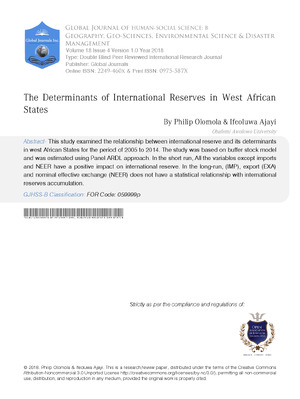
This study examined the relationship between international reserve and its determinants in west African States for the period of 2005 to 2014. The study was based on buffer stock model and was estimated using Panel ARDL approach. In the short run, All the variables except imports and NEER have a positive impact on international reserve. In the long-run, (IMP), export (EXA) and nominal effective exchange (NEER) does not have a statistical relationship with international reserves accumulation. I.

References

14 Cites in Article
  1. I Bentum-Ennin (2014). International Reserves Accumulation and Economic Growth in the West African Monetary Zone.
  2. Graham Bird,Alex Mandilaras (2011). Once Bitten: The Effect of IMF Programs on Subsequent Reserve Behavior.
  3. David Irefin,N Baba,Yaaba (2013). Determinants of Foreign Reserves in Nigeria: An Autoregressive Distributed Lag Approach.
  4. Piti Disyatat,Donald Mathieson (2001). Currency Crises and the Demand for Foreign Reseves.
  5. Martin Feldstein (1999). A Self-Help Guide for Emerging Markets.
  6. Jacob Frenkel,Boyan Jovanovic (1981). Optimal International Reserves: A Stochastic Framework.
  7. Shin-Ichi Fukuda,Yoshifumi Kon (2010). Macroeconomic Impacts of Foreign Exchange Reserve Accumulation: Theory and International Evidence.
  8. Jean Imbs,Paolo Mauro (2000). Pooling Risk Among Countries.
  9. M Pesaran,Yongcheol Shin,Ron Smith (1999). Pooled Mean Group Estimation of Dynamic Heterogeneous Panels.
  10. M Pesaran,Ron Smith (1995). Estimating long-run relationships from dynamic heterogeneous panels.
  11. Victor Polterovich,Vladimir Popov (2003). Accumulation of Foreign Exchange Reserves and Long Term Growth.
  12. M Ramachandran (2004). The optimal level of international reserves: evidence for India.
  13. H Rincón (2007). Financial Globalization, Economic Growth, and Macroeconomic Volatility.
  14. S Shchebakov (2002). Foreign Reserves Adequacy: Case of China, prepared for the Fifteenth Meeting of the IMF Committee on Balance of Payment Statistics.

Funding

No external funding was declared for this work.

Conflict of Interest

The authors declare no conflict of interest.

Ethical Approval

No ethics committee approval was required for this article type.

Data Availability

Not applicable for this article.

How to Cite This Article

Philip Olomola. 2018. \u201cThe Determinants of International Reserves in West-African States\u201d. Global Journal of Human-Social Science - B: Geography, Environmental Science & Disaster Management GJHSS-B Volume 18 (GJHSS Volume 18 Issue B4).

Download Citation

Journal Specifications

Crossref Journal DOI 10.17406/GJHSS

Print ISSN 0975-587X

e-ISSN 2249-460X

Keywords
Classification
GJHSS-B Classification FOR Code: 059999p
Version of record

v1.2

Issue date
November 17, 2018

Language
en
Experiance in AR

Explore published articles in an immersive Augmented Reality environment. Our platform converts research papers into interactive 3D books, allowing readers to view and interact with content using AR and VR compatible devices.

Read in 3D

Your published article is automatically converted into a realistic 3D book. Flip through pages and read research papers in a more engaging and interactive format.

Article Matrices
Total Views: 3118
Total Downloads: 1540
2026 Trends
Related Research
Our website is actively being updated, and changes may occur frequently. Please clear your browser cache if needed. For feedback or error reporting, please email [email protected]

Request Access

Please fill out the form below to request access to this research paper. Your request will be reviewed by the editorial or author team.
X

Quote and Order Details

Contact Person

Invoice Address

Notes or Comments

This is the heading

Lorem ipsum dolor sit amet, consectetur adipiscing elit. Ut elit tellus, luctus nec ullamcorper mattis, pulvinar dapibus leo.

High-quality academic research articles on global topics and journals.

The Determinants of International Reserves in West-African States

Philip Olomola
Philip Olomola <p>Obafemi Awolowo University</p>
Ifeoluwa Tolulope Ajayi

Research Journals