
I. INTRODUCTION
Currently, cluster method is one of the approaches applied by the government in the development of SMEs, due to the numerous advantages. Marcin Piatkowski (2015:313-320) reported on the possible benefits, which include profitability, skills improvement for employees, influential effect on economic policy at regional and national scales, and also the possibility of joint product promotion. Other considerations related to the contribution of SMEs in accelerating economic growth, include the increasing number of enterprises, employment generation, and an upsurge in gross domestic product (Tambunan, 2011).
This study emphasizes on organization development through network management, with reference to the weaknesses of SMEs Cluster in East Kalimantan, which limit focus on the product, hence marketing tends to be slow and unable to penetrate beyond the region. However, reinforcing the network management is assumed capable of influencing the development and expansion of product distribution. This characteristics is generally attributed as weak, based on the following indicators; (1) sub-optimal interaction among stakeholders, including the local governments, banks, large companies, and associations, and also between clusters. (2) a shortfall in the distribution percentage of SMEs products outside the province of East Kalimantan, as well as the low frequency and mobility of relationships established with affiliated agencies. Based on the fundamental networking problems, this research concentrates on two basic questions, including the factors influencing the effectiveness of network management, and the development of possible achievement strategies in the development of SMEs Cluster.
II. THEORETICAL REVIEW
Tambunan, (2005), reported on the ease for government to establish patterns, strategies and policies supporting the development of SMEs cluster. This was confirmed in a study by Sarah Foghani (2017:2), which made reference to the agglomeration of interrelated companies producing of similar commodities. Conversely, the concentration of businesses in one place has been associated with the relative ease of consolidation and cooperation in management, although the main theory is centered on defining the cluster as a geographical area where interrelated companies are converged. The operations are conducted in a similar sector, which is simultaneously cooperate (Porter:1998). Meanwhile, then the supporting theory asserts cluster as "an organizational form that involves stakeholder in the course of development, including some formula of partnership (Palmen & Baron, 2011:13). In another viewpoint, this is explained as a group of companies, institutions and economic agencies located in close proximity to each other (Clipa, 2012: Ibrahim M. Awad et al, 2017: 631-654). In addition, Marcin Piatkowski (2015:313-320), reported on the following advantages and benefits of clusters: a. Creating favorable conditions for business development. b. Enhancing the skills of employees. c. Fostering interactions in the product development process. d. Joint promotion and creation of merchandise. e. Affecting economic policies associated with issues surrounding cluster specialization.
Also, it is necessary to recognize a common value with this cluster system, with emphasis networking and cooperation (Haviernikova, 2013: Ibrahim M. Awad et al, 2017: 631-654), and as a legal entity offering support, management, and direction (Adumitroaei et al., 2013). This union have numerous positive effects, including better access to market and suppliers, competent human resources, and easy technology spillover of know-how (Long and Zhang (2011), needed to improve innovation capacity and competitive ability (Zhang and Luo, 2014). Meanwhile, a common aspect is that the geographic proximity of related industries or service providers share considerable interests linked through interdependencies (Ibrahim M. Awad 2017: 631-654). There are good explanations for the operation of a successful cluster, in terms of increased competitiveness, which subsequently play an important role in economic growth. These initiatives tend to increase yield and innovative capacities, stimulate quick production, and attract new firms, ensuring higher quality of regional strategic planning (Stejskal and Hajek, 2012: Ibrahim M. Awad et al, 2017: 631-654). Haris (2015), defines cluster as a collection, unit, or group of objects with similar characteristics and indicators. This concept has comparable indicators with SME cluster, which is also obtainable in all kinds of businesses, interconnected with each other, and conducted in a single location. Lyon and Atherton (2000) reported on the three fundamental requirement of categorical SME industry clustering, which include: commonality, concentration, and connectivity.
Based on the above description, SME cluster is then defined as a group of enterprises assumed to fulfill certain and specific requirements, including (1) commonality; refers to similarities in products, (2) concentration; a grouping of businesses with the tendency to interact, (3) connectivity; this is affiliated with interconnection and interdependence, and (4) ease to reach the market, indicated by the straight-forward recognition as a centre of industry.
Developing the cluster method is one of strategy to strengthen SMEs, hence the stages of institutionalization instrument from W. Richard Scott (2003) are monitored. There are three phases in institutional development, including the regulative, normarive and cultural-cognitive, which are identified using four idnikators, encompassing the symbolic and relational system, as well as routine and artifacts.
Tambunan (2008:99) reported on the use of paradigm change as a single method of organization development. the success of this strategy is not observed in the increasing the number of units but in the extent of innovative and productivity. Furthermore, Tambunan (2011: 68) implement four indicators in the development of SMEs, which include the role of SMEs, critical constraints, the women entrepreneurship development, and innovation capability. Moreover, Dipta, IW (2005) reported on the ability for facilitated associations to consequently synergize resource allocation through clusters, in a quest to create and enhance effective coaching, facilitate technology transfer, and promote information dissemination. In addition, other thoughts and ideas are possibly obtained through the identification of problems, with the following as the most common; a. Lack of production design, planning and control, b. Managing the process, c. Aspects of safety and maintenance (Eugenio López-Ortega: 2016: 59-69).
The driving factors for cluster growth encompass collective efficiency, social capital, and policy (Parrilli 2009; Lucas Figal Garone et al., 2015), while Lucas Figal Garone, (2015) revealed the impact of central government authority on encouraging the development of small sectors through financial, technical, and managerial assistance. Sri Herliana (2015) emphasized on growth fact that was determined by several indicators, comprising of human resources, marketing, capital, technology, organization and management, infrastructure issues, cooperation, competitors, access to large businesses and government. Therefore, the possibility of adequately developing a cluster design through several indicators was established, including market mechanism, human resources, external support, and the role of government. This concept has the tendency of adoption with certain considerations in some cases in Indonesia, including East Kalimantan.
Enhancements in innovation was identified as the engine to increase small business activities, in attempts to assure contribution towards sustainable economic growth (Sri Herliana: 2015), while competition is the trigger force of any market (Sibel Ahmedova 2015). This is particularly divided into three separate groups, including the environmental factor, industry-level and enterprise (company)-level (Sibel Ahmedova 2015). Hence, a combination of innovation augmentations and competitiveness amongst business entities is assumed to play a role in encouraging the development of businesses. However, the absence of the latter makes it difficult to achieve this target, although innovation successfully drive competitiveness.
Based on the theories above, internal and external factors were concluded to have an influence on the development of SMEs cluster. Conversely, the internal factor consist of business strategy and diversity, technology, human resources, network strength, performance and productivity, as well as production and marketing, business capital, the next generation, enhancement in innovations, organization and management. In addition, external factors comprises of market, customer, business competitor, government role and policy, partnership, competition, suppliers, supporting institutions, and access to large enterprises.
In connection with network management, Robert Agranoff (2001) raised several basic questions based on flexibility in networks, accountability and trust issue, mutual dependency, power in networks, alongside results and productivity. Mirzadeth P. (2012) reported on three fundamental themes of network management, which include strategies, organization, and information, established under the scope of material, infrastructure, supervision of network information and equipment, as well as public relations. Therefore, network management is a study associated with planning, organizing, supervising, controlling, and accounting of affiliated resources, in attempt to maximize efficiency and productivity, as well as to allocate, deploy, coordinate, and monitor network resources.
III. RESEARCH METHOD
This study implements the analysis of Structural Equation Modeling (SEM), a multivariate technique encompassing a combination of factor and regression, aimed at examining the relationships between variables (Hair et al., 1998: 583). This is a confirmatory procedure, due to the analytical characteristics with the ability to describe, rather than explain affirmation.
The following theory was used in the determination of samples;
First, estimating the type of input and matrix of the model, with reference to Ferdinand, 2006. The data obtained from the field was compiled in a tabulation and automatically converted by the program into a covariance or correlation matrix. This was followed by changes effected by the Analysis of Moment Structures (AMOS), and the table below makes reference to the proposed model:
| No. | Sample Size | Model Estimation |
| 1 | 100–200 | Maksimum Likelihood (ML) |
| 2 | 200–500 | Maksimum Likelihood atau Generalized Least Square (GLS) |
| 3 | 500–2.500 | Unweighted Least Square (ULS) atau Scale Free Least Square (SLS) |
| 4 | > 2.500 | Asymptotically Distribution Free (ADF) |
Second, the research location determination, which was based on the existence of SME clusters and the quality of relationship, as well as the development of home industries. The sample sizes were determined based on ownership, size of SME and time of operation (Suafa Badi 2017). Hence, this study was conducted in four regions and three Cluster categories, including Batik, Food and Handicraft. The criteria used involve having a minimum of 5 units and less than 100 employees, being members of a joint business group and a part of the cluster system. Based on these concept, three hundred and fifty-one respondents were selected in four regions to be sampled, using a cluster sampling design. Therefore, data collection was performed with a full structure questionnaire, and measured on an ordinal scale, using five answer levels.
IV. RESEARCH FINDING AND DISCUSSION
The effectiveness of network management is expected to have an impact in the process of strengthening network management. This is required to assess and classify the scores height for each indicator, as arranged in the four levels below:
| No. | Category | Score |
| 1 | Low | 351 to 702 |
| 2 | Medium | 703 to 1.054 |
| 3 | High | 1.055 to 1.406 |
| 4 | Very High | 1.407 to 1.758 |
a) Internal Factor
There are seven influential internal factors associated with the effectiveness of network management, including business strategy and diversity, technology development and innovation, human resources, network strength, performance and productivity. However, a reference to the results of data analysis show three internal factors with a strong relationship, which include;
i. Network Performance
There is a list of five indicators assumed to serve as a measure, although the quality of business people is known to be the most influential, in terms of network performance. Therefore, an upgrade in individual attributes enhances network performance, which subsequently reflects on the company output. The logic, however, is that business people cannot work alone, as other supporting factors are required to supplement this key quality. In addition, the policy is expected to strengthen the position of business people, as well as the institutions' status, as the Business Capital Assistance is a decisive indicator, with the tendency of being a driving force to start a business. Meanwhile, a total of three are in the high category, while the others are medium. The following are factors influencing network performance.
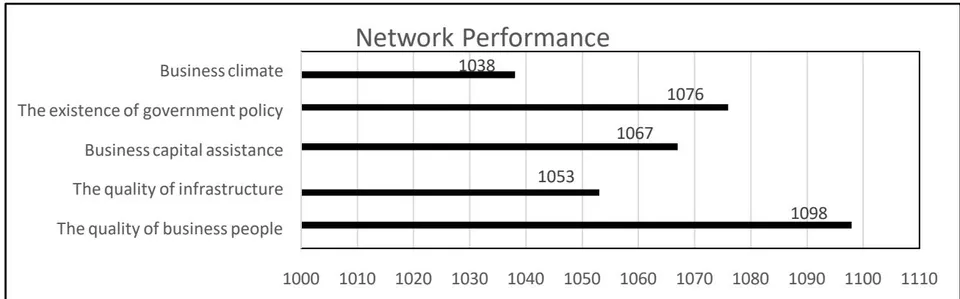
Figure 1 shows all the role of indicators in the effectiveness of network management, with differences in the level of intensity. Furthermore, the following is a statement from a chairman of the association of the Ulap Doyo Batik Cluster; "The important key for SMEs is on leaders quality: Most of the business people in Ulap Doyo exhibit weak managerial abilities, hence activities carried out are centered on the association chairman. Therefore, progress is expected to be made only with the propagation of good technical and non-technical qualities.
ii. Business Diversity
Business diversity can be observed from size, type, and design, as well as product quality, which is specifically attributed the most important, and is placed in the high category, while others indicators are classified as medium. In addition business trend tends to focus on product design, hence a reduction in attractiveness leads to difficulties in market competition. Therefore, there is need to deeply and properly analyze the aspects of quality and design, as a good design without quality has an impact on product durability, while the reverse influences sales. Conversely, size and types are not an urgent concern for SMEs Cluster businesses, reinforced by the association members of the Samarinda Rhombus Cluster: "The maintenance of consumer loyalty requires maintaining the quality of product, hence business people acquire better confidence in market expansion". These explanations emphasizes the influence of quality on business success, hence more direct attention is paid in this direction, in order to maintain consumer loyalty and ultimately support market penetration.
iii. Network Productivity
The effect of network productivity on the effectiveness of management is assessed through five indicators, including the direction of the leaders to staff; business owners summit; meeting among the joint venture leaders; supervision and guidance by government staff; discussions between business owner and non-government stakeholders. In addition, most individuals in SME cluster explained the direction of leadership towards staff as the most influential indicator of productivity, designating the strength and influence of business owners.
b) External Factors
Based on the results of data analysis, three external factors were identified to have a strong relationship with the effectiveness of network management. These include partnership, customer, and Policy.
i. Partnership
The purpose of this research, therefore, is to determine the right institution to partner in the development of SMEs Cluster. Therefore, the measurement of network management effectiveness in patenership programs require the use of several instruments, including the collaboration program of SMEs Clusters with Technical and Vocational Education and Training Centers (TVETC); large companies; capital assistance institutions; Associations; as well as communities surrounding the business location. According to most affected business people, the partnership programs with TVETC, a large company, and capital assistance institutions were assumed to have a great impact on the effectiveness of network management. Therefore, it is important for government to prioritize policies to support the association between SMEs Clusters and the three institutions.
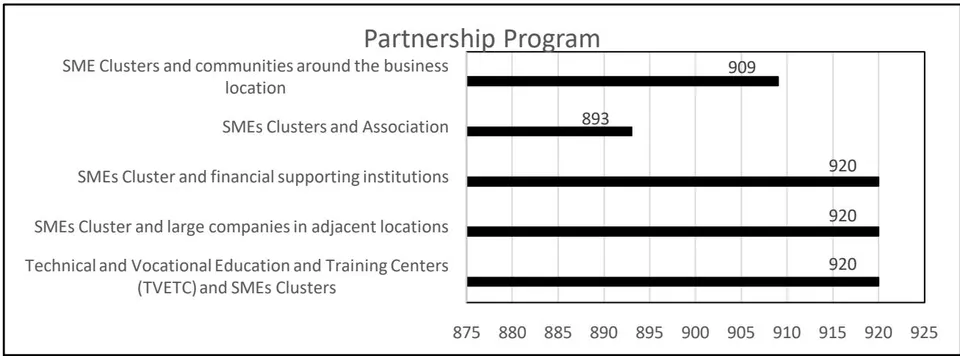
The implementation of partnership programs are observed in several locations, while the realization in Kutai Kertanegara Regency is an example for other regions. However, maximizing this approach in East Kalimantan is expected to optimize the important role of the three recommended institutions, including SMEs Cluster partner companies, supporting institutions, as well as Technical and Vocational Education and Training Centers (TVETC). Hence, partnership programs are estimated to have a significant influence on the cluster development.
ii. Policy and Government Role
This study was conducted to determine the policy role in achieving effectiveness in network management. These were identified using five item, of which three were ascertained as priority by business people, including (1) simplification of regulations and tax reduction, (2) simplification of bureaucracy in business licensing, and (3) standardization of product quality. These collectively have a significant impact, hence the need for government to immediately respond technically on issues related to these aspects. Meanwhile, product quality control is required to overcome market competition levels, which ultimately ensure customer satisfaction and maintain loyalists. In addition, the implementation of complicated regulations and high tax are known obstacles and burdens for SMEs Cluster entrepreneurs, thus the need for government to implement a different scheme in this environment. This realization is a step toward a encouraging performance. Also, business people frequently face complicated bureaucracies in managing licenses, which often causes delay in proposing legalities of individual institutions. This is possibly solved by government intervention in ensuring simplicity in bureaucracy:
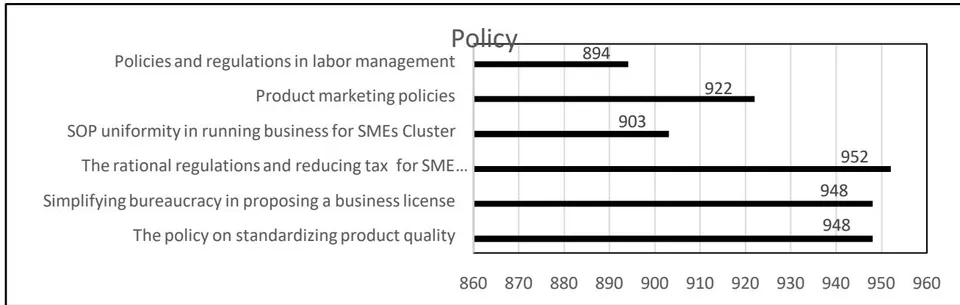
The data above is strengthen through the following statement from the Food Cluster Association:
"As start-up entrepreneurs, it is important to demand intervention, care and government support towards the existence and development of businesses, particularly in terms of simplifying permits and tax breaks. Therefore, the government is expected to accommodate these aspirations and take concrete steps to prepare encouraging policies.
iii. Customer
Customer play an important role in the development of networks and characterization, which is measured through several indicators. This consumerbased attribute is highly considered by most business people, resulting from the ability to balance and harmonize the reciprocal relationship with the manufacturers. In addition, producers play a different role by fabricating the customer needs, which serves as the market. This relationship is mutually beneficial, hence the existence of customers greatly influence the process of network development in SMEs Cluster.
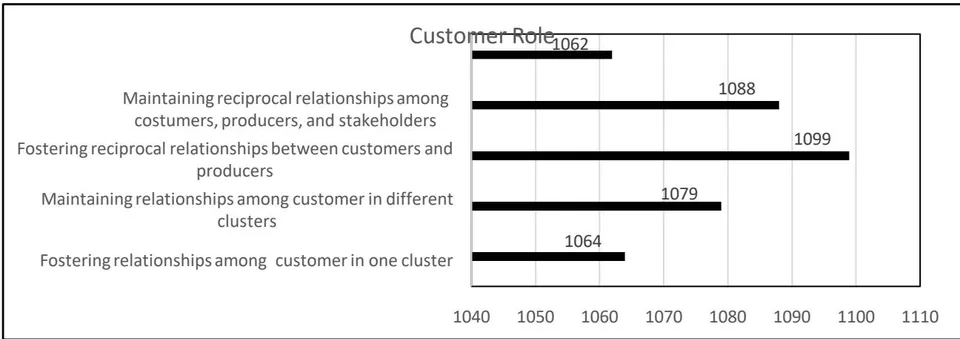
The figure above is strengthened through the following statement from the chairman, Business Clinic Board; "In my opinion, the most important role of customers is activity and the desire to maintain a reciprocal relationship. This is a very helpful characteristic for SMEs Clusters to evaluate the development of businesses, primarily regarding products and market conditions". Based on the opinions above, it is established the tremendous assistance rendered to business people, by the response from customer, pertaining to the products distributed, realized through the maintenance of mutual relations.
c) Strategy
There are four strategies strongly associated with the effectiveness of network management, including;
i. Community and bureaucratic Orientated Strategy
As a space to ensure creativity and innovation, the community members tend to demonstrate genuine concerns for one another. This involves the role played in product distribution and also in ensuring loyalty and fanaticism. In addition, the role of the community orientation strategy is assessed by measuring some indicators with equal degree, which are collectively optimized by adjusting the implementation process to government programs. However, challenges are frequently experienced during direct application, and the following responses were obtained from the entire respondents:
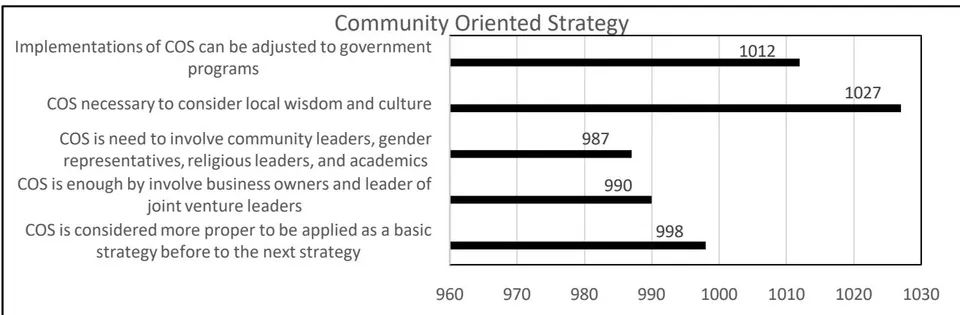
Based on the community orientation strategy, a government staff of Citra Niaga stated: "Managers observe the establishment of various communities by indigenous business people as an effort to develop the enterprise. This was attained through some department, including culture, art, sports, hobbies, and others, although culture and local wisdom were attributed the most interesting, empowered to encourage SMEs. Therefore, the role of community is concluded to be very effective in these Cluster business development, especially for those with a purpose to extend culture and local wisdom, hence the need for further considerations.
ii. Accounting Management Strategy
Business people with good accounting management proficiency possess the capacity to control business developments from existing balance sheets. This role is evaluated through the assessment of several indicators, assumed to greatly inspire human resource performance, based on the basic accounting functions, which becomes a strong foundation in business. The following contains general information on the roles of accounting.
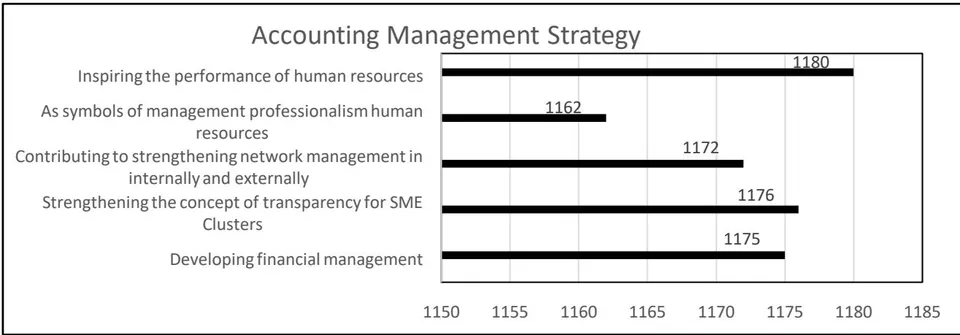
This primary data is strengthened by the statement from government official: "The weaknesses of business people lies in bookkeeping and business reporting. This is frequently emphasized, as orderly and neat bookkeeping practices have been known to inspire the performance of SMEs, especially for the actors involved in the business. However, this method has not been fully developed, both personally (business people) and institutionally".
iii. Workforce Management Strategy
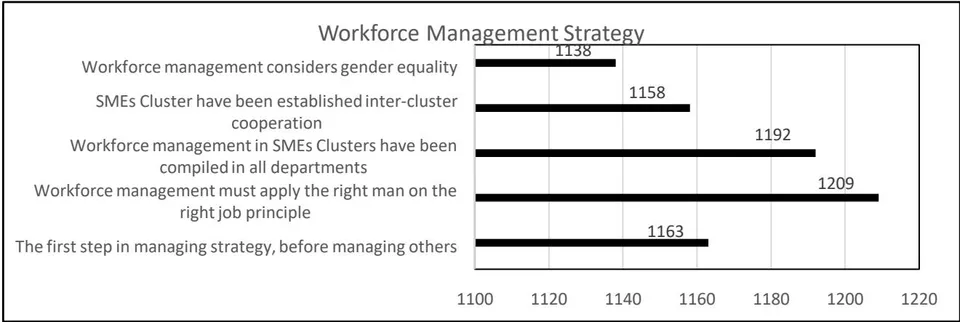
Workers plays an important role in the conduction of business activities, and also in ensuring the existence as an important asset. The role of workforce management is measured through several indicators, as employees are considered useful by business people, on the basis of expertise. These attributes subsequently influence the effectiveness of network management, and the following figure provides a descriptive illustration.
SMEs Cluster have been established inter-cluster cooperation
Workforce management in SMEs Clusters have been compiled in all departments
Workforce management must apply the right man on the right job principle
The first step in managing strategy, before managing others
Figure 7: Workforce Management Strategy
The Indonesia Bank has a good commitment to the development of SMEs cluster, with priority centered on the field of food security, and also in the development of local cultural potentials. The Following is a statement by the representative of Indonesia Bank: "As a supervisor, we strongly emphasize on the importance of workforce management, hence job distribution is expected to be adjusted in accordance with expertise. This ought to be considered during the employee recruitment process, although challenges arise in the inability for business leaders to demonstrate capable management skills, hence the Indonesia Bank established a Mini University". Based on these statements and the assessment from other business inclined individuals, it is possible to conclude that the workforce management strategy provides a very significant influence on the effectiveness of network management, especially through expertise structuring.
iv. Maintain Interdependence Strategy
The substance of the network encompass the relationship among stakeholder, assumed to depend on, encourage and support one another. The purpose of this research is to identify the most influential indicators of interdependence maintenance strategies, and the findings show the role of SMEs Cluster business people in controlling power, in order to avoid domination. Hence, the individuals involved are observed to have an equal position with each other, and collectively maintaining dominance in the presence or absence of business. Meanwhile, developing this strategy is required to avoid monopoly, which denotes the interdependence of members to one another, leading to the generation of stronger bonds. The following supporting data clarifies the role of this strategy:
Keep interdependence functioning as a tool to maintain balance in network management
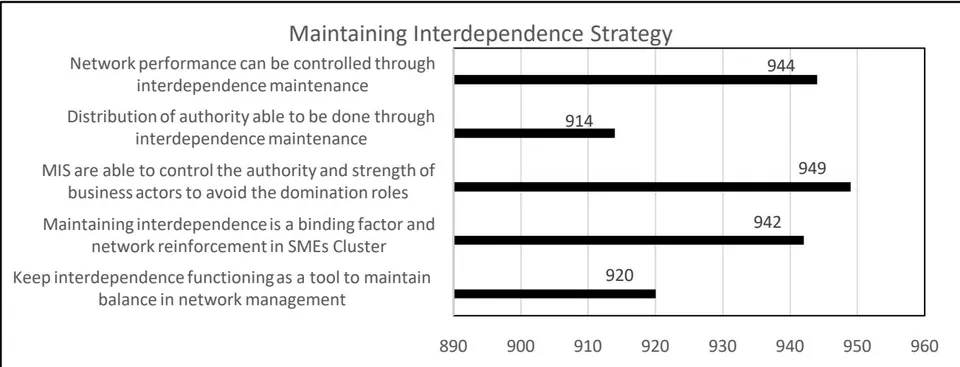
There is need to maintain the dependencies in SMEs Clusters, alongside position equality and connectivity among business inclined individuals. The following is a statement from one of the business people in Sarong Samarinda Cluster: "As sarong craftsmen, it is often difficult developing businesses, due to the incidence of domination (for example, in promotion programs), and a host of other problems surrounding Sarong Samarinda Cluster. However, this incidence is anticipated to not happen here, due to the equality in individual role, which creates the opportunity for healthy and pleasant competition". Based on the statements obtained from the business people, the strategy highlighted to ensure the maintenance of dependency ought to be developed. Finally, it is also possible to adequately maintain the existence of cluster, hence facilitating the strength of SME Cluster networks.
d) Analysis of Structural Equation Modeling (SEM)
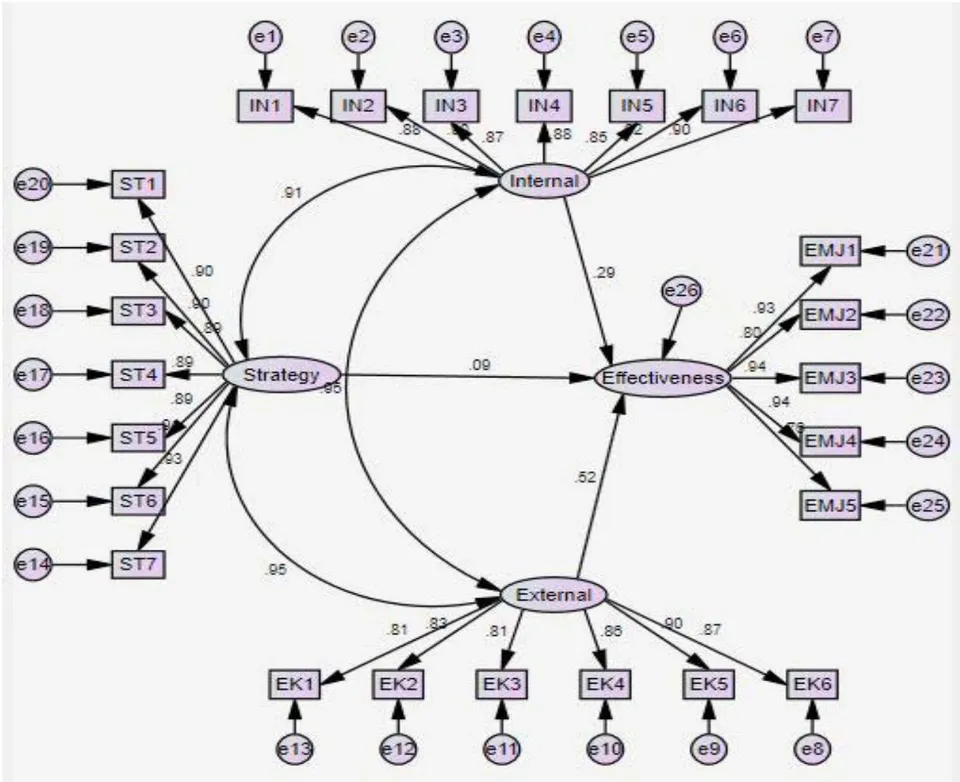
The figure above is a structural model produced by AMOS, which according to Ghozali (2014), is used to test for good or bad. The principle was based on the ability to fulfil at least four criteria among others, including chi-square, degree of freedom, probability, and CFI. The following is overall information data collected:
Tabel 3: Criteria Goodness of fit Index Model
| No. | Goodness of fit Index | Criteria | Cut of value |
| 1 | Chi square | > Chi Square table | 1.224 |
| 2 | Probability | > 0,05 (5%) | .000 |
| 3 | Root Mean Square Error Approximation (RMSEA) | < 0,08 | 0,08 |
| 4 | The Minimum Sampel Discrepancy Function atau Degree of Freedom (CMIN/DF). | < 2 atau 3 | 3 |
| 5 | Comparative Fit Index (CFI) | > 0.95 | 1 (SM) |
Based on the table above, the model is concluded as good, despite the absence of absolute values, with reference to assumptions of Structural Equation Modeling analysis. In addition, the figures obtained and the Goodness of Fit Index Model Criteria table show a measureable variable relationship.
i. Test the Relationship among Variables
The AMOS test was used to generate the structural model as shown in figure 6.4. This technique identified a relationship between the exogenous and endogenous constructs, and the following hypothesis were obtained:
Hypothesis 1: There is the relationship between Internal Factors and the effectiveness of Network Management, based on the covariance (Regression Weights) of 0.210, and correlation (Standardized Regression Weights) of 0.241. These were significant at p < 0.5, indicating the existence of a positive association between X1 and Y.
Hypothesis 2: There is the relationship between External Factor and the effectiveness of Network Managers. This is evidenced by a covariance (Regression Weights) of 0.440 or correlation (Standardized Regression Weights) of 0.399, at significance of p < 0.5, which indicate a positive correlation between X2 and Y. Furthermore, the AMOS also confirms this association in SMEs Cluster.
Hypothesis 3: There is the relationship between Strategy and the effectiveness of Network Management. This is proved by a covariance (Regression Weights) of 0.471 or correlation (Standardized Regression Weights) of 0.346, at significance of p < 0.5, which indicate a positive association between X3 and Y. In addition, the AMOS test ascertains this claim, hence the specific Strategy implemented by business actors in SMEs Cluster influences Network Management Effectiveness.
V. CONCLUSION
Based on the research finding, the acquisition of organizational development through the effectiveness of network management in SMEs Cluster is achievable through the following stages:
First, Focus on the Five Internal Factors. There are three internal factors confirmed to have a strong relationship with the effectiveness of network management, including (1) network performance, which is linked with the quality of business people. This is because the presence of good attributes fosters creativity in business development, and also enables the development of critical thinking. (2) Business diversity: this parameter in association with astounding network performance facilitates the creation of ideas related to qualitative production. In addition, the majority of SMEs Cluster business people reported on the maintenance of quality as a key to marketing success, resulting from the enhanced ease of establishing a company image. Network productivity: this is the outcome of appropriately conducting the previous factors, determined by the direction chosen. Therefore, an integration of these three factors is expected to encourage the effectiveness of network management.
Second, Focus on External Factors. These factors have a strong relationship with the effectiveness of network management, consisting of (1) Partnership, a system of collaboration between large companies and SMEs, expected to strengthen and expand the cluster network with other agencies. (2) Policy: this relationship is possibly facilitated by implementing the appropriate governmental policies, due to the supporting role towards the existence of SMEs. Hence, there is need to focus on the preparation of regulations, provision of infrastructure, as well as access to development. (3) Customers, this is known to play a role in establishing balance and harmony, and also reciprocal relationships with producers. Furthermore, an integration of these three external factors is predicted to strongly impact on the effectiveness of network management
Third, Implementing the Proper Strategy. With reference to statements from business people, four strategies were identified to have a strong relationship with the effectiveness of network management. These include; First, community and bureaucratic oriented strategy; this has proven to be effective in the development of SMEs Cluster businesses. The development of local culture and wisdom, is primarily strengthened through local government interventions, based on the provision of simple and transparent bureaucracy, as well as standardized public services. Second, accounting management strategy; this significantly inspires the performance of human resources, based on the basic functions of accounting, being a strong foundation in business. Third, workforce management; the placement of employee in accordance with expertise is known to help strengthen network management, which consequently affects the effectiveness of network management. Fourth, maintenance of interdependence; expected to control the power of business people, in order to avoid role domination. This is possible because individuals in the SMEs Cluster have equal positions with each other, which is used collectively to maintain the business and evade dominance. Furthermore, the proper implementation of these four strategies are expected to influence network management, which ultimately encourages and strengthens the existence of SMEs Clusters.