Obong UniversityTo: Author
Article Fingerprint
ReserarchID
Y733B
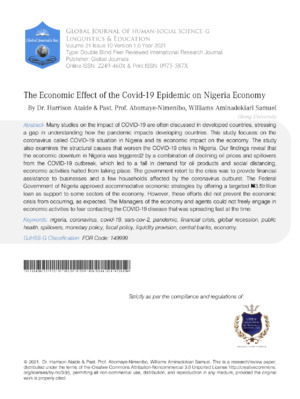
Many studies on the impact of COVID-19 are often discussed in developed countries, stressing a gap in understanding how the pandemic impacts developing countries. This study focuses on the coronavirus called COVID-19 situation in Nigeria and its economic impact on the economy. The study also examines the structural causes that worsen the COVID-19 crisis in Nigeria. Our findings reveal that the economic downturn in Nigeria was triggered2 by a combination of declining oil prices and spillovers from the COVID-19 outbreak, which led to a fall in demand for oil products and social distancing, economic activities halted from taking place. The government retort to the crisis was to provide financial assistance to businesses and a few households affected by the coronavirus outburst. The Federal Government of Nigeria approved accommodative economic strategies by offering a targeted ₦3.5trillion loan as support to some sectors of the economy. However, these efforts did not prevent the economic crisis from occurring, as expected. The Managers of the economy and agents could not freely engage in economic activities to fear contacting the COVID-19 disease that was spreading fast at the time.
Prof. Abomaye-Nimenibo Williams Aminadokiari Samuel. 2021. \u201cThe Economic Impact of the Covid-19 Epidemic on Nigeria Economy\u201d. Global Journal of Human-Social Science - G: Linguistics & Education GJHSS-G Volume 21 (GJHSS Volume 21 Issue G10): .
Crossref Journal DOI 10.17406/GJHSS
Print ISSN 0975-587X
e-ISSN 2249-460X
Explore published articles in an immersive Augmented Reality environment. Our platform converts research papers into interactive 3D books, allowing readers to view and interact with content using AR and VR compatible devices.
Your published article is automatically converted into a realistic 3D book. Flip through pages and read research papers in a more engaging and interactive format.
Total Score: 108
Country: Nigeria
Subject: Global Journal of Human-Social Science - G: Linguistics & Education
Authors: Dr. Harrison Ataide, Past. Prof. Abomaye-Nimenibo, Williams Aminadokiari Samuel (PhD/Dr. count: 1)
View Count (all-time): 189
Total Views (Real + Logic): 2202

Total Downloads (simulated): 887

Publish Date: 2021 08, Sat
Monthly Totals (Real + Logic):
This paper attempted to assess the attitudes of students in
Advances in technology have created the potential for a new
Inclusion has become a priority on the global educational agenda,
Many studies on the impact of COVID-19 are often discussed in developed countries, stressing a gap in understanding how the pandemic impacts developing countries. This study focuses on the coronavirus called COVID-19 situation in Nigeria and its economic impact on the economy. The study also examines the structural causes that worsen the COVID-19 crisis in Nigeria. Our findings reveal that the economic downturn in Nigeria was triggered2 by a combination of declining oil prices and spillovers from the COVID-19 outbreak, which led to a fall in demand for oil products and social distancing, economic activities halted from taking place. The government retort to the crisis was to provide financial assistance to businesses and a few households affected by the coronavirus outburst. The Federal Government of Nigeria approved accommodative economic strategies by offering a targeted ₦3.5trillion loan as support to some sectors of the economy. However, these efforts did not prevent the economic crisis from occurring, as expected. The Managers of the economy and agents could not freely engage in economic activities to fear contacting the COVID-19 disease that was spreading fast at the time.
Lorem ipsum dolor sit amet, consectetur adipiscing elit. Ut elit tellus, luctus nec ullamcorper mattis, pulvinar dapibus leo.