The use of new technologies in the process of educational intervention is undoubtedly a basic and valuable tool for teachers. Specifically, using new forms of representation of educational content and providing a teaching practice that enhances the user’s visual perception of the real environment, is a key factor favoring the educational inclusion of students with special educational needs. In the present study we will investigate whether teachers believe that the use of augmented reality (AR) in children with autism affects their social skills, as well as the possibilities of augmented reality in enhancing the communication skills of children with ASD in areas speech, social interaction, pretend play, reading, enhancing visual perception, imitative ability, attention management and perception of the physical world.
## I. INTRODUCTION
In the international literature there is frequent reference to the use of augmented reality in education. Undoubtedly, through research it has been proven that the application of augmented reality in the educational process is an important tool for teachers as it brings significant benefits to the learning process. According to researchers, this method is considered important as it enables students with autism to interact directly and in real time with the help of virtual objects. According to Wu and colleagues (2013), this method is considered a separate event due to the fact that the objects on the one hand may not be directly accessible in the natural world or for reasons of danger, or due to temporal or spatial distance, or because their dimensions do not allow it, or because it may concern imaginary creations. The user through augmented reality has the ability to interact independently of the object and any difficulties that may arise in a real situation (Dragomir et al., 2018).
Also, an important characteristic of augmented reality is the fact that it creates the appropriate framework according to which the user can obtain the information he needs every time (Kolomoiets et al., 2018). This has the result that the student with autism receives the information, but also understands it more easily, with the aim that the student can better build the correct cognitive structures for the fact, phenomenon and object under study (Lee, 2012).
According to research by Di Siero and his colleagues (2013) augmented reality has the potential to increase students' interest in approaching knowledge. In this way, their motivation and attachment to knowledge increases, they put in more effort and can achieve better learning results (Chen et al., 2016; Casas et al., 2012). The easier and more effective acquisition of knowledge through augmented reality occurs because this method has the ability to visualize complex phenomena or objects with which the user can interact with them. This results in the student approaching and understanding cognitively difficult concepts or situations in their environment in an easy and fun way (Chen et al., 2016; Bhatt et al., 2014). Thus, they can develop skills, critical thinking, cooperation and communication with others, learn to solve daily problems, develop techniques of reflection and self-guided learning process (El Seoud et al., 2019; Nazaruddin et al., 2018).
## II. AUGMENTED REALITY AND AUTISM
a) The impact of Augmented Reality tools in the education of children with ASD
According to research data, people with autism show deficits in key developmental areas. In a study conducted by Casas et al. (2012) implemented the augmented reality-based Kinect device for people with ASD, in which an augmented mirror with virtual objects was designed in which the user could see himself. The Kinect system is equipped with two cameras (one infrared camera and one video camera) and a standard video stream and a depth stream - images are presented at the same time. The sample consisted of five children with autism and two typically developing children aged three to four. The results of the research showed that one child could not respond to the game, while another started to play, but after a while stopped the game and continued. The other three children played and showed more skills than the other children, while a special impression was presented by one child, who played like the children of typical development.
One of the hallmarks of autism is a lack of spontaneous pretend play, coupled with an absence of social interaction and communication. Thus, Bai et al. (2013) in their research studied the application of a glass game for children with autism. Through this research they aimed to examine the effects of augmented reality in relation to pretend play by superimposing virtual content on the physical world in AR.
The study sample consisted of twelve children, ten boys and two girls, aged 4 - 7 years. The experiment consisted of two conditions, one with the use of augmented reality and one with no use of it. The augmented reality system is designed by bringing a mirrored mirror enriched with AR augments. This system consisted of a 3x2 meter visualization screen, a projection or retro-projection system, depending on the room where it is to be installed, a computer, a Kinect device and speakers. The Kinect was equipped with two cameras, an infrared and a video camera with a resolution of 640x480 pixels. The reason the Kinect device was used is that it enables the development of not only a standard video stream but also a depth stream in the images. images captured by the Kinect were displayed mixed with virtual information, creating for users an augmented mirror where they could see what was embedded in the augmented scene. The system was designed for use by users, who could play with two different roles both as a child and as a teacher.
This system has been implemented by creating a set of subsystems that deal with different tasks. Depending on the user's activity and actions, the output system creates an augmented environment by incorporating real-world images, video, audio, and virtual elements. Research results showed that students using the AR system increased pretend play and showed more engagement and engagement compared to a non-increased condition.
In a study by Qin et al. (2014) implemented an experiential Augmented Reality system for children with autism. Specifically, there was an autism simulator that used augmented reality. The purpose of the present research is the construction of an experiential system that uses augmented reality with the aim of imitating perceptual symptoms in autism. In addition to reproducing symptoms, it can change patterns or severity with the environment to quantify symptoms. This system helps people with autism adapt to activities of daily living, such as the focus assist system.
According to Almeida da Silva et al. (2015), the method used is STAR (Speech Therapy with Augmented Reality) together with speech therapy through augmented reality, aiming to integrate augmented reality into communication interventions by combining elements of augmented and alternative communication and applied behavior analysis. This method enables children to show significant improvement in the area of speech.
The synthesis of results shows that people with autism have difficulty understanding the emotions of others. They have difficulty recognizing and understanding critical non-verbal behaviors as a result of which they ignore non-verbal movements and social cues, such as facial expressions, which affect the social interaction of individuals. However, learning non-verbal behaviors through augmented reality shows positive results. Specifically, in a study carried out by Chen et al. (2016) used a video of nonverbal facial cues in children with autism to enhance perceptions and judgments of facial emotions. Thus, they tried to train children with autism to imitate the expressions and emotions of the face shown in the video to improve their social skills. Augmented reality is also used in conjunction with Video-modeling storybook (VM) to train children to imitate non-verbal behaviors and enhance social interaction. The results of the research showed that the ARVMS intervention contributed to the understanding of expressions and emotions, increased children's visual index and their attention to non-verbal social patterns.
In a study conducted by Cihak et al. (2016) investigating the learning of basic hygiene techniques in children with autism and the assessment of augmented reality for the completion of a chain task of elementary school students with autism. The object of study of this research was to combine digital information in relation to the real world and then examine the effects of augmented reality with the aim of teaching the student a series of steps. In particular, with augmented reality, students are transported to the bathroom of a special education classroom, and also, there is a breakdown of illustrated five-step tasks as visual support. With the fourth generation iPod touch Aurasma (2014) app, there are individual toothbrushes, toothpaste and paper cups. In the research process, one student uses a picture exchange system to communicate, while the other two students use a Pragmatic Organization Dynamic Display (PODD) book to communicate.
The results of the research were positive and encouraging, showing that children with autism can be taught better with the contribution of visual media. They showed that all the students learned the process of brushing their teeth, retaining this skill nine months later. Furthermore, research has shown that students can learn the entire routine without interruption and complete the mastered steps.
In a study by Liu et al. (2017), had as its object the possibility for social interaction and communication through the Smartglasses Augmented Reality system. The purpose of the research was the ability to guide emotion recognition, face-directed gaze, eye contact, and behavioral guidance. The Brain Power System (BPS), is a digital behavioral assistant that helps collect quantitative data using smart glasses and artificial intelligence. The sample consisted of two boys with autism, aged eight and nine. The results were positive and showed that children with autism were able to improve non-verbal communication. Specifically, they showed improved eye contact and social interaction, while one student showed decreased emotional engagement and behavioral self-regulation, and the second showed improvement on both levels.
The use of smart AR sunglasses in the development of social communication is an important aid for children with autism. Specifically, in a study conducted by Sahin et al. (2018), looked at the safety as well as the lack of negative effects of the aid worn by the sample. The research involved 18 children and adults, from 4.5 to 21.5 years old, men and women, who were in a wide spectrum of autism with high levels of severity. However, to collect the research data the researchers used the Enhanced Brain version, the older Brain Power Autism System (BPAS) and Google Glass (Google, Mountain View, CA, USA). The results showed that there were no significant negative effects when using the AR glasses, while there was only one case of dizziness, one case of eye strain and one case of nasal discomfort. Of course, after using the AR glasses they showed high heat, which was not particularly worrying.
Also, another research by Lorenzo et al. (2019), showed that the application of augmented reality affects and improves the social skills of children with ASD. The research was carried out through a Quicker Vision application and the instrument used to collect the data was the Autistic Spectrum Inventory of Riviere. The sample was 10 boys and one girl. Regarding the experimental group participated in augmented reality activities, while the control group participated in the same intervention without the use of the tool, for 20 weeks with 15 minutes per session every 2 times a week. This resulted in statistically significant differences between the two groups.
Social story creation through augmented reality in children with ASD was studied by Syahputra et al. (2018), and aimed to enhance children's intrinsic motivation through storytelling to affect children's emotional change, socialization, and empathy with others. The medium used to achieve the research is 3D animation and the Leap Motion Controller. Three children with ASD took part in the research. The results of the research showed that the specific system is considered suitable for the treatment of children with ASD, the visualization of a story, the use of colors and images create a fun, attractive and interesting educational context, motivating children to participate in the educational process.
In the education of children with autism it is important to have the motivation to mobilize the interest of children with ASD but also to improve their skills to interact with the social environment. Thus, the question investigated in the study by Rega et al. (2018) on the use of augmented reality in increasing the motivation of children with ASD. For this reason, new technologies such as Google Scholar, PubMed, CiteSeerX and IEEEXplore were used. The results of the research showed that the use of augmented reality can enhance the motivation of children with autism, encourage the communication, social, language and cognitive skills of children with ASD.
The research of Escobedo et al. (2014), implemented the Mobile Object Identification System, which enabled teachers to use digital content on physical objects. The object of the research was the possibility of augmented reality in being able to increase the selective and sustained attention of children with autism during object discrimination treatments and to acquire more positive emotions. The sample of children is 12 low-functioning children aged 3-8, mean age (m) was 5.08 and standard deviation (SD) was 0.9, and 7 teachers. The results showed that $62\%$ while using Mobis the students showed selective and sustained attention in 06:18, while before using Mobis they stayed attentive for 01:05 minutes, and after Mobis it decreased again, to 58 seconds $(p = 0.0002)$. Also the use of Mobis showed that it affected more positive emotions among students during the treatments an increase of $24\%$, 2:13 minutes during, while the time before was 0:01, and 0:07 after using Mobis, $p = 0.004$.
## III. METHODOLOGY
The present research is a descriptive review on augmented reality and its educational intervention on children on the autism spectrum. We will investigate the role of augmented reality as an effect of social support in the education of children with autism, as well as the investigation of teachers' attitudes in relation to the virtual possibilities of augmented reality and its importance in the cooperation and communicative behavior of students with autism.
### a) Objectives
As we have mentioned before, the main objective of this work is to determine the intervention of augmented reality in the education of children with autism, as well as the investigation of teachers' attitudes in relation to the virtual possibilities of augmented reality and its importance in cooperation and communication behavior of students with autism.
- To consider increasing motivation to learn.
- To explore how augmented reality can help to enhance emotional and visual contact and gaming skills.
- To determine how augmented reality can affect the basic hygiene techniques of students with autism.
- To determine the conditions of social interaction from the use of augmented reality.
- ✓ To consider e-learning support in the educational process, as well as the development of cooperative and communicative behavior, practical perception, development of verbal communication, strengthening of cooperative and symbolic play.
Considering the above objectives, the hypotheses are as follows:
Hypothesis 1: Teachers emphasize increasing motivation to learn and enhancing emotional and visual contact and play skills.
Hypothesis 2: The support of the educational process with the use of e-learning is a factor that contributes to the development of cooperative and communicative behavior, practice of perception, development of verbal communication, strengthening of cooperative and symbolic play.
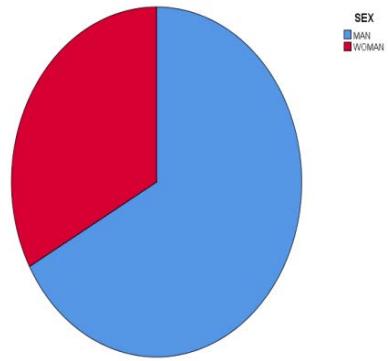
1. Sample distribution according to Gender
Hypothesis 3: The contribution of augmented reality does not create conditions of alienation of students with autism.
### b) Sample
The sample, for the question of this research, consisted of teachers of secondary school general education in the area of Attica. 427 teachers, 286 (67%) men and 141 (33%) women with experience in special education, 147 teachers from all over took part. Finally, teachers have a bachelor's degree, a smaller part, 286 teachers, has completed a postgraduate degree, and 23 teachers has a doctorate.
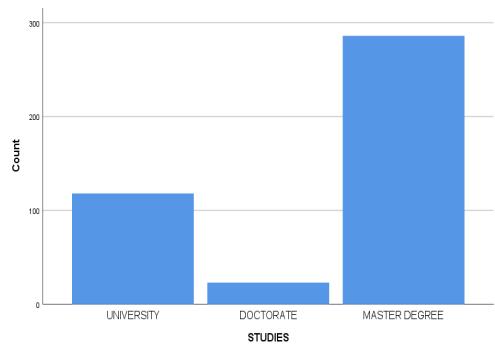
2. Sample distribution according to studies
### c) Instrument
For the research question we select the questionnaire with which we will collect the information that will be given to us by the respondents. Questions will be closed-ended and individuals will be asked to answer by selecting a number from the five. Completing, encoding and analyzing data will be easier. Also, with the questionnaire, subjects are given the opportunity to answer all in exactly the same frame of reference. Participants were asked to complete an anonymous questionnaire that included 12 closed-ended questions from which teachers were asked to choose one of the suggested options. The questionnaire refers to teachers' views on the use of Social Welfare Robots in children with autism. The time required to complete it was 20 minutes and it was completed at the end of the course. The questionnaire is listed at the end of the text.
The type of questions will be of the closed type and will be the scale graded from the negative point to the positive and will be asked by the subject of the survey to choose one of the five.
The method of questioning will be done by visiting the researcher in a group of people, that is, at school. So we seek to involve many people in the research in a minimum of time and at the same time. We also have the possibility of clarification and more information to solve questions that may arise during the completion of the questionnaire.
#### Data analysis
The analysis of the data was descriptive to see the frequency in the teachers' answers and the percentage in each answer.
## IV. RESULTS ANALYSIS
### a) Descriptive study
Initially, the following tables give a picture of gender, studies, previous service in general and special school and the participation of teachers in training programs.
Table 1: Distribution of a sample based on gender and on the qualifications GENDER
<table><tr><td colspan="2"></td><td>Frequency</td><td>Percent</td><td>Valid Percent</td><td>Cumulative Percent</td></tr><tr><td rowspan="3">Valid</td><td>Man</td><td>286</td><td>67,0</td><td>67,0</td><td>67,0</td></tr><tr><td>Woman</td><td>141</td><td>33,0</td><td>33,0</td><td>100,0</td></tr><tr><td>Total</td><td>427</td><td>100,0</td><td>100,0</td><td></td></tr></table>
From table 1 it can be seen that the majority of the sample are men, at a rate of $67\%$, while women make up $33\%$ of the sample.
Table 2: Distribution of a sample based on training in special education
<table><tr><td colspan="2"></td><td>Frequency</td><td>Percent</td><td>Valid Percent</td><td>Cumulative Percent</td></tr><tr><td rowspan="5">Valid</td><td>5-10 year</td><td>204</td><td>47,8</td><td>47,8</td><td>47,8</td></tr><tr><td>11-15 years</td><td>154</td><td>36,1</td><td>36,1</td><td>83,8</td></tr><tr><td>16-20 years</td><td>25</td><td>5,9</td><td>5,9</td><td>89,7</td></tr><tr><td>21-25 years</td><td>44</td><td>10,3</td><td>10,3</td><td>100,0</td></tr><tr><td>Total</td><td>427</td><td>100,0</td><td>100,0</td><td></td></tr></table>
From the above table we find that teachers with less educational experience have more years in special education, while those with more years in education have less educational experience in special education.
Table 3: Distribution of a sample based on training in general education Years_of_Service_in_General_Education
<table><tr><td colspan="2"></td><td>Frequency</td><td>Percent</td><td>Valid Percent</td><td>Cumulative Percent</td></tr><tr><td rowspan="3">Valid</td><td>5-10 year</td><td>35</td><td>8,2</td><td>52,2</td><td>52,2</td></tr><tr><td>11-15 years</td><td>32</td><td>7,5</td><td>47,8</td><td>100,0</td></tr><tr><td>Total</td><td>67</td><td>15,7</td><td>100,0</td><td></td></tr><tr><td>Missing</td><td>System</td><td>360</td><td>84,3</td><td></td><td></td></tr><tr><td colspan="2">Total</td><td>427</td><td>100,0</td><td></td><td></td></tr></table>
Looking at the above tables, tables 2 and 3, work experience in general and special education can be seen. $47.8\%$ have experience in the specialty for 5- 10 years and $36.1\%$ up to 15 years.
Table 4: Sample distribution based on the master's degree and doctoral details Studies
<table><tr><td colspan="2"></td><td>Frequency</td><td>Percent</td><td>Valid Percent</td><td>Cumulative Percent</td></tr><tr><td rowspan="4">Valid</td><td>University</td><td>118</td><td>27,6</td><td>27,6</td><td>27,6</td></tr><tr><td>Doctorate</td><td>23</td><td>5,4</td><td>5,4</td><td>33,0</td></tr><tr><td>Master Degree</td><td>286</td><td>67,0</td><td>67,0</td><td>100,0</td></tr><tr><td>Total</td><td>427</td><td>100,0</td><td>100,0</td><td></td></tr></table>
From table 4 we can see that the majority of the sample holds a master's degree, at a rate of $67\%$, while a small percentage holds a doctorate, $5.4\%$. Finally, in
27.6 studies have remained at the basic degree, without any academic development.
Table 5: Distribution of a sample based on the answers given to all teachers
<table><tr><td></td><td></td><td>N</td><td>%</td></tr><tr><td rowspan="6">1. Technological learning, using new forms of content representation and delivery education services with the strengthening of visual perception of the real environment of the user, favors the social development of children with ASD.</td><td>Totally disagree</td><td></td><td></td></tr><tr><td>I disagree</td><td></td><td></td></tr><tr><td>Neither disagree -nor agree</td><td></td><td></td></tr><tr><td>I agree</td><td>262</td><td>61,3%</td></tr><tr><td>totally agree</td><td>165</td><td>38,6%</td></tr><tr><td>Total</td><td>427</td><td>100%</td></tr><tr><td rowspan="3">2. Virtual games are intended to encourage, concentration and imagination through it repetitive motion and vision feedback of children with ASD.</td><td>Totally disagree</td><td></td><td></td></tr><tr><td>I disagree</td><td></td><td></td></tr><tr><td>Neither disagree -nor agree</td><td></td><td></td></tr><tr><td rowspan="3"></td><td>I agree</td><td>113</td><td>26,4%</td></tr><tr><td>totally agree</td><td>314</td><td>73,5%</td></tr><tr><td>Total</td><td>427</td><td>100%</td></tr><tr><td rowspan="6">3. The use of augmented reality improve social interaction, identifies and understands human emotions hand-eye coordination in children with ASD.</td><td>Totally disagree</td><td></td><td></td></tr><tr><td>I disagree</td><td></td><td></td></tr><tr><td>Neither disagree -nor agree</td><td></td><td></td></tr><tr><td>I agree</td><td>106</td><td>24,8%</td></tr><tr><td>totally agree</td><td>321</td><td>75,2%</td></tr><tr><td>Total</td><td>427</td><td>100%</td></tr><tr><td rowspan="6">4. Augmented reality helps to integration of the physical and the digital world and mimics current strategies for the management of attention in autism.</td><td>Totally disagree</td><td></td><td></td></tr><tr><td>I disagree</td><td></td><td></td></tr><tr><td>Neither disagree -nor agree</td><td></td><td></td></tr><tr><td>I agree</td><td>285</td><td>66,7%</td></tr><tr><td>totally agree</td><td>142</td><td>33,2%</td></tr><tr><td>Total</td><td>427</td><td>100%</td></tr><tr><td rowspan="6">5. The use of an ASD simulator based on augmented reality, can mimic perceptual hyper responsiveness of the symptoms of children with ASD in activities of daily living.</td><td>Totally disagree</td><td></td><td></td></tr><tr><td>I disagree</td><td></td><td></td></tr><tr><td>Neither disagree -nor agree</td><td>14</td><td>3,2%</td></tr><tr><td>I agree</td><td>157</td><td>36,8%</td></tr><tr><td>totally agree</td><td>256</td><td>60%</td></tr><tr><td>Total</td><td>427</td><td>100%</td></tr><tr><td rowspan="6">6. The integration of Augmented Reality in communication interventions, connecting elements of the augmented strategy and alternative communication and of applied behavior analysis shows benefits in speech-language therapy.</td><td>Totally disagree</td><td></td><td></td></tr><tr><td>I disagree</td><td></td><td></td></tr><tr><td>Neither disagree -nor agree</td><td>21</td><td>4,9%</td></tr><tr><td>I agree</td><td>176</td><td>41,2%</td></tr><tr><td>totally agree</td><td>272</td><td>63,7%</td></tr><tr><td>Total</td><td>427</td><td>100%</td></tr><tr><td rowspan="6">7. Students with autism tend to they learn best by using visual media.</td><td>Totally disagree</td><td></td><td></td></tr><tr><td>I disagree</td><td></td><td></td></tr><tr><td>Neither disagree -nor agree</td><td></td><td></td></tr><tr><td>I agree</td><td>324</td><td>75,8%</td></tr><tr><td>totally agree</td><td>103</td><td>24,1%</td></tr><tr><td>Total</td><td>427</td><td>100%</td></tr><tr><td rowspan="6">8. Learning non-verbals behaviors through Augmented Reality improves social skills of children with ASD.</td><td>Totally disagree</td><td></td><td></td></tr><tr><td>I disagree</td><td></td><td></td></tr><tr><td>Neither disagree -nor agree</td><td></td><td></td></tr><tr><td>I agree</td><td>188</td><td>44%</td></tr><tr><td>totally agree</td><td>239</td><td>56%</td></tr><tr><td>Total</td><td>427</td><td>100%</td></tr><tr><td rowspan="6">9. The use of AR smart glasses in children with Autism affect the social interaction of children with ASD.</td><td>Totally disagree</td><td></td><td></td></tr><tr><td>I disagree</td><td></td><td></td></tr><tr><td>Neither disagree -nor agree</td><td></td><td></td></tr><tr><td>I agree</td><td>236</td><td>55,2%</td></tr><tr><td>totally agree</td><td>191</td><td>44,8%</td></tr><tr><td>Total</td><td>427</td><td>100%</td></tr><tr><td rowspan="6">10. The creation of social history through of Augmented Reality in children with Autism affects the emotional change, empathy with others and social interaction of children with ASD.</td><td>Totally disagree</td><td></td><td></td></tr><tr><td>I disagree</td><td></td><td></td></tr><tr><td>Neither disagree -nor agree</td><td></td><td></td></tr><tr><td>I agree</td><td>129</td><td>30,2%</td></tr><tr><td>totally agree</td><td>298</td><td>69,8%</td></tr><tr><td>Total</td><td>427</td><td>100%</td></tr><tr><td rowspan="6">11. Augmented Reality (AR) can increase the motivation of children with ASD to area of social and everyday skills.</td><td>Totally disagree</td><td></td><td></td></tr><tr><td>I disagree</td><td></td><td></td></tr><tr><td>Neither disagree -nor agree</td><td></td><td></td></tr><tr><td>I agree</td><td>246</td><td>57,6%</td></tr><tr><td>totally agree</td><td>181</td><td>42,4%</td></tr><tr><td>Total</td><td>427</td><td>100%</td></tr><tr><td rowspan="6">12. The application of augmented technology reality contributes to its improvement effectiveness of cognition and developmental training of children with ASD.</td><td>Totally disagree</td><td></td><td></td></tr><tr><td>I disagree</td><td></td><td></td></tr><tr><td>Neither disagree -nor agree</td><td></td><td></td></tr><tr><td>I agree</td><td>196</td><td>45,9%</td></tr><tr><td>totally agree</td><td>231</td><td>54,1%</td></tr><tr><td>Total</td><td>283</td><td>100%</td></tr></table>
Above in table 5, the percentages of responses for the questions of the scale given by the participants are presented. Uniformity is observed in the answers without particular deviations between the respondents. Specifically, it is observed that in question 1 "Technological learning, using new forms of content representation and delivery education services with the strengthening of visual perception of the real environment of the user, favors the social development of children with ASD", $63.3\%$ said they agreed, while $38.6\%$ said they strongly agreed. In question 2 "Virtual games are intended to encourage, concentration and imagination through its repetitive motion and vision feedback of children with ASD" $73.5\%$ state that they completely agree, while $26.4\%$ state that they agree. According to question 3 "The use of augmented reality improve social interaction, identifies and understands human emotions hand-eye coordination in children with ASD" the largest percentage of the sample declares that they completely agree, at a rate of $75.2\%$. In question 4 "Augmented reality helps to integration of the physical and the digital world and mimics current strategies for the management of attention in autism" it is observed that $66.7\%$ of the sample agrees, while $33.2\%$ stated that they completely agree. The use of an ASD simulator based on augmented reality can mimic the perceptual over-responsiveness of ASD children's symptoms in activities of daily living, our survey shows that $60\%$ strongly agree. While incorporating augmented reality into communication interventions, evidence linking augmented strategy and alternative communication and applied behavior analysis shows benefits in speech therapy, $63.7\%$ strongly agree, while $41.9\%$ agree. In question 7 "Students with autism tend to they learn best by using visual media" the largest percentage of the sample states that they agree at a rate of $75.8\%$, while $24.1\%$ state that they completely agree. Learning nonverbal behaviors through augmented reality improves the social skills of children with ASD, as evidenced by $56\%$ of the sample strongly agreeing and $44\%$ agreeing. The use of AR smart glasses in children with Autism seems to affect the social interaction of children with ASD and $55.2\%$ agree and $44.8\%$ strongly agree. In question 10 "The creation of social history through of Augmented Reality in children with Autism affects the emotional change, empathy with others and social interaction of children with ASD" it seems that a large percentage of the sample agrees absolutely in the effect of social history on empathy and social interaction of children with ASD at a rate of $69.8\%$. On the other hand, it is shown that Augmented Reality (AR) can increase the motivation of children with ASD in the area of social and everyday skills, and $57.6\%$ of the sample agrees with this. Finally, $54.1\%$ of respondents agree that the application of augmented technological reality contributes to improving the effectiveness of cognitive and developmental-mental education of children with ASD.
### b) Analysis of variance (ANOVA)
To calculate the reliability of the questionnaire, the Cronbach Alpha coefficient was examined, which studies the degree of internal consistency in which all the elements of a cumulative scale measure the same product, i.e. whether the specific questionnaire can be used as a tool for measuring the goals for which it was created. The reliability of the scale on questions 1 to 10 was calculated by the Cronbach alpha coefficient. From the Reliability Statistics table we have that Cronbach's coefficient is satisfactory (0.927). So the 10 questions of the questionnaire compose a scale very satisfactorily.
Table 6 Reliability Statistics
<table><tr><td>Cronbach's Alphaa</td><td>Cronbach's Alpha Based on Standardized Itemsa</td><td>No. of Items</td></tr><tr><td>,761</td><td>,927</td><td>12</td></tr></table>
Comparing the scale of questions (12 questions) concerning, the Likert scale was used to record the opinions, with high values corresponding to disagreement and low values to agreement (this results from the arbitrary coding we gave) in relation to gender. The first table contains the averages and standard deviations of the values of the dependent variable of the two groups (men-women). In the second table the first row refers to the Levene test for equality of variances. Depending on the significance value of this test we accept the assumption of equal variances or not (here the power of the assumption of equal variances is 0.000, less than 0.05 so we do not accept that the variances are equal. Therefore we check the significance of the t-test in first line. Also, it was observed that there is a statistical significant relationship, as shown in the tables P-value= 0.000 < 0.05, so they are significantly correlated with each other.
Table 7 Group Statistics Table 8
<table><tr><td>SEX</td><td>N</td><td>Mean</td><td>Std. Deviation</td><td>Std. Error Mean</td></tr><tr><td>Man</td><td>286</td><td>10,7273</td><td>,24284</td><td>,01436</td></tr><tr><td>Woman</td><td>141</td><td>11,0511</td><td>,12740</td><td>,01073</td></tr></table>
Independent Samples Test
<table><tr><td rowspan="3"></td><td colspan="2">Levene's Test for Equality of Variances</td><td colspan="7">t-test for Equality of Means</td></tr><tr><td rowspan="2">F</td><td rowspan="2">Sig.</td><td rowspan="2">t</td><td rowspan="2">df</td><td rowspan="2">Sig.(2_tailed)</td><td rowspan="2">Mean Difference</td><td rowspan="2">Std. Error Difference</td><td colspan="2">95% Confidence Interval of the Difference</td></tr><tr><td>Lower</td><td>Upper</td></tr><tr><td rowspan="2">TOTAL_1</td><td>Equal variances assumed</td><td>76,706</td><td>,000</td><td>14,851</td><td>425</td><td>,000</td><td>-,32379</td><td>,02180</td><td>-,36665</td></tr><tr><td>Equal variances not assumed</td><td></td><td></td><td>18,063</td><td>423,405</td><td>,000</td><td>-,32379</td><td>,01793</td><td>-,35902</td></tr></table>
In order to check whether the mean values of a quantitative variable differ between the categories of a qualitative variable, when it has more than two categories, you use One-Way ANOVA. The Levene Test of Equality of Error Variances shows whether the variances are equal, in this case for the scale of the questions and the experience of teachers in special education, it gives the level of significance $p < 0.05$. Consequently, it is true that there is a significant difference between the dispersions. While from the
ANOVA table there is a statistically significant effect between the variables,$p = 0.000 < 0.05$. The Levene Test of Equality of Error Variances shows whether the variances are equal, in this case for the scale of the questions and the experience of teachers in special education, it gives the level of significance$p < 0.05$. Consequently, it is true that there is a significant difference between the dispersions.
The Levene Test of Equality of Error Variances shows whether the variances are equal, in this case for the scale of the questions and the experience of teachers in special education, it gives the level of significance $p < 0.05$. Consequently, it is true that there is a significant difference between the dispersions. While from the ANOVA table there is a statistically significant effect between the variables, $p = 0.000 < 0.05$.
Table 9 Descriptives TOTAL 1 Table 10
<table><tr><td rowspan="2"></td><td rowspan="2">N</td><td rowspan="2">Mean</td><td rowspan="2">Std. Deviation</td><td rowspan="2">Std. Error</td><td colspan="2">95% Confidence Interval for Mean</td><td rowspan="2">Minimum</td><td rowspan="2">Maximum</td><td rowspan="2">Between-Component Variance</td></tr><tr><td>Lower Bound</td><td>Upper Bound</td></tr><tr><td>5-10 year</td><td>204</td><td>10,60</td><td>,152</td><td>,011</td><td>10,58</td><td>10,63</td><td>10</td><td>11</td><td></td></tr><tr><td>11-15 years</td><td>154</td><td>11,06</td><td>,153</td><td>,012</td><td>11,04</td><td>11,09</td><td>11</td><td>11</td><td></td></tr><tr><td>16-20 years</td><td>25</td><td>11,00</td><td>,000</td><td>,000</td><td>11,00</td><td>11,00</td><td>11</td><td>11</td><td></td></tr><tr><td>21-25 years</td><td>44</td><td>11,00</td><td>,000</td><td>,000</td><td>11,00</td><td>11,00</td><td>11</td><td>11</td><td></td></tr><tr><td>Total</td><td>427</td><td>10,83</td><td>,261</td><td>,013</td><td>10,81</td><td>10,86</td><td>10</td><td>11</td><td></td></tr><tr><td rowspan="2">Model</td><td>Fixed Effects</td><td></td><td></td><td>,140</td><td>,007</td><td>10,82</td><td>10,85</td><td></td><td></td></tr><tr><td>Random Effects</td><td></td><td></td><td></td><td>,170</td><td>10,29</td><td>11,37</td><td></td><td>,077</td></tr></table>
Test of Homogeneity of Variances Table 11
<table><tr><td></td><td></td><td>Levene Statistic</td><td>df1</td><td>df2</td><td>Sig.</td></tr><tr><td rowspan="4">TOTAL_1</td><td>Based on Mean</td><td>22,376</td><td>3</td><td>423</td><td>,000</td></tr><tr><td>Based on Median</td><td>11,506</td><td>3</td><td>423</td><td>,000</td></tr><tr><td>Based on Median and with adjusted df</td><td>11,506</td><td>3</td><td>355,829</td><td>,000</td></tr><tr><td>Based on trimmed mean</td><td>21,864</td><td>3</td><td>423</td><td>,000</td></tr></table>
ANOVA TOTAL 1
<table><tr><td></td><td>Sum of Squares</td><td>df</td><td>Mean Square</td><td>F</td><td>Sig.</td></tr><tr><td>Between Groups</td><td>20,729</td><td>3</td><td>6,910</td><td>354,220</td><td>,000</td></tr><tr><td>Within Groups</td><td>8,251</td><td>423</td><td>,020</td><td></td><td></td></tr><tr><td>Total</td><td>28,981</td><td>426</td><td></td><td></td><td></td></tr></table>
Tov niva kostoc, npatnpetai otkai otic 2 katnyopiec nou exouv avaluthetai, npatnpetai oti ouoyctovtai onuavtka $\mu \varepsilon$ p-value $= 0.000 < 0.005$ ta etn 11-15 kai 21-25 years ka 16-20 years.
Table 12
### Multiple Comparisons
Dependent Variable: TOTAL_1
Tukey HSD
<table><tr><td rowspan="2">(I) YEARS_OF_SERVICE_IN_SPECIAL_EDUCATION</td><td rowspan="2">(J) YEARS_OF_SERVICE_IN_SPECIAL_EDUCATION</td><td rowspan="2">Mean Difference (I-J)</td><td rowspan="2">Std. Error</td><td rowspan="2">Sig.</td><td colspan="2">95% Confidence Interval</td></tr><tr><td>Lower Bound</td><td>Upper Bound</td></tr><tr><td rowspan="3">5-10 year</td><td>11-15 years</td><td>-.459*</td><td>,015</td><td>,000</td><td>-.50</td><td>-.42</td></tr><tr><td>16-20 years</td><td>-.395*</td><td>,030</td><td>,000</td><td>-.47</td><td>-.32</td></tr><tr><td>21-25 years</td><td>-.395*</td><td>,023</td><td>,000</td><td>-.45</td><td>-.34</td></tr><tr><td rowspan="3">11-15 years</td><td>5-10 year</td><td>.459*</td><td>,015</td><td>,000</td><td>,42</td><td>,50</td></tr><tr><td>16-20 years</td><td>,064</td><td>,030</td><td>,151</td><td>-.01</td><td>,14</td></tr><tr><td>21-25 years</td><td>.064*</td><td>,024</td><td>,040</td><td>,00</td><td>,13</td></tr><tr><td rowspan="3">16-20 years</td><td>5-10 year</td><td>.395*</td><td>,030</td><td>,000</td><td>,32</td><td>,47</td></tr><tr><td>11-15 years</td><td>-.064</td><td>,030</td><td>,151</td><td>-.14</td><td>,01</td></tr><tr><td>21-25 years</td><td>,000</td><td>,035</td><td>1,000</td><td>-.09</td><td>,09</td></tr><tr><td rowspan="3">21-25 years</td><td>5-10 year</td><td>.395*</td><td>,023</td><td>,000</td><td>,34</td><td>,45</td></tr><tr><td>11-15 years</td><td>-.064*</td><td>,024</td><td>,040</td><td>-.13</td><td>,00</td></tr><tr><td>16-20 years</td><td>,000</td><td>,035</td><td>1,000</td><td>-.09</td><td>,09</td></tr></table>
In this case, for the scale of the questions and the educational level of the teachers, it gives the level of significance $p < 0.05$. Consequently, it is true that there is a significant difference between the dispersions. While from the ANOVA table there is a statistically significant effect between the variables, $p = 0.000 < 0.05$.
The Levene Test of Equality of Error Variances shows if the variances are equal, in this case for the scale of the questions and the educational level of the teachers, it gives the level of significance $p < 0.05$. Consequently, it is true that there is a significant difference between the dispersions. While from the ANOVA table there is a statistically significant effect between the variables, $p = 0.000 < 0.05$.
Table 13
TOTAL_1 Descriptives
<table><tr><td rowspan="2" colspan="2"></td><td rowspan="2">N</td><td rowspan="2">Mean</td><td rowspan="2">Std. Deviation</td><td rowspan="2">Std. Error</td><td colspan="2">95% Confidence Interval for Mean</td><td rowspan="2">Minimum</td><td rowspan="2">Maximum</td><td rowspan="2">Between-Component Variance</td></tr><tr><td>Lower Bound</td><td>Upper Bound</td></tr><tr><td colspan="2">UNIVERSITY</td><td>118</td><td>10,54</td><td>,134</td><td>,012</td><td>10,52</td><td>10,57</td><td>10</td><td>11</td><td></td></tr><tr><td colspan="2">DOCTORATE</td><td>23</td><td>10,60</td><td>,000</td><td>,000</td><td>10,60</td><td>10,60</td><td>11</td><td>11</td><td></td></tr><tr><td colspan="2">MASTER DEGREE</td><td>286</td><td>10,97</td><td>,186</td><td>,011</td><td>10,95</td><td>11,00</td><td>11</td><td>11</td><td></td></tr><tr><td colspan="2">Total</td><td>427</td><td>10,83</td><td>,261</td><td>,013</td><td>10,81</td><td>10,86</td><td>10</td><td>11</td><td></td></tr><tr><td rowspan="2">Model</td><td>Fixed Effects</td><td></td><td></td><td>,168</td><td>,008</td><td>10,82</td><td>10,85</td><td></td><td></td><td></td></tr><tr><td>Random Effects</td><td></td><td></td><td></td><td>,211</td><td>9,93</td><td>11,74</td><td></td><td></td><td>,084</td></tr></table>
Table 14
Test of Homogeneity of Variances
<table><tr><td></td><td></td><td>Levene Statistic</td><td>df1</td><td>df2</td><td>Sig.</td></tr><tr><td rowspan="4">TOTAL_1</td><td>Based on Mean</td><td>13,517</td><td>2</td><td>424</td><td>,000</td></tr><tr><td>Based on Median</td><td>12,101</td><td>2</td><td>424</td><td>,000</td></tr><tr><td>Based on Median and with adjusted df</td><td>12,101</td><td>2</td><td>399,120</td><td>,000</td></tr><tr><td>Based on trimmed mean</td><td>14,988</td><td>2</td><td>424</td><td>,000</td></tr></table>
Table 15
#### ANOVA
TOTAL_1
<table><tr><td></td><td>Sum of Squares</td><td>df</td><td>Mean Square</td><td>F</td><td>Sig.</td></tr><tr><td>Between Groups</td><td>17,028</td><td>2</td><td>8,514</td><td>301,995</td><td>,000</td></tr><tr><td>Within Groups</td><td>11,953</td><td>424</td><td>,028</td><td></td><td></td></tr><tr><td>Total</td><td>28,981</td><td>426</td><td></td><td></td><td></td></tr></table>
In the post hoc table, it is observed that in both the 2 analyzed categories, it is observed that they are significantly correlated with p-value $= 0.000 < 0.005$ at the master degree level.
Table 16
#### Multiple Comparisons
Dependent Variable: TOTAL_1
Tukey HSD
<table><tr><td rowspan="2">(I) STUDIES</td><td rowspan="2">(J) STUDIES</td><td rowspan="2">Mean Difference (I-J)</td><td rowspan="2">Std. Error</td><td rowspan="2">Sig.</td><td colspan="2">95% Confidence Interval</td></tr><tr><td>Lower Bound</td><td>Upper Bound</td></tr><tr><td rowspan="2">University</td><td>Doctorate</td><td>-,059</td><td>,038</td><td>,269</td><td>-,15</td><td>,03</td></tr><tr><td>Master Degree</td><td>-,433*</td><td>,018</td><td>,000</td><td>-,48</td><td>-,39</td></tr><tr><td rowspan="2">Doctorate</td><td>University</td><td>,059</td><td>,038</td><td>,269</td><td>-,03</td><td>,15</td></tr><tr><td>Master Degree</td><td>-,374*</td><td>,036</td><td>,000</td><td>-,46</td><td>-,29</td></tr><tr><td rowspan="2">Master Degree</td><td>University</td><td>,433*</td><td>,018</td><td>,000</td><td>,39</td><td>,48</td></tr><tr><td>Doctorate</td><td>,374*</td><td>,036</td><td>,000</td><td>,29</td><td>,46</td></tr></table>
The first table contains the averages and standard deviations of the values of the dependent variable of the two groups (years of experience in general education). In the second table the first row refers to the Levene test for equality of variances. Depending on the significance value of this test we accept the assumption of equal variances or not (here the power of the assumption of equal variances is 0.000, less than 0.05 so we do not accept that the variances are equal. Therefore we check the significance of the t-test in first line. Also, it was observed that there is a statistical significant relationship, as shown in the tables P-value=0.000<0.05, so they are significantly correlated with each other.
Table 17 Panel label: Group Statistics.
<table><tr><td>Years of Service in General Education</td><td>N</td><td>Mean</td><td>Std. Deviation</td><td>Std. Error Mean</td></tr><tr><td>5-10 year</td><td>35</td><td>10,40</td><td>,181</td><td>,031</td></tr><tr><td>11-15 years</td><td>32</td><td>10,60</td><td>,000</td><td>,000</td></tr></table>
Table 18
Independent Samples Test
<table><tr><td rowspan="2"></td><td colspan="2">Levene's Test for Equality of Variances</td><td colspan="5">t-test for Equality of Means</td><td colspan="2">95% Confidence Interval of the Difference</td></tr><tr><td>F</td><td>Sig.</td><td>df</td><td>Sig. (2-tailed)</td><td>Mean Difference</td><td>Std. Error Difference</td><td>Lower</td><td>Upper</td><td></td></tr><tr><td rowspan="2">TOTAL_1</td><td>Equal variances assumed</td><td>124,179</td><td>,000</td><td>6,229</td><td>65</td><td>,000</td><td>-,200</td><td>,032</td><td></td></tr><tr><td>Equal variances not assumed</td><td></td><td></td><td>6,519</td><td>34,000</td><td>,000</td><td>-,200</td><td>,031</td><td></td></tr></table>
## V. CONCLUSIONS
The use of new technologies has been characterized as an important aid in the educational process with enormous benefits in the education of children with special educational needs, and especially children with autism. The evolution of the educational system has a direct connection with the introduction of technology in schools. For this reason, there should be an application of important innovative methods of applying the new technologies in educational practice, giving advantages and opportunities to improve the acquisition of knowledge and the learning process (El Seoud et al., 2019; Nazaruddin et al., 2018). The use of new technologies is considered particularly important for children with ASD. Augmented reality is thus an innovative method, which through the literature review and the results of this research, is considered important as it allows viewing a physical environment that is augmented reality by projecting a virtual environment (information, persons, situations...) designed on the computer.
It is easy to use and can be used by everyone and in all academic subjects. Augmented reality can relate and improve students' abilities with their everyday life, and especially students with special educational needs. For this reason it can be used for children with autism, meeting the needs they need with the appropriate educational tools and supporting their difficulties. The benefits to children with autism are significant in the areas of social interaction, affecting their cognitive, social, emotional, physical development (Syahputra et al., 2018). In this way, the autonomy, independence, socialization and smooth integration and acceptance of these children in society at a productive and functional level are strengthened.
Autism is a developmental disorder, which is not amenable to any treatment, however, research interest is directed towards the search and investigation of ways for a more effective approach and treatment. Many therapeutic-educational approaches have been created and implemented to improve autism deficits (Kucuk et al., 2017). Of course, in order to implement each intervention method, the special characteristics of each child are taken into account.
Therefore, a different approach to how to treat children with autism is augmented reality. Thus, in this particular research, the attitudes of teachers are presented regarding the special possibilities that augmented reality offers to the social and all-round development and development of children with ASD (Bai et al., 2013). Through this possibility, children with autism can improve their social skills, integrate smoothly into society, and strengthen their daily living skills. Educators argued that the use of augmented reality enhances these children's motivation to learn and improve social, language, emotional and motor skills (Rega et al., 2018).
Technological learning, using new forms of content representation and education service provision by enhancing the user's visual perception of the real environment, favors the social development of children with ASD (Liu et al., 2017). For the development of communicative behaviors, the use of augmented reality detects and understands the hand-eye coordination of human emotions in children with ASD, improves social interaction, while learning non-verbal behaviors through Augmented Reality shows positive results for the social skills of children. of children with ASD of (Lorenzo et al., 2019). Also, the use of AR smart glasses in children with Autism appears to significantly affect the social interaction of children with ASD. Also, the research review shows that social story creation through Augmented Reality in children with Autism affects emotional change, empathy with others and social interaction of children with ASD (Syahputra et al., 2018). In this way, the social inclusion of children with ASD is achieved, while the use of colors and images create a fun, attractive and interesting educational context, motivating children to participate in the educational process.
Regarding the imitative ability of children with ASD, it seems that the use of augmented reality is gaining interest from scientists and the educational community, since virtual games aim to encourage, focus and imagine through this repetitive motion feedback and vision of children with ASD, while the use of an augmented reality-based ASD simulator can mimic the perceptual hyperresponsiveness of children with ASD symptoms in activities of daily living. Research results show that augmented reality helps integrate the physical and digital worlds and mimics current strategies for attention management in autism (Escobedo et al., 2014).
In the area of verbal development the integration of Augmented Reality into communication interventions, evidence linking augmented strategy and alternative communication and applied behavior analysis shows benefits in speech therapy, while students with autism tend to learn better using visual media (Chen et al., 2016; Almeida da Silva et al., 2015). This aims to improve the effectiveness of the cognitive and developmental education of children with ASD.
The review of research shows that there is a positive effect of augmented reality in enhancing the cooperative, communicative and social behavior of children with ASD. Of course, we can conclude that augmented reality works effectively in the process of planning, implementing and evaluating the educational intervention of children with ASD. However, the presence and contribution of the teacher in this process is important and decisive, because it is necessary to control and coordinate the entire intervention process.
## BIBLIOGRAPHICAL REFERENCES
1. Almeida da Silva, C., Fernandes, A. & Grohmann, A. (2015). STAR: Speech Therapy with Augmented Reality for Children with Autism Spectrum Disorders. a, Universidade Presbiteriana Mackenzie.
2. Bai, Z., Blackwell, A.F. & Coulouris, G. (2013). Through the Looking Glass: Pretend Play for Children with Autism. International Symposium on Mixed and Augmented Reality 2013, 49-58.
3. Bhatt, S.K., De Leon N.I. & AlJumaily A. (2014). Augmented Reality game therapy for children with Autism spectrum disorder. International journal on smart sensing and intelligent systems, 7, 519-536.
4. Casas, X., Herrera, G., Coma, E. & Fernandez, M. (2012). A Kinect-based augmented reality system for individuals with autism spectrum disorders. Sciterpress Science and Technology Publications, 440-446.
5. Chen, C.H., Lee, I.G. & Lin, L.Y. (2016). Augmented reality-based video-modeling storybook of non-verbal facial cues for children with autism spectrum disorder to improve their perceptions and judgments of facial expressions and emotions. Elsevier, 55, 477-485.
6. Cihak, D.F., Moore, E.J., Wright, R.E., McMahon, D.D., Gibbons, M.M. & Smith, C. (2016). Evaluating Augmented Reality to Complete a Chain Task for Elementary Students With Autism. Journal of Special Education Technology, 1-10.
7. Di Serio, Á., Ibanez, M. B., & Kloos, C. D. (2013). Impact of an augmented reality system on students' motivation for a visual art course. Computers & Education, 68, 586-596.
8. Dragomir, M., Manches, A., Fletcher Watson, S. & Pain (2018). Facilitating Pretend Play in Autistic Children: Results from an Augmented Reality App Evaluation. Proceedings of the 20th International ACM SIGACCESS Conference on Computers and Accessibility, 407-409.
9. El Seoud, M.S.A., Halabi, O. & Geroimenko, V. (2019). Assisting Individuals with Autism and Cognitive Disorders: An Augmented Reality based Framework. International Journal of Online and Biomedical Engineering, 15(4), 28-39.
10. Escobedo, L., Tentori, M., Quintana, E., Favela, G., & Garcia-Rosas, D. (2014). Using Augmented Reality to Help Children with Autism Stay Focused. IEEE Pervasive Computing, 13(1), 38-46.
11. Kolomoiets, T.H. & Kassim, D.A. (2018). Using the Augmented Reality to Teach of Global Reading of Preschoolers with Autism Spectrum Disorders. National Metallurgical Academy of Ukraine.
12. Kucuk, S., & Sisman, B. (2017). Behavioral patterns of elementary students and teachers in one-to-one robotics instruction. Computers & Education, volume 111, pp. 31-43.
13. Liu, R., Salisbury, J.P., Vahabzadeh, A. & Sahin, N.T. (2017). Feasibility of an Autism-Focused Augmented Reality Smart glasses System for Social Communication and Behavioral Coaching. Frontiers in Pediatrics.
14. Lorenzo, G., Gómez- Puerta, M., Arráez-Vera, G. & Lorenzo- Llendo, A. (2019). Preliminary study of augmented reality as an instrument for improvement of social skills in children with autism spectrum disorder. Springer Link, 24, 181-204.
15. Nazaruddin, M.A. & Efendi, M.E. (2018). The Book of Pop Up Augmented Reality to Increase Focus and Object Recognition Capabilities for Children with Autism. Journal of ICSAR, 2(1), 9-14.
16. Rega, A., Mennitto, A., Vita, S. & lovino, L. (2018). New technologies and autism: can augmented reality (AR) increase the motivation in children with autism. Proceedings of INTED2018, 4904-4910.
17. Qin, S., Nagai, Y., Kumagaya, S., Ayaya, S. & Asada, M. (2014). Autism Simulator Employing Augmented Reality: A Prototype. 4th International Conference on Development and Learning and on Epigenetic Robotics, 123-124.
18. Sahin, N.T., Keshav, N.U., Salisbury, J.P. & Vahabzadeh, A.V. (2018). Safety and Lack of Negative Effects of Wearable Augmented-Reality Social Communication Aid for Children and Adults with Autism. Journal of Clinical Medicine, 7, 188-205.
19. Syahputra, M.F., Arisandi, D., Lurbanbatu, A.F., Kemit, L.F., Nababan E.B. & Sheta, O. (2018). Augmented reality social story for autism spectrum disorder. Journal of Physics, 978, 1-6.
20. Wu, H.-K., Lee, S. W.-Y., Chang, H.-Y., & Liang, J.-C. (2013a). Current status, opportunities and challenges of augmented reality in education. Computers & Education, 62, 41-49.
Generating HTML Viewer...
References
20 Cites in Article
C Almeida Da Silva,A Fernandes,A Grohmann (2015). STAR: Speech Therapy with Augmented Reality for Children with Autism Spectrum Disorders.
Zhen Bai,Alan Blackwell,George Coulouris (2013). Through the looking glass: Pretend play for children with autism.
S Bhatt,N Leon,Adel Al-Jumaily (2014). Augmented Reality Game Therapy For Children With Autism Spectrum Disorder.
X Casas,G Herrera,E Coma,M Fernández (2012). A Kinect-based augmented reality system forndividuals with autism spectrum disorders.
C Chen,I Lee,L Lin (2016). Augmented reality-based video-modeling storybook of nonverbal facial cues for children with autism spectrum disorder to improve their perceptions and judgments of facial expressions and emotions.
David Cihak,Eric Moore,Rachel Wright,Don Mcmahon,Melinda Gibbons,Cate Smith (2016). Evaluating Augmented Reality to Complete a Chain Task for Elementary Students With Autism.
Á Di Serio,M Ibáñez,C Kloos (2013). Impact of an augmented reality system on students' motivation for a visual art course.
M Dragomir,A Manches,S Fletcher Watson,Pain (2018). Facilitating Pretend Play in Autistic Children: Results from an Augmented Reality App Evaluation.
M El Seoud,O Halabi,V Geroimenko (2019). Assisting Individuals with Autism and Cognitive Disorders: An Augmented Reality based Framework.
Lizbeth Escobedo,Monica Tentori,Eduardo Quintana,Jesus Favela,Daniel Garcia-Rosas (2014). Using Augmented Reality to Help Children with Autism Stay Focused.
T Kolomoiets,D Kassim (2018). Using the Augmented Reality to Teach of Global Reading of Preschoolers with Autism Spectrum Disorders.
S Kucuk,B Sisman (2017). Behavioral patterns of elementary students and teachers in one-to-one robotics instruction.
Runpeng Liu,Joseph Salisbury,Arshya Vahabzadeh,Ned Sahin (2017). Feasibility of an Autism-Focused Augmented Reality Smartglasses System for Social Communication and Behavioral Coaching.
G Lorenzo,M Gómez-Puerta,G Arráez-Vera,A Lorenzo-Llendo (2019). Preliminary study of augmented reality as an instrument for improvement of social skills in children with autism spectrum disorder.
Muhammad Nazaruddin,Mohammad Efendi (2018). The Book of Pop Up Augmented Reality to Increase Focus and Object Recognition Capabilities for Children with Autism.
Angelo Rega,Andrea Mennitto,Salvatore Vita,Luigi Iovino (2018). NEW TECHNOLOGIES AND AUTISM: CAN AUGMENTED REALITY (AR) INCREASE THE MOTIVATION IN CHILDREN WITH AUTISM?.
Ned Sahin,Neha Keshav,Joseph Salisbury,Arshya Vahabzadeh (2018). Safety and Lack of Negative Effects of Wearable Augmented-Reality Social Communication Aid for Children and Adults with Autism.
M Syahputra,D Arisandi,A Lumbanbatu,L Kemit,E Nababan,O Sheta (2018). Augmented reality social story for autism spectrum disorder.
Hsin-Kai Wu,Silvia Wen-Yu Lee,Hsin-Yi Chang,Jyh-Chong Liang (2013). Current status, opportunities and challenges of augmented reality in education.
No ethics committee approval was required for this article type.
Data Availability
Not applicable for this article.
How to Cite This Article
Thanopoulou Athanasia Med. 2026. \u201cThe Effect of Augmented Reality on the Development of Social Skills of Children with Autism\u201d. Global Journal of Human-Social Science - G: Linguistics & Education GJHSS-G Volume 23 (GJHSS Volume 23 Issue G5): .
Explore published articles in an immersive Augmented Reality environment. Our platform converts research papers into interactive 3D books, allowing readers to view and interact with content using AR and VR compatible devices.
Your published article is automatically converted into a realistic 3D book. Flip through pages and read research papers in a more engaging and interactive format.
The use of new technologies in the process of educational intervention is undoubtedly a basic and valuable tool for teachers. Specifically, using new forms of representation of educational content and providing a teaching practice that enhances the user’s visual perception of the real environment, is a key factor favoring the educational inclusion of students with special educational needs. In the present study we will investigate whether teachers believe that the use of augmented reality (AR) in children with autism affects their social skills, as well as the possibilities of augmented reality in enhancing the communication skills of children with ASD in areas speech, social interaction, pretend play, reading, enhancing visual perception, imitative ability, attention management and perception of the physical world.
Our website is actively being updated, and changes may occur frequently. Please clear your browser cache if needed. For feedback or error reporting, please email [email protected]
Thank you for connecting with us. We will respond to you shortly.