The Effect of Electronic Human Resource Management Systems on Sustainable Competitive Advantages: The Roles of Sustainable Innovation and Organizational Commitment
This study endeavors to examine the impact of electronic human resources management (E-HRM) systems on achieving a sustainable competitive advantage (SCA) in the health sector in Riyadh and Eastern region in Saudi Arabia by combine sustainable innovation (SI) and organization commitment (OC). The research was applied in health units that rely on E-HRM in their work, such as: electronic recruitment and online training. Structured questionnaires were used to collect data from respondents. Overall, 575 questionnaires were distributed and received 468, response rate 81.4%. The research data was analyzed using Amos-SEM. Research result: E-HRM have a positive and significant effect on SCA, SI, and OC, SI and OC they have a positive and significant effect on SCA. SI and OC are able to mediate the influence of E-HRM on SCA. The study adds to existing literature on who E-HRM impacts SI, OC and SCA. The current study has addressed gaps by empirically analyzing these relationships in the context of Kingdom of Saudi Arabia health sector. It integrates E-HRM, innovation, OC and competitive advantage within the context of sustainability in health sector.
## I. INTRODUCTION
The Saudi Vision 2030 aimed to expansion in economic fields other than oil by boosting the diversification of economic. The service sector has succumbed significant transformation to attract the investors (Parveen & Alraddadi, 2024). The medical sector is considered one of the sectors that received attention from Vision 2030 for reduction of Saudis dependence on abroad for many medical service.
The impact of applying information technology and its innovative solutions on all activities and tasks of organizations has led to changing the ways of performing these activities and tasks, among the areas in which information technology has been applied is HRM, the application of information technology in performing activities and tasks of HRM has led to emergence of a new concept, which is e-HRM (Berber & etal, 2018). Organizations that used e-HRM were able to achieve their goals by retaining competencies employees, supporting strategic decisions, and a achieving sustainable superiority, e-HRM also enabled organizations to enhance organizational effectiveness through developing human resources policies (Shamout & et al, 2022).
## II. LITERATURE REVIEW AND DEVELOPMENT OF HYPOTHESIS
# a) The
The define of e-HRM as "a way of implementing HRM strategies, policies and practices in organizations through conscious and directed support and with the full use of web technologies" joint HR activities. HR related to handling HR data involve several processes such as recruitment, selection induction, training and development, fostering employee interaction, performance appraisal, and others (Syarief, etal, 2022). Findikli & Rofanin (2016) believe that e-HRM is integration of computers in work life a long with the rapid changes in internet technologies influenced HRM. According to Ahmed (2019) e-HRM practices can reduce workload, reduce waste of time and ensure proper human resource management practices. E-HRM is mediated by information technologies to help the organizations to acquire, develop, and deploy intellectual capital (Shah, etal, 2020), Omran and Anan (2018) indicated that the shift to e-HRM is expected to lead to simplify a more efficient and strategic way of working for HR professionals, automation of HR tasks and practices means transforming traditional HR tools, labor-intensive HR tasks into effective and fast responsive activities that will help organizations to anticipate environmental transformations and benefit from them to create a competitive advantage.
SCA are organizational strengths unique to organization, these are the strengths that set a part from competition, it's what do well and is distinctly valuable in market (Ahmed, 2019), in another study conducted by Nanath and Pillai (2017) they indicated that SCA are a set of assets, characteristics, or capabilities that allow an organization to meet its customer needs better than competition can. Azeem et al (2021) indicate that SCA is the ability to deal with competitors effectively, and this is done through the organization adding value that competitors can't imitate. Competitive advantage must be commensurate with the organization's capabilities and resources (Obeidat et al, 2021).
Almasharfi (2020) showed that use e- HRM directs organizations to reduce organizational cost and effective communication between manager and employees. Bondarouk, etal (2017) conducted that eHRM contemporary e- HRM tec\`nologies contain powerful functionality that can support organization in attaining SCA in reducing the cost and improving the quality of HR service delivery, as well as enabling higher productivity and providing strategic capability. This study proposes the following hypothesis.
Hypothesis 1: Electronic human resource management positively affects sustainable competitive advantage.
### b) Relationship between E-HRM and SI
Innovation is the management of all actions related to the process of creating a business, developing technology, manufacturing and marketing a new product or equipment, its \` the key to winning of competition (Samuel, Sigina & Octavia, 2017). Adomako and Nguyen (2020) indicated that SI is a process of change that occurs in a organizations to maintain a current position through improve the quality of products or services offered, continuous innovation is one way of organizations to continue to improve customer satisfaction by offering better products or service and to compete and increase their competitive advantage. SI is the source of competitive advantage by reducing production costs through increasing efficiency of the production process (Seeck & Diech, 2017). The pivotal role of organizational innovation is to preserve the effectiveness of an organization in achieving long term success to overcome unrest in the external environment (Sabiu, etal, 2016).
Implementing e-HRM could help firms grow and increase the quality of service (Igbal, et al, 2018). E-HRM can boost organizational innovation by improving HR processes and encouraging employee cooperation (Jansen, et al, 2013). From here, the following hypothesis is proposes:
Hypothesis 2: Electronic human resource management positively affects sustainable innovation.
### c) Relationship between SI and SCA
Ketata, etal (2015), Nanath & Pillai (2017), Achmad, etal (2024) indicated that SI serves as essential driver of unique for organizations, through innovative proffer and sustainable products, services, or processes, organizations can characterize them selves in the market and provide distinctive value propositions to customers, the enhance differentiation foster increased customer loyalty, market share, and pricing power, which may lead to a sustainable competitive advantage. Companies with an innovative nature are accustomed to developing efficient and effective systems to play their role in predicting investment opportunities and using these systems to develop the organization's work and address organizational problems (Gualandris & Kalchmidt, 2014). SI has a strong and important relationship to SCA (Shen et al, 2020). Accordingly, the below hypothesis is proposes:
Hypothesis 3: Sustainable innovation positively impact sustainable competitive advantage.
### d) Relationship between e-HRM and OC
Organization commitment refers to the willingness of organization members to make efforts for the organization and achieve its goals, OC is important for both individuals and organizations (Dursun, 2015). Organization commitment has been extensively study and analyzed to improve organizational performance based on organizational commitment of members from the point of view of organizational behavior (Ha & Lee, 2022).
Different international studies show e-HRM practices influencing organizational commitment (Whitener, 2001; Chew & Chan, 2007; Wright & Kehoe, 2008; Ordaz et al, 2001; Coetzee et al, 2014; Al. Adresi & Darun, 2017). Hence, the hypothesis is formulated as follows:
Hypothesis 4: Electronic human resource management positively impact organization commitment.
### e) Relationship between OC and SCA
OC is an individual's passion for what he does, through which he feels secure and ready to prepare himself for it in order to contributing to the success of the organization (Jun & Jun, 2022). OC has recently found interest in the field of management due to its impact on the effectiveness of the organization and the effort made by the individual in the workplace, which in turn is reflected in the strength of the organization and helps it to remain in the circle of competition with other organizations (Alserhan & Alshbail, 2020). Based on the above, the following hypothesis is formulated:
Hypothesis 5: Organization commitment positively impact sustainable competitive advantage.
# f) The Mediating Role of SI in the Relationship
Implementing e- HRM could help firms grow and increase the quality of service (Iqbal & etal, 2018). E- HRM contributes to providing an appropriate environment to improve innovation in organizations by providing a collaborative platform that helps generate ideas and implement them, which helps in taking measures that will lead to SCA (Parveen & Alraddadi, 2024). SI encourages differentiation between organizations and helps create loyalty among customers, which leads to increased SCA (Aminudin & etal, 2024). Therefore, hypothesis is formulated as follows:
Hypothesis 6: The mediating role of sustainable innovation in the relationship between electronic human resource management and sustainable advantage.
g) The Mediating role of OC in the Relationship between E-HRM and SCA:
Capacity development ensures employee commitment, that will foster the company's performance, a common trend in previous studies indicated that e-HRM impact positively on the company's performance through OC, and that further lead to a competitive advantage for the company (Alqarni & etal, 2023). Accordingly, the following hypothesis is formulated:
Hypothesis 7: Organization commitment a mediating role in the relationship between electronic human resource management and sustainable advantage.
## III. THE RESEARCH MODEL
Figure 1 indicates the theoretical framework of the relationships between the study variables. The theoretical framework proposes the electronic human resource management (E-HRM) system are indicators of sustainable competitive (SCA), through sustainable innovation (SI) and organization commitment (OC).
The model contends that these E-HRM system are indicators of SCA through SI and OC. The model also proposes that SI and OC mediates the effect of E-HRM on SCA. That is E-HRM, SI and OC have a direct and indirect effect on SCA. As represented in the theoretical framework, the data were gathered from the staff of private hospital in Riyadh and Eastern province in Saudi Arabia.
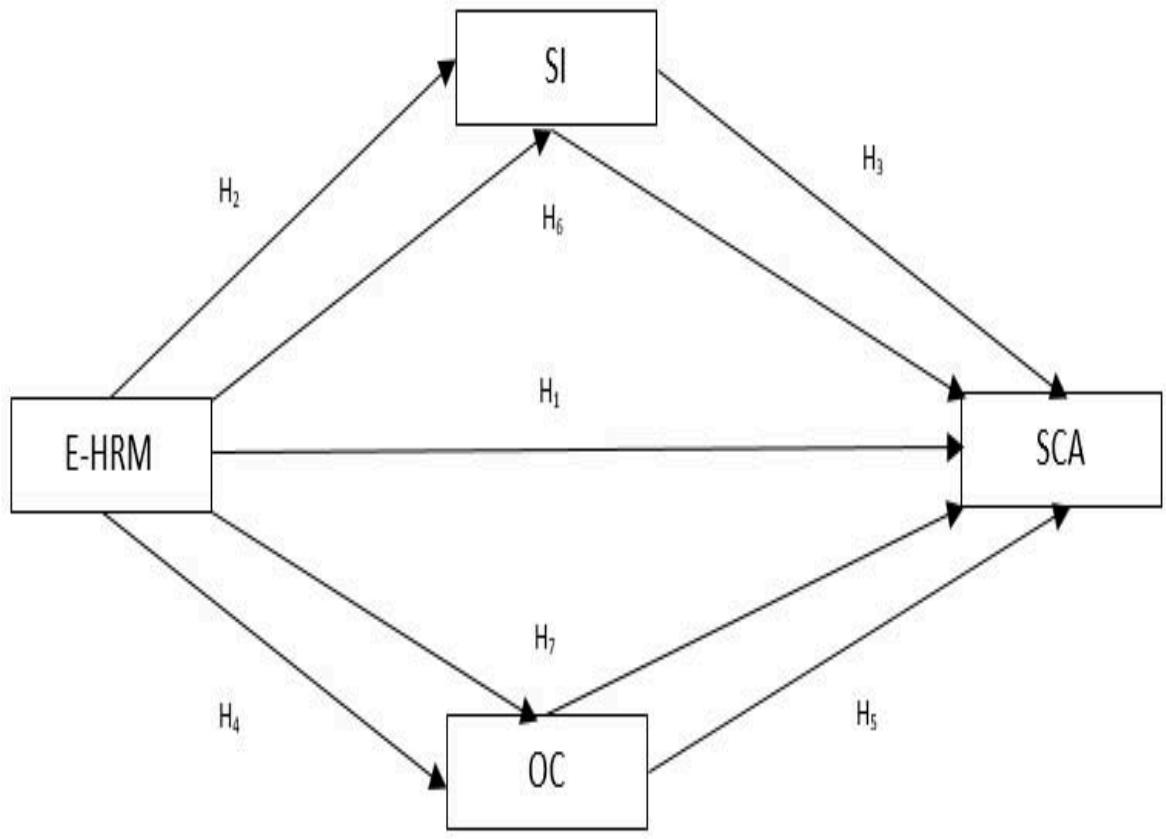 Figure 1: Research Model
Source: prepared by author (2025)
## IV. METHODOLOGY
### a) Questionnaire Design and Study Measures
A quantitative approach is employed to gather required data from the employees of private medical sector in Riyadh and Eastern province in Saudi Arabia. A survey was used to evaluate the E-HRM system and its impact on SCA, SI and OC. The survey is divided into two parts. In the first part is employee profiles, including gender, age, education level, job experience and occupation. In the second part investigated concepts of study, all items were evaluated using a five - point Likert scale.
The first variable "the E-HRM system" is measured using 6 items, scale created by Nyathi and Kekwaletswe (2022). There are, 1) I have the necessary knowledge to use the e-HRM system. 2) Use of e-HRM application does not require a lot of mental effort. 3) The e-HRM system is clear and understandable. 4) The e-HRM system helps me improve my job performance. 5) I find the e-HRM system useful for performance my day-to-day job- related activities at lower costs. 6) E-HRM allows employees to perform job- related activities faster. The second variable "sustainable competitive advantage" was assessed by a 4 items scale adapted from Hossain et al (2021). There are, 1) This hospital offers comparatively lower prices than competitors. 2) This hospital offers high- quality product/service to the customer. 3) This hospital responds well to customer demand for new features. 4) This hospital has a time-to-market lower than the industry average. The third variable is "sustainable innovation" is measured using 6 items scale adapted from Delmas and Pekovic (2018). Therefore, 1) We have introduced products, processes, and organizational, or marketing innovations that reduce resources and materials per unit of production. 2) We have introduced products, processes, and organizational, or marketing innovations that reduce energy use. 3) We have introduced products, processes, and organizational, or marketing innovations that reduce carbon dioxide production. 4) We have introduced products, processes, and organizational, or marketing innovations that replace materials with less polluting or hazardous substitutes. 5) We have introduced products, processes, and organizational, or marketing innovations that reduce soil, water, noise, or air pollution. 6) We have introduced products, processes, and organizational, or marketing innovations to recycle waste, water, or materials. On the other hand, the fourth variable "organization commitment" was evaluated by 4 items scale created by Allen & Meyer (1990), there are, 1) My company has a great deal of personal meaning for me. 2) I really feel as if my company 's problems are my own. 3) I do feel like "part of the family" at my company. 4) I would be very happy to spend the rest of my career with my company.
### b) Sample and Data Collection Procedures
The research population consists of all workers from the private medical sector in Riyadh and Eastern Region in Kingdom of Saudi Arabia. The private medical sector was chosen for its great role in achieving vision 2030, also this sector is keen to espouse a diversity of E-HRM systems to improve their operations and a achieve a SVA while keeping the global need for sustainability in mind. The suitability sample approach was adapted for this research, because it is widely employed when randomization is impractical due to a large population and limited resources. A total of (575) questionnaires were sent to the firms under study in Riyadh and Eastern Region in Kingdom of Saudi Arabia after making communication with management of the firms to request approval to visit and disseminate the questionnaire on their property. Only (468) valid from were obtained with response rate $(81.4\%)$.
### c) Data Analysis
In this research employed SPSS-Amost technique for data analysis to assess the measurement and structural model, as well as test research hypotheses. This technique is considered appropriate tool for assess complex structural models that link several variables via both direct and indirect pathways. The operational framework of the research was evaluated through structural equation modeling (SEM), while the importance of mediating effects was assessed bootstrapping (Hayes, 2002).
## V. RESULTS
### a) Participant Profiles
Table 1 show that the sample of respondents consists of 468 participants, there were 261 (55.8%) male and 207 (44.2%) female. A total of 58 (12.4%) respondents were under the ages of 30, 124 (26.5%) were between the ages of 30 and 40, while 151 (32.3%) there ages between 40 and 50, as well 135 (28.8%) there ages greater than 50 years. Furthermore, 183 (39.1%) had a bachelor's degree, and the majority 271 (57.9%) had master/ PhD degree. Also, 33 participants (7%) had practical experience less than 5 years, 95 (20.4%) between 5 and 10 years, and 340 (72.6%) there work experience 10 years and more. In addition, 405 (86.5%) they work in medical professions.
### b) Reliability and Validity
The confirmatory factor analysis has been implemented in table 2. It presents composite reliability (CR) results of each latent variable which is above 0.60 accepted thresholds (Lawrence & Kingsley, 2018). The computed item loading varied between 0.582 and 0.998, factor loading values greater than 0.5 were considered accepted, in line with Hair et al (2010). Table 2 also shows that Cronbach's alpha (CA) and average variance extracted (AVE) values are more than 0.5 for all variables, this indicated a good reliability. Additionally, computed the variance inflation factor (VIF) for each latent in model, indicating that it is free of common method bias since the VIF values are $\leq 3.3$ (Kock, 2015).
Table 1: Participants Profiles (N= 468)
<table><tr><td></td><td></td><td>Frequency</td><td>Percent</td></tr><tr><td rowspan="2">Gender</td><td>Male</td><td>261</td><td>55.8</td></tr><tr><td>Female</td><td>207</td><td>44.2</td></tr><tr><td rowspan="4">Age</td><td>< 30 years</td><td>58</td><td>12.4</td></tr><tr><td>30 < 40 years</td><td>124</td><td>26.5</td></tr><tr><td>40 < 50 years</td><td>151</td><td>32.3</td></tr><tr><td>≥ 50 years</td><td>135</td><td>28.8</td></tr><tr><td rowspan="3">Education</td><td>High school/institute</td><td>14</td><td>3</td></tr><tr><td>Bachelor</td><td>183</td><td>39.1</td></tr><tr><td>Master's/PhD</td><td>271</td><td>57.9</td></tr><tr><td rowspan="3">Experience</td><td>< 5 years</td><td>33</td><td>7</td></tr><tr><td>5 < 10 years</td><td>95</td><td>20.4</td></tr><tr><td>≥ 10 years</td><td>340</td><td>72.6</td></tr><tr><td rowspan="2">Occupation</td><td>Medical</td><td>405</td><td>86.5</td></tr><tr><td>Non- medical</td><td>63</td><td>13.5</td></tr></table>
Table 2: Validity and Reliability for Constructs
<p>Table 2: Validity and Reliability for Constructs</p>
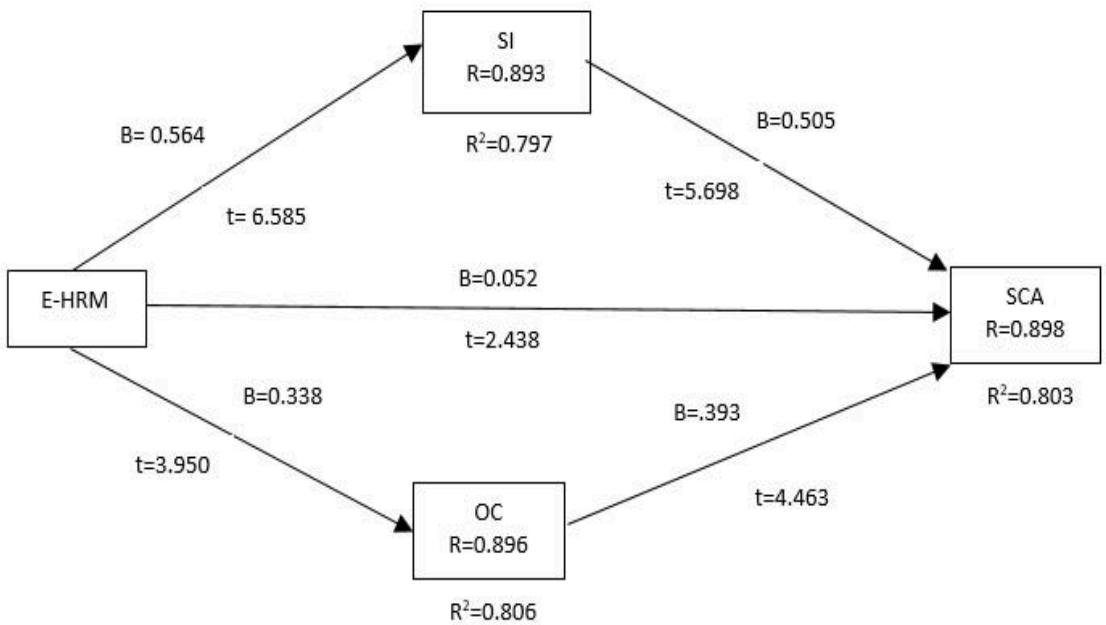 Source: prepared by the author (2025) Figure 2: Final Model of the Study
<table><tr><td>Hypothesis</td><td>Interaction</td><td>Beta</td><td>t-value</td><td>Decision</td></tr><tr><td>H1</td><td>E-HRM → SCA</td><td>0.052</td><td>2.438</td><td>Supported</td></tr><tr><td>H2</td><td>E-HRM → SI</td><td>0.564</td><td>6.585</td><td>Supported</td></tr><tr><td>H3</td><td>SI → SCA</td><td>0.505</td><td>5.698</td><td>Supported</td></tr><tr><td>H4</td><td>E-HRM → OC</td><td>0.338</td><td>3.950</td><td>Supported</td></tr><tr><td>H5</td><td>OC → SCA</td><td>0.393</td><td>4.463</td><td>Supported</td></tr><tr><td>H6</td><td>E-HRM → SI → SCA</td><td>0.285</td><td>6.142</td><td>Supported</td></tr><tr><td>H7</td><td>E-HRM → OC → SCA</td><td>0.133</td><td>4.207</td><td>Supported</td></tr></table>
<table><tr><td>Hypothesis</td><td>Interaction</td><td>Beta</td><td>t-value</td><td>Decision</td></tr><tr><td>H1</td><td>E-HRM → SCA</td><td>0.052</td><td>2.438</td><td>Supported</td></tr><tr><td>H2</td><td>E-HRM → SI</td><td>0.564</td><td>6.585</td><td>Supported</td></tr><tr><td>H3</td><td>SI → SCA</td><td>0.505</td><td>5.698</td><td>Supported</td></tr><tr><td>H4</td><td>E-HRM → OC</td><td>0.338</td><td>3.950</td><td>Supported</td></tr><tr><td>H5</td><td>OC → SCA</td><td>0.393</td><td>4.463</td><td>Supported</td></tr><tr><td>H6</td><td>E-HRM → SI → SCA</td><td>0.285</td><td>6.142</td><td>Supported</td></tr><tr><td>H7</td><td>E-HRM → OC → SCA</td><td>0.133</td><td>4.207</td><td>Supported</td></tr></table>
### c) Testing of Hypothesis
The hypothesis testing findings (figure 2) disclose that E-HRM have direct and positive impact on SCA ( $\beta = 0.052$, $t = 2.4308$ ). Thus, hypothesis 1 was acceptable. The results determine that E-HRM have positive influence on SI ( $\beta = 0.564$, $t = 6.585$ ) and OC ( $\beta = 0,338$, $t = 3.950$ ). Therefore, hypothesis 2 and 4 were both supported. Furthermore, SI and OC are both have a direct and positive impact on SCA ( $\beta = 0.505$, t = 5.698), ( $\beta = 0.393$, t = 4.463). Thus, hypothesis 3 and 5 was supported. In addition, figure 2 displays the E-HRM explains $80\%$ of the variance in SI ( $R^2 = 0.797$ ) and $81\%$ of the variance of OC ( $R^2 = 0.806$ ). Furthermore, E-HRM, SI, and OC explains $81\%$ of the variance pin SCA ( $R = 0.803$ ).
E-RM→SI→SCA 0.564 0.505 0.285 0.069 6.585 0.103 0.450 supported E-HRM→OC→SCA 0.338 0.393 0.133 0.072 5.698 0.072 0.609
<tr><td>E-RM→SI→SCA</td><td>0.564</td><td>0.505</td><td>0.285</td><td>0.069</td><td>6.585</td><td>0.103</td><td>0.450</td><td>supported</td></tr><tr><td>E-HRM→OC→SCA</td><td>0.338</td><td>0.393</td><td>0.133</td><td>0.072</td><td>5.698</td><td>0.072</td><td>0.609</td><td></td></tr>
Table 3 show the testing of the mediating effect of SI and OC. For the SI mediating effect, the indirect effect's $\beta = 0.285$, $t = 6.585$, the $95\%$ bootstrapped confidence internal lower limited 0.103 and upper limited 0.450. Furthermore, the author found mediating effects of SI in the relationship between E-HRM and SCA. Also, the finding indicate a partial mediating relationship for E
HRM $\rightarrow$ OC $\rightarrow$ SCA ( $\beta = 0.133$, t = 5.698) the lower limited 0.072 and upper limited 0.609.
## VI. DISCUSSION
The aim of this research is to investigate how E-HRM, SI, and OC serve as indicators of SCA. It also examines the mediating roles of SI and OC in the impact of E-HRM on SCA. Data were collected from workers in the private health sector in Riyadh and the Eastern Region of the Kingdom of Saudi Arabia to examine this relationship. The study found that E-HRM affects SCA, SI, and OC. This result is compatible with other studies (Shamout et al., 2022; Alqarni et al., 2023, 2024; Aminudin et al., 2024; Parveen & Al Raddadi, 2024; Najm, 2024), which emphasize the crucial role of E-HRM in healthcare management.
The health sector, like every other business sector, faces challenges in a dynamic and complex competitive business environment (Hamadamin & Atan, 2019). The application of E-HRM has several benefits, such as reducing costs, improving quality, speeding up processes, and carrying out HRM tasks efficiently. Additionally, E-HRM influences SCA (Shah et al., 2022). E-HRM contributes to the effectiveness of human resource practices and promotes increased value for human resources, which has a positive impact on SCA (Shamout et al., 2022; Najm, 2024). Findings from the study indicate that E-HRM positively influences SI. E-HRM has the ability to integrate the organization's capabilities, providing employees with analytical and creative thinking skills to enhance innovation. This makes the organization more flexible and open to adopting modern ideas for development and sustainability. This result aligns with previous studies (Aminudin et al., 2024; Parveen & Al Raddadi, 2024; Alqarni et al., 2023), which found similar results indicating that SI is influenced by E-HRM. Therefore, this study suggests that the private health sector in Riyadh and the Eastern Region must place greater value on E-HRM to enhance SI by enabling employees to develop their capabilities. This, in turn, reduces production costs and minimizes material waste.
E-HRM is found to have a direct and positive impact on OC in the private health sector. The adoption of E-HRM in health organizations fosters high employee commitment and enhances their creative and professional capabilities through continuous education and training. It improves their scientific and practical knowledge and increases their decision-making capabilities by providing necessary information. E-HRM also helps health organizations adopt a strategic approach that aligns organizational goals with employees' goals, thereby enhancing commitment to the organization. This result is consistent with previous studies (Hamadamin & Atan, 2019; Alserhan & Alshbail, 2020; Ozan et al., 2021), which found that effective E-HRM enhances employee OC. Employees with strong OC perceive themselves as integral to the organization, which boosts morale and commitment.
The direct impact of both SI and OC on SCA was evaluated. The findings indicate that both variables have a significant and positive impact on SCA. Aminudin et al. (2024) concluded that organizations can distinguish themselves from competitors through SI by providing innovative products, meeting market needs, and fulfilling customer expectations, thereby creating SCA. Thi et al. (2023) asserted that SI is a key factor in improving and enhancing an organization's competitive advantages through forecasting opportunities and challenges. SI contributes to SCA by optimizing resource utilization, improving technical processes, and reducing costs (Alqarni et al., 2023). The findings also confirm previous studies emphasizing the importance of OC in SCA. Ozan et al. (2021) found a strong relationship between OC and organizational performance. In highly competitive sectors such as healthcare, quality and customer satisfaction are crucial. Highly committed employees play a major role in SCA. Alserhan & Alshbail (2020) and Hamadamin & Atan (2019) highlighted that employees with OC contribute significantly to SCA, requiring HR management strategies that enhance employee OC.
In this study, two mediating factors were selected to measure the indirect effect of E-HRM on SCA (E-HRM $\rightarrow$ SI $\rightarrow$ SCA, and E-HRM $\rightarrow$ OC $\rightarrow$ SCA). E-HRM activities include recruiting, training, and developing employee capabilities via the internet (Alqarni et al., 2023; Aminudin et al., 2024; Parveen & Alraddadi, 2024). The retention of competent employees reflects on their morale, commitment to the organization, and teamwork in strategy development and implementation, leading to high performance and improved market positioning, ultimately achieving SCA (Alserhan & Alshbail, 2020). The study highlights the importance of innovation as a mediator between E-HRM and SCA in private-sector medical organizations in Riyadh and the Eastern Region. The results emphasize the need for organizations to foster a culture of innovation among employees to distinguish themselves from competitors. Additionally, OC mediates the relationship between E-HRM and SCA by ensuring organizations focus on employee development, digital HR strategies, and skill enhancement through HR processes.
## VII. CONCLUSIONS
This study aimed to investigate how E-HRM systems affect SCA. The roles of SI and OC as mediating factors were also considered. The private health sector in Riyadh and the Eastern Region was examined at the level of medical and administrative staff using the AMOS-SEM approach. The results revealed that E-HRM positively affects SCA, SI, and OC. Additionally, a positive correlation between SI and OC with SCA was identified. The study also found that SI and OC act as mediators in the relationship between E-HRM and SCA. This research contributes to the existing literature on E-HRM and its impact on SCA, SI, and OC.
## VIII. THEORETICAL IMPLICATIONS
The theory of dynamic capabilities explains how the ability to form, renew, and restructure organizational resources to meet competitive market demands enhances an organization's adaptability to environmental changes. This adaptability is a key factor in achieving competitive advantage. This study examines how E-HRM influences SCA through the roles of SI and OC. It emphasizes the unique capabilities and mechanisms through which E-HRM practices enhance SI and OC to achieve SCA. From a theoretical standpoint, this study contributes to research by highlighting the specific roles of E-HRM practices in proactively developing employee competencies and capabilities to benefit the organization.
## IX. MANAGEMENT IMPLICATIONS
This study clarifies the significant effects of E-HRM on SCA in private healthcare organizations in Riyadh and the Eastern Region. It also explores the mediating roles of SI and OC in this relationship. The study has many practical implications, emphasizing the role of digital technology in HR operations. To succeed in the medical sector, healthcare organizations must adopt digital transformation to enhance efficiency, effectiveness, and decision-making in HR processes. This leads to improved organizational performance and SCA. The study also highlights the importance of SI as a mediator between E-HRM and SCA in private healthcare organizations. Organizations must cultivate a culture of innovation among employees to generate ideas that seize opportunities and enhance collaboration, thereby distinguishing the organization from competitors.
The study also examines OC's role in the relationship between E-HRM and SCA in private-sector healthcare organizations in Saudi Arabia. The results show a significant impact of OC on this relationship. Organizations must prioritize E-HRM processes, including digital recruitment, training, and performance evaluation, to enhance employee capabilities in alignment with HR strategies to strengthen OC.
## X. LIMITATIONS AND SUGGESTIONS FOR FURTHER RESEARCH
Like other social studies, this research examines the impact of E-HRM on SCA while considering SI and OC as mediating factors in private-sector healthcare services. However, the study acknowledges its limitations, warranting further research. Future studies could explore alternative mediating variables, such as leadership style, intellectual capital development, and organizational strategy, to gain a comprehensive understanding of the E-HRM-SCA relationship. Comparative studies between private and public healthcare sectors could further enrich the literature. Additionally, this study did not account for external factors affecting E-HRM and SCA. Future research could examine external influences such as industry dynamics, regulatory environments, and technological advancements to deepen the understanding of E-HRM's impact on SCA.
Generating HTML Viewer...
References
33 Cites in Article
A Achmad,K Nobel,S Otniel,M Yogi,Siswantari,R Dini,M Husain,N Nahed (2024). Investigating electronic human resource management system, sustainable innovation, and organizational agility on sustainable competitive advantage in the manufacturing industries.
S Adomako,N Nguyen (2020). Human resource slack, sustainable innovation and environmental performance of small and medium-sized enterprises in sub-Saharan Africa, business strategy and the environment.
M Ahmed (2019). E-HRM Practices and its impact on Organizational Performance: A study on the Manufacturing industry in Bangladesh.
Alaeldeen Al Adresi,Mohd Darun (2017). Determining relationship between strategic human resource management practices and organizational commitment.
K Almasharfi (2020). Human resource management and the electronic human resource management (E-HRM): A literature review.
A Alnidawi,A Alshemery,M Abdulrahman (2017). Competitive advantage based on human capital and its impact on organizational sustainability: Applied study in Jordanian Telecommunications sector.
K Alqarni,M Agina,H Khairy,B Alromeedy,D Farrag,R Abdallah (2023). The effect of electronic human resource management systems on sustainable competitive advantages: The effect of electronic human resource management systems on sustainable competitive advantage: The roles of sustainable innovation and organizational agility.
H Alserhan,M Alshbail (2020). the role of organizational commitment in the relationship between human resource management practices and competitive advantage in Jordanian private universities.
Achmad Aminudin,Nobel Tampubolon,Otniel Safkaur,Yogi Makbul,Siswantari Siswantari,Dini Rahmiati,M Husain,Nahed Nuwairah (2024). Investigating electronic human resource management systems, sustainable innovation, and organizational agility on sustainable competitive advantage in the manufacturing industries.
Muhammad Azeem,Munir Ahmed,Sajid Haider,Muhammad Sajjad (2021). Expanding competitive advantage through organizational culture, knowledge sharing and organizational innovation.
N Berber,B Dordevic,S Milanovic (2018). E-HRM: Anew concept for digital Age.
T Bondarouk,E Parry,E Furtmueller (2017). E-HRM four decades of research on .15 adoption and consequences.
J Chew,C Chan (2007). Human resource practices, organizational 7 commitment and intention to stay.
M Coetzee,M Mitonga,B Swart (2014). Human resource practices as predictors .8 of engineering staffs organizational commitment.
Magali Delmas,Sanja Pekovic (2018). Corporate Sustainable Innovation and Employee Behavior.
E Dursun (2015). The relation between organization trust, organization support and organization commitment.
Mine Findikli,Yasin Rofcanin (2016). The concept of e-HRM, its evolution and effects on organizational outcomes.
J Gualandris,S Kalch (2014). Customer pressure and innovativeness: Their role in .23 sustainable supply chain management.
Jun-Chul Ha,Jun-Woo Lee (2022). Realization of a Sustainable High-Performance Organization through Procedural Justice: The Dual Mediating Role of Organizational Trust and Organizational Commitment.
J Hair,W Black,B Balin,R Anderson (2010). Multivariate Data Analysis: Maxwell Macmillan International Editions.
Md Hossain,Suresh Kannan,Sree Raman Nair (2021). Factors Influencing Sustainable Competitive Advantage in the Hospitality Industry.
N Igbal,S Anwar,N Haider (2018). Impact of e-HRM on HRM effectiveness.
P Jansen,P Lober,E Stavrou (2013). The impact of e-HRM on HRM effectiveness: results from a quantitative study in Dutch organizations: the international journal of human resource management.
C Jun,W Jun (2022). Realization of sustainable high-performance organization through procedural justice: The dual mediating role of organizational trust and organization commitment.
Ihsen Ketata,Wolfgang Sofka,Christoph Grimpe (2015). The role of internal capabilities and firms' environment for sustainable innovation: evidence for <scp>G</scp>ermany.
N Kock (2015). Common method bias in PLS -SEM: Afull collinearity assessment approach.
E Lawrence,O Kingsley (2018). Mapping the perceived role of strategic human resource management practices in sustainable competitive advantage.
H Najm (2024). Unknown Title.
Krishnadas Nanath,Radhakrishna Pillai (2017). The Influence of Green IS Practices on Competitive Advantage: Mediation Role of Green Innovation Performance.
Musa Nyathi,Ray Kekwaletswe (2022). The relationship between electronic human resource management and employee job satisfaction in organizational value-creation in Africa: the case of Zimbabwe.
U Obeidat,B Obeidat,A Alrowwad,M Alshuride,R Masadeh,M Abuhashesh (2021). The Effect of Intellectual capital on competitive Advantage: The Mediating Role of Innovation.
Kamel Omran,Noha Anan (2018). Studying the impact of using E-HRM on the effectiveness of HRM practices: An exploratory study for the internet service providers (ISP) in Egypt.
C Ordaz,J Cruz,E Ginel,R Cabrera (2011). The influence of human resource resource management on knowledge sharing and innovation in Spain: The mediating role of affective commitment.
No ethics committee approval was required for this article type.
Data Availability
Not applicable for this article.
How to Cite This Article
Sheriff Yousif Hamid Ahmed. 2026. \u201cThe Effect of Electronic Human Resource Management Systems on Sustainable Competitive Advantages: The Roles of Sustainable Innovation and Organizational Commitment\u201d. Global Journal of Management and Business Research - A: Administration & Management GJMBR A Volume 25 (GJMBR Volume 25 Issue A2): .
Explore published articles in an immersive Augmented Reality environment. Our platform converts research papers into interactive 3D books, allowing readers to view and interact with content using AR and VR compatible devices.
Your published article is automatically converted into a realistic 3D book. Flip through pages and read research papers in a more engaging and interactive format.
This study endeavors to examine the impact of electronic human resources management (E-HRM) systems on achieving a sustainable competitive advantage (SCA) in the health sector in Riyadh and Eastern region in Saudi Arabia by combine sustainable innovation (SI) and organization commitment (OC). The research was applied in health units that rely on E-HRM in their work, such as: electronic recruitment and online training. Structured questionnaires were used to collect data from respondents. Overall, 575 questionnaires were distributed and received 468, response rate 81.4%. The research data was analyzed using Amos-SEM. Research result: E-HRM have a positive and significant effect on SCA, SI, and OC, SI and OC they have a positive and significant effect on SCA. SI and OC are able to mediate the influence of E-HRM on SCA. The study adds to existing literature on who E-HRM impacts SI, OC and SCA. The current study has addressed gaps by empirically analyzing these relationships in the context of Kingdom of Saudi Arabia health sector. It integrates E-HRM, innovation, OC and competitive advantage within the context of sustainability in health sector.
Our website is actively being updated, and changes may occur frequently. Please clear your browser cache if needed. For feedback or error reporting, please email [email protected]
Thank you for connecting with us. We will respond to you shortly.
Lorem ipsum dolor sit amet, consectetur adipiscing elit. Ut elit tellus, luctus nec ullamcorper mattis, pulvinar dapibus leo.
The Effect of Electronic Human Resource Management Systems on Sustainable Competitive Advantages: The Roles of Sustainable Innovation and Organizational Commitment