## I. EXPLORING THE GREY ZONE OF MILD COGNITIVE DISORDER
### Katerina Siampani
Ageing is a prevailing phenomenon throughout the globe correlated with increased prevalence of age-related conditions, some of which slow down mental processing. The severity of mental disorders ranges from Mild Cognitive Disorder (MCD) to dementia. In 2017 the World Health organisation reported that there are almost 50 million persons who suffer from dementia around the world. This number is expected to triple by 2050 [1] resulting in significant socio-economic problems.
Mild Cognitive Disorder is a term coined in 1988 by Reisberg et al [2]. In the last 20 years there has been an explosion of papers concerning MCD characteristics.
MCD entails the initial clinical characteristics of Mental Disorders, such as Alzheimer's and other dementias, e.g., frontotemporal dementia and Lewy body Dementia [3].
Most researchers support that if we wait for functional disorder signs (or even for the first Mild Mental symptoms) it might be too late to treat the underlying process of the condition [4]. Ideally, we would like to be in a position to prevent or delay dementia using early intervention methods.
If an intervention modulates the progress of dementia or if there are effective interventions concerning the lifestyle of those with a predisposition for dementia, it would be ideal to implement it as early as possible so as to prevent progression of the condition. In other words, diagnosing MCD is an intermediate step (a clinical stage) aiming at primary prevention, which serves the useful goal of providing substantial treatment interventions [5].
According to international health studies, treatment with medication against age-related neurodegenerative conditions is not expected before 2025 [6]. Regardless of potential development of pharmaceutical treatment, tackling complex and chronic conditions generally entails a combined approach of various treatments, some of which use medication as well.
The aim of non-pharmaceutical interventions is to maintain the mental function of patients and their functional independence regarding daily activities.
Another goal is to improve behavioural and psychological symptoms that often accompany memory disorders, as well as to reinforce the quality of life of these individuals. To be more specific, non-pharmaceutical interventions are considered to provide first-line treatments to manage behavioural and psychological symptoms [7], such as anxiety, aggressiveness, or apathy, which are experienced by almost three quarters of persons with dementia [8, 9]. What is important is that non-pharmaceutical interventions may also delay patients' institutionalisation and relieve the burden on carers.
To conclude, MCD is a syndrome, rather than a specific condition, and it is described as the intermediate state between normal ageing and dementia. Quite often, MCD appears to persons with mild depression and anxiety, patients who suffer from conditions affecting the brain, such as heart failure, hypertension, diabetes mellitus, or patients who have suffered brain damage. Research indicates that not MCD cases progress to dementia. Therefore, our own non-pharmaceutical intervention means we try to prevent MCD from progressing into dementia using Gestalt therapy and incorporating various therapeutic approaches, such as Art Therapy, Sandplay or storytelling [11]. Observers of group intervention sessions held at the day-care premises of 13 Petrou Syndika Street are going to present some of their comments on how interventions decelerate or prevent MCD progression to dementia.
# a) A Few Words
Melina Makridou
The only spot from which we can take a step forward is the exact spot we are stepping on" (Yontef, 1993)
The Gestalt psychotherapist is present during the therapeutic process, calling the Alzheimer/related disorder patient and the caregiver into an active teamwork. The Gestalt therapist does not remain neutral. In the contrary, "the therapist becomes the tool of his/her work". The Gestalt therapist believes in encouraging the Alzheimer patient into becoming whatever he/she is experiencing in each moment. As a result, the patient turns down the role of the one that brings the change. Change is not self-righteous. Change does not come through effort, control or avoidance. Change happens when the patient and the caregiver becomes what he/she really is and not what he/she tries to become.
The Gestalt therapist is affectionate and truly interested towards the new reality the Alzheimer patient is experiencing. The Gestalt therapist supports the patient and senses all sides of the patient functional or not, healthy or not, the obstacles that intervene their contact, the way he/she gets relates, without pressure or imposing opinions.
## II. THE BUTTERFLY COCOONSTORY
The butterfly circle teaches us the eternal interchange within-whatever dies transforms into something new.

The Gestalt therapist helps the Alzheimer patient and the caregiver to accept the changes that the illness brings upon their lives, operating according to performance, awareness and creative adjustment. One of Gestalt's therapeutic targets is for the Alzheimer patient to learn how to change constantly and to be able to deal with the ever-changing conditions, and at the same time be able to maintain personal stability.
In any case, the change is interwoven to life and existence itself. Arnold Beisser (1925-1991), through his personal experience from being an athlete to becoming a quadriplegic patient, he passed on to us the "Paradoxical Theory of Change", in which he claimed that the more we try to "become something different from what we are, the more we remain the same". The Gestalt therapist encourages the Alzheimer patient and the caregiver to be what he/she is and not give in depreciations like "how has he become, I don't recognize him he is not my father..." or comparisons "Ann's father is doing better than you..." Without bearing the burden of aiming at a specific result (that of the ideal patient) and the equal meeting among the therapist, the patient and the caregiver, the ground for a valuable remedial experiences prepared, for the patient and the caregiver to shorten the shame and the rejection, and to welcome the 'change' that dementia and its symptoms bring upon.
In any case, health is not about being perfect, but being whole.
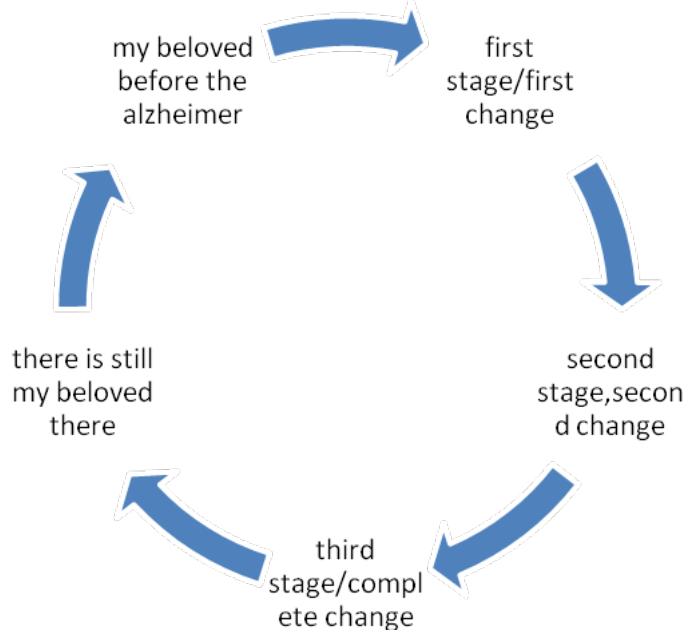
The Gestalt therapist, consciously accepts and understands the "here and now" and that only in this way one can change and adapt My beloved before the Alzheimer disease/Related disorders.
The first stage/the first change in memory loss and cognitive difficulties.
The second stage/the second change in repeating questions, taking longer to complete normal daily tasks.
The third stage/the complete change in personality and behavior changes. In all stages and in all changes I have to remember that still there is my beloved there.
But let's move on from theory to practice...
Observations on the flow of experience and the emergence of fragmented forms from a blurred background.
a) Gathering the Fragments: M. C. I., Gestalt Therapy and Art therapy.
inability to be objective in my conclusions, and at the same time, the fact that, however discerning I may be, the observed will inevitably be affected by my presence as much as I from theirs. On a third level, I need to be keenly aware of where I come from as an observer: who I am, what I bring from my lived experience and what my beliefs and attitudes are as a person, and to identify my emotions as they arise within my physical body, so that I can discern them from the experience of the observed, keep track of them and at the same time stay in contact with my own needs, and take care of myself. I will not try to obliterate my individuality in order to achieve the purest, most valid result. Instead, I will use my own self as a tool, and with training and empathy, observe my relationship with the observed. I will, to my awareness, inevitably often project, or retroflect some of my emotions as I cannot express them on the spot, since my role is solitary, a function in a defined context. It is important to allow myself this, and reflect on it, so that I can separate my experience from that of the Other, but also to be present for myself. To be a good observer, I need to trust the process, and aspire to tune in to the aesthetic quality of the experience, to focus on what is, on what I am, and on what we are becoming together.
Danae, Achilles, Antonis, Dina, Charalambos. The room, warm, comfortable, bright, full of paintings, dedicated "To my teacher"...
Every session starts with conversation. Every dialogue evokes a personal connection with the painting theme of the day... And they connect, sharing feelings, opinions and pieces of identity. They share snapshots of their lives, what they had for lunch, Thessaloniki back in the day, flying kites in Russia, a daughter in law from Brazil, the past and the present inextricably woven together, forming new combinations in the here and now. I watch in awe as these elderly people enter into the process of creation, illustrating line by line their perception of reality, drawing at the same time the outlines of their inner processes. In our small group every person has the space to express themselves without criticism, every member to stand out in their own individuality. The coordinator, with a warm and firm hand, monitors, suggests and helps where requested, without interfering. With respect, and genuine interest, reassuringly inclusive, sets the tone for the session.
As I observe them paint, I witness them becoming whole. They seem younger, as if, once they have been given a chance to focus and express themselves, have emerged from a fixed function of self, age, disease, from the rigid, automatized persona of normality they struggle to maintain with the habit of a lifetime. Vulnerable and authentic in the here and now...
Achilles, a key member of the team. Consistently participating in the conversation, encouraging others, sharing thoughts and opinions. He often looks at me. Seemingly apathetic, motionless, and in the same time vigilant and tense, when he paints he transforms. He puts his entire body to the task, adjusting his position on his chair, bending over his painting, eyes wide open, his gaze acquiring new vitality and focus.
Then there is Antonis, intense, loud, eager to help, always up for a chat. At times sulking, with an internal unrest. I often feel a weariness in his presence, as if he is trying too hard. In constant deflection normally, when he begins to paint he suddenly calms down, becoming still, solemn, silent, in concentration. Sometimes he struggles and he squints, his body clenching tight.
Charalambos looks old, worn out. With a blank expression, almost - present, in a daze, he hesitates with his pencil in hand, and after being prompted by the coordinator, he replies in a thin, low voice: "...yes, yes, I will start." He draws slowly, with difficulty, a first line. He stares at the paper and, sitting on the edge of his chair, he seems shaky, ready to fall. He first tries to capture the background, the outline of the frame... he presses his pencil hard on the paper, goes over the same line again and again, as if to confirm its existence. And then he stops, freezes, and takes an eraser, erasing the only line he managed to draw. He looks at Antonis' painting, almost finished by now, and then at his own. Many times, as if he is struggling to muster his concentration and loses it the next minute. I am filled with unease. He's here but not here, he looks like a sleepwalker struggling to wake up. He keeps looking at Antonis, who, absorbed in his effort, continues his work. At some point, he sits back in his chair heavily, in resignation. He says, "I thought I would do a better job", in his thin, mismatched voice.
Dina, quiet, with an ever present small smile on the edges of her lips, and her awkward laugh, "heh-heh," curls her whole body over the paper, and doesn't raise her head until she's finished. Her drawings are praised by team members for their accuracy. She doesn't talk much, pressing her pencil on the paper very lightly, and the result is always perfect, but faint, spectral.
Danae, pretty, fragile, in her own parallel process, is kind to everybody. She often bursts out in song and has a keen sense of humor, unexpectedly black. She experiences some difficulty in identifying objects. Slowly, hesitantly, she carefully traces the contours of shapes, as if in an attempt to grasp the complete form of each thing. Then she paints fragmentary, disconnected details, seemingly struggling to see the big picture, the meaningful whole. She asks for the coordinator's help, but no matter how many times she guides her, to show her how, Danae, turned inwards, with the filters of her own reality, keeps drawing fragments, with out of place colors. She often forgets the names of the colors themselves and blames it on her poor eyesight...
I wonder, watching these elderly people paint, how is it that I am filled with a childlike impression, as it is clear to me that I have adults before me, and I know that to interpret their behavior using terms appropriate for children, does not help me to know them better and to relate... this type of projection distances me from the essence of the experience of the Other. Developmentally it clearly looks like regression, and certainly the mental disorder is real, as is the impairment, sometimes the loss of certain functions. But how does treating the Other as a clinical specimen of a disease at some stage, as abnormal, as incomplete, as damaged, help the relationship, me and the Other? And in this small group, I see the power of acceptance, the equal treatment and honest attitude of the coordinator acting beneficially, awakening and empowering the members. The degree of effort required to draw a line is not always the same, nor taken for granted, and every session always ends with applause. My heart swells, it warms up to them, I worry, I am proud, I sympathize. I see authentic people, and I am asked to relate to them on the terms of their reality in the here and now, so if I want to meet them I need to walk the distance there... And it is what it is, authentic to the mood of each moment, spontaneous, sometimes impulsive, with unfiltered vulnerability... And in the same time I witness a turn within, as if restoring a private relationship with the imaginary, inner reality, legitimizing self-expression, any trace of self criticism fading away. A paradoxical form of self-care without guilt, but with a simultaneous loss of touch with the external reality, disorientation, confusion, helplessness, momentary panic. I am certainly glad to hear them ask for help, when they stumble along the way, when they forget, when their body betrays them.
The greatest act of self-care, to recognize when and how I need the assistance of the Other, and to reach out to them. Maybe sometimes, I need to forget who I was, to allow myself to finally listen to my own needs, to stop thinking about the "shoulds" and the "what would they think of me", for the introjected rules and self-censorship to gradually wear away along with other automatized, fixed behavioral patterns...
I observe their processes, as attempts to communicate their inner world, a world that has been rearranged and does not function as it used to. I listen to the silent agony of getting stuck in the in - between, the inability to complete the picture, the fragmentation. Where any past experience starts to fade away gradually, without warning, disrupting the flow of the present, gnawing at the foundations of the structure of the Self. Every painting like a message in a bottle, from a castaway, stranded on the lonely island of their reality in the Here and Now, in the middle of the vast ocean of experience, There and Then, Tomorrow. And at the same time, where the logical organization of experience, the stability and shape of forms collapse, the living, sensitive body remembers. The awareness lingers a little while longer, in the hand that holds the pencil, in spite of the mind not remembering which color we call "red", how much pressure I need to put on the paper so it doesn't tear, and whether a dog is bigger than a house. It is enough to trust this hand, that it tells its truth, for now, and that this truth is both important and valid. And to give its owner the space and time to do so, legitimizing their existence, albeit fragmented, and reflect back the image of a person, whole.
### b) " Art as a Vehicle of Awareness
#### Using Imagination to Understand the present
#### Anna Timbanari
As a fourth year trainee in Gestalt psychotherapy, part of my internship includes observing the psychotherapy groups with mild cognitive impairment facilitated by Ms. Siampani. Through a cycle of observations, I was given the opportunity to get in touch with both this population and how Gestalt therapy approach to the disease.
Gestalt therapy is part of the existential-phenomenological school and aims to expand the awareness of the individual. We use the term awareness to refer to the process of deep insight into our sensations, thoughts, feelings and behaviours as well as our environment. The phenomenological method focuses on the observation and study of the phenomena of awareness in order to determine the role of the subjective experiential process in the creation of meaning. That is to seek understanding based on what is revealed by each situation experientially rather than on interpretation from the perspective of the observer or therapist. As an observer of the therapeutic group my observation was phenomenological, meaning that I tried to bracket any pre-conceived beliefs, biases, interpretative theories and assumptions about the individuals in the therapeutic group as their experience unfolded before me each time. I observed how the therapist became a facilitator and companion to the group process by initiating some, introductory experiments, thus assisting the members in exploring and unveiling their inner dynamics and realities. Part of what we call experimentation in Gestalt psychotherapy is the use of various forms of art as a stimulus for reflection and self-observation of what is produced and is understood to have therapeutic value. I had the opportunity to see how, with such a stimulus in one of the group meetings, the members got in touch with their creativity and through imagination were able, under a new light, to create new relationships between elements of their everyday life, mixing the old with the new, the familiar with the imaginary, their fears with hope. In one of the meetings, the therapist showed the group members, who were all women, a portrait of the Lady in the Hat by Henri Matisse (1905) and asked them for the next group meeting to write her story as they imagine it, through her perspective. She also asked them to imagine what she sees, what she smells, what she hears, what she tastes, touches how she speaks, the tone of her voice, how she moves. This stimulus, became a powerful experiential way for each member to engage their sensory movement, emotional, cognitive and intuitive levels of functioning.
At the next group meeting, one member Ms. E. shared her initial fear that she would not be able to write the story and that when she barely got started it flowed like water, as she said, and this brought her a sense of satisfaction. The girl in the portrait, she began her story, grew up in a house in the country, bright and big and she loved running in the field, smelling the dirt, admiring the flowers where when the pollen blew it stuck to her nose and tickled her. She loved when it rained to walk barefoot on the ground. Eventually she moved to the city and became a dancer. These memories made her happy and helped her dance very, very beautifully.
"That's my story"Mrs. E. said and took a deep breath.
"I envy her," she continued, "I would like to be in her shoes."
What are you jealous of? " the therapist asked her.
"I envy her dancing. When I was young, at my village fairs, I was the first to dance and everyone told me how well I danced. I remember how much it pleased me. I wanted to join a club with traditional dances, but the children and other responsibilities wouldn't let me.
"I wouldn't let me," the therapist adds.
"Yes, that's right," says Mrs. E. "I wouldn't let me" and looks at the floor.
For a moment she is silent.
"Now I have a lot of time...sometimes I don't know what to do....". "It's like I've forgotten to do things that make me happy".
The above fragment, is an example of how through experiential experience, self-awareness expands, and thus the individual has the choice to become the creator of her own transformations and changes.
As Gestalt therapy emphasizes learning through experiential learning, internal representations, feelings and experiences become concrete. This is very helpful quality as it aids transformation and reconstruction through the tangible representation of what the person feels hopeless or lost. Through the stimuli of art it also allows for the expression of feelings and experiences that individuals may not dare to express in their daily lives. Activating the imagination can relax defenses and allow a person to feel, process, try and experiment with what is unusual, what seems difficult or distant. Gestalt's view that perception and expression are not just mental activities but experiences involving all the senses was seen as a way of expanding the human capacity for awareness, expression and creativity.
I will conclude with one of the many takeaways from my experience.
Creativity is intrinsically linked to the very process of life and belongs to the natural potential of all of us.
### c) How with a Song I Connect with My Difficulty and the Difficulties of those Around me
Tigas Michalis
The first group that I chose to follow within the framework of Gestalt observation-practice in collaboration with the Greek Alzheimer's Society was the group of mild cognitive impairment. My beginning is connected to this group of people and to the experience I gained from observing them. This experience is multifaceted and involves many of the work and processes of the group that I am grateful to have been a witness to. Today I have chosen to talk to you about one of the group members' work on my fourth day of observation.
The process was started by the group coordinator, Katerina Ciampani, bringing to the group, a song she would like them to listen to and suggesting that when they heard the song they write on the room's whiteboard whatever they felt or needed at that moment. Some members wrote verses and feelings. The common emotion that most members felt was fear as was evident from what they wrote. In the circle after listening to the song, the members who wrote fear mentioned that the song made them feel a sense of fear. This common ground between the members and their connection to the feeling of fear was the trigger for Mrs. P. to open up and talk about her fear, her fear of feeling lonely in particular. After Mrs. P. opened up, the other members felt the need to give her feedback on what they had just heard. In the feedback the members shared their understanding towards the theme she opened up, shared their connection with her and several members felt the need to give her a hug of understanding and compassion as they expressed to her.
As I observed through that activity the group members reported that listening to the song made them feel the emotions they felt e.g. it referred to fear and so they felt the fear. What happened in the process is what we call in Gestalt therapy as projection. Projection is the process by which I attribute feelings, attitudes and thoughts onto something or someone else while they are my own feelings my own attitudes and my own thoughts. It is a very common process in therapy but also in our daily lives. In short, through the projection in this song several members got in touch with their feeling and created a common ground with the feeling of the other members. Through this process, a member's need to speak about her feeling and her difficulty was born.
At the same time with the group's work, I as an observer in listening to the song came in contact with my own piece of anguish, I rehearsed and listened to my own anguish in several parts of the song. Even though I was an observer of the process of a group of people at that moment I was working alongside myself without having the right to actively participate.
Finally, I would like to thank my colleagues and my supervisors Melina Makridou and Katerina Siampani for their caring, patience and for giving me the opportunity to gain experience and knowledge through this supervision.
d) Is there a Way for a Narration to Give Rise to the Dialogue?
Nikos Papadimitriou
My name is Nikos Papadimitriou and I work as a mental health counselor trained at Gestalt therapy. I will talk with a few words about my experience as an observer in the Mild Cognitive impairment team coordinated by Mrs. K. Siampani.
The topic which I will elaborate in this essay concerns the use of an allegory or a narration and how this can spark dialogue among the members of a therapy group. The narration of a story conceals different meanings than those it appears to state. This possibility allows each person to differently interpret the story and thus create fields for different analysis. It is interesting for each member of a group to realize how many different perspectives can coexist in a therapeutic circle.
The use of a narration is capable of igniting thoughts, memories, dreams, solutions and a variety of feelings. Dialogue is the only way to share them all. Truth is born through dialogue. What do I mean with the word truth? I mean the content that is revealed after making a series of questions. Through this research, we are simultaneously led to two different conclusions. Firstly, we raise our awareness and secondly we understand the truth of the others, since only through interaction an individual can come to obtain a clearer self-image.
Dialogue within the group I worked with, became a determinant force which gave meaning and lead to personal and collective freedom. It became the group's inner voice and guided everyone to a plurality of observations, realizations and self-conscious thoughts. The members of the particular group found safety and trust and adopted behaviors which they lacked outside of the team. They were enriched by the process itself, even if at first it was difficult for them to understand it.
I remember an allegorical story of Jorge Bucay that Mrs. Siabani shared in this group. A little while ago the group seemed to agree that one member overanalyzes his thoughts resulting in giving a feedback with little or no emotion, in contrast to another member of the group, where his emotion is the dominant way of dealing with any situation resulting in fragile logical thoughts.
The story of Jorge Bucay (Bucay, 2000) talks about an allegory. The writer presents the story of a man who accepts a gift that is waiting for him outside of his house. Delighted, he sees a beautiful carriage made of the best materials, elegant and specially designed to his measurements and personalized to his tastes.
"What an unbelievable gift" he thinks and begins to explore and enjoy it. Shortly after a while, he starts to get bored and wonders how long he will see the same things in and out of the window of the carriage. He comes out with the result that his gift is completely useless. At that time his neighbor passes by and says to him,
"What a nice carriage, won't you add any horses?"
"That's what I'm missing," he thinks, and goes out to buy two horses to start his ride.
Now the view is wonderful and the landscape changes and becomes a constant surprise. Suddenly, the carriage begins to wobble dangerously on this bumpy downhill dirty road. It takes the man to strange and dangerous areas. He realizes that he has no control over the horses or the road, or the destination. He begins to feel fear that something unsecure is happening. At that moment, his neighbor passes by again and tells him that he needs a carter. With great difficulty they stop together the carriage and the horse's rampage and the man finds a suitable carter who knows his job. Now he can enjoy the road and what it has to offer.
"This little allegory will help us understand the holistic view of man," writes Bucay. When we came into the world, we left our 'home' and found before us a gift: our body. A carriage specially designed for each one of us. A vehicle capable to adapt to all the changes that time brings, but also capable to offer stability and consistency throughout the journey. Shortly after birth, our body registered a desire, a need, an instinctual demand, and moved forward to satisfy it. This carriage – our body- would be of no use without any horses.
In this story, horses represent our desires, needs, impulses and emotions. For a while everything goes smoothly. At some point, however, we realize that these desires lead us down to dangerous and risky paths. So, we need to put a brake on our desires...and bring logic and sense to the surface. We need to bring a carter. (Bucay, 2000). According to the author, these three "personalities" need to work together to maintain balance and harmony, because the carriage, the horses and the carter throughout the journey is our life (Bucay, 2000).
The discussion was initiated when the group realized that certain emotions like guilt and shame were leading the way of life of some of the members. When we have difficulty understanding the source of those feelings, why we feel them and with which experiences we associate them with, we might find ourselves in dead ends. This is where awareness comes through the discussion between the members of the group, the coordinator and all the dynamics of the process. Fruitful dialogue begins when members identify their own process through someone else's process, when they disagree or reveal personal feelings and behaviors. Inside the circle of the group, the members have the opportunity to express themselves and feel safety, acceptance and non-criticism that is built between them. The use of a story in Gestalt psychotherapy can be a useful tool. It can help everyone interpret and connect what they hear, to a personal experience. The diversity of perception and the personal stigma expressed by each member of that group captivated me as an observer. I totally forgot their medical diagnoses and saw each and every person through their authentic experience. I saw them individually and I also observed them as a group. Each distinct quality of each member connected with the one next to it, the one next to it and so on and each time a new figure was created and I was lucky enough to be a spectator of it. As a counselor in Gestalt psychotherapy, this was a valuable and useful experience for me that helped me mature, connect, accept and understand the diversity, uniqueness and charismatic quality of each person and I owe it to the opportunity and possibility that was given to me by the Hellenic Alzheimer Society and the supervision of Mrs. Siampani Katerina and Makridou Melina.
A few words about Gestalt therapy
Gathering the fragments: M. C. I., Gestalt therapy and Art therapy.
"Art as a vehicle of awareness: Using imagination to understand the present" How with a song I connect with my difficulty and the difficulties of those around me Is there a way for a narration to give rise to the dialogue?
1. Giamarellou G., Diplas G., Konstantinidou A., Mpalliou D., Hatzilakou K., (2011). Introduction: Gestalt Psychotherapy. Gestalt Foundation: Thessaloniki.
2. Beisser, A. R. (1970). The paradoxical theory of change. In: Gestalt Therapy Now, eds. J. Fagan
Katerina Siampani
BSc Psychology, Msc Counseling Psychology, City University - Sheffield U.K.,- Psychotherapist-Trainer-Supervisor Gestalt - Trained on Art-Therapy & Sandplay Therapy. Member of the Hellenic and European Gestalt Therapy (HAGT) and (EAGT), holder of ECP, writer. Member of Hellenic Association of Alzheimer's Disease and Related Disorders.
MSc in Health Psychology and Mental Performance
University of Bristol, U.K.
Gestalt Psychotherapist and Supervisor,
Member of the E.A.G.T & H.A.G.T
Mental Health Counselor, Gestalt therapist in training, Gestalt Foundation Psychotherapy and Education Center, Thessaloniki, Greece
Trainee Mental Health Counselor Gestalt Foundation Thessaloniki.
Trainee Mental Health Counselor Gestalt Foundation Thessaloniki.
Nikos Papadimitriou
Mental Health Consultant trained at Gestalt therapy.
Generating HTML Viewer...
References
27 Cites in Article
M Mittelman,S Ferris,G Steinberg,E Shulman,J Mackell,A Ambinder,J Cohen (1993). An Intervention That Delays Institutionalization of Alzheimer's Disease Patients: Treatment of Spouse-Caregivers.
B Reisberg,S Ferris,M De Leon (1988). Stagespecific behavioral, cognitive, and in vivo changes in community residing subjects with age-associated memory impairment and primary degenerative dementia of the Alzheimer type.
K Siampani,Μ Tsolaki (2014). Marching together. Gestalt Therapy in Dementia.
D Steffens,M Maytan,M Helms,B Plassman (2005). Prevalence and clinical correlates of neuropsychiatric symptoms in dementia.
(2019). Looming dementia epidemic in Asia.
M difficulty and the difficulties of those around me Is there a way for a narration to give rise to the dialogue?.
G Giamarellou,G Diplas,A Konstantinidou,D Mpalliou,K Hatzilakou (2011). Introduction Gestalt Psychotherapy.
A Beisser,J (1970). Fagan The Effect of Gestalt Therapy on Groups of Patients with Mild Cognitive Disorder Exploring the grey zone of Mild Cognitive Disorder.
D Craig,A Mirakhur,D Hart,S Mcilroy,A Passmore (2005). A cross-sectional study of neuropsychiatric symptoms in 435 patients with alzheimer's disease.
J Cummings,P Aisen,B Dubois,L Frölich,Jack Cr Jr,R Jones,J Morris,J Raskin,S Dowsett,P Scheltens (2016). Drug development in alzheimer's disease: the path to 2025.
Jan Roubal,Gianni Francesetti,Michela Gecele (2013). Aesthetic Diagnosis in Gestalt Therapy.
Serge Ginger (2010). Dreams in Gestalt Therapy.
L Jacobs,R Hycner (2018). The Therapeutic Relationship.
Roza Laious,Evangelia Galanaki,Aikaterini Aggeli,Chara Tzavara,Eftychia Argalia,Daria Bakourini,Vassiliki Koutrafouri,Aikaterini Marini,Ioanna Sintila (1995). Evaluation of a Schema Therapy-Based Prevention Group Program for Children and Their Parents.
Donna Orange (2010). Thinking for Clinicians.
F Perls (1964). Gestalt Therapy Verbatim.
F Perls,G Hefferline,P Goodman (1971). Gestalt Therapy: Excitement & Growth in the Human Personality.
F Perls (1989). The Gestalt approach.
E Polsters,M (1973). THE GROWING EDGE OF GESTALT THERAPY Edward W. L. Smith New York: Brunner/Mazel, 1976. xvi plus 239 pp., $12.95, hardbound.
Gary Yontef,Reinhard Fuhr (1993). Gestalt Therapy Theory of Change.
J Zinker (1977). Is Gestalt Therapy a Humanistic Form of Psychotherapy?.
No ethics committee approval was required for this article type.
Data Availability
Not applicable for this article.
How to Cite This Article
Dr. Katerina Siampani. 2026. \u201cThe Effect of Gestalt Therapy on Groups of Patients with Mild Cognitive Disorder\u201d. Global Journal of Medical Research - A: Neurology & Nervous System GJMR-A Volume 25 (GJMR Volume 25 Issue A1): .
Explore published articles in an immersive Augmented Reality environment. Our platform converts research papers into interactive 3D books, allowing readers to view and interact with content using AR and VR compatible devices.
Your published article is automatically converted into a realistic 3D book. Flip through pages and read research papers in a more engaging and interactive format.
Our website is actively being updated, and changes may occur frequently. Please clear your browser cache if needed. For feedback or error reporting, please email [email protected]
Thank you for connecting with us. We will respond to you shortly.