## I. INTRODUÇÃO
inclusão escolar de alunos com Transtorno do Espectro Autista (TEA) é considerada por pesquisadores e educadores como um desafio para os profissionais da saúde e da educação, devido à heterogeneidade imposta pela caracterização do transtorno (CABRAL; MARIM, 2017). Essas características heterogênicas se manifestam de acordo com os fatores fisiológicos, grau de comprometimento funcional e influência dos fatores ambientais, o que sugere que, tendo em vista as suas especificidades clínicas, os indivíduos com esse quadro devem receber atenção especializada no processo de escolarização (CINTRA; JESUINO; PROENÇA, 2015).
Em função da especificidade do TEA, a inclusão desses alunos implica em reflexões importantes a respeito das possibilidades de intervenções, adequações e acolhimento necessários para contemplar toda a diversidade imposta pelo diagnóstico. Desta forma, é fundamental a parceria entre educação e saúde para que se tenha o máximo de conhecimento das características de cada aluno tanto do ponto de vista funcional quanto educacional e com isso a sua inclusão seja eficiente e se dê de maneira adequada às suas necessidades (FERRAIOLI; HARRIS, 2011).
Vale enfatizar ainda a importância na mesma medida da relação de parceria travada entre pais e equipe escolar sendo considerada como de fundamental importância para possibilitar o melhor entendimento do comportamento da criança com TEA, nos contextos familiar e escolar, e contribuir para o seu desenvolvimento, especialmente quanto às dificuldades de aprendizagem e interação social de acordo com CABRAL; MARIM, 2017).
Mattos e Nuernberg (2011) em seus estudos corroboram com esse pensamento ao enfatizar a relevância do trabalho interdisciplinar entre saúde e educação. De acordo com os autores, no ambiente escolar, a brincadeira e a mediação pedagógica facilitam as trocas sociais, promovendo O desenvolvimento da comunicação e a participação do indivíduo com TEA. Todavia, observa-se que, além da competência social, é necessário que as atividades pedagógicas favoreçam o desenvolvimento cognitivo e o enfrentamento das dificuldades do aluno sendo imprescindível que as práticas educacionais ocorram de maneira articulada com as práticas terapêuticas.
Como parte da equipe multiprofissional que atua no contexto escolar e clínico para favorecer o desenvolvimento global dos alunos com TEA, destacase a Terapia Ocupacional com ênfase na Abordagem de Integração Sensorial de Ayres como instrumento de intervenção.
A Associação Americana de Terapia Ocupacional (2014) reconhece a Abordagem de Integração Sensorial de Ayres $\textsuperscript { \textregistered }$ como uma das abordagens utilizadas pelos terapeutas ocupacionais com alunos no contexto escolar público ou privado quando estes demonstram déficits sensoriais, motores ou de praxis que interferem nas suas possibilidades de acessar o currículo educacional.
A Terapia Ocupacional com a Abordagem de Integração Sensorial de Ayres $\textsuperscript { \textregistered }$ no contexto escolar tem por objetivo prestar serviços e intervenções que apoiem os alunos com disfunções de processamento sensorial favorecendo a sua participação educacional. Participação escolar é uma das ocupações primárias da infância e é definida como o envolvimento em atividades necessárias para aprender e participar no ambiente educacional (ASSOCIAÇÃO AMERICANA DE TERAPIA OCUPACIONÀL, 2014).
O terapeuta ocupacional por meio do seu raciocínio clínico que é embasado nos processos neurofisiológicos da integração sensorial, assim como na análise da ocupação, deve identificar como os aspectos integrativos estão conectados e influenciam o desempenho e a participação do aluno em relação às demandas do ambiente e atividade (SCHAAF, et al., 2013). Assim, tanto as funções e estruturas do corpo, especialmente os sistemas sensoriais quanto às atividades, ambiente e contexto recebem atenção no processo de avaliação e estabelecimento de metas.
No que se refere ao procedimento de avaliação, os terapeutas ocupacionais utilizam vários instrumentos que podem ser padronizados ou não para que seja obtido o máximo possível de informações funcionais relacionadas à participação, socialização e desempenho acadêmico. Estas informações podem ser obtidas por meio das observações das famílias, dos professores e ou observação direta do terapeuta no ambiente escolar (COSTER, FROLEK CLARK, 2013).
À medida que as informações obtidas sugerem problemas sensoriais, motores e práxicos que estejam impactando na participação e desempenho escolar do aluno, a intervenção se faz necessária e será elaborada com base na análise dos dados, para que o aluno possa se desenvolver adequadamente (SCHAAF, BENEVIDES, 2012).
A escola enquanto instituição de ensino é reconhecida como um ambiente rico em oportunidades e desafios sensoriais de múltiplas modalidades de estímulos que ocorrem concomitantemente e de maneira pouco previsível e controlada na maioria das vezes. Esta característica do ambiente escolar pode ameaçar a aprendizagem e a participação educacional de alunos que apresentam disfunção de integração sensorial especialmente os alunos com Transtorno do Espectro Autista.
Os estudos apontam que alunos com disfunção de integração sensorial têm menor participação em atividades educacionais e pior desempenho acadêmico (ASHBURNER, ZIVIANI, RODGER, 2008; BAR-SHALITA, VATINE, PARUSH, 2008; KOENIG, RUDNEY, 2010). As atividades que os desafiam são inúmeras e por vezes se sobrepõem, entre as quais estão incluídas as dificuldades para concluir o trabalho pedagógico em sala de aula, participar das aulas de educação física, brincar com os amigos no intervalo, almoçar na lanchonete, controlar seu comportamento diante de frustrações e conflitos entre tantas outras.
Jean Ayres (2005) descreve que alunos que apresentam dificuldades no processo de aprendizagem podem ter como problema primário a disfunção de integração sensorial que interfere diretamente nas condições comportamentais e educacionais do aluno. Problemas sociais podem ocorrer como consequência destes processos complexos de integração sensorial que constituem a base para o seu desenvolvimento.
Sendo assim, é importante que as escolas e os profissionais envolvidos tenham conhecimento sobre os sinais e dificuldades relacionados à integração sensorial para serem capazes de identificar os possíveis impactos no comportamento e aprendizado do aluno, oferecendo-lhes o suporte adequado.
O terapeuta ocupacional, por sua vez, pode atuar individualmente com o aluno em atendimento clínico com o objetivo de favorecer a adequação da integração dos estímulos sensoriais e ou realizar mediação junto à escola em esquemas de reuniões com a equipe escolar para informar e conscientizar a respeito das características de processamentos sensoriais identificadas em cada aluno, orientando e estabelecendo possibilidades de uso de estratégias sensoriais regulatórias que favoreçam a participação escolar.
Nesse sentido, a colaboração estabelecida entre saúde e educação especialmente com oportunidade de ampliar a compreensão a respeito do processamento sensorial voltado à participação e desempenho escolar dos alunos, permite que os terapeutas ocupacionais tenham condições de advogar por acomodações e modificações que auxiliará o desempenho e estruturará serviços que melhorem a participação em atividades físicas, acadêmicas e jogos sociais, além de adaptar o ambiente de maneira que práticas sensoriais, motoras e práxicas sejam introduzidas para apoiar o sucesso da participação do aluno.
Ao falarmos do trabalho da terapia ocupacional com a Abordagem de Integração Sensorial de Ayres $\textsuperscript { \textregistered }$ no contexto da educação inclusiva especificamente para alunos com diagnóstico de TEA, devemos ressaltar que nestes casos, outras problemáticas estão associadas à disfunção de integração sensorial, e, portanto, devem ser consideradas ao definir os programas de intervenção. Geralmente esses alunos apresentam dificuldades para engajar-se ativamente em tarefas e interações; suas habilidades de comunicação não são funcionais para garantir a sua eficiência na linguagem com seus pares e professores e apresentam posturas e padrões de comportamentos repetitivos e inflexíveis que interferem nas suas habilidades acadêmicas, sociais e lúdicas (ASHBURNER, ZIVIANI, RODGER, 2008).
Os estudos demonstram que os alunos com TEA, respondem bem a contextos educacionais quando ocorrem as modificações necessárias para atender as suas necessidades. Do ponto de vista sensorial é de suma importância que os professores entendam o impacto que as experiências sensoriais exercem na participação dos alunos com disfunção de integração sensorial (MILLER, KUHANECK, KELLEHER, 2015).
## II. OBJETIVOS
Nesta perspectiva o objetivo geral deste estudo foi verificar a eficácia da intervenção de Terapia Ocupacional por meio da Abordagem de Integração Sensorial de Ayres na participação escolar de alunos com Transtorno do Espectro Autista (TEA), sob a análise dos fatores: tratamento clínico e mediação escolar. Como objetivos específicos as seguintes variáveis foram analisadas: a influência do processamento sensorial dos alunos com TEA na participação escolar; nível de assistência recebido e adaptações ambientais necessárias; eficácia da abordagem de Integração Sensorial de Ayres $\textsuperscript { \textregistered }$ no tratamento das disfunções de integração sensorial em alunos com Transtorno do Espectro Autista; efeito da mediação estruturada junto ao professor com base na Abordagem de Integração Sensorial de Ayres $\textsuperscript { \textregistered }$ sobre a participação dos alunos com TEA, no contexto escolar.
## III. MÉTODO
Com relação aos aspectos éticos este estudo foi submetido ao Comitê de Ética, vinculado à Faculdade de Filosofia e Ciências da UNESP de Marília, seguindo as recomendações vigentes na Resolução CNS 196/96 com parecer de aprovação $\mathsf { n } ^ { \mathrm { o } } \ 3.098.517$. Posteriormente à autorização, os participantes da pesquisa e/ou responsáveis receberam todas as informações relativas ao projeto, incluindo objetivos, procedimentos de coleta de dados, tempo de duração, sigilo da privacidade do participante e utilização dos dados para fins científicos, juntamente com o Termo de Consentimento Livre e Esclarecido que foi assinado por eles.
Participaram deste estudo dezesseis alunos com Transtorno do Espectro Autista, com idade de quatro a oito anos e onze meses, classificados como nível um de gravidade matriculados em escolas públicas, e dezesseis professores de um município localizado no interior do estado de São Paulo.
Como critério de inclusão foi estabelecido que os alunos deveriam ter idade entre quatro e oito anos e onze meses no momento da inscrição, com diagnóstico de Transtorno do Espectro Autista, comprovado por laudo médico; apresentar desempenho cognitivo, social e de linguagem compatíveis com a classificação de gravidade nível 1, de acordo com a descrição do DSM5 (APA, 2014); ser aluno matriculado em salas comuns de escolas regulares de um município localizado no interior do estado de São Paulo; demonstrar desafios de integração sensorial medidas pelo Perfil Sensorial 2 (DUNN, 2014); disponibilidade dos responsáveis para participar das sessões semanais, durante o período de vinte semanas, e de se abster de iniciar novas modalidades terapêuticas durante o período do estudo, desde que não houvesse prejuízos e riscos à sua saúde; disponibilidade dos professores para realizar as reuniões mensais com a terapeuta e responder os instrumentos de coleta de dados apresentados como questionário.
Foram excluídos do estudo os alunos que apresentavam níveis de gravidade grau 2 e 3, de acordo com o DSM5 (APA, 2014), deficiência auditiva, visual e múltiplas deficiências associadas ao TEA e que já estivessem em acompanhamento de Terapia Ocupacional com a Abordagem de Integração Sensorial de Ayres $\textsuperscript { \textregistered }$.
A seleção dos participantes ocorreu no Centro Escola Municipal de Atendimento Educacional Especializado, no qual foram identificados cinquenta e oito alunos com diagnóstico de TEA, com a idade de quatro a oito anos e onze meses. Posteriormente, foi feita uma análise de todos os prontuários, disponíveis nessa instituição, os quais continham laudo diagnóstico com nível de gravidade, encontrando-se apenas quatorze prontuários que dispunham dessa informação. Assim, ampliou-se a análise, realizando-se a leitura dos relatórios médicos, terapêuticos e escolares dos alunos detectados, a fim de que fosse possível caracterizá-los conforme a descrição dos aspectos relacionados à interação, comunicação e cognição.
Ao final dessa etapa, foram identificados trinta alunos para serem convidados a participar da triagem e aplicação do questionário Perfil Sensorial Cuidador 2. O convite foi feito por contato telefônico, sendo selecionados vinte alunos, conforme o interesse dos familiares, e, na sequência, efetuou-se o agendamento da triagem para a realização da anamnese, observação livre e aplicação do Perfil Sensorial Cuidador 2.
Foi efetuada uma anamnese, contemplando os aspectos demográficos familiares, história pregressa do desenvolvimento, tratamentos atuais e queixa principal ligada à participação do aluno no ambiente escolar, a partir da perspectiva dos seus pais. Em seguida, foi aplicado o Perfil Sensorial do Cuidador (DUNN, 2017) e realizada uma observação livre, no contexto lúdico do comportamento do aluno, na qual foi observada a comunicação, compreensão de ordens simples, exploração do ambiente e interesse nas atividades lúdicas por parte do aluno.
O objetivo da observação e anamnese foi detectar se os alunos apresentavam as condições mínimas de colaboração e compreensão, para serem avaliados por meio do SIPT Sensory Integration and Praxis Tests (AYRES, 1989), assim como selecionar aqueles a serem conduzidos para intervenção, de maneira que houvesse o máximo possível de homogeneidade no perfil funcional dos participantes da pesquisa.
Após a anamnese, observação livre e análise dos resultados obtidos pelo questionário Perfil Sensorial 2 (Cuidador), do total de vinte participantes, foram selecionados dezesseis, os quais foram divididos em dois grupos - A e B -, utilizando-se como critério a idade dos alunos, de sorte que os grupos estivessem com a característica de idade mais próxima possível entre si e mesmo número de participantes, sendo a média de idade dos alunos de cinco anos, para ambos os grupos. A definição de qual dos dois grupos seria aquele submetido à mediação junto à escola foi obtida através de sorteio. Dos quatro alunos excluídos do estudo, dois não possuíam disponibilidade para atendimento semanal e dois não finalizaram o processo da triagem por dificuldades familiares para comparecer aos atendimentos.
Com relação aos professores participantes, eles foram contatados após a seleção dos dezesseis alunos, sendo a média de idade de trinta e sete anos e tempo médio de atuação como professor de treze anos.
A coleta de dados aconteceu em nove escolas da rede regular de ensino e em uma clínica de Terapia Ocupacional especializada em Integração Sensorial de Ayres $\textsuperscript { \textregistered }$, no período de janeiro a dezembro de 2019. Foram utilizados três instrumentos para a coleta de dados: School Function Assessment (Avaliação da Função Escolar) - SFA (COSTER et al., 1989), Perfil Sensorial 2 (DUNN, 2017) e Sensory Integration and Praxis Tests SIPT (AYRES, 1989).
A SFA (Avaliação da Função Escolar) avalia o desempenho do aluno em tarefas da rotina escolar que favorecem a sua participação nas atividades pedagógicas. O questionário pode ser respondido pelo professor ou funcionários da escola, e o resultado pode ser analisado comparando-se os alunos por faixa etária ou com os demais da mesma série ou sala de aula (COSTER et al., 1998). É dividida em três partes: parte I avalia a participação do aluno nos ambientes escolares considerando sala de aula, pátio de recreio/intervalo, transporte da/para a escola, banheiro/higiene, transição entre os diversos ambientes e refeições. A parte II, avalia a necessidade de suporte para favorecer o desempenho do aluno, ao realizar as tarefas propostas. São avaliados dois aspectos: a assistência de terceiros e a adaptação nos ambientes, uso de equipamentos e/ou programas diferenciados, tanto nas tarefas físicas quanto nas tarefas cognitivo-comportamentais. Por fim, a parte III avalia o desempenho de atividades do cotidiano escolar considerando a demanda funcional física e a cognitivo-comportamental.
O segundo instrumento utilizado foi o Perfil Sensorial 2 (DUNN, 2017) que corresponde à segunda edição do instrumento Perfil Sensorial (DUNN, 1999), o qual tem como objetivo avaliar e mensurar o processamento sensorial de crianças' com idade de 0 a 14 anos e onze meses, baseado no julgamento do cuidador e/ou professor. As pontuações estão distribuídas em quadrantes de padrões sensoriais, seções de sistemas sensoriais, seções comportamentais e fatores escolares.
Cada questionário do Perfil Sensorial 2 apresenta um sistema de classificação em escala de 5 a 1, que define a frequência de respostas das crianças aos estímulos sensoriais: quase sempre (5); frequentemente (4); metade do tempo (3); ocasionalmente (2); quase nunca (1). Uma última opção de classificação é destinada aos casos nos quais a frequência não se aplica: (0).
Por fim, o último instrumento utilizado para coleta de dados corresponde ao Sensory Integration and Praxis Tests - SIPT. Esse instrumento foi desenvolvido pela Dr.a Jean Ayres (1989), e é até o momento considerado como o único teste capaz de oferecer informações diagnósticas de integração sensorial, no âmbito da percepção e discriminação, assim como a respeito das funções práxicas de crianças em idade de quatro a oito anos e onze meses.
Os testes que compõem o SIPT são: figurafundo, equilíbrio estático e dinâmico, cópia de desenho, práxis postural, coordenação motora bilateral, práxis do comando verbal, práxis construcional, nistagmo pósrotatório, precisão motora, práxis sequencial, práxis oral, percepção manual da forma, cinestesia, identificação de dedos, grafestesia e localização de estímulos táteis. A pontuação e a correção seguem as normas fixadas e descritas no manual e determinam um escore, documentado através de programa computadorizado, o\_ qual gera um valor e posteriormente um gráfico com o desempenho da criança em cada teste realizado (MAILLOUUX, 1990).
A coleta de dados foi feita em três etapas: pré- intervenção, intervenção e pós-intervenção. Como referencial teórico, foi adotado o Guia Clínico para Implementar a Abordagem de Integração Sensorial de Ayres $\textsuperscript { \textregistered }$ (SCHAAF; MAILLOUX, 2015), tendo como princípio básico a Tomada de Decisão Baseada em Dados DDDM (SCHAAF; MAILLOUX, 2015).
A escolha por esse protocolo de intervenção se deu diante da possibilidade de avaliar de maneira objetiva a intervenção, com relação não apenas aos seus resultados, mas também aos seus procedimentos de confiabilidade analisada por meio das medidas de fidelidade à Integração Sensorial de Ayres $\textsuperscript { \textregistered }$ (PARHAM, 2011). A análise e a interpretação dos dados da avaliação possibilitam a geração de hipóteses quanto aos possíveis fatores sensório-motores que podem impactar na participação da criança, em ocupações diárias (MAILLOUX, 2011).
O quadro a seguir apresenta em síntese os padrões de disfunção identificados nas avaliações abrangentes de Integração Sensorial de Ayres $\textsuperscript { \textregistered }$, exemplos de recursos e atividades empregados na intervenção deste estudo.
Padrões de Disfunção Sensorial e Possibilidades Terapêuticas
Padrão de Disfunção
<table><tr><td>Padão de Disfunção</td><td>Avalação Abrangente</td><td>Exemplos de Recursos de IS</td><td>Exemplos de Atividade</td></tr><tr><td>Somatodispraxia</td><td>PPr- Por-MFP-KIN-FI-GRA-LTS</td><td>Escada suspensa,ureen de escalada, rampa, tirolesca, piscina de bolinhas, almafadoes,trapézio, túnel de malha ou lycra.</td><td>1-subir na parede de escalada e salvar os animais no topo da "montanha".2-brincar de pirata subindo com quatro apoíos na rampa inclinada e saltar na piscina de bolinhas para recuperar o tesouro perdido (objectos escondidos na piscina).3-Subir na escada suspensa e saltar nos almafadoes posicionados em Lugares.4-Brincadeira no túnel suspenso com o desafio de passar pelo túnel e encontrar objetivos levando-os de um(lado) a sem perdê-los pelo caminho (ocontexto lúcido deve ser de interesse da criadça).</td></tr><tr><td>Padão de Disfunção</td><td>Avalação Abrangente</td><td>Exemplos de Recursos de IS</td><td>Exemplos de Atividade</td></tr><tr><td>Visuodispraxia</td><td>Sv-FG-CPr-MAc</td><td>Balancões, plataformas suspensas,redes,camera de ar,jogos com alvo, blocos de construcão</td><td>1-Brincadeira com alvo imantado. Usando uma plataforme suspensa a criadça pegá a flecha oferecida pela terapeuta em Lugares no espaço com o balanço em movimento e atira no alvo posicionado na linha média da criadça (altura dos olhos).2-Derrubar os animais espalhados na sala acertando uma bola.Sentado no disco flexor em movimento longitudes e rotacionais, a criadça pegá a bola do solo e lança os animais para derubá-los.3-Brincadeira de pescaria. Deitado em prono na rede de lycra(barco) com uma varinha de pescar imantada, a criadça pesca ospeixinhos que estão no río e os lança no balde de pescador.4-Balançar na plataforme puxando-se com um corda elástica para levar a nave em direções a medida que os alienagens nasurgem de supresa em lages no espaço sem previsibilitadese</td></tr><tr><td>Padão de Disfunção</td><td>Avalação Abrangente</td><td>Exemplos de Recursos de IS</td><td>Exemplos de Atividade</td></tr><tr><td>Integração vestibular Bilateral</td><td>PRN-BMC-SWB-SPR</td><td>Balancões, plataformas suspensas,redes,trapesio,camera de ar,tirolesca,rampa e skate,escalada suspensa.</td><td>1-Pegar objetivos (personagens minuaturas) no chão enquanto balança em prono no eixo longitudinal e ou rotacional na rede de lycra.2-Acetar alvo (derrubar blocos de espuma)utilizando oproprio corpo em movimento na postura sentada no balanco.3-Brincar de super-herói com a tirolesa deslocando-se de um ponto a outro da sala (plataforma até a piscina de bolinha) para salvar os amigos em perigo.4-Descer na rampa deitado em prono no skate e derrubar os pinos de boliche.</td></tr><tr><td>Padão de Disfunção</td><td>Avalação Abrangente</td><td>Exemplos de Recursos de IS</td><td>Exemplos de Atividade</td></tr><tr><td>Modulação sensorial Hiperreatividade</td><td>SPM/ Perfil Senosrial Input tátil Input vestibular Input tátil visual Input oral</td><td>Balancões, plataformas suspensas,redes,roupas e coletes com tensão gentil (calor neutro),almafado,piscina de bolinhas.</td><td>1-Brincadeira de enrolar no almafado de espuma (para o tato de cordo todo)2-Balançoa lyra com almafadas sobre o corpo da criadça e luz do ambiente controlada, favorecido movimento linear e rítm.3-Piscina de bolinhas (tato de cordo todo) com atididaque proporcione defaso na medida certa Ex: puxar-se com uma corda para sair (propriocepção associosa)4-Uso de tecidos com pressão gentil para o calor neutro durante a realização de atividades desafadoras do ponto de vista sensorial. Ex: neoprene.</td></tr><tr><td>Padão de Disfunção</td><td>Avalação Abrangente</td><td>Exemplos de Recursos de IS</td><td>Exemplos de Atividade</td></tr><tr><td>Modulação sensorial Hiporreatividade</td><td>SPM/ Perfil Senosrial Input tátil Input vestibular Input tátil visual Input oral Input proprioceptivo</td><td>Balancões, plataformas suspensas, camera de ar,redes,coletes com peso(gentil),parede de escalada,tirolesca,piscina de bolinhas</td><td>1-Balançar no eixo tridimensional com interrupções intermitentes e intensidade adequada para atingir o limiar da criadça com desafio do controle motor ex:balançar na camera de ar puxando-se com corda elástica.2-Tirolesa corregindo uma pelúcia entre os joelhos de um ponto a outro com flexão de membrros superfiores (cai na piscina de bolhas e ou almafadoes)3-Tunél de lycra supremo ultrapassando os obstáculos (bolas) de various tamenhos colocados Dentro do túnel.4-Balançar no eixo longitudinal com interrupções intermitentes e intensidade adequada para atingir o limiar da criadça com desafio do controle motor em extensão,ex:balançar em prono e lançar objects no alvo</td></tr></table>
Ao final do período previsto para a intervenção, os mesmos procedimentos de avaliação foram replicados, com o objetivo de mensurar os resultados. Os terapeutas ocupacionais geralmente estão interessados nos resultadosrelacionados à participação em ocupações significativas, mas também se preocupam com os fatores sensoriais, motores e cognitivos proximais ou subjacentes que influenciam a participaçãO (PFEIFFER; BENSON; BODISON, 2017).
O programa de intervenção no ambiente clínico foi planejado e caracterizado em função das necessidades e condições individuais de cada aluno, tanto do ponto de vista do processamento sensorial (SIPT e Perfil Sensorial) quanto dos aspectos relacionados à participação dos alunos no contexto escolar (SFA).
A frequência das sessões foi definida com base em estudos que sugerem uma viabilidade de resultados com sessões realizadas três vezes por semana, durante dez a doze semanas, com crianças com diagnóstico de Transtorno do Espectro Autista (MILLER et al., 2007; PFEIFFER et al., 2011; SCHAAF; HUNT; BENEVIDES, 2012). Todavia, tais investigações retratam a realidade americana da reabilitação infantil, o que difere em muitos aspectos da realidade brasileira (política e assistência socioeconômica para pessoas com deficiência). Logo, optamos por ampliar o tempo de intervenção para vinte semanas e manter a frequência com dois atendimentos semanais de cinquenta minutos cada.
Os atendimentos efetuados com a Abordagem de Integração Sensorial $\textsuperscript { \textregistered }$ são dinâmicos e flexíveis, pela própria filosofia e referencial teórico que valida a intervenção; entretanto, após a análise dos dados obtidos nas avaliações, os padrões de disfunção sensorial identificados, associados às metas estabelecidas e características individuais de cada aluno e seu contexto (no caso deste estudo, o contexto escolar), determinaram a geração de hipótese dos fatores sensório-motores que estavam impactando a participação do aluno, nas atividades escolares, assim como as estratégias terapêuticas usadas.
Em paralelo à intervenção de Terapia Ocupacional no ambiente clínico, foi realizada a mediação da terapeuta junto aos professores de oito dos dezesseis alunos que foram distribuídos por meio de sorteio (grupo A).
A configuração dessa mediação consistiu em reuniões mensais, realizadas individualmente com o professor (cinco encontros), no período de vinte semanas, com duração de uma hora aproximadamente, com as quais se objetivou esclarecer as relações entre processamento sensorial e participação nas atividades escolares; discutir com os professores acerca das estratégias dirigidas à modulação sensorial; percepção sensorial e autorregulação, que poderiam impactar nos aspectos sensório-motores e cognitivo- comportamentais e, por fim, formular, em parceria, as adequações das tarefas e ambiente que poderiam favorecer a participação escolar dos indivíduos com diagnóstico de TEA.
A fim de se estabelecer as estratégias indicadas para cada aluno, foram empregados os dados obtidos no Perfil Sensorial Il escolar e SIPT, em conjunto com os dados da SFA, partes 1 e 2. As discussões permearam três dos seis ambientes analisados: sala de aula, pátio, recreio e hora do lanche; a escolha desses ambientes se deu em consenso com os professores participantes, entendendo-se que, nesses ambientes, o aluno com TEA apresentava importantes dificuldades de participação, especialmente por envolverem maior nível de interação, trocas sociais e estímulos sensoriais de toda ordem. Além disso, as outras áreas contempladas pela análise da SFA (banheiro, transições na escola e transporte) foram consideradas situações cujas atividades, geralmente, o aluno executava individualmente e era supervisionado pelos profissionais de apoio (os cuidadores).
As discussões a respeito da participação dos alunos tiveram como referência, os indicadores de participação bem-sucedida, os quais realçam O envolvimento e comportamentos adequados frente à tarefa; tempo de atenção e resposta do aluno; atender às regras com contribuições, durante a sua permanência no ambiente escolar; período de tempo que consegue permanecer sentado para realizar as atividades propostas; capacidade de realizar trabalhos com independência e em colaboração com seus pares e desempenho acadêmico propriamente dito (BURGOYNE; KETCHAM, 2015; FEDEWA; DAVIS; AHN, 2015; HODGETTS; MAGILL-EVANS; MISIASZEK, 2011).
Os dados obtidos nas avaliações pré- intervenção foram analisados, de sorte que as hipóteses fossem geradas quanto à interferência do processamento sensorial na participação dos alunos com TEA do grupo A, no contexto escolar, e, com isso, direcionaram as discussões com os professores, com o intuito de auxiliar o aluno a desenvolver respostas adaptativas a esses estímulos, assim como adequar as atividades, ambientes e contextos às necessidades e capacidades de cada aluno. As observações expressas pelos professores, as quais contextualizaram as informações dos questionários da SFA, foram de grande valia nesse processo, para que sugestões de adequações das demandas das tarefas e do ambiente pudessem ser efetivadas.
O quadro a seguir apresenta a maneira como a sistematização da mediação foi realizada, com os dados obtidos pelas avaliações abrangentes, juntamente com as queixas apontadas pelos professores e alguns exemplos de orientações e estratégias sugeridas em parceria com os professores.
ALUNO SFA PARTE 1 ATIVIDADE FISICA ATIVIDADE COGNITIVA Queixas dos professores SIPT PERFIL SENSORIAL ALUNO 17anos Participation em55% das atividades. Não receive assistência em69% dasatividades Não receive adaptação em80% dasatividades Não receive assistência em44% dasatividades Não receive adaptação em55% dasatividades - Dificuldades para atender comando verbal- Não fica sentido nacadeira- Desatento e inflexivel-Dificuldade pedagógica-Dificuldades graticas Somatodispraxia com componente vestibular/ Práxis do Comando VerbalPercepção Visual -positivo Sensibilidade e exploração- Auditivo, movimento e comportamentoFator escolar: 2 ALUNO 2 Participação em55% das atividades. Não receive assistência em69% dasatividades Não receive adaptação em80% dasatividades Não receive assistência em44% dasatividades Não receive adaptação em55% dasatividades - Dificuldades para atender comando verbal- Não fica sentido nacadeira- Desatento e inflexivel-Dificuldade pedagógica-Dificuldades graticas Somatodispraxia com componente vestibular/ Práxis do Comando VerbalPercepção Visual -positivo Sensibilidade e exploração- Auditivo, movimento e comportamentoFator escolar: 2 ALUNO 3 Participação em55% das atividades. Não receive assistência em69% dasatividades Não receive adaptação em80% dasatividades Não receive assistência em44% dasatividades Não receive adaptação em55% dasatividades - Dificuldades para atender comando verbal- Não fica sentido nacadeira- Desatento e inflexivel-Dificuldade pedagógica-Dificuldades graticas Somatodispraxia com componente vestibular/ Práxis do Comando VerbalPercepção Visual -positivo Sensibilidade e exploração- Auditivo, movimento e comportamentoFator escolar: 2 ALUNO 4 Participação em55% das atividades. Não receive assistência em69% dasatividades Não receive adaptação em80% dasatividades Não receive assistência em44% dasatividades Não receive adaptação em55% dasatividades - Dificuldades para atender comando verbal- Não fica sentido nacadeira- Desatento e inflexivel-Dificuldade pedagógica-Dificuldades graticas Somatodispraxia com componente vestibular/ Práxis do Comando VerbalPercepção Visual -positivo Sensibilidade e exploração- Auditivo, movimento e comportamentoFator escolar: 2
<table><tr><td rowspan="2">ALUNO</td><td rowspan="2">SFA PARTE 1</td><td colspan="2">ATIVIDADE FISICA</td><td colspan="2">ATIVIDADE COGNITIVA</td><td rowspan="2">Queixas dos professores</td><td rowspan="2">SIPT</td><td rowspan="2">PERFIL SENSORIAL</td></tr><tr><td>ASSISTÊNCIA</td><td>ADAPTAÇÃO</td><td>ASSISTÊNCIA</td><td>ADAPTAÇÃO</td></tr><tr><td>ALUNO 17anos</td><td>Participation em55% das atividades.</td><td>Não receive assistência em69% dasatividades</td><td>Não receive adaptação em80% dasatividades</td><td>Não receive assistência em44% dasatividades</td><td>Não receive adaptação em55% dasatividades</td><td>- Dificuldades para atender comando verbal- Não fica sentido nacadeira- Desatento e inflexivel-Dificuldade pedagógica-Dificuldades graticas</td><td>Somatodispraxia com componente vestibular/ Práxis do Comando VerbalPercepção Visual -positivo</td><td>Sensibilidade e exploração-Auditivo, movimento e comportamentoFator escolar: 2</td></tr><tr><td colspan="9">Estradições/Medação</td></tr><tr><td colspan="9">- Uso de pista visuais associado ao commando verbal individual para a realização das atividades pedagogicas- Rotina escolar visual posicionala na mesa do aluno para antecipação e organização comportamental- Execuição grafica com lápis triangular grafite para que tenha successo e menos gasto enerético- Uso de plano inclinado para as atividades graficas (campo visual e posicionamento do membro superior)- Contextualizar a movimentação do aluno pela sala de forma functional (ajudante da professora), guardar material entre outras- Uso de assento de espuma que permita mais sensação e mobilidade- Nos momentos de parque, opunturizar o uso do balanço como possílibadade de estúlimação vestibular para modulação do nível de alerta</td></tr><tr><td>ALUNO 24anos</td><td>Participation em58% dasatividades.</td><td>Não receive assistência em80% dasatividades</td><td>Não receive adaptação em88% dasatividades</td><td>Não receive assistência em33% dasatividades</td><td>Não receive adaptação em38% dasatividades</td><td>- Muito nervoso e irritado com mudança de rota e barulho- Dificuldade explorar os brinquados no parque- Tromba muito nos amigos e briga por istso.- Evita brincar com os amigos- Evita as atividades pedagogicas com problemas comportamentais</td><td>Problemas de Práxis e Integração vestibular bilatera. Visuopraxis epercepção Tátil-positivo</td><td>Sensibilidade e exploração-Auditivo, tato, movimento e comportamentoFator escolar: 2</td></tr><tr><td colspan="9">Estradições/Medação</td></tr><tr><td colspan="9">- Uso de modelo com o passo a passo para a realização das atividades pedagogicas (um commando por vez direcionado individualmente) e se possevel associar imagens e objetivos concretos para que o aluno possa Manipolar e receivebir informações multissensoriais.- Rotina escolar visual para antecipação e organização comportamental (montada diariamente com o auxilio do aluno)- Aprosicao dos brinquados no parque a partir do interesse da cniaça (aceita o gira - gira e as atividades na areia). À medira em que o alunoica maiscomfortavel no ambiente, pode ser estimulado a experimentar otherbrios comedados como por example o balanço que devese ser do tipo cadeirinha com apoio anterior para que garanta a confiança do aluno, alcém de permitir que os pés toqueem no chão (o aluno controla a intensidade do movimento inicial) -Favorecer a interação comPEGQUENO GRUOS DE CRIANÇAS NO MAXIMO TRES IPOINUM E MEDIAR A BRINDADEA FACILITADA A Participação do aluno nos momentos de atividades Ilhres. Observar o aluno para identifcaras sus afinidades e priorizar these amigos,alternando os poucoss para que Hajta maior flexibilitadde.</td></tr><tr><td>ALUNO 34anos</td><td>Participation em52% dasatividades.</td><td>Não receive assistência em77% dasatividades</td><td>Não receive adaptação em83% dasatividades</td><td>Não receive assistência em38% dasatividades</td><td>Não receive adaptação em38% dasatividades</td><td>- Dificuldades para identifcaris osbjectos personais- Se aproxima muito das pessoas e esbarra nas mobiliñas (se machuca)- Parece desinteressao naatividades pedagogicas- Cai com frequência na hora do intervalo-Dificuldados grafiques- Se irrita com barulho dos amigos e costuma se esconder</td><td>Problemas perceptron visual, Práxis eIntegração vestibular bilatera.Percepção e discriminação Tátil-positivo</td><td>Esquiva e sensibiliadete-audito, visual, movimento e comportamentoFator escolar 3</td></tr><tr><td colspan="9">Estradições/Medação</td></tr><tr><td colspan="9">- Associar a fotodol aluno ao nome para a identificacao dos objetos personais e em todas as atividades em que o nome do aluno for aparecido- Modificar a posicao do aluno em sala de aula para que fique proximity à professora e sua mesa de atividades esta na fronte da sala para fazer que o aluno precise se deslocar muito pelas mobiliarias. A posicao do aluno vaidém favorecer o nível de atençao e controle do ruido na sala de aula. Segundo a professora, a sala é grande e provocaca. - As atividades graficas devem ser realizadas com canetinha jumbo e lápis triangular para favorecer a preensão adequada. O uso do plano inclinado com a folha posicondada a 30° de angulamento é esquerda favorece o desempenho motor e controle ocelo manual.- A sala é ampla e permitte a organização de um ambiente "calmante" que possa organizar o comportamento do aluno e nível de alerta. Foi sugerido um tatame e alimentadas que funcional bem tanto no ambiente domiciliar quantoclinicalo nos momentos em que o aluno fica sobrecarregado. A orientação é que possa ir até lá quando necessite de umtempinho com menos estimulo sensorial, mas que conclusa as atividades propostas sempre que possível.</td></tr><tr><td>ALUNO 46anos</td><td>Participation em77% dasatividades.</td><td>Não receive assistência em91% dasatividades</td><td>Não receive adaptação em100% dasatividades</td><td>Não receive assistência em91% dasatividades</td><td>Não receive adaptação em100% dasatividades</td><td>- Dificuldades para a escrita (orientação espacial e espalhemato)- Dificuldades nas aulas de educacao fisica especiallyesportes-Muito desconforto com barulho- Fica agitado quando terminas asatividades antes</td><td>Práxis e integração vestibular bilateralPercepção e discriminação visual e Tátil-positivo</td><td>Exploração e observação-auditivo, tato, comportamentoFator escolar 1</td></tr><tr><td colspan="9">Estradições/Medação</td></tr><tr><td colspan="9">- As atividades graficas realizadas com espoço delimitado com linhas coloridas (potencializar a percepção visual como estrategia para controle oculomotor).- Utilizar marca na margem esquerda para orientação da direção da escrita (esquerda para direira).- Nas aulas de educatedzoma,fazecor a praticada de atividades em dupla para o aplicadizao de novas praticas, uma vez que grupoiores dispersam e desorganizam o aluno. Repetir varias vezes cada etapa daatividade antes de realizar aatividade completa, favorece o aplicadizao. Para a praticta de atividades com bola ex: futebol, aposigo de goleiro é uma alternativa inicialement (reduz a demanda motora associada a imprevisiblidade da bola e jogadores em movimento), desde que se jea motivador e acertoço da sala de aula. - O ruido da sala de aula pode ser controlado porprotetor de ouvido quando estiver muito intenso.- Contextualizar a movimentação do aluno pelasala de forma functional, introduzindoatividades mais dinamicas paras todos os aluns ou apenas o redirecionando epoxyus umtempo de deslocamento. Realizaratividades na lousa porexample é umalternativa.</td></tr><tr><td>ALUNO 84 anos</td><td>Participation em 33% das atividades.</td><td>Não receive assistência em 77% das atividades.</td><td>Não receive adapção em 91% das atividades</td><td>Não receive assistência em 30% das atividades</td><td>Não receive adapção em 30% das atividades</td><td>- Pouca socialização, mas procura muito o conta fico.
- Se incomoda muito com barulho da sala e anda de um lado para o com as mês nos ouvidos
- Apresenta dificuldade para atender comando verbal coletivo
- Coloca muito os objetivos na boa
- Não fica parado para realizar as atividades.
- Não antecipa a rotina escolar
- Desorganizzato com seu pertens</td><td>Somatodispraxia com componente vestibular/ Práxis do Comando Verbal
Percepção visual - positivo</td><td>Exploração e observação auditivo, movimento e comportamento. Fator escola 1</td></tr><tr><td colspan="9">Estrativagens/ Mediação</td></tr><tr><td colspan="9">- Estimolar a interação nos momentos em que o aluno busca o conta fico, abraçar com aperto comfortavel eBUSCAR o conta visual.
- O aluno necessita fazer proxieso à professora nos momentos da orientação verbal. Sempre que possivel inclui o toque (com pressão) para realizar o commando individual ao aluno e demonstrar (modelo) ou que deve ser feito.
- O toque profunda com o abraço é uso de tecidos como por example lydra auxiliam na reorganização do aluno em situações de estresse por desconforto auditivo.
Brincadeiras de enrolar os aluns com tecidos, passar por túnel, brincar de cabaninha não estrategias que favorecem a autorreguição do aluno.
- A rotina escolar construira com a fotdo do proxieso aluno realizando as atividades auxilia no reconhecimento e antecepção da rotiva.
- Atividades de exploração tátil que favoreça a manipulação de texturas favorecem a percepção e pode auxiliar a reduzir a necessidade de exploração oral.
- A exploração oral también éutilizando como autorreguição do aluno,sendo assim foco suzerido o uso de sabores mais citricos e azedinhos, alimentados com crocância e se necessário uso de objetos de borracha com a temperatura geladinha nos momentos em que a exploração dos briguidados na boa estiver muito intenso a ponto de prejudicair a participação nas atividades.
- Associar a foto do aluno ao nome para a identificacao dos seu pertences e tambem aparecer as mesemas imagens associadas ao commando verbal. Ex: a professora Solicite ao aluno que busque a sua lancheira, quando a aparece a foto da lancheira (pista visual associada ao commando verbal)</td></tr></table>
Fonte: Elaborado pela autora
A partir dessa sistematização, as sugestões propostas foram revisadas e modificadas a cada encontro com os professores, já que o processo de aprendizagem e o de reabilitação são dinâmicos e mutáveis, de acordo com as necessidades dos alunos, assim como o próprio ambiente, atividade e contexto.
## IV. RESUlTAdOS
A análise dos dados deste estudo ocorreu por meio de procedimentos estatísticos e descritivos. Os estatísticos analisaram a variável tratamento, englobando os resultados obtidos através dos instrumentos adotados SFA (Avaliação da Função Escolar), perfil sensorial cuidador (PSC), perfil sensorial escolar (PSE) e o SIPT e da variável Grupo (com mediação e sem mediação escolar). Os indicadores empregados para direcionar a mediação emergiram dos resultados obtidos sob os parâmetros interpretativos previstos para cada teste.
Com relação às análises descritivas das variáveis, esta ocorreu tendo-se em vista os valores de média e desvio-padrão nos quais as diferenças entre as médias de todas as variáveis avaliadas foram realizadas por meio da Análise Variância (ANOvA), já que os resíduos dos modelos atenderam às pressuposições de normalidade, segundo o teste de Cramer-von Mises, e homogeneidade, de acordo com o teste de Box-Cox. Como os resultados foram colhidos na mesma unidade experimental, antes e após a realização do tratamento, os dados foram considerados como pareados, sendo adotado um nível de significância igual a $5\%$. As análises foram feitas por meio do Software R (R CORE TEAM, 2020).
As variáveis que compõem a análise do SIPT foram submetidas considerou os efeitos de tratamento e grupo. Para a análise estatística, os dados foram comparados teste a teste, nas avaliações pré- intervenção e pós-intervenção, nas quais não foram identificadas diferenças estatisticamente significantes. Entretanto, para a variável grupo, foi detectada diferença nos testes de SV (visualização espacial) e BMc (Integração Bilateral) $( \mathsf { p } < 0,05 )$.
Em face dos resultados obtidos por meio do SIPT, procedeu-se à análise, do ponto de vista da mudança clinicamente significativa, através da estatística de Cohen's D, a qual indica efeitos relevantes entre os grupos, antes e depois da realização da intervenção. Valores de Cohen's D são estabelecidos em uma distribuição de 0 a 1, sendo que valores superiores a 0,5 apontam efeito clínico relevante no tratamento sobre a variável analisada (R CORE, 2020).
O valor de Cohen's D foi calculado segundo a fórmula $\mathsf { D } \mathop =$ (M1-M2)/ $( \mathsf { S } \mathsf { D } 1 + \mathsf { S } \mathsf { D } 2 ) / 2$, sendo o conjunto de dados pareados de mesmo tamanho e grupo. As análises foram feitas no Software R, cujos resultados estão mostrados na Tabela a seguir. Vale destacar que os valores finais aparecem com característica negativa, por se tratar de um resultado decrescente, lembrandose de que quanto maior o resultado negativo obtido no SIPT (-1 a -3), pior é a habilidade pesquisada pelo instrumento. A seguir apresenta-se a tabela com a síntese desta análise.
Análise Descritiva e Mensuração da Significância Clínica
<table><tr><td>Var</td><td>Grupo</td><td>M1antes</td><td>M2após</td><td>DPantes</td><td>DPapós</td><td>Dif. Média</td><td>DP Média</td><td>Cohen's D</td></tr><tr><td rowspan="2">SV</td><td>A</td><td>-0,28</td><td>-0,18</td><td>0,98</td><td>0,91</td><td>-0,09</td><td>0,94</td><td>-0,10</td></tr><tr><td>B</td><td>-1,01</td><td>-0,89</td><td>0,75</td><td>0,77</td><td>-0,12</td><td>0,76</td><td>-0,15</td></tr><tr><td rowspan="2">FG</td><td>A</td><td>-0,32</td><td>-0,21</td><td>1,22</td><td>1,16</td><td>-0,11</td><td>1,19</td><td>-0,09</td></tr><tr><td>B</td><td>-0,86</td><td>-0,72</td><td>0,65</td><td>0,62</td><td>-0,14</td><td>0,63</td><td>-0,21</td></tr><tr><td rowspan="2">MFP</td><td>A</td><td>-1,08</td><td>-0,95</td><td>0,47</td><td>0,50</td><td>-0,12</td><td>0,49</td><td>-0,25</td></tr><tr><td>B</td><td>-0,64</td><td>-0,54</td><td>0,86</td><td>0,86</td><td>-0,10</td><td>0,86</td><td>-0,12</td></tr><tr><td rowspan="2">KIN</td><td>A</td><td>-1,25</td><td>-1,07</td><td>0,20</td><td>0,26</td><td>-0,17</td><td>0,23</td><td>-0,75</td></tr><tr><td>B</td><td>-0,80</td><td>-0,57</td><td>0,96</td><td>0,93</td><td>-0,24</td><td>0,94</td><td>-0,25</td></tr><tr><td rowspan="2">FI</td><td>A</td><td>-0,93</td><td>-0,71</td><td>0,52</td><td>0,65</td><td>-0,22</td><td>0,59</td><td>-0,37</td></tr><tr><td>B</td><td>-1,10</td><td>-0,97</td><td>0,49</td><td>0,49</td><td>-0,14</td><td>0,49</td><td>-0,28</td></tr><tr><td rowspan="2">GRA</td><td>A</td><td>-1,10</td><td>-0,97</td><td>0,71</td><td>0,71</td><td>-0,13</td><td>0,71</td><td>-0,18</td></tr><tr><td>B</td><td>-1,10</td><td>-0,97</td><td>0,85</td><td>0,81</td><td>-0,12</td><td>0,83</td><td>-0,15</td></tr><tr><td rowspan="2">LTS</td><td>A</td><td>-0,99</td><td>-0,87</td><td>0,35</td><td>0,38</td><td>-0,12</td><td>0,36</td><td>-0,33</td></tr><tr><td>B</td><td>-1,31</td><td>-1,15</td><td>0,47</td><td>0,50</td><td>-0,16</td><td>0,49</td><td>-0,32</td></tr><tr><td rowspan="2">PrVC</td><td>A</td><td>-1,49</td><td>-1,34</td><td>0,95</td><td>0,92</td><td>-0,15</td><td>0,93</td><td>-0,16</td></tr><tr><td>B</td><td>-1,69</td><td>-1,53</td><td>0,62</td><td>0,60</td><td>-0,16</td><td>0,61</td><td>-0,27</td></tr><tr><td rowspan="2">CPr</td><td>A</td><td>-0,27</td><td>-0,10</td><td>0,89</td><td>0,88</td><td>-0,17</td><td>0,88</td><td>-0,20</td></tr><tr><td>B</td><td>-0,48</td><td>-0,33</td><td>0,60</td><td>0,60</td><td>-0,15</td><td>0,60</td><td>-0,24</td></tr><tr><td rowspan="2">PPr</td><td>A</td><td>-1,45</td><td>-1,29</td><td>0,26</td><td>0,25</td><td>-0,16</td><td>0,25</td><td>-0,64</td></tr><tr><td>B</td><td>-1,33</td><td>-1,21</td><td>0,35</td><td>0,36</td><td>-0,12</td><td>0,35</td><td>-0,33</td></tr><tr><td rowspan="2">Por</td><td>A</td><td>-1,10</td><td>-0,95</td><td>0,66</td><td>0,66</td><td>-0,15</td><td>0,66</td><td>-0,22</td></tr><tr><td>B</td><td>-0,79</td><td>-0,68</td><td>0,65</td><td>0,64</td><td>-0,10</td><td>0,65</td><td>-0,16</td></tr><tr><td rowspan="2">SPr</td><td>A</td><td>-1,21</td><td>-1,05</td><td>0,39</td><td>0,38</td><td>-0,16</td><td>0,38</td><td>-0,41</td></tr><tr><td>B</td><td>-0,92</td><td>-0,80</td><td>0,59</td><td>0,60</td><td>-0,12</td><td>0,60</td><td>-0,20</td></tr><tr><td rowspan="2">BMc</td><td>A</td><td>-1,42</td><td>-1,27</td><td>0,48</td><td>0,47</td><td>-0,15</td><td>0,47</td><td>-0,31</td></tr><tr><td>B</td><td>-1,08</td><td>-0,96</td><td>0,36</td><td>0,39</td><td>-0,12</td><td>0,37</td><td>-0,33</td></tr><tr><td rowspan="2">SWB</td><td>A</td><td>-1,26</td><td>-0,98</td><td>0,52</td><td>0,77</td><td>-0,28</td><td>0,64</td><td>-0,43</td></tr><tr><td>B</td><td>-1,39</td><td>-1,25</td><td>0,43</td><td>0,42</td><td>-0,15</td><td>0,42</td><td>-0,35</td></tr><tr><td rowspan="2">PRN</td><td>A</td><td>-0,82</td><td>-0,68</td><td>0,60</td><td>0,68</td><td>-0,13</td><td>0,64</td><td>-0,21</td></tr><tr><td>B</td><td>-0,80</td><td>-0,66</td><td>0,77</td><td>0,77</td><td>-0,15</td><td>0,77</td><td>-0,19</td></tr><tr><td rowspan="2">MAC</td><td>A</td><td>-0,76</td><td>-0,46</td><td>0,83</td><td>0,95</td><td>-0,30</td><td>0,89</td><td>-0,34</td></tr><tr><td>B</td><td>-1,00</td><td>-0,82</td><td>0,78</td><td>0,78</td><td>-0,18</td><td>0,78</td><td>-0,23</td></tr></table>
Os resultados apresentados na tabela acima demonstram que houve mudança positiva nos resultados de todos os testes analisados, na comparação intragrupo (pré e pós, para grupo A e B), com variações entre pequeno e médio efeito, ressaltando-se que não houve nenhuma comparação entre os grupos, por meio dessa análise.
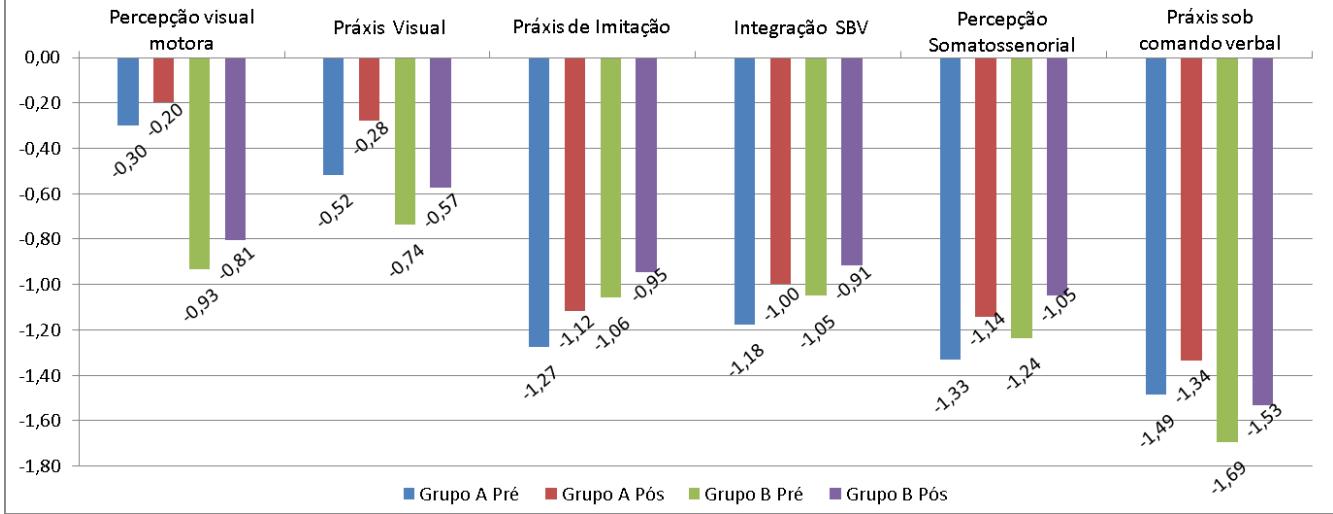
A compreensão dessa mudança positiva nos resultados pode ser facilitada com a análise dos resultados reunidos na Figura a seguir referente à média de pontuação obtida pelos grupos, com relação às áreas de integração sensorial avaliadas. Os resultados entre -1,00 e +1,00 correspondem ao esperado para a faixa normativa, resultados acima de $+ ~ 1 {, } 00$ estão acima do esperado para a faixa etária, enquanto os resultados abaixo de -1,00 são considerados abaixo do esperado para a faixa etária. A única exceção é o teste PRN (nistagmo pós-rotatório), cujos resultados abaixo de -1,00 ou acima de $+ 1 {, } 00$ correspondem a características de disfunção. Como nenhum dos participantes apresentou pontuações acima de $+ 1 {, } 00$, no PRn, ele foi incluído com os demais, na análise.
 Panel label: Resultado SIPT.
Os dados pré e pós-intervenção assinalam que, em todas as áreas pesquisadas, tanto o grupo A quanto o grupo B melhoraram as pontuações dos testes. Essa observação, apoiada na análise efetivada com o teste de Cohen's D, sugere que, durante o período de Intervenção com a Abordagem de Integração Sensorial de Ayres $\textsuperscript { \textregistered }$, houve mudança, do ponto de vista clínico, das habilidades práxicas e perceptuais avaliadas no SIPT dos alunos com TEA participantes desta pesquisa.
Com relação aos resultados da análise das variáveis SFA (avaliação da função escolar) e PSE (perfil sensorial escolar) demonstraram homogeneidade de variância, pela análise de Box-Cox, e foram testadas como normais, segundo o teste de Cramer-von Mises.
Resultados Estatísticos SFA e PSE
<table><tr><td rowspan="2">Variavel</td><td rowspan="2">N</td><td colspan="3">Média (DP)</td></tr><tr><td>Pré-intervença</td><td>Período Controle</td><td>Pós - intervenção</td></tr><tr><td>SFA</td><td>16</td><td>148,68 (23,87)b</td><td>154,62 (62,50)b</td><td>176,81 (21,91)a</td></tr><tr><td>PSE</td><td>16</td><td>478,25 (61,34)b</td><td>460,12 (59,82)b</td><td>308,75 (51,54)a</td></tr></table>
A comparação entre as intervenções considerou dezesseis alunos (oito do grupo A e oito do grupo B). Isso se deve ao fato de a análise ter mostrado que não houve diferença estatística entre os grupos, quer atinente aos resultados obtidos na SFA, quer concernente aos dados obtidos no PSE. Na ausência de diferença significante entre os grupos, a influência da intervenção foi analisada para com o total de 16 alunos.
Os dados apresentados na Tabela 1 indicam que houve diferença significativa entre os resultados pré-intervenção e os resultados finais, para os dois testes. Por conseguinte, observa-se que, embora a análise da intervenção por grupo não tenha sido significante, para as variáveis SFA e PSE, a intervenção exerceu influência estatisticamente significante nos quesitos avaliados pelos dois testes, na análise com a reunião dos dois grupos.
Em face desses resultados, verificou-se que ambos os grupos tiveram melhora significativa da sua participação escolar, a partir dos procedimentos de intervenção com a Abordagem de Integração Sensorial de Ayres, e o grupo que foi submetido à intervenção clínica associada à mediação escolar, não se diferenciou do grupo que esteve apenas em atendimento clínico, do ponto de vista estatístico.
O primeiro ponto a ser destacado, a fim de compreender esse resultado, é a influência dos aspectos integrativos na participação escolar dos alunos com TEA. À medida que os alunos possuem melhores condições de integrar as informações sensoriais provenientes do ambiente e do próprio corpo, suas possibilidades de participação nas atividades, de maneira geral, são potencializadas.
O segundo aspecto a ser realçado é o modelo de mediação proposto neste estudo, que buscou, em parceria com a equipe escolar, por meio de encontros periódicos, discutir as capacidades, necessidades e dificuldades de cada aluno e estabelecer estratégias, as quais, aplicadas ao ambiente escolar, poderiam favorecer a participação escolar dos alunos. Em contrapartida, o terapeuta, ao identificar as necessidades dos alunos no seu ambiente e contexto real (escola), pode intervir no ambiente clínico, com enfoque nos pré-requisitos esperados para determinadas atividades, assim como na adequação das atividades em si, do ambiente e contexto.
Vale enfatizar o aspecto dinâmico, coletivo e interacional que caracteriza o ambiente escolar e que difere, em grande proporção, dos elementos existentes no ambiente clínico, onde muitas variáveis podem ser
Gráfico dos Resultados da SFA (Grupo A com Mediação) controladas. Logo, é oportuno ressaltar a importância do papel do Terapeuta Ocupacional como parte da equipe escolar, onde é possível aproximar-se da realidade do aluno, seu ambiente, contexto e atividades, podendo intervir junto aos professores imediatamente, quando se fizer necessário.
No que se refere às estratégias escolhidas para favorecer a participação de cada aluno do grupo A, foi identificado, nos relatórios mensais preenchidos na ficha do aluno, como controle da mediação que $86\%$ foram implantadas e destas, $89\%$ foram bem-sucedidas e permaneceram ao longo de todo o processo de mediação. As estratégias não implementadas tiveram como justificativa a ausência de adesão do profissional de apoio, inconsistência do comportamento do aluno e sobrecarga profissional do professor, que impedia a modificação de rotinas escolares já estabelecidas.
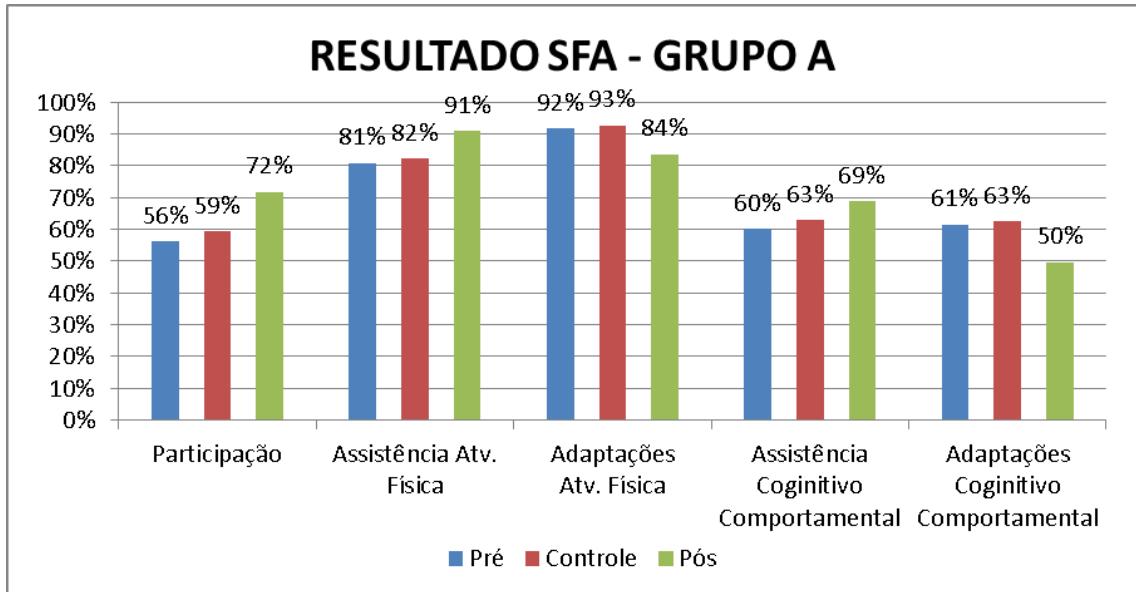
Os dados percentuais obtidos na comparação dos resultados do grupo A e B demonstram que houve uma tendência de resposta qualitativa favorável ao grupo A. Se se considerar a diferença percentual encontrada nas categorias medidas pelo instrumento, expostas nas Figuras 4 e 5, verifica-se que a alteração do comportamento perceptivo dos professores foi maior no grupo A, comparativamente ao grupo B, podendo-se deduzir que a mediação favoreceu maior atenção do professor para a identificação das necessidades do aluno.
 Fonte: Elaborada pela autora
Gráfico dos Resultados da SFA (Grupo B)
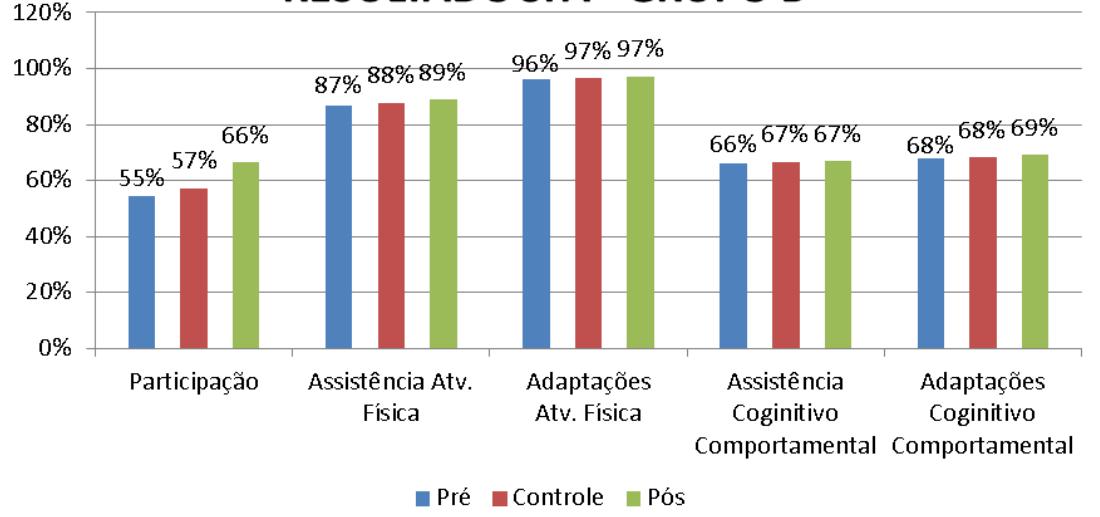 RESULTADO SFA - GRUPO B
Verifica-se, nas figuras acima, que, na análise intragrupo, houve maior mudança no nível de assistência e adaptações oferecidas ao grupo A, o qual recebeu mediação associada à intervenção, em comparação ao nível de assistência e adaptações oferecidas ao grupo B, que recebeu somente intervenção de Integração Sensorial de Ayres $\textsuperscript { \textregistered }$. Quanto à participação dos alunos, no período-controle, observa-se que ambos os grupos tiveram uma diferença não expressiva, na sua participação para a execução das atividades escolares, mas, no decorrer do tratamento, há indícios de melhor aproveitamento.
Vale ressaltar que, além do nível de participação alcançado pelos alunos, no ambiente escolar, atenção deve ser dada ao nível de assistência e adaptações disponibilizadas a esses alunos, o que pode garantir principalmente o aspecto qualitativo da participação escolar, com ênfase na autonomia, ao reconhecer as características, necessidades e capacidades individuais de cada aluno. Neste estudo de acordo com resultados apresentados nas figuras acima houve maior redução do nível de assistência no grupo que recebeu a intervenção clínica associada à mediação escolar (grupo A).
Por fim os resultados deste estudo demonstram que ambos os grupos submetidos à intervenção com a Abordagem de Integração Sensorial de Ayres $\textsuperscript { \textregistered }$ apresentam melhora na sua participação escolar. No entanto, o grupo A (submetido também à mediação), revelou melhora na participação, além de reduzir o nível de assistência necessário, à proporção que as adaptações e modificações foram implantadas, no contexto escolar. O grupo B (apenas com a intervenção clínica), por outro lado, apesar de exibir melhora da sua participação, durante o período em que foi submetido à intervenção com a Abordagem de Integração Sensorial de Ayres $\textsuperscript { \textregistered }$, não apresentou mudanças expressivas quanto à necessidade de assistência e uso de adaptações, o que sugere a interferência da mediação junto aos professores com o grupo A de alunos.
A intervenção com a Abordagem de Integração Sensorial de Ayres $\textsuperscript { \textregistered }$ tem por objetivo favorecer a integração das informações sensoriais e, com isso, possibilitar o desenvolvimento e aprimoramento de habilidades sensório-motoras em indivíduos com TEA. Entretanto, tal condição não é suficiente para garantir a generalização dessa competência e participação nas atividades dessa natureza, em virtude de existir uma dinâmica interacional entre funções e estruturas do corpo, ambiente, contexto e atividade que determina o nível de desempenho e participação do indivíduo em qualquer ocupação que seja a ele atribuída como significativa (AOTA, 2014; CIF, 2011).
Assim, à medida que são implantadas as modificações no ambiente e nas atividades, com o objetivo de atender às necessidades e características individuais dos alunos, em paralelo à intervenção que se dá no âmbito do ambiente clínico, a execução das atividades pode acontecer com maior autonomia e competência, sem que seja necessário o suporte externo constante de terceiros.
## V. CONCLusÃO
Os resultados obtidos neste estudo demonstraram que, durante o período de intervenção com a Abordagem de Integração Sensorial de Ayres®, os alunos com TEA melhoraram a participação no contexto escolar, tendo em vista a análise dos professores responsáveis, obtida por meio da aplicação do questionário utilizado (SFA), comparando-se os resultados no período-controle e pós- intervenção.
Quanto à mediação, ao se comparar estatisticamente os resultados obtidos nos grupos A e B, através do instrumento SFA, verifica-se que os grupos não se diferenciaram. No entanto, a análise qualitativa do nível de assistência e adaptações necessárias, no ambiente escolar, sugere que, no grupo A (de alunos submetidos à intervenção e mediação escolar), houve redução do nível de assistência, à medida que as modificações e adaptações foram implantadas. Essa observação não se aplica ao grupo B de alunos, o qual foi submetido apenas à intervenção.
No que tange à intervenção com a Abordagem de Integração Sensorial de Ayres $\textsuperscript { \textregistered }$, os resultados revelaram que, ao se comparar as características de integração sensorial dos alunos no período-controle e intervenção, ambos os grupos obtiveram mudança positiva, do ponto de vista clínico, após o período de intervenção. Assim, conclui-se que, tanto no âmbito da modulação quanto da percepção sensorial e práxis, os alunos com TEA foram beneficiados com a Abordagem de Integração Sensorial de Ayres $\textsuperscript { \textregistered }$.
Generating HTML Viewer...
References
67 Cites in Article
(2014). Occupational Therapy Practice Framework: Domain and Process (3rd Edition).
American,Association (2014). DSM-5: Manual Diagnóstico e Estatístico de Transtornos Mentais.
Jill Ashburner,Jenny Ziviani,Sylvia Rodger (2008). Sensory Processing and Classroom Emotional, Behavioral, and Educational Outcomes in Children With Autism Spectrum Disorder.
A Ayres (1989). Sensory Integration and Praxis Tests.
A Ayres (2005). Review for "Ayres Sensory Integration Therapy for a Child With Rett Syndrome: A Case Report".
T Bar-Shalita,J Vatine,S Parush (2008). Sensory modulation disorder: A risk factor forparticipation in daily life activities.
M Burgoyne,C Ketcham (2015). Observation of classroom performance using therapy balls as a substitute for chairs in elementary school children.
C Cabral,A Marin (2017). Inclusão escolar de crianças com Transtorno do Espectro Autista: uma revisão sistemática da literatura.
Marina Morettin (2011). Classificação internacional de funcionalidade, incapacidade e saúde, versão crianças e jovens (CIF-CJ): elaboração de um checklist para avaliação da funcionalidade em usuários de implante Coclear.
R Cintra,M Jesuino,M Proença (2015). As possibilidades da EAD no processo de inclusão no ensino superior da pessoa com autismo: um estudo de caso.
Faraz Yousefian,Francesca Genera,Matin Md,Victoria O’neill,Christian Dupuy,Bernardhildebrand Md,Manuel Md (1998). Listeria monocytogenes Infection in a 69-year-old Diabetic.
W Coster,G Clark (2013). Best practices in school occupational therapy evaluation to support participation.
W Dunn (2014). Sensory Profile 2: User's Manual.
Alicia Fedewa,Matthew Davis,Soyeon Ahn (2015). Effects of Stability Balls on Children’s On-Task Behavior, Academic Achievement, and Discipline Referrals: A Randomized Controlled Trial.
Suzannah Ferraioli,Sandra Harris (2011). Effective Educational Inclusion of Students on the Autism Spectrum.
Sandra Hodgetts,Joyce Magill-Evans,John Misiaszek (2011). Effects of weighted vests on classroom behavior for children with autism and cognitive impairments.
K Koenig,S Rudney (2010). Performance challenges for children and adolescents with difficulty processing and integrating sensory information: A systematic review.
Zoe Mailloux (1990). An Overview of the Sensory Integration and Praxis Tests.
Zoe Mailloux,Shelley Mulligan,Susanne Roley,Erna Blanche,Sharon Cermak,Gina Coleman,Stefanie Bodison,Christianne Lane (2011). Verification and Clarification of Patterns of Sensory Integrative Dysfunction.
L Mattos,A Nuernberg (2011). Reflexões sobre a inclusão escolar de uma criança com diagnóstico de autismo na educação infantil.
L Miller (2007). Concept evolution in sensory integration: a proposed nosology for diagnosis.
H Miller-Kuhaneck,J Kelleher (2015). Development of the Classroom Sensory Environment Assessment (CSEA).
L Parham,Susanne Roley,Teresa May-Benson,Jane Koomar,Barbara Brett-Green,Janice Burke,Ellen Cohn,Zoe Mailloux,Lucy Miller,Roseann Schaaf (2011). Development of a Fidelity Measure for Research on the Effectiveness of the Ayres Sensory Integration® Intervention.
B Pfeiffer (2011). Efetividade de intervenções de integração sensorial em crianças com distúrbios do espectro do autismo: um estudo-piloto.
Beth Pfeiffer,Teresa May-Benson,Stefanie Bodison (2017). State of the Science of Sensory Integration Research With Children and Youth.
R Core,T (2020). A language and environment for statistical computing.
R Schaaf (2013). An intervention for sensory difficulties in children with autism: A randomized trial.
R Schaaf,S Roley (2006). Sensory integration: applying clinical reasoning to preactice whith diverse populations.
R Schaaf,J Hunt,T Benevides (2012). Occupational therapy using sensory integration to improve participation of a child with autism: A case report.
R Schaaf,J Hunt,T Benevides (2012). Occupational Therapy Using Sensory Integration to Improve Participation of a Child With Autism: A Case Report.
R C Schaaf,Z Mailloux (2015). Promoting Participation for Children With Autism.®: Promoção da participação de crianças com autismo.
R Schenker,W Coster,S Parush (2005). Participation and activity performance of students with cerebral palsy within the school environment.
J Schmahmann (2000). O papel do cerebelo no afeto e na psicose.
C Schmidt (2013). Autismo, educação e transdisciplinaridade.
Christina Schmitz,Joëlle Martineau,Catherine Barthélémy,Christine Assaiante (2003). Motor control and children with autism: deficit of anticipatory function?.
Cynthia Schumann,David Amaral (2005). Stereological estimation of the number of neurons in the human amygdaloid complex.
Scott-Van,Z (2010). Reward processing in autism.
Anna Silva,Géssica Fonseca,Max Brito (2018). O estudante com autismo na educação infantil: concepções dos profissionais da sala de aula regular e do AEE.
L Silva (2019). Contribuições da análise do comportamento ao processo de inclusão de alunos com diagnóstico de TEA no Rio de Janeiro.
M Silva (2014). Trajetórias escolares de alunos com transtorno do espectro autista e expectativas educacionais das famílias.
R Silva (2013). Para além do discurso oficial das políticas públicas: possibilidade de (re)pensar o paradigma de inclusão escolar para o educando com transtorno do espectro autista na cidade de Manaus.
E Simonoff (2008). Transtornos psiquiátricos em crianças com distúrbios do espectro do autismo: prevalência, comorbidade e fatores associados em uma amostra de população.
C Siqueira (2016). O cérebro autista: a biologia da mente e sua implicação no comprometimento social.
R Smith (2007). Understanding Ayres Sensory Integration.
L Costa,B Teixeira,F Cruz,E Monteiro,W Soares (2019). Inspeção predial com auxílio de drone e com alpinismo industrial para identificação de desplacamento cerâmico em fachadas: um estudo de caso.
J Souza (2014). Formação continuada de professores: transtorno do processamento sensorial e as consequências para o desempenho escolar. 2014. 191 f. Dissertação.
Susan Spitzer (2003). With and Without Words: Exploring Occupation in Relation to Young Children with Autism.
S Spitzer,S Roley (2001). Sensory integration revisited: a philosophy of practice.
F Stelzer (2010). Uma pequena história do autismo.
Antonio Silva Neto,Paulo Costa,Ângela Balça (2017). A segregação socioespacial de uma escola pública brasileira.
Abigail Thompson,Declan Murphy,Flavio Dell’acqua,Christine Ecker,Grainne Mcalonan,Henrietta Howells,Simon Baron-Cohen,Meng-Chuan Lai,Michael Lombardo (2017). Impaired Communication Between the Motor and Somatosensory Homunculus Is Associated With Poor Manual Dexterity in Autism Spectrum Disorder.
C Trombly,M Radomski (2005). Terapia ocupacional para disfunções físicas.
Alexander Vaiserman (2015). Epidemiologic evidence for association between adverse environmental exposures in early life and epigenetic variation: a potential link to disease susceptibility?.
C Vakalopoulos (2007). Unilateral neglect: A theory of proprioceptive space of a stimulus as determined by the cerebellar component of motor efference copy (and is autism a special case of neglect).
Rosanita Vargas,Carlo Schmidt (2017). <b>Envolvimento parental e a inclusão de alunos com autismo.
L Vicari (2019). Escolarização de alunos com TEA: práticas educativas em uma rede pública de ensino. 2019. 164f. Dissertação.
G Vieira (2016). Políticas Públicas Educacionais Inclusivas para a criança com Transtorno do Espectro do Autismo na Educação Infantil na Cidade de Manaus.
C Vila,S Diogo,S Sequeira (2009). Monografia (Trabalho de conclusão de curso) -Instituto Superior Manuel Teixeira Gomes.
R Watling,S Hauer (2015). Effectiveness of Ayres Sensory Integration® and Sensory-Based Interventions for People with Autism Spectrum Disorder: A Systematic Review.
A Weimer (2001). Motor" impairment in Asperger syndrome: Evidence for a deficit in proprioception.
J Williams,J Higgins,C Brayne (2006). Systematic review of prevalence studies of autism spectrum disorders.
V Wilson,B Peterson,Comprehensive,Physiology (2011). Unknown Title.
L Wing (1969). The handicaps of autistic children: a comparative study.
B Yates,T Wilson (2009). Encyclopedia of Neuroscience.
Laura Zapparoli,Silvia Seghezzi,Paola Scifo,Alberto Zerbi,Giuseppe Banfi,Marco Tettamanti,Eraldo Paulesu (2018). Dissecting the neurofunctional bases of intentional action.
Y Zhang,N Schuff,G Jahng,W Bayne,S Mori,L Schad,M Weiner (2007). Diffusion tensor imaging of cingulum fibers in mild cognitive impairment and Alzheimer disease.
L Zwaigenbaum (2015). Early identification of autism spectrum disorders: Recommendations for practice andresearch.
No ethics committee approval was required for this article type.
Data Availability
Not applicable for this article.
How to Cite This Article
Mirela Moreno Almeida de Andrade. 2026. \u201cThe Effectiveness of the Ayres® Sensory Integration Approach in the School Context for Students With Additional Disorders Autistic Spectrum\u201d. Global Journal of Human-Social Science - G: Linguistics & Education GJHSS-G Volume 23 (GJHSS Volume 23 Issue G10): .
Explore published articles in an immersive Augmented Reality environment. Our platform converts research papers into interactive 3D books, allowing readers to view and interact with content using AR and VR compatible devices.
Your published article is automatically converted into a realistic 3D book. Flip through pages and read research papers in a more engaging and interactive format.
Our website is actively being updated, and changes may occur frequently. Please clear your browser cache if needed. For feedback or error reporting, please email [email protected]
Thank you for connecting with us. We will respond to you shortly.