The teaching approach using mathematical games is gaining more attention as an innovative method to improve the learning of preschool students. This study was conducted to evaluate the effectiveness of math games implemented in learning centers in improving number mastery among preschool students. This study involved 10 students selected from a population of 25 in a preschool class in Putrajaya. Instruments such as pre-and post-tests are used to find out the level of student achievement, in addition to observation and interviews to get an in-depth view of the effects of using games. The results of the study found that after this intervention program was carried out, there was a significant increase in understanding and mastering the concept of numbers. Mathematical games not only help improve cognitive performance, but also foster students’ motivation, interest, and enjoyment in learning. Students who are exposed to this method are more confident and enthusiastic about engaging in activities related to Early Mathematics. This study also identified important factors such as the teacher’s role as a facilitator, the compatibility of the game with the student’s level of development, and consistent implementation to guarantee the effectiveness of this approach.
## I. INTRODUCTION
The National Preschool Standard Curriculum (KSPK) was first introduced in 2010 and was later refined to meet the new policy requirements outlined in the Malaysian Education Blueprint (PPPM) 2013-2025. These improvements ensure that the Malaysian preschool curriculum meets international standards, in line with global best practices. As part of this reform, the Curriculum and Assessment Standard Document (DSKP) was formulated to strengthen the KSPK. The DSKP comprises three main components, namely Content Standards, Learning Standards, and Performance Standards. The implementation of Performance Standards in this curriculum document has brought about a major transformation in the country's education system, where students are now assessed continuously.
This approach allows their level of mastery in each area of learning to be identified more thoroughly. Teachers can also design follow-up actions or implement intervention programs to support students' optimal development. In the Early Mathematics subject in preschool, children are introduced to basic Mathematics skills through pre-number experiences. These activities help build a strong foundation in the concept of numbers and their uses in everyday life. Among the pre-number skills applied are matching, sorting, classifying, seriation, as well as identifying repeating patterns and building patterns. All these activities are not only fun, but also strategically designed to stimulate children's logical thinking and creativity.
Wong and Teo (2023) argue that structured games with clear learning objectives can have a greater impact on the mastery of mathematical concepts. This effect becomes more significant when the games are combined with effective teacher training. According to Griffin, Case, and Siegler (1994), the focus of mathematics learning in early childhood should begin with basic skills such as number recognition, counting, and calculating small quantities. Baroody (1987) emphasizes that early mathematics learning among children develops gradually. This process involves meaningful discovery and the building of a deeper understanding of numbers and calculation concepts.
Learning Centers are one of the effective strategies in teaching and learning (T&L) activities in preschool classrooms, in addition to theme-based and project-based learning approaches. When Learning Centers are optimally implemented during T&L sessions, students are given the opportunity to learn independently, according to their own interests and abilities. Through exploration in the Learning Centers, students not only gain relevant mathematical knowledge during T&L sessions but are also able to apply these concepts in daily life. This approach helps them build a deeper understanding of number mastery as well as more complex mathematical concepts, making learning more meaningful and enjoyable.
Preschool learning centers refer to places or spaces where preschool children learn and interact with the learning environment. Indirectly here we can see that the children gain a comprehensive and holistic learning experience. In addition, the preschool learning environment must provide a conducive environment for learning. This includes the use of appropriate learning materials, a safe space, and activities that stimulate children's interests. Therefore, preschool learning centers are places where preschool children gain comprehensive learning experience, develop skills, and foster positive attitudes in themselves.
Learning through play is a carefully planned and structured approach to ensure that children learn in a comfortable, fun, and positive atmosphere. Through this approach, they not only can enjoy learning, but can also explore the world around them more freely. These new experiences gained directly and naturally help children understand concepts more deeply, while fostering their curiosity and creativity. The implementation of effective Mathematics T&P among preschool students often faces challenges, especially when traditional teaching approaches do not sufficiently interest children. In this regard, the use of mathematics games in learning at preschool learning centres has been proposed as an innovative approach that can interest students in learning numbers. Mathematics games provide opportunities for students to explore number concepts through fun and interactive activities, this supporting the KSPK goal of producing students with basic Mathematics skills.
## II. LITERATURE REVIEW
Previous studies have shown that mathematical games can enhance mathematical learning by making it a more enjoyable and effective learning activity, especially in helping children understand the concept of numbers at an early stage, namely preschool. Mathematical games refer to activities that involve mathematical concepts, such as in this study, the emphasis on mastery of numbers is implemented in the form of games or fun activities. This approach can attract preschool students to tend to learn through activities that involve movement and exploration (Sarama & Clements, 2009).
Piaget (1896-1980) believed that effective learning can only occur when there is a connection between previously learned concepts and new concepts acquired. This connection helps children understand new ideas more easily, while reinforcing their existing knowledge. Zoltan (1916-2014) was a Hungarian mathematician whose name is synonymous with the multi-base blocks (also known as Dienes blocks) that were invented for teaching place value. Dienes believed that to make learning mathematics more engaging for young children, we need to create an informal environment where children learn mathematics through play, singing, dancing, and using manipulative materials. Diene's is also known for his Six Stages
Theory of Learning Mathematics. By engaging in activities that involve mathematical processes, children are unaware that they are learning mathematical skills and concepts because they are not being directly done.
Mathematical games are an increasingly popular tool used in preschool education to expose children to number concepts. Ginsburg (2009), learning through games can not only attract students' attention, but also increase their understanding of basic mathematical concepts. Wright (2004) preschool children are more likely to be actively involved in fun and interactive activities, making mathematical games an effective medium to strengthen their number skills.
Several studies have shown the effectiveness of mathematical games in improving number mastery. Hughes (2012), games that involve object manipulation and the use of visuals can help children understand the relationships between numbers more clearly. These games give them the opportunity to practice practically and learn through experience, which is more effective than theoretical and passive teaching methods.
### Previous Studies
A study by Thorell et al. (2009) showed that repetitive play has a positive impact on increasing mathematical knowledge among preschoolers. This repetitive play activity not only improves children's memory but also helps them master mathematical concepts better. Piaget & Inhelder (1969) also emphasized that allowing children to manipulate toys gives them the opportunity to see the results of their actions, which in turn deepens them understanding of the concept. Similarly, a study by Doig & Ompok (2010) emphasized the importance of providing a natural and conducive environment to help children's development. These studies prove that playing is not only fun but can also lead to positive achievement in the subject of mathematics among preschoolers. Therefore, game methods need to be integrated more widely in the teaching and learning (T&L) process to attract students' interest in mathematics.
Game-Based Learning (GBL) is an activity in the classroom where students will be involved in activities carried out by the teacher. They will learn mathematical concepts and increase their understanding of it through games. Zaida (1962) students can learn through their experiences and their involvement in game activities. For children, early mathematical understanding is a very important thing in learning mathematics (Zaida, 2018). Children need to be given emphasis on understanding concepts through experience with concrete objects, rather than relying entirely on rote learning techniques. Piaget (1962) divided cognitive development into three main stages, namely sensory motor training, symbolic at the preoperational stage, and rule-based play at the concrete operational stage. Sensory motor training, for example, involves games that encourage children to use their senses to explore the world around them. For example, the Write That Number Game allows children to physically form numbers, providing direct experience in learning the concept of numbers through action.
Overall, this literature review shows that the use of mathematical games in preschool education is an effective tool in improving number mastery among students. The available evidence shows that these games can improve the understanding of number concepts in a more interesting and effective way. This study will focus on obtaining the effectiveness of the use of mathematical games in learning centers.
## III. RESEARCH METHODOLOGY
This study is a case study; the research methodology is quantitative and qualitative to obtain comprehensive findings. This approach was chosen because it allows students to measure the effectiveness of mathematical games objectively through quantitative data, such as pre and post test scores, while exploring students' experiences in depth through qualitative data, such as observations and interviews. The combination of these two approaches not only provides complete data but also ensures that the study results are more meaningful and relevant to the real situation. The mixed approach was chosen because:
### a) Quantitative
- Provides objective evidence of the effectiveness of math games based on changes in student test scores.
- Allows statistical comparisons to be made, through paired t-test analysis to determine significant differences between pre- and post-tests.
### b) Qualitative
- Provides a deeper understanding of how math games influence student behavior, motivation, and learning experiences.
- Data from observations and interviews can complement quantitative findings by providing more detailed explanations.
This approach is suitable because it provides different but complementary perspectives to answer the research questions in a more holistic way. Case studies allow researchers to focus on a specific group, namely preschoolers, and see how math games affect them holistically. The combination of approaches allows for more comprehensive research results, as it combines statistical data with student experience. Quantitative and qualitative data that support each other increase the credibility and validity of the study.
### c) Research Design
This study employed a mixed-methods case study design to examine the effectiveness of math games on number mastery among preschoolers. The case study approach allowed an in-depth exploration of a specific group, while the mixed-methods framework integrated quantitative and qualitative data to provide both measurable evidence and contextual understanding. Quantitative data, such as test scores, documented improvements in number skills, while qualitative data from observations and interviews explained how the games facilitated conceptual understanding. This combination enhanced the rigor and relevance of the findings, providing both statistical validation and insight into the learning process.
### d) Consistency in Implementation
A key aspect of this study was systematic consistency, applied throughout the nine-week intervention. Learning activities were carefully sequenced from simple to more complex tasks, starting with foundational number recognition and counting, and gradually progressing to problem-solving and higher order thinking challenges. This consistent approach allowed preschoolers to consolidate prior knowledge before engaging in more demanding tasks, reinforcing learning through repeated, scaffolded practice. By providing a stable and predictable learning environment, the intervention supported incremental skill development, promoted critical thinking, and facilitated the internalization of mathematical concepts. Consistency thus served as a crucial factor in achieving measurable improvement in number mastery and cognitive growth among participants.
### e) Population and Sample
The study population is 25 students in the urban area of the Federal Territory of Putrajaya. The study sample involved 10 preschool students who were purposively selected based on the criteria of students with different levels of number mastery at the beginning, to see the difference in the impact of the game on students with different levels of mastery as well as students who were willing to participate in the math game session conducted in this study. Purposive sample selection allows this study to focus on students who can provide relevant views and feedback towards the objectives.
### f) Research Instruments
The main instrument for collecting data was a pre- and post-assessment test which was carried out before and after the use of the math game. Unstructured interviews were conducted with 10 students involved. The interviews were conducted to obtain students' experiences while playing the math game, their views on the fun and effectiveness of the game in helping them understand numbers, as well as the challenges they faced. Interview questions will be designed based on the study objectives and will be adapted to the students' level of understanding and ability.
Observation or direct observation of students during a math game session. This includes observing the interactions between students, their involvement in playing activities, and how the game affects their understanding of number concepts. This observation also aims to assess whether math games can increase students' motivation and interest in the subject of Mathematics. The observation process involved 3 stages, namely:
#### Before Observation
- Introducing the game to the students.
- Provide clear instructions on how to play.
During Observation
- Observe the students directly and record observations using a checklist or form.
- Do not disturb the students while they are playing unless necessary.
#### After Observation
- Analyze the observational data based on the checklist and notes.
- Compare pre- and post-observation findings to identify changes.
The following include direct observations, oral questions, and practical activities:
#### Direct Observation
1. Accuracy and Fluency in Counting: Can the students count from 1 to 10 in ascending and descending order without errors?
2. Accuracy in Sequencing: Can the students arrange numbers in ascending and descending order correctly?
3. Ability to Count and Fill in Missing Cards: Can the students count and fill in missing cards in the correct numerical order?
4. Ability to Complete Puzzles: Can the students complete puzzles with the correct number arrangement?
#### Oral Questions
1. "Can you count from 1 to 10?"
2. "Can you arrange numbers from 10 to 1?"
3. "What number comes before 5?"
4. "What number comes after 6?"
#### Practical Activities
Practical activities are used as assessment tools to evaluate the sample in the following areas:
a) Smart Counting Box Game: Students can count from 1 to 10 in the correct order.
b) I Love Pizza Game: Students can recognize and name numbers randomly with accuracy.
c) Cookie and Apple Counting Game: Students can match groups of objects with numbers correctly.
d) Caterpillar and Number Hopscotch Game: Students can count numbers in ascending and descending order accurately and organize objects into groups in correct ascending and descending order.
e) Choo-Choo Train Game: Students can count continuously from 11 to 20 accurately.
f) Caterpillar Game: Students can count in groups of ten systematically, both in ascending and descending order, with precise numbers.
This observation guide helps to systematically assess the effectiveness of mathematical play, focusing on students' behavior, interactions, and performance. Furthermore, a learning portfolio and a student engagement rating scale are provided to collect students' work during the mathematical play activities for analysis.
## IV. RESEARCH STUDY
This research will be conducted over four weeks, with the following procedures:
### Phase 1: Introduction and Preparation
In the first week, students will be introduced to the study's objectives and the mathematical games to be used. They will be provided with explanations about the types of games they will play and how these games can assist in their learning of numbers.
#### Phase 2: Implementation of Mathematical Game Activities
From the second to the fourth week, mathematical game sessions will be conducted regularly. The chosen games will involve activities based on numbers and basic operations. Each session will last between 30 to 45 minutes and will be conducted in small groups to ensure each student receives sufficient attention.
#### Phase 3: Data Collection
Data will be collected through semi-structured interviews following each game session. The researchers will also observe the sessions, documenting student interactions and their comprehension of numbers. Activity documentation will be prepared to capture the overall learning process.
#### Phase 4: Data Analysis
Data will be analyzed using pre- and post-tests, unstructured interviews, observations, learning portfolios, and student engagement scales, adopting a thematic analysis approach. Key themes related to the effectiveness of mathematical games in enhancing number mastery among preschool students will be identified. Responses and feedback will be categorized to assess changes in number mastery and students' experiences throughout the learning process.
## V. DATA COLLECTION METHODS
### Pre- and Post-Assessment Tests
- Purpose: To evaluate students' mastery of numbers before and after exposure to mathematical games.
- Process:
- Pre-tests are conducted prior to the implementation of mathematical game activities to establish baseline data.
- Post-tests are conducted after the mathematical game sessions to measure changes in mastery levels.
- Data Collected: Students' scores reflecting improvement or changes in number mastery.
#### Observation
- Purpose: To gain direct insights into students' behavior, engagement levels, and responses during mathematical game activities.
- Process: Observers record students' interactions with learning materials and peers.
- Checklists or field notes are used to ensure data collection is systematic.
- Data Collected: Students' behaviors, activity levels, and the effectiveness of games in capturing interest.
#### Unstructured Interviews
- Purpose: To gather qualitative information from students about their experiences and opinions regarding mathematical games.
- Process: Students are given opportunities to share their experiences informally and casually.
- Data Collected: Feedback and perspectives on the effectiveness of games in the learning process.
#### Learning Portfolios and Student Engagement Rating Scales
- Purpose: To document students' learning progress throughout the study.
- Process:
- Learning portfolios are filled with students' work, such as worksheets and records of mathematical game activities.
- Engagement rating scales are used to assess students' participation levels during learning activities.
- Data Collected: Students' work and engagement scores.
## VI. RESEARCH FINDINGS
This study involved a sample of 10 preschool students aged 6 years from the Federal Territory of Putrajaya. The sample was selected from a population of 25 preschool students. It consisted of 4 boys and 6 girls, all of whom were Malay, chosen based on the results of a pre-test conducted earlier.
The pre-test included 30 questions focusing on number recognition, counting, and arranging numbers in ascending and descending order. The selected sample comprised students who scored low to moderate marks, ranging from 0 to 26.
The primary objective of this study was to evaluate the effectiveness of using mathematical games in learning centers to enhance number mastery among preschool students. This study served as an intervention program, utilizing play-based teaching aids to capture students' interest and help them understand concepts more easily through engaging activities.
The mathematics assessment instrument used in this study consisted of 30 questions covering the topic of numbers, divided into six key areas:
1. Recognizing numbers 1-10 correctly.
2. Recognizing numbers 11-20 correctly.
3. Recognizing numbers 10-100 correctly.
4. Recognizing random numbers correctly.
5. Counting numbers in ascending and descending order correctly.
6. Counting numbers and matching them with objects accurately.
In this study, students were not required to write or color but participated in interactive games to achieve learning outcomes. The tasks included:
- Completing puzzles in the "I Love Pizza" Game.
- Arranging numbers in ascending and descending order using the "Caterpillar Game" and "Choo-Choo Train" Game.
- Counting objects from 1 to 10 using the "Number Box" Game.
- Counting chocolate chips and matching their quantity with the correct number in the "My Cookies" Game.
- Recognizing numbers 11-20 and 10-100 through the "Caterpillar Game".
- Matching numbers with objects in the "Count the Apples" Game.
- Identifying numbers in ascending and descending order through the "Number Hopscotch" Game.
These activities were designed to make learning enjoyable and interactive, systematically improving students' number recognition and counting skills while maintaining their interest and engagement.
<table><tr><td>Sample</td><td>Pre-Test</td><td>Post-Test</td></tr><tr><td>P1</td><td>22</td><td>28</td></tr><tr><td>P2</td><td>22</td><td>20</td></tr><tr><td>P3</td><td>0</td><td>30</td></tr><tr><td>P4</td><td>0</td><td>30</td></tr><tr><td>P5</td><td>23</td><td>30</td></tr><tr><td>P6</td><td>26</td><td>30</td></tr><tr><td>P7</td><td>20</td><td>30</td></tr><tr><td>P8</td><td>25</td><td>23</td></tr><tr><td>P9</td><td>25</td><td>26</td></tr><tr><td>P10</td><td>26</td><td>30</td></tr></table>
### Diagram 1
Diagram 1 shows the data for the pre-test and post-test of ten students (P1 to P10). Based on the data:
#### 1. Pre-Test Scores:
- There were students with very low scores (0 marks), such as P3 and P4.
- The overall average score for the pre-test is 18.9, indicating that the students' initial mastery of numbers was moderately low.
- The standard deviation for the pre-test is 10.15, reflecting a large variation in students' performance before the intervention.
#### 2. Post-Test Scores:
Students showed improvement in their post-test scores after the implementation of the mathematical play intervention.
- The average post-test score is 27.7, showing a significant improvement in students' mastery of numbers.
- The standard deviation for the post-test is 3.59, indicating that the variation in students' performance is smaller after the intervention, which reflects an improvement in consistency.
#### 3. Comparison of Pre-Test and Post-Test:
- Students such as P3 and P4 improved from 0 marks (pre-test) to 30 marks (post-test).
- Overall, there was an average increase of 8.8 marks in students' achievement after using mathematical play.
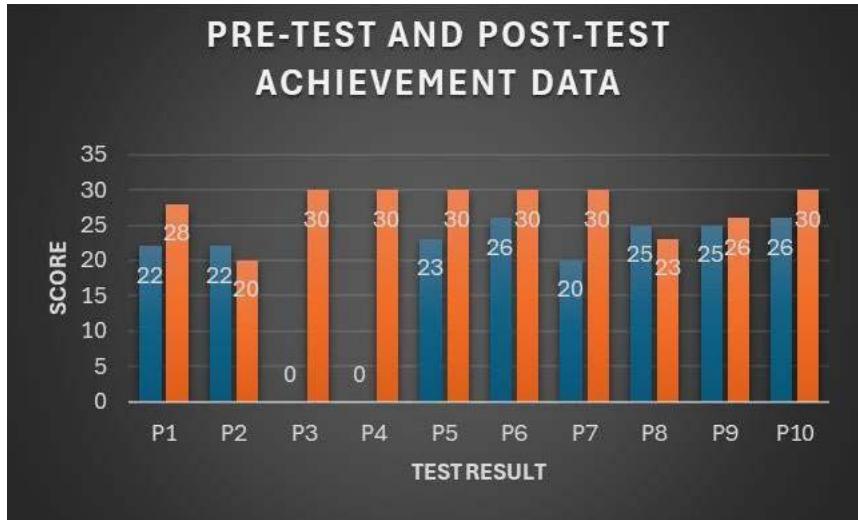
Diagram 2
Diagram 2 presents the achievement scores before and after the intervention for each student in the form of a bar graph, which facilitates the visualization of the changes that occurred.
#### 1. Improvement in Each Student's Achievement:
- All students showed consistent improvement in their post-test scores compared to the pre-test.
Students P3 and P4, who scored 0 marks in the pre-test, achieved the maximum score (30 marks) in the post-test.
#### 2. Maximum Score (30 Marks):
- Five students (P3, P4, P5, P6, and P10) achieved the maximum score in the post-test, reflecting the positive impact of the intervention.
#### 3. Data Visualization:
- The graph shows a significant gap between the pre-test and post-test, especially for students with initially low achievements (such as P3 and P4).
- Students with higher pre-test scores (such as P6 and P10) also showed improvement, though their increase was smaller.
Based on both figures, the intervention using mathematical play was effective in improving the number mastery of preschool students. This improvement is evident not only in the overall average scores but also in the consistency of achievements across students. This data supports the study's hypothesis that game-based learning methods can significantly enhance students' performance.
#### Descriptive Analysis
#### 1. Average Scores for Pre-test and Post-test:
- The average score for the pre-test is 18.9, indicating that the students' mastery of numbers before the intervention was low.
- The average score for the post-test is 27.7, showing a significant improvement after the use of mathematical play.
#### 2. Difference in Averages:
The difference in the average scores between the pre-test and post-test is 8.8 marks, reflecting the effectiveness of the intervention.
#### 3. Standard Deviation:
- The standard deviation for the pre-test is 10.15, indicating a large variation in students' performance before the intervention.
- The standard deviation for the post-test is 3.59, showing that students' performance became more consistent after the intervention, reflecting an improvement in their achievement consistency.
#### 4. Improving the Performance of Weaker Students:
- Students like P3 and P4, who scored 0 in the pretest, achieved the maximum score (30 marks) in the post-test.
- This demonstrates that mathematical play was effective in helping students with lower levels of mastery.
#### 5. Percentage of Students Achieving Maximum Score:
- Five students $(50\%)$ achieved the maximum score (30) in the post-test, compared to 0 students in the pre-test.
Inferential Analysis
A paired t-test was used in the inferential analysis to measure whether there was a statistically significant difference between the pre-test and post-test scores.
#### 1. Study Hypothesis:
- $H_{0}$ (Null Hypothesis): There is no significant difference between the pre-test and post-test scores.
- $H_{1}$ (Alternative Hypothesis): A significant difference exists between the achievements in the pre-test and post-test.
#### 2. Results of Paired t-test:
- t-statistic value: 2.36
- $p$ -value: 0.043
- Results: Since the p-value is $< 0.05$, the study rejects the null hypothesis $(H_0)$ and supports the alternative hypothesis $(H_1)$.
#### 3. Statistical Interpretation:
- The results have demonstrated that there is a statistically significant difference between the pretest and post-test scores.
- This indicates that the findings from the mathematical play intervention had a positive impact on students' number mastery.
#### 4. Impact of the Intervention:
- The overall increase in scores shows that mathematical play not only improved students' average level of number mastery but also reduced the variation in achievement among students, making their performance more consistent.
Based on the descriptive and inferential analysis, it can be concluded that the average post-test scores significantly increased compared to the pre-test scores. This improvement was confirmed through the paired t-test, where the p-value showed statistically significant results. The intervention using mathematical play proved effective, especially in improving the performance of weaker students and achieving better consistency in their results.
Results of the Study on the Effectiveness of Mathematical Play to Improve Number Mastery Among Preschool Students:
1. Improvement in Number Recognition Skills:
- Intervention games such as I Love Pizza, Caterpillar, and Cucucu Train helped students better recognize numbers. In parts i to iii, students showed gradual and consistent improvement in recognizing numbers 1-10, 11-20, and 10-100.
2. Skills in Counting Upward and Downward:
- Games such as Teng Teng Numbers and Caterpillar helped students understand the concept of
number sequencing both upward and downward more clearly. Activities like number sorting through play were found to engage students and increase their focus.
#### 3. Skills in Counting and Matching Numbers with Objects:
- Activities like My Cookies, Number Boxes, and Count the Apples provided students with the opportunity to count objects practically. Students quickly understood the concept of matching the number of objects to the correct number through direct play experiences.
#### 4. Random Number Mastery:
- Activities involving interactive games like Cucucu Train helped students recognize numbers randomly. They were able to identify numbers when called or shown without relying on a specific sequence.
#### 5. Enjoyment in Learning Through Play:
- Observations showed that students were more motivated to learn when the learning process was done through play. This activity increased their engagement and helped them grasp mathematical concepts naturally. Games like Teng Teng Numbers and I Love Pizza sparked healthy competition, fostering teamwork and interaction within groups.
#### 6. Understanding Concepts Through Practical Activities:
Students demonstrated a deeper understanding when they were actively involved in activities such as sorting puzzles, matching objects, and direct counting.
Conclusion: The intervention program using teaching tools in the form of games successfully improved number mastery among preschool students. This approach made the teaching and learning process more enjoyable and helped students grasp basic mathematical concepts quickly and effectively.
Findings from the Unstructured Interviews During the Mathematical Play Activities:
#### 1. I Love Pizza Game (Counting numbers and matching with objects correctly):
Question: "Do you like to eat pizza?"
Answer: "Yes, teacher, I like to eat pizza."
Question: "What card are you holding?"
Answer: "The tomato card, teacher."
Question: "How many items are on that card?"
Answer:"1...2...3...4...5...6...there are 6 in total, teacher."
Teacher's feedback: "Yes, that's correct...there are 6. Well done!"
#### 2. Number Box Game (Identifying numbers 1-10 correctly):
Question: "What picture is on the box?"
Answer: "There's a picture of sea animals, teacher."
Question: "What animal is on your hand?"
Answer: "A starfish."
Question: "How many starfish are there? Can you count them for me?"
Answer: "1...2...3...4...5...there are 5."
Teacher's feedback: "Well done!"
#### 3. Caterpillar Game (Identifying numbers randomly):
Question: "What are you doing?"
Answer: "I'm arranging the caterpillars."
Question: "What number is on your hand?"
Answer: "Number 15."
Question: "What number comes after 15?"
Answer: "Number 16."
Question: "Are you arranging the numbers from smaller to larger or vice versa?"
Answer: "From smaller to larger, teacher."
Question: "If you're making the numbers bigger, is that going up or down?"
Answer: "Up, teacher."
4. Caterpillar and Cucucu Train Games (Identifying numbers 11 - 20, 10 - 100, and random numbers):
Situation 1:
Question: "What comes after number 11?"
Answer:"Number 12, teacher."
Situation 2:
Question: "What comes after number 20?"
Answer: "Number 30, teacher."
Situation 3:
Question: "What number is on the card you're holding?"
Answer:"Number 17, teacher."
Question: "Can you show me the card number 15? I want to see if you recognize it."
Answer: (Student shows card number 13 instead of 15).
Peer's feedback: "Hey, that's not number 15... that's number 13."
Peer's action: (Another peer shows the correct number 15 card).
Teacher's feedback: "Yes, that's correct... the card your friend is holding is number 15."
#### 5. Counting Apples Game (Matching numbers with objects correctly):
Question: "Do you like eating apples?"
Answer: (Student nods and smiles).
Question: "There are so many apples on the tree... can you count how many apples are there?"
Answer:"1...2...3...4...5...6...7...8...there are 8, teacher."
Teacher's feedback: "Well done, that's correct... there are 8 apples on that tree."
#### 6. Teng Teng Number Game (Increasing and decreasing numbers):
Question: "If the number is getting bigger, is it going up or down? From 1 to 10, is it going up or down?"
Answer: "It's going up, teacher... from smaller to bigger." Question: "If you jump from the big number to the small number, like from 10 to 1, is that going up or down?"
Answer: "It's going down, teacher... because the numbers are getting smaller."
These findings indicate that structured interviews through interactive games not only help enhance students' mastery of basic mathematics but also highlight their interest, motivation, and ability to learn in a relaxed and enjoyable manner.
A learning portfolio is used to record and monitor students' progress in number mastery based on the mathematical play activities. Each portfolio documents the students' learning outcomes, including their success in the game activities, as well as changes in their attitudes and motivation. The Student Engagement Rating Scale is used to assess the level of student involvement during the mathematical play activities. Student engagement is measured based on observations of their behavior, interactions, and responses during the learning process.
## VII. DISCUSSION
In conclusion, the use of Mathematical games in preschool learning centers has been recognized as an effective approach to improving number mastery among preschool students. This is evidenced by the intervention program involving the use of Mathematical games. The results from the pre-test and post-test demonstrate a very positive impact on the sample. Their confusion and lack of understanding of numbers were indirectly addressed using games in early childhood mathematics. Mathematical games make learning more enjoyable and engaging, as the findings of this study indicate the effectiveness of using mathematical games in learning centers to enable number mastery among preschool students. Students are more motivated to learn when the learning is in the form of play.
Learning through play is fun, as observed in the study where the sample was deeply engaged with the learning materials and never bored of arranging and pasting the correct answers. Based on the findings from the unstructured interviews, it was found that the sample answered all the questions enthusiastically, indirectly showing that they were excited and interested in the learning session in the classroom that used this learning centre. The fun element in the games helps reduce students' anxiety towards the subject of Mathematics.
Games that focus on motor skills in early mathematics are essential in helping preschool students understand basic mathematical concepts while developing their fine and gross motor skills. The games used in this study, such as Number Box Game, I Love Pizza, Cookies, Counting Apple, Caterpillar, Teng Teng Number, and Cucucuu Train, are all games focused on motor skills. For example, the number puzzle game/Love Pizza helps preschoolers form a pizza according to the correct number while matching it correctly. Indirectly, this game trains students to identify numbers and develop hand muscles and hand-eye coordination, which are activities involved in fine motor skills. Additionally, The Teng Teng Number game allows students to memorize the sequence of numbers in ascending and descending order, indirectly training their balance and body coordination, which are part of gross motor skills.
This study yields significant findings in early childhood education, particularly in mathematics instruction. The discussion based on these findings has also brought about many positive effects, including an improvement in the mastery of mathematical concepts among preschool students. Play-based activities are not only fun but also help reduce the stress typically associated with formal mathematics learning. Furthermore, the study also had a significant impact on low-performing students, with those who struggled with mathematics showing the most noticeable improvement. These findings confirm that play-based approaches are the most effective method for helping students who face challenges in understanding basic mathematical concepts.
However, there were limitations in this study, particularly the short duration of the intervention, which restricted the study and was a major constraint. This short time frame may not have been sufficient to assess the long-term effects or the overall effectiveness of this approach. Additionally, the study was conducted in a single preschool location, which may limit the generalization of the findings to other educational contexts with different socio-economic and cultural backgrounds. Comparison with Previous Studies.
This study aligns with various previous studies that support the effectiveness of play-based learning. Sarama and Clements (2009) stated that play-based learning can improve mastery of mathematical concepts, which is consistent with the findings of this study. According to Kim et al. (2018), interactive mathematical games significantly improve preschoolers' cognitive and numeracy skills because they focus on collaboration and healthy competition. Additionally, a study by Papadakis et al. (2020) found that using technology such as mobile app-based digital games could enhance motivation and mastery of mathematical concepts among students.
This study provides significant implications for early childhood education practices, particularly in enhancing mathematical skills among students, especially in terms of number mastery. Therefore, this approach should be implemented widely in preschools to maximize its effectiveness. This learning method not only provides academic benefits but also enhances cognitive skills such as critical thinking and social skills like teamwork.
Fun play activities can strengthen student motivation and interest in learning. This approach makes students more active, enthusiastic, and engaged in the learning process. Teachers are also encouraged to explore and use creative learning resources, such as innovative teaching aids and appropriate games.
Ongoing professional development should be provided to teachers to ensure they can implement this approach effectively. Teachers should also be trained to integrate technology into learning games. A child-friendly learning environment should be created to support play- based learning. Parental and community support also plays a crucial role in the success of this approach. This activity-based approach encourages more active learning, where students interact directly in the learning process. In addition to making learning more enjoyable, it also helps students understand concepts more deeply and meaningfully.
## VIII. CONCLUSION
Logically, the acquisition of knowledge using learning tools such as games can have a positive impact on the achievement of preschool students, as it is inherent in children to enjoy playing. The findings from this study, which involved both quantitative and qualitative approaches with the study sample, clearly show that the objectives of this study were achieved. Through the analysis of data obtained from both methods, it is evident that significant changes have occurred, confirming the effectiveness of the applied approach. The observations and interviews conducted provided a deeper understanding of the participants' experiences, further reinforcing the conclusion that the objectives of this study were successfully met.
Generating HTML Viewer...
References
14 Cites in Article
I Karlidag (2021). Creating Learning Environments in Preschool Classrooms: Perpectives of Pre-service Preschool Teachers.
C Björklund,M Heuvel-Panhuizen,A Kullberg (2020). Research on early childhood mathematics teaching and learning.
Bahagian Pembangunan,Kurikulum (2017). Pembentukan Akhlak Kanak-kanak Berdasarkan Akhlak Nabi Dalam Kurikulum Standard Prasekolah Kebangsaan (KSPK).
(2004). Hawaii State School Readiness Assessment School Results: School Year 2009-2010.
(2002). Early Childhood Mathematics: Promoting Good Beginnings.
C Shin,C Ompok,J Bacotang (2019). Kesan kaedah mengajar terhadap pencapaian awal matematik dalam kalangan kanak-kanak prasekolah: The effects of teaching methods in the early mathematics achievement among preschool children.
Connie Ompok,Alley Emison (2021). Permainan Matematik Untuk Kanak-Kanak Prasekolah.
Khairil Hassan,Hasnur Kamaruddin,Norazah Nawawi,Mohd Md Shaari,Yeow Fei,Hazeeq Azman (2020). TEACHER’S PERCEPTION OF GAME-BASED LEARNING FOR SUSTAINABLE QUALITY EDUCATION USING THE FUN LEARNING MATHEMATICS KIT.
N Ibrahim (2020). Methods Of Teaching And Assessment Of Teachers In Early Mathematics Towards 6 Year's Old In Private Kindergarten.
I Ramli,S Maat,F Khalid (2023). Learning mathematics in the new norms caused by digital game-based learning and learning analytics.
N Tahir,R Zakaria,Z Zakaria (2013). Perkembangan Kognitif dan Pembelajaran Kanakkanak.
N Tahir,Dr Mariani Md Nor,M Hamidah Sulaima,H (2012). Penilaian dan Kemajuan Kanak-kanak.
T Sulaiman,R Omar Dev (2014). Perkembangan Kanak-kanak.
Beh Chun Chuan,Nada Zulkufli,Chelvam Rajesvaran,Rohaizat Yon,Siow Loke Khee (2021). Lessons from the Lab: SARS-CoV-2 Detection Rate amongst the Vaccinated Travel Lane and Non-Vaccinated Travel Lane Travellers into Malaysia.
No ethics committee approval was required for this article type.
Data Availability
Not applicable for this article.
How to Cite This Article
Hilmun Rafi. 2026. \u201cThe Effectiveness of Using Mathematical Games in Learning Centers in Improving Number Mastery among Preschool Students\u201d. Global Journal of Human-Social Science - G: Linguistics & Education GJHSS-G Volume 25 (GJHSS Volume 25 Issue G8): .
Explore published articles in an immersive Augmented Reality environment. Our platform converts research papers into interactive 3D books, allowing readers to view and interact with content using AR and VR compatible devices.
Your published article is automatically converted into a realistic 3D book. Flip through pages and read research papers in a more engaging and interactive format.
The teaching approach using mathematical games is gaining more attention as an innovative method to improve the learning of preschool students. This study was conducted to evaluate the effectiveness of math games implemented in learning centers in improving number mastery among preschool students. This study involved 10 students selected from a population of 25 in a preschool class in Putrajaya. Instruments such as pre-and post-tests are used to find out the level of student achievement, in addition to observation and interviews to get an in-depth view of the effects of using games. The results of the study found that after this intervention program was carried out, there was a significant increase in understanding and mastering the concept of numbers. Mathematical games not only help improve cognitive performance, but also foster students’ motivation, interest, and enjoyment in learning. Students who are exposed to this method are more confident and enthusiastic about engaging in activities related to Early Mathematics. This study also identified important factors such as the teacher’s role as a facilitator, the compatibility of the game with the student’s level of development, and consistent implementation to guarantee the effectiveness of this approach.
Our website is actively being updated, and changes may occur frequently. Please clear your browser cache if needed. For feedback or error reporting, please email [email protected]
Thank you for connecting with us. We will respond to you shortly.