Considering that entrepreneurship has been consolidated in Brazil and around the world, it is essential to understand how decisions to undertake have been made in the face of competitive evolution. This work aims to understand the entrepreneurial logic of effectuation for the development of cooperation as a strategy for adding value and competitive advantage. In this way, the present work seeks to present theories about the logic of effectuation and cooperation to relate them to the entrepreneurial action presented in the Global Entrepreneurship Monitor survey (GEM), 2022. The methodological approach of the research was qualitative, field and bibliographical; it enabled the concepts studied to be identified and analyzed. A census was conducted with entrepreneurs located in a food truck plaza in Parque das Laranjeiras neighborhood, in Manaus, Brazil. Perceived as an original gap, this absence inspired the writing of this article. To this end, we adopted a mixed-methods approach and exploratory-descriptive research. The results identified show that entrepreneurs use the effectuation logic, valuing their entrepreneurial action characteristics.
## I. INTRODUCTION
Entrepreneurship has brought significant results for regional development as a whole, generating employment, income and, above all, innovation in products, services, marketing, processes, organizational models, business models, technology, among others.
For several authors such as Moreira, et al (2021), entrepreneurship aims to benefit individuals and society. And in the view of Pelogio et al, (2013) entrepreneurship is formed by the individual or group of individuals who start a business or seek to expand a preexisting one.
For the Global Entrepreneurship Monitor survey (2022), entrepreneurship is assessed in a broad sense. Entrepreneurs from all walks of life can be reached, whether they have sound businesses or not. In the GEM concept, entrepreneurship is any attempt to create a new enterprise (formal or informal), be it a self-employed individual activity, a new company or the expansion of an existing enterprise. Moreover, entrepreneurial activity begins even before the business is created. This phase is known as pre-operational and is characterized by identifying opportunities and planning the validation of the idea. In Brazil, it is estimated that close to 42.2 million individuals are involved in creating or maintaining their own business at any stage.
In the view of Drumond & Batinga (2020), it is common for entrepreneurs to replace formal planning strategies with emerging strategies that arise in day- to-day operations and gradually become standards - the fruit of previous experiences and partnerships that are established for the success of the business. This strategic proposal is called effectuation. It studies how entrepreneurs make decisions under the perspectives of an uncertain future. Effectuation also focuses on evaluating the resources available, by creating short-term objectives from them.
Partnerships in this 21st century have brought about a major change in management, especially when they develop their dynamic capabilities together. In this way, they favor cooperation as a synergistic game that produces superior results to actions carried out individually. Inter-organizational collective learning can allow innovation to be present and provide the basis for relevant competitive advantages, as a result of implemented strategic exchanges.
In this context, this paper seeks to present the effectuation logic and its relationship with cooperation in the entrepreneurial process through the valorization of partnerships to achieve strategic results. In order to contribute to an understanding of the issues and to provide a starting point for future studies and applications by entrepreneurs and their scholars, we attempted to answer the following question: How does the development of a network of contacts contribute to entrepreneurs, considering effectuation logic and cooperation?
## II. THEORETICAL FRAMEWORK
This part of this article presents the theoretical bases, looking at entrepreneurship, effectuation logic and cooperation.
### a) Entrepreneurship
After understanding the need to prepare academics for the 21st century market, the topic of entrepreneurship in academia has been addressed extensively. Entities like SEBRAE (Brazilian Entrepreneur Support Service) and the IEL (Euvaldo Loidi Institute) have tried to improve those entrepreneurs who operate in the markets in an empirical way.
It is essential to understand that an entrepreneur is someone who makes their business, social and economic dreams come true in order to change their status quo and their environment. For Baron (2004 apud Garcia & Andrade, 2022), the ability to recognize opportunities is what differentiates entrepreneurs from non-entrepreneurs.
The concept of entrepreneurial opportunity is directly related to the possibility of meeting a market need through a creative combination of resources, to deliver superior value. (Behling & Lenzi, 2019). The same authors also mention that entrepreneurial opportunities are situations generated by entrepreneurial action where new goods, services, raw materials and organizational methods are introduced and sold for more than their production costs (Hisrich, Peters & Shepherd, 2014). An entrepreneurial opportunity is an apparent way to generate value through unique, new, or desirable products, services, and processes that have not been previously explored. To become viable, an opportunity needs to generate value (Neck; Neck. Murray, 2018).
In the view of Behling & Lenzi (2019), the work presented by Sarasvathy (2001) proposes two ways to identify and take advantage of an opportunity. Causation, the first one of them, happens when the entrepreneur has a goal in mind and acts to implement his ideas in a causal logic. While in the second process, called effectuation, opportunities are created through the entrepreneur's interaction with the environment.
## i. Contact Network
A highly relevant characteristic today is to develop and maintain a good network of contacts that favors the achievement of goals and objectives through cooperation and the breaking of business management paradigms, seeking greater efficiency and effectiveness in entrepreneurial actions. For entrepreneurs, managers and businesspeople, networking can bring direct benefits to the business, such as partnerships, sales, referrals, innovations, among other business and personal development factors.
The central idea behind establishing cooperation networks is to bring together attributes that allow them to adapt to the competitive environment in a single structure, supported by standardized but decentralized actions that enable competitive gains for the associated companies (Vershore & Balestrin, 2008). Interpersonal, intra-institutional and inter-institutional relationships are relevant as they provide gains to their participants through the exchange of experiences and collaboration, which allow the synergistic development of actions focused on present and future results.
In today's highly competitive and fast-changing market, establishing partnerships is of great value when it comes to bringing value for one's customers. It allows access to resources and knowledge, that strengthen participants and enable them to identify and explore opportunities in the market. It is therefore essential to develop and maintain contact networks, using deliberate strategies to influence and persuade key people to help achieve better conditions and previously defined objectives.
## ii. Causation and Effectuation Logic
According to Cerqueira & Santos (2020), Sarasvathy's studies were carried out in North American companies with the aim of understanding how entrepreneurs created long-lasting, profitable and successful ventures, making decisions amidst the uncertainty of a market for their businesses. These authors also state that causal logic and effectual logic are two alternative approaches, but they are not mutually exclusive. This is because they are used by entrepreneurs in the process of creating and developing new businesses, and can happen simultaneously, overlapping or interspersed.
In causal logic, the objectives to be achieved are first defined and the existing opportunities in the market are identified - whether due to lack or absence. After this, the entrepreneur evaluates those that maximize the return on his investments, and then analyzes and plans the activities needed to achieve the results previously established, based on the exploitation of his knowledge and resources.
The causal process establishes an objective and focuses on selecting the means necessary to achieve that objective, with the central assumption of the process being the logic that: "as long as we can predict the future, we can control it" (Cerqueira e Santos, 2020).
Leucz & Andreassi (2015) highlight the idea of Sharma & Salvato, (2011) where causation is more related to previously structured businesses, in which the entrepreneur carries out linear management and the processes and activities are planned.
Causal logic selects the means to achieve the objective and effectuation logic focuses on which objectives can be achieved with the available means, such as knowledge and networks. The key question of causal logic is "What should I do to achieve the goal?" and for effectuation logic it is "what can I do with these means?" (Saravasthy, 2008) For Saravasthy, in the effectuation logic the entrepreneur sees the future as unknown and the focus is on the means he controls to make his idea a reality, thinking about objectives and means of support, such as inter-organizational partnerships.
Image 1 shows the effectuation cycle. In it, the line of reasoning that leads the entrepreneur to make a decision begins with the recognition of one's identity, according to Zotti & Derroso (2017) based on Sarasvathy's studies, (2011). From this, the entrepreneur will identify what they can do to make their idea a reality, thinking about the objectives and ways of expanding resources through interaction with people. This search for the ones interested in interacting with the business is the step towards finding new partners who are committed to the idea, enabling new objectives and new
means. With this, a network of allies committed to the creation of the new company begins to emerge; the cycle continues as the idea takes shape and creates a market, thus bringing the product or service closer to the commercialization phase.
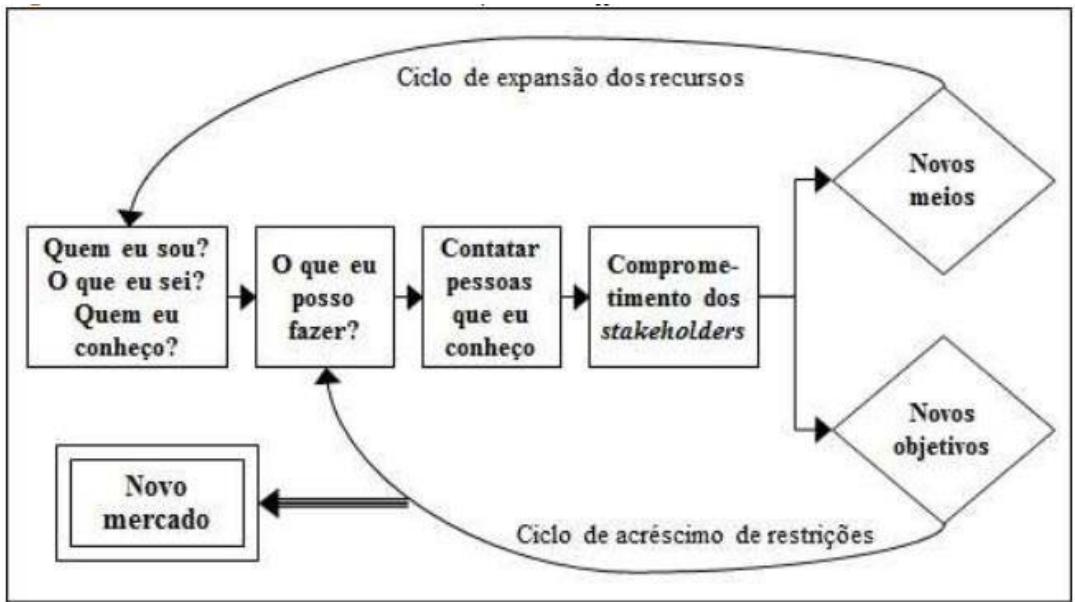 Figure 1: Effectuation Cycle
Source Adapted from Sarasvathy & Dew (2005) and Wiltbank, Dew, Read & Sarasvathy (2006) by Barros et al (2020)
According to Saravasthy (2008), there are five principles of effectuation logic:
The first one is the bird in hand principle. Experienced entrepreneurs start off thinking first about their identity (who they are), their knowledge (what they know) and their network (who they know), and then create possibilities with the resources available at the time.
The second one is the principle of tolerable losses, where successful entrepreneurs and their partners take calculated risks. They limit their risks by understanding what they are willing to lose at each stage of resource allocation.
The third one is the patchwork principle. In it, the formation of alliances with partners who share unique objectives reduces uncertainties through participation in entrepreneurial actions, consolidating a positive network of contacts.
The fourth principle is the one called lemonade, in which contingencies are seen as opportunities. Organizational learning must be treated as a dynamic capacity for strengthening and growth.
And the fifth principle is that of the airplane pilot, in which entrepreneurs work with the resources they can access and use them to achieve their goals, developing skills for managing the business in a dynamic and non-linear way.
### b) Cooperation and Co-opetition
In this 21st century, which started out turbulent and confusing, substantial changes have taken place in the market. Taking advantage of opportunities has been pursued through strategies that use dynamic capabilities as a way of gaining competitive advantage. The use of inter-company collaboration and cooperation has grown, providing better conditions for market performance. This combination of cooperation and competition is known as co-opetition. Given that the market is increasingly demanding efficiency, quality, win-win results, continuous learning, partnerships, synergy, among other aspects, this requires entrepreneurs to make radical changes to the traditional way of operating with synergistic collective results that generate sustainability for partners and superior delivery to the market.
For Dagnino & Padula (2002), co-opetition is a new conceptualization of the interdependence between organizations. There is a convergence of objectives and interests, giving shape to the "co-opetitive value creation" system.
The foundation of co-opetition lies in aligning different interests in favor of a common goal. To achieve this, interests and objectives must converge through relationships that seek to create opportunities to generate competitive advantages; not only that, but also to remove external obstacles and neutralize threats (Chin; Chan; Lam, 2008).
Since Brandenburger and Nalebuff's (1996) initial concept, co-opetition has evolved over time and with successful experiences, from a simple definition of 'competing + cooperating simultaneously', to a broad vision of a value network. In this evolution, issues such as the existence of congruent goals for opening up markets (Bengtsson & Kock, 2000) and the degree of interdependence between network participants (Luo, 2005) have been considered. Co-opetition is no longer treated as a behavior, but rather as a system or a management strategy (Dagnino, 2012). Nowadays, co-opetition is seen as the formation of a new paradigm (Della Corte & Aria, 2016).
Co-opetition uses competitive synergies to achieve more and better results, based on relationships, transparency and partnerships with customers, suppliers, competitors and complementors, as Nalebuff and Brandenburger (1996) described in their seminal work.
Santos & Cerdeira (2013), based on various other authors, describe that there may be conflicts between the parties involved; problems of integration, lack of trust, risk of dependency, incompatibility, lack of a spirit of cooperation and opportunism that breaks down trust between the participants, which hinders the development of copetition.
Ferreira (2010 apud Vitorino Filho et al, 2013) states that a relationship is the ability to relate to, live with or communicate with others through a bond of friendship, affection, professionalism, etc., conditioned by a series of reciprocal attitudes. Every day, more and more entrepreneurs and companies realize that this integration with partners - previously seen as competitors - expands their operations, their results and brings about more sustainable development.
In today's market, using and developing one's network of contacts is very important as it increases the power to achieve one's goals, do new business and win new clients and markets, as it creates better conditions for entrepreneurial action.
## III. METHODOLOGY
This research used the descriptive method, with a qualitative approach, relying on primary data collected through interviews with the target audience and secondary data obtained through published literature.
According to Prodanov (2013), descriptive research is one of the classifications of scientific research. Its objective is to describe the characteristics of a population, a phenomenon or an experience for the study carried out. It is up to the researcher to study, analyze, record and interpret the facts of the physical world, without manipulation or interference.
The approach used was qualitative because it is descriptive and does not require the use of statistical methods and techniques; plus, the researcher maintains direct contact with the environment and the object of the study.
As for the technical procedures, (Prodanov, 2013) says that depending on how we obtain the data needed to carry out the research, it is necessary to draw up a conceptual and operational model. Bibliographical research looked for published material, mostly books, magazines, periodicals and scientific articles. The aim was to put the researcher in direct contact with all the material previously written on the subject of the research. We used field research to obtain information and/or knowledge about a problem to which we were looking for an answer. To this end, data was collected for analysis, and the variables that were presumed to be relevant were recorded.
According to Prodanov (2013), data was collected directly from the source, and it was carried out between June 5th and 15th, 2023.
The target audience was made of food truck entrepreneurs located in the Parque das Laranjeiras food park, in Manaus, Brazil; interviews were conducted with the 09 managers and/or owners of the businesses located there.
The interview script was adapted from scripts previously used by other researchers, such as Prado et al (2020). The following questions were asked:
What were your goals when creating the company? What resources (financial, physical, knowledge, network) did you use? Did you do a research and/or a business plan before implementing? How did you go about implementing your business (planning)? Who are your key partners? What is your goal for the next 5 years?
## IV. RESULTS
The theoretical framework allowed us to analyze the entrepreneurs' responses and identify the use of effectuation logic and cooperation between key partners to achieve entrepreneurial objectives.
We identified the interviewees by ordinal numbers, six of whom were male, three female; every one of them have been in business for more than 2 years.
As for the objectives for setting up the company, two main factors were identified. The first one was related to the need to generate income to support oneself and family through a well-known activity that suited one's skills. The second factor was the opportunity to take advantage of a market demand, in line with the Global Entrepreneurship Monitor (GEM) classification (2019).
Interviewees 3, 8 and 9: "I was unemployed, and as I have always worked with food, I decided to set up the food truck."
Interviewee 7: "I was fired and used the funds from my severance pay to earn an income."
Interviewee 1, 2: "I was looking for something that would bring me greater fulfillment than my job in commerce, so I decided to set up the business."
Interviewee 4, 5, 6: "I was analyzing business possibilities and saw the demand for fast food here near the university."
As for the initial objectives, and drawing on the theory presented by Behling and Lenzi, (2019) the entrepreneurial opportunity is directly related to the possibility of meeting a market need through a creative combination of resources, to deliver superior value.
The resources used by the entrepreneurs came from two sources: their own resources, and from investments made by the state development agency (AFEAM).
With the exception of interviewee "7", all the others sought resources at AFEAM, under the guidance of friends or external consultants linked to the institution itself, or its partners.
All interviewees report that they collected information from friends and institutions that support new entrepreneurs, regarding both the viability of the business, as well as access to resources, and how to implement the venture. Searching for information allows the entrepreneur to know how the market behaves and what is necessary to transform an idea into a business opportunity, acting with greater security.
They also declared they maintain an open communication and partnership channel with their business partners located on site, whether supporting them with products and services or systematically analyzing the market. Everyone believes that they are partners in their inter-company actions, cooperating and competing in a respectful way. In addition, suppliers and employees of establishments are also considered partners.
Networking is fundamental so that the entrepreneur can not only install a business, but seek support to innovate and develop. As for the formal planning to implement the business and establish goals, everyone stated that they created a business plan both to meet the obligations of access to credit and to validate the idea and implement it. Planning is a fundamental tool to allow entrepreneurs to take risks in a calculated way, by evaluating alternatives and ideas.
Half of the respondents want to open a branch within 5 years; two of them want to increase their current offer; and other two were not able to predict it. Entrepreneurs are characterized for knowing what they want and acting on how to accomplish it. Goals are the driving force that transforms the "status quo" and motivates the accomplishment of goals.
## V. CONCLUSIONS
In order to contribute to the understanding of the topic and seeking to be a starting point for future studies and applications by entrepreneurs and their scholars, we sought to answer the following problem: How does the development of the contact network contribute to entrepreneurs, considering effectuation logic and cooperation?
Defined by Saravasthy, the effectuation logic can be confirmed in the present study. In it, the entrepreneur uses the means under his control to make his idea a reality, and thinks about the objectives and means of support as inter-organizational partnerships.
It seems that the capacity for relationships and partnerships favors not only the implementation of the business, but also its operationalization, as data shows there is support between competitors installed in the same location and competing in meeting the same needs of customers, which is food.
The definition of challenging goals linked to the development, growth and innovation of business motivates entrepreneurs to act in the search for achievement.
To achieve these goals, planning actions and taking calculated risks is essential for greater efficiency, making use of contact networks, to seek information in partnership and thus take advantage of the opportunities that the market demands. Therefore, it is essential that entrepreneurs know and take advantage of their own and their partners' capabilities, in order to achieve better qualitative and quantitative results in a synergistic way.
This study leaves a provocation for delving deeper into the topic, as well as expanding the number of participants in new studies, so that correlations can be made between different sectors, thus expanding the study group. The group studied has a small number due to accessibility, despite a census being carried out among entrepreneurs in a specific area in a neighborhood of Manaus, Brazil.
Generating HTML Viewer...
References
20 Cites in Article
Gustavo Behling,Fernando Lenzi,Cézar (2019). Oportunidades empreendedoras: do paradigma à operacionalização.
Anailde Cerqueira,; Santos,Daisy Santos,Lima De Souza (2020). Empreendedorismo à luz do effectuation: um estudo com mulheres empreendedoras.
Giovanni Dagnino,Giovanna Padula (2002). Coopetition Strategy: a new kind of interfirm dynamics for value creation.
Andreza Drumond,Batinga Capelo Cândido,Georgiana Luna (2020). Anais do(a) Encontro Internacional de Gestão, Desenvolvimento e Inovação (EIGEDIN).
André Garcia,Daniela Andrade (1990). O campo de pesquisas do empreendedorismo.
Aercio De Oliveira (2019). Porto Maravilha: alegoria de um Brasil em desencontro com o Brasil.
Robert Hisrich,Michael Peters,Dean Shepherd (2014). Empreendedorismo.
Talita Leucz,Tales Andreassi O processo decisório e o uso das lógicas effectuation e causation, frente à transição da pequena para a média empresa: casos do setor hoteleiro na cidade de Curitiba-PR.
Everton Moreira,Juliana Silveira,Vinícius Maeta,Eliana Adami,Rosana Ogoshi (2021). Desenvolvimento regional e empreendedorismo: percepções dos atores locais de transformação.
B Nalebuff,A Brandenburger,Coopetição (1996). Rocco.
Heidi Neck,Christopher Neck,Emma Murray (2018). Entrepreneurship: the practice and mindset.
Renata Prado,Liliane Ayala,Marcelo Pedroso (2020). Tomada de decisão estratégica para empreendedores: uma aplicação da abordagem effectuation / Strategic decision making for entrepreneurships: an application of the effectuation approach.
Cléber Prodanov,Ernani Freitas,César De (2013). Metodologia do trabalho científico, métodos e técnicas de pesquisa e do trabalho acadêmico.
Sara Santos,Cerdeira,P José (2013). Estratégias de coopetição em Portugal: O contributo dos polos e clusters de empresas.
S Sarasvathy (2001). Causation and Effectuation: Towards a theoretical shift from economic inevitability to entrepreneurial contingency.
P Sharma,C Salvato (2011). Commentary: exploiting and exploring new opportunities over life cycle stages of family firms.
Jorge Verschoore,Alsones Balestrin (2008). Fatores relevantes para o estabelecimento de redes de cooperação entre empresas do Rio Grande do Sul.
Valdir Vitorino Filho,Eliciane Silva,João Camargo Júnior,Silvio Pires (2013). Identificação dos Principais Autores em Coopetição.
Emerson Zotti,Giuliano Derrosso (2017). EMPREENDEDORISMO E EFFECTUATION: UM ESTUDO SOBRE OS EMPREENDEDORES DE SUCESSO NO SETOR DO COMÉRCIO DE FOZ DO IGUAÇU.
Explore published articles in an immersive Augmented Reality environment. Our platform converts research papers into interactive 3D books, allowing readers to view and interact with content using AR and VR compatible devices.
Your published article is automatically converted into a realistic 3D book. Flip through pages and read research papers in a more engaging and interactive format.
Considering that entrepreneurship has been consolidated in Brazil and around the world, it is essential to understand how decisions to undertake have been made in the face of competitive evolution. This work aims to understand the entrepreneurial logic of effectuation for the development of cooperation as a strategy for adding value and competitive advantage. In this way, the present work seeks to present theories about the logic of effectuation and cooperation to relate them to the entrepreneurial action presented in the Global Entrepreneurship Monitor survey (GEM), 2022. The methodological approach of the research was qualitative, field and bibliographical; it enabled the concepts studied to be identified and analyzed. A census was conducted with entrepreneurs located in a food truck plaza in Parque das Laranjeiras neighborhood, in Manaus, Brazil. Perceived as an original gap, this absence inspired the writing of this article. To this end, we adopted a mixed-methods approach and exploratory-descriptive research. The results identified show that entrepreneurs use the effectuation logic, valuing their entrepreneurial action characteristics.
Our website is actively being updated, and changes may occur frequently. Please clear your browser cache if needed. For feedback or error reporting, please email [email protected]
Thank you for connecting with us. We will respond to you shortly.