Summery-The assessment of the educational project has occupied the researchers of educational evaluation in the last decades in general education as well as in special education. The necessity of teacher evaluation is aimed at their professional improvement and the qualitative upgrading of their role in the context of co-education (parallel support and integration of departments) of children with Special Educational Needs (SEN) in the general school. The aim of this research proposal is to investigate the attitudes of teachers towards the evaluation of their work in the context of co-education of students with SEN and without SEN, but also to establish the relationship that exists between the evaluation and the improvement of their educational work.
## I. INTRODUCTION
In recent years, special education in public education has been implemented in a scientific and organized manner, while it has now become mandatory according to law 3699/2008. As it follows from this law on special education, the difference between students with Special Educational Needs (SEN) and students without SEN. in a normal school it is found in the existence of a serious learning difficulty or some psychopathology or motor difficulty on the part of the students (Aθανασιάδης, 2001). This results in the emotional load and pressure that special education teachers receive being intense. The degree of responsibility they have is great given that special education students are often unable to perceive dangers and protect themselves. This means that the teacher is constantly alert and ready (Kοσμίδω, 2005). Of course, teachers who have to face such difficulties, the question arises as to whether they have training in this subject. Now that special education has begun to develop in our country, there is a question of organizing and improving the effectiveness of the education of these individuals and the characteristics of educational practice (Νούτοσς, 2001; Adams et al., 2016). The present research is part of this effort, which seeks to investigate the attitudes of teachers towards the evaluation of their work and to find the relationship that exists between the evaluation of the educational work and its improvement.
The purpose of the research is to investigate the attitudes of special education teachers towards the evaluation of their educational work, and also to investigate the relationship that exists between the evaluation and the improvement of their educational work in the context of the co-education of students with and without SEN.
The research questions of this research are:
A) What is the attitude of the teachers regarding the evaluation of their educational work (Positive - Negative)?
B) What is the relationship between the evaluation of teachers' work and the improvement of their educational work in a class with students with SEN?
The educational research of the last decades has highlighted the need for the co-education of students with SEN in the general school together with the other children, giving the possibility to smoothly integrate these children into the school community (Voros, 2000). This position leads to the view that the work of teachers with students with SEN in the general school it is charged with a more complex role, which makes the need for evaluation imperative in the educational work. From the review of the literature, it was found that there are researches related to this topic which, however, do not cover several aspects of the topic, so it is considered appropriate to investigate the teachers' attitudes towards the evaluation and also the possibility of improving the project through the evaluation (Δημιτρόπουλος, 1999; Ευσταθίου, 2018).
Through the evaluation of the educational work, it is sought to make judgments and findings about the functioning of the educational process, educational policy, educational programs, school textbooks, the teacher and the student. In this sense, assessment is part of the whole of education. Research results show that the implementation of evaluation leads to an improvement in the quality of their work, to changes and innovations, to feedback, self-awareness and responsibility of teachers (Δημιπρόπουλος, 1999; Ευσταθίου, 2018). We also find the achievement of students, the highlighting of teachers' weaknesses and their support in educational programs, enhancing the professional prestige, the quality of the work and the effectiveness of the educational system (Βωρός, 2000; Adams et al., 2016).
This study will explore teachers' attitudes towards assessment. In particular, it will study the positive and negative attitudes, feelings and behaviors of teachers for evaluation. A second element he will study is the relationship between evaluation and improvement. Specifically, we will emphasize the quality of the educational work, the personal and professional development of the teacher, the strengthening of the pedagogical relationship between teachers and students with SEN, the highlighting of mistakes and weaknesses and their treatment, as well as the development of a climate of mutual respect and trust in the classroom, but also the help of students with SEN to the right to education and participation in the school community as equal members.
## II. THEORETICAL PART
### a) Literature review
The attitudes that teachers have towards the evaluation of their work in relation to the teaching of children with SEN. in a regular school, they split into two directions. One direction is positive and the other is negative. The evaluation affects the functioning of the education in terms of the quality of the project, the difficulty of achieving the educational goals for the two categories of children and their training in special education, the personal and professional development of the teacher, the strengthening of the pedagogical relationship, the marking of weaknesses and mistakes and an effort to eliminate them, as well as the development of a climate of mutual respect and trust of teachers and students with or without SEN.
The attitudes of teachers towards assessment has occupied the educational community for decades, especially in the sensitive part of education which is special education. In most European countries, the quality and evaluation of educational work are considered as two interdependent concepts and as a basis for educational practices (Angelidis, 2004). It is a parameter that controls the reliability of the educational system, planning, organization, operation of schools, the effectiveness of educational planning and the implementation of educational policies.
Evaluation has been applied in recent decades in many European countries with the aim of improving the quality of educational work through the activation and conscious functioning of teachers (Zovyavéλης et al., 2007). In this way, the school unit creates conditions for innovations, reconstruction and formation of educational practices.
The evaluation of the educational project has a systemic character, since it is directly related to all aspects of education. Research reports that assessment has a feedback role contributing to the improvement of teaching practice, to the understanding of weaknesses, needs and motivations for self-improvement (Δούκας,
1999). The necessity of the evaluation can be seen from official institutional frameworks such as the law 2986/2002, through which it tries to find application and ways of implementation in educational practice, in the context of the co-education of children with SEN. in regular school.
The educational work concerns the result of the teaching work and the products of the educational system. Teaching tools, equipment, teaching methods, all actions and efforts of the teacher creating a pedagogical relationship with all students are approached through the provision of evaluation with the aim of improving them (Mπαγάκης, 1999).
From the institutional framework 3699/2008 we can establish the mandatory implementation of the co-education of students with SEN in a general school for primary and secondary education, but also for the more general education of children with special needs from the Special Vocational Education and Training Laboratories and the Diagnostic and Counseling Support Centers. In this way, educational services are provided to students with disabilities and identified educational needs from a team of various specialties (Kapayiavn, 2018).
From the research results, it appears that teachers are suspicious and skeptical of the institution of evaluation. This arises because of the lack of meritocracy that exists in the administration, by whom and how the evaluation will be done. The teachers' attitudes and feelings appear as pressure, stress and control of the educational work, having to deal with both cases of children. It limits pedagogical freedom leading to a reduced performance of their work (Avópéov, 2003).
The improvement of educational work through assessment is commonly accepted by many researches. Specifically, it contributes to the quality of the project, to personal and professional development, providing the opportunity to deal with other aspects of education, such as special education (Bερεβή, 2003). It strengthens relationships of trust and respect among the actors of the educational community, identifying weaknesses and mistakes, thereby creating conditions for improvement (Bερεβή, 2003). With the evaluation, teachers will become aware of the functions of education and their role, cultivating co-responsibility and self-commitment, giving the possibility for a smooth and fair education for children with SEN (Καραγιάνη, 2018).
The synthesis of the results of other research shows the suspicious attitude of teachers towards assessment. In the work of Xαδεμενακου (2005) we find that the evaluation is important because in this way we will discover the personal criteria that each teacher has for the evaluation and through them we will be able to understand how he accepts the plans for its implementation. Although it is legally institutionalized (2986/2002), in the last 3 decades no evaluation has been done at the two levels of education and the teachers have no experience of evaluation programs.
After evaluating students and the education system, teachers should also be evaluated. The teachers' attitudes towards this process have two directions. The first appears to be positive from the teachers' point of view, considering that evaluation is the means that ensures meritocracy, activates all the factors of the educational community, cultivates the climate of mutual respect and trust (Aγιακλή, 2003). It shows the educational hierarchy in a specific way as well as the fields of interventions. According to Aθανασιδη (2001) "... evaluation works as a motivation for improvement for teachers" (p. 146). It leads to the discovery of real needs of the teacher and can form the basis of their work in this difficult part of special education education. Through evaluation, the teacher can assume his share of responsibility, while at the same time the possibility of offering adequate educational services is ensured (Καρατζά - Σταυλίωτη, 1999;Καραγίαννη, 2014).
The second direction concerns the teachers' negative attitudes and criticisms of the assessment. Many consider that evaluation is the means that exerts stress, pressure, limits the pedagogical freedom of the teacher, leading the teaching work to a reduced performance, taking into account the difficulties of students with SEN (Xαιδεμενάκου, 2005). Still, there is the fear of the non-meritorious and objective criteria of those who will be chosen to evaluate (Μαυρογιώργος, 2002; Στασινός, 2020). Another element that has been criticized is the dependency relationships created between evaluators and teachers affecting the educational community and creating conditions of stress. The definition of the criteria combined with the lack of dialogue makes teachers cautious (Zούγανέλης et al., 2007). A landscape of doubt and suspicion is created for their assessment.
Regarding the relationship between evaluation and project improvement, research shows that the role of evaluation is important. Evaluation contributes to upgrading and improving the quality of the educational process. In this way, changes and innovations are promoted, the feedback and self-awareness of teachers is strengthened (Πασιαρδής, 1994). The development of teachers' responsibility and initiative strengthens their pedagogical freedom and improves the performance of students with or without SEN.
The possibility of pointing out and correcting mistakes, weaknesses and shortcomings of the teacher will contribute to the development of a climate of trust, cooperation and mutual respect between students and teachers and will lay the foundations for a proper pedagogical relationship (Παπασταμάτης, 2001; Kapαγιάννη, 2014). Finally, it strengthens the mobilization of teachers' interest in school matters, resulting in their systematic work, their active participation and taking initiatives for planning the educational work within the school community (Bερεβή, 2003).
We appreciate that if the teachers, the education officials and all the actors of the educational community want it, considering that this is an integral element of their work, they can contribute so that the evaluation acquires the form of a fruitful process, thus activating all its actors educational community and highlighting designs that will open new fields in special education.
## III. METHODOLOGY
The present study is a descriptive review of teacher evaluation in the context of collaborative learning. We will investigate the positions of the teachers for the evaluation of their educational work.
### a) Data analysis - results
## i. Objectives
As previously mentioned, the main objective of this work is to determine the intervention of the evaluation of teachers with the aim of improving their educational work, as well as the investigation of the positions of teachers in relation to the evaluation of their work in the context of the co-education of students with special educational needs and without special educational needs, but also to establish the relationship between the evaluation and the improvement of their educational work.
- to establish the advantages and disadvantages of the educational project through the evaluation.
- to offer feedback to teachers.
- to take the form of a fruitful process thus activating all the actors of the educational community and highlighting designs that will open new fields in special education.
Based on the above objectives, the hypotheses are as follows:
Hypothesis 1: Teachers emphasize the need to implement the evaluation of the educational project.
Hypothesis 2: The support of the educational process through evaluation is a factor that contributes to the improvement of the educational work.
Hypothesis 3: The implementation of the evaluation does not limit the pedagogical freedom of the teacher.
## ii. Sample
The sample, for the present research question, consisted of secondary general education teachers in a provincial town in the Peloponnese, in Greece. 50 teachers participated, 10 men and 40 women with experience in special education, 30 teachers from all over the world. Finally, teachers have a bachelor's degree, a smaller proportion have a master's degree, and none have a doctorate.
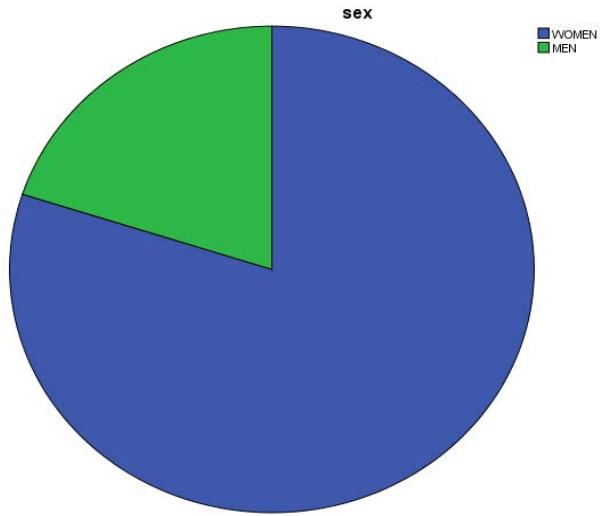
1. Sample distribution according to sex
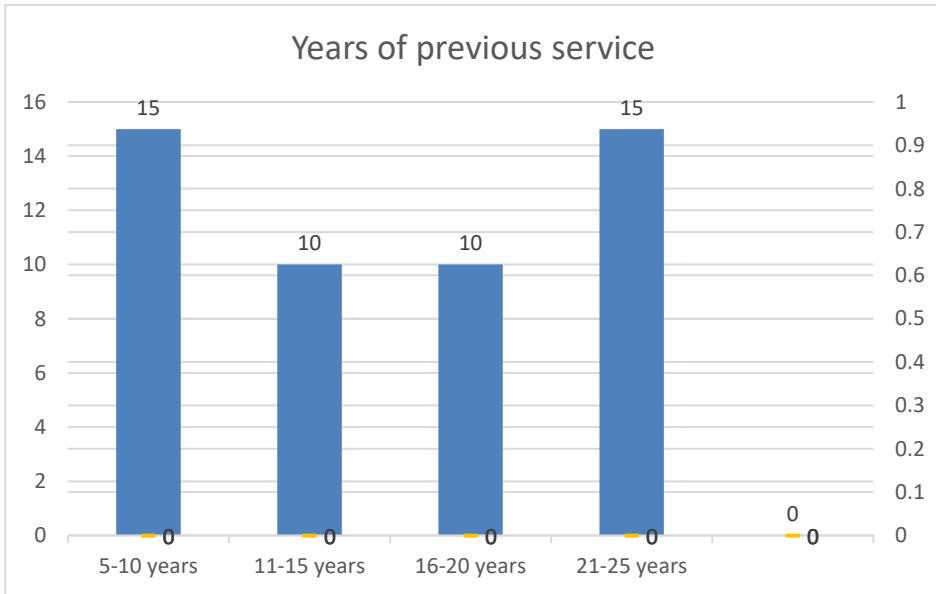
2. Sample distribution according to years of previous servise
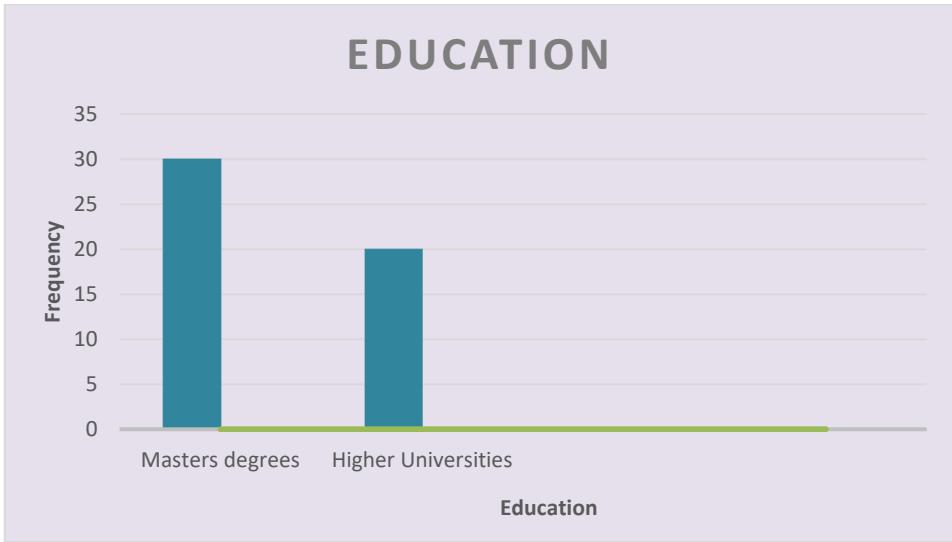
3. Sample distribution according to education
## iii. Instrument
For the research question we select the questionnaire with which we will collect the information that will be given to us by the respondents. Questions will be closed-ended and individuals will be asked to answer by selecting a number from the five. Completing, encoding and analyzing data will be easier. Also, with the questionnaire, subjects are given the opportunity to answer all in exactly the same frame of reference. Participants were asked to complete an anonymous questionnaire that included 10 closed-ended questions from which teachers were asked to choose one of the suggested options. The questionnaire refers to teachers' views towards the evaluation of their educational work and What is the relationship between the evaluation of the teachers' work and the improvement of their educational work in a class with students with special educational needs. The time required to complete it was 15 minutes and it was completed at the end of the course. The questionnaire is listed at the end of the text.
The type of questions will be of the closed type and will be the scale graded from the negative point to the positive and will be asked by the subject of the survey to choose one of the five.
## iv. Procedure
The method of questioning will be done by visiting the researcher in a group of people, that is, at school. So, we seek to involve many people in the research in a minimum of time and at the same time. We also have the possibility of clarification and more information to solve questions that may arise during the completion of the questionnaire.
## v. Analyses conducted
### Data analysis:
The analysis of the data was descriptive to see the frequency in the teachers' answers and the percentage in each answer.
The following analytical tests were conducted with the SPSS (v.23) statistics package:
- A descriptive study of all the items in the questionnaire (measures of centrality - mean), and dispersion (standard deviation).
- A descriptive study of all the items in the questionnaire (measures of centrality -mean), and dispersion (standard deviation).
- An analysis of variance to verify the existence of a relationship between the 3 dimensions of the questionnaire and the independent variables: gender, and academic year.
- The relation between the dimensions that comprised the questionnaire were verified with bivariate correlations.
- ANOVA, t-test, post-hoc analysis was performed.
The Pearson Ratio was calculated, as well as Cronbach's Alpha, to show reliability.
## IV. RESULTS
### a) Descriptive study
Initially, the following tables give a picture of gender, studies, previous service in general and special school and the participation of teachers in training programs.
Table 1: Distribution of a sample based on gender and on the qualifications.
<table><tr><td colspan="2"></td><td>Frequency</td><td>Percent</td><td>Valid Percent</td><td>Cumulative Percent</td></tr><tr><td rowspan="3">Valid</td><td>WOMEN</td><td>40</td><td>80,0</td><td>80,0</td><td>80,0</td></tr><tr><td>MEN</td><td>10</td><td>20,0</td><td>20,0</td><td>100,0</td></tr><tr><td>Total</td><td>50</td><td>100,0</td><td>100,0</td><td></td></tr></table>
Specifically, the percentage of men is $20\%$ and of women $80\%$ (Table 1). The qualifications are $100\%$ Higher Education Institutions and $0\%$ Technological Institutions (Table 1).
Table 2: Sample distribution based on the master's degree and doctoral details.
<table><tr><td colspan="2"></td><td>Frequency</td><td>Percent</td><td>Valid Percent</td><td>Cumulative Percent</td></tr><tr><td rowspan="3">Valid</td><td>Masters Degrees</td><td>30</td><td>60,0</td><td>60,0</td><td>60,0</td></tr><tr><td>Higher Universities</td><td>20</td><td>40,0</td><td>40,0</td><td>100,0</td></tr><tr><td>Total</td><td>50</td><td>100,0</td><td>100,0</td><td></td></tr></table>
From the data we have gathered we can see that a large part of the sample has not done postgraduate studies. Specifically, the $31.5\%$ of teachers hold a master's degree, while $6.5\%$ have not done postgraduate studies (Table 2). Regarding the answer for obtaining a doctorate, we find that none of the respondents in the sample have a doctorate. According to the data we collected we find that $100\%$ have not completed doctoral studies (Table 2).
Table 3: Distribution of a sample based on teaching experience in general schools.
<table><tr><td colspan="2"></td><td>Frequency</td><td>Percent</td><td>Valid Percent</td><td>Cumulative Percent</td></tr><tr><td rowspan="5">Valid</td><td>5-10 years</td><td>15</td><td>30,0</td><td>30,0</td><td>30,0</td></tr><tr><td>11-15 years</td><td>10</td><td>20,0</td><td>20,0</td><td>50,0</td></tr><tr><td>16-20 years</td><td>10</td><td>20,0</td><td>20,0</td><td>70,0</td></tr><tr><td>21-25 years</td><td>15</td><td>30,0</td><td>30,0</td><td>100,0</td></tr><tr><td>Total</td><td>50</td><td>100,0</td><td>100,0</td><td></td></tr></table>
Regarding the years of previous service in the general school, we can find that from 5-10 years the percentage is $30\%$, from 11-15 years the percentage is
20%, from 16-20 years 20% and from 21-25 25% (Table 3).
Table 4: Sample distribution based on teaching experience in special schools.
<table><tr><td colspan="2"></td><td>Frequency</td><td>Percent</td><td>Valid Percent</td><td>Cumulative Percent</td></tr><tr><td rowspan="3">Valid</td><td>1-5 years of experience</td><td>45</td><td>90,0</td><td>90,0</td><td>90,0</td></tr><tr><td>no experience</td><td>5</td><td>10,0</td><td>10,0</td><td>100,0</td></tr><tr><td>Total</td><td>50</td><td>100,0</td><td>100,0</td><td></td></tr></table>
According to Table 4, we find that several teachers have worked in special schools. Thus, the percentage of experience in special education ranges from 1-5 years, $90\%$ of the sample seems to have experience in special education (Table 4).
Table 5: Sample distribution based on special education training.
<table><tr><td>Sex Questions</td><td>Men</td><td>Total</td><td>Women</td><td>Total</td><td>Total</td></tr><tr><td>Yes</td><td>0</td><td>0%</td><td>0</td><td>0%</td><td>0%</td></tr><tr><td>No</td><td>0</td><td>0%</td><td>0</td><td>100%</td><td>100%</td></tr><tr><td>Total</td><td>10</td><td>0%</td><td>40</td><td>100%</td><td>100%</td></tr></table>
In this table we can see that the $100\%$ have not attended training seminars in use of Social Welfare Robots in children with autism (Table 5).
#### 4. Sample distribution according to the teachers' answers
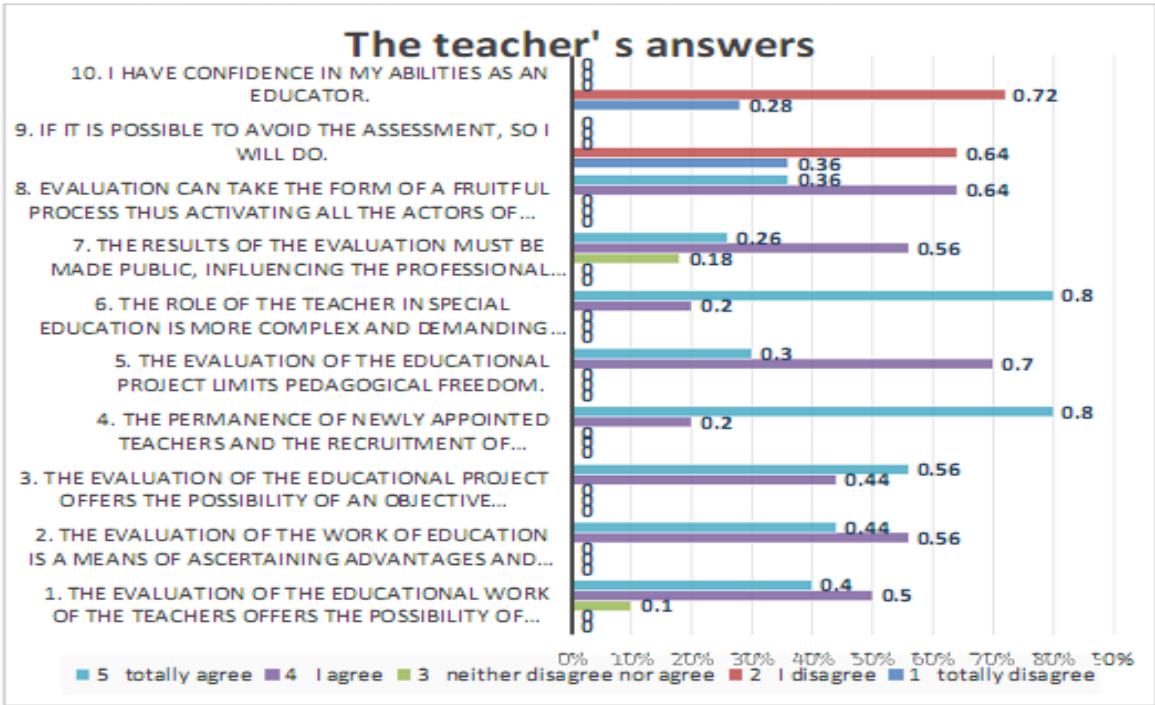
In this section, a descriptive analysis of the answers given to all teachers will be presented for each question. Each question is given a table with the teachers' answers in descending order.
To the question 1 «The evaluation of the educational work of the Teachers offers the possibility of feedback to the teachers », we find that $50\%$ of teachers that they agree, the $40\%$ that they totally agree and the $10\%$ that they neither disagree nor agree. There is no answer to the totally disagree and I disagree (percent $0\%$ ).
To the question 2 « The evaluation of the work of education is a means of ascertaining advantages and disadvantages of the educational system », most of the teachers in the sample at $56\%$ agree, 22 teachers with $44\%$ totally agree. There is no answer to the neither disagree nor agree, totally disagree and I disagree (percentage $0\%$ ).
To the question 3 « The evaluation of the educational project offers the possibility of an objective assessment of the educational project », the choice "totally agree" of 28 teachers at a rate of $56\%$ prevails, followed by the option "agree" with 22 teachers at a rate of $44\%$. No answer is given to the options neither disagree nor agree, totally disagree and I disagree (percentage $0\%$ ).
To the question 4 « The permanence of newly appointed teachers and the recruitment of substitutes must be linked to the results of the evaluation », $80\%$ of teachers 40 of the total prefer the "totally agree", while 10 teachers, the $20\%$, shows preference in answer "I agree". No answer is given to the options "neither disagree nor agree", "totally disagree" and "I disagree" (percentage $0\%$ ).
To the question 5 « The evaluation of the educational project limits pedagogical freedom» the preference of 35 teachers reaches $70\%$ in the "I agree", while "totally agree" is preferred by 15 teachers in $30\%$. The options "neither disagree nor agree", "totally disagree" and "I disagree" are not selected $(0\%)$.
To the question 6 « The role of the teacher in special education is more complex and demanding than in general education » out of 50 teachers, 40 prefer the answer about of "Totally agree" $80\%$, while 10 of the total prefer "I agree" at a rate of $20\%$. The options "neither disagree nor agree", "totally disagree" and "I disagree" are not selected $(0\%)$.
To the question 7 « The results of the evaluation must be made public, influencing the professional development of teachers » most of the teachers in the sample at $56\%$ prefer the answer "I agree", the sample at $26\%$ state that the "totally agree", while the $18\%$ state that the "neither disagree nor agree". No answer is given to the option that "totally disagree" and "I disagree" (percentage $0\%$ ).
To the question $8 \ll$ Evaluation can take the form of a fruitful process thus activating all the actors of the educational community and highlighting designs that will open new fields in special education $\times$ most of the teachers in the sample at $64\%$ prefer the answer "I agree" and the $36\%$ state of the "totally agree". The options "neither disagree nor agree", "totally disagree" and "I disagree" are not selected (0%).
To the question 9 « If it is possible to avoid the assessment, so I will do » the choice "I disagree" of 32 teachers at a rate of $64\%$ prevails, followed by the option "totally disagree" with 18 teachers at a rate of $36\%$. No answer is given to the options "neither disagree nor agree", "I agree" and "totally agree" $(0\%)$.
To the question 10 « I have confidence in my abilities as an Educator » we can see that the out of 50 teachers, 36 prefer "I disagree" in percentage $72\%$, While 14 of the total prefer "totally disagree" at a rate of $28\%$. No answer is given to the options "neither disagree nor agree", "I agree" and "totally agree" $(0\%)$.
#### Pearson's Correlation Coefficient
The Pearson Correlation Coefficient is a numerical measure or indicator of the magnitude of the correlation between two sets of values. Correlation tests explain whether and to what extent changes in one variable are related to changes in another variable. (Gnardellis, 2009) The correlation coefficient (effect) of the examined variables is $r(50) = 0.000$, so there is a positive correlation between the variables. This means that the scale The evaluation of the educational work of the Teachers offers the possibility of feedback to the teachers correlates with the scale The evaluation of the educational project offers the possibility of an objective assessment of the educational project. The significance level is less than 0.001, so the significance level $p < 0.001$, an association is observed. $(r(50) = 0.000, df = 50, p < 0.001)$.
#### ANOVA
In order to check whether the mean values of a quantitative variable differ between the categories of a qualitative variable, when it has more than two categories, you use One-Way ANOVA. The Levene Test of Equality of Error Variances shows whether the variances are equal, in this case for the scale The evaluation of the educational work of the Teachers offers the possibility of feedback to the teachers and the teachers' seniority, it gives the level of significance $p < 0.05$. Consequently, it is true that there is a significant difference between the dispersions. While from the ANOVA table there is a statistically significant effect between the variables, $p = 0.000 < 0.05$.
The Levene Test of Equality of Error Variances shows whether the variances are equal, in this case for the scale The evaluation of the work of education is a means of ascertaining advantages and disadvantages of the educational system and the teachers' seniority, gives the level of significance $p < 0.05$. Consequently, it is true that there is a significant difference between the dispersion. While from the ANOVA table there is a statistically significant effect between the variables, $p = 0.000 < 0.05$.
In the post hoc table, it is observed that in both the 2 analyzed likert categories, it is observed that they are significantly correlated with p-value $= 0.000 < 0.005$ in the years 5-10 and 21-25 years.
Comparing the question concerning The role of the teacher in special education is more complex and demanding than in general education, the Likert scale was used to record the opinions, with high values corresponding to disagreement and low values to agreement (this results from the arbitrary coding that we gave) in relation to gender. The first table contains the averages and standard deviations of the values of the dependent variable of the two groups (men-women). In the second table the first row refers to the Levene test for equality of variances. Depending on the significance value of this test we accept the assumption of equal variances or not (here the power of the assumption of equal variances is 0.000, less than 0.05 so we do not accept that the variances are equal. Therefore we check the significance of the t-test in first line. Also, it was observed that there is no statistical significant relationship, as shown in the tables P-value= $0.080 > 0.05$, so they are not significantly correlated with each other.
The correlation coefficient (effect) of the examined variables is $r(50) = 0.000$, so there is a positive correlation between the variables. This means that the scale $<<$ more time should be devoted to children with autism in the school curriculum playing with the robot $>>$ correlates with the scale of question 7. The level of significance is less than 0.001, so the level of significance $p < 0.001$, correlation is observed. $r(50) = 0.000$, $df = 50$, $p < 0.001$.
The correlation coefficient (effect) of the examined variables is $r(50) = 0.000$, so there is a positive correlation between the variables. This means that the scale of question 9 is correlated with the scale of question 10. The significance level is less than 0.001, so the significance level $p < 0.001$, a correlation is observed. $r(50) = 0.000$, $df = 50$, $p < 0.001$.
Comparing questions 9 and 10 regarding which the Likert scale was used to record opinions, with high values corresponding to disagreement and low values to agreement (this results from the arbitrary coding we gave) in relation to the level of education. The first table contains the averages and standard deviations of the values of the dependent variable of the two groups (men-women). In the second table the first row refers to the Levene test for equality of variances. Depending on the significance value of this test we accept the assumption of equal variances or not (here the power of the assumption of equal variances is 0.000, less than 0.05 so we do not accept that the variances are equal. Therefore we check the significance of the t-test in first line. Also, it was observed that there is a statistical significant relationship, as shown in the tables P-value=0.000<0.05, so they are significantly correlated with each other.
To calculate the reliability of the questionnaire, the Cronbach Alpha coefficient was examined, which studies the degree of internal consistency in which all the elements of a cumulative scale measure the same product, i.e. whether the specific questionnaire can be used as a tool for measuring the goals for which it was created. (Gnardellis, 2009) The reliability of the scale regarding questions 7, 8, 9 and 10 was calculated by the Cronbach alpha coefficient. From the Reliability Statistics table we have that Cronbach's coefficient is satisfactory (0.874). So the 4 questions of the questionnaire satisfactorily compose a scale.
## V. CONCLUSIONS
One of the most important effects received by education in the last decades has been the demand for inclusion, integration and co-education of children with special needs in the usual educational processes. Nowadays, the dominant view is that the school and the teacher have the obligation to educate all children with or without learning difficulties together. The acceptance of this point of view led to an evolution of education programs in the common school and their co-education in the same classes as children of their age. Participation in education is a democratic process.
The success of the institution of inclusive education depends on many and important factors: among them are the needs of students with SEN and disabilities, the parents of children with and without SEN and disabilities, the logistical infrastructure and others. However, one of the most important factors for the success or failure of the co-education of children with and without SEN and disability has been proven to be the role of the teacher's attitude, because this can influence the students in his class, colleagues, parents (Hegarthy, 1994; $\Sigma \tau \alpha \sigma \iota \nu \acute{\circ} \varsigma$, 2020). The issue of teachers' perceptions of co-education was and is the subject of intense reflection and has been systematically investigated by many researchers. Both positive and negative views of teachers on co-education are an important research topic and it is widely accepted that the successful implementation of co-education presupposes the positive attitude of teachers towards it (Avramidis & Norwich 2002:129). Positive attitudes of teachers can lead to a more positive approach to teaching students with disabilities or special educational needs in mainstream school (Jansma, & French, 1994). The differentiation that takes place in an inclusive context aims to benefit all students as well as the quality of the teaching practice. It requires teachers to reflect both on the knowledge they provide to students and on the very process of constructing knowledge (Zóviou - Σερη et al., 2004).
From the results of the research, it appears that teachers are suspicious and skeptical of the institution of evaluation. This arises because of the lack of meritocracy that exists in the administration, by whom and how the evaluation will be done. The teachers' attitudes and feelings appear as pressure, stress and control of the educational work, having to deal with both cases of children. It limits pedagogical freedom leading to a reduced performance of their work.
The teachers' attitudes towards this process have two directions. The first appears to be positive from the teachers' point of view, considering that evaluation is the means that ensures meritocracy, activates all the factors of the educational community, cultivates the climate of mutual respect and trust (Aγιακλή, 2003). It shows the educational hierarchy in a specific way as well as the fields of interventions, the evaluation works as a motivation for improvement for teachers. It leads to the discovery of real needs of the teacher and can form the basis of their work in this difficult part of special education education. Through evaluation, the teacher can assume his share of responsibility, while at the same time the possibility of offering adequate educational services is ensured (Καρατζία - Στανλιώτη, 1999).
The second direction concerns the teachers' negative attitudes and criticisms of the assessment. Many consider that evaluation is the means that exerts stress, pressure, limits the pedagogical freedom of the teacher, leading the teaching work to a reduced performance, taking into account the difficulties of students with SEN (Xauδεμενακον, 2005). Still, there is the fear of the non-meritorious and objective criteria of those who will be chosen to evaluate (Mauρογιώργος, 2002). Another element that has been criticized is the dependency relationships created between evaluators and teachers affecting the educational community and creating conditions of stress. The definition of the criteria combined with the lack of dialogue makes teachers cautious (Zouγανέλης, et al., 2007). A landscape of doubt and suspicion is created for their assessment.
BIBLIOGRAPHICAL REFERENCES
1. Aγγελίδης, Π. (2004) O ρόλος των σκιαγραφήσεων στη βελτίωση των σχολείων, Eπιστήμες της Αγωγής, 2, 45-58.
2. Aγιακλή, X. (2003) Αξιολόγηση: Eλεγκτική Διαδικασία ἡουσιαστική λειτουργία, Aspects, 72, 41-43.
3. Adams, D., Harris, A. & Jones, M.S. (2016). Teacher-Parent Collaboration for an Inclusive Classroom: Success for Every Child, Malaysian Online Journal of Educational Sciences, Vol. 4, No. 3, pp. 58-72.
4. Aθανασιδης, X. (2001), Ta εκπαιδευτία συνδικάτα και η αξιολόγηση των εκπαιδευτικών 1982-2000. Στο Γ., Mπayáκης (επμ. εκδ.) Aξιολόγηση εκπαιδευτικών προγραμμάτων και σχολείου (σ.146-153). Aθήνα: Μεταιχμύ.
5. Avdpéou, A. (2003) Táosεις και προσεγγίσεις για την αξιωλόγηση στην εκπαιδευση, H λέοχη των εκπαιδευτικόν, 30, 20-23.
6. Bερεβή, A. (2003) H συμβολή του εκπαιδεντικόν στην αξιολόγηση και βελτίωση του εκπαιδεντικόν του εργου, H λέσχη των εκπαιδεντικών, 30, 23-26.
7. Bwpoc, $\Phi$ (2000) Axioloyon $\tau \eta \varsigma$ aioyon $\sigma \eta \nu$ EKaiδvOn, Dlooyk, 70, 66-67.
8. Λημητρόπουλος, E. (1999), ἐκπαιδεντική Aξιολόγηση - H Aξιολόγηση της εκπαιδενσης και τοῦ εκπαιδεντικόν ἐργούν. Αθήνα: Γρηγόρης.
9. Oókac, X. (1999). Ioiotnra kai axiolóyno n otnv ektaedovon. Svvoptik εpεvntik n eioKoŋn. Eiθερηση εκαιδεvtikov θματov, 1, 172-185.
10. Evotaiou, M., A. (2018). H DiaywOn, n AioIoyOn, n EKpiaodvOn twv ATouov uE Avanpiia oTnv ELaada kai O Ayovac yia SupeiI npTikk EKpiaedvOn. Θeosalovikn: EkOeic Ipaqma.
11. Zovayavéλης, A., KaΦετζόπουλος, K., Σοφύ, E., Tσαφος, B. (2007). Αξιλόγηση To εκπαιδεντικόν ἔργου. Eπιθεώρηση εκπαιδεντικόν ἔργου, 13, 135 - 151.
12. Kapayiavn, F. (2014). Порожа согпг Ддгкн ekdoon twv C. Barnes, M. Oliver & L. Barton: Σουdές για την Αναπρία και Παιώγωική της Evταξης. Στο
13. Barnes C., Oliver, M. & Barton, L. (Eπμ. Γ. Kapαγιάννη). Θι σπουδές για την αναπηρία σήμερα. Aθήνα: ἐκόσεις ἐπικεντρο.
14. Kapayiavn, Γ. (2018). Марлбога, αναι πρία και εκταιδενοη. Тέτάδι Марлбούουν, τχ. 6, σ. 145 - 156.
15. Kapατια-Στανλιώτη, E. (1999). Σχολική αποτελεσματικότητα - Mia συγκριτική Οικόνομική Προσέγγιση. Méντορας, 1, 49-76.
16. Kaosotakns, M. (2003). Axioloyon tov ektaedevtikov epyov kai tov ektaidev-tikov. H lεoyn tov ektaidevtkov, 30, 3-8.
17. Kaosotakns, M. (1992). To aitnua tsg avtkeevikns aioyngou Epyov ka ta npoalma tou Aioyogou Epaodvok Epyov -Baoikkataopn kai npuoppwon twv kaaedvtkov, 46-70.Ahva: Ekdtikoc Oulos Vyypaeov - Kaoyntow.
18. Koσμiδον, X. (2005). Ποιότητα εκπαίδενικόν ἔργον και αἰσιλόγηση. Aθήνα: ἐλληνικά Γράμματα.
19. Maupoyu ωργος, Γ. (2002), Aξioλόγησι τον εκπαιδενικόν: η εναρμόνισι τον Πανοπισμόν. Στο. X.,
- Kατοικας & Γ., Kαββαδίας, (επιμ.εκδ.) H αξιολόγηση Στην εκπαίδευση - Ποιος, ποιον και γιαίτι (σ. 139-149). Aθήνα: Σαββάλας.
20. Mtaayakns, F. (1999). Avaetaovtac $\varepsilon \lambda \lambda \eta \nu \kappa$ 0laio soi ngns yia tnv afoyn- on stnv eknaidevoen. Ekaideuk Koivotra, 49, 20-27.
21. Noutooc, M. (2001) Ektaudovtkoi ka qavtraaata aioyno, Ektaudovtki Koivoteta, 60, 24-29.
22. Εωχέλλης, Π. (2006). O εκπαιδεντικός στον σύγχρονο κόσμο. Aθήνα: Tυπωθήτω -Γ. Δαρδανός.
- 23.Παπαναστασιον,K.&Παπαναστασιου,E.K.(2005). Meθοδολογία Eκπαιδευτικής Eρευνας.Λεύκωσia.
24. Iαποσταμάτης, A. (2001). Αξιολόγηση του ἔργου των εκαιδευτικών. Παιδayω-γική Eπιθεώρηση, 31, 37-64.
25. Iασιαρόns, Π. (1994). IIpoc ενα συστημα αξιλόγησος του ἔργου του εκπαίδευτι-Kού. Nεα Iαίδεία, 72, 15-33.
26. Στασινός, Δ. (2020). H ειδική εκλαιδενοη 2020 plus. Γία μία συμπεριληπική ἡλική εκλαιδενοη στο νέο ψηφιακό σγολείο με ψηφιακόνς πρωταθλητές. Αθήνα: Παπαζήσης.
27. Xαδεμενακου, Σ. (2005). Aξιλόγησς τον εκπαδενικού ἔργού και εκπαδενικοί, από την πλευρά των εκπαδενικών Δ/βαθμας εκπαδενης Noμού Θεσπρωτία. Πάτρα: Διπλωματική εργασία.
Nóμοι και Προεδρικά Διατγματα
1. Nómuç: 2986/2002 - ΦEK 24/13-2-2002: Opyavωση
tw περιφερειακών υπηρεσιών της Π/θμας και Δ/θμας
εκπαιδευσης, αξιλόγησηου εκπαιδευτικόν ἔργου και
tw εκπαιδευτικών και ἀλλες διατάξις.
2. Nómuç: 3699/2008 - ΦEK 199/A'/2.10.2008. Eiδικη Ayωγή καιΕκπαίδενοη ατόμων με αναπηρία ἡ ειδικές εκπαίδενικές ανάγκες.
Generating HTML Viewer...
References
28 Cites in Article
Π Αγγελίδης (2004). Ο ρόλος των σκιαγραφήσεων στη βελτίωση των σχολείων.
Χ Aγιακλή (2003). Αξιολόγηση: Ελεγκτική Διαδικασία ή ουσιαστική λειτουργία.
D Adams,A Harris,M Jones (2016). Teacher-Parent Collaboration for an Inclusive Classroom: Success for Every Child.
Χ Αθανασιάδης (2001). Τα εκπαιδευτικά συνδικάτα και η αξιολόγηση των εκπαιδευτικών 1982-2000.
Α Ανδρέου (2003). Τάσεις και προσεγγίσεις για την αξιολόγηση στην εκπαίδευση.
Α Βερεβή (2003). Η συμβολή του εκπαιδευτικού στην αξιολόγηση και βελτίωση του εκπαιδευτικού του έργου.
Φ Βωρός (2000). Αξιολόγηση της αξιολόγησης στην εκπαίδευση.
Ευστάθιος Δημητρόπουλος (1999). Σχέση του εκπαιδευτικού σχεδιασμού με την εκπαιδευτική αξιολόγηση και έρευνα: μια διερεύνηση της «διάθεσης» των εκπαιδευτικών της μέσης εκπαίδευσης.
Χ Δούκας (1999). Ποιότητα και αξιολόγηση στην εκπαίδευση. Συνοπτική ερευνητική επισκόπηση.
Μ Ευσταθίου,Α (2018). Unknown Title.
Α Ζουγανέλης,Κ Καφετζόπουλος,Ε Σοφού,Β Τσάφος (2007). Αξιολόγηση Το εκπαιδευτικού έργου.
Γ Καραγιάννη,M Barnes,L Oliver,Barton (2014). Σπουδές για την Αναπηρία και Παιδαγωγική της Ένταξης.
C Barnes,M Oliver,L Barton,Γ Επιμ,Καραγιάννη Unknown Title.
Γ Καραγιάννη (2018). Μαρξισμός, αναπηρία και εκπαίδευση.
Ε Καρατζιά-Σταυλιώτη (1999). Σχολική αποτελεσματικότητα -Μια συγκριτική Οικονομική Προσέγγιση.
Μ Κασσωτάκης (2003). Αξιολόγηση του εκπαιδευτικού έργου και των εκπαιδευ-τικών.
Μ Κασσωτάκης (1992). Το αίτημα της αντικειμενικής αξιολόγησης του εκπαι-δευτικού έργου και τα προβλήματά του.
Χ Kοσμίδου (2005). Ποιότητα εκπαιδευτικού έργου και αξιολόγηση.
Γ ; Μαυρογιώργος,Στο (2002). Αξιολόγηση του εκπαιδευτικού: η εναρμόνιση του Πανοπτισμού.
Γ Mπαγάκης (1999). Αναζητώντας ελληνικό πλαίσιο συζήτησης για την αξιολόγη-ση στην εκπαίδευση.
Μ Νούτσος (2001). Εκπαιδευτικοί και φαντάσματα αξιολόγησης.
Π Ξωχέλλης (2006). Ο εκπαιδευτικός στον σύγχρονο κόσμο.
No ethics committee approval was required for this article type.
Data Availability
Not applicable for this article.
How to Cite This Article
Thanopoulou Athanasia Med. 2026. \u201cThe Evaluation of the Educational Project in Students with Special Educational Needs (SEN) in Regular School\u201d. Global Journal of Human-Social Science - G: Linguistics & Education GJHSS-G Volume 23 (GJHSS Volume 23 Issue G2): .
Explore published articles in an immersive Augmented Reality environment. Our platform converts research papers into interactive 3D books, allowing readers to view and interact with content using AR and VR compatible devices.
Your published article is automatically converted into a realistic 3D book. Flip through pages and read research papers in a more engaging and interactive format.
Summery-The assessment of the educational project has occupied the researchers of educational evaluation in the last decades in general education as well as in special education. The necessity of teacher evaluation is aimed at their professional improvement and the qualitative upgrading of their role in the context of co-education (parallel support and integration of departments) of children with Special Educational Needs (SEN) in the general school. The aim of this research proposal is to investigate the attitudes of teachers towards the evaluation of their work in the context of co-education of students with SEN and without SEN, but also to establish the relationship that exists between the evaluation and the improvement of their educational work.
Our website is actively being updated, and changes may occur frequently. Please clear your browser cache if needed. For feedback or error reporting, please email [email protected]
Thank you for connecting with us. We will respond to you shortly.