The Expenditure Pattern of Microfinance Clients of Sinapi Aba Trust in Ghana

§ Pentecost University

Send Message

To: Author

The Expenditure Pattern of Microfinance Clients of Sinapi Aba Trust in Ghana

Article Fingerprint

ReserarchID

MBRS2O19

The Expenditure Pattern of Microfinance Clients of Sinapi Aba Trust in Ghana Banner

AI TAKEAWAY

Connecting with the Eternal Ground
  • English
  • Afrikaans
  • Albanian
  • Amharic
  • Arabic
  • Armenian
  • Azerbaijani
  • Basque
  • Belarusian
  • Bengali
  • Bosnian
  • Bulgarian
  • Catalan
  • Cebuano
  • Chichewa
  • Chinese (Simplified)
  • Chinese (Traditional)
  • Corsican
  • Croatian
  • Czech
  • Danish
  • Dutch
  • Esperanto
  • Estonian
  • Filipino
  • Finnish
  • French
  • Frisian
  • Galician
  • Georgian
  • German
  • Greek
  • Gujarati
  • Haitian Creole
  • Hausa
  • Hawaiian
  • Hebrew
  • Hindi
  • Hmong
  • Hungarian
  • Icelandic
  • Igbo
  • Indonesian
  • Irish
  • Italian
  • Japanese
  • Javanese
  • Kannada
  • Kazakh
  • Khmer
  • Korean
  • Kurdish (Kurmanji)
  • Kyrgyz
  • Lao
  • Latin
  • Latvian
  • Lithuanian
  • Luxembourgish
  • Macedonian
  • Malagasy
  • Malay
  • Malayalam
  • Maltese
  • Maori
  • Marathi
  • Mongolian
  • Myanmar (Burmese)
  • Nepali
  • Norwegian
  • Pashto
  • Persian
  • Polish
  • Portuguese
  • Punjabi
  • Romanian
  • Russian
  • Samoan
  • Scots Gaelic
  • Serbian
  • Sesotho
  • Shona
  • Sindhi
  • Sinhala
  • Slovak
  • Slovenian
  • Somali
  • Spanish
  • Sundanese
  • Swahili
  • Swedish
  • Tajik
  • Tamil
  • Telugu
  • Thai
  • Turkish
  • Ukrainian
  • Urdu
  • Uzbek
  • Vietnamese
  • Welsh
  • Xhosa
  • Yiddish
  • Yoruba
  • Zulu
Font Type
Font Size
Font Size
Bedground

Abstract

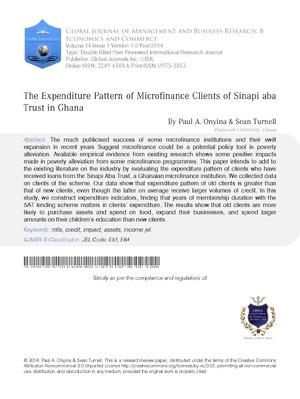
The much publicised success of some microfinance institutions and their swift expansion in recent years Suggest microfinance could be a potential policy tool in poverty alleviation. Available empirical evidence from existing research shows some positive impacts made in poverty alleviation from some microfinance programmes. This paper intends to add to the existing literature on the industry by evaluating the expenditure pattern of clients who have received loans from the Sinapi Aba Trust, a Ghanaian microfinance institution. We collected data on clients of the scheme. Our data show that expenditure pattern of old clients is greater than that of new clients, even though the latter on average receive larger volumes of credit. In this study, we construct expenditure indicators, finding that years of membership duration with the SAT lending scheme matters in clients’ expenditure. The results show that old clients are more likely to purchase assets and spend on food, expand their businesses, and spend larger amounts on their children’s education than new clients.

References

32 Cites in Article
  1. Takeshi Amemiya (1981). Qualitative Response Models: A Survey.
  2. S Amin,A Rai,G Topa (2003). Does microcredit reach the poor and vulnerable? Evidence from northern Bangladesh.
  3. Armendáriz De Aghion,B Morduch,J (2005). The Economics of Microfinance.
  4. Armendáriz De Aghion,B Gollier,C (2000). Peer group formation in adverse selection model.
  5. T Besley,S Coate (1995). Group lending, repayment incentives and social collateral.
  6. Bharat Bhole,Sean Ogden (2010). Group lending and individual lending with strategic default.
  7. S Cheston,L Kuhn (2002). Empowering women through microfinance.
  8. J Cramer (2007). Robustness of Logit Analysis: Unobserved Heterogeneity and Mis‐specified Disturbances*.
  9. Supriya Garikipati (2008). The Impact of Lending to Women on Household Vulnerability and Women’s Empowerment: Evidence from India.
  10. M Ghatak (1999). Group Lending, Local Information and Peer Selection.
  11. N Goldberg (2005). Measuring the impacts of microfinance: Taking stock of what we know.
  12. D Washington Unknown Title.
  13. Valentina Hartarska,Denis Nadolnyak (2008). An Impact Analysis of Microfinance in Bosnia and Herzegovina.
  14. Syed Hashemi,Sidney Schuler,Ann Riley (1996). Rural credit programs and women's empowerment in Bangladesh.
  15. D Hulme (2000). Impact assessment methodologies for microfinance: Theory, experience and better practice.
  16. Dean Karlan (2007). Social Connections and Group Banking.
  17. S Khandker (2005). Microfinance and Poverty: Evidence Using Panel Data from Bangladesh.
  18. Jean-Jacques Laffont,Tchétché N'guessan (2000). Group lending with adverse selection.
  19. J Maes,L Foose (2006). Microfinance services for very poor people: Promising approaches from the field and the US law's mandate to reach very poor people: What strategies are MFIs developing, and what do they mean for the rest of the field? -A Practitioner Survey.
  20. J Maldonado,C Gonzales-Vega (2008). Impact of microfinance on schooling: Evidence from poor rural households in Bolivia.
  21. Jonathan Morduch (1999). The Microfinance Promise.
  22. Jonathan Morduch (2000). The Microfinance Schism.
  23. Mark Pitt,Shahidur Khandker (1998). The impact of Group‐Based Credit Programs on Poor Households in Bangladesh: Does the Gender of Participants Matter?.
  24. Mark Pitt,Shahidur Khandker,Jennifer Cartwright (2006). Empowering Women with Micro Finance: Evidence from Bangladesh.
  25. M Pitt,S Khandker,O Chowdhury,D Millimet (2003). Credit programs for the poor and the health status of children in rural Bangladesh.
  26. E Rhyne,M Otero (2006). Microfinance through the next decade: Visioning the Who, what, where, when and how.
  27. A Simanowitz,A Walter (2002). Ensuring impact: Reaching the poorest while building financially selfsufficient institutions, and showing improvement in the lives of the poorest women and their families.
  28. Aba Sinapi,Trust (2007). Organizational Profile.
  29. Aba Sinapi,Trust (2009). Transforming Lives through Micro Finance.
  30. Aba Sinapi,Trust (2009). the Sinapi Aba Trust.
  31. Stephen Smith (2002). Village Banking and Maternal and Child Health: Evidence from Ecuador and Honduras.
  32. J Stiglitz (1990). Peer monitoring and credit markets.

Funding

No external funding was declared for this work.

Conflict of Interest

The authors declare no conflict of interest.

Ethical Approval

No ethics committee approval was required for this article type.

Data Availability

Not applicable for this article.

How to Cite This Article

Dr. Onyina. 2014. "The Expenditure Pattern of Microfinance Clients of Sinapi Aba Trust in Ghana". Global Journal of Management and Business Research, Global Journal of Management and Business Research - B: Economic & Commerce GJMBR-B Volume 14 (GJMBR Volume 14 Issue B1).
Download Citation

Journal Specifications

Crossref Journal DOI 10.17406/GJMBR

Print ISSN 0975-5853

e-ISSN 2249-4588

Keywords
Classification
GJMBR-B Classification JEL Code: E51
E64
Version of record

v1.2

Issue date
March 25, 2014

Language
English
Experiance in AR

Explore published articles in an immersive Augmented Reality environment. Our platform converts research papers into interactive 3D books, allowing readers to view and interact with content using AR and VR compatible devices.

Read in 3D

Your published article is automatically converted into a realistic 3D book. Flip through pages and read research papers in a more engaging and interactive format.

Article Matrices
Total Views: 1.5K
Total Downloads: 117
All Trends

Request Access

Please fill out the form below to request access to this research paper. Your request will be reviewed by the editorial or author team.
X

This is the heading

Lorem ipsum dolor sit amet, consectetur adipiscing elit. Ut elit tellus, luctus nec ullamcorper mattis, pulvinar dapibus leo.


High-quality academic research articles on global topics and journals.

The Expenditure Pattern of Microfinance Clients of Sinapi Aba Trust in Ghana

Dr. Onyina
Dr. Onyina Pentecost University