
I. INTRODUCTION
The firm value will be a reflection of the overall evaluation of the company as well as its prospects for future growth. When it comes to actual indicators of a company's financial performance, position in the market, and overall financial health, values can act as a compass or guide for investors and other stakeholders. Market capitalisation and book value, which represent the total worth of a company's assets, liabilities, and earnings potential, are typically used to express a firm's value. (Rosset al. 2010; Heliani et al. 2023). It's crucial to remember that evaluations are frequently dynamic and influenced by a range of internal and external circumstances. This has led to the realisation that comprehending firm value is crucial since it affects the company's ability to survive over the long run, attracts stakeholders, and increases value for shareholders. (Utami and others, 2023).
A number of scandals have impacted company valuations. A number of scandals, including financial manipulation, have damaged the market's trust in corporate governance. Then, the public's trust in the corporation was damaged by the case of product safety test manipulation. Energy World (2022) and Tempo (2021) have identified ftse100 as another controversy involving listed corporations. The company has been under public pressure about environmental issues, including waste management and the effects of resource exploitation. A number of these examples demonstrate how environmental concerns and inadequate corporate governance can cause a company's value to drop in the eyes of stakeholders and the general public. In general, maintaining and improving the market's perception of the firm's value depends on an awareness of these issues and competent management of them.
Environmental, Social, and Governance (ESG) frameworks are becoming more significant in the assessment of firms as a result of the increased awareness of global issues resulting in sustainable business practices. ESG transcends typical financial measures and is embodied in three pillars: environmental, social, and governance. The management of a company's environmental impact is referred to as the "environmental pillar," and it can involve concentrating on issues like carbon emissions, resource management, and ecological preservation. (Adeneye et al. 2022). The social pillar pertains to the domain of social responsibility, wherein a company's interactions with its workforce, local communities, and the broader community are assessed (Liu & Lyu, 2022). The governance pillar, on the other hand, is concerned with the governance structure and looks at things like executive salary, board makeup, and moral business practices (Adeneye et al. 2022). A change in the understanding of business values that encompasses not only financial gains but also wider societal consequences and sustainable practices that include environmental, social, and corporate governance is reflected in the growing importance of ESG in valuations.
It is believed that sustainability data, like ESG, might affect a company's value (Aboud & Diab, 2017). This relationship, wherein ESG-related information is a kind of duty to the firm's stakeholders, can be explained by the theory of stakeholders. ESG is a policy that considers governance, society, and the environment. By considering these three areas, a company may perform its commitments to stakeholders in a fair and equitable manner (Fatemi et al. 2018). ESG disclosure will thereby raise public confidence in the company, which will raise the company's worth.
An increasing number of studies is revealing the intriguing relationship between corporate principles and ESG policies. Stronger ESG practices are frequently reflected in a company's greater market valuation and increased stakeholder trust (Cardillo et al. 2023). This phenomena is the result of multiple elements coming together. Businesses with an awareness of ESG practices are thought to be more adaptable to shifts and hazards, like pandemics (Broadstock et al. 2021). Furthermore, companies typically develop closer ties with stakeholders, which fosters consumer trust and brand loyalty (Sarpong et al. 2023). Empirical data paints a vivid picture of how companies that adhere to ESG principles not only surmount obstacles more skilfully but also prosper over the long haul, hence boosting firm value.
The second point to be clarified is the way in which ESG practices can raise the value of a company. Here, financial performance plays a crucial function as an intermediary. A company's operational efficiency may be accurately reflected by financial performance measures including profitability, ROA, and EPS (Wang et al. 2016). In the end, this implies that quantifiable measurements may be made of the effects of ESG practices. ESG practices' measurability can be defined as the process of converting sustainability initiatives into observable, cash-generating advantages. The idea is that financial performance can serve as a proxy for how ESG practices might raise company value; companies that score highly on ESG will find that their customer interactions improve, which will lead to higher profitability (Yunica & Rokhim, 2023). The firm value will rise in response to the improvement in the firm's financial performance (Akhmadi & Januarsi, 2021; Pratiwi, 2020). This mediation offers a crucial analytical framework for comprehending the relationship between firm valuation and sustainable business strategies like ESG. Simplified, financial performance data can be thought of as a signal that a company provides to its stakeholders. The way that stakeholders can interpret financial performance data into decisions that impact corporate value can be explained by signalling theory.
According to earlier studies, ESG may have an impact on a company's value (Wong et al. 2021). Yet, conflicting findings suggest that ESG has no bearing on company value (Rastogi et al. 2023). ESG has an impact on financial performance, according to earlier studies (Maji & Lohia, 2023). Different findings, however, also indicate that there is no connection between financial performance and ESG practices (Junius et al. 2020). Similarly, there are contradictory findings in the relationship between corporate value and financial performance. Numerous scholarly works have demonstrated a correlation between a company's worth and its financial success (Rutin et al. 2019). Nevertheless, a number of studies also present the opposite findings (Kansil et al. 2021). More study is still needed to fully understand how ESG affects business value when financial performance plays a mediating role. This is because the results are inconsistent or have varied conclusions.
Despite the recognised link between ESG and corporate principles, there are compelling arguments to investigate financial performance's mediation function. This is due to the necessity of identifying the precise processes and flow via which ESG practices impact business value. We can comprehend the creation of value and shareholder wealth by looking at how ESG principles translate into financial performance. Additionally, companies looking to integrate sustainable practices with long-term financial well-being must comprehend the significance of this mediation. The goal of this study is to clarify the relationship between ESG, financial performance, and company value in order to improve knowledge of how businesses may create sustainable value. In terms of its theoretical contribution, it is envisaged that this study would validate the theories of signalling and stakeholders and assist in resolving inconsistencies found in the findings of earlier studies. Furthermore, it is anticipated that the study will help stakeholders and investors evaluate a company, assisting them in making decisions.
II. LITERATURE REVIEW
According to Pesqueux and Damak-ayadi (2005), the implicit postulate of the individual-group-society-firm-organization-institution-state continuum forms the basis of the organisational theory known as stakeholder theory. Stakeholders can be categorised into multiple groups: those who have a direct connection to the activities of the company and those who are not, but nonetheless experience the effects. A number of stakeholder groups are explained by Mallin (2019), including communities, environmental organisations, government, suppliers, customers, shareholders, employees, and creditors. According to this idea, businesses can create a solid basis for long-term growth and sustainability by paying attention to the requirements and interests of all parties involved. This is because they will gain the trust of stakeholders, maintain a positive reputation, get support from customers, attract sustainable investors, and more. Ultimately, it will support decision-making for interested parties.
A concept known as "signalling theory" outlines the relationship between two parties, the sender and the recipient of the signal. In this scenario, the sender plays a crucial role in deciding whether and how to transmit information through signals, among other things. In the meantime, the signal sender's signal must be interpreted or understood by the signal receiver (Connelly et al. 2011; Spence, 1973). The signalling theory employed in this study is predicated on the claim that it can account for how businesses communicate with parties outside of their own organisation, including shareholders and investors. The information that managers disclose to different parties outside the company might stifle the information asymmetry that ought to develop between owners and management.
As a sustainability endeavour, ESG aims to strike a balance between the environmental, social, and governance pillars. It is essentially still associated with CSR. ESG can increase a company's value by lowering its capital costs and fostering social and economic advancement, all of which will improve the company's reputation and boost its worth (Liu & Lyu, 2022). Stakeholder theory states that enhanced ESG practices should raise the interest of stakeholders like investors. It also assumes that ESG practices are viewed as a form of corporate responsibility towards these stakeholders, which is reflected in the rise in firm value in the market. ESG has a favourable impact on firm value, according to several research (Wong et al. 2021). These explanations lead to the following theories being put forth:
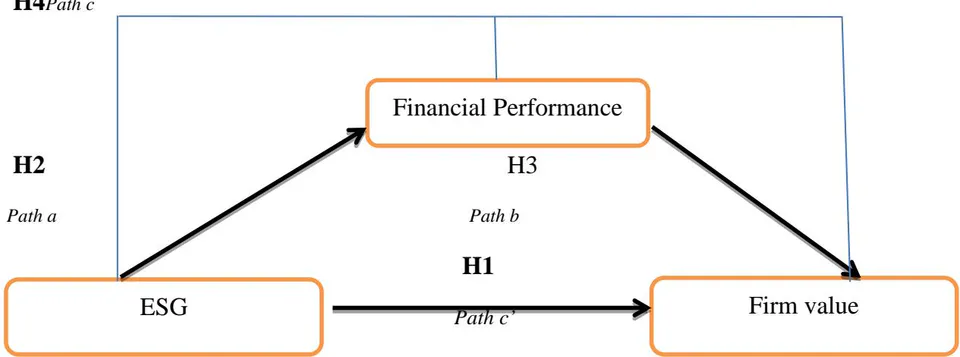
H1: Firm value is positively impacted by ESG.
A company's potential to increase profitability can be achieved through implementing ESG practices. Businesses that implement ESG practices can lower their cost of capital (Jang et al. 2020); additionally, the positive image these practices generate can draw in investors and clients; and lastly, sustainable practices can lower long-term operating expenses, which in turn can boost business profitability. According to stakeholder theory, the rise in ESG practices gives businesses advice on how to manage their operations for the benefit of all stakeholders. This includes adopting Good Corporate Governance, which has an impact on how efficiently a business manages its costs, which will show up as improved financial performance. ESG has a beneficial impact on financial performance, according to several research (Pulino et al. 2022; Maji & Lohia, 2023). These explanations lead to the following theories being put forth:
H2: ESG has a favourable impact on financial results.
According to Umar et al. (2020), financial performance essentially indicates how well the company is implementing its finances in compliance with current regulations. Profitability indicators, which demonstrate the effectiveness of the company's financial management and its capacity to turn a profit, are typically used to evaluate financial performance (Suryasari & Artini, 2020). The current demand for firm shares will rise in exact proportion to the increase in firm value, as this value rises. Based on the signalling theory, a rise in profitability as a proxy for financial performance will raise market trust, which in turn will raise firm value. Numerous scholarly works elucidate the favourable correlation between financial performance and firm worth (Akhmadi & Januarsi, 2021; Rutin et al. 2019). These explanations lead to the following theories being put forth:
H3: Firm value is positively impacted by financial performance.
More research is still needed to determine how ESG affects company value in the relationship between it and that value. It is believed that financial performance combined with profitability metrics can illustrate how ESG factors can affect company value. This relationship is explained by the theories of signalling and stakeholders. A company that successfully implements ESG practices has proven its accountability to stakeholders, which can reduce capital costs and increase profitability. The market will then receive good signals from the increased firm profitability, which will translate into an increase in the firm's valuation. Prior studies have demonstrated the positive relationship between ESG and financial performance (Maji & Lohia, 2023; Pulino et al. 2022), as well as the relationship between financial performance and business value (Akhmadi & Januarsi, 2021; Rutin et al. 2019). These explanations lead to the following theories being put forth:
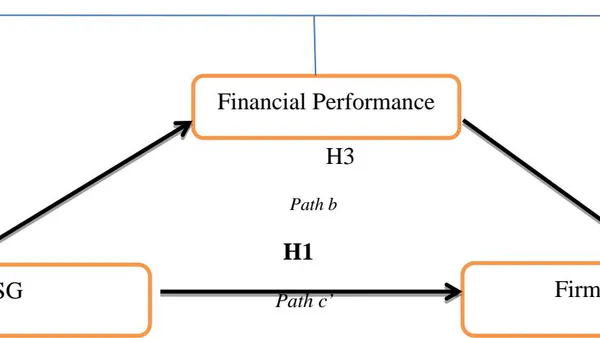
H4: The relationship between business value and ESG is mediated by financial performance.
III. RESEARCH METHODS
A quantitative research approach is used in this study. The Osiris Database provides information on financial performance and corporate worth, whereas the Thomson Reuters Database provides information on environmental, social, and governance (ESG) issues. All of the non-financial companies listed on the FTSE 100 between 2018 and 2023 are part of the research population, and the Thomson Reuters Database contains their data. Purposive sampling is used to determine the sample for this study. The criteria include:
(1) being consistently listed on the FTSE 100 between 2018 and 2023; (2) not being registered as a financial firm; and (3) the firm consistently having complete information regarding ESG, financial performance, and firm value between 2018 and 2023. The total number of observations is 582 firm years because, according to this sampling technique, 97 firms were acquired for each year that satisfied the criteria. Next, Table 1 below provides an explanation of how each variable included in this study was measured.
| Variable | Proxy | Measurement | Reference |
| ESG | Thomson Reuters ESG Score | Environmental Indicator Score + Social Indicator score + Governance Indicator Score | (Thomson Reuters Eikon, 2017) |
| Financial Performance | ROA | Net Profit/Total Assets × 100% | (Necib et Jarboui, 2023) |
| Firm value | Price to Book Value (PBV) | Market Value per Share/Book Value per Share | (Ross et al. 2010) |
Then, the three steps in the data analysis process used in this study are: (1) a test of descriptive statistics, which is helpful in providing an overview of the data; (2) a test of coefficient of determination, which is helpful in determining the extent to which the independent variable in the research can explain the dependent variable; and (3) hypothesis testing, which is helpful in determining whether to accept or reject the suggested hypothesis. The Hayes PROCESS Macro in the SPSS software was utilised for hypothesis testing in this study. In this instance, the direct relationship between the independent and dependent variables is tested using PROCESS Macro model 4, along with the mediating variable's influence on the relationship between the independent and dependent variables (Hayes, 2022). Because it enables the assessment of any relationship between variables in a single test, including mediation effects, the testing option utilising Hayes' PROCESS Macro was selected (Hayes, 2022).
The regression equation utilised in this study is shown below:
Where:
ROA = Return on Assets (Mediation Variable)
PBV = Price to Book Value (Dependent variable)
ESG = Environmental, Social, and Governance (Independent Variable)
IV. RESULTS AND DISCUSSION
a) Statistical Test Results
| Variable | N | Mean | Std.Deviation | Min | Max |
| PBV | 582 | 5.24 | 8.32 | 0.22 | 70.11 |
| ESG | 582 | 53.66 | 21.74 | 11.37 | 88.07 |
| ROA | 582 | 9.93 | 10.49 | -14.28 | 53.79 |
The results display the mean, standard deviation, greatest and smallest values for each of the variables in this research, as can be seen in the above table of descriptive statistics. 70.11 is the biggest value, while 0.22 is the smallest. PBV average for 2017–2022 is 5.24, with an 8.32 standard deviation. The 2018 GSE had a maximum value of 88.07 and a lowest value of 11.37. Consequently, the ESG average for the years 2018–2023 is 53.66, with a standard deviation of 21.74. The ROA with the biggest value is 53.79, and the one with the smallest value is -14.28. With a standard deviation of 10.49, the average return on assets (ROA) for the years 2018–2023 is 9.93.
| Equation | R | |
| Equation 1 | 0.29 | 0.64 |
| Equation 2 | 0.64 | 0.38 |
Equation 1's value is 0.64 and Equation 2's value is 0.38 based on the test results shown in Table 3. This demonstrates that the independent variables in equations 1 and 2 can account for 64% and 38%, respectively, of the dependent variable's variance. Given that there are still a number of external and internal elements that might affect the firm's worth and financial performance, this is still within reasonable bounds. This creates new avenues for future investigation.
| Regression Variables | Coefficient | P |
| ESG on ROA (path a) | 2.6479 | 0.0000 |
| ROA on PBV (path b) | 0.4995 | 0.0000 |
| ESG on PBV (path c') | 0.0245 | 0.4937 |
| ESG on PBV through ROA (path c) | 0.0816 | 0.0061 |
Financial performance as a mediator can mediate the relationship between ESG and firm value, which can be included in the full mediation type, according to the regression test results in Table 4. The next part will provide a more thorough explanation of how each variable is related to the others.
i. The Effect of ESG on Firm Value
The relationship between company value and ESG has a p-value of 0.4937 and a coefficient of 0.0245, according to the test findings shown in Table 4. This demonstrates that ESG cannot positively impact business value as measured by PBV (p > 0.05), leading to the rejection of H1. These findings show that a higher ESG score does not translate into a higher firm value. In the UK, ESG-related information is still unable to raise firm value. This may be due to a lack of interest from stakeholders in ESG-related matters, which keeps its impact on firm value minimal.
The study's findings refute the stakeholder theory, which holds that because stakeholders do not fully embrace ESG information as a form of corporate responsibility, it does not improve the company's reputation in the marketplace and does not significantly raise its value. Since ESG is essentially thought to be unable to raise firm worth in situations where they have the same market value, companies that have ESG information are likewise terrible and, more or less, have the same value. (Atan and colleagues, 2018). The outcome or conclusion of this study is consistent with earlier research by Atan et al. (2018), and Rastogi et al. (2023), which found that ESG had no bearing on company value.
ii. The Effect of ESG on Financial Performance
The relationship between ESG and financial success has a coefficient of 2.6479 and a p-value of 0.0000, according to the test results in Table 4. H2 is acceptable since this demonstrates how ESG can have a beneficial impact on financial performance as measured by ROA (p < 0.05). These findings show that financial performance can be enhanced by raising the ESG score. Financial performance will increase by 2.6479 when ESG rises by 1. The positive value found in the coefficient of correlation between ESG and financial performance, as measured by ROA, may be attributed to various variables, including the company's emphasis on social and corporate governance. This is frequently linked to improved financial performance that arises from adopting environmentally conscious activities (Pulino et al. 2022).
Investing in ESG practices may be costly initially, but these will be outweighed by the long-term advantages. Even though it requires a relatively large initial investment, a significant increase in return on assets (ROA) can be realised over the long run (Nguyen et al. 2022). This is demonstrated by the sample firms in this research, which are companies that continuously implemented ESG practices between 2018 and 2023.
Our findings are consistent with the notion of stakeholder relations; the rise in ESG practices suggests that companies have an obligation to account for all of their stakeholders through both business operations and potentially excellent governance. This will have an impact on how efficiently the company uses its operating resources, which will enhance its financial performance and ultimately lead to lower operational expenses. The outcome or conclusion of this investigation is consistent with earlier studies conducted by Maji & Lohia (2023) and Pulino et al. (2022).
iii. The Effect of Financial Performance on Firm Value
The relationship between business value and financial performance has a p-value of 0.0000 and a coefficient of 0.4995, according to the test findings shown in Table 4. This demonstrates that company value as measured by PBV is positively impacted by financial success as measured by ROA (p < 0.05), supporting the acceptance of H3. These findings show that business value can rise in response to an increase in financial performance value. Firm value will improve by 0.4995 for every unit increase in financial performance of 1. The relationship between financial performance and firm value, as measured by PBV, can have a positive coefficient because, in general, as business profitability rises and financial performance improves, so does the firm's market valuation. The profitability of the firm is determined by the amount of nett profit it can generate from its operations. As a result, high nett profits can influence the amount of profits distributed to investors and add value to their investment (Rutin et al. 2019).
According to Mudjijah et al. (2019), our research bolsters the signalling theory: a firm's ability to generate profits through effective asset management is indicated by increased financial performance, which is reflected in profitability as measured by ROA. This signal is then picked up by outside parties like investors and has a positive impact. An growth in the firm's worth can be interpreted by external parties as a signal from ROA. The outcome or conclusion of this investigation is consistent with earlier studies conducted by Supriyadi & Setyorini (2020), Murni & Sabijono (2018), and Kansil et al. (2021).
iv. The Effect of ESG on Firm Value Through Financial Performance
With a coefficient value of 0.0816 and a p-value of 0.0061, financial performance can mediate the relationship between ESG and business value, according to the test results in Table 4, supporting the acceptance of H4. According to Baron & Kenny (1986), there is a mediating function played by financial success in the relationship between ESG and business value because Path A and Path B exist and are relevant. Since Path A and B have considerable value and Path C' is not significant, the financial performance can be considered to play a full mediation role.
The relationship between business value and ESG can be better understood in terms of financial performance. An improvement in ESG does not always translate into a rise in company value. The improvement in the firm's financial performance value as measured by ROA is indicative of how ESG will assist the company create profits through sound corporate governance and will be a form of corporate responsibility towards its stakeholders (Pulino et al. 2022). Then, as a result of investing in ESG practices, a company's financial performance (ROA) will rise, which will boost the company's market evaluation. A rising profit margin is a positive indicator for outside parties like investors. This signal will be captured by investors and then reflected in increasing firm value (Murni & Sabijono, 2018).
The research findings demonstrate that financial performance acts as a complete mediating factor. The outcome is corroborated by earlier study findings. Prior studies have indicated that financial performance and ESG have the potential to impact business value (Kansil et al., 2021; Murni & Sabijono, 2018; Supriyadi & Setyorini, 2020; Maji & Lohia, 2023; Nguyen et al., 2022; Pulino et al., 2022).
b) Theoretical Implications and Practical Implications
The research's findings provide empirical support for the stakeholder theory. Investors and other stakeholders place a high value on ESG, which demonstrates that businesses must practice good governance in order to conduct their operations as efficiently as possible. In addition, the signalling hypothesis is supported by actual data in this study. A firm's ability to turn a profit is shown by an improvement in financial performance, which is subsequently picked up by outside parties like investors and has a beneficial effect. The research findings further contribute to the abundance of scholarly literature on the relationship between financial performance and effective ESG practices and how ESG mechanisms might raise firm value.
When considering the practical ramifications, this study shows how ESG improves financial performance to raise firm value. When trying to maximise the value of their company, managers should take environmental, social, and governance (ESG) principles into account. This will help them gain the trust of stakeholders and investors by managing assets in an optimal manner. Furthermore, the outcomes provide enhanced comprehension of the pertinent data taken into account by stakeholders and investors when evaluating a company. Investors can evaluate the firm's responsibility and commitment through the financial performance's mediating role in the relationship between ESG and firm value, which gives these parties greater confidence to invest in the firm. It is envisaged that the research findings mentioned above will enable stakeholders to have a comprehensive understanding of sustainability practices in UK businesses, enhancing their evaluation during the decision-making process.
V. CONCLUSION
The test results demonstrate that business value cannot be directly impacted by ESG. Financial performance has a favourable impact on company value, and ESG has a positive impact on both. These results suggest that business value and ESG can be mediated by financial performance, with full mediation being the resultant mediation effect. These findings demonstrate that a rise in ESG practices will lead to an increase in firm efficiency, which can raise nett profit made by the company. This, in turn, will improve the firm's market evaluation, as evidenced by the rise in firm value.
This study makes a contribution by offering empirical proof of how sustainability practices, like ESG, affect firm valuation through an examination of the moderating role played by firm financial performance. The study's findings also support signalling theory, which holds that business value is influenced by financial success, and stakeholder theory, which links ESG to financial performance. In addition, the study's findings help investors and other stakeholders evaluate businesses so they can make decisions.
This study has a number of flaws, including a small sample size because there is currently a dearth of information about ESG practices in the UK, even though the research used balanced data. The second drawback has to do with calculating company value, which is primarily concerned with evaluating past expenses and hence does not accurately represent present worth. As recommendations, future studies can use panel data that is both balanced and imbalanced, as well as other ESG datasets that contain a wider range of data. Further studies might also take into account utilising alternative firm value metrics that account for both past and present values. The relationship between ESG and business value can then be explained by mediating variables other than financial success in future study, such as environmentally friendly innovation, financial crisis, and so on.