
Introduction
Ecological posthumanism is a way of thinking that asks us to stop treating humans as the center of everything and start seeing ourselves as one participant among many in a deeply interconnected ecological world. Ecological posthumanism challenges human-centered worldviews by emphasizing the interconnected agency of humans, non-humans, technology and ecosystems, advocating ethical responsibility within a shared planetary ecology. The term first occurred in the article “Prometheus as Performer: Towards a Posthumanist Culture” by Ihab Hassan. It combines two thoughts:
Posthumanism: critiques anthropocentrism (the belief or worldview that human beings are the central and most important entities in the world.)
Ecological thought: focuses on environmental interdependence, sustainability and planetary survival.
Together, they argue that humans, animals, plants, technologies, microbes, and ecosystems all co-constitute life on Earth. Core ideas of ecological posthumanism are as follows:
Decentering humans: Humans are not masters of nature but entangled and networked with non-human life forms (soil, water, bacteria, climate, or machines). Traditional humanism presents humans as rational and superior beings, separate from nature. They are masters of technology and environment. Posthumanism questions this assumption by showing that humans are deeply dependent on other forms of life, technology, and ecological systems. Posthumanism shows that humans depend on ecosystems for survival; technological systems shape everyday life; human bodies are interconnected with microbes and biological processes. Thus, humans cannot be considered autonomous or superior beings. Posthumanism emphasizes that humans exist within networks of relationships that include animals, plants, microorganisms, technologies, and environments. According to Donna Haraway, humans are “companion species”, meaning they evolve and exist in constant interaction with other life forms. This perspective shifts the focus from human individuality to relational existence.
Relational Ontology: Beings don’t exist in isolation. Identity and agency emerge through relationships—human/non-human, organic/technological, local/global. Relational ontology posits that entities are not pre-existing, separate substances, but emerge through their dynamic, mutual interactions or intra-actions. It challenges anthropocentrism and Cartesian dualism, arguing that relations are more fundamental than the individual things themselves, promoting a view of interconnected becoming.
More than Human Ethics: Moral concern should extend beyond humans to animals, ecosystems, future generations, and even non-living entities (rivers, mountains, climate systems).
Critique of Anthropocentrism & the Anthropocene: The critique of Anthropocentrism and the Anthropocene is a key component of posthumanist thought. Anthropocentrism is the worldview that places humans at the center of existence. It considers human interests superior to all other life forms, treats nature primarily as a resource for human use. This perspective became dominant during the Enlightenment and modern humanism, where humans were viewed as rational subjects capable of mastering nature. Posthumanism argues that anthropocentrism is problematic because it separates humans from nature by creating a strict division between human culture and nonhuman nature. Posthumanism rejects this dualism and emphasizes that humans are biologically and ecologically interconnected with other species and ecosystems. Besides, Anthropocentrism produces environmental exploitation. When humans consider themselves superior, nature is treated as raw material, property, and an object of control. This mindset contributes to deforestation, climate change, biodiversity loss, and pollution. Ecological Posthumanism therefore calls for a more ethical relationship with the environment. Anthropocentrism assumes that only humans possess agency and intelligence. Ecological Posthumanism challenges this assumption by recognizing that animals possess complex behaviors; ecosystems regulate environmental processes and technologies influence human actions. Agency is therefore distributed across humans and nonhumans. Although the Anthropocene highlights human environmental impact, posthuman scholars raise several critiques. Interestingly, the term “Anthropocene” universalizes responsibility. The concept suggests that all humans are equally responsible for ecological damage. However, critics argue that industrialized nations, colonial histories and capitalist economies have contributed unevenly to environmental destruction. Therefore, some scholars prefer alternative terms such as Capitalocene (focus on capitalism) or Plantationocene (focus on colonial plantation systems). These alternatives emphasize the historical and political causes of ecological crises. Ironically, the term Anthropocene continues to place humans at the center of planetary history. Ecological Posthumanists argue that this reinforces anthropocentrism instead of fully recognizing the agency of Earth systems and nonhuman life. Posthuman thinkers emphasize the importance of multispecies coexistence. According to Donna Haraway, humans must learn to “make kin” with other species, recognizing shared survival on a fragile planet. This approach promotes ecological responsibility, interspecies ethics and collaborative survival. Ecological Posthumanism proposes several alternatives to anthropocentric thinking. The posthuman critique of anthropocentrism and the Anthropocene reveals that human-centered thinking has contributed significantly to ecological crises. By decentering the human and recognizing the interconnectedness of life, posthumanism encourages a planetary ethical perspective in which humans coexist responsibly with other species, technologies, and ecological systems.
Material Agency: Jane Bennett in her book Vibrant Matter: A Political Ecology of Things (2010) is of the view that agency is not exclusively human. Non-human forces actively shape reality. Ecological posthumanism believes that matter itself has agency—oceans rise; viruses mutate; plastics circulate. Nature is not passive.
Critique of Humanist Individualism: The rational human individual is a myth. Ecological posthumanism sees subjectivity as collective, selfhood as ecological and survival as shared.
Rosi Braidotti’s ’Zoe-Centered Egalitarianism’: Described in the book The Posthuman, this is a key post-anthropocentric concept that extends moral consideration beyond human life (bios) to all living matter (zoe) including animals, bacteria and geological or environmental structures. It posits that all life forms are equal in essence and intelligent, aiming at challenging the human-centric, capitalist commodification of nature.
Planetary Perspective: A planetary perspective means viewing Earth as a single interconnected ecological system rather than a collection of separate nations, cultures, or species. From this perspective, humans are one species among many. Life exists within complex ecological networks. Planetary systems such as oceans, climate, and atmosphere sustain all life. This approach shifts attention from human-centered thinking to Earth-centered thinking.
Geological time, Deep ecological history: The concept of Deep Time refers to the understanding that the history of the Earth and the universe extends over vast temporal scales—millions or billions of years—far beyond the span of human history. This concept is important in fields like Geology, Evolutionary Biology, and ecological philosophy, and it also plays a significant role in posthuman and environmental thought. The idea of deep time was first developed scientifically by the geologist James Hutton in the eighteenth century, who argued that Earth’s geological processes operate over immense timescales.
Donna Jeanne Haraway in her book Staying with the Trouble: Making Kin in the Chthulucene (2016) says, “Human beings are with and of the earth, and planet.” (Haraway, 2) This emphasizes humans as part of the earth, not above them. In another book When Species Meet (2008) Haraway uses the phrase “Becoming-with, not becoming”, meaning that existence is relational. We do not evolve alone; we evolve with other species.
Samantha Harvey and Orbital
Samantha Harvey is an English novelist who won the 2024 Booker prize for her novel Orbital (2023). Besides drawing conventions from multiple genres and fields including literary fiction, science fiction and philosophy, this novel ardently reflects ecological posthumanism. The novel focuses on six astronauts aboard the International Space Station who orbit the Earth during a single day. Each character comes from a different cultural background and contributes to the novel’s exploration of planetary perspective, identity, and human vulnerability. Main Characters in Orbital include Roman, a Russian cosmonaut who often reflects on time, routine, and the rhythms of orbit. Shaun is an American astronaut who thinks deeply about Earth’s beauty and fragility. Pietro is an Italian astronaut who often reflects on art, culture, and human creativity. Anton is another Russian cosmonaut who embodies technical expertise and professionalism. Nell is a British astronaut who frequently thinks about her family and life on Earth. Chie is a Japanese astronaut who is particularly sensitive to nature and the environment. Although the novel includes individual characters, it does not focus heavily on dramatic personal conflict. Instead, the astronauts function as a collective human presence observing Earth from space. Together they represent different nations and cultures, shared human vulnerability and the interconnectedness of humanity with planetary systems. Their experiences create a global and planetary perspective that transcends national boundaries.
Aim and Objectives
The aim of the present research article is to analyze the novel Orbital as a reflection of ecological posthumanism. To fulfill the aim, the objectives of the present research article are:
To explore how the novelist systematically uses ecological posthumanism (as developed by theorists like Donna Haraway, Rosi Braidotti, Jane Bennett) as a framework to interpret Orbital’s depiction of human/non-human entanglements, distributed agency, or relational subjectivity.
To show how Orbital represents interactions among species, matter, and technology, moving beyond human emotional reflection to networked agency.
To investigate how Orbital conceptualizes planetary time, orbit cycles, and deep time in relation to posthuman thinking.
To examine how gender, nationality, or “self” are reshaped in these non-Earth environments as presented in the novel.
Analysis of Orbital as a Reflection of Ecological Posthumanism
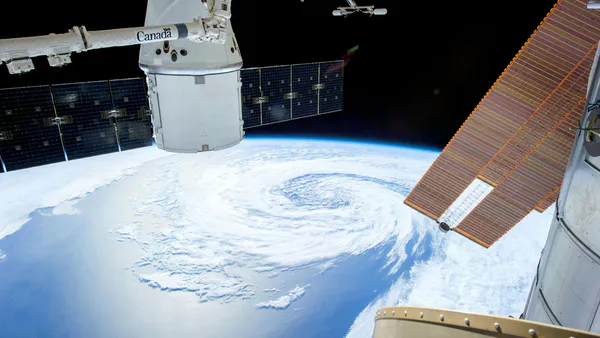
In Samantha Harvey’s Orbital (2023), ecological posthumanism is not just a theme—it’s the framework and the structuring consciousness of the novel. The book imagines life from the vantage point of astronauts circling Earth, and that distance allows Harvey to radically decenter the human and foreground a planetary, more-than-human perspective. From orbit, Earth is not divided by nations, borders, or identities. It appears as a single, fragile, breathing entity. Human concerns—politics, conflicts, personal histories—shrink in scale. This aligns directly with ecological posthumanism: Humans are not masters of Earth, but temporary inhabitants. The planet precedes and will outlast human presence. Human life is only one strand in a vast ecological mesh. The astronauts themselves become almost posthuman figures—bodies sustained by machines, oxygen systems, gravity-defying technology—blurred boundaries between human, machine, and environment.
Harvey repeatedly describes Earth as dynamic and active: clouds move like thought; oceans pulse and shift; weather systems evolve independently of human will. This reflects Jane Bennett’s “vibrant matter” and Rosi Braidotti’s zoe-centric ethics, where agency is distributed across human and non-human forces and nature is not passive scenery but an active participant.
Relational Existence and Shared Vulnerability
In Orbital by Samantha Harvey, relational existence and shared vulnerability are central ideas that emerge from the astronauts’ experience aboard the International Space Station. The novel shifts attention away from individual human dominance and instead portrays life as part of a complex web of relations among humans, technology, Earth, and other forms of matter. These themes strongly connect with ideas from ecological posthumanism. Relational existence in the novel refers to the idea that beings do not exist independently; rather, they exist through connections with others—humans, non-humans, environments, and technologies. The astronauts on the station come from different nations and cultures, yet their survival depends on constant cooperation and trust. In orbit, national boundaries disappear, and they form a small, interdependent community. Their lives depend on shared routines, communication, and mutual care. Life in orbit shows that humans are deeply dependent on technological systems—oxygen generators, spacecraft modules, communication networks, and monitoring devices. These systems are not merely tools but co-actors in sustaining life. The astronauts’ existence becomes relational not only with each other but also with machines. From space, astronauts observe Earth as a single fragile organism. Political borders vanish, and the planet appears as a shared home. Their perception emphasizes that human life is inseparable from the planet’s ecosystems and atmospheric systems. The novel also highlights relationships among oceans, weather patterns, animals, and human societies. The astronauts witness storms, day–night cycles, and climate phenomena from orbit, reminding readers that human life is embedded within larger planetary processes.
The novel also emphasizes shared vulnerability, meaning that humans, technologies, and the Earth itself are fragile and interdependent. In orbit, astronauts experience extreme vulnerability. A small malfunction—loss of oxygen, radiation exposure, or technical failure—could be fatal. This vulnerability challenges the traditional idea of human control over nature. Looking down at Earth, the astronauts recognize how thin the atmosphere is and how delicate the planet appears. Environmental crises such as climate change become more visible from space, suggesting that all life on Earth shares ecological vulnerability. The astronauts reflect their families, memories, and the distance from Earth. Their emotional experiences reveal the shared human condition of uncertainty, longing, and dependence on relationships. By observing the planet as a whole system, the narrative implies that humans, animals, and ecosystems face interconnected risks—from environmental destruction to climate instability. These themes resonate with the ideas of Donna Haraway and Rosi Braidotti, who argue that humans are not autonomous beings but part of entangled networks of life, matter, and technology.
In the novel human identity becomes collective rather than individual. Agency is distributed across humans, machines, and planetary systems and survival depends on cooperation and ecological awareness.
Time in the Novel
The novel’s treatment of time resonates with posthumanist thought, especially ideas about de-centering human perspectives. Thinkers such as Donna Haraway and Rosi Braidotti argue that humans must understand themselves within larger ecological and temporal networks. The concept of time in the novel is also central to the novel’s philosophical and narrative structure. Time in the novel is not presented as a simple linear progression but as cyclical, planetary, and multi-layered, reflecting the astronauts’ experience aboard the International Space Station and their view of Earth from orbit.
In Orbital, time is experienced simultaneously at multiple levels:
Human Time or Cyclical and Repetitive Time: The repetitive orbit of the station creates a sense of cyclical time. The astronauts perform the same routines repeatedly. The Earth constantly rotates beneath them, reinforcing the idea of endless cycles rather than linear progress. This cyclical structure mirrors natural processes such as planetary rotation and ecological rhythms.
Personal and Emotional Time: Despite the orbital cycles, the astronauts experience subjective time through memories, reflections, and thoughts about loved ones on Earth. Personal memories collapse past and present. Distance from Earth intensifies feelings of nostalgia and longing. Thus, the novel contrasts mechanical time (clocks and schedules) with psychological time (memory and emotion).
Orbital Time (Accelerated Cycles): One of the most striking aspects of time in the novel is the orbital rhythm of the space station. The astronauts circle the Earth roughly every 90 minutes, experiencing about sixteen sunrises and sunsets in a single day. “In this new day they’ll circle the earth sixteen times. They’ll see sixteen sunrises and sixteen sunsets, sixteen days and sixteen nights” (Harvey, 4). This rapid cycle disrupts the ordinary 24-hour human perception of time. Day and night lose their usual meaning, making time feel fragmented and repetitive. Instead of following a natural day, astronauts rely on artificial schedules and clocks. This shows how human experiences of time are constructed and dependent on the environment and technology. This layered temporality destabilizes the human body as the measure of time. Circadian rhythms (term coined by Franz Halberg) lose authority. Instead, time is shaped by machines, orbital physics and planetary rotation.
Planetary Time: From orbit, the astronauts observe Earth’s planetary rhythms—weather systems, oceans, storms, and seasonal shifts. Time appears as a large-scale planetary process rather than a human-centered timeline. The astronauts witness phenomena such as hurricanes forming or continents slowly passing beneath them. Planetary time reminds readers that Earth operates on vast natural cycles beyond human control. This framing resonates with the “Gaia-like view of Earth” as a system (concept developed by James Lovelock and Lynn Margulis), where the planet is considered a single, self-regulating, living superorganism indifferent to human divisions. National borders disappear; political events shrink.
Deep Time: The novel also evokes deep time, the geological and evolutionary time scale that stretches millions or billions of years. The concept “deep time” (coined by John McPhee, concept given by James Hutton) is an immense temporal scale associated with geology and cosmology rather than human narrative. Looking at Earth from space makes human history appear extremely brief and fragile. The astronauts realize that civilizations, borders, and political conflicts are temporary within Earth’s long history. This perspective challenges anthropocentric thinking by situating humans within much longer planetary and cosmic histories. “If the cosmic calendar is all of time, then humanity occupies only the smallest fraction of it... most of it has not yet occurred” (Harvey, 174). The universe moves on with “its usual nihilism” (Harvey, 173-174).
Zoe-Centered Egalitarianism in Orbital
Rosi Braidotti brilliantly developed the philosophical framework of “Zoe-Centered Egalitarianism”. In posthuman theory, zoe refers to the vital force of life shared by all living beings, not just human life (bios). Egalitarianism means the rejection of human superiority over other forms of life. Zoe-centered egalitarianism therefore emphasizes the equal value of all forms of life—human, animal, ecological, and even planetary systems. This concept emphasizes ecological interconnectedness, equality among species and recognition of the agency of nonhuman life.
The narrative of Orbital reflects this idea in several ways. In Orbital, the astronauts observe Earth from space. This perspective fundamentally changes how they perceive life. From orbit national borders disappear; human infrastructures appear to be tiny and natural systems such as oceans, forests, and clouds dominate the view. This perspective encourages readers to see the planet as a living ecological whole, rather than a human-controlled world. The astronauts’ vantage point therefore decenters human importance and aligns with zoe-centered thinking. Besides, the novel repeatedly describes Earth as a dynamic system of interacting with life forms and natural processes. The astronauts witness swirling hurricanes over oceans, forests stretching across continents, migrating atmospheric systems or oceans and polar ice sheets. These observations reveal that life on Earth operates through complex ecological relationships that include humans but are not dominated by them. In this sense, the novel presents Earth as a planetary network of life, where humans are only one participant among many.
Zoe-centered egalitarianism rejects the hierarchical model that places humans above animals, plants, and ecosystems. In Orbital, the astronauts often reflect on animals, oceans, forests, and microbial life as part of the same planetary system. Life appears collective rather than hierarchical, and the survival of humans depends on the health of ecosystems. This representation suggests that human life cannot exist independently from other forms of life, reinforcing ecological equality. The novel’s representation of Earth encourages a posthuman ethical perspective. Instead of viewing humans as rulers of nature, Orbital suggests that humans must recognize the interdependence of species, the shared vitality of life forms and the fragility of planetary ecosystems. This ethical shift reflects Braidotti’s argument that humanity should develop a planetary sense of responsibility toward all forms of life.
The narrative structure of Orbital also reinforces this philosophy. The novel focuses less on dramatic human action and more on observation of Earth, planetary cycles and environmental phenomena. By shifting attention away from human-centered storytelling, the narrative allows nonhuman life and planetary processes to become central elements of the story. Ultimately, the novel encourages readers to recognize that humans are biological participants in Earth’s ecosystems, life exists through interdependent ecological networks, and the future of humanity depends on respect for all forms of life.
Distributed Agency in the Novel
In traditional humanist thinking, humans are seen as independent agents controlling nature and technology. Distributed agency refers to the idea that action, influence, and power are not controlled only by humans but shared among humans, technologies, natural forces, and planetary systems. In the novel, agency is distributed across multiple actors, showing that human beings are part of a larger network rather than the sole agents of action. The astronauts aboard the International Space Station carry out scientific research, maintenance tasks, and observations of Earth. At first glance, they appear to be the primary agents of action. However, their agency is limited and dependent on other factors: they must follow strict schedules and protocols; their survival depends on life-support systems, and their movements are constrained by microgravity and spacecraft design. Thus, human agency exists but within a network of dependencies.
Technology plays a crucial role in sustaining life in orbit. The space station, spacecraft systems, and monitoring devices regulate oxygen and temperature, control communication with Earth, manage navigation and orbital movement. These systems actively shape the astronauts’ lives. Without them, human existence in space would be impossible. “You’re bound to Coordinated Universal Time” (Harvey, 6). This line shows how astronauts’ lives are regulated by technological systems and global time protocols, indicating that machines and systems structure human action. Technology therefore functions not merely as a passive tool but as an active participant in the astronauts’ survival, sharing agency with humans.
Earth itself emerges as a powerful agent in the novel. From orbit, astronauts observe hurricanes and storms, ocean currents, atmospheric movements, and changing weather systems. These natural processes operate independently of human control. They influence the astronauts’ understanding of the planet and remind them that Earth’s ecological systems possess their own forms of agency. The astronauts’ lives are also shaped by cosmic forces and physical laws like gravity and microgravity, orbital mechanics, solar radiation, and the rotation of Earth. These forces determine the movement of the station and the rhythm of life in orbit. Human beings must adapt to these forces rather than control them. The astronauts come from different countries and backgrounds, but their survival depends on collective cooperation. No individual astronaut can function independently. Tasks such as repairs, experiments, and daily routines require teamwork. This shows that the agency in the novel is also collective rather than individual. “It’s not so much that the earth is one thing and the weather is another, but that they’re the same. The earth is its air currents...” (Harvey, 83). The narrative structure itself distributes agency. Instead of focusing on one heroic character, the novel shifts between different astronauts’ thoughts and observations. It also gives attention to Earth’s landscapes, atmospheric phenomena, and technological systems. This narrative strategy reinforces the idea that humans are not the sole center of action. In Orbital, the traditional idea of agency is thus challenged as humans depend on machines, machines depend on human maintenance and ultimately both depend on planetary and cosmic systems. Agency therefore emerges from interconnected networks rather than individual control.
Identity in Orbital
The construction of identity in Orbital is shaped by the astronauts’ unique spatial position in orbit, their collective existence aboard the space station, and their planetary perspective on Earth. The novel challenges traditional ideas of identity based on nationality, individuality, and human centrality, and instead presents identity as relational, fluid, and posthuman. The astronauts aboard the International Space Station come from different countries, cultures, and linguistic backgrounds. On Earth, identity is often shaped by nationality and political boundaries. However, from orbit national borders are invisible, the Earth appears as a single planet and geopolitical divisions lose significance. This experience encourages the astronauts to rethink their identities not as representatives of separate nations but as members of a shared human community. Thus, identity becomes planetary rather than national. Life in the confined environment of the space station requires cooperation and interdependence. The astronauts must work together to perform experiments, maintain equipment, and ensure survival. Because of this individual autonomy decreases, teamwork becomes essential and survival depends on collective responsibility. Identity therefore shifts from individual identity to collective identity. Instead of focusing on personal achievements, the astronauts experience themselves as part of a cooperative network of people and systems.
The novel also constructs identity through relationships rather than isolated individuality. The astronauts’ identities are shaped by their connections with other astronauts, technological systems that sustain life and the Earth they observe from space and memories of family and home. This relational framework suggests that identity emerges through interactions and interdependence. From space, astronauts witness Earth as a fragile, interconnected ecosystem. They observe oceans and continents, atmospheric systems, storms and environmental processes. This planetary perspective encourages them to see themselves as inhabitants of Earth rather than citizens of specific countries. The novel therefore constructs identity at a planetary scale, emphasizing humanity’s shared existence on a single fragile planet. The astronauts’ lives depend heavily on technological systems: because human survival in space requires technological mediation, the novel suggests that identity is not purely human but technologically entangled. This reflects ideas in posthuman philosophy associated with thinkers like Donna Haraway and Rosi Braidotti, who argue that human identity is formed through interactions with technology, environment, and other species. The astronauts’ distance from Earth transforms their understanding of themselves. Seeing the planet from space diminishes human arrogance, highlights the fragility of civilization, and reveals the interconnectedness of life. This shift in perspective encourages a humble and ecological understanding of identity.
Conclusion
In Samantha Harvey’s Orbital, a powerful literary exploration of ecological posthumanism is constructed by shifting the narrative away from human-centered perspectives toward a planetary and relational understanding of existence. Through the experiences of astronauts orbiting Earth, the novel invites readers to reconsider humanity’s position within the broader ecological and cosmic systems that sustain life.
First, the novel decenters the human subject, a key principle in posthumanist thought. When the astronauts observe Earth from space, human-made divisions such as national borders, political conflicts, and cultural identities disappear. What remains visible are oceans, continents, clouds, and atmospheric systems, emphasizing the dominance of planetary processes rather than human activity. This perspective challenges the anthropocentric belief that humans control or dominate the natural world and instead situates them as one species among many within a complex ecological network.
Second, Orbital highlights the interdependence between humans, technology, and the environment. The astronauts’ survival in space depends entirely on technological systems—life-support mechanisms, oxygen generators, and communication networks. At the same time, these technologies ultimately rely on Earth’s ecological stability. The novel therefore demonstrates that human existence is embedded within interconnected systems of machines, environments, and biological processes, reinforcing the posthuman idea that agency and survival are distributed across multiple actors.
Third, the narrative emphasizes the shared vulnerability of life on Earth. From orbit, the astronauts observe the planet’s thin atmosphere, shifting weather systems, and environmental changes. These observations reveal the fragility of Earth’s ecosystems and the precarious conditions that sustain life. The realization that the entire biosphere depends on a delicate balance encourages a sense of planetary responsibility, where humans must recognize their dependence on ecological systems rather than exploiting them.
Additionally, the novel incorporates planetary and deep temporal perspectives, placing human history within the immense timeline of Earth and the universe. By presenting the rapid cycles of orbit alongside reflections on cosmic time, Orbital reminds readers that human civilization represents only a brief moment in the planet’s long history. This awareness reinforces the posthuman argument that humanity must move beyond short-term, human-centered thinking and develop a broader understanding of planetary continuity and ecological sustainability.
Ultimately, Orbital portrays Earth as a living, interconnected system where humans, animals, ecosystems, technologies, and atmospheric processes coexist in dynamic relationships. By dissolving traditional hierarchies between humans and the natural world, the novel promotes a vision of zoe-centered egalitarianism, where all forms of life share intrinsic value. In doing so, Harvey’s narrative encourages readers to adopt a planetary consciousness, recognizing that humanity’s future depends on cultivating ethical relationships with the environment and other life forms.
Thus, Orbital not only narrates the experiences of astronauts in space but also serves as a philosophical meditation on humanity’s ecological position in the universe. Through its emphasis on interconnectedness, shared vulnerability, and planetary awareness, the novel exemplifies the principles of ecological posthumanism and invites readers to imagine a more responsible and sustainable relationship between humans and the Earth.