INTRODUCTION
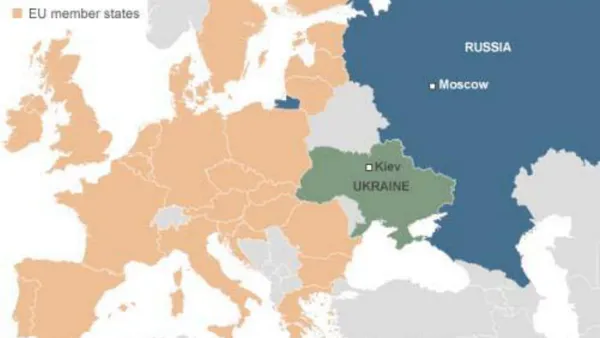
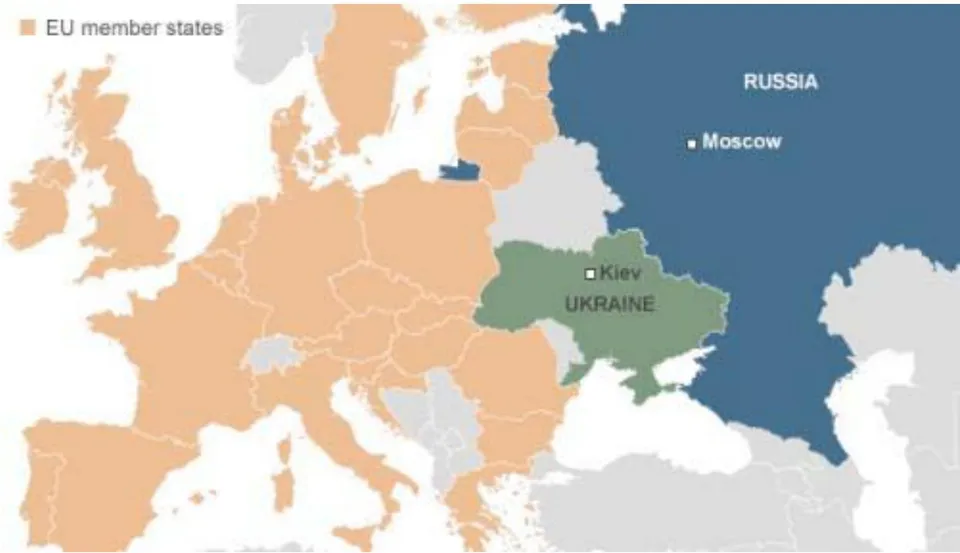
The international Crisis that unfolded upon the territory of the Ukraine - comprised of the Maidan protest and its seizure of the institutions of statepower in Kiev, the declaration of independence of Crimea and its reunification, the pre-emptive series of elections and referendums in Kiev, Luhansk, Donetsk, escalated to and by an intensifying civil war and humanitarian crisis, and military intervention - evinced a confrontation between two bordering international actors: the EU and Russia. Therein, the Crisis juxtaposes structural regional hierarchy - embodied by the EU - with anarchy in the international system both empirically and theoretically, in which Russia arises as light blue light of new civilizational liberal world order. Respective the neo-liberal institutional project is confronted with structural realism. The violent manifestation of such crises in the developed world was forecast in Mearsheimer's poignant 1990 article "Why We Will Soon Miss the Cold War", predicting a reversion to unbalanced multipolarity, which could result in interstate war between powers that the balanced bipolarity of the Cold War avoided (Mearsheimer, 1990, 1). The key Crisis fault lines are stacked within each other like a series of Matrioshki, around the dyads of players opposing each other: first, the state versus nation disjuncture; second, an European Eurasian powers border confrontation, and third drawing in other interested powers from the global arena, such as, China at the other extreme of the Eurasian landmass, the US which presents itself as the ever-willing North Atlantic balancer against the rise of significant European hegemons, and subsequently other powers that are interested to profit from or thwart the shifting polarity of the status-quo, including Turkey, Iran, Japan. The trouble is that "In the great-power politics of a multipolar world, who is a danger to whom and who can be expected to deal with threats and problems are matters of uncertainty."(Waltz, 1988, 9) This is precisely the Crisis situation, not only is there uncertainty on the actualized capabilities of powers due to the fast changes occurring, most significantly the intentions of the powers are put to question by the Crisis, as its resolution will change the balance of power at least incrementally, if not systemically (Gilpin, 1981, 234). The international Crisis in the Ukraine is caused at its core by a quest for security within the new and evolving structure of the post-Cold War world. While Constructivism explains the causality of human ideas crafting the variables at stake - anarchy, the state, and national identity; Offensive Realism predicts an unintended reversal to a balanced system regardless of the actors' intentions. The Crisis can be resolved through inter-state war, balancing using soft means (Nye, 2004, 7), or the extension of the hierarchical structures presented by Institutionalist tools. Whichever form the resolution will takes: it will reflect an actualized hierarchy of prestige (Gilpin, 1981, 24) corresponding to the balance of power in Eurasia in the second decade of the twenty-first century. Ultimately, however, the paper considers domestic factors, a domestic solution through open debate and agreement between the regions, and uses approaches from comparative politics to suggest the policy framework of consociationalism.
I. BACKGROUND OF CRISIS: STRATEGIC ASPECTS OF AXES AND FLOWS
On the chessboard of the contemporary multipolar structure theorized by structural realism, the role of the main actors in constituting the international Crisis are examined through the lens of the mirror-processes of balancing and bandwagoning. It is important to situate the Crisis at its inception, the creation of a Ukrainian state in 1991. The importance of this fact is not to be underestimated: a new unit is introduced into the state system, while another unit's territory and sovereignty is fractured as a result of the Cold War's end. This process of new state-creation is an act of balancing in and of itself. The 1990s did present a momentary shift from a balance of power system to a concert system. A concert usually arises following a major war, resulting in a system dominated by status quo states, which have succeeded in provoking the collapse of their rival (Jervis, 1986, 3), the Soviet Union. Powers at such times are less concerned about others taking advantage of their lowered guard due the cooperative spirit whose goal, remains preventing the resurgence of a recent common enemy by its integration into the system with regular open lines of communication. (Jervis, 1986, 6) At the same time, the US emerged as a power of unrivaled capabilities. Gilpin's Law of Uneven Growth suggests that other states had incentive to build up capabilities more efficiently (Gilpin, 1981, 124), such as, China, Germany, EU, Russia. Upon this canvas, concentric circles of internal and external balancing around the pivotal Ukraine -axis began to unfold: re-unifying Germany, decommissioning the Warsaw Pact Alliance, nuclearizing Ukrainian territory, and fortifying pan-European institutions. The concert system reverted to a balance-of-power system as the face of new poles became discernable, through power-gap minimization between the US and China, for example. The Ukrainian Crisis is driving a wedge between the EU and Russia, and thus preventing the domination over Eurasia by neither the EU, nor the Eurasian Union of States proposed by Moscow for creation in 2015, excluding China. While China has contracted Ukraine's wheat production for the next twenty years, and are benefitting from the EU and US-imposed sanctions on Russia, which are accelerating the drifting of Russian gas, petroleum, technological cooperation, and space cooperation Eastward to China. BRIC represents an important potential anti-G7 formation on a global scale. Apart from the evident regional hegemony that has been on China's agenda, best summed up with President Xi Jinping's 2013 announcement for the trans-Asian Silk Road Economic Belt and Maritime Silk Road which tie in South-East Asia, first; the Chinese envision a new era of bipolarity between themselves and the US (Carnegie Center Moscow). On the other pole, the US-Ukraine Charter on Strategic Partnership signed in 2008 and the NATO Membership Action Plan clearly indicates that for the US, the Crisis presents an opportunity to balance against Russia, and in the future as a counter-balance against Europe, following the case of Poland, one of the most favored EU-partners of the US. It is a reflection of the old adage of Brzezinski: "It is imperative that no Eurasian challenger emerges, capable of dominating Eurasia and thus also of challenging America" (Brzezinski, 1997, xii). All major actors involved are sieving their Crisis-policy through a balancing and bandwagoning prism, either as Walt postulates against a threat (Walt, 1987, 3) or as Schweller purports in order to maximize their interests (Schweller, 1994, 24). Bringing the revisionist state back in, Shweller defines balancing as the protection of interests already possessed; bandwagoning as obtaining interests sought after, and postulates that it is possible to engage in this behavior with both the status quo or the revisionist state depending on aligned interests (Schweller, 1994, 26): a markedly visible process surrounding the Ukrainian Crisis.
II. WHY DID IT HAPPEN? IDENTITIES, INTERESTS, AND SECURITY
The international Crisis is centered on the Ukraine for two principle reasons. First, in 1991 the
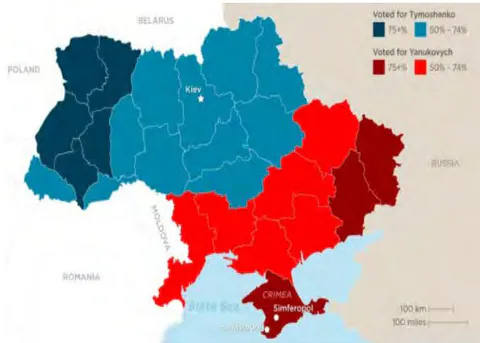
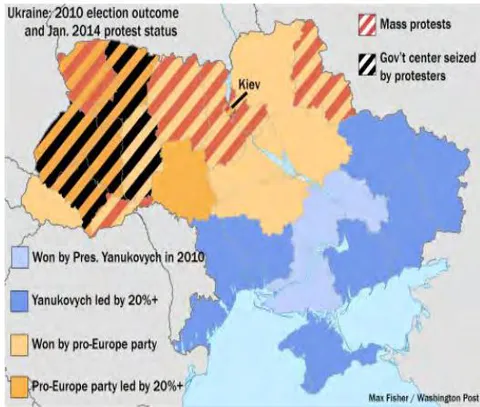
Ukrainian State assembled together populations divided not only on religious grounds (for example, amongst the Orthodox Christians there are three rival denominations) but also linguistically. "One can't oblige Ukraine, except through drama, to choose one camp over another" (Vitrine, 2014). Respectively, in the 2005 and 2010 presidential elections the West of the country voted 80 to for the "orange candidate" and the East voted 80 to for the "blue" one. The concentration of preferences dividing the Northwest from the Southeast encompassed even more areas by the 2010 elections as can be seen on the adjacent maps. In the last rounds of elections, voters in the East have not participated in the West-ballots whilst, voters in the West have not participated in the referendums carried out in the East. This societal cleavage reflects an explicit national dis-unity on the direction of the Ukraine as a unitary nation-state. Second, the Ukraine at its inception was a power of German dimension. (Mearsheimer, 1993, 4) Despite its denuclearization by 1996, it is a nuclear-power player and a significant transit state for gas pipelines; its territory is Europe's largest; a highly fertile arable land with vast natural resources, including rare earth metals essential for military production and respective military-facilities. The economic potential of these resources has ultimately been wasted, benefitting the Ukrainian oligarchs. Thus, besides a societal cleavage in terms of national identity, the successive protest movements highlighted corruption and the search for a solution to the pervasive challenges facing the Ukrainian economy. Some Ukrainians look West towards the EU, while other Ukrainians look East for a solution. At the same time the international powers seek a way to maintain influence over this strategically important state in terms of their own security interests, as is predicted by structural realism. With so much insecurity involved, the Crisis will be exacerbated until all interested domestic and international actors can define a mutually acceptable strategy for the future of the Ukraine.
The two-stage model of state behavior incorporates the importance of individual preferences as influencing state preferences and thus determining the nature of state interactions in the context of the external constraints of international structure. (Moravcsik, 1997, p. 544-545) Unraveling the causality of the Ukraine Crisis on this two-stage approach elucidates Second Image domestic causes of the Crisis. "Realist theory with its assumption of a unitary state and fixed preferences" (Moravcsik, 1997, 530), cannot fully explain why different segments of society are pushing towards different kinds of interaction with other states. "The liberal conception of power is based on an assumption that the willingness of states to expend resources or make concessions is itself primarily a function of preferences not capabilities." (Moravcsik, 1997, 523). Liberal theory exogenizes societal preferences as a separate variable constitutive of state preferences. Putnam mirrors the two-level model with a "general equilibrium" that considers both "second image" and "second-image reversed" that is the reciprocal relation between domestic causes and international effects, and international causes and domestic effects (Putnam, 1988, 1366). The Ukraine Crisis is a case in point that there is an interrelation between Second Image and Third Image causality: notably that the rebalancing is occurring around the Ukraine rather than another border state is due not only to its location but to the fact that conditions on the ground in Ukraine, in terms of interests and identities, had matured to a stage than a Crisis was ignited. These conditions were shaped by both domestic and international actors, and the Crisis in turn is re-shaping the relative power of domestic groups and international actors. "The most portentous development in the fields of comparative politics and international relations in recent years is the dawning recognition...of the need to take into account entanglements between the two" (Powell, 1991, 459-460). Alexander Wendt in developing Constructivism as a theory in International Relations unravels causality to an even more exalted dimension, notably evoking that anarchy itself, just as the state, and any other actor, process or structure that manifests itself in the international relations arena, is socially and historically constructed by ideas put forth by man, rather than constituted by material forces. The interests and identities of actors are a result of ideas rather than imposed by nature. (Wendt, 1994, 1) The Ukrainians are evidently expressing the consequence of the historical absence of a constitution of a national identity encompassing the entire territory of its post-1991 state-status. The Maidan-protests and the subsequent attempts of independence of different regions ignite a process of shaping the state.
III. WHAT WILL HAPPEN NEXT: INTENTIONS, INFORMATION, AND PERCEPTION
Four principles of structural and offensive realism underpin the prediction of the resolution of the Crisis. First, the assumption that "...it is virtually impossible for any state to achieve global hegemony," due to the presumed absence of nuclear superiority, indicates the continuation of a balance-of-power system (Mearsheimer, 2001, 136). Furthermore, hegemony is regionally limited by the challenge of projecting power across oceans (Mearsheimer, 2001, 137). Global hegemony is only possible if a great power is the only regional hegemon in the world (Mearsheimer, 2001, 137). Destabilizing the Ukrainian state further with a precipitated adhesion to an external alliance, such as, NATO or the SCO, would destabilize the regional balance. The status-quo of the US being the only regional hegemon is put into question by the Ukrainian Crisis, which could see the rise of a hegemon in Eurasia if the crisis spills over into inter-state war. The resolution of the Crisis must settle the question accurately by reflecting the balance of power between the US, EU, Russia, China in Eurasia with a corresponding hierarchy of prestige. Secondly, it is important to recognize that realism is a theory, not a foreign policy framework. (Waltz, 1959, 12) Although hard military means are frequently associated with offensive realism; military force is only one of a large set of tools available to states for securing their interests, survival, and security. Structural realism seeks to explain long periods of peace, as well as, the occurrence of inter-state war. (Jervis, 1999, 1) Third, although unbalanced multipolarity gives rise to uncertainty making it more war-prone (Mearsheimer, 2001, 196), incomplete information is the trigger that leads to war through the underestimation or overestimation of risk. Walt argues that offensive intentions, and not offensive capability, constitute a threat. It is the perception of intentions that is crucial. The potential for war between the great powers is limited if all actors are reasoning accurately and objectively about the costs and risks involved. The prediction supported by the empirical research suggests that the resolution will entail a peaceful settlement.
In the no-man's land of intentions and information, these two scarce and contested commodities in anarchy can either become the inevitable naïve causes of war through misperception and miscalculation, or be twisted in a true Machiavellian maneuver worthy of Sun-Tzu like smoke and mirrors to provoke war. Waltz argues that fear is a necessary but insufficient condition that makes anarchy a cause of war. (Waltz, 1959, 4). Fear is a psychological phenomenon that can be constructed. In the process of resolving the Ukrainian Crisis it is essential to avoid anachronistic remnants of Cold War or Second World War- mentality in Group Think and stereotyping, such as, Russia is a mighty nuclear power out to destroy Western democracy, despite actively cooperating with the West in countering Terrorism since 9/11 and facing the same threats at home; or Germany continues to seek Lebensraum in the depopulated Osten, despite successfully integrating the largest immigrant population and refugees in Europe. Russia has aggregate power, offensive capability, and it located in proximity to the Crisis. These are in themselves indeterminate variables in constituting a threat in accordance to Walt's Balance of Threat Theory The determinate variable constituting a threat are offensive intentions. In an October Foreign Affairs article, Mearsheimer analyzes Russia's response to the Crisis as defensive (Mearsheimer, 2014, Kissinger, 2014). Given that under a balance of power system offensive and defensive posturing are difficult to differentiate (Jervis, 1986, 19), this is a significant distinction. Constructivist Theory also serves to explain the current perception of Russia as threat, that is, expressing offensive international intention, whereas it has presented self-restraint when evidently it is faced with war on its Southeast border, a third and final stage of the sanctions, and suspension from the G7. The perception of Russia as threat is a distinctly socially and historically constructed phenomenon reflecting a continuation of the Cold War mentality, and specifically a quite irrational fear of the threat of Communist expansion. The policy of isolating Russia is socially constructed. "Anarchy is what the states make out of it." (Wendt, 1994, 1) States frequently absorb an externally imposed identity. Yet, due to changes in the domestic or international environment it faces, a given state's identity might not "conform to international expectations of the state's role" (Chafetz, 1996, 665) The Ukraine Crisis is constructing new lines of division in international politics, missing the opportunity of Concert presented by the end of the Cold War.
The successive US and EU eastward expansion of military and political institutions are redrawing the border of the Russian sphere of influence, already surrounded by "color revolutions" which invariably result in the placement of US or NATO troops ever-closer to the Russian territory. The 2008 US- Ukraine Charter included an increased US presence in Crimea with a NATO-seat in Sebastopol, home of the largest Russian naval base since 1784. After Georgia, the Crisis, presented the potential of turning the Ukraine and respectively Crimea into zones of controlled chaos, a direct threat to Russian security and sovereignty. Prior to the violent eruption of the Crisis, the European Commission consistently refused the Russian proposals to negotiate for Ukraine a simultaneous association with the EU and the Eurasian Union of States. Russia's 2008 proposal for a joint European Security Treaty has met a similar fate thusfar. The sanctions regime is forcing Russia to balance internally search for alliance partners regionally and globally, through alternative mechanisms, such as, the Silk Road and Eurasian Union. Walt's postulate on alliance behavior that "balancing predominates over bandwagoning", signifies that when balancing is prevalent, security is abundant as aggression is punished." (Walt, 1987, 116). However, in the current Crisis there are states that are self-interested to bandwagon with non-status-quo powers as well, meaning that security may become scarce. Russia may not have explicit offensive intentions, but its resolve to defend its state-security has been more than clearly signaled.
The current stalemate offers grounds for the beginning of a negotiation of a settlement, which would reflect the relative gains made during the Ukraine Crisis by each party. Where do the powers and Ukraine want to end up? (Kissinger, 2014). The approach seconded by Rodric Braithwaite, the final British Ambassador to the Soviet Union, offers a bargaining range that could elicit credible commitments from the actors. The settlement would guarantee some form of devolution for the contested regions, recognize the status of Crimea as part of Russia, and would put NATO membership up to a referendum comprising at least two-thirds of the population (Braithwaite), enabling the Ukrainian nation to have time to construct its national identity gradually. The first step would be to appoint a neutral intermediary to buffer between the parties, like Martii Ahtisaari, who successfully brought the Kosovo War to resolution. "The prospects for cooperation are... sensitive to the cost of fighting. If the use of force is no longer at issue, then a state's relative loss will not be turned against the state. Relative gains no longer matter, and cooperation now becomes feasible." (Powell, 1991, 1316) Ultimately, these negotiations can be conducted when the ceasefire agreement is respected.
IV. ENDING OF THE INTERNATIONAL
RELATIONS STRUCTURAL CONFRONTATION IN THE UKRAINE
In answering the question, why did the current international crisis in Ukraine occur and what will the resolution of the crisis be? the conclusion is reached that: the Crisis has first, second, and third image causality (Waltz, 1959, 10), yet the determining factor providing the constraints for Crisis-resolution is located in the third image of IR Theory. Distinguishing between the three levels of analysis in IR theories allowed the identification of Realist, Institutionalist, Liberal, and Constructivist causal variables constitutive of the Crisis. The empirical research demonstrates complex causes, which interact across the levels of analysis. Theories that stress the interactions across Waltz- images and recognize the structural constraints of anarchy were highlighted. Moravcik and Putnam's two-level symbiotic consideration of state-society preferences, theoretically and in the practice of diplomacy, provided a viable alternative explanation. The conception is that international society influences sub-national society and vice-versa, thus constituting state preferences through a transnational exchange between societal groups. This explanatory model reflects a more profound set of variables useful in encompassing the scope of causes that have led to the Crisis, including the significant issue of societal preferences, which have been at odds with state preferences throughout the Ukraine's brief history, regardless of whether the state promoted a pro-Russian or pro-Western agenda. Putnam correctly introduces his model by drawing attention to the fact that the matter in theoretical dispute is not whether state and society influence each other's preferences; but rather the question to ask is "When?" and "How?" (Putnam, 1988, 427) Institutionalism follows this two-level causal chain replacing the actors tandem with state-international institutions relations. This tandem mutually affects preferences (Jervis), while mutual state-interests lead to cooperation and interdependence creating the necessary symbiosis of preferences and interests that makes international institutions viable. (Keohane, 1995, 44) Alexander Wendt's Constructivism provides the most comprehensive conception for the causes of the Crisis. The historical and societal misconstruction of: the modern Ukrainian state and national identity, the anachronism of perceiving states today through a Cold War mentality, and of anarchy in the post-Westphalian international system - is the unifying explanatory variable that acts simultaneously across the three levels of analysis, the latter themselves having been historically, socially, and ideationally constructed. Wendt concurs with Waltz that the structure of the international system is anarchic. "Anarchy is what states make of it." (Wendt, 1992, 391) The resolution of the Crisis is firmly rooted in evaluating the different ways in which anarchy can be navigated by the actors to resolve the Crisis. Thereby, anarchy, that is the real threat of inter-state war is treated as the overall constraint shaping the possible resolution of the Crisis. Due to the involvement of major international powers in the Crisis, the cost of war is high for all parties. The resolution is located in the overlap of the win-set and bargaining range mutually acceptable to all parties and reflects an Institutionalist approach of economic cooperation to expand the relative gains of the parties and shift from a pure war-model bargaining calculation. This will assuage interests, while allowing for a political solution which balances states in a way that security is maximized. This will involve the gradual preparation of the Ukraine for EU and/or EAU membership, which includes the protection of the rights of all its citizens. The question of NATO membership should be carefully approached upon, and is impossible in practice without a formal recognition by the US of the
Crimean base as Russian territory with a respective land corridor granted to Russia.
V. THE FUTURE OF THE REGIME: DECENTRALIZING THE PATH TO DEMOCRACY
A central debate in comparative politics reflects the tension between two opposing forces: the regional pooling of sovereignty and territory in federal projects (exemplified by the EU) and the fragmentation of sovereignty and territory through secession movements (such as, Kosovo, Scotland, and Crimea). The current situation in the Ukraine exposes a confrontation of these two opposing forces both theoretically and empirically. The European project for regional hierarchy confronts a state in anarchy, that is, in the post-Westphalian international structure. The enduring significance of the territorial state as an organizing principle is not directly challenged by the domestic turmoil in the Ukraine, as the movements within the peripheries of the existing state to form new autonomous states simply reproduce the existing since 1648 organizing logic of a society of states. However, the Ukrainian question exposes the friction of the non-congruence of nation and state, which is currently exacerbated by what is proving to be a premature project of EU-integration that is leading to the politicization and polarization of sub-state identities along an additional line of fragmentation of society. Traditionally, there have been three different solutions to the non-congruence of nation and state: assimilation (nation-building), secession (resistance to assimilation), and accommodation (self-rule and shared rule). Which one of these outcomes can arise in the Ukraine in view of both the domestic societal pressures, as well as, the external pressures arising from the limits of European integration and the dynamics of political rule in Russia. The theories of Esping-Anderson, Lijphart (on societal divisions and institutional arrangements and their impact on regime), Meadwell (on tools and logics of rational political bargaining and their impact on the state), Carothers, Bova, and Risse-Kappan (on the path of democratization) are applied to evaluate the basis for the political turmoil in the Ukraine. A political bargain is proposed based on consociationalism, territorial and multinational federalism, and political decentralization. The conclusion reached is that the engineering of political decentralization in the Ukraine is the mechanism through which violent scission can be avoided. Decentralization should reflect a form of power-sharing which redresses economic imbalance, as well as, accommodates cultural heterogeneity in the current state-territory in order to provide a legitimate democratic regime in the Ukraine. The question remains who can implement the political bargain, given that no self-enforcing is currently taking place; and the conflict for foreign influence from the EU, US, and Russia is fueling division in the Ukraine rather than tempering it.
The establishment of the state of Ukraine was supported by an Independence Referendum held in 1991, where-in of 31,891,742 registered voters, representing of the electorate, supported the establishment of a unitary Ukrainian state. (Nohlen, 2010, 1985). "Ukrainian sociologists have shown that the rise of pro-autonomy tendencies is transitory, and mainly a defensive reaction to how Kiev deals...." (Shapovalova, 2014, 4) Thus respectively the parties who find themselves in opposition to the government in power, including Timoshenko's Bloc in 2004 and Yanukovich's Party of the Regions in 2009, generally campaign on a platform of decentralization while parliamentary deputies use their power to curtail the executive. Once the opposition gains control over the executive branch of the unitary state following the repeated crises in the country, measures for decentralization are moderated and curtailed by both the so-called pro-EU and pro-Russian politicians. The newly elected May 2014 administration appears to be following the same route, contrary to the stated policy objectives of the Maidan protest: which included 1) curtailing the power of the Oligarchs, 2) decentralization of power to the periphery, and 3) integration of economic and political practice in line with European integration. On the first policy expectation of Maidan: it appears that the oligarchs continue to wield power through a selection of news presented on the media channels they own. President Poroshenko is one of Ukraine's eight principle billionaires (Forbes, 2014), while other oligarchs are consolidating their power under the new government. For example, oligarch Kolomoisky's rose to political power in 2014 as governor of Dnepropetrovsk, financed a private policing force, and proposed a bounty-award for each captured rebel. These events suggest that oligarchs will continue to shape politics in the new government. (Forbes, 2014) On the second policy expectation of Maidan: Although a law for Special Self-Government Procedures in Donetsk and Luhansk regions was passed in the Verhovna Rada on September , and signed into force on October by President Poroshenko; the latter has threatened to repeal the law on November (Interfax Ukraine, Nov 5, 2014). The uncertainty arising from the non-recognition of the local leaders of Donetsk and Luhansk elected on November , effectively fuels a continued resistance to assimilation. Consequently, "activists do not believe that the new political arrangements after concessions are self-enforcing. Rather, these arrangements are considered to be vulnerable to further political mobilization" (Meadwell, 2008, 3). The situation is further exacerbated by the announcement of the new cabinet of Ukraine on December , which includes three foreign nationals as Ministers of State. Previously the Ukrainian government had been criticized for including oblast non-residents on oblast pre-election lists as a measure hampering local representation and accountability following the introduction of proportional representation in local elections in 2006. The appointing of oblast non-residents to governor positions, such as, the Donetsk-born governor of Crimea in 2010 also met harsh criticism. Yet, the current appointment of non-Ukrainian citizens, some of whom have served in non-Ukrainian governments, to key cabinet positions in Kiev and the expectation that this will follow suit across the administration is unprecedented. On the one hand, "Diasporas, it has been argued, tend on average to be more radical than the median individual in the group back home because they do not have to bear the potential costs of radicalism." (Fearon, 1998, 16) This is likely to cause additional insecurity about the legitimacy and sovereignty of the government in power. This reflects a tendency towards ostracization of representatives of significant pillars of the Ukrainian population. A policy of conciliation and crisismanagement would see ministerial positions being granted to Ukrainian nationals of different colors in an effort to build a coalition government. "[Civil] violence might be profitably understood as a species of preventive war, and the real problem of preventive war is the inability to make commitments in an anarchic environment" (Fearon, 1995, 3). Meadwell posits "that there can be a form of heterogeneity which is not about identity per se. This form is a potential challenge to at least some kinds of institutional arrangements but it is not motivated by the desire to have a state of one's own. Instead it is motivated by the fear of excessive centralization of power" (Meadwell, 2008, 19). Political heterogeneity is evaluated in contrast to cultural heterogeneity, as "motivating challenges to the state itself to get some protection from excessive concentration of power, rather than recognition of identities" (Meadwell, 2008, 23). In contrast to the cultural challenge, the political challenge is "skeptical about both sovereignty and nationalism" and "seeking to hollow out the state by decentralizing public authority" (Meadwell, 2008, 24). A paradox arises: "If the stability of decentralized institutional arrangements is not self-enforcing but is enforced, then it depends on impositions. But this is exactly the problem that motivates the political fear of centralization" (Meadwell, 2008, 24). Respectively, it must be recognized that the entities and persons creating the institutional design are part of the problem to which they seek a solution (Meadwell, 2008, 24). The dilemma in a situation as seen in the Ukraine is to create an institutional design that is self-enforcing to be scission-proof, otherwise it must be imposed from the outside, making it undemocratic (Meadwell, 2008, 24).
As to depolarizing the current vertical division created as a result of the Maidan protest, Fearon suggests a corresponding approach to international actors: "If national identities are not fixed and historically given, if they can be constructed over time, then privileging national communities internationally creates incentives for political entrepreneurs to "rediscover" and construct national identities at successively more local levels" (Fearon, 2002, 16). This is the principle that the EU espouses to uphold, and as such should require a pre-existing respect for others (minority/majority rights) from the Ukraine. "A foreign policy that makes consociational democracy a priority deserves a serious look" (Fearon, 2002, 16). Bova cautions: "One might view the transitions under way in the USSR as a transition to rather than from the kind of authoritarian rule that other nations in Europe... have been trying to transcend" (Bova, 1991, 114-5).
The confluence of domestic and international pressures as exhibited in the current situation in the Ukraine raise questions about the future of the Westphalian principle of non-intervention between states, as well as, about the evolution of the democratic regime type within the states. Since its sudden independence, the Ukraine found itself between three models for state and regime-transformation, as influenced by Europe, the US, and Russia. The evolution of the state-society relation suggests that the latent civil war could be undone by an institutional procedure that would make a highly decentralized federal state of the country. Mark Eyskens, former Prime Minister, argues that Belgian federalism has three specific characteristics that the Ukrainian government might be strongly interested in. First, Belgium evolved from a unitary state to a federation and presents an example of progressive accommodation which could be a basis for institutional engineering in the Ukraine in the form of domestic disassociation. Second, Belgian federalism is twofold with regions, responsible for territorial matters and communities who are competent for cultural matters. This model fits well in Ukraine with its Russian and Ukrainian-speaking populations. The structure of Ukrainian federalism could be reflected at two levels: that of the oblasts, on the one hand, which are federated entities holding powers linked to territory and economy, and that of the language-communities, on the other, which manage cultural, linguistic and personalized policy-issues, such as, health care. Belgian federalism superimposes three levels of equal power, capturing the different overlapping layers of societal division. This is a captivating model for the Ukraine, as there is similarity in the structure of society and the geographic distribution of wealth-production. Third, the Belgian regions can sign international agreements abroad. A Ukrainian federation would permit each region to form its respective separate international association and trade treaties, which could placate the international pressures upon the Ukrainian state. The Eastern Ukraine could conclude a cooperation agreement with Russia and Western Ukraine with the EU, while the state borders of Ukraine remain fixed.
The costs of a scission constitute the ultimate guarantees for the survival of a decentralized or federal state, provided the necessary incentives are granted to the South-East regions to remain a part of the state. A significant part of strategic industries located in the South East, raising the cost for scission for the North West. The current political and economic bargain proposed by Kiev is drive these regions to seek a solution outside of the existing state, influenced by the limits of European integration. Global governance institutions should enable the resolution of conflicts, curtail violence ad anarchy in the international system, in the event that regional solutions to reach peace, and liberty. There should be peace between and within all countries of the world. Peace between states is the new position of the international order and theory of international relations.