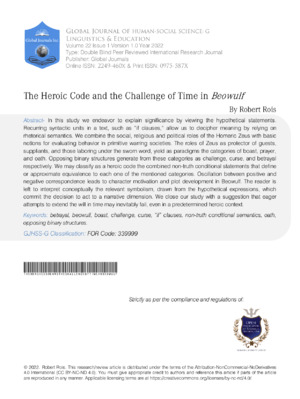
The Heroic Code and the Challenge of Time in Beowulf

Robert P Rois
Robert P Rois
Robert Rois
Robert Rois

Send Message

To: Author

The Heroic Code and the Challenge of Time in Beowulf

Article Fingerprint

ReserarchID

ZZI1P

The Heroic Code and the Challenge of Time in Beowulf Banner

AI TAKEAWAY

Connecting with the Eternal Ground
  • English
  • Afrikaans
  • Albanian
  • Amharic
  • Arabic
  • Armenian
  • Azerbaijani
  • Basque
  • Belarusian
  • Bengali
  • Bosnian
  • Bulgarian
  • Catalan
  • Cebuano
  • Chichewa
  • Chinese (Simplified)
  • Chinese (Traditional)
  • Corsican
  • Croatian
  • Czech
  • Danish
  • Dutch
  • Esperanto
  • Estonian
  • Filipino
  • Finnish
  • French
  • Frisian
  • Galician
  • Georgian
  • German
  • Greek
  • Gujarati
  • Haitian Creole
  • Hausa
  • Hawaiian
  • Hebrew
  • Hindi
  • Hmong
  • Hungarian
  • Icelandic
  • Igbo
  • Indonesian
  • Irish
  • Italian
  • Japanese
  • Javanese
  • Kannada
  • Kazakh
  • Khmer
  • Korean
  • Kurdish (Kurmanji)
  • Kyrgyz
  • Lao
  • Latin
  • Latvian
  • Lithuanian
  • Luxembourgish
  • Macedonian
  • Malagasy
  • Malay
  • Malayalam
  • Maltese
  • Maori
  • Marathi
  • Mongolian
  • Myanmar (Burmese)
  • Nepali
  • Norwegian
  • Pashto
  • Persian
  • Polish
  • Portuguese
  • Punjabi
  • Romanian
  • Russian
  • Samoan
  • Scots Gaelic
  • Serbian
  • Sesotho
  • Shona
  • Sindhi
  • Sinhala
  • Slovak
  • Slovenian
  • Somali
  • Spanish
  • Sundanese
  • Swahili
  • Swedish
  • Tajik
  • Tamil
  • Telugu
  • Thai
  • Turkish
  • Ukrainian
  • Urdu
  • Uzbek
  • Vietnamese
  • Welsh
  • Xhosa
  • Yiddish
  • Yoruba
  • Zulu
Font Type
Font Size
Font Size
Bedground

Abstract

In this study we endeavor to explain significance by viewing the hypothetical statements. Recurring syntactic units in a text, such as “if clauses,” allow us to decipher meaning by relying on rhetorical semantics. We combine the social, religious and political roles of the Homeric Zeus with basic notions for evaluating behavior in primitive warring societies. The roles of Zeus as protector of guests, suppliants, and those laboring under the sworn word, yield as paradigms the categories of boast, prayer, and oath. Opposing binary structures generate from these categories as challenge, curse, and betrayal respectively. We may classify as a heroic code the combined non-truth conditional statements that define or approximate equivalence to each one of the mentioned categories. Oscillation between positive and negative correspondence leads to character motivation and plot development in Beowulf. The reader is left to interpret conceptually the relevant symbolism, drawn from the hypothetical expressions, which commit the decision to act to a narrative dimension. We close our study with a suggestion that eager attempts to extend the will in time may inevitably fail, even in a predetermined heroic context.

References

27 Cites in Article
  1. S Andrews (1969). Recent Literature: Various Contributions by Russell to Books, 1969-71.


  2. Stephen Barney (1977). Word-Hoard. An Introduction to Old English Vocabulary.
  3. Andrew Barton (2018). The Knight's Progress and Virtual Realities: The Medieval Adventure from Beowulf to Ready Player One.
  4. Beowulf (1968). Unknown Title.
  5. Joseph Bosworth (1976). CHAPTER 7 Supplementing: T. Northcote Toller’s An Anglo-Saxon Dictionary Supplement (1921).
  6. M Clanchy (1979). From Memory to Written Record.
  7. R Fulk (2008). Klaeber's Beowulf and the Fight at Finnsburg.
  8. D Green (1965). The Carolingian Lord: Semantic Studies in Four Old High German Words: Balder, Frô, Truhtin, Hêrro.
  9. Stanley Greenfield (1974). 'Gifstol' and goldhoard in Beowulf.
  10. Donald Fry (1982). The Wisdom of Poetry: Essays in Early English Literature in Honor of Morton W. Bloomfield ed. by Larry D. Benson, Siegfried Wenzel.
  11. John Hill (1965). Cultural World in Beowulf.
  12. Otto Jespersen (1949). A Modern English Grammar on Historical Principles.
  13. Stefan Jarisinski (2006). Ancient Priviliges: "Beowulf," Law, and the Making of Germanic Antiquity.
  14. Fr Klaeber (1950). Beowulf and the Fight at Finnsburg.
  15. Felix Liebermann (1916). Die Gesetze der Angelsachsen.
  16. Claude Lévi-Strauss (1963). Structural Anthropology.
  17. Lloyd-Jones,Hugh (1983). The Justice of Zeus.
  18. Albert Lord (1976). The Singer of Tales.
  19. Fabienne Michelet (2015). Hospitality, hostility, and peacemaking in Beowulf.
  20. John Niles (1974). Ring Composition and the Structure of <i>Beowulf</i>.
  21. Andy Orchard (2007). A Critical Companion to "Beowulf.
  22. Marie Borroff (1976). John Collins Pope: a bibliography.
  23. Alain Renoir (1963). <i>Studies in Old English Literature in Honor of Arthur G. Brodeur</i>. Stanley B. Greenfield.
  24. Fred Robinson (1985). APPOSITIVE STYLE AND THE THEME OF BEOWULF.
  25. Ursula Schaefer (1997). A Beowulf Handbook by Robert E. Bjork and John D. Niles (review).
  26. Thomas Shippey (1997). A Beowulf Handbook by Robert E. Bjork and John D. Niles (review).
  27. David Williams,Cain (1982). Beowulf:" A Study in Secular Allegory.

Funding

No external funding was declared for this work.

Conflict of Interest

The authors declare no conflict of interest.

Ethical Approval

No ethics committee approval was required for this article type.

Data Availability

Not applicable for this article.

How to Cite This Article

Robert P Rois. 2026. \u201cThe Heroic Code and the Challenge of Time in Beowulf\u201d. Global Journal of Human-Social Science - G: Linguistics & Education GJHSS-G Volume 22 (GJHSS Volume 22 Issue G1).

Download Citation

A scholarly article analyzing the iconic epic's treatment of time and its mythic symbolism.
Journal Specifications

Crossref Journal DOI 10.17406/GJHSS

Print ISSN 0975-587X

e-ISSN 2249-460X

Keywords
Classification
GJHSS-G Classification FOR Code: 339999
Version of record

v1.2

Issue date
February 11, 2022

Language
en
Experiance in AR

Explore published articles in an immersive Augmented Reality environment. Our platform converts research papers into interactive 3D books, allowing readers to view and interact with content using AR and VR compatible devices.

Read in 3D

Your published article is automatically converted into a realistic 3D book. Flip through pages and read research papers in a more engaging and interactive format.

Article Matrices
Total Views: 1891
Total Downloads: 48
2026 Trends
Related Research
Our website is actively being updated, and changes may occur frequently. Please clear your browser cache if needed. For feedback or error reporting, please email [email protected]

Request Access

Please fill out the form below to request access to this research paper. Your request will be reviewed by the editorial or author team.
X

Quote and Order Details

Contact Person

Invoice Address

Notes or Comments

This is the heading

Lorem ipsum dolor sit amet, consectetur adipiscing elit. Ut elit tellus, luctus nec ullamcorper mattis, pulvinar dapibus leo.

High-quality academic research articles on global topics and journals.

The Heroic Code and the Challenge of Time in Beowulf

Robert Rois
Robert Rois

Research Journals