Neural Networks and Rules-based Systems used to Find Rational and Scientific Correlations between being Here and Now with Afterlife Conditions
Neural Networks and Rules-based Systems used to Find Rational and
Article Fingerprint
ReserarchID
LI9J4
Maria Cristina Celuppi
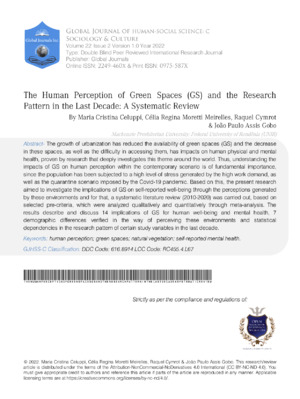
The growth of urbanization has reduced the availability of green spaces (GS) and the decrease in these spaces, as well as the difficulty in accessing them, has impacts on human physical and mental health, proven by research that deeply investigates this theme around the world. Thus, understanding the impacts of GS on human perception within the contemporary scenario is of fundamental importance, since the population has been subjected to a high level of stress generated by the high work demand, as well as the quarantine scenario imposed by the Covid-19 pandemic. Based on this, the present research aimed to investigate the implications of GS on self-reported well-being through the perceptions generated by these environments and for that, a systematic literature review (2010-2020) was carried out, based on selected pre-criteria, which were analyzed qualitatively and quantitatively through meta-analysis. The results describe and discuss 14 implications of GS for human well-being and mental health, 7 demographic differences verified in the way of perceiving these environments and statistical dependencies in the research pattern of certain study variables in the last decade.
Maria Cristina Celuppi. 2026. \u201cThe Human Perception of Green Spaces (GS) and the Research Pattern in the Last Decade: A Systematic Review\u201d. Unknown Journal GJHSS-C Volume 22 (GJHSS Volume 22 Issue C2): .
The methods for personal identification and authentication are no exception.
Total Score: 104
Country: Brazil
Subject: Uncategorized
Authors: Maria Cristina Celuppi, Célia Regina Moretti Meirelles, Raquel Cymrot, João Paulo Assis Gobo (PhD/Dr. count: 0)
View Count (all-time): 76
Total Views (Real + Logic): 1556

Total Downloads (simulated): 25

Publish Date: 2026 01, Fri
Monthly Totals (Real + Logic):
Neural Networks and Rules-based Systems used to Find Rational and
A Comparative Study of the Effeect of Promotion on Employee
The Problem Managing Bicycling Mobility in Latin American Cities: Ciclovias
Impact of Capillarity-Induced Rising Damp on the Energy Performance of
The growth of urbanization has reduced the availability of green spaces (GS) and the decrease in these spaces, as well as the difficulty in accessing them, has impacts on human physical and mental health, proven by research that deeply investigates this theme around the world. Thus, understanding the impacts of GS on human perception within the contemporary scenario is of fundamental importance, since the population has been subjected to a high level of stress generated by the high work demand, as well as the quarantine scenario imposed by the Covid-19 pandemic. Based on this, the present research aimed to investigate the implications of GS on self-reported well-being through the perceptions generated by these environments and for that, a systematic literature review (2010-2020) was carried out, based on selected pre-criteria, which were analyzed qualitatively and quantitatively through meta-analysis. The results describe and discuss 14 implications of GS for human well-being and mental health, 7 demographic differences verified in the way of perceiving these environments and statistical dependencies in the research pattern of certain study variables in the last decade.
We are currently updating this article page for a better experience.
Lorem ipsum dolor sit amet, consectetur adipiscing elit. Ut elit tellus, luctus nec ullamcorper mattis, pulvinar dapibus leo.