
I. INTRODUCTION
The manufacturing sector in Nigeria is striving to thrive and overcome the various challenges in the current competitive market by enhancing their organizational efficiency [17, 16 and 18]. To achieve better results and increase profit margins, firms in the sector are implementing various cutting-edge business tools and management approaches, such as corporate social responsibility, employee engagement, and employee satisfaction [1]. As companies are facing mounting pressure from stakeholders to become more socially and environmentally responsible and to focus on understanding the impact of engaged employees on business outcomes like productivity and profitability [22], corporate social responsibility has become a crucial issue for corporations globally [24]. Both customers, investors, and other stakeholders, as well as business organizations, have shown interest in corporate social responsibility because it is believed that engaging in socially desirable activities can positively impact a firm's financial performance [19]. Additionally, Ali et al. [1] indicated that the interest in corporate social responsibility also arises from the fact that it strengthens the bond between employees and corporations and leads to better employee and organizational performance.
Manufacturing firms are striving to be more mindful of their performance by placing emphasis on employee performance. In this regard, they seek individuals who will go beyond their assigned job duties, foster teamwork, and assist their colleagues, employers, and clients [13]. Employee engagement is seen as a critical concern for companies who consider their workforce as their most valuable asset [10]. Nonetheless, leaders are aware of the various obstacles that hinder employee engagement. But organizations that can overcome these challenges have great potential for growth, particularly in terms of business performance [14]. Disengaged employees can negatively impact productivity and profitability [12] [15]. Therefore, organizations must cultivate an environment that encourages employee involvement and implement strategies that maintain this involvement to secure exceptional organizational performance.
II. STATEMENT OF THE PROBLEM
In recent years, multiple authors have explored the connection between Corporate Social Responsibility (CSR) activities and employee performance, specifically in regards to employee engagement, commitment and satisfaction. The studies have suggested a positive correlation between the constructs [20, 25, 24, 6, 15, 16]. Further research and understanding is necessary in regards to the relationship between corporate social responsibility, employee engagement, commitment and satisfaction, particularly in developing countries such as Nigeria. This paper seeks to investigate the impact of corporate social responsibility on employees of manufacturing firms in Nigeria in relation to employees' engagement, commitment and satisfaction. The paper will endeavour to answer the following questions:
What is the effect of corporate and social responsibility on the engagement of the employees in the Nigeria manufacturing sector?
What is the impact of CSR on employees' commitment in the Nigeria manufacturing sector?
What is the impact of CSR on employees' satisfaction in the Nigeria manufacturing sector?
III. RESEARCH HYPOTHESES
The following research hypotheses will be used to guide the study:
- Ho1: There is no significant effect of corporate and social responsibility on the engagement of the employees in the Nigeria manufacturing sector
- Ho2: There is no significant impact of CSR on employees' commitment in the Nigeria manufacturing sector
- Ho3: There is no significant impact of CSR on employees' satisfaction in the Nigeria manufacturing sector
IV. OBJECTIVE OF THE STUDY
The main objective of this study is to examine the impact of CSR on the employees' performance in the Nigeria manufacturing sector. The specific objectives are to:
Observe the effect of corporate and social responsibility on the engagement of the employees in the Nigeria manufacturing sector.
Examine the impact of CSR on employees' commitment in the Nigeria manufacturing sector.
Ascertain the impact of CSR on employees' satisfaction in the Nigeria manufacturing sector.
This study focuses on the impact of CSR on the employees' performance in the Nigeria manufacturing sector. The study is centered on the male and female employees of the Nigeria manufacturing sector. However, the study makes use of 30 manufacturing firms' headquarters in Lagos state out of the six South west states in Nigeria (Lagos, Osun, Ogun, Ondo, Ekiti and Oyo states). Lagos state is chosen because it remains the industrial hub of the Southwest region of Nigeria where employees in the state are educated and conversant with CSR in the region.
V. LITERATURE REVIEW
a) Corporate Social Responsibility (CSR)
Corporate Social Responsibility (CSR) refers to the voluntary actions taken by a company to address social and environmental issues that go beyond its legal obligations. CSR encompasses various activities such as community involvement, employee relations, ethical sourcing, environmental sustainability, and philanthropy [1]. The concept of CSR has gained widespread attention in recent years due to increased awareness of the social and environmental impact of businesses. CSR is believed to enhance a company's reputation and contribute to long-term financial success [8, 6, 15,16, 17]. Furthermore, CSR has become an important consideration on for consumers, investors, and other stakeholders who are increasingly looking for companies that align with their values (Carroll, 1991). Organizations have realized that embracing a socially responsible approach to their operations is crucial. This understanding stems from the various social, economic, legal, ethical, and environmental issues that organizations must navigate, and the realization that solely focusing on economic management to achieve goals is no longer viable [16]. In addition, organizations are facing pressure from a multitude of stakeholders, including communities, regulators, NGOs, activists, socially responsible investors, etc., to act as responsible corporate citizens [4]. As noted in [7], organizations engage in corporate social responsibility for multiple reasons, all of which help enhance their financial portfolio.
Organizations have the ability to engage in various forms of corporate social responsibility, such as promoting a positive work environment for employees, being considerate towards investors, being environmentally conscious, upholding ethical standards, showing respect for communities, and supporting causes such as the arts and universities [15]. [16] suggests that organizations can demonstrate social responsibility by being environmentally responsible, treating employees fairly, and contributing to cultural and arts programs in the community. Engaging in socially responsible activities brings many benefits to organizations, such as improving relationships with stakeholders by reducing conflicts and increasing loyalty [8]. It can also enhance corporate reputation, reduce organizational costs by creating positive social impacts and reducing negative ones, align corporate and social values, identify new opportunities, and lead to positive performance results. There are various methods used to evaluate a company's level of corporate social responsibility. One approach proposed dividing CSR into four categories: economic, legal, ethical, and discretionary. Another suggested examining CSR from the viewpoint of different stakeholders. Additionally, some scholars have proposed categorizing CSR practices into internal and external social responsibilities (as cited in references 18, 12, and 22), however, internal CSR will serve as the basis for measurement in this study.
b) Internal CSR
Internal corporate social responsibility (CSR) encompasses all aspects of a company's internal operations [22]. It concentrates on enhancing the well- being and productivity of employees, which ultimately impacts the organization's profitability [22]. Internal CSR practices refer specifically to those initiatives aimed at improving the physical and psychological working environment for employees [12]. As employees are regarded as crucial internal stakeholders, the focus on them is crucial for the success of the organization [20]. According to [24], internal CSR practices can be divided into four categories, known as "value classes," which address employee development, social justice, health and safety in the workplace, worker satisfaction and well-being, and work quality.
c) CSR Toward Employees
The socially responsible actions of an organization that are specifically aimed at employees are more likely to have a significant impact on their performance due to their exclusive focus on employee welfare. Such activities, such as fair treatment, professional development opportunities, and consideration of employee needs and opinions, create a positive work environment and increase the employees' sense of organizational support. Research supports this, with a study by Liu et al., [18] finding that socially responsible HR practices positively influence employee behavior through increased organizational identification. Similarly, [18] found a strong correlation between a company's perceived social responsibility toward employees and job performance.
d) Employee Engagement
In today's constantly evolving business world, company leaders have come to understand the importance of having a high-performing workforce for the success and longevity of their organizations. This has led to employee engagement becoming a crucial focus for companies as a highly engaged workforce has been shown to boost innovation, productivity, and financial performance, as well as lower the costs associated with hiring and retaining top talent [14]. The term was first introduced into academic literature by [19], who suggested that personal engagement occurs when individuals bring their personal selves into or exclude them from their work roles [20] defined employee engagement as a positive outlook that employees have towards the organization and its values. In this definition, engaged employees are well-informed about the company's context and work collaboratively with their colleagues for the benefit of the organization. Studies have shown that organizations with high levels of employee engagement are also more likely to have a strong CSR commitment [14]. Engaged employees are more likely to support and participate in CSR initiatives, and they are also more likely to align their personal values with the values of the organization [14]. Moreover, a strong CSR culture can positively impact employee engagement by creating a sense of purpose and meaning in the workplace [19].
e) Employee Commitment
Employee commitment is an essential aspect of organizational success, as it is associated with various positive outcomes, including improved job satisfaction, higher levels of productivity, and reduced turnover [7]. Commitment can be influenced by various factors, including the organization's policies and practices, as well as the employees' perceptions and attitudes towards the organization. Research has indicated that employees who work for organizations with strong CSR practices tend to have higher levels of commitment and job satisfaction [18]. For example, a study by [18] found that employees who worked for organizations with a strong CSR orientation were more likely to be engaged and committed to their work, and less likely to consider leaving the organization. Moreover, employees who perceive their organizations as socially responsible are more likely to be proud of their organization, and to recommend it to others [21]. This, in turn, can positively impact the organization's reputation and overall performance.
f) Employee Satisfaction
Employee satisfaction is a critical component of organizational success, as it affects employee motivation, productivity, and overall job performance (Robbins & Judge, 2007). Corporate Social Responsibility (CSR) is a term used to describe a company's commitment to operating in an ethical and responsible manner, taking into account the impact of its activities on stakeholders, including employees [16]. Studies have shown that CSR activities positively impact employee satisfaction. For example, research by McDonald and Galbreath (2009) found that employees who perceived their employers to be engaged in CSR activities had higher levels of job satisfaction and organizational commitment. Additionally, a study by [19] found that employees who work for organizations with a strong commitment to CSR tend to have higher levels of job satisfaction and lower levels of burnout. Furthermore, CSR initiatives can help foster a sense of purpose and belonging among employees, leading to increased job satisfaction. For instance, a study by Lindgreen and Swaen (2010) found that employees who work for companies that engage in CSR activities feel more connected to their organization and have a stronger sense of purpose.
VI. THEORETICAL FRAMEWORK
a) Social Exchange Theory
This study is hinged on the social exchange theory. The social exchange theory, originally put forth by Blau in 1964, states that reciprocity plays a crucial role in shaping relationships within organizations. If an organization treats its employees with fairness, kindness, and care, employees are likely to respond in kind. Over time, this mutual exchange of positive behavior leads to the development of trust, loyalty, and commitment. To better understand this social exchange relationship, the concepts of leader-member exchange and trust have been studied. Leader-member exchange refers to the relationship between employees and their supervisors or leaders, while trust refers to the exchange
relationship between employees and their employers and immediate supervisors.
b) Conceptual Framework
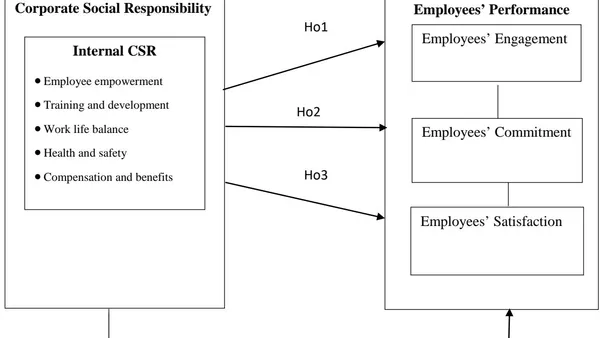
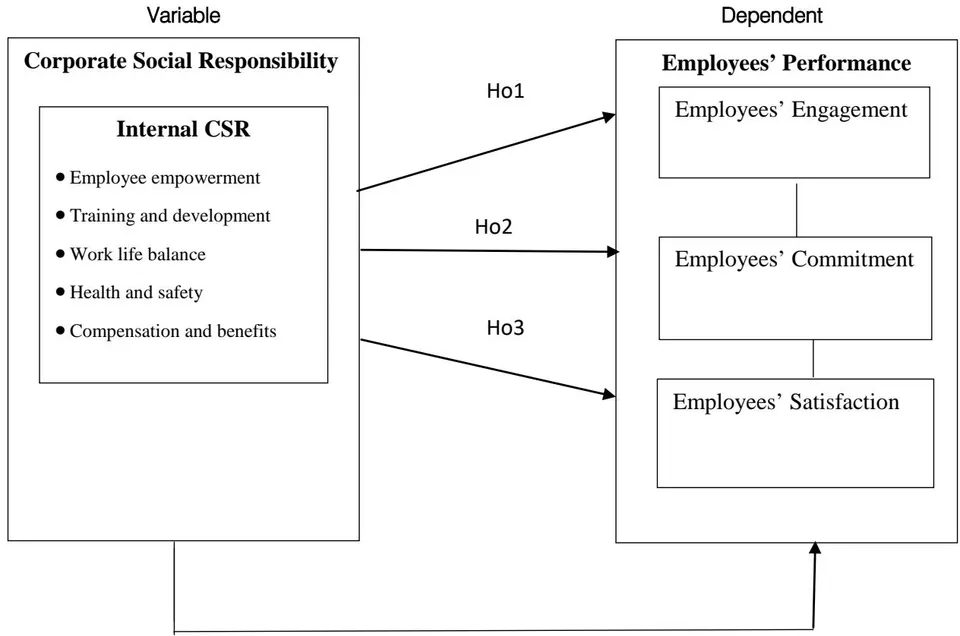
Figure 1: depicts the conceptual model for the study. It is observed from the study CSR has a direct effect on employees' performance. This could be observed with three arrows that directly pointing from the internal CSR to the employees' engagement, employees' commitment and employees' satisfaction.
VII. RESEARCH METHODOLOGY
This study will apply deductive approach by employing descriptive research survey which has to do with specific predictions, narration of facts, characteristics concerning individual, group or situation. Descriptive statistics inform of frequency count, and percentage will be applied to analyze the research questions formulated in this study while inferential statistics in form of regression analysis was employed to test the hypotheses postulated in this study. Descriptive research survey is preferred because it enabled the researcher to collect data and information with efficiency and make concrete recommendations. Survey research design was employed to gather information and data relating to the impact of CSR on the employees performance from the manufacturing firms in Nigeria. Thirty manufacturing firms were selected and 30 employees were selected from each firm. Therefore sample size consists of 300 employees from various manufacturing firms in Nigeria. The data collection method used is a customized questionnaire which has two parts. The first part includes demographic and personal information, while the second part is based on a Likert scale ranging from "strongly agree" to "strongly disagree." The aim is to examine the impact of CSR internal factor on employee performance, taking into account the effect on employees' engagement, commitment and satisfaction.
a) Reliability and Validity Tests
Table 3 displays the outer model's construct validity and reliability as evaluated in our study. The table presents the values of construct reliability and average variance extracted (AVE), both of which indicate the convergent validity of our constructs. The results demonstrate that all variables have a construct reliability greater than the acceptable standard of 0.7 for internal consistency. Additionally, each construct's average variance extracted value is greater than 0.5, indicating that the data is convergent valid. (Hair et al., 2017)
VIII. DATA ANALYSIS
The dependability of a measurement is determined by its ability to produce consistent results when conducted under the same conditions. If a questionnaire produces highly consistent answers during testing, it can be considered a reliable tool. On the other hand, if the results vary significantly, the instrument is considered unreliable. One method of determining internal consistency is through Cronbach's Alpha test, which yields a coefficient score. A coefficient between 0.60 and 0.70 is considered to have fair reliability, while a coefficient between 0.70 and 0.80 is considered good reliability. A coefficient greater than 0.80 is considered excellent reliability. It is important to note that for research purposes, a minimum alpha coefficient of 0.70 is recommended.
| Constructs | No. of Items | Mean | Std. Deviation | Construct, Reliability | Average Variance Extracted (AVE) |
| CSR and Engagement | 8 | 3.54 | 0.53 | 0.834 | 0.562 |
| CSR and Commitment | 7 | 3.38 | 0.69 | 0.839 | 0.511 |
| CSR and Satisfaction | 7 | 3.55 | 0.58 | 0.824 | 0.549 |
Table 2 displays the discriminant validity of the data using Fornell and Larker's (1981) method. The diagonal values show the square root of the average variance extracted, while the remaining values indicate the correlations between the variables. All diagonal average variance extracted values exceed the correlations, demonstrating the presence of discriminant validity in the data.
| CSR and Engagement | CSR and Commitment | CSR and Satisfaction | |
| CSR and Engagement | 0.75 | ||
| CSR and Commitment | -0.134 | 0.715 | |
| CSR and Satisfaction | 0.253 | 0.075 | 0.741 |
IX. DATA ANALYSIS AND DISCUSSION
a) Demographic Characteristics of the Population Studied
Three hundred (300) questionnaires was administered and were correctly filled and retrieved in good condition and subject to analysis through SPSS (22.0). The demographic distribution is as follows:
i. Distribution of Sample by Gender
Respondents were asked to indicate their gender in order to understand the percentage of male and female workers in the study area.
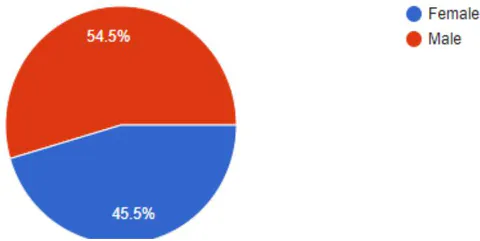
women in the Nigerian workforce, despite the predominance of men in the manufacturing sector.
ii. Distribution of Sample by Age
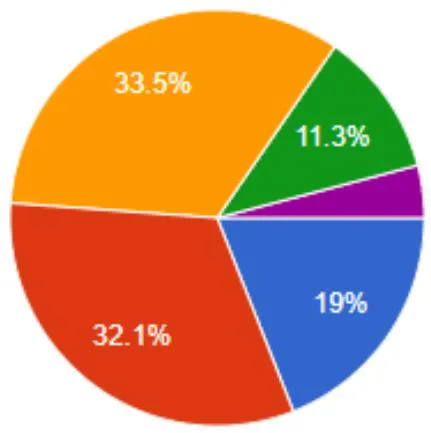
Respondents were also implored to indicate the category of age which they belong to and this was represented in the figure 3 below:
- 19-29 Years
- 30-39 Years
- 40-49 Years
- 50-59 Years
- 60 Years & Above
Figure 3: Distribution of Sample by Age As depicted in figure 3 above, the age group with the highest percentage of respondents was between 40 to 49 years. This suggests that most of the participants belonged to the working class in the manufacturing sector and were still in their active years to contribute towards production.
iii. Distribution of Sample by Education
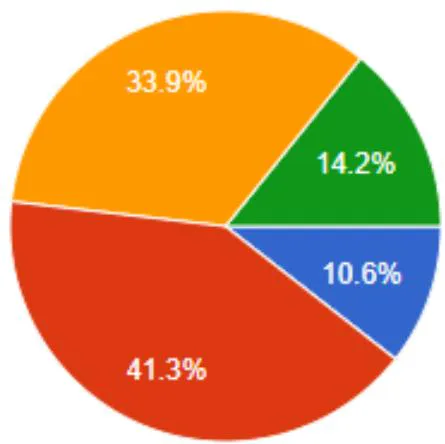
Respondents indicated their level of literacy according to the certificate obtained. This is presented in figure 3.
- OND
- HND/B.Sc.
- M.Sc
- PhD
The education distribution of the respondents is illustrated in Figure 4 above. The data reveals that out of the 300 participants who completed the research instrument accurately, possessed a higher level of education, including Higher National Diploma (HND) and/or Bachelor of Science (BSc.). This is closely followed by of respondents who had obtained a
Master of Science (M.Sc.) degree. Furthermore, of participants held a Ph.D. while a smaller proportion possessed an Ordinary National Diploma (OND). These results indicate a high level of literacy among the respondents, which is likely attributed to the study area's metropolitan and elitist nature and the abundance of educational facilities.
iv. Distribution of Sample by Years of working Experience
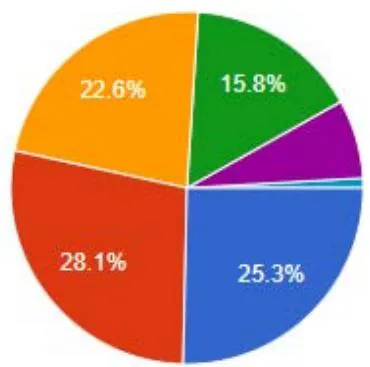
Respondents were also asked to indicate their years of working experience. This is represented in figure 4 below:
Less than 5yrs 5-10 yrs 11-15 yrs 16-20 yrs 21-25 yrs 26-30 yrs Above 30 yrs
Figure five reveals that of the participants had a work experience of over 5 years in the study location, whereas of them had a job tenure of under 5 years. Additionally, of the respondents had worked in the companies for more than 11 years, and had a working experience of 16-20 years. Therefore, it can be inferred that the majority of the participants had been earning a salary from the companies for a minimum of 5 years due to their long-term job tenure in the study area.
b) Descriptive Statistics
This analysis is simplified and understandable by constituting the research and analysis into three factors. These three factors, in line with the research questions, are as follows:
What is the effect of corporate and social responsibility on the engagement of the employees in the Nigeria manufacturing sector?
What is the impact of CSR on employees' commitment in the Nigeria manufacturing sector?
What is the impact of CSR on employees' satisfaction in the Nigeria manufacturing sector?
i. Research Question One
What is the effect of corporate and social responsibility on the engagement of the employees in the Nigeria manufacturing sector?
The percentage responses from the participants were aggregated based on the four Likert scale of strongly agree, Agree, Disagree and Strongly Disagree. This is represented in the chart below:
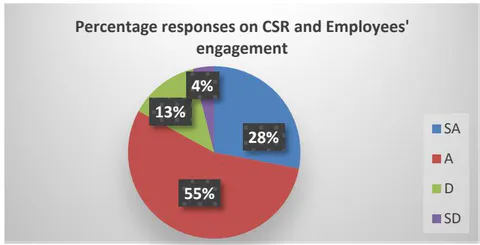
It is indicated in figure 6 above that more than half of the employees agreed that corporate and social responsibility has a large effect on the engagement of the employees in the Nigeria manufacturing sector.
ii. Research Question Two
What is the impact of CSR on employees' commitment in the Nigeria manufacturing sector?
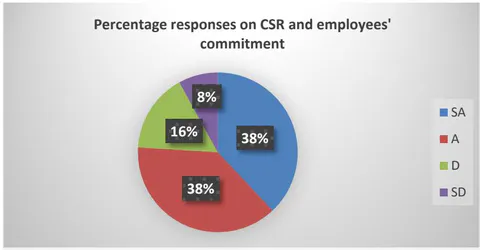
It is also observed from figure 7 above that CSR has a larger effect on employees' commitment in the Nigeria manufacturing sector with higher percentage strongly agree and agree to the statement
iii. Research Question Three
What is the impact of CSR on employees' satisfaction in the Nigeria manufacturing sector?
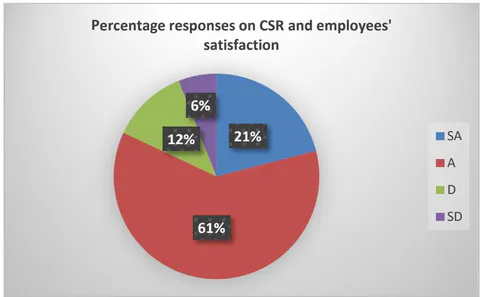
Figure 8 indicate a large effect of CSR on the employees' satisfaction in the Nigeria manufacturing sector with higher percentage agreed to the assertion.
X. TESTING OF HYPOTHESES
Result of the hypotheses is presented in table 3 below. Regression analysis was run to test the following research hypotheses:
Ho1: There is no significant effect of corporate and social responsibility on the engagement of the employees in the Nigeria manufacturing sector
Ho2: There is no significant impact of CSR on employees' commitment in the Nigeria manufacturing sector
Ho3: There is no significant impact of CSR on employees' satisfaction in the Nigeria manufacturing sector
Therefore, the results of the hypotheses were combined in table 3 below
| Coefficients | Standard Deviation (STDEV) | T Statistics | P-Values | 5% | 95% | |
| CSR->Engagement | -0.219 | 0.051 | 4.317 | 0.00 | -0.307 | -0.119 |
| CSR->Commitment | 0.251 | 0.041 | 6.096 | 0.00 | 0.168 | 0.327 |
| CSR->Satisfaction | 0.118 | 0.051 | 2.309 | 0.02 | 0.021 | 0.214 |
Table 2 presents a comprehensive display of the direct and indirect regression paths, alongside their respective levels of significance and standard deviation values for all variables. As per the first hypothesis, the initial pathway is from corporate social responsibility to employee engagement, indicating a positive and significant direct correlation at (H1 accepted).
Similarly, the table reveals that the p-value for the second hypothesis, which asserts the effect of corporate social responsibility on employee commitment, is 0.000, which falls below the significant threshold of 0.05. This demonstrates a clear and positive relationship between CSR and employee commitment.
The results presented in Table 2 demonstrate a noteworthy effect of CSR on the satisfaction of employees. This is corroborated by the p-value of 0.02, which is below the critical threshold of 0.05.
XI. DISCUSSION
This study explores the impact of corporate social responsibility on the employees performance in relation to engagement, commitment and satisfaction of the employees in the Nigeria manufacturing sector.
Further, the paper explored whether CSR had significant impact on the employees' engagement, commitment and satisfaction in the Nigerian manufacturing sector. It is observed from the findings that there is significant effect of corporate and social responsibility on the engagement of the employees in the Nigeria manufacturing sector. This finding is supported by the findings of [14] who found out that a strong CSR culture can positively impact employee engagement by creating a sense of purpose and meaning in the workplace. Finding is also similar to that of [19] who found out that engaged employees are more likely to support and participate in CSR initiatives, and they are also more likely to align their personal values with the values of the organization.
The study also showed that there is significant impact of CSR on employees' commitment in the Nigeria manufacturing sector. This is in line with that of [18] who found that employees who worked for organizations with a strong CSR orientation were more likely to be engaged and committed to their work, and less likely to consider leaving the organization. Moreover, employees who perceive their organizations as socially responsible are more likely to be proud of their organization, and to recommend it to others according to [21].
The study also showed that there was significant impact of CSR on employees' satisfaction in the Nigeria manufacturing sector. This finding corroborates with the research by [18] who found that employees who perceived their employers to be engaged in CSR activities had higher levels of job satisfaction and organizational commitment. Finding is also in line with that of a study by [19] who found that employees who work for organizations with a strong commitment to CSR tend to have higher levels of job satisfaction and lower levels of burnout. Furthermore, CSR initiatives can help foster a sense of purpose and belonging among employees, leading to increased job satisfaction.
XII. CONCLUSION
The basis of this research is founded on the social exchange theory discussed previously. The theory proposes that reciprocal actions have a significant impact on the relationships formed within organizations. When an organization treats its staff with equity, benevolence, and concern, it can expect a similar response from its employees. This ongoing exchange of positive behavior eventually leads to the cultivation of trust, allegiance, and dedication. According to the study's results, the implementation of internal corporate social responsibility serves as a vital measure of management's attentiveness to the well-being and safety of employees. Workers are able to detect these signals and offer their support in appreciation for the well-intentioned actions carried out on their behalf. By demonstrating corporate social responsibility and showing care and concern for employees, trust is established, leading to higher employee engagement, commitment and consequently employee satisfaction. However, inadequate employee support undermines the intended moderating effect, failing to influence employee behavior towards the development of trust in the organization or its leaders. This highlights the prioritization of activities directly impacting individual employees over those involving external stakeholders or colleagues in the Nigeria manufacturing sector, potentially due to lower economic status and Nigeria's status as a developing nation. Studies have revealed that the existence of organizational trust and positive social connections between supervisors and their subordinates have a significant impact on an employee's perception of a safe work environment and their psychological empowerment [24, 22 and 20]. This, in turn, allows employees to exhibit extra-role behaviors, such as work engagement, commitment and voice behavior. Regrettably, in countries like Nigeria, where an authoritarian and bureaucratic approach is prevalent, employees lack faith in their supervisors and leaders, which diminishes the influence of such positive relationships on their work behavior.
- Ali, A. I., Rana, M. J., Nahar, S., Tesha, N. H. A., & Jabir, I. M. S. (2022). CSR AND ORGANIZATIONAL PERFORMANCE: A THEORETICAL MODEL.
APPENDIX
Research Instrument
Section A: Demographic Data
Gender: Male []; Female []
Age: 19-29 years []; 30-39 years []; 40-49 years []; 50-59 []; 60 years and above []
Service Tenure Years: 1.3 years []; 4-6 years []; 7-9 years []; 10 years and above
Educational Qualification: Below BSc. []; BSc []; Masters []; PhD []
Section B: Statement on effect of corporate and social responsibility on the engagement of the employees in the Nigeria manufacturing sector
| S/n | Statement | SA (Strongly Agree) | A (Agree) | D (Disagree) | SD (Strongly Disagree) |
| 1 | Corporate and social responsibility positively affects employee engagement | 30% | 60% | 10% | 0% |
| 2 | Employees are more motivated to work for socially responsible companies | 20% | 60% | 15% | 5% |
| 3 | Socially responsible companies have higher employee retention rates | 25% | 55% | 15% | 5% |
| 4 | Corporate responsibility initiatives can improve employee morale | 35% | 50% | 10% | 5% |
| 5 | Companies with a strong social responsibility focus have a better reputation among employees | 40% | 45% | 10% | 5% |
| 6 | Corporate responsibility positively impacts employee job satisfaction | 30% | 50% | 15% | 5% |
| 7 | Companies with a strong social responsibility focus attract and retain top talent | 25% | 55% | 15% | 5% |
| 8 | Socially responsible companies tend to have more loyal employees | 20% | 60% | 15% | 5% |
Section C: Statement on relationship between CSR and employees' commitment in the Nigeria manufacturing sector
| S/n | Statement | SA (Strongly Agree) | A (Agree) | D (Disagree) | SD (Strongly Disagree) |
| 1 | Implementing CSR initiatives can enhance employee morale and job satisfaction | 45% | 40% | 10% | 5% |
| 2 | Companies that prioritize CSR are more likely to attract and retain talented employees | 35% | 45% | 15% | 5% |
| 3 | CSR initiatives can increase employees' sense of pride and loyalty towards their employer | 40% | 40% | 15% | 5% |
| 4 | Companies that engage in CSR are perceived as more socially responsible and ethical, leading to increased employee trust and commitment | 50% | 35% | 10% | 5% |
| 5 | CSR initiatives that benefit the community and environment can make employees feel like they are part of a larger purpose and mission | 45% | 40% | 10% | 5% |
| 6 | Lack of investment in CSR can negatively impact employee engagement and commitment | 10% | 20% | 45% | 25% |
| 7 | Employees who feel that their employer is socially responsible are more likely to be motivated and committed to their job | 40% | 45% | 10% | 5% |
Section D: Statement on the relationship between CSR and employees' satisfaction in the Nigeria manufacturing sector
| S/n | Statement | SA (%) | A (%) | D (%) | SD (%) |
| 1 | CSR activities positively impact employee job satisfaction in the Nigeria manufacturing sector. | 25% | 60% | 10% | 5% |
| 2 | CSR initiatives can enhance employee satisfaction to their organization in the Nigeria manufacturing sector. | 20% | 65% | 10% | 5% |
| 3 | CSR activities can improve employee morale in the Nigeria manufacturing sector. | 22% | 60% | 12% | 6% |
| 4 | CSR programs can increase employee satisfaction in the Nigeria manufacturing sector. | 18% | 62% | 15% | 5% |
| 5 | CSR activities can contribute to creating a positive corporate culture in the Nigeria manufacturing sector. | 24% | 58% | 11% | 7% |
| 6 | CSR initiatives can lead to a more positive perception of the company by employees in the Nigeria manufacturing sector. | 21% | 60% | 12% | 7% |
| 7 | CSR activities can positively impact employee retention in the Nigeria manufacturing sector. | 19% | 61% | 14% | 6% |
| S/n | Statement | SA (%) | A (%) | D (%) | SD (%) |
| 1 | CSR activities positively impact employee job satisfaction in the Nigeria manufacturing sector. | 25% | 60% | 10% | 5% |
| 2 | CSR initiatives can enhance employee satisfaction to their organization in the Nigeria manufacturing sector. | 20% | 65% | 10% | 5% |
| 3 | CSR activities can improve employee morale in the Nigeria manufacturing sector. | 22% | 60% | 12% | 6% |
| 4 | CSR programs can increase employee satisfaction in the Nigeria manufacturing sector. | 18% | 62% | 15% | 5% |
| 5 | CSR activities can contribute to creating a positive corporate culture in the Nigeria manufacturing sector. | 24% | 58% | 11% | 7% |
| 6 | CSR initiatives can lead to a more positive perception of the company by employees in the Nigeria manufacturing sector. | 21% | 60% | 12% | 7% |
| 7 | CSR activities can positively impact employee retention in the Nigeria manufacturing sector. | 19% | 61% | 14% | 6% |