
I. INTRODUCTION
Tax burden index is an important indicator that reflects the macroeconomic stability of a country, where the interest in tax burden has increased since the middle of the last century as an important indicator which illustrates the performance of the tax system and shows the total taxes paid or incurred by society during a certain period of time to finance public activity (Baer and Galvao, 2005). The tax burden is also referred to as the total taxes actually paid by society attributed to an indicator of community income such as GDP or GNP. The tax burden can be divided into two categories: the first category is the general tax burden, and represents the total taxes attributed to GDP or GNP. The second category is the individual tax burden, which is a measure of per capita tax to GDP per capita (Maroun, 2010). What is of interest to us in this study is the general tax burden (tax revenues attributed to GDP).
The main objective of tax revenues is to finance public spending, redistribute income, stabilize the economy and promote real economic growth and development. For developed economies, developing countries suffer from the low tax burden, which makes it difficult to finance public spending and development plans, and according to World Bank and International Monetary Fund data, the tax burden in Jordan is very low, reaching 15.5% in 2017 and 15% in 2018, compared to some other countries, Turkey 22%, Greece 26%, Denmark 47% and countries of Economic Cooperation and Development Organization 26% (Jordan Strategy Forum, 2018).
The relationship between foreign investment, development assistance, and tax burden is controversial. With regard to foreign investments, especially direct ones, some economists and analysts believe that they have a negative impact on the tax burden. This is due to the volume of tax exemptions granted by countries, especially developing ones, to attract foreign direct investments. And these exemptions are often not tied to a certain period of time and not stopped when the economic activity reaches the required size, these exemptions are not subjected to continuous evaluation to calculate the desired benefit, in addition to not linking these exemptions to achieve economic activity the national objectives such as employment and infrastructure improvement. While others see the importance of these tax exemptions in stimulating the investment climate and attracting foreign investment, which in turn have a significant impact on real economic growth, increasing exports, transferring technology from abroad, reducing unemployment, and rehabilitating human capital. Thus all this leads to an increase in tax revenues and a diversified tax base (Amoah, 2014).
The overlap between foreign aid and tax revenues is large and also controversial. While some argue that foreign aid has an effective role in reducing poverty and achieving real economic growth and that this aid does not affect tax revenues and therefore the tax burden, others believe that this assistance It undermines the government's tax collection efforts and works to crowd out and reduce capital expenditures by increasing current expenditures and creating the so-called "illusion of aid" (IMF, 2016). In other words, when externally financed capital spending increases, current spending increases as a result of spending on what has been created, and if public finances are weak, future capital spending will decline in favor of current spending (Dutch Disease), which undermines efforts to increase state revenues which receive external assistance (Jordan Strategy Forum, 2018).
This study aims to examine the effect of foreign direct investment and ODA on the tax burden in Jordan during the period 1991-2018. The study derives its importance as one of the rare studies that examined the impact of foreign direct investment and official development assistance on the tax burden in Jordan, using a new methodology to achieve its goals.
II. LITERATURE REVIEW
The literary library is replete with studies that dealt with the impact of both FDI and ODA separately on economic growth, but few studies that address the effect of these two variables on the tax burden, and this study is one of the rare studies that combined between these two types of foreign flows.
Some studies have shown the positive impact of foreign direct investment and official development assistance on tax revenues, such as: The study of Balıkçıoğlu, Dalgıç, and Fazlıoğlu (2016), which examined the effect of the foreign direct investment (FDI) on taxes paid in Turkey with a special focus on the differentials between firms operating with different technology levels. The study utilized a comprehensive dataset for Turkish manufacturing firms over the 2004-2012 periods and employed a generalized method of moments methodology. The results of the study confirm that foreign investments increase the taxes paid by the firms and a bigger impact of FDI on taxation for high-technology firms than medium or low technology firms. According to Yohou, Goujon, Laporte and Guerineau (2016), the study explored the heterogeneous effects together with the transmission channels of aid on tax revenues in 47 African countries over 1990-2011 using a panel smooth threshold regression model and two alternative tax datasets from IMF and ICTD. The study finds that aid enhances tax revenues with decreasing returns for a threshold of 6.3% and 23% of GNI for total taxes and non-resource taxes respectively. Aid effect varies across countries and over time, but, on average, is positive. Moreover, it evidence that aid conditions the impact of the level of development, trade, institutions, and resource wealth on tax. In addition to the study of Balyar and Ozturk (2018), which analyzed the relationship among foreign direct investment inflows, economic growth, and total tax revenues in 33 OECD countries during 1995-2014 period using Westerlund-Durbin-Hausmann (2008) panel co integration test and Dumitrescu and Hurlin (2012) panel causality test. The study revealed a co integrating relationship between foreign direct investment inflows, economic growth, and total tax revenues. Furthermore; there was one-way causality from foreign direct investment inflows to total revenues and bidirectional causality between economic growth and foreign direct investment inflows.
On the other hand, some studies have shown the negative impact of foreign direct investment and official development assistance on tax revenues in some countries, such as Huu, Manh, and Aditya (2013) paper, which investigated the effect of foreign direct investment (FDI) on the welfare of the host country through the process of corporate tax rate determination. The study argued that the competition effect reduces the production of domestic firms and thereby lowers the level of corporate tax revenue while the technological spillovers can have positive or negative welfare effects depending on the absorptive capacity of local firms. And the degree of FDI contribution in government revenue in the host country also depends on the demand creation effect and technological transfer cost. In Gupta, Benedek, Crivelli, and Mothoora paper (2012). The paper examined the relationship between aid and local tax revenue using a more recent and comprehensive data set covering 118 countries for the period 1980-2009. Overall, the study showed a negative correlation between net ODA and tax revenue. The paper also found that net ODA and grants were negatively related to VAT, tax revenue and income tax, but had a positive relationship with trade taxes, and that aid had a particularly strong negative impact on domestic tax revenues in low-income countries and in countries with relatively weak institutions. Finally, a study of the Jordan Strategy Forum (2018) examined the relationship between grants and concessional loans on tax revenues in Jordan for the period 1983-2016 using vector error correction method and variance decomposition analysis. The results showed that the impact of grants and concessional loans on tax revenues in Jordan is negative, the higher these cash flows, the lower the ratio of tax revenues to GDP. And grants reflect an increasing importance in explaining the variation in the ratio of tax revenues to GDP higher than concessional loans over time.
During the review of previous studies, it's noticed that some studies have shown a positive impact while others have shown that there is a negative impact. In addition to using these studies different methodologies to achieve its objectives. What distinguishes this study from other studies is that it combines the two foreign inflows (FDI & ODA) together and it is one of the studies that may be the only one that discusses this impact on tax burden in the Jordanian economy. Thus, a study covering this country will be a benefit and an addition to economic literature.
III. DATA AND METHODOLOGY
The study used annual data for the period of 1991-2018 for empirical analysis, the data series included: Ratio of Tax Revenues to GDP (TB), Ratio of Foreign Direct Investment to GDP (FDI), Ratio of Official Development Assistance to GDP (ODA), Real Interest Rate (INT) and Inflation (INF). All data set have been taken from the World Development Indicators of World
Bank, International Monetary Fund (IMF), United Nations Conference on Trade and Development (UNCTAD), Jordanian Department of Statistics, and Central Bank of Jordan. Figure 1 below shows the time profile of the FDI, ODA, and tax burden (TB) over the period 1991-2018.
Figure 1 shows that during the period 1990-1999, the average ratio of FDI to GDP was 1.2%, the average ratio of official development assistance to GDP is 10.2% and the average tax burden is about 10%. In the new millennium 2000-2009, Jordan's dependence on foreign direct investment (FDI) increased and its dependence on official development assistance (ODA) decreased, with the average FDI to GDP ratio being 10.7%, the average ratio of official development assistance to GDP is 5.43% and the average tax burden is 13.64%. The researcher attributes the reason to Jordan was more open to the outside world in this period, Jordan's accession to the World Trade Organization (UNCTAD), the signing of several trade agreements, and Jordan's privatization approach in 2000. Between 2010 and 2018, due to the repercussions of the global financial crisis and the Arab Spring crisis, the average ratio of FDI to GDP fell to 5.35%, the average ratio of official development assistance was 5.3% and the average tax burden was 9.62%.
In this study, to illustrate the impact of foreign direct investment and official development assistance on tax burden in Jordan, the standard model was formulated based on the traditional economic theory and previous studies. The linear economic model was used. Since the impact of FDI and ODA requires a long time to show its impact on host economies, attention was paid to the long-term relationship of variables, so the standard model was based on the results of the diagnostic tests as follows:
Where:
TB: Tax revenues (% of GDP).
FDI: Net FDI inflows (% of GDP).
ODA: Official development assistance (% of GDP).
INT: Real interest rate.
INF: Inflation.
: Parameters of the model.
ε: random error.
t: Time period.
Diagnostic tests were carried out to use the appropriate standard model to analyze data during the study period (1991-2018). These diagnostic tests include the stationary unit root tests (Augmented Dicky Fuller test), Autocorrelation test, Heteroscedasticity test, Normal Distribution test, and Bounds test. As the Auto Regressive Distributed Lag Bounds Testing approach (ARDLBT) was used as a statistical analysis tool (Pesaran and shin, 1999). The following flowchart illustrates the econometric methodology which followed in this paper.
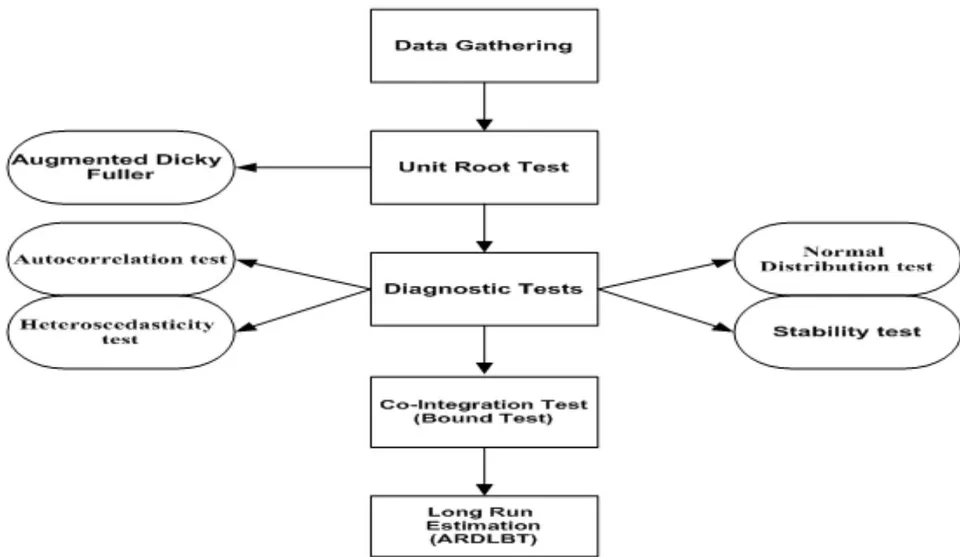
To test the unit root for the study variables, the Augmented Dickey-Fuller test (ADF) was used (Dickey and Fuller, 1981), and Table 1 shows the test results.
| Variables | Panel A:Level | Panel B:1 st difference | Results |
| Actual value | Actual value | ||
| TB | -4.4281*** | -9.2719 | I(0) |
| FDI | -1.9421 | -5.2326*** | I(1) |
| ODA | -4.2528*** | -5.1951 | I(0) |
| INT | -2.7994* | -8.7747 | I(0) |
| INF | -5.9401*** | -9.0687 | I(0) |
The time series of (TB), (ODA), (INT) and (INF) are static at level, and the time series (FDI) become static after the first difference, and for the possibility of a long-term equilibrium relationship, ARDLBT was used by using the bound test proposed by (Pesaran et al, 2001).
| F- statistic | Significance level | Low bound | Upper bound |
| FW= 12.08 | 10% | 2.2 | 3.09 |
| 5% | 2.56 | 3.49 | |
| 2.5% | 2.88 | 3.87 | |
| 1% | 3.29 | 4.37 |
Since the variables showed a common integration, this indicates a long-term equilibrium relationship between these variables, therefore the
ARDL model was then used to estimate the long-term relationship and the results were as follows:
| Panel A: ARDL Co integrating And Long Run Form | ||||
| Dependent Variable: TBSelected Model: ARDL (1,0,1,1,1) | ||||
| Variables | Coefficient | St. error | t- statistic | |
| FDI | 0.525193* | 0.269750 | 1.769827 | |
| ODA | 1.448351*** | 0.475219 | 3.047756 | |
| INT | -4.745637*** | 1.153575 | -4.113853 | |
| INF | -6.233914*** | 1.647099 | -3.784784 | |
| Intercept | 49.557586*** | 13.063242 | 3.793667 | |
| Panel B: ARDL specification | ||||
| Specification with optimal lag (automatic lag):ARDL (1, 0, 1, 1, 1): Cointq = TB - (0.525*FDI+1.448*ODA-4.745*INT- 6.234*INF + 49.557). | ||||
| Panel C: Residual Diagnostics and Misspecification test results for ARDL (1, 0, 1, 1, 1). | ||||
| Notes: *, ** and *** indicate significance levels at 10%, 5% and 1%, denote Chi-squared statistics to test the null hypotheses of no serial correlation, no autoregressive conditioned heteroscedasticity, and; and indicate Jarque-Bera and F-statistic to test the null hypotheses of normal distribution and the significance probability of the model respectively, and; R-squared and Adjusted R-squared to indicates the ability of independent variables to interpret the dependent variable change. | ||||
Table 3 shows that the estimated parameters of the independent and long-term variables, and through the above model it's observed the following:
The findings show that the adjusted-R square (adj-R2) was 62.0%. This means the independent variables combined explain 62.0% of the change in the economic growth, and the results indicate that all parameters in the model are statistically acceptable (FDI at 10% significant level, ODA at 1% significant level, INT at 1% significant level and INF at 1% significant level).
For the ratio of Foreign Direct Investment to GDP (FDI coefficient), it's positive, and if (FDI) increases by 1%, Tax Burden (TB) will increase by 0.53%, with the stability of other factors. The result of this study coincides with some of the studies mentioned in the literature review as a study of Balıkçıoğlu, Dalgıç, and Fazlıoğlu (2016) which showed the positive impact of foreign direct investment on tax revenues in Turkey.
For the ratio of Official Development Assistance to GDP (ODA coefficient), it's positive and if the (ODA) increases 1%, Tax Burden (TB) will increase by 1.45%, with the stability of other factors. This study is also compatible with a study of Yohou, Goujon, Laporte, and Guerineau (2016), which indicates that foreign aids increase the ratio of tax revenues to GNI in 47 African countries.
According to the coefficient of Real Interest Rate (INT), it's negative, if (INT) increases 1%, Tax Burden (TB) will decrease by 4.74%, with the stability of other factors.
Finally; according to the coefficient of Inflation (INF), it's negative, if (INF) increases 1%, Tax Burden (TB) will decrease by 6.23%, with the stability of other factors.
V. CONCLUSION
Jordan's interest in the tax burden and its impact on increasing economic growth has increased, especially after many studies have shown a decrease in the tax burden in Jordan compared to countries in the region and the world, and hence the purpose of this study is to investigate the impact of foreign direct investment and official development assistance on the tax burden in Jordan during the period 1991-2018 and concluded the following: There is a long-term co-integration relationship between the independent variables (FDI, ODA, INT, and INF) and the dependent variable (TB), foreign direct investment increases the tax burden, official development aid also boosts the tax burden, and both of real interest rate and inflation reduce the tax burden.
Depending on the results of the study, some recommendations can be identified, including:
The need to activate the role of tax policy in encouraging foreign direct investment, and the formulation of tax exemptions in the framework of preventing the erosion of tax revenues as a result of these exemptions, so that these exemptions are not granted without discrimination in general, but the tax exemption must be within the limits that ensure the success of the investment process and be A real advantage for projects that cannot be done without these incentives. And the government should be able to assess the contribution of different investment projects to the economic development process.
Although the findings of the study show that foreign aid does not undermine Jordan's tax burden, it should be managed with great caution and directed towards promoting economic growth and capital expenditures and reducing its role in supporting state current expenditures.
The Jordanian government should work to achieve greater levels of macroeconomic stability, such as reducing inflation, maintaining an interest rate consistent with investment promotion, as well as increasing tax flexibility by increasing the tax base and diversifying sources of tax collection. The study also recommends that this research paper be an introduction to other studies aimed at studying tax policy in Jordan such as the study of tax flexibility, tax effort and tax capacity, and its impact on achieving national economic growth.
AKNOWLEDGMENT
This research received no specific grant from any funding agency in the public, commercial, or not-for-profit sectors.