An estimated 17.7 million deaths are attributable to cardiovascular disease, or 31% of total global mortality, cardiovascular diseases (Hypertension) represent one of the most significant health problems of modern civilization. Stroke; and heart attack often lead to lethal outcomes; the essential problem underneath is thrombus formation. Prophylactic approaches include acetylsalicylic acid and clopidogrel therapy on the level of primary hemostasis, i.e., primary clot formation.Thus, the application of plant species, medicinal plants rich in rosmarinic acid and polyphenols, and flavonoids in the prevention of thrombus formation is of interest. The rationale of the present review is to analyse the activity of Rosmarinus officinalis in the cardiovascular system. Pre-clinical; studies under experimental conditions show that Rosemary has a marked effect on Hypertension.
## I. INTRODUCTION
Low levels of blood pressure are not considered a significant disease as they do not imply a risk to a patient's life. Nonetheless, people suffering from Hypotension, mainly chronic or constitutive hypotension, suffer from physical and psychological symptoms such as temporary fatigue and sensation of weakness that usually affect their daily life and health-related quality of life [1, 2]. Several herbal remedies have been traditionally used to treat hypotension, such as those plants rich in purine bases (i.e., caffeine, theobromine [3]), likecoffee tea (Camellia Sinensis [4]) or cola (Cola nitida or Cola acuminata [5]), or different essential oil-containing plants. Rosemary (Rosmarinus officinalis L.) is a spontaneous shrub growing in the Mediterranean. It; belongs to the Lamiaceae family and has been used because of its medicinal properties in the earliest times The first references cited the traditional use of rosemary oil as a tonic for asthenia relief, blood circulation, and the nervous system, chronic weakness, as then and, peripheral vascular disorders. For medicinal purposes, Rosemary oil was distilled during the Middle Ages and used as a tonic, stimulant, and carminative for dyspepsia, headache, and nervous tension, as described in the Dioscorides Materia Medica in 1555 [6,7]; as a bath additive, it has been traditionally used in conditions of exhaustion and for stimulation of circulation [8]. And, Indian Materia Medica [9], described it as having carminative and stimulant actions. The; British Herbal Pharmacopoeia (1983) lists the specific indications of "Depressive states with general debility and indications of cardio-vascular weakness" for Rosemary oil. Nowadays; rosemary essential oil has used as a brain and nerve tonic, and as a remedy for mental fatigue [10]. Several; other activities are reported in the literature: antiseptic, diuretic, antidepressant, and antispasmodic; it is also used to treat colds, influenza, and rheumatic pain [11,12] and has proved to enhance the performance for overall quality of memory and secondary memory factors [13]. Rosemary leaves contain no less than $12\mathrm{ml / kg}$ of essential oil, whose composition may vary according to the plant chemotype or other factors such as climatic conditions, geographic origin, or time of collection [14-17]. This work aims is to study Rosmarinus officinalis essential oil's effect on primary hypotension and so, its positive impact on the HRQOL of patients. To determine the relationship between the two types of variables in the study and to assess the effectiveness of Rosemary essential oil, statistical methods were used as a key tool. Quantitative variables (SBP and DBP), and scores from physical and mental summary measures were obtained from the SF-36 Health Survey.
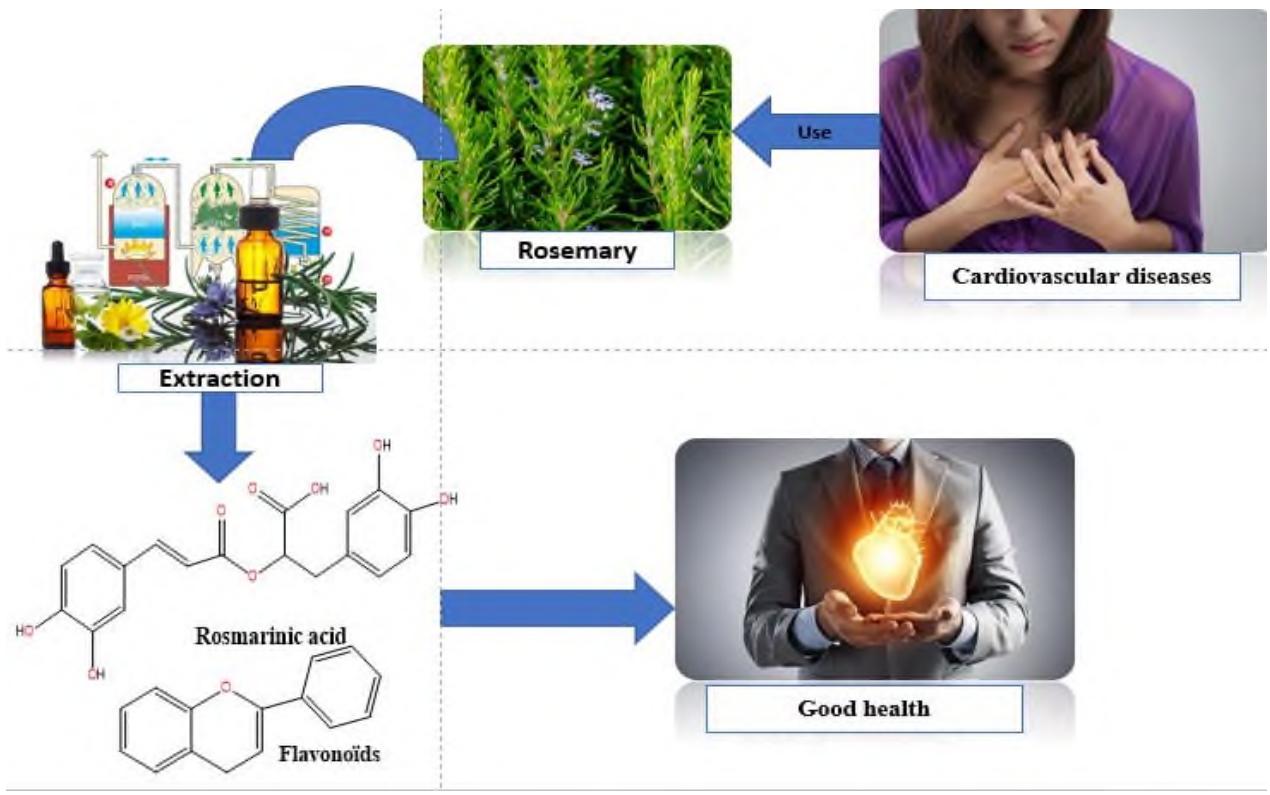 Figure 1: The Effect of Rosemary on Cardiovascular Diseases.
## II. CARDIOVASCULAR DISEASES
Cardiovascular diseases (CVD) [18] are disorders of the heart and blood vessels and include conditions such as Hypertension, hyperlipidemia, thromboembolism, coronary heart disease, and heart failure. The most prevalent of these is hypertension, which is a major factor in the development of CVDs [19]. According to tong, World Health Organization (WHO), over 17 million people die per year (31% of all global deaths) from CVDs). Before 2030, it is predicted that mortality will reach 23.3 million due to the rise in CVD diagnoses [20].
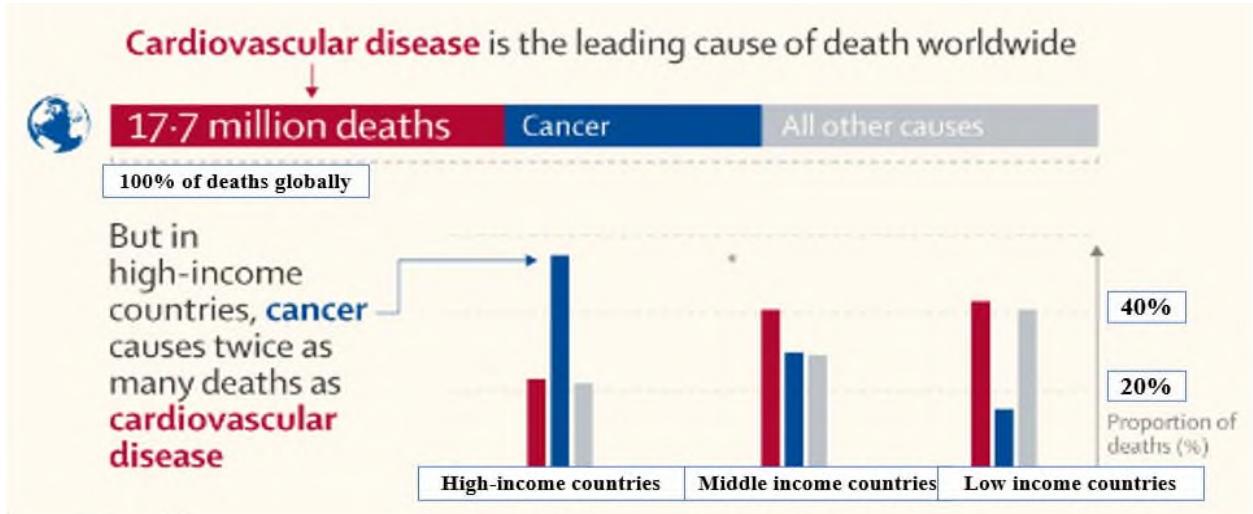 Figure 2: Cardiovascular Diseases Risk Factors and Mortality Around The World (WHO).
For instance, the most common cause of death in Morocco is cardiovascular disease. These illnesses can be divided into various categories., namely, valvulopathy, heart failure, arterial Hypertension, ischemic heart disease, cardiomyopathy, and arterial diseases. This project's goal is to describe the prevalence of cardiovascular diseases according to the age and sex of patients and to study the association between sex, age, and the appearance of different types of cardiovascular diseases [21].
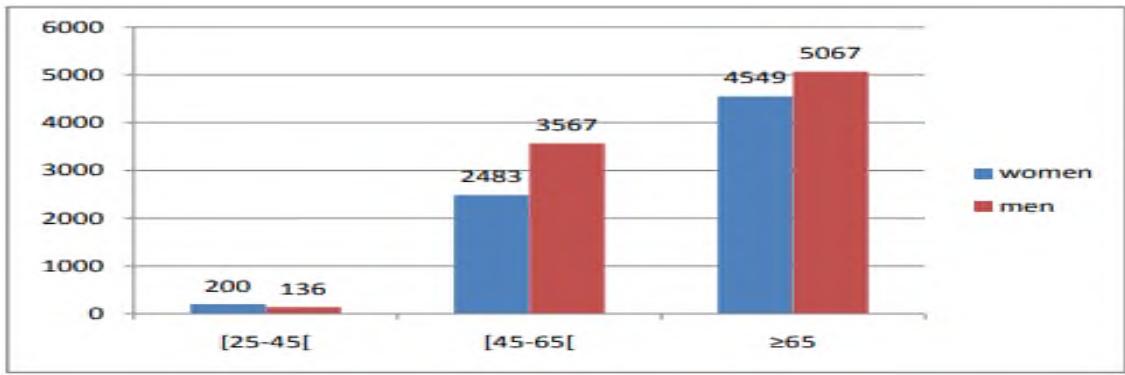
Figure 3: Distribution of Patients by Age and Sex [21]
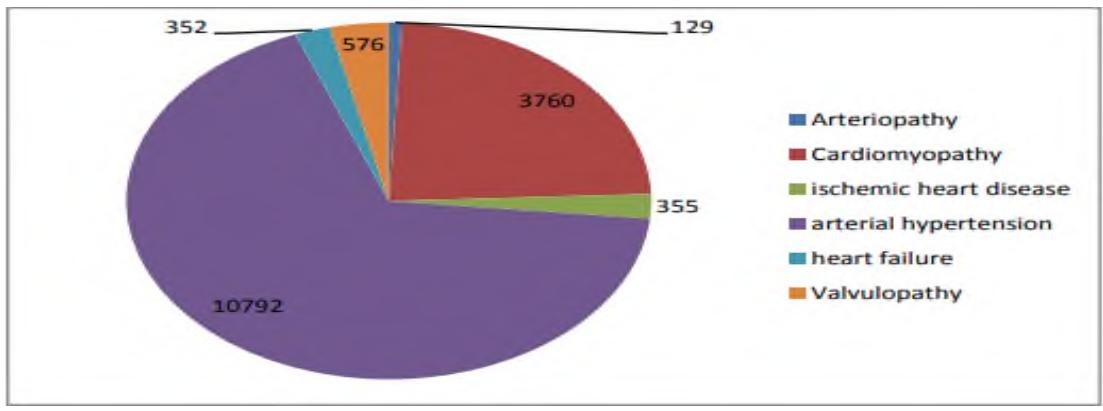 Figure 4: Prevalence of Cardiovascular Diseases during the Study Period [21]
The survey involved 16002 patients, including 7232 women $(45.2\%)$ and 8770 men $(54.8\%)$ with a slight male predominance (sex ratio $= 1.21$, chi-square test $= 87.3$, $p \leq 0.0001$ ). It was 70.27 16.5 years on average. Women are most affected in young adults, while men outnumber women in adults and seniors (Figure 3). Cardiovascular disease prevalence was as follows: Hypertension $(67.4\%)$, cardiomyopathies $(23.2\%)$, valvulopathies $(3.6\%)$, ischemic heart disease $(2.2\%)$, cardiac insufficiency $(2\%)$, and arterial diseases $(1\%)$ (Figure4) [21].
Cardiovascular diseases include pathologies that affect the heart and all blood vessels, such as (WHO):
- Stroke
- Atherosclerosis
- Congenital heart disease
- Myocardial infarction
- Heart failure
- Diseases of the vessels
- Heart rhythm disorders
- High blood pressure (Hypertension)
## III. HYPERTENSION
Blood pressure is the force exerted by circulating blood on the walls of the arteries, that is to say, the main vessels that allow blood circulation in the body. We speak of hypertension when this pressure is too high (WHO).
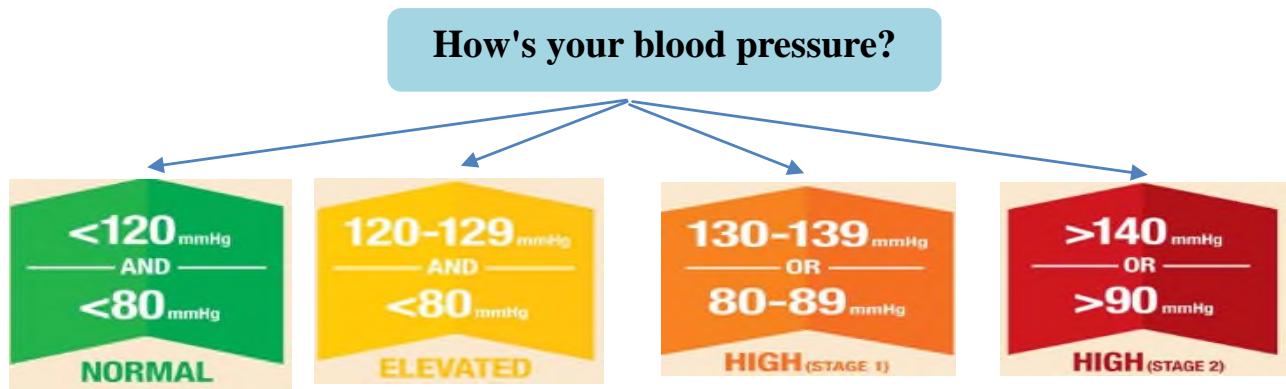 Figure 5: Chart of Blood Pressure (WHO)
As per a statement of the World Health Organization (WHO), Hypertension is one of the silent killers in the 21st century and is one of the biggest global public health concerns. Hypertension is amajor contributor to cardiac complications, stroke, heart disease, kidney failure, blindness, premature death, and disabilities. Hypertension is curable and treatable, for which there is a need for involvement from individual entities, government and private sectors, health workers, and civil societies moreover, personal awareness is highly recommended.
As per the estimation of WHO, globally more than 1.13 billion people are affected with Hypertension among which less than 1 in each 5 is under control. Unhealthy diets, lack of physical activities, and consumption of alcohol & tobacco are the main contributing factors to Hypertension. In 2016, the Global
Heart Initiative was launched by the World Health Organization and the US Centers for Disease Control and Prevention. Globally, Hypertension or High Blood Pressure leads $7.5$ million death cases which, share about $12.8\%$ of all death cases recorded. Hypertension also accounts for about 57 million disabilities adjusted life years which is about $3.7\%$ of total adjusted life years. In 2016, the Global Heart Initiative was launched by the World Health Organization and the US Centers for Disease Control and Prevention.
The Global prevalence of Hypertension in adults aged $>25$ was about $40\%$ in 2008. From 1980 to 2008, there was a moderate prevalence. But, due to sharp growth in population, the aging population uncontrolled Hypertension reached 1 billion in 2008 from 600 million. The prevalence of Hypertension was highest in Africa $(>40\%)$ and lower in the Americas $(35\%)$ [22]
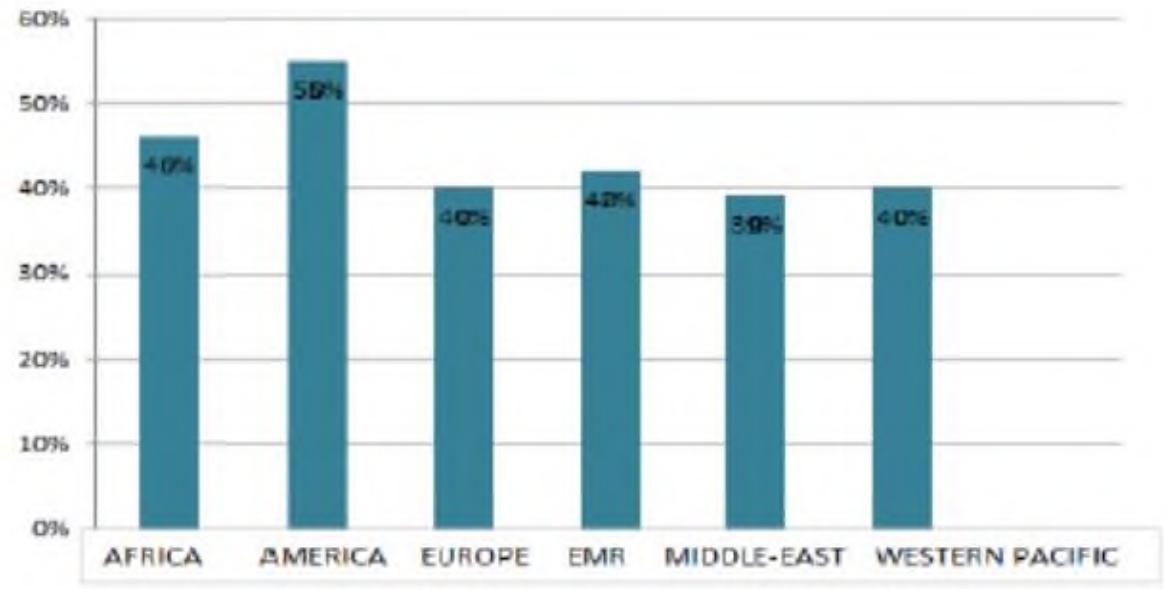 Figure 6: Hypertension Statistics World 2020 [22]
What is the risk factor?
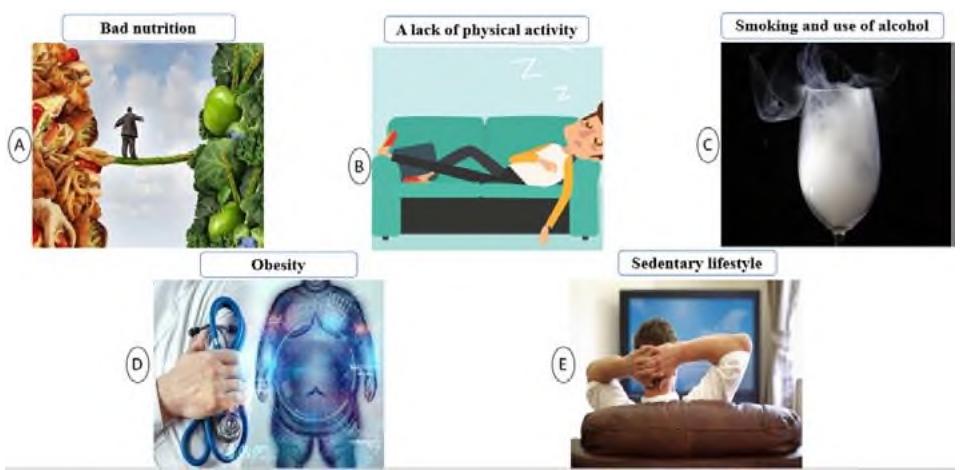 Figure 7: Factors of the Risk of Cardiovascular Disease and Hypertension (A&B [24], D [23] E [24], C [25])
## IV. ROSEMARY
Rosemary is a medicinal plant of the Lamiaceae family which is called in Arabic Azir and French Romarin, the scientific name of this plant is Rosmarinus officinalis. Rosemary, a plant Abundant in the wild all around the Mediterranean, is traditionally valued for its bioactive constituents, with antioxidant, anti-inflammatory, and anti-cancer, antifungal, antibacterial, insecticide, and hepaprotective properties, which can be removed by distillation under form aromatic oils or by extraction in solvents in the form of extract or oleoresin. Rosemary leaves contain macronutrients (Ca, K, P, Na) and micronutrients (trace elements) (Cu, Zn, Mn, Fe) [26]. They are a good source of vitamins A, B, and C [27].
Rosemary is similarly used in cosmetic formulations and in treating pathological and non-pathological conditions, such as cellulite, alopecia, ultraviolet damage, and aging [28].
### a) Other Names
- Azir, barkella, haselban, Aklilljabal, kilege (in North Africa) [29].
- Grass-aux-courounnes, sea dew, sea rose, rosemary of the troubadours, bouquet-de-la-vierge (France).
- Folia Anthos, Folia Rorismarini, Encensier, rosemary (Angle), Rosmarinblatter, Krankrautblatter, Kranzenkrautblatter, Rosmarein (Allemand).
Rosemary has long been known for its medicinal properties, especially by the Greeks and Romans. Later produced crowns, thus the Arabic name Ikilal-Jabal (mountain crowns), translated from Latin. In the Middle Ages, it enjoyed great prestige as a medicine for paralysis. The water of the Queen of Hungary, famous in the seventeenth century because Queen Isabella, tasty and paralytic, used it as water of youth, was nothing but rosemary alcoholate. It is also a grilling condiment. Rosemary supplies an important distillation industry in Maghreb [29]. Since Morocco has excellent potential in the field of aromatic and medicinal plants.
### b) Botany
Branched, woody, 1 m tall, bushy, and aromatic shrub. The leaves are narrowly lanceolate and up to 3 cm long and 4 mm wide, causes, and friable; The edge is involuted downwards (top row). On their upper side, young leaves are pubescent, while the older ones are glabrous. They are wrinkled and streaked due to a sunken midrib, which is very prominent on the underside, and covered by a dense white pubescence. The January blooming of the flowers, pale blue or lilac, are grouped in axillary and terminal racemes in the upper part of the branches [29]. These spiciform inflorescences bear subsessile flowers in all seasons. The gamosepalous calyx, bilabiate bell-shaped, has three lobes. The gamopetalous corolla is long and tubular with a helmet-shaped upper lip with two lobes and a lower lip with three lobes. The two protruding stamens protrude well beyond the corolla; two others are reduced to square brackets. The fruit is brown achene [30]. This very polymorphic species has several varieties. But Many botanists prefer to use the chemical makeup of the essential oil to classify four chemotypes instead of this sporadic morphological differentiation., according to the dominant compound:
1. Rosemary in cineole,
2. Rosemary with verbenone,
3. Rosemary with camphor,
### c) Chemical Composition
Essential Oils: 1 to $2.5\%$ Rosemary flowering tops provide 10 to $25\mathrm{ml} / \mathrm{kg}$ of an essential oil whose main constituents are: camphor (15 to $25\%$ ), cineole (15 to $50\%$ ), alpha-pinene (10 to $25\%$ ) and borneol, free and esterified. Among other things, the essential oil's composition varies. Depending on the origin, the French pharmacopeia retains two types of products: the Morocco and Tunisia type and the Spain type. resulting from hydro-distilling natural populations, these essential oils differ slightly in their composition and physical constants [30].
Table 1: Chemical Composition of Rosemary EO [31]
<table><tr><td>Compound</td><td>Mroroccooil</td><td>Spain oil</td><td>Algerieoil</td></tr><tr><td>α-Pinene</td><td>12.51</td><td>24.7</td><td>5.2</td></tr><tr><td>1, 8-Cineole</td><td>47.44</td><td>18.9</td><td>52.4</td></tr><tr><td>Camphene</td><td>3.62</td><td>11.2</td><td>3.0</td></tr><tr><td>β-Myrcene</td><td>1.57</td><td>4.9</td><td>1.7</td></tr><tr><td>Borneol</td><td>2.97</td><td>4.5</td><td>3.4</td></tr><tr><td>Verbenene</td><td>-</td><td>-</td><td>-</td></tr><tr><td>Bornylacetate</td><td>0.23</td><td>1.0</td><td>1.1</td></tr><tr><td>Camphor</td><td>7.9</td><td>18.9</td><td>12.6</td></tr><tr><td>Verbenone</td><td>0.46</td><td>-</td><td>-</td></tr><tr><td>Verbenol</td><td>-</td><td>-</td><td>-</td></tr><tr><td>β-Pinene</td><td>7.2</td><td>3.4</td><td>5.7</td></tr><tr><td>Linalool</td><td>0.7</td><td>1.0</td><td>1.1</td></tr><tr><td>β-Caryophyllene</td><td>3.31</td><td>2.2</td><td>4.2</td></tr><tr><td>3-Octanone</td><td>-</td><td>-</td><td>-</td></tr><tr><td>β -Phellanderene</td><td>-</td><td>-</td><td>-</td></tr><tr><td>Limonene</td><td>1.9</td><td>3.1</td><td>-</td></tr><tr><td>Sabinene</td><td>0.12</td><td>0.4</td><td>-</td></tr></table>
#### Other Chemical Compositions of Rosemary
- Flavonoids: luteolin, apigenin, quercetin, diosmin.
- Diterpenes:carnosic acid, rosmadial.
- Triterpenes and steroids: oleanolic acid, ursolic acid.
- Tannins.
- Lipids: n-alkanes, isolalkanes, alkenes.
- Rosmarin.
- Rosmarinic acid.
## There are two ways to extract bioactive molecules from Rosemary.:
- By conventional so-called conventional methods: Hydrodistillation; Steam distillation; Aqueous Alcoholic Extraction by Fermentation; Maceration; Two-step extraction with organic solvents (hexane, ethanol); Extraction by pressurized liquid.
- By new and innovative methods: $\mathrm{CO}_{2}$ extraction; Supercritical $\mathrm{CO}_{2}$ extraction; Subcritical state extraction $(\mathrm{H}_{2} \mathrm{O})$; Extraction assisted by ultrasound; Microwave assisted extraction; Extraction by microwaves without solvents; extraction by hydrodiffusion by microwaves and gravity; Extraction by microwave vapor diffusion; Extraction by instantaneous controlled pressure drop; by Advanced Technology Phytonics (non-chlorinated fluorohydrocarbons); Extraction by High Voltage Pulse Fragmentation Technology...[32].
## V. THE EFFECT OF ROSEMARY ON
### CARDIOVASCULAR DISEASES AND
#### HYPERTENSION
Epidemiological and clinical studies on the influence of flavonoids on cardiovascular diseases are rare and inconsistent. The main issue outlines the evolutionary exposition of flavonoids through diet and developed mechanisms that reduce their bioavailability (transporters that reduce absorption and metabolism that increases excretion from the body). Although studies on the European population show consumption of flavonoids of more than $100\mathrm{mg}$ per day [33], the bioavailability of flavonoids is limited to up to $24\%$ as reported for quercetin. As the half-life of quercetin in plasma is 11 to 28 hours, it is regarded that slow elimination increases the accumulation of quercetin in the body [34]. Usually, concentrations up to 1 mol L-1 are reported for plasma [35]. According to research conducted by our team, flavonoids can have clinically significant interaction with the ristocetin and arachidonic acid-induced platelet aggregation assay. even at very low flavonoid concentrations (i.e., 60 nmol L-1) can influence platelet aggregation assays induced by arachidonic acid and ristocetin. These assays are used for the assessment of von Willebrand factor (vWF) function [36], and flavonoids can consequently cause misdiagnosis of blood clot disorders related to vWF. In a clinical study on healthy males, the influence of tomato (Solanum lycopersicum L.)[37] pomace extract was tested ex vivo [38]. It showed a reduction of platelet aggregation in the test induced by ADP (5 days after starting the treatment, three hours after the last dose was consumed). While the polyphenol profile of tomato extract was analyzed by high-performance liquid chromatography coupled with mass spectrometry (HPLC-MS), no clear indication of component(s) responsible for the activity was provided. Polyphenols-enriched beverage $(326\mathrm{mgL}^{-1}$ of gallic acid equivalent) reduced platelet aggregation in healthy athletes after stress (marathon)[35]. Anthocyanin consumption (320 mg per day) by healthy volunteers reduced ex vivo platelet aggregation by $29\%$ in platelet aggregation assay induced by ADP [38]. Nearly all epidemiological research on the impact of flavonoids on cardiovascular diseases is inconclusive and calls for more research [39]. However, one of the rare studies confirming the beneficial effects of flavonoids in cardiovascular diseases was one performed by Wang et al. [40]. Meta-analysis of published data from 1966 to 2013 shows that an increase in flavanol intake by $20\mathrm{mg}$ per day reduces the risk of stroke by $14\%$ in men. The same effect was not confirmed in females.
Rosmarinic acid (AR) is a purely natural compound derived from herbs belonging to the Lamiaceae family, such as Rosemary, sage, basil, and mint. These plants are widely and frequently utilized in recipes for food. Rosmarinic acid is an ester of caffeic acid and 3,4-dihydroxy phenyl lactic acid. The biological benefits of chronic RA use on cardiometabolic abnormalities have been revealed. Rosmarinic acid reduces blood pressure by inhibiting of angiotensin-converting enzyme (ACE). (ACE) [41], promotes nitric oxide production and regulates endothelin-1 (ET-1) production, and downregulates endothelin-1 (ET-1) production [42]. Chronic treatment with RA improves whole-body insulin sensitivity in fructose-fed hypertensive rats [43] and high-fat diet (HFD)-induced diabetic rats [44]. It also reversed streptozocin-induced decreases in skeletal muscle plasma membrane GLUT-
4 content in diabetic rats [44]. However, the mechanisms through which RA increases glucose uptake need to be elucidated. Angiotensin II (ANG II) is a potent hypertensive agent. It is involved in the generation of reactive oxygen species (ROS) that activate p38 MAPK, reduce Akt phosphorylation, and decrease GLUT-4 translocation in skeletal muscles [45, 46]. The antioxidant properties of RA inhibit the production of ROS via c-Jun N-terminal kinase (JNK) and extracellular signal-regulated kinase (ERK) in a cell death model of cardiac muscle [47]. A previous study reported that ERK plays a crucial role in the therapeutic actions of RA in the hippocampus [48]. Moreover, exercise and 5-aminoimidazole-4-carboxamide-1-betad-riboside (AICAR) increase skeletal muscle glucose transport through the activation of ERK and adenosine monophosphate-activated protein kinase (AMPK) activities [49]. Together, RA might induce skeletal muscle glucose transport via the ERK pathway. In addition, RA could improve both cardiovascular and metabolic problems in hypertensive conditions. Therefore, this study aimed to evaluate the effects of acute and chronic RA administration on blood pressure and skeletal muscle glucose transport in rats treated with ANG II. Moreover, this study assessed the signaling pathways involved in skeletal muscle glucose transport.
## VI. TREATMENT REGIMEN
The dosage of rosemary essential oil of 1 ml every eight hours has been indicated according to the German Commission E monograph on rosemary essential oil, as well as the safety profile derived from its use in its clinical and traditional use [50]. Rosemary essential oil samples were purchased by Meta pharmaceutical (Barcelona, Spain). The main components were 1,8-cineol $(47.6\%)$, camphor $(13.8\%)$, and $\alpha$ -pinene $(11.7\%)$, which corresponds to a Moroccan-type rosemary oil. The minor components were $\beta$ -pinene, camphene, borneol, limonene, $\alpha$ -terpineol, p-cymene, $\beta$ -myrcene, bornyl acetate, and verbenone. Rosemary essential oil and placebo were supplied in 30ml vials. made of topaz-colored glass with a dropper. Patients received the corresponding dose by dropping 1 ml on a sugar cube to avoid an unpleasant taste. Sugar cubes to avoid any unpleasant taste[51]. This study is a part of many others works on the valorization of natural products started since 2006 [52-84].
## VII. CONCLUSION
The antihypertensive and cardiovascular disease-stimulating effects of rosemary essential oil are shown in this work, along with the corresponding improvement in patients' quality of life. The study, which was conducted in a pharmacy, allowed for the evaluation of both the therapeutic efficacy and the significance of pharmaceutical care in patient compliance. The findings of this study can act as a roadmap for future investigations aimed at advancing scientific understanding of widely used plants.
### ACKNOWLEDGMENTS
The authors would like to thank you for the financial support of the project ANPMA/CNRST/UMP/VPMA347 /20 entitled "Fungal, insecticide, or acaricide formulations of essential oils of aromatic and medicinal plants and their extracts".
Generating HTML Viewer...
References
84 Cites in Article
A Mann (1992). Psychiatric symptoms and low blood pressure.
A Tonkin (2004). Low blood pressure and low energy: (how) are they related?.
J Brown,J Yen,M Schantz,B Porter,K Sharpless (2004). Determination of Caffeine, Theobromine, and Theophylline in Standard Reference Material 2384, Baking Chocolate, Using Reversed-Phase Liquid Chromatography.
E Dewole,D Dewumi,J Alabi,A Adegoke (2013). Proximate and Phytochemical of Cola nitida and Cola acuminata.
Isabel Sánchez-Berriel,Luz Moreno De Antonio,Eliasib García Martín,Alejandro Hernández Hernández,Beneharo González González,Alejandro Cabrera Díaz,J Alberto,Rafael Betancor-Villalba,R Betancor-Villalba,Jorge Hernández Hernández (1968). Experiences in data visualization of public statistics from the Canary Islands on mobile device.
Alberto Borobia,Antonio Carcas (2005). Implementación de la farmacogenética en la práctica clínica: hacia las estrategias de genotipado anticipado.
J Morton (1977). Major Medicinal Plants: Botany, Culture, and Uses.
K Nadkarni (1999). Unknown Title.
G Laybourne,M Moss,K Wesnes,S Scott (2003). Effects of acute oral administration of rosemary and peppermint on cognition and mood in healthy adults.
Michael Chandler,David Galas (1985). Studies on the Transposition of IS1.
A Erenmemisoglu,U Ozdogan,R Saraymen,A Tutus (1997). Effect of Some Antidepressants on Glycaemia and Insulin Levels of Normoglycaemic and Alloxan-induced Hyperglycaemic Mice.
Mark Moss,Jenny Cook,Keith Wesnes,Paul Duckett (2003). AROMAS OF ROSEMARY AND LAVENDER ESSENTIAL OILS DIFFERENTIALLY AFFECT COGNITION AND MOOD IN HEALTHY ADULTS.
Alberto Angioni,Andrea Barra,Elisabetta Cereti,Daniela Barile,Jean Coïsson,Marco Arlorio,Sandro Dessi,Valentina Coroneo,Paolo Cabras (2004). Chemical Composition, Plant Genetic Differences, Antimicrobial and Antifungal Activity Investigation of the Essential Oil of <i>Rosmarinus officinalis</i> L..
Dmitar Lakušić,Mihailo Ristić,Violeta Slavkovska,Branislava Lakušić (2013). Seasonal Variations in the Composition of the Essential Oils of Rosemary <i>(Rosmarinus officinalis</i>, Lamiaceae).
O Palomino,M Gómez-Serranillos,T Ortega,M Carretero,F Varela,P Navarrete,M Cases (2010). VARIATION IN THE ESSENTIAL OIL COMPOSITION OF ROSMARINUS OFFICINALIS COLLECTED FROM DIFFERENT SPANISH LOCATIONS IN THE ANDALUCIA REGION.
F Varela,P Navarrete,R Cristobal,M Fanlo,R Melero,J Sotomayor,M Jordán,P Cabot,D Sánchez De Ron,R Calvo,A Cases (2009). VARIABILITY IN THE CHEMICAL COMPOSITION OF WILD ROSMARINUS OFFICINALIS L..
J Rodrigues,M C Lira,T C Almeidae,A Ritter,S Tondoe,D Torres,E Schaffner,M De Souza,Magnani (2020). Unknown Title.
Babak Baharvand-Ahmadi,Mahmoud Bahmani,Arman Zargaran (2016). A brief report of Rhazes manuscripts in the field of cardiology and cardiovascular diseases.
Shanoo Suroowan,Fawzi Mahomoodally (2015). Common phyto-remedies used against cardiovascular diseases and their potential to induce adverse events in cardiovascular patients.
A Elkafssaoui,Boufars (2000). Epidemiology of Cardiovascular Diseases in Morocco: About 16002 Cases Followed Between.
Wei Ling,Huang (2020). International Conference on Hypertension and Healthcare.
Null- Forrest,Clareann Bunker,Andrea Kriska,Flora Ukoli,Sara Huston,Nina Markovic (2001). Physical activity and cardiovascular risk factors in a developing population.
A Ghazalah,A Ali (2008). Rosemary Leaves as a Dietary Supplement for Growth in Broiler Chickens.
B Sasikumar (2012). Rosemary.
Lucas De Macedo,Érica Santos,Lucas Militão,Louise Tundisi,Janaína Ataide,Eliana Souto,Priscila Mazzola (2020). Rosemary (Rosmarinus officinalis L., syn Salvia rosmarinus Spenn.) and Its Topical Applications: A Review.
J Bellakhdar,Février (2006). Précis de phytothérapie moderne ; plantes médicinales au Maghreb et soin de base / Edition le Fennec Pages.
N Abdoulhoussen (1990). Soutenances de thèse de doctorat.
Ivanka Maleš,Sandra Pedisić,Zoran Zorić,Ivona Elez-Garofulić,Maja Repajić,Lijun You,Sanda Vladimir-Knežević,Dražan Butorac,Verica Dragović-Uzelac (2022). The medicinal and aromatic plants as ingredients in functional beverage production.
V Zamora-Ros. R ;,L Knaze,N Luján-Barroso,I Slimani,V Romieu,M Fedirko,U Magistris,P Ericson,A Amiano,V Trichopoulou,A Dilis,D Naska,G Engeset,A Skeie,K Cassidy,P Overvad,J Peeters,M.-J Huerta,J Sánchez,C Quirós,S Sacerdote,R Grioni,G Tumino,I Johansson,I Johansson,F Drake,A Crowe,R Barricarte,B Kaaks,H Teucher,C Bueno-Demesquita,T Rossum,D Norat,A.-C Romaguera,Vergnaud,J Tjønneland,F Halkjaer,M.-C Clavel-Chapelon,M Boutron-Ruault,S Touillaud,K.-T Salvini,N Khaw,H Wareham,J Boeing,E Förster,C Riboli,González (2011). Estimated dietary intakes of flavonols, flavanones, andflavones in the European Prospective Investigation into Cancer and Nutrition(EPIC) 24-hour dietary recall cohort.
Claudine Manach,Gary Williamson,Christine Morand,Augustin Scalbert,Christian Rémésy (2005). Bioavailability and bioefficacy of polyphenols in humans. I. Review of 97 bioavailability studies.
K Krogholm,L Bredsdorff,P Knuthsen,J Haraldsdóttir,S Rasmussen (2010). Relative bioavailability of the flavonoids quercetin, hesperetin and naringenin given simultaneously through diet.
Ivan Palomo,Anibal Concha-Meyer,Mariane Lutz,Macarena Said,Bárbara Sáez,Adriana Vásquez,Eduardo Fuentes (2019). Chemical Characterization and Antiplatelet Potential of Bioactive Extract from Tomato Pomace (Byproduct of Tomato Paste).
Thomas Nickel,K Lackermair,J Scherr,A Calatzis,M Vogeser,H Hanssen,G Waidhauser,U Schönermark,H Methe,S Horster,U Wilbert-Lampen,M Halle (2016). Influence of high polyphenol beverage on stress-induced platelet activation.
Kiara Thompson,Holly Hosking,Wayne Pederick,Indu Singh,Abishek Santhakumar (2017). The effect of anthocyanin supplementation in modulating platelet function in sedentary population: a randomised, double-blind, placebo-controlled, cross-over trial.
Julia Peterson,Johanna Dwyer,Paul Jacques,Marjorie Mccullough (2012). Associations between flavonoids and cardiovascular disease incidence or mortality in European and US populations.
Wang Zhao,D Nie,Z Zhao,H Zhou,B Gao,W Wang,L Yang,Z (2014). Flavonol intake and stroke risk: a meta-analysis of cohort studies.
Q-L Li,B-G Li,Y Zhang,X-P Gao,C-Q Li,G-L Zhang (2008). Three angiotensin-converting enzyme inhibitors from Rabdosia coetsa.
Dhanapalan Karthik,Periyasami Viswanathan,Carani Anuradha (2011). Administration of Rosmarinic Acid Reduces Cardiopathology and Blood Pressure Through Inhibition of p22phox NADPH Oxidase in Fructose-Fed Hypertensive Rats.
J Runtuwene,K Cheng,A Asakawa,H Amitani,M Amitani,A Morinaga (2016). Rosmarinic acid ameliorates hyperglycemia and insulin sensitivity in diabetic rats, potentially by modulating the expression of PEPCK and GLUT4.
Mujalin Prasannarong,Fernando Santos,Erik Henriksen (2012). ANG-(1–7) reduces ANG II-induced insulin resistance by enhancing Akt phosphorylation via a Mas receptor-dependent mechanism in rat skeletal muscle.
Kim Ds 2005,H Kim,E Woo,S Hong,Chae,Chae Sw (2005). Inhibitory effects of rosmarinic acid on adriamycin-induced apoptosis in H9c2 cardiac muscle cells by inhibiting reactive oxygen species and the activations of c-Jun Nterminal kinase and extracellular signal-regulated kinase.
Huang Nie,Zhengwu Peng,Ning Lao,Huaning Wang,Yihuan Chen,Zongping Fang,Wugang Hou,Fang Gao,Xia Li,Lize Xiong,Qingrong Tan (2014). Rosmarinic acid ameliorates PTSD-like symptoms in a rat model and promotes cell proliferation in the hippocampus.
Hubert Chen,Gautam Bandyopadhyay,Mini Sajan,Yoshinori Kanoh,Mary Standaert,Robert Farese,Robert Farese (2002). Activation of the ERK Pathway and Atypical Protein Kinase C Isoforms in Exercise- and Aminoimidazole-4-carboxamide- 1-β-d-riboside (AICAR)-stimulated Glucose Transport.
L Fernández,O Palomino,G Frutos (2014). Effectiveness of Rosmarinus officinalis essential oil as antihypotensive agent in primary hypotensive patients and its influence on health-related quality of life.
Babak Baharvand-Ahmadi,Mahmoud Bahmani,Arman Zargaran (2016). A brief report of Rhazes manuscripts in the field of cardiology and cardiovascular diseases.
(2000). Herbal Medicine. Expanded Commission E Monographs.
E Bocchio (1985). Hydrodistillation des huiles essentielles -Théorie et applications.
J Clevenger (1928). Apparatus for the Determination of Volatile Oil*.
Abdelhamid Bitari,Imane Oualdi,Rachid Touzani,Mostafa Elachouri,Abdelkhalek Legssyer (2023). Alpinia officinarum Hance: A mini review.
Bitaria,Oualdii,Touzanir,Elachourim,A Megssyer (2023). Zingiber officinale Roscoe: A comprehensive review of clinical properties.
Imane Oualdi,Kaoutar Elfazazi,Hanane Azzouzi,Adyl Oussaid,Rachid Touzani (2023). Chemical composition and antimicrobial properties of Moroccan Mentha pulegium L. essential oil.
Imane Oualdi,Khaoula Diass,Salah-Eddine Azizi,Mohammed Dalli,Rachid Touzani,Nadia Gseyra,El Yousfi (2022). <i>Rosmarinus officinalis</i> essential oils from Morocco: new advances on extraction, GC/MS analysis, and antioxidant activity.
J Serbout,Bitaria,Touzanir,Bouklahm,Hammoutib (2022). An insight on the corrosion inhibition of mild steel in aggressive medium by henna extract.
Hammouti,Bdahmani,Myahyi,Aettouhami,Amessali,Masehraou,Abouyanzer,Awarad,R Itouzani (2019). Black Pepper, the "King of Spices": Chemical composition to applications.
Haroon Khan,Taibi Hadda,Rachid Touzani (2018). Diverse Therapeutic Potential of Nitidine, A Comprehensive Review.
Loukilieh Rmilir,Merimii,Saidin,Ramdanim Touzanir (2018). Curcuma species: phytochemical composition, Nutritional value and Pharmacological activities: A review.
El Ouadiy,Beladjilaa,Bouyanzera,Kabouchez,Bendaifh,Youssfif,Berrabahm,Touzanir,Chetouania,Hammoutib (2017). Inhibitive Properties of Date Seed Extracts (Phoenix Dactylifera L.) on Mild Steel Corrosion in 1M HCl Solution: Experimental and DFT Studies.
Kabouchea Tadrentw,Kabouchez Touzanir (2016). Carvacrol and thymol chemotypes of east mediteranean wild labiatae herbs.
Ghorabh Ferhatm,Laggounes,Ghannadia,Sajjadise,Touzanir,Kabouchez Kabouchea (2014). Composition and antioxidant activity of the essential oil of Thymus dreatensis from Algeria.
El Ouadiy,Bouratouaa,Bouyenzera,Kabouchez,Touzanir,El Msellemh,Chetouania Hammoutib (2015). Effect of Athamantasicula oil on inhibition of mild steel corrosion in 1M HCl.
Kabouchea Tadrentw,Touzani,Z Rkabouche (2014). Chemotypes investigation of essential oils of "Guertoufa" herbs.
Ferhat Bouratouaa,Mkabouche,Alaggoune,Stouzani,Z Rkabouche (2014). Comparative compositions of essential oils of Ferula.
Kabouchea Belhadjmostefam,Abazai,Aburjait,Rkabouchez Touzani (2014). Chemotypes investigation of Lavandula essential oils growing at different North African soils.
Chibanis Lehbilim,Kabouchea,Semraz,Smatif,Abuhamdahs,Kabouchez Touzanir (2013). Composition, antibacterial and antioxidant activity of the essential oil of Thymus guyonii de Noé from Algeria.
Laggounes Zeghiba,Kabouchea,Semraz,Smatif,Kabouchez Touzanir (2013). Composition, antibacterial and antioxidant activity of the essential oil of Thymus numidicus Poiret from Constantine (Algeria).
Kabouchea Ghorabh,Semraz,Ghannadia,Sajj-Adieb,Kabouchez Touzanir (2013). Biological activeties and compositions of the essential oil of Thymus ciliatus from Algeria.
Reguia Bencheraiet,Ahmed Kabouche,Zahia Kabouche,Rachid Touzani,Maurice Jay (2012). Flavonoids from Physospermum acteaefolium.
A Khalfallah,D Berrehal,A Kabouche,R Touzani,Z Kabouche (2012). Flavonoids from Centaurea omphalodes.
C Bensouici,A Kabouche,Z Kabouche,R Touzani,C Bruneau (2012). Sesquiterpene lactones and flavonoids from Centaurea foucauldiana.
Bencheraietr,Kabouchea,Z Kabouche,R Touzani,Jaym (2012). Flavonol 3-O-Glycosides from Three Algerian Bupleurum Species.
I Labed,S Chibani,Z Semra,A Kabouche,T Aburjai,R Touzani,Z Kabouche (2012). Antibacterial Activity and Chemical Composition of Essential Oil of <i>Athamanta sicula</i> L. (Apiaceae) from Algeria.
Salih Chibani,Chawki Bensouici,Ahmed Kabouche,Talal Aburjai,Rachid Touzani,Zahia Kabouche (2012). Analysis of the Essential Oil of Aerial Parts of<i>Ferula lutea</i>Poiret from Algeria.
Naima Boutaghane,Ahmed Kabouche,Rachid Touzani,Yousriya Maklad,Aida El-Azzouny,Christian Bruneau,Zahia Kabouche (2011). GC/MS Analysis and Analgesic Effect of the Essential Oil of <i>Matricaria pubescens</i> from Algeria.
Kabouchea,Kabouchez,Touzanir,Bruneauc (2011). Flavonoids from Centaurea sulphurea.
Labeda Khalfallaha,Semraz,Kakib,Kabouchea,Kabouchez Touzanir (2011). Antibacterial activity and chemical composition of the essential oil of Ammi visnagaL. (Apiaceae) from Constantine, Algeria.
Lakhalh,Boudiart,Kabouchea,Kabouchez,Touzanir,Bruneauc (2010). New sesquiterpene lactone and other constituents from Centaurea sulphurea (Asteraceae).
A Kabouche,Z Kabouche,R Touzani,C Bruneau (2008). Diterpenes and sterols from the roots of Salvia verbenaca subsp. clandestina.
L Benmekhbi,A Kabouche,Z Kabouche,B Ait-Kaki,R Touzani,C Bruneau (2008). Five glycosylated flavonoids from the antibacterial butanolic extract of Pituranthos scoparius.
A Nacer,A Bernard,J Boustie,R Touzani,Z Kabouche (2006). Aglycone flavonoids of Centaurea tougourensis from Algeria.
No ethics committee approval was required for this article type.
Data Availability
Not applicable for this article.
How to Cite This Article
Abdessamad Benabbou. 2026. \u201cThe Impact of Rosemary on Cardiovascular and Hypertension Diseases\u201d. Global Journal of Science Frontier Research - B: Chemistry GJSFR-B Volume 23 (GJSFR Volume 23 Issue B1): .
Explore published articles in an immersive Augmented Reality environment. Our platform converts research papers into interactive 3D books, allowing readers to view and interact with content using AR and VR compatible devices.
Your published article is automatically converted into a realistic 3D book. Flip through pages and read research papers in a more engaging and interactive format.
An estimated 17.7 million deaths are attributable to cardiovascular disease, or 31% of total global mortality, cardiovascular diseases (Hypertension) represent one of the most significant health problems of modern civilization. Stroke; and heart attack often lead to lethal outcomes; the essential problem underneath is thrombus formation. Prophylactic approaches include acetylsalicylic acid and clopidogrel therapy on the level of primary hemostasis, i.e., primary clot formation.Thus, the application of plant species, medicinal plants rich in rosmarinic acid and polyphenols, and flavonoids in the prevention of thrombus formation is of interest. The rationale of the present review is to analyse the activity of Rosmarinus officinalis in the cardiovascular system. Pre-clinical; studies under experimental conditions show that Rosemary has a marked effect on Hypertension.
Our website is actively being updated, and changes may occur frequently. Please clear your browser cache if needed. For feedback or error reporting, please email [email protected]
Thank you for connecting with us. We will respond to you shortly.