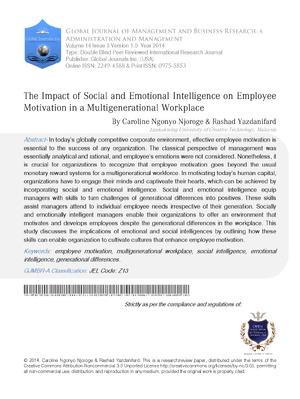
The Impact of Social and Emotional Intelligence on Employee Motivation in a Multigenerational Workplace

Caroline Ngonyo Njoroge
Rashad Yazdanifard
Rashad Yazdanifard
Limkokwing University of Creative Technology Limkokwing University of Creative Technology

Send Message

To: Author

The Impact of Social and Emotional Intelligence on Employee Motivation in a Multigenerational Workplace

Article Fingerprint

ReserarchID

KTJ42

The Impact of Social and Emotional Intelligence on Employee Motivation in a Multigenerational Workplace Banner

AI TAKEAWAY

Connecting with the Eternal Ground
  • English
  • Afrikaans
  • Albanian
  • Amharic
  • Arabic
  • Armenian
  • Azerbaijani
  • Basque
  • Belarusian
  • Bengali
  • Bosnian
  • Bulgarian
  • Catalan
  • Cebuano
  • Chichewa
  • Chinese (Simplified)
  • Chinese (Traditional)
  • Corsican
  • Croatian
  • Czech
  • Danish
  • Dutch
  • Esperanto
  • Estonian
  • Filipino
  • Finnish
  • French
  • Frisian
  • Galician
  • Georgian
  • German
  • Greek
  • Gujarati
  • Haitian Creole
  • Hausa
  • Hawaiian
  • Hebrew
  • Hindi
  • Hmong
  • Hungarian
  • Icelandic
  • Igbo
  • Indonesian
  • Irish
  • Italian
  • Japanese
  • Javanese
  • Kannada
  • Kazakh
  • Khmer
  • Korean
  • Kurdish (Kurmanji)
  • Kyrgyz
  • Lao
  • Latin
  • Latvian
  • Lithuanian
  • Luxembourgish
  • Macedonian
  • Malagasy
  • Malay
  • Malayalam
  • Maltese
  • Maori
  • Marathi
  • Mongolian
  • Myanmar (Burmese)
  • Nepali
  • Norwegian
  • Pashto
  • Persian
  • Polish
  • Portuguese
  • Punjabi
  • Romanian
  • Russian
  • Samoan
  • Scots Gaelic
  • Serbian
  • Sesotho
  • Shona
  • Sindhi
  • Sinhala
  • Slovak
  • Slovenian
  • Somali
  • Spanish
  • Sundanese
  • Swahili
  • Swedish
  • Tajik
  • Tamil
  • Telugu
  • Thai
  • Turkish
  • Ukrainian
  • Urdu
  • Uzbek
  • Vietnamese
  • Welsh
  • Xhosa
  • Yiddish
  • Yoruba
  • Zulu
Font Type
Font Size
Font Size
Bedground

Abstract

In today’s globally competitive corporate environment, effective employee motivation is essential to the success of any organization. The classical perspective of management was essentially analytical and rational, and employee’s emotions were not considered. Nonetheless, it is crucial for organizations to recognize that employee motivation goes beyond the usual monetary reward systems for a multigenerational workforce. In motivating today’s human capital, organizations have to engage their minds and captiveate their hearts, which can be achieved by incorporating social and emotional intelligence. Social and emotional intelligence equip managers with skills to turn challenges of generational differences into positives. These skills assist managers attend to individual employee needs irrespective of their generation. Socially and emotionally intelligent managers enable their organizations to offer an environment that motivates and develops employees despite the generational differences in the workplace. This study discusses the implications of emotional and social intelligences by outlining how these skills can enable organization to cultivate cultures that enhance employee motivation.

References

27 Cites in Article
  1. K Albrecht (2009). Social Intelligence: The New Science of Success.
  2. R Ali,M Ahmed (2009). The impact of reward and recognition programs on employee's motivation and satisfaction: an empirical study.
  3. John Antonakis,Neal Ashkanasy,Marie Dasborough (2009). Does leadership need emotional intelligence?.
  4. James Bennett,Michael Pitt,Samantha Price (2012). Understanding the impact of generational issues in the workplace.
  5. P Chopra,G Kanji (2010). Emotional intelligence: a catalyst for inspirational leadership and management excellence.
  6. K Crowne (2009). The relationships among social intelligence, emotional intelligence and cultural intelligence.
  7. R Devadass (2011). Employees motivation in organizations: an integrative literature review.
  8. R Emmerling,R Boyatzis (2012). Emotional and social intelligence competencies: cross cultural implications.
  9. N Gladwell,C Dorwart,C Stone,C Hammond (2010). Importance of and satisfaction with organizational benefits for a multigenerational workforce.
  10. A Glass (2007). Understanding generational differences for competitive success.
  11. D Goleman,R Boyatzis (2008). Social intelligence and the biology of leadership.
  12. D Goleman (2006). Social Intelligence: The New Science of Social Relationships.
  13. Laura Guillen,Willem Saris (2009). Making Sense of Managerial Competencies: A Motive-Based Approach.
  14. Margaret Hopkins,Diana Bilimoria (2008). Social and emotional competencies predicting success for male and female executives.
  15. L Hughes (2011). Managing the multigenerational workforce: from the GI generation to the millennials.
  16. C Joseph,S Lakshmi (2010). Social intelligence, a key to success.
  17. R Keating,S Harper,D Glew (2013). Emotional intelligence dilutes the toxins.
  18. Q Manzoor (2011). Impact of employees motivation on organizational effectiveness.
  19. N Nohria,B Groysberg,L Lee (2008). Employee motivation: a powerful new model.
  20. E O'boyle,R Humphrey,J Pollack,T Hawver,P Story (2011). The relation between emotional intelligence and job performance: a meta-analysis.
  21. V Rathman (2011). Four Generations at Work.
  22. Ronald Riggio,Rebecca Reichard (2008). The emotional and social intelligences of effective leadership.
  23. K Rukhmani,M Ramesh,J Jayakrishnan (2010). Effect of Leadership Styles on Organizational Effectiveness.
  24. R Sharma (2012). Measuring social and emotional intelligence competencies in the indian context.
  25. R Sternberg (2007). Intelligence, competence, and expertise.
  26. D Wawra (2009). Social Intelligence.
  27. Melissa Wong,Elliroma Gardiner,Whitney Lang,Leah Coulon (2008). Generational differences in personality and motivation.

Funding

No external funding was declared for this work.

Conflict of Interest

The authors declare no conflict of interest.

Ethical Approval

No ethics committee approval was required for this article type.

Data Availability

Not applicable for this article.

How to Cite This Article

Caroline Ngonyo Njoroge. 2014. \u201cThe Impact of Social and Emotional Intelligence on Employee Motivation in a Multigenerational Workplace\u201d. Global Journal of Management and Business Research - A: Administration & Management GJMBR-A Volume 14 (GJMBR Volume 14 Issue A3).
Download Citation

Journal Specifications

Crossref Journal DOI 10.17406/GJMBR

Print ISSN 0975-5853

e-ISSN 2249-4588

Version of record

v1.2

Issue date
May 22, 2014

Language
en
Experiance in AR

Explore published articles in an immersive Augmented Reality environment. Our platform converts research papers into interactive 3D books, allowing readers to view and interact with content using AR and VR compatible devices.

Read in 3D

Your published article is automatically converted into a realistic 3D book. Flip through pages and read research papers in a more engaging and interactive format.

Article Matrices
Total Views: 4702
Total Downloads: 2390
2026 Trends
Related Research
Our website is actively being updated, and changes may occur frequently. Please clear your browser cache if needed. For feedback or error reporting, please email [email protected]

Request Access

Please fill out the form below to request access to this research paper. Your request will be reviewed by the editorial or author team.
X

Quote and Order Details

Contact Person

Invoice Address

Notes or Comments

This is the heading

Lorem ipsum dolor sit amet, consectetur adipiscing elit. Ut elit tellus, luctus nec ullamcorper mattis, pulvinar dapibus leo.


High-quality academic research articles on global topics and journals.

The Impact of Social and Emotional Intelligence on Employee Motivation in a Multigenerational Workplace

Caroline Ngonyo Njoroge
Caroline Ngonyo Njoroge <p>Limkokwing University of Creative Technology</p>
Rashad Yazdanifard
Rashad Yazdanifard

Research Journals