
I. INTRODUCTION
Over the last two decades, the concept of empowerment used as a weapon to encourage employees to work effectively to achieve organizational goals. To replicate typical power transfer mode of organizations i.e. job enrichment, scholars have come up with new mechanism, which is called employee empowerment (Menon, 2001). Although, employee empowerment consists with different approaches e.g. relational approach and psychological approach, psychological empowerment is becoming more significant for enhancing employee workplace performance. Although, the concept of employee psychological empowerment popular among scholars, only few researchers have paid their attention to psychological empowerment (Menon, 2001). From prior studies, we already know the benefits of psychological empowerment. However, we hope that psychological empowerment based on supervisor-subordinate relationship, because, this is happening through emotional contagion between supervisor and subordinate. Thus, we believe that trust between related parties as a significant predictor of employee psychological empowerment. In contrast, employee trust considered as a predictor of different organizational outcomes, such as job performance, citizenship behavior, job satisfaction and organizational commitment (Dirks & Ferrin, 2002), intentions to quit (Brower, Lester, Korgaard & Dineen, 2009), interpersonal facilitation (Kim, Wang & Chen, 2016). Only few scholars (e.g. (Ergeneli, Ari, & Metin, 2007, Findikli, Gulden & Semercioz, 2010; Mayer at al., 1995) have investigated the association of interpersonal trust between supervisor and subordinate on empowerment. Thus, we know little about the role of trust in enhancing psychological empowerment. Hence, to eradicate above gaps in the literature and fill the knowledge gap in the literature, the present study investigates the impact of two forms of trust, i.e., trust in supervisor and felt trust on subordinate psychological empowerment.
This study contributes to the literature in several ways. First, by empirically investigating the effect of trust on psychological empowerment, we contribute to enhance our understanding of trust and psychological empowerment. Interpersonal trust is the most vigorous component in the workplace which make a foundation for a favorable working climate between supervisors and subordinates. But today most organizations are struggling to cope up with rapid changes and survive in the marketplace. They have missed the importance of the trust relationship of supervisor-subordinate dyad and its positive outcomes. The current research emphasizes the importance of interpersonal trust between supervisor and subordinate in order to make a psychologically empowered subordinate. Second, we assess the interpersonal trust relationship in two aspects; trust in supervisor and felt trust. Trust in supervisor reflects how much subordinate trusts his/her supervisor. Felt trust reflects subordinates' feeling of being trusted by their supervisors. However, most of the extant research focused on subordinate trust in their supervisor across multiple disciplines (e.g., Brown, Gray, McHardy, & Taylor, 2015; Engelbrecht & Mahembe, 2015; Shah, 2014; Xiong, Lin, Li & Wang; 2016). But little attention has been paid to examine subordinates' felt trust. Furthermore, the major limitation of past researches on interpersonal trust is almost exclusively focused in upward relationship within the organization (e.g., trust in supervisor) (Knoll & Gill, 2011). The current research moves beyond the construct of trust in supervisor and investigates the impact felt trust in subordinate psychological empowerment. Third, most of the extant research based upon samples from western countries. However, western understanding of trust might be different from east. Thus, collecting data from a sample of Sri Lankan apparel industry executive level employees, this study contribute to fill the gap in the literature.
II. LITERATURE REVIEW AND HYPOTHESES
a) Psychological empowerment
Empowered employees are stewed with internalized organizational goals, performed beyond their defined roles, willing to accept and adjust to changes and become more effective (Conger et al., 1988). Ergeneli and his colleagues (2007) havestated that the empowerment has two approaches, namely "relational approach" and "psychological approach". In the relational approach, mainly environment factors are considered. Based upon relational approach of empowerment, Niehoff, Moorman, Blakely, and Fuller (2001) defined empowerment as "managerial activities and practices that give employees the right to use and control the resources of the organization". The second approach of empowerment i.e., psychological approach, based upon employee perception and emphasized the psychological conditions of the employee. Conger and colleague (1998) defined the psychological empowerment as "a process of enhancing feelings of self-efficacy among organizational members through the identification of conditions that foster powerlessness and through their removal by both formal organizational practices and informal techniques of providing efficacy information". Ergeneli et al. (2007), emphasized this psychological perspective of empowerment as an effort which encourages the active participation of employees in the decision-making procedure. In some cases, although the power has delegated to employees they do not perform as expected level. The reason for that is employees either do not aware the authority was transferred to them or feel powerless in the organizational hierarchy. Thus, the empowerment is a psychological element which involves self-perception of employee (Forrester, 2000). Zimmerman (1995), argued that psychological empowerment is not just self-perceptions of competence, but it comprises active engagement with one's community and also understanding of one's environment of socio-politics. The psychological empowered workers permit themselves to use larger control over their tasks and greater responsibility for their tasks (Hoch & Dulebohn, 2013).
Moreover, Conger et al. (1988) explained empowerment in terms of relational aspect and motivational aspect. Under the relational aspect, the empowerment considers as the process which transferring or sharing leaders' power and authority with their followers or subordinates. Thus employees effectively contribute to achieving the firm's goals and strategies. Under the motivational aspect, the empowerment takes as a motivational factor which motivates employees to control and influence to others.
Scholars (e.g. Thomas et al., 1990; Yukl et al., 2006) have identified psychological empowerment as a multidimensional construct. Four instancer researchers (Conger et al. 1998; Jha, 2017; Ugwu et al., 2014; Spreitzer, 1995; Boudrias et al., 2004) have identified four dimensions of psychological empowerment, namely; Meaning, competence, self-determination and impact. Meaning refers to "the value of the task goal or purpose, judged in relation to the individual's own ideals or standards; the individual's intrinsic caring about a given task" (Thomas et al., 1990). The second dimension Competence refers to "the degree to which a person can perform task activities skillfully when he or she tries" (Thomas et al., 1990)., self-determination has described the choice of the person in initiating and controlling activities (Deci, Connell, & Ryan, 1989; Mostafa, 2017). The fourth dimension Impact refers to the degree to which behavior is seen as "making a difference" in terms of achieving the purpose of the task, that is, producing intended effects in one's task environment" (Thomas & et al., 1990). In this study, we assessed psychological empowerment using all these four aspects.
b) Trust
The concept of trust has been getting increased attention in many recent management studies with identifying the trust as a key ingredient in the effectiveness of the organization (Afsar & Saeed, 2010). Business survival required organizations to continue to learn and trust their employees. Even though the trust has played as a vital role in the workplace, there is no universally accepted definition of trust (Rousseau, Sitkin, Burt, & Camerer, 1998). Scholars have brought different definitions to elaborate the concept of trust. The most repeated definition of trust which can found in the past literature was "willingness of a party to be vulnerable to the actions of another party based on the expectation that the other will perform a particular action important to the trustor, irrespective of the ability to monitor or control that other party" (Mayer et al., 1995, p.712). Rousseau et al. (1998) have viewed "trust as a psychological state comprising the intention to accept vulnerability based upon positive expectations of the intentions or behavior of another". Scholars accepted as true that trust was a crucial element in cooperative relationships. However, the current study has focused on the interpersonal trust relationship between supervisor and subordinate. McAllister (1995) has introduced two elements in trust: Affect-based trust and cognition-based trust. Affect-based trust based on affection, emotional bonds and interpersonal care between trustor and trustee where the cognitive based trust is about the belief of trustor regarding the ability, integrity, and reliability of trustee. Emotional based trust concern intrinsic values of relational parties and reciprocity (mutual concern and mutual care, McAllister, 1995) is an important norm of their relationships, where both parties enjoy the benefits. In contrast, under the cognitive based trust related parties are take decisions based on their prior experience rather mutual understanding. In management literature, researchers (e.g. Brower et al. 2009; Schoorman et al. 2007), mainly paid their attention to supervisor subordinate relationships and they mainly emphasized three forms of trust, i.e., trust in supervisor, trust in subordinate and felt trust. However, in this study, we only paid our attention to trust in supervisor and felt trust.
c) Trust in supervisor
Trust in supervisor is about how much the subordinate trust his/her supervisor, where the trust played vital role in supervisor -subordinate relationships (Mishra et al., 1998; Wei, 2004). Trust in supervisor refers to Employees' willingness to be vulnerable based on expectations that the intentions, words, or actions of their supervisor can be relied upon" (Afsar et al., 2010).
d) Felt trust
In the literature, the felt trust has received a wider attention from various scholars (e.g., Brower, Schoorman, & Tan, 2000) as one of an unidirectional forms of trust between supervisor-subordinate dyad. Felt trust defined as "Subordinates' feeling of being trusted by their supervisors" (Kim et al., 2016).
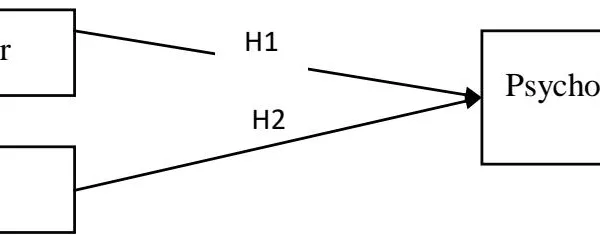
In this study, we considered trust in supervisor and felt trust as independent variables and psychological empowerment as the dependent variables. We believe that trust in supervisor and felt trust has significant impact on psychological empowerment, where if subordinate trust and have the feeling of supervisor of being trusted by their supervisor, which lead to high psychological empowerment of subordinate. In support prior research (Findikli et al., 2010; Mayer et al., 1995; Mishra et al., 1998; Laschinger et al., 2004) have found that trust between supervisor and subordinate positively related to subordinates' psychological empowerment. In another study Ergeneli et al., (2007) found that the subordinates' cognition-based trust positively associated with their psychological empowerment. Based on these evidence, we hypothesize that,
Hypothesis: There is a significant impact of trust in supervisor on subordinate's psychological empowerment.
Hypothesis: There is a significant impact of felt trust on subordinate's psychological empowerment.

III. METHOD
a) Data collection procedure
To test our hypotheses, we collected data from 95 executive level employees who are working in a leading garment manufacturing company in Sri Lanka. We collected data using a paper-pen survey which is available in English. We distributed 110 (that is the entire population) surveys and received back only 95 surveys. The survey consisted with 3 parts including a cover letter which explained the purpose and confidentiality of data. The part one of the survey measures our independent variables, i.e., trust in supervisor and felt trust. Part two is about dependent variable, i.e. psychological empowerment and at end of the survey, we asked about participants' demographics information.
b) Sample
Among the participants of this study 51% were male and majority of our sample was age between 30-39 years old. Of all respondents 52.1% have bachelor degree, 45.7% are having General Certificate of Advance Level qualification and rest of the participants are having postgraduate qualification. Majority of participants (30%) were following human resource management special degree, while 73.4% of participants were married. In terms of working experience, majority of survey participants (50%) had 1-5 years of working experience. However, majority of survey participants (40.4%) had less than 1 year current supervisor.
c) Measures
Trust in supervisor: To measure trust in supervisor, we adapted the scale developed by McAllister (1995) which includes two dimensions, i.e., affect-based trust and cognitive-based trust. The original scale consisted with eleven items, however, based on factor loadings (factor loading <.70), we selected only 10 items. In line with Kim, Wang, and Chen (2016), we slightly changed the wordings of the items in a meaningful way. Sample items are "I can freely share my ideas, feelings, and hopes with my supervisor" and "I trust and respect to my supervisor". The anchor points of the scale used to measure non-financial rewards ranged from 1, "strongly disagree" to 7, "strongly agree". Cronbach's Alpha for the composite scale was 0.87.
Felt trust: To measure felt trust, we adapted the scale developed by McAllister (1995). The scale contained with eleven items, which measures both affect-based trust and cognition-based trust. In line with Kim et al, (2016), we slightly change the wordings. Sample items include "My supervisor can talk freely to me about difficulties (s)he is having at work" and "My supervisor sees no reason to doubt my competence and preparation for the job". The anchor points of the scale used to measure non-financial rewards ranged from 1, "strongly disagree" to 7, "strongly agree". Cronbatch alpha for composite scale was 0.87.
Psychological empowerment: The dependent variable of this study is psychological empowerment. To measure psychological empowerment, we adapted the scale developed by Spreitzer (1995). The scale consistent with a total of 12 items while covering four dimensions, i.e., meaning, competence, self-determination and impact (Thomas & Velthouse (1990). The employees rated their responses on a seven-point Likert scale from 1-strongly disagree to 7-strongly agree. Sample items are, "The work I do is very important to me", "I am confident about my ability to do my job", "I have significant autonomy in determining how I do my job", "I have considerable opportunity for independence and freedom in how I do my job". Cronbatch alpha for composite scale was 0.88.
Control variables: In line with prior researchers (Ergeneli, Ari, & Metin, 2007), we control for age, gender, tenure with current supervisor, years of prior work experience and education level. However, we did not control for participants' position as all our sample were in executive level.
IV. RESULTS
a) Preliminary analysis
Before we test our hypotheses, we conducted confirmatory factor analyses (CFA) to validate the scales. We assessed the overall model fit using the comparative fit index (CFI), Tucker Lewis index (TLI), the root mean square residual (RMSEA) and standardized root mean square (SRMR). According to Hu and Bentler (1999), a model has reasonably good fit if: (1) SRMR values are close to.08 or below; (2) RMSEA values are close to.06 or below; and (3) CFI and TLI values are close to.95 or greater. Our theoretical model show a reasonable fit to the data ( ; DF=340; p=.000; CMIN/DF=1.56; CFI=.91; TLI=.91; RMSEA=.05; SRMR=.07). Moreover, all items loaded on their respective factor significantly, with loadings higher than.40. Moreover, to reduce the potential of multicollinearity, we standardized all variables (Field, 2013).
Results
The means, standard deviations, and inter-correlation among variables are reported in Table 1. Table 1: Mean, standard deviation, and inter-item correlation
| Variable | Mean | S.D | 1 | 2 | 3 | 4 | 5 | 6 | 7 | 8 | |
| 1 | Age | 1.96 | .854 | ||||||||
| 2 | Gender | 1.49 | .503 | -.227* | |||||||
| 3 | Education Level | 1.57 | .577 | -.124 | .244* | ||||||
| 4 | Organizational Tenure | 2.03 | .754 | .820** | -.269** | .007 | |||||
| 5 | Tenure with Supervisor | 1.88 | .902 | .789** | -.204* | .027 | .764** | ||||
| 6 | Civil Status | 1.73 | .444 | .622** | .011 | -.069 | .603** | .431** | |||
| 7 | Trust in supervisor | 5.5234 | .59774 | -.025 | .019 | .070 | -.049 | .059 | -.065 | ||
| 8 | Felt trust | 5.4287 | .64901 | .049 | -.011 | .067 | .068 | .186 | .075 | .616** | |
| 9 | Psychological empowerment | 5.6259 | .63884 | -.046 | -.032 | .067 | .032 | .007 | .031 | .467** | .537* |
| Model 1 | Model 2 | Model 3 | |
| Age | -.226 | -.200 | -.109 |
| Gender | -.039 | -.034 | -.038 |
| Education Level | .046 | .017 | .028 |
| Organizational Tenure | .174 | .269 | .211 |
| Tenure with Supervisor | .043 | -.077 | -.180 |
| Trust in supervisor | .479*** | .559*** | |
| .021 | .243 | .314 | |
| .021 | .223 | .293 | |
| F | .370 | .4.667 | 6.623 |
| ΔF | .370 | 25.632 | 37.126 |
b) Hypotheses testing
In hypothesis 1, we proposed that trust in supervisor has significant effect on subordinate psychological empowerment. Supporting our hypothesis H1, results of hierarchical linear regression shows that there is significant impact of trust in supervisor on subordinate psychological empowerment ( ). Hypothesis 2 predicted the direct effect of felt trust on psychological empowerment. Controlling for age, gender, education, tenure with current supervisor, and years of prior experience, the hierarchical linear regression show that felt trust lead to psychological empowerment (( ). Thus, hypothesis 2 is supported.
c) Supplemental analysis
Although, we have not hypothesize combined effect of trust in supervisor and felt trust on psychological empowerment, we further extend our analysis to test the combined effect. The results of regression analysis shows that there is a significant effect of trust (combine effect of felt trust and trust in supervisor) ( , 581p<.00,t=6.504) on psychological empowerment.
V. Discussion
The concepts of trust and empowerment were critical and important considerations in an organization setting. The current study findings provided useful information regarding executives' employees' psychological empowerment in apparel industry. The study findings suggested that the trust in supervisor and felt trust have significant impact on subordinate empowerment.
a) Theoretical implications
This study has several theoretical contributions. We contribute to trust literature by examining the effect of trust on psychological empowerment, from two sources of trust, trust in subordinate and felt trust. Most of prior studies focus only on trust in supervisor. However, we tested the effect of trust from two related, but, distinguish sources, i.e., trust in supervisor and felt trust. Thus this study contributes to increase our understanding of supervisor. Since the trust was a salient factor of the smooth functioning of the organization, the current study findings provided an important framework to investigate the contribution of trust to the empowerment perception of individuals (Ergeneli et al., 2007). Moreover, in this study, we examined the effect of trust on important outcome variable, i.e., psychological empowerment. Thus, and the results of this study shows that both trust in supervisor and felt trust positively related to psychological empowerment. This results are consistent with prior studies (e.g. Findikli et al., 2010; Mayer et al., 1995; Mishra et al., 1998; Laschinger et al., 2004) who found positive association between trust and psychological empowerment. Next, the sample of this study based upon executive level employees. Executive level employees are distinguish from other categories of employees as they have subordinates under them and working under supervisors.
b) Practical implications
Empowered individuals possessed strong expectations on their own efficacy. They have developed a sense of personal mastery and "can do" attitude regardless of hopes for favorable performance outcomes. In general, empowerment has referred to enabling, and it implied with boosting individuals' convictions in their own effectiveness. Empowerment techniques and strategies that have provide emotional support for subordinates and that formed a supportive and trusting atmosphere can be more effective in strengthening self-efficacy beliefs. In addition to that, the empowerment improved employee commitment, managerial and organizational efficiency and effectiveness, product quality, and performance, thus enabling organizations to adapt to environmental changes. Empowerment practices are useful in motivating subordinates to endure despite difficult organizational and environmental obstacles (Conger et al., 1988).
The present study has demonstrated that, there is a significant impact of trust in subordinate and felt trust on subordinate psychological empowerment. The result emphasized need of strong rapport among supervisors and subordinates in order to empower both parties psychologically. Typically, in the apparel industry, employees were in a hectic environment. They do not have much time to build deep relationships with others. Therefore, they do not clearly know others competencies and traits. Thus the majority of employees are frustrated on their subordinate or supervisor. Interpersonal trust accelerates strong relationships. Therefore, establishing and maintaining healthy relationships among supervisors and subordinates was recommended to create a sense of empowerment.
The necessity of empowering subordinates becomes more crucial when subordinates feel they are powerless in their job role. Thus, it is important to recognize conditions within organizations that make a sense of powerlessness among subordinates. Once these conditions are recognized, the management can use empowerment strategies and tactics to eliminate those conditions. With the formalization of organizations, the use of control systems was increased. Even though control systems speed up tasks, such systems were hindering the habit of trusting others and the creativity of employees, ultimately leading to a feeling of powerlessness. Therefore, we recommend that managers create an avenue to encourage employee creativity and employee interaction while aligning with the control systems of the organization.
Effective communication has provided a flat form to supervisors and subordinates to share their ideas, emotions, difficulties, problems etc. The communication facilitated to both affect and cognition based trust. Cooperative relationships among individuals were primarily based on mutual trust. If the subordinates have the trust and confidence over their supervisors, they ready to go beyond their traditional job role. In contrast, if the supervisors have the trust and confidence over their subordinates they accept risks and ready to go beyond their traditional job role. Therefore, we recommend to promote effective communication within the organization in order to create a sense of empowerment. Moreover, leadership and supervision practices were recognized as a source of empowering individuals. Expressing confidence in subordinates with high-performance expectations, provide opportunities to subordinates to involve in decision making process and allow subordinates work with autonomy were also recommended to create a sense of empowerment.
VI. LIMITATIONS AND AVENUES FOR FUTURE RESEARCH
Although this research provided an opportunity to obtain a better insight regarding the trust and psychological empowerment, it did not fully address dilemmas in the area of trust and empowerment. The study itself has several limitations. First, the primary data were collected from the executive level employees in a leading garment manufacturing company in Sri Lanka. Thus the study results might not be generalized in different contexts and different professions. Thus, the future researcher should continue to examine the trust and empowerment researches across various cultures and work contexts.
Second, the current study model has viewed the independent variable; the trust only from the subordinate aspect. Trust in supervisor and felt trust were viewed only from the subordinate viewpoint. But the important thing was the interpersonal trust was mutual and reciprocal. Brower et al. (2000), has argued that the importance of investigating the trust relationship in supervisor-subordinate dyad from the perspectives of both supervisor and subordinate. But the current model did not explore the reciprocity in trusting relationships and its impact on subordinate psychological empowerment. Moreover, data collection of this study is limited one point in time. Thus, we recommend future researchers to explore the trust relationship from both supervisor and subordinate aspects over different time points. Third, this relationships can be vary with demographic and social factors. Thus, we recommend future researcher to test our model with moderator variables.
Apart from these limitations, the findings of the present study have provided some evidence that the trust in supervisor and felt trust have influenced on psychological empowerment, thus offering an avenue for further exploration on the relationship between trust and psychological empowerment.